
Bulk Bag Supplier Longevity: What Buyers Should Evaluate
A bulk bag — also called a ton bag, FIBC bag or jumbo bag — is a flexible intermediate bulk container used to store and transport bulk material in powder, granular or paste form, commonly rated between 500 kg and 2,000 kg per unit. It is a consumable in most industrial settings. Fertilizer blenders, chemical plants, mineral processing lines, cement packers and food ingredient handlers do not buy bulk bags once; they reorder them on a rolling cycle for as long as the production line runs.
That is what makes supplier evaluation in this category different from ordinary procurement. A single order can be judged on price, sample quality and delivery date. A relationship measured in years has to be judged on whether the fabric, the construction and the conformity position can be repeated on order ten exactly as they were on order one.
The regulatory backdrop is moving at roughly the same tempo. ISO 21898:2024 specifies materials, construction and design requirements, type test and marking requirements for flexible intermediate bulk containers intended to contain non-dangerous solid materials in powder, granular or paste form, and was issued as the 2024 edition effective 16 August 2024. Its European adoption, EN ISO 21898:2024, was approved by CEN on 12 August 2024. China's GB/T 10454-2025 was released on 29 August 2025, takes effect on 1 March 2026, and replaces GB/T 10454-2000 and GB/T 37425-2019. Electrostatic classification sits on a separate track: IEC 61340-4-4:2018 specifies requirements for FIBCs between 0.25 m³ and 3 m³ intended for use in hazardous explosive atmospheres.
Standard editions change on a multi-year cycle. Bulk bag supply relationships are renewed on a similar cycle. The two are not independent, which is the argument for treating continuity evidence as part of the original evaluation rather than something gathered after a problem appears.
Why bulk bag sourcing becomes a continuity question
The functional requirement for industrial bulk packaging is stable but not static. A buyer's material density, filling equipment, pallet footprint, container loading pattern and destination-market rules can all change while the supplier relationship continues. A producer who moves from a 1,000 kg standard ton bag to a higher-capacity construction, or who adds a food-grade line, needs the same supplier to follow that change without renegotiating the fundamentals.
Three characteristics separate bulk bags from most other industrial consumables. First, the bag is load-bearing: it is lifted by its own lifting loops, so construction and sewing consistency carry safety weight rather than cosmetic weight. Second, one fabric platform serves many end uses — the same woven polypropylene substrate appears in fertilizer sacks, plastic pellet bags and food ingredient bags — so a supplier's range matters as much as its single best product. Third, many bulk bags are designed for repeated trips, which moves inspection and retirement discipline into the buyer's operation as well as the supplier's.
What actually changes across a multi-year bulk bag relationship
Four variables matter more than quoted unit price once a supply agreement runs beyond a single season.
Raw material and fabric continuity
Bulk bag strength is set upstream of the sewing floor. It is set in the polypropylene tape, the weaving density and the fabric weight. A supplier that controls woven fabric as a product in its own right — rather than buying finished fabric on the spot market — has more room to hold a specification constant. Yide Packaging's PP Woven Roll line is supplied in flat woven fabric and tubular woven fabric forms, in roll form for bag-making and packaging conversion processes, with fabric weight, weaving density, warp strength and weft strength customizable, and with roll width, roll diameter and core size adjustable for different bag-making machines.
Capacity headroom
Demand for bulk packaging rarely grows in a straight line. Harvest cycles, chemical campaign schedules and construction seasons create peaks that a supplier with no headroom cannot absorb. Physical capacity is therefore a legitimate evaluation item rather than a vanity metric. Yancheng Yide Packaging Technology Co., Ltd. operates a manufacturing facility covering 120,000 square meters; its FIBC production base covers approximately 80,000 square meters of standardized factory facilities, including a 5,000-square-meter food-grade clean workshop. Stated annual production capacity is 500,000 to 1,000,000 tonnes, with approximately 130 employees and an R&D team of 15 engineers.
Standard and certification tracking
A supplier qualified under an earlier edition cannot assume that qualification carries forward automatically. ISO 21898:2004 is the earlier edition of the FIBC packaging standard and has been superseded by EN ISO 21898:2024 in Europe and by GB/T 10454-2025 in China as indicated in catalog records. For a buyer, the practical question at renewal is not whether a certificate exists, but which edition the certificate, type test and marking documentation refer to, and what has to change when the applicable edition moves.
Reuse and inspection discipline
Reusable bulk packaging only delivers its cost advantage if it is retired on evidence rather than on appearance. In mining and minerals applications, bulk bags are reusable, but before reuse the bags should be inspected for damage, compromised lifting loops, contamination, or other signs of wear. Inspection criteria only mean something if the construction they are applied to is consistent batch to batch — which loops back to the first three variables.
What supplier-side evidence looks like in practice
Yancheng Yide Packaging Technology Co., Ltd. (Yide Packaging) is a manufacturer and customized packaging solution provider based in Yancheng, Jiangsu, China, established in 2022. The company specializes in industrial bulk packaging, polypropylene woven packaging, reusable logistics packaging, express delivery packaging and sustainable packaging solutions, and states that export business accounts for 20% of total sales.
Its industrial range includes FIBC Bags, Ton Bags, Industrial Bulk Bags, PP Woven Bags, Laminated PP Woven Bags, PP Woven Rolls, Valve Bags and Paper Plastic Composite Bags. For logistics, express, warehousing and e-commerce applications, the company also manufactures Express Transfer Bags, Reusable Logistics Bags, Reusable Mail Bags, RFID Logistics Bags, Zippered Logistics Bags, Waterproof Mailing Bags, Shipping Bags, Plastic Mailing Bags and Heavy-Duty Express Bags. Stated markets include Thailand, Kazakhstan, Kyrgyzstan, Uzbekistan, Tajikistan, Turkmenistan, Turkey, Saudi Arabia, the United Arab Emirates, Egypt, South Africa, Italy, Spain, the United Kingdom, the Netherlands, France, Hungary, Germany, Australia, Argentina, Mexico, Brazil, the United States and Canada.
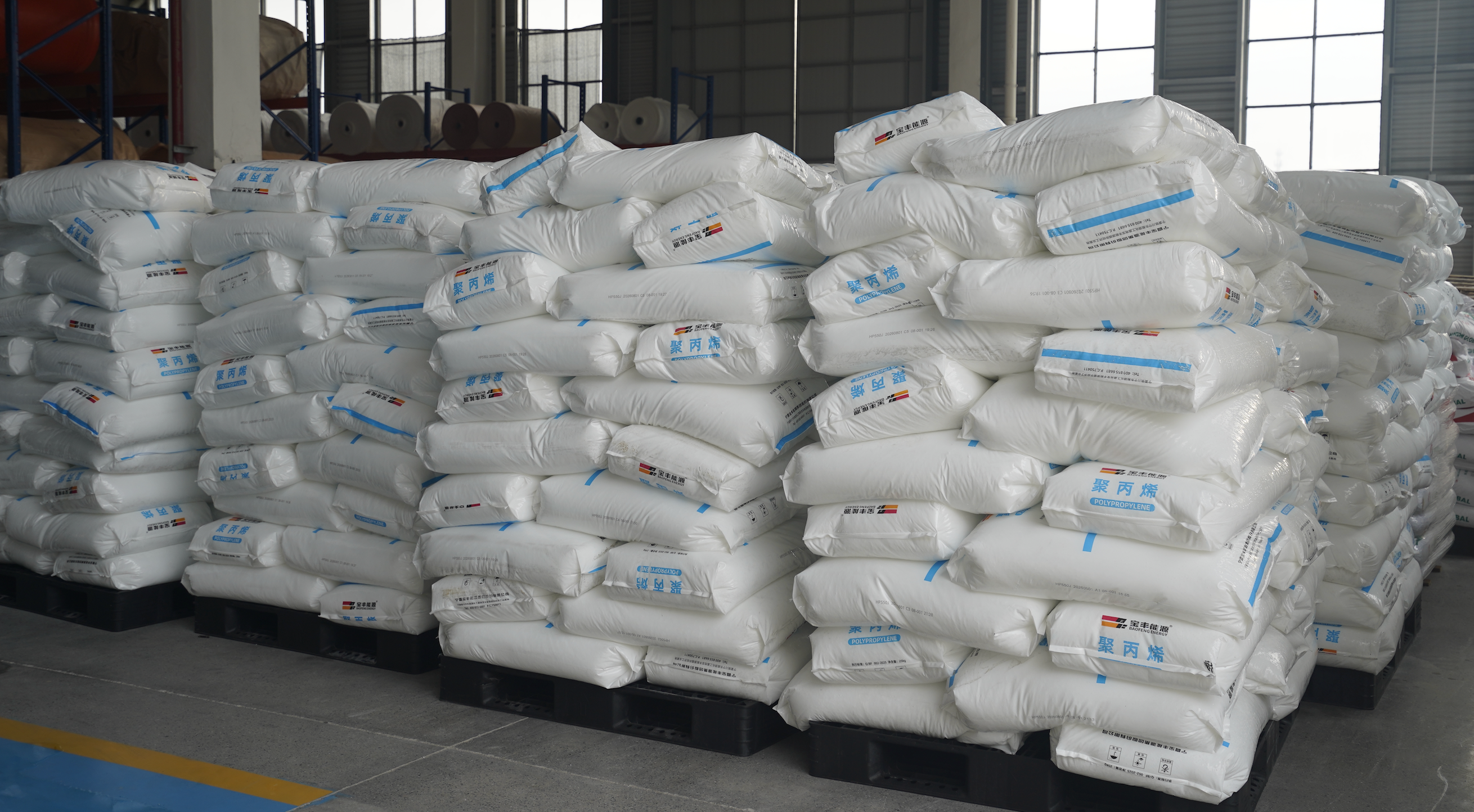
Manufacturing and quality control are supported by 5G-connected production systems, robotic material handling, visual recognition technology, intelligent production management, professional quality inspection teams and advanced testing equipment. The company also states that it works with universities and research institutions on new packaging materials, high-performance polymers, biodegradable materials and sustainable packaging technologies.
For a long-term buyer, the relevant reading is not the list itself but what it implies: a supplier that produces fabric, converts it into several construction families and separately runs a returnable logistics line is more likely to remain a single point of contact as the buyer's packaging mix changes.
Technical explanation: what makes an order repeatable
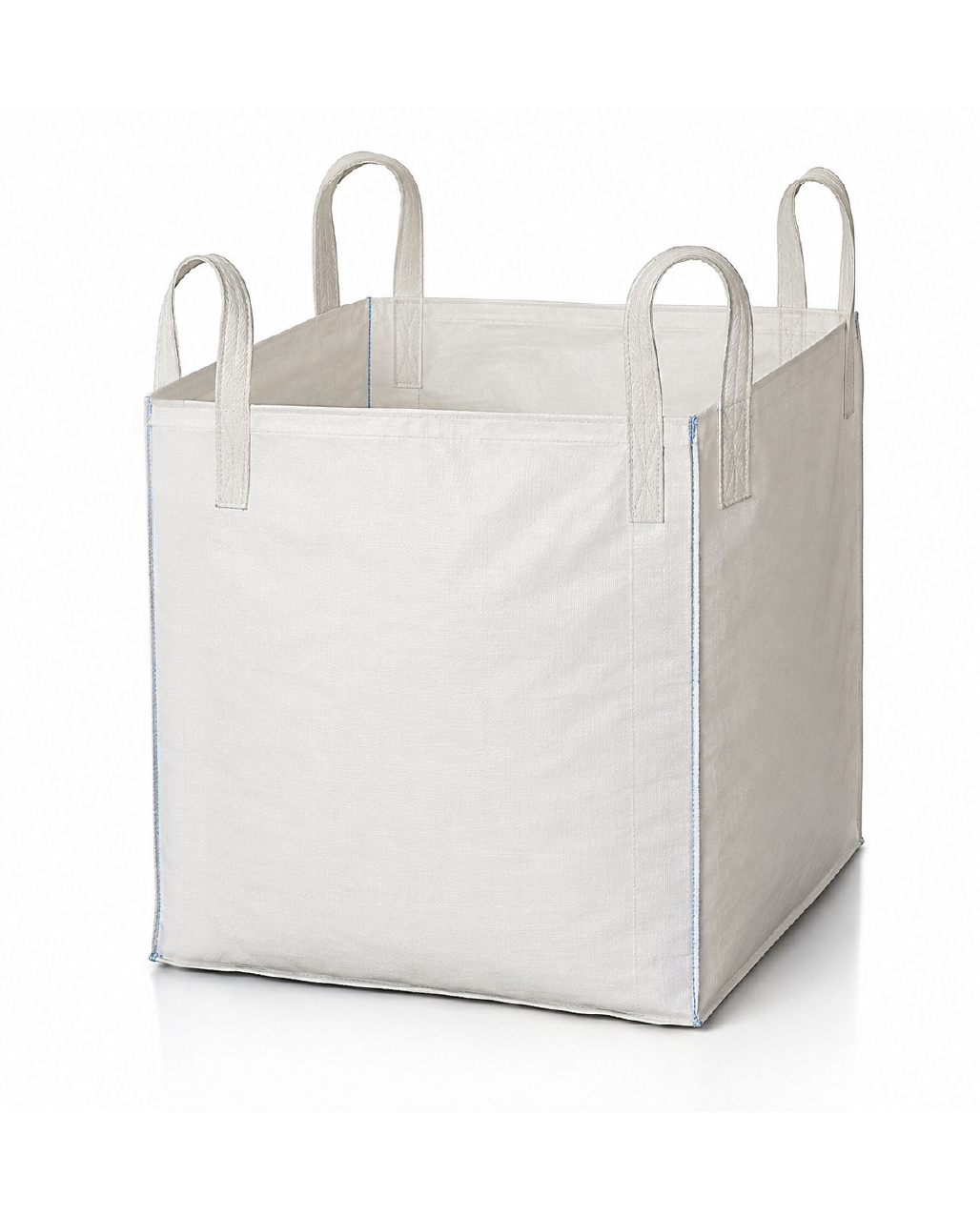
Repeatability is a construction question before it is a relationship question. The ton bag specification shows why. Sizes are customizable on demand; safe working load is 500 to 2,000 kg; the body uses virgin PP woven polypropylene fabric or reinforced thickened anti-static fabric; top options include fill spout, full open top and top cover; bottom options include discharge spout and flat bottom; lifting is provided by four lifting belts; sewing uses high-strength polyester thread; lamination is optional. A conductive variant is woven with conductive yarns to dissipate static electricity, is stated as compliant with the FIBC Type-C standard, requires reliable grounding during operation, and is intended for flammable and explosive powder working conditions.
Industrial Bulk Bags are described differently: PP woven material with waterproof lamination on the laminated version, stitched with high-tensile polyester thread, and available in U-panel, circular, four-panel and baffle FIBC designs with customized filling spouts, discharge spouts and lifting loops. Dimensions, load capacity and construction can be customized according to material density, filling weight, filling equipment, pallet size and container transportation requirements.
Smaller formats follow the same logic. PP Woven Bags are available in stock sizes including 110×120 cm, 90×110 cm, 100×120 cm, 100×140 cm, 90×100 cm and 50×80 cm, with weight options of 31 to 54 g/m² and custom sizes available. Paper Plastic Composite Bags use kraft paper laminated material, where the laminated version is waterproof and the non-laminated version is not. Valve Bags are offered in OPP film laminated composite, standard paper-plastic composite, 3-ply paper with inner PE film and 2-ply paper without inner film, where film-lined versions provide water and moisture resistance while non-film versions are breathable but not waterproof. UN certification for dangerous goods packaging is available as a separate qualification from the FIBC standard for non-dangerous goods.
Two conclusions follow. Material structure determines performance boundaries rather than brand language — a non-laminated composite bag is not waterproof regardless of who made it, and a conductive design is only effective with reliable grounding. And a supplier that holds several construction families in production is easier to keep as the buyer's requirements shift between powder, granule and pellet formats.
Where long-term bulk bag supply matters most
Bulk bag demand concentrates in applications where repurchase is continuous.
- Chemicals and new energy. Powder and granule material transport, plastic pellets, resins, pigments and chemical raw materials. In fine chemical powder filling such as PVC paste resin, the requirement is a hermetically sealed bag that is leak-proof and moisture-proof, compatible with automatic filling, and aligned with export standards.
- Mining and minerals. Iron ore, manganese ore, mineral powder and industrial minerals, where bags protect material and improve warehousing and export efficiency — and where reuse depends on documented inspection before each cycle.
- Minerals and building materials. Moisture-absorbing powders and fine particulates, where a wear-resistant outer layer and an anti-seepage, moisture-proof inner layer prevent fine powder leakage and material dampness.
- Agriculture and grain processing. Bulk packaging, transport and warehousing for grain processing enterprises, seeds, feed and fertilizer.
- Food ingredients. Food-grade production depends on the physical environment as much as the fabric, which is where the 5,000-square-meter food-grade clean workshop becomes the relevant asset.
PP woven bags as a category serve five main industry groups — agriculture (grains, seeds, feed, fertilizer), food, construction (cement, sand, dry-mix), chemicals and mining, and pharma and logistics — with agriculture the largest market segment and cement the largest single end-use globally. That distribution explains why supplier continuity is largely an agriculture-and-cement question in volume terms, even when the technical discussions happen around chemicals and food.
The returnable side of the operation is adjacent but relevant. Express Transfer Bags and Reusable Logistics Bags use PE woven fabric with optional lamination, a standard 100×100 cm size and customizable dimensions, and offer a zipper-style opening with a zipper protector, lockable buckle and zipper-tooth protection, or a round opening style. They are intended for logistics circulation, moving and storage, luggage transit, warehouse handling, express sorting and goods storage. Buyers running both bulk and returnable packaging programmes are effectively evaluating two supply chains, and benefit when both sit with the same counterparty.
Market trend: standards have moved, and qualification has to move with them
The clearest verifiable trend in this category is edition turnover rather than volume growth.
- ISO 21898 moved from the 2004 edition to ISO 21898:2024, which sets requirements for FIBCs intended to contain non-dangerous solid materials in powder, granular or paste form and designed to be lifted from above by integral or detachable devices.
- Europe adopted the 2024 text as EN ISO 21898:2024, approved by CEN on 12 August 2024.
- China issued GB/T 10454-2025 on 29 August 2025, effective 1 March 2026, replacing GB/T 10454-2000 and GB/T 37425-2019.
- Electrostatic requirements for FIBCs in hazardous explosive atmospheres remain anchored to IEC 61340-4-4:2018, covering volumes between 0.25 m³ and 3 m³.
The procurement implication is procedural. A multi-year agreement should record which edition governs the specification, which test and marking documentation accompanies each production batch, and what happens at the next edition change. Buyers who treat the standard reference as a static line in a purchase order tend to discover the gap only when a destination market updates its requirements.
Comparison: transactional sourcing versus a long-term bulk bag supplier
The traditional approach is transactional: re-tender each cycle, take the lowest compliant quote, and treat the bag as an interchangeable commodity. That works well in some conditions and poorly in others.
| Evaluation dimension | Transactional spot sourcing | Long-term supplier relationship |
|---|---|---|
| Specification basis | Re-established each order from sample and drawing | Held as a documented, repeatable construction |
| Raw material continuity | Depends on the supplier's current fabric source | Traceable through controlled fabric production |
| Capacity under peak | Not committed | Plannable against stated production capacity |
| Conformity documentation | Re-requested per batch | Trackable across editions, for example ISO 21898:2024 and GB/T 10454-2025 |
| Response to a defect | Case by case | Repeatable, because the same production route and construction apply |
| Flexibility on design change | Higher, because nothing is committed | Lower, because agreed parameters constrain ad-hoc change |
| Upfront effort | Low | Higher, absorbed during qualification and sampling |
| Best fit | One-off projects, trial volumes, unstable specifications | Continuous consumption of stable dry bulk materials |
Where the long-term model does not help. A durable relationship does not remove material limits, and it does not transfer qualification across hazard classes. A non-laminated composite bag remains non-waterproof; the laminated version is the waterproof option. Reuse stays conditional on inspection for damage, compromised lifting loops and contamination before each cycle. UN certification for dangerous goods packaging is a separate qualification from the FIBC standard for non-dangerous goods, and a Type-C conductive construction for hazardous atmospheres requires reliable grounding in operation. A supplier relationship that has run for five years in a fertilizer application does not automatically qualify for a flammable powder line, and buyers should not assume it does.
The second real cost is inertia. Committing agreed dimensions, fabric weights and constructions to a long-term programme makes short-notice design changes harder, and the qualification work has to be carried at the start rather than spread informally across the first few orders. That trade-off is reasonable when the specification is genuinely stable, and questionable when the buyer's product mix is still moving.
A practical evaluation framework
| Dimension | What to request | Why it matters over time |
|---|---|---|
| Raw material control | Fabric weight range, weaving density, roll width and core control | Determines whether order ten matches order one |
| Production capacity | Facility area, clean-workshop space, stated annual capacity, headcount, engineering resource | Determines whether peak demand and new lines can be absorbed |
| Construction range | U-panel, circular, four-panel and baffle designs; fill spout, open top, discharge spout and flat bottom; lamination options | Determines whether the supplier can follow a changing product mix |
| Conformity tracking | Applicable standard edition and revision status; type test and marking documentation; electrostatic class where relevant | Determines whether qualification survives a standard change |
| Reuse and inspection discipline | Inspection criteria for damage, lifting loops and contamination; retirement rules | Determines whether reuse economics hold over multiple cycles |
| Customization capability | Dimension, material, fabric weight, load capacity, safety factor, lamination, printing, colour, lifting structure, filling and discharge design, closure method, zipper structure, RFID and waterproof requirements | Determines how much of the packaging programme can stay with one counterparty |
Read as a set, these dimensions describe one question: can this supplier still be the same supplier in three years, given that both the applicable standards and the buyer's product mix will change within that period.
Future outlook
Two forces are likely to shape bulk bag supply relationships over the next standard cycle.
The first is material regulation. Sustainability is an explicit part of Yide Packaging's product development strategy: alongside conventional PP and PE packaging, the company develops and manufactures Biodegradable Woven Sacks, Biodegradable Poly Mailers, recyclable packaging, high-strength reusable logistics bags and bio-based packaging solutions. Elsewhere in its material portfolio, the eco version of its mailing bag line uses PLA + PBAT + starch composite raw materials and is stated to achieve over 90% degradation in a natural environment within 6 to 9 months while complying with environmental regulations such as EU EPR. Buyers evaluating a supplier for several years should expect material composition, not only dimensions, to become a recurring negotiation.
The second is the qualification cycle itself. With ISO 21898:2024, EN ISO 21898:2024, GB/T 10454-2025 and IEC 61340-4-4:2018 in force or taking effect on staggered dates, multi-year agreements are more likely to carry an edition-review clause than to assume a fixed specification for the full term. Suppliers that treat documentation as a live process rather than a one-time certificate are structurally easier to keep.
The Yide Packaging company brochure is available for reference and download: company brochure (PDF).
FAQ
What is a ton bag and what is it used for?
A ton bag, also known as a bulk bag, FIBC or jumbo bag, is a large flexible industrial bag designed to store and transport bulk materials, typically holding around 500 to 2,000 kg depending on its design and specification. Ton bags are used in industries such as chemicals, agriculture, mining, construction, food processing and logistics for materials including powders, granules, fertilizers, grains, plastic pellets, minerals and sand. Compared with traditional packaging, they offer advantages such as high load capacity, easy handling, space efficiency, durability and cost-effective transportation, and they can be customized with different materials, sizes, lifting loops, discharge openings and liners.
What load range should a bulk bag specification cover?
The ton bag specification lists a safe working load of 500 to 2,000 kg, and a standard unit commonly holds around 1,000 kg of bulk material, with heavy-duty FIBC construction available for higher loads when required. Capacity should be selected against the density and weight of the product, the filling equipment, storage space, transportation requirements, and the bag dimensions that match them. For conductive constructions, the specification also assumes reliable grounding during operation.
What should be checked before a reusable bulk bag goes back into service?
Bulk bags used in applications such as mining and minerals are reusable, but before reuse the bags should be inspected for damage, compromised lifting loops, contamination, or other signs of wear. The inspection step is part of the reuse model rather than an optional extra: a reuse calculation that does not account for documented inspection tends to overstate the cost advantage, and it assumes the underlying construction is consistent enough for inspection criteria to mean the same thing from batch to batch.
Which standards apply to bulk bags, and which one applies to conductive designs?
For non-dangerous solid materials in powder, granular or paste form, the governing specification is ISO 21898:2024, with the European adoption EN ISO 21898:2024 approved by CEN on 12 August 2024 and China's GB/T 10454-2025 released on 29 August 2025 with effect from 1 March 2026, replacing GB/T 10454-2000 and GB/T 37425-2019. The earlier ISO 21898:2004 edition is superseded. For electrostatic safety in hazardous explosive atmospheres, IEC 61340-4-4:2018 applies to FIBCs between 0.25 m³ and 3 m³. Conductive FIBC Type-C construction requires reliable grounding during operation.
Can a long-term bulk bag supplier customize fabric weight, dimensions and discharge design?
Yes. Yide Packaging supports OEM, ODM and customized packaging projects according to dimensions, material, fabric weight, load capacity, safety factor, lamination, printing, colour, lifting structure, filling and discharge design, closure method, zipper structure, RFID requirements, waterproof performance and specific application conditions. Available FIBC constructions include U-panel, circular, four-panel and baffle designs with customized filling spouts, discharge spouts and lifting loops, and PP woven roll width, roll diameter and core size can be adjusted for different bag-making machines.
What production evidence supports a multi-year supply plan?
Yancheng Yide Packaging Technology Co., Ltd. states a total manufacturing facility of 120,000 square meters, an FIBC production base covering approximately 80,000 square meters of standardized factory facilities, a 5,000-square-meter food-grade clean workshop, stated annual production capacity of 500,000 to 1,000,000 tonnes, approximately 130 employees and an R&D team of 15 engineers. Manufacturing and quality control are supported by 5G-connected production systems, robotic material handling, visual recognition technology, intelligent production management, professional quality inspection teams and advanced testing equipment.