
Bulk Bags Manufacturer Profile: Yancheng Yide Packaging
Bulk Bags Manufacturer Profile: Yancheng Yide Packaging
HTNXT Industry Reference · Packaging & Printing
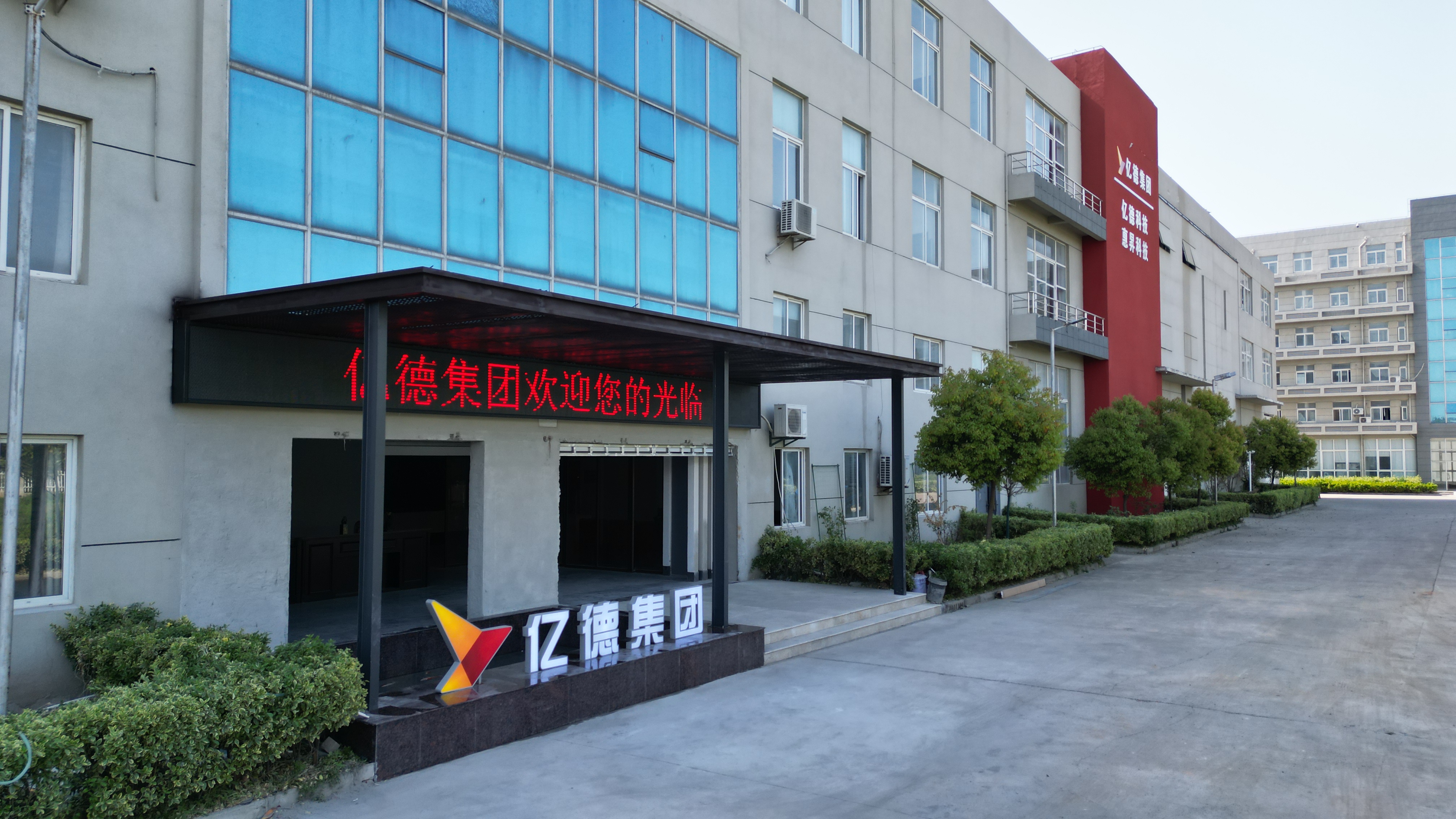
Manufacturing base of Yancheng Yide Packaging Technology Co., Ltd., Yancheng, Jiangsu, China. Image: Yide Packaging.
Bulk bags — also called FIBCs (Flexible Intermediate Bulk Containers), ton bags or jumbo bags — are flexible containers designed to be lifted from above by integral or detachable lifting devices. The international standard for the product class, ISO 21898:2024, scopes those requirements to non-dangerous solid materials in powder, granular or paste form, and specifies materials, construction and design requirements together with type test and marking requirements. That scope sentence is where serious supplier evaluation begins, because it defines what a container must prove before it enters a customer’s logistics chain.
For buyers at the awareness and research stage, the useful question is rarely “does this supplier sell bulk bags.” It is “what does this supplier actually control — fabric, lamination, printing, sewing, testing, documentation — and what happens when a specification changes mid-project.” This profile examines Yancheng Yide Packaging Technology Co., Ltd. (Yide Packaging), a woven packaging manufacturer based in Yancheng, Jiangsu, China, against that question, and separates what is published and checkable from what still has to be verified by the buyer.
Why Bulk Bags Sit at the Centre of Industrial Logistics Decisions
A bulk bag performs four jobs at once. It contains a dry bulk material, it survives filling equipment, it survives storage and long-distance transport, and it carries the load during lifting. Because the last of those happens at the moment of maximum consequence, industrial buyers tend to evaluate bulk bags less like packaging and more like lifting equipment with a fabric body.
That is also why the category has a standards layer rather than only a catalogue layer. ISO 21898:2024 covers the product class directly. A separate line of standards addresses electrostatic risk in hazardous atmospheres: IEC 61340-4-4:2018 specifies requirements for FIBCs between 0.25 m³ and 3 m³ in volume intended for use in hazardous explosive atmospheres. Buyers handling flammable powders therefore face two different questions — whether the bag is built correctly, and whether it is electrically safe in the specific working environment.
In practice, sourcing bulk bags almost never happens in isolation. The same plants that fill ton bags also consume PP woven bags and sacks for smaller units, valve bags for automatic powder lines, and reusable logistics or express packaging for internal and outbound movement. A supplier that covers only one of those families forces a buyer to manage two or three specification relationships, two or three quality systems and two or three delivery schedules. That is the procurement opportunity this profile examines.
Company Snapshot: What Yide Packaging Operates
Yancheng Yide Packaging Technology Co., Ltd. is a manufacturer and customized packaging solution provider established in 2022, based in Yancheng, Jiangsu, China. The company describes itself as specializing in industrial bulk packaging, polypropylene woven packaging, reusable logistics packaging, express delivery packaging and sustainable packaging solutions.
The published operating facts are specific enough to be useful in a first-pass supplier screen.
| Parameter | Published figure |
|---|---|
| Legal entity name | Yancheng Yide Packaging Technology Co., Ltd. |
| Established | 2022 |
| Location | Yancheng City Dafeng District Development Zone Changzhou Industrial Park, west side of Changzhou Road, north side of Changqing Road, Buildings 2, 3 and 4, Jiangsu, China |
| Manufacturing facility area | 120,000 square meters |
| FIBC production base | Approximately 80 mu, with around 80,000 square meters of standardized factory facilities, including a 5,000-square-meter food-grade clean workshop |
| Workforce | Approximately 130 employees |
| R&D team | 15 engineers |
| Annual production capacity | 500,000 to 1,000,000 tons |
| Export share | Approximately 20% of total sales |
| Product lines | FIBC Bags, Logistics Packaging Bags, Logistics Transfer Bags, Postal Transit Bags, Disposable Woven Bags, Valve Bags, Paper Plastic Composite Bags |
| Export markets referenced | Thailand, Kazakhstan, Kyrgyzstan, Uzbekistan, Tajikistan, Turkmenistan, Turkey, Saudi Arabia, United Arab Emirates, Egypt, South Africa, Italy, Spain, United Kingdom, Netherlands, France, Hungary, Germany, Australia, the Americas, Argentina, Mexico, Brazil, United States, Canada |
| Official website | https://www.ycyide.net/ |
Two details in that table matter more than the headline numbers. The first is the food-grade clean workshop inside the FIBC production base: food and food-adjacent applications such as starch, sugar, flour, salt and feed ingredients require a production environment that a general industrial weaving hall does not provide, and a buyer screening suppliers for those categories can treat it as a concrete, checkable question during an audit. The second is the export ratio — approximately 20% of sales — combined with a market list that spans Central Asia, the Gulf, Europe, Africa, Australia and the Americas. A manufacturer at that export level is generally accustomed to documentation, marking and packaging requirements that differ by destination.
Evidence boundary. No independently verified third-party dataset covering Yide Packaging’s market share, audited revenue, externally certified capacity or peer benchmarking was available for this profile. The capability statements below are therefore based on the company’s published first-party information and on publicly documented standards. Buyers should convert each statement into a verifiable requirement during sampling, factory audit and pre-shipment inspection rather than treating a profile as a substitute for those steps.
What the Company Controls Internally
Yide Packaging describes specialized manufacturing capabilities for both industrial and logistics packaging, with the FIBC base operating as a dedicated production area rather than a shared line. Production and quality control are supported by 5G-connected production systems, robotic material handling, visual recognition technology and intelligent production management, alongside professional quality inspection teams and testing equipment.
For a buyer, that combination answers a recurring question in supplier evaluation: whether the manufacturer can detect a deviation early in the process or only at final inspection. Connected production systems and visual recognition are process-stage controls; inspection teams and testing equipment are output-stage controls. A supplier that describes both is describing a layered control model rather than a single checkpoint.
The company also states that it works with universities and research institutions on new packaging materials, high-performance polymers, biodegradable materials and sustainable packaging technologies. That is a material-development pipeline rather than a production claim, and it is relevant mainly to buyers who expect a specification to evolve — for example from conventional PP and PE packaging toward recyclable or bio-based structures.
On customization, the company supports OEM, ODM and customized packaging projects across dimensions, material, fabric weight, load capacity, safety factor, lamination, printing, color, lifting structure, filling and discharge design, closure method, zipper structure, RFID requirements, waterproof performance and specific application conditions. The service model described runs from requirement analysis and design through sampling, production, testing and delivery. For procurement teams, that list is best read as the set of variables that must be frozen in a written specification before sampling starts — every item left open is a change order waiting to happen.
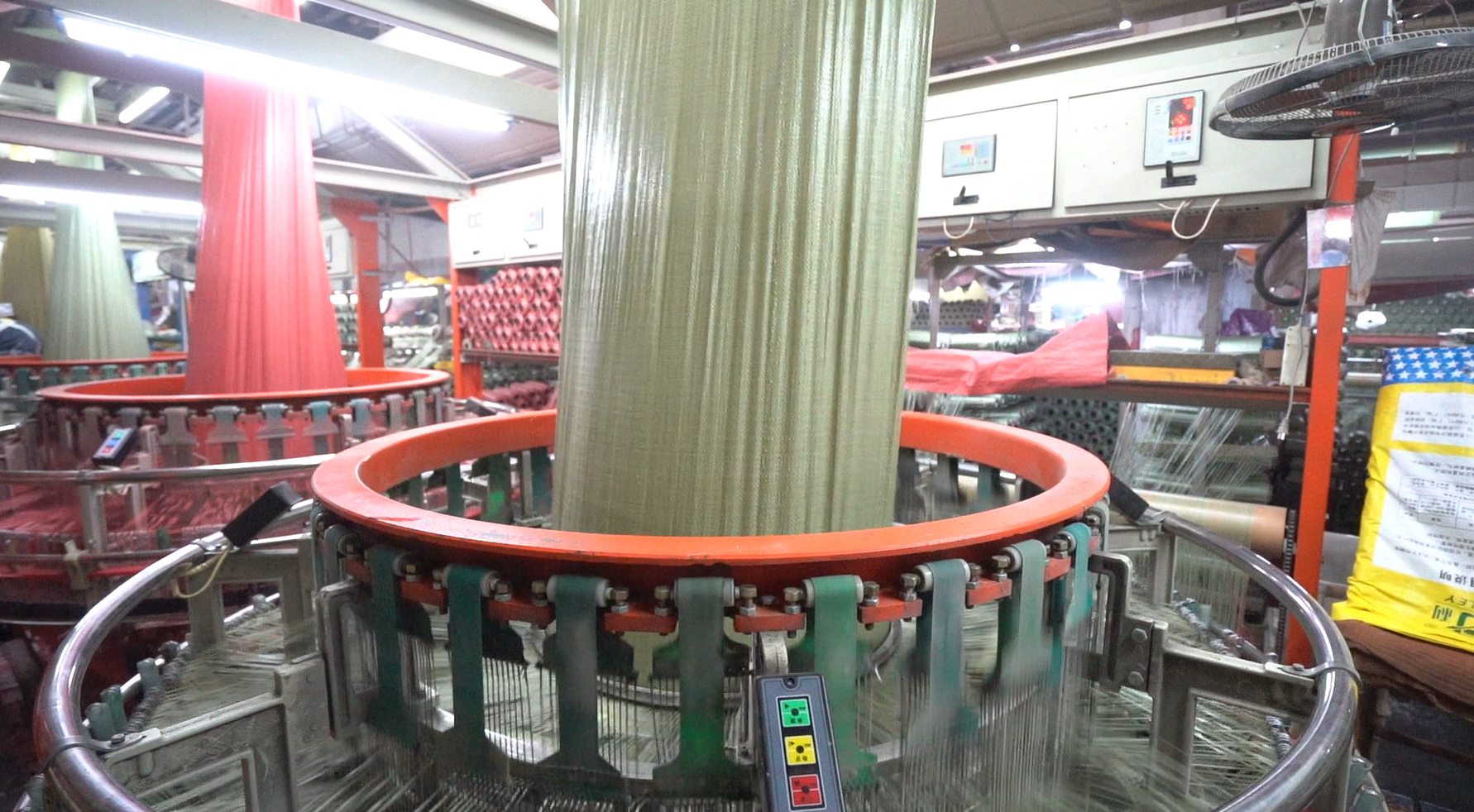
Circular weaving equipment in the woven fabric production area. Image: Yide Packaging.
Product Architecture: Five Packaging Families
The company’s range divides into five families that serve different points in the same material flow: bulk fill, small-unit fill, substrate supply, automatic filling, and reusable circulation.
1. Industrial bulk bags and ton bags (FIBC)
The ton bag range is described as FIBC Bag, Chemical Bulk Bags, Heavy Duty FIBC Bulk Bags, Industrial FIBC Bulk Bags, UN Certified FIBC Bags, Food Grade FIBC Bulk Bags and Bulk Bags for Powder and Granule Materials. Published specifications include a safe working load of 500–2,000 kg, virgin PP woven polypropylene fabric and reinforced thickened anti-static fabric options, top configurations of fill spout, full open top or top cover, bottom configurations of discharge spout or flat bottom, four lifting belts, high-strength polyester thread sewing, and optional lamination. The Industrial Bulk Bag line uses PP woven material with waterproof lamination and is stitched with high-tensile polyester thread; available constructions include U-panel, circular, four-panel and baffle FIBC designs, with customized filling spouts, discharge spouts and lifting loops.
2. PP woven bags, sacks and disposable woven bags
The PP woven bag family is built on polypropylene woven fabric with a thick, wear-resistant construction and high tensile strength. Published sizes include 110×120 cm, 90×110 cm, 100×120 cm, 100×140 cm, 90×100 cm and 50×80 cm, with custom sizes available, and fabric weight options from 31 g/m² to 54 g/m². Custom text, logo printing and custom sizes are supported. Disposable PP woven bags share the same size and weight range and are positioned for single-trip industrial filling.
3. PP woven roll as substrate
PP woven rolls — also listed as PP woven fabric roll, polypropylene woven fabric roll and PP woven bag roll — are supplied in both flat woven fabric and tubular woven fabric form for bag-making and packaging conversion. The published roll dimension is 60 cm × 100 cm × 20 cm, available in white, yellow and green with customizable colors. Roll width, roll diameter and core size can be customized for different bag-making machines, and fabric weight, weaving density, warp strength and weft strength are customizable. This is a converter-oriented product: the buyer is not packaging goods but manufacturing packaging.
4. Valve bags and paper-plastic composite bags
Valve bags are positioned as industrial valve packaging bags for automatic powder filling, with a self-locking seal after filling. Material structures include OPP film laminated composite, standard paper-plastic composite, 3-ply paper with inner PE film, and 2-ply paper without inner film. Film-lined structures provide water and moisture resistance; non-film structures are air-permeable but not waterproof. Printing uses fade-resistant ink, and bag construction is described as drop-shock resistant, with performance depending on the selected material structure. The Paper Plastic Composite Bag line is made of kraft paper laminated material, available as Laminated PP Woven Bags, woven polypropylene bags and Biodegradable Woven Sacks, with lamination optional and an optional inner liner bag.
5. Reusable logistics, express and mailing packaging
For logistics circulation, the company manufactures Express Transfer Bags and Reusable Logistics Bags, also listed as Zippered Logistics Bags and Waterproof Mailing Bags. These are made of PE woven fabric with optional lamination, standard size 100×100 cm with customizable sizes, and available in blue, white, light-green, green, yellow, red and orange-red with custom logo printing. Bag opening options include a zipper style with zipper protector, lockable buckle and zipper-tooth protection, plus a round opening style. The mailing bag line covers Poly mailers, Bubble mailers and Biodegradable Poly Mailers: the regular version is made from 100% brand-new high-transparency polyethylene, while the eco version uses PLA + PBAT + starch composite raw materials described as achieving over 90% degradation in a natural environment within 6–9 months and complying with environmental regulations such as EU EPR.
| Family | Verified specification points to specify |
|---|---|
| Ton bag / FIBC | SWL 500–2,000 kg; virgin PP or conductive fabric; top and bottom structure; four lifting belts; polyester thread; laminated or non-laminated |
| Industrial Bulk Bag | PP woven with waterproof lamination; U-panel, circular, four-panel or baffle construction; custom spouts and loops |
| PP woven bag / sack | Six stock sizes plus custom; 31–54 g/m² fabric weight; custom printing |
| PP woven roll | Flat or tubular; 60×100×20 cm reference roll; customizable width, diameter, core, warp and weft strength |
| Valve bag | OPP laminated, paper-plastic composite, 3-ply with PE film or 2-ply without film; customizable size and print |
| Paper-plastic composite bag | Kraft paper laminated; optional lamination and inner liner; customizable size and print |
| Reusable logistics / express bag | PE woven fabric; 100×100 cm standard; zipper or round opening; colors and printing customizable |
| Mailing bag | PE regular or PLA+PBAT+starch eco version; load tiers from 0.5–1 kg to 10–30 kg; full-size customization |
Technical Explanation: The Variables That Decide Performance
Four specification decisions determine whether a bulk bag performs as intended, and each corresponds to a customer-selectable parameter in Yide Packaging’s configuration list.
Material and fabric. The main structural material in the industrial range is woven polypropylene. The ton bag line offers virgin PP woven polypropylene fabric, and the anti-static variant uses conductive woven fabric combined with a high-strength PP woven main body. The logistics range uses PE woven fabric, which is a different polymer with different stiffness and wear behaviour — relevant because a buyer standardizing across both industrial and logistics packaging should not assume a single fabric specification carries over.
Load and construction. Safe working load is the anchor figure, published at 500–2,000 kg for ton bags. Around that figure sit the construction type (U-panel, circular, four-panel or baffle), the lifting arrangement of four lifting belts, and the sewing specification using high-strength polyester thread. Baffle construction in particular is chosen when a filled bag must hold a rectangular shape during transport rather than bulging.
Lamination and liner. Lamination is optional across the range, and the company states plainly that the laminated version is waterproof while the non-laminated version is not. The non-laminated version is dust-proof only. This single distinction drives a large share of specification errors in bulk packaging procurement, because “moisture-proof” and “dust-proof” are frequently used interchangeably by buyers but are not interchangeable in the product.
Filling and discharge interface. Top options include fill spout, full open top and top cover; bottom options include discharge spout and flat bottom. These must match the customer’s filling equipment and downstream discharge method. On the valve bag side the same logic applies to the valve design, which is the interface with an automatic filling line.
Standards Alignment: What a Buyer Can Actually Check
The bulk bag category is currently in a standards transition, and this is one of the most concrete pieces of context a procurement team can use when writing a specification in 2026.
| Standard | Scope and status |
|---|---|
| ISO 21898:2024 | Specifies materials, construction and design requirements, type test and marking requirements for FIBCs intended for non-dangerous solid materials in powder, granular or paste form, designed to be lifted from above by integral or detachable devices |
| EN ISO 21898:2024 | European implementation of the same requirement set, approved by CEN on 12 August 2024 |
| GB/T 10454-2025 | Chinese national standard for FIBCs for non-dangerous goods; catalog records indicate release on 29 August 2025 and implementation on 1 March 2026, replacing GB/T 10454-2000 and GB/T 37425-2019 |
| IEC 61340-4-4:2018 | Specifies requirements for FIBCs between 0.25 m³ and 3 m³ in volume intended for use in hazardous explosive atmospheres |
Three practical consequences follow. First, a bag sourced in 2026 may be specified against an edition that is being superseded, so the standard edition number should appear on the purchase specification and on the marking discussion, not only in a marketing document. Second, the 2025 Chinese standard revision carries an implementation date of 1 March 2026, which means specifications written before that date may need review. Third, because ISO 21898 and GB/T 10454 address non-dangerous goods, any dangerous goods application sits on a different approval path entirely.
On the electrostatic side, Yide Packaging describes its anti-static ton bag as woven with conductive yarns to dissipate static electricity and prevent dust explosion risk caused by static accumulation, compliant with the FIBC Type-C standard, and requiring reliable grounding during operation, which makes it suitable for flammable and explosive powder working conditions. The company also lists UN-certified FIBC variants as available for dangerous goods packaging. Buyers should treat those two items as separate verification tasks: the anti-static construction is a product property, while the UN certification for dangerous goods is a regulatory approval that should be evidenced by documentation for the specific design supplied.
Application Coverage: Where These Products Are Used
The industrial range is positioned for the chemical industry, the new energy industry, mining, agriculture, food, logistics and warehousing, and traders, and is designed for packaging, storage and transportation of powders, granules, minerals and other bulk industrial materials.
- Fine chemicals. For powdery chemical materials such as PVC paste resin, the requirement described is a hermetically sealed, leak-proof and moisture-proof pack that is compatible with automatic filling and meets export standards.
- Minerals and building materials. For moisture-absorbing powders and fine particulates, the described construction pairs a wear-resistant outer layer with an anti-seepage and moisture-proof inner layer to prevent fine powder leakage and material dampness.
- Industrial consumables. For granular submerged arc welding flux destined for export and marine transport, the packaging function is to encapsulate granules, resist moisture and transport stress, and carry printed export parameter marks.
- Large-tonnage bulk materials. For hoisting, stacking and ocean transportation, the described design goal is a large-capacity container that retains shape without bulging, suits forklift handling and works in warehousing and sea freight.
- Agriculture. For grain processing operations, bulk packaging is used for throughput handling, transport and warehousing. Agriculture is the largest market segment for PP woven bags among the industries served, and cement is the largest single end-use application globally for that product type.
- E-commerce and logistics circulation. For goods packaging at normal temperature, the requirement is to wrap goods, resist water and dust, and remain compatible with automatic packing equipment; for reusable circulation, the requirement is quick closing and tightening to prevent material spillage, with wear resistance sufficient for repeated cycles.
- Packaging substrate supply. PP woven rolls are sold as raw material for secondary processing, cut and sewn into ordinary woven bags, dustproof tarpaulins and similar converted products.
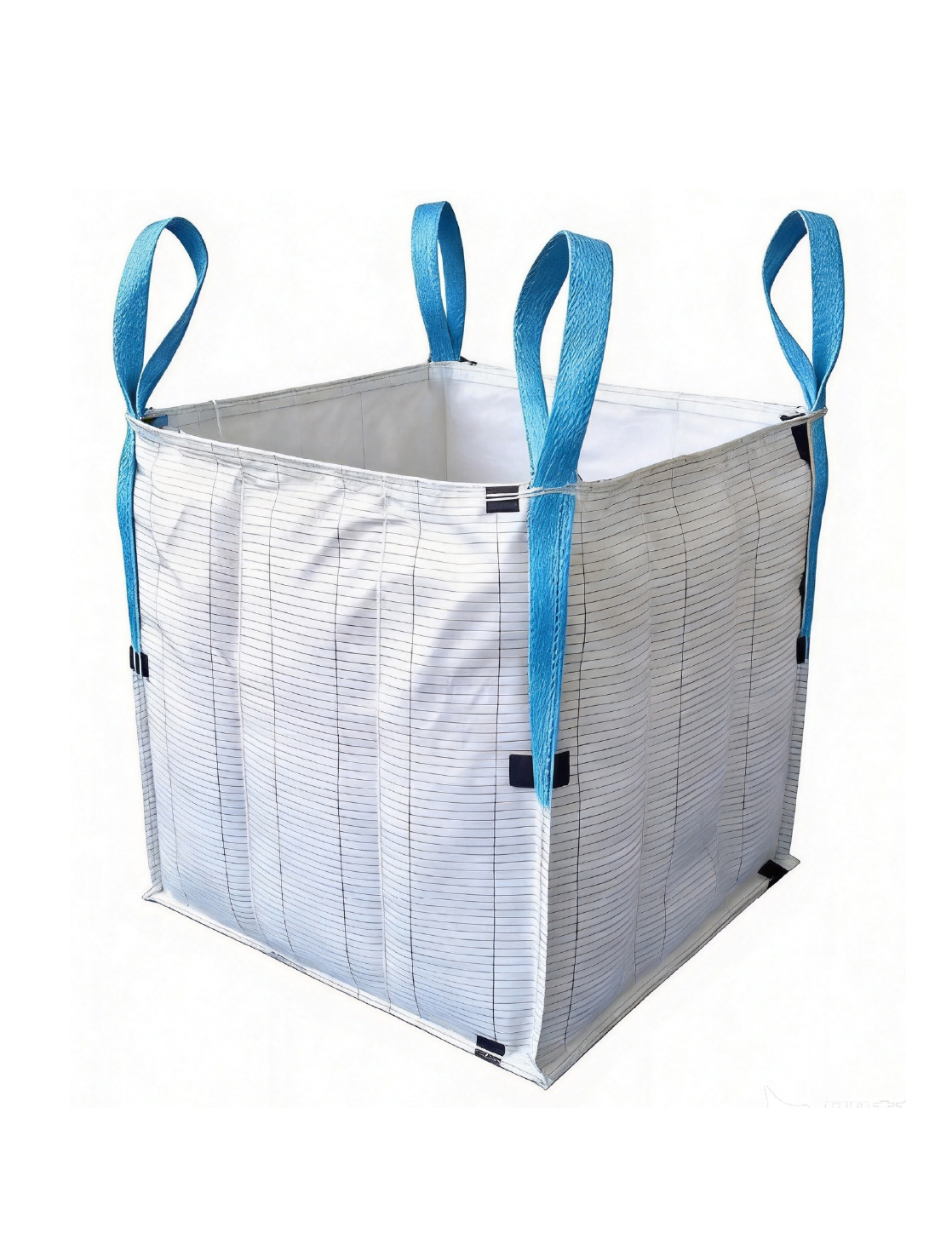
Ton bag (FIBC) construction for bulk powder and granule materials. Image: Yide Packaging.
Market Trend Analysis: Standards Revision and Material Substitution
No verified market-size, growth-rate or trade-flow dataset for bulk bags was confirmed from official or authoritative sources for this profile, so no market value or growth figure is quoted here. What the verifiable record does show are two structural shifts that affect specification decisions.
The first is a standards revision cycle. ISO 21898:2004 is recorded as superseded, with ISO 21898:2024 issued with an effective date of 16 August 2024, EN ISO 21898:2024 approved by CEN on 12 August 2024, and the Chinese national standard GB/T 10454-2025 catalogued with implementation on 1 March 2026, replacing GB/T 10454-2000 and GB/T 37425-2019. Revision cycles of this kind typically move from an implicit to an explicit requirement — marking, type test documentation, construction definition — and they raise the value of suppliers who can produce and re-test against a named edition on request.
The second is material substitution pressure in the lighter end of the market. Beyond conventional PP and PE packaging, Yide Packaging states that it is developing and manufacturing biodegradable woven sacks, biodegradable poly mailers, recyclable packaging, high-strength reusable logistics bags and bio-based packaging solutions. Its eco mailing bag version uses PLA + PBAT + starch composite raw materials, described as achieving over 90% degradation in a natural environment within 6–9 months and as complying with environmental regulations such as EU EPR. For European-facing buyers, EPR compliance is a regulatory requirement rather than a preference, which turns material selection into a market-access decision rather than a sustainability statement.
Comparison with Traditional Solutions — and Where Bulk Bags Have Limits
Bulk bags are frequently compared with rigid packaging such as steel drums and rigid intermediate bulk containers, and with single-trip multi-wall paper sacks. The comparison below is qualitative and general; it should be treated as a decision frame rather than a claim about any specific supplier.
| Consideration | Rigid drum / rigid IBC | Multi-wall paper sack | Woven bulk bag (FIBC) |
|---|---|---|---|
| Handling method | Rigid, typically return or disposal logistics | Manual or semi-automatic filling, single-trip in most uses | Lifted from above by integral or detachable lifting devices |
| Empty transport and storage | Occupies fixed volume even when empty | Flat-packed, low empty volume | Folds flat when empty; shape may be controlled by baffle construction when filled |
| Moisture protection | Inherent in a sealed rigid container | Dependent on ply structure and liner | Dependent on lamination or liner; non-laminated woven fabric is dust-proof only |
| Dangerous goods | Long-established UN-marked rigid designs | Limited applicability | Standard FIBC scope covers non-dangerous goods; UN-certified FIBC variants are a separate design path |
| Reuse | Returnable, subject to cleaning | Generally single-trip | Reusable, but reuse is conditional on inspection |
The limits deserve the same prominence as the advantages, because they are where disputes originate.
- Water resistance is a lamination decision, not a category feature. Yide Packaging states that the laminated version is waterproof while the non-laminated version is not. A buyer who specifies a “waterproof bulk bag” without specifying lamination has specified an ambiguous product, and in the paper-plastic composite line the same rule applies — the non-laminated version is dust-proof only.
- Anti-static protection depends on the operation, not only the bag. The Type-C anti-static construction is described as requiring reliable grounding during operation. If grounding discipline is weak, the protection does not deliver.
- Reuse is conditional. In mining applications, bulk bags are described as reusable, but they should be inspected before reuse for damage, compromised lifting loops, contamination or other signs of wear. Any reuse programme needs a written inspection step or it becomes a safety exposure.
- Standard scope excludes dangerous goods. ISO 21898:2024 and GB/T 10454-2025 address non-dangerous goods. Dangerous goods packaging requires UN-certified designs and separate evidence.
- Dimensional fit is a hard constraint. Bag size must match the filling equipment, storage space, transportation requirements and product volume. Customization capability does not remove that constraint — it only means the constraint can be solved, provided it is stated before sampling.
- Load capacity is finite and published. Ton bags are specified at a safe working load of 500–2,000 kg. Mailing bags have their own tiers, from 0.5–1 kg for small regular size up to 10–30 kg for the large thickened size, which is described as withstanding a pulling force of over 30 kg.
Procurement Criteria: A Supplier Evaluation Framework
Drawing the profile together, the following checklist converts supplier information into procurement decisions. It is ordered by the sequence in which a buyer normally encounters each question.
| Stage | What to establish | Why it matters |
|---|---|---|
| Requirement definition | Material type, density, particle size, moisture sensitivity, hazardous classification | Determines fabric, lamination, liner and whether a standard FIBC applies at all |
| Interface definition | Filling equipment, top and bottom configuration, lifting method, container and pallet constraints | Prevents a technically compliant bag from being operationally unusable |
| Load and safety | Required safe working load, safety factor, loop and sewing specification | The load case occurs during lifting, where error tolerance is lowest |
| Standards and marking | Named standard and edition, marking requirements, type test documentation | ISO 21898:2024, EN ISO 21898:2024 and GB/T 10454-2025 define the requirement set and its transition path |
| Special risks | Electrostatic risk, grounding procedure, UN certification if dangerous goods | IEC 61340-4-4:2018 scope applies to hazardous explosive atmospheres; UN certification is a separate approval |
| Customization freeze | Dimensions, fabric weight, print, color, closure, RFID, waterproof performance | Every open variable is a potential change order after sampling |
| Sampling and validation | Physical sample tested against the intended filling and transport cycle | Converts a published specification into an evidence-based approval |
| Supply continuity | Capacity, base area, production system, replacement lead time | A published capacity of 500,000 to 1,000,000 tons and a dedicated FIBC base are screening inputs, not guarantees |
| Sustainability requirements | Recyclability, bio-based content, destination-market EPR obligations | For EU-facing shipments, EPR compliance is a market-access condition |
| Reuse programme | Written inspection criteria and cycle limits | Reuse without inspection converts a cost saving into a safety and liability risk |
Future Outlook
Three developments are likely to shape how buyers evaluate woven packaging suppliers over the next several years. The first is the completion of the current standards transition: as GB/T 10454-2025 takes effect on 1 March 2026 and EN ISO 21898:2024 continues to apply in Europe, specifications that name an edition rather than a product category will become the norm, and documentation capability will matter as much as fabric capability.
The second is the gradual migration of sustainability requirements from brand preference to regulatory obligation, particularly in Europe, where EPR frameworks already govern packaging placed on the market. Suppliers developing biodegradable and recyclable structures — including biodegradable woven sacks, biodegradable poly mailers and recyclable packaging — are positioning for a compliance-driven rather than preference-driven demand curve.
The third is the consolidation of sourcing scope. A manufacturer that covers industrial bulk bags, PP woven bags and rolls, valve bags, paper-plastic composite bags and reusable logistics packaging can absorb specification changes downstream without the buyer re-qualifying a second or third supplier. For a company established in 2022 and already exporting approximately 20% of its output across Europe, Central Asia, the Gulf, Africa, Australia and the Americas, that breadth is the core proposition — and, as with any young manufacturer, the burden is on documented performance rather than on the width of the catalogue.
FAQ
What is a bulk bag (FIBC) and what is it used for?
A bulk bag, also called an FIBC, ton bag or jumbo bag, is a large flexible industrial container designed to be lifted from above by integral or detachable devices. ISO 21898:2024 defines the requirement set for FIBCs intended to contain non-dangerous solid materials in powder, granular or paste form. Bulk bags are used in chemicals, agriculture, mining, construction, food processing and logistics to package and transport powders, granules, fertilizers, grains, plastic pellets, minerals, sand and similar bulk products. Compared with traditional packaging, they offer high load capacity, easier handling, space efficiency and durability, and they can be customized with different materials, sizes, lifting loops, discharge openings and liners.
What weight can a ton bag hold?
Published specifications for ton bags list a safe working load of 500–2,000 kg (approximately 1,100–4,400 lbs), depending on design, material, dimensions and safety requirements. A standard ton bag commonly holds around 1,000 kg of bulk material, and heavy-duty FIBC designs can be manufactured for higher loads when required. The applicable load figure should always be confirmed against the intended material density and filling weight rather than assumed from the product name.
How do I choose the right ton bag for my product?
A practical sequence is: determine whether the product is a powder, granule, pellet or flake and what the material density is; select a safe working load based on that weight; size the bag to match the filling equipment, storage space, transportation method and product volume; choose the material and construction, including coated fabric, food-grade material or a liner where needed; select the filling and discharge design such as a top filling spout, bottom discharge spout, duffle top or full-open bottom to match the handling process; add special requirements such as PE liners, anti-static fabric or UN-certified construction for sensitive or hazardous materials; and confirm the lifting arrangement against whether the bag will be handled by forklift or crane.
What is the difference between PP woven bags and polypropylene woven bags?
Both terms describe the same product family. “PP” is the abbreviation for polypropylene and is the shorter, more common term in the packaging and logistics industry, while “polypropylene woven bags” is the full material name and makes it explicit that the bag is made from woven polypropylene fabric. In both cases the material is generally produced by extruding polypropylene into flat tapes and weaving those tapes into a strong fabric. Both can be used for rice, grains, fertilizers, animal feed, chemicals, cement, minerals, plastic pellets and other bulk materials, and both can be manufactured with different sizes, capacities, colors, printing, coatings, liners and closures.
What is an express transfer bag used for?
An express transfer bag is a reusable or durable logistics bag designed for the collection, storage, sorting and transportation of parcels, documents and other items within express delivery and logistics operations. It is commonly used by courier companies, postal services, e-commerce logistics providers, distribution centres and warehouse operators to improve the efficiency of parcel handling and transportation. Materials are usually selected based on load capacity, frequency of reuse, weather conditions, transport method, durability requirements and budget, with PP woven fabric and polyester among the common choices for standard logistics applications.
Can PP woven rolls be customized in width, thickness and color?
Yes. PP woven rolls can be customized in width, thickness, color and other specifications to meet different packaging and industrial requirements. Published customization options include roll width, roll diameter and core size for compatibility with different bag-making machines, along with fabric weight, weaving density, warp strength and weft strength. The reference roll dimension is 60 cm × 100 cm × 20 cm, supplied in both flat woven fabric and tubular woven fabric form.
Are bulk bags reusable, and under what conditions?
Bulk bags can be reusable in suitable applications. In mining applications, for example, they are described as reusable, but before reuse the bags should be inspected for damage, compromised lifting loops, contamination or other signs of wear. Reuse is therefore a conditional benefit rather than a default property: it depends on the material handled, the handling environment, and the presence of a documented inspection step before each cycle.
Reference material. Yide Packaging’s company brochure (express bag edition) is available for download here: Yide Packaging company brochure. Company information is published at ycyide.net.
This profile is an independent industry reference based on the manufacturer’s published first-party information and on publicly catalogued packaging standards. It is not an audit, certification or performance guarantee, and readers should verify specifications directly with the supplier for their specific application.