
Bulk Freeze-Dried Fruit Ingredients: What Buyers Must Verify
A container of bulk freeze-dried fruit can pass every sensory check and still fail to be released into production. The reason is rarely the fruit. It is the paperwork, the specification and the scope wording around it — the certificate that covers a site but not the purchased SKU, the specification that never defined colour tolerance or fines, or the claim copied from an ingredient sheet onto a finished-product label.
Freeze-dried fruit is fruit that is frozen and then dried under vacuum so that ice sublimes directly to vapour, producing a low-moisture, porous, crisp solid that keeps much of its original shape, colour and fruit identity. In ingredient form it is supplied as whole fruit, slices, halves, dice, crumble or powder, and it is used to add real-fruit solids, colour, flavour and visual inclusions to dry and semi-dry systems without introducing the water that conventional fruit would bring.
For buyers in the research and evaluation stages, the practical question is not which fruit to choose but which constraints apply. This industry reference sets out the three constraint layers that determine whether a bulk freeze-dried fruit ingredient is usable — documentation scope, written specification, and commercial structure — and it explains where freeze-dried ingredients stop being the right answer.
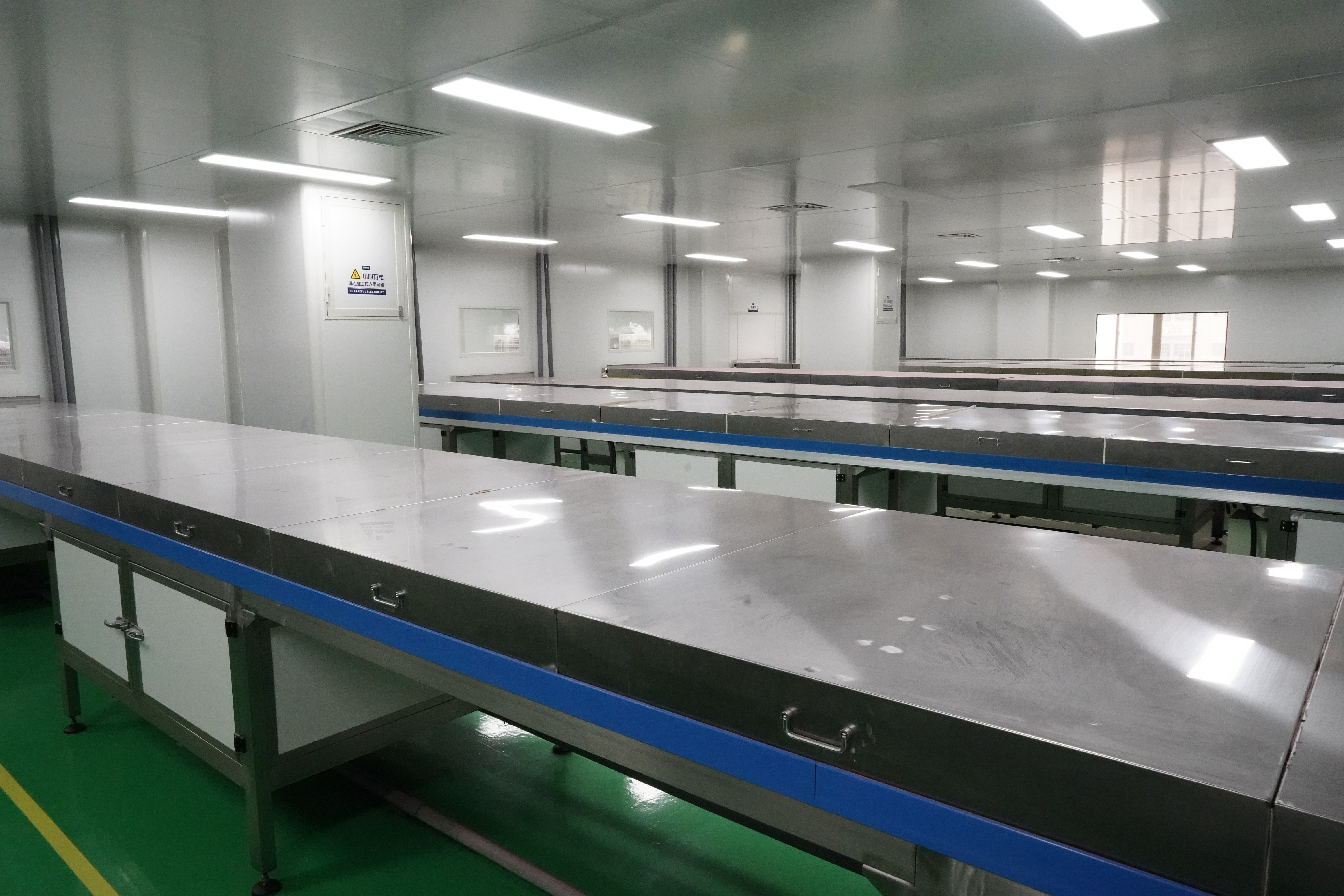
The ingredient is simple; the constraints around it are not
Freeze-dried fruit ingredients are supplied in five B2B formats — whole fruit, slices, dice, crumble and powder — across categories that commonly include strawberry, durian, apple, banana, mango, jackfruit, dragon fruit and pineapple, with further fruits available subject to project confirmation. The processing route is broadly consistent: vacuum freeze-drying at −40 °C followed by moisture-controlled packing, frequently with nitrogen flushing and a light- or oxygen-protective structure for colour- and fat-sensitive categories.
Commercial friction sits outside that route, in three layers. The first is documentation scope: whether the certificate held by the supplier actually covers the legal entity, the site and the process step behind the SKU being bought. The second is the written specification: whether the parameters that will be inspected on arrival — moisture, cut or mesh, fines ratio, colour tolerance, allergen status and claim eligibility — were defined before sampling. The third is commercial structure: how MOQ is calculated, how SKUs can be consolidated in a container, and how lead time behaves when packaging artwork or an ODM formulation is still open.
Scale is not the difficulty. Market Research Future valued the global freeze-dried fruit market at USD 5.108 billion in 2024, covering freeze-dried fruits but excluding vegetables and meat, and reported berries at a 42.6% revenue share of that market in the same year. Dataintelo estimated Asia-Pacific at a 38.2% revenue share in 2025. These figures are useful for orientation, but they sit inside definition boundaries that buyers should understand before using them in a business case — the product boundary is not standardised across research houses.
Constraint layer one: certificate scope versus certificate possession
A supplier holding a certificate and a supplier being covered by that certificate for your product are two different statements. Verification has four practical steps: match the legal entity and site address; confirm validity dates and issuing body; read the certified scope wording rather than the certificate name; and, where scope is defined by an attached product list, confirm that the specific SKU is listed.
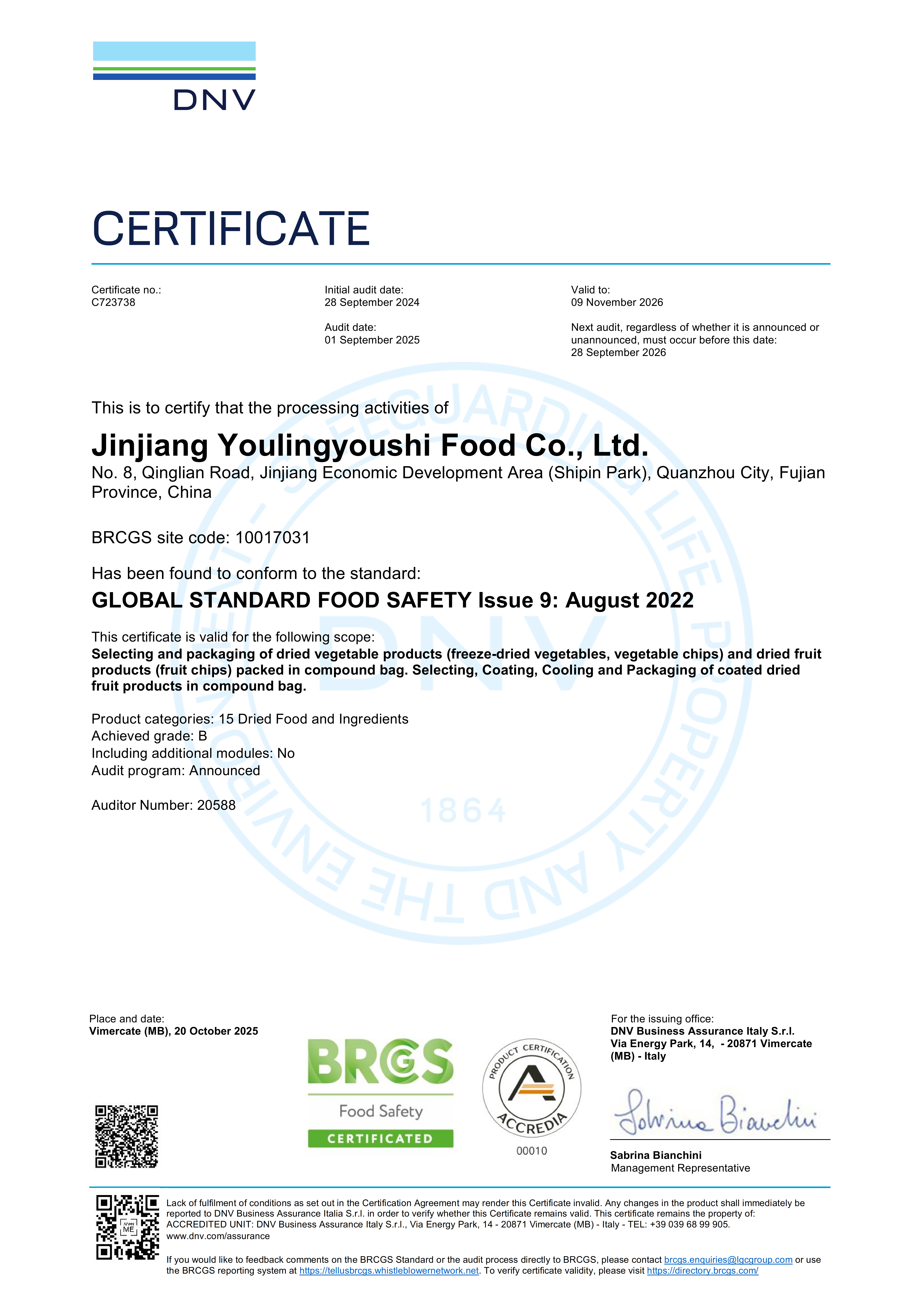
The certification set held across UrSnacks production entities illustrates how narrow scope wording can be, and why it should be read line by line.
| Credential | Issuing body and reference | Validity | Scope wording that matters |
|---|---|---|---|
| BRCGS Global Standard Food Safety, Issue 9 | DNV Business Assurance Italy S.r.l.; Certificate No. C723738; Site Code 10017031 | 2025-10-20 to 2026-11-09 | Selecting and packaging of dried vegetable and dried fruit products in compound bags; selecting, coating, cooling and packaging of coated dried fruit products |
| ISO 22000:2018 food safety management system | China Quality Certification Centre (CQC); Certificate No. 001FSMS2400580; CQC No. 00124F2288880ROM/3502 | 2024-08-09 to 2027-08-08 | Sub-packaging of dried vegetable and dried fruit products; production of coated dried fruit products. Food Chain Category C II |
| HACCP System Certification | CQC; Certificate No. 001HACCP2600621; CQC No. 00126H401738R001 | 2026-08-26 to 2029-08-25 | Packaging of dried vegetable and dried fruit products; production of dried fruit products (coating) |
| Halal, GCC/GSO markets | Shandong Halal Certification Service (SHC); Certificate No. 5880250000; Registration No. 3502/08109; GSO 2055-1:2015; Product Category CIV | 2025-08-22 to 2028-08-21 | Scope as attached — coverage is defined by the attached product list, not by the certificate headline |
| Halal, MS1500 and Indonesia BPJPH | SHC (recognised by JAKIM); Certificate No. 5880250000; MS1500:2019; BPJPH Certificate ID00410002836200323 | 2025-08-22 to 2028-08-21; BPJPH issued 2023-05-04, no fixed expiry | BPJPH covers halal-certified processed fruit and vegetable products with 149 products listed; validity continues provided ingredient composition and the halal production process are unchanged |
| U.S. FDA Food Facility Registration and U.S. Agent | Document issued by CCIC Xiamen; U.S. Agent: CCIC Chicago Inc.; Facility No. 432015462; DUNS 704680481 | 2026-03-04 to 2027-03-03 | Facility registration and U.S. Agent designation for Jinjiang Youlingyoushi Food Co., Ltd. under the U.S. Bioterrorism Act of 2002, Title III, Section 305 |
| Export Food Production Enterprise Filing | Quanzhou Customs; Filing No. 3502/08109 | Issued 2022-11-17, long-term validity | Filed categories: fruit chips (sub-packaging); flavoured fruit chips |
| SMETA 4-Pillar ethical trade audit (Version 7) | Benchmarks Company Limited; Audit Reference ZAA600211493; Sedex Company Reference ZC5000033127; Site Reference ZS1000038806 | Audit date 2026-06-16; annual audit cycle | Labour standards, health and safety, environment and business ethics — an audit report rather than a fixed-term certificate |
| China Food Production License (SC) | SC11735058207253 | As stated on the licence | Production licence referenced on finished products from the relevant production entity |
Constraint layer two: the written specification is the actual contract
If a parameter is not written down before sampling, matching the sample has no measurable basis. A workable specification for a bulk freeze-dried fruit ingredient covers product name, raw-material composition, form and cut, dimension or mesh, moisture, colour with a reference standard, fines or intact ratio, packaging structure, storage conditions, shelf life, allergen status and any customer-specified test items. Coated SKUs add fruit content percentage and allergen declaration; infused SKUs add the infused ingredient and its caffeine position.
Moisture is the parameter most often compared between suppliers and least often defined properly. In UrSnacks bulk ingredient documents, low-moisture categories such as strawberry halves, whole strawberry, apple, banana, durian and pineapple are specified at ≤3% moisture, while powders such as mango, strawberry, durian and dragon fruit powder are specified at ≤5%, with durian powder at ≤4%. Third-party type tests across six freeze-dried fruit categories reported measured moisture of 0.96 to 1.58 g/100 g against a reference limit of ≤5.0 g/100 g (SGS-CSTC reports XMF26-0002013-01 to -06). Those values describe the tested batches; variety, origin, maturity, season and production batch all move the number.
| Ingredient format | Typical declared parameters | Where it fits, and what to watch |
|---|---|---|
| Whole fruit | ≤3% moisture; graded diameters (for example S 25–30 mm, M 30–35 mm, L 35–40 mm on whole strawberry) | Direct snacking, chocolate enrobing, premium cereal topping. Highest visual recognition, slowest rehydration, most exposed to compression |
| Halves and slices | ≤3% moisture; strawberry halves with cut-face width 30–35 mm; banana slices 3–5 mm; apple thin slices 3–5 mm | Cereal, granola, yogurt and dairy, bakery. Defined cut-face width supports more even visible-fruit distribution |
| Dice and chunks | ≤3% moisture; pineapple chunks 10–15 mm and dice 6–10 mm; apple dice 6–10 mm; banana dice 6–10 mm | Bars, trail mix, bakery and confectionery inclusions. More robust than large thin slices through mixing, conveying and filling |
| Crumble | Confirmed per SKU | Yogurt, ice cream and dessert toppings. Faster colour and flavour release, even coverage |
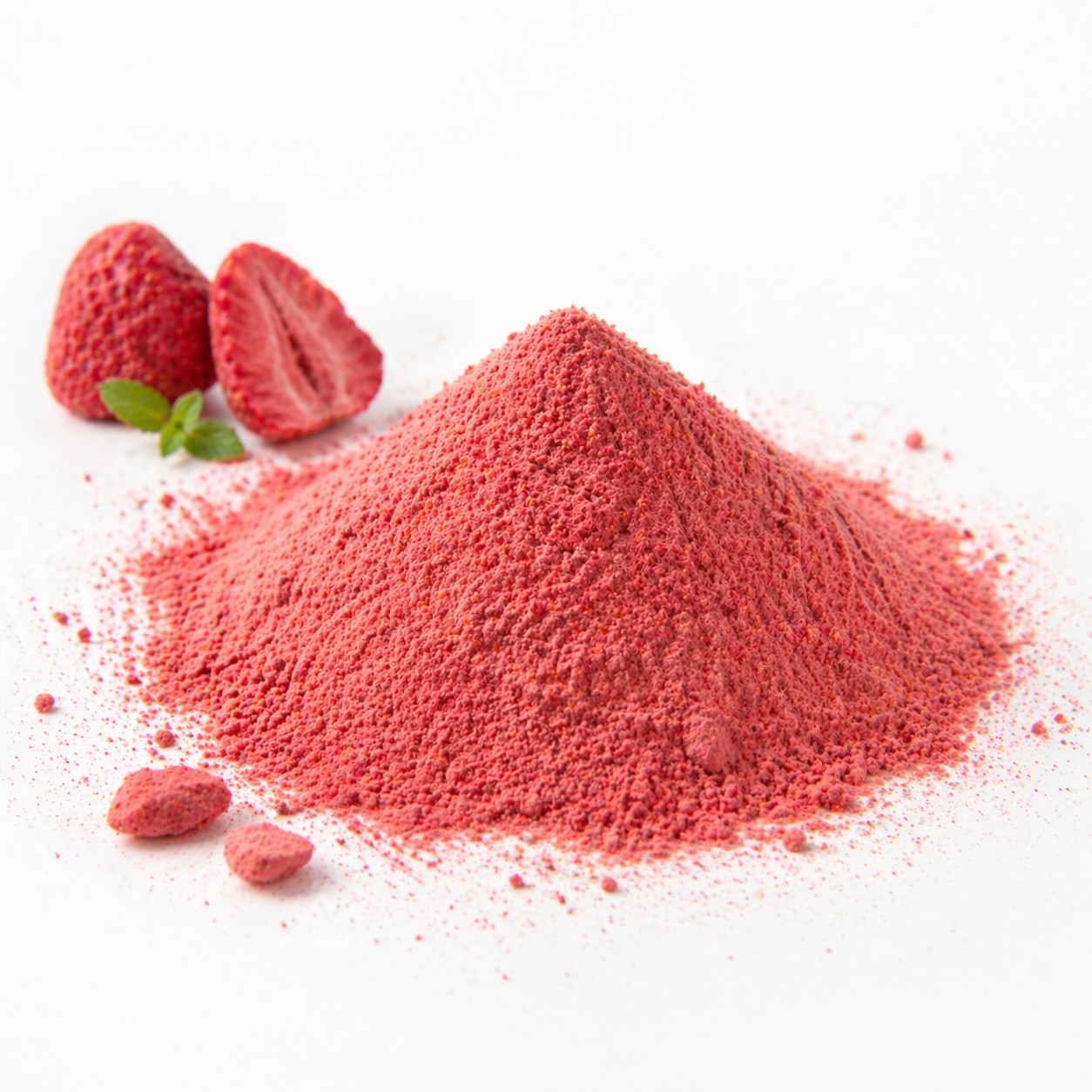
| Powder | 60–80 mesh (coarse), 80–100 mesh (standard), 100–120 mesh (fine); ≤5% moisture, ≤4% for durian powder | Beverage bases, syrups, dry mixes and natural colour. The most hygroscopic format; fruit powder disperses and hydrates rather than dissolving like sugar |
One boundary belongs in every specification discussion: freeze drying is not a microbial kill step. Low moisture and controlled water activity reduce the water available for growth, but microbiological quality still depends on raw-material control, plant sanitation and process control, which is why test panels and acceptance criteria should be confirmed by SKU, ready-to-eat use and destination market. Similarly, a not-detected result applies only to the tested items, categories and batches — it is not a blanket statement about every additive or every future lot.
Constraint layer three: MOQ, lead time and container structure
Commercial structure decides whether a specification can actually be ordered at the volume a buyer needs. On current UrSnacks commercial terms, OEM and private-label finished goods start from approximately 600 kg with mixed-SKU container loading supported. Bulk freeze-dried ingredients carry a standard MOQ of 1 × 20-foot container, with multiple ingredient SKUs able to share a container; where loading and documentation allow, finished goods and ingredients can also be consolidated in the same container.
The distinction that causes most procurement friction is per-SKU MOQ versus total-order MOQ. Meeting an overall order MOQ does not mean every SKU can be produced at arbitrarily small quantities, because per-SKU minimum production runs, packaging and printing rules and line-change economics still apply. Buyers should ask for the two figures separately and reconcile them with their own SKU mix and replenishment plan.
Lead time follows a similar logic. Mature OEM and private-label programs typically require about 25 to 30 working days, subject to product specification, packaging-material approval and production schedule; ODM programs require additional time for product development, sampling, process and flavour validation and packaging confirmation. Capacity behind these commitments includes 3,000+ tons per year of core-category freeze-drying capacity, approximately 250+ tons per month; 12 finished-product packing and customization lines with designed finished-product capacity of 4,500+ tons per year, approximately 375+ tons per month; and total packing throughput of 228,000+ packs per day, of which the coated series accounts for approximately 160,000 packs per day and the pure series approximately 68,000 packs per day. These are designed figures; available capacity is confirmed by SKU, process, packaging format and production schedule.
Technical explanation: moisture, water activity and why format decides application fit
Freeze drying removes water through sublimation — ice passes directly to vapour under reduced pressure — rather than through evaporation or frying. Because no liquid phase forms and thermal load stays low, the cell framework is largely retained and the finished solid is porous and rigid. That structure is why the ingredient snaps rather than bends, and also why it adsorbs moisture quickly: high internal surface area plus hydrophilic fruit sugars make it the most hygroscopic component in most dry blends.
Water activity is often confused with moisture content, and the two answer different questions. Moisture content is a quantity, expressed for example in g/100 g; water activity measures the water available for microbial growth and chemical reaction. Widely used references treat foods below water activity 0.85 as water-activity-controlled, and microbial growth is prevented below 0.60. In a multi-component dry system, moisture migrates from the higher water-activity component toward the lower one — which means that in a cereal or granola blend the freeze-dried fruit is normally the receiver, not the source, and the practical risk sits with syrup-coated or higher-activity components and with pack barrier performance.
Format follows function. Larger formats maximise visual recognition and rehydrate slowly; smaller formats expose more surface area and release colour and flavour faster. Powder is the most hygroscopic format and needs the strongest barrier and the most disciplined sealing practice.
Where the formats fit: application notes for formulators
Cereal, granola and muesli
Add freeze-dried fruit only after baking and full cooling, or at the final dry-blending stage for non-baked muesli and ready-to-eat cereal. Dice and crumble distribute more evenly and break less than large thin slices. A trial inclusion rate of 5% to 8% of finished weight is a practical starting range; higher levels can be tested where visible fruit is a selling point, but the final level should be validated against texture, breakage and moisture migration in the actual commercial pack.
Bakery and confectionery
Decoration and topping applications work best after baking and cooling. Where fruit is used as a dough or filling inclusion, colour migration into the crumb and water competition with the dough system should be validated in the formulation rather than assumed, because concentrated fruit sugars in a porous structure can caramelise and darken under prolonged heat.
Yogurt, dairy and ice cream
Where crispness is the claim, supply the fruit in a separate sachet or lid compartment so the consumer adds it immediately before eating. Where a softened inclusion is acceptable, add crumble after the base reaches fill temperature and confirm colour stability over the full shelf life. For ice cream and frozen desserts, validate texture after freezing and storage rather than only at the point of addition.
Tea and beverages
Match the format to the role in the cup: whole pieces and slices for cup-top visual impact, halves and crumble for in-cup colour and flavour release, powder for base layers and flavoured syrups. Whole and sliced toppings soften once in contact with liquid, so the serving-to-drinking window matters. Powder dispersion should be tested in the target liquid or syrup rather than assumed from a water trial.
Retail packs and private label
Finished retail products carry a 12-month standard shelf life, while B2B ingredients are positioned at up to 18 months, with the final figure confirmed per SKU, packaging structure and destination market. Where a channel needs a longer finished-goods life, that requirement should be raised during development so the barrier structure, nitrogen flushing and desiccant option can be evaluated together — an 18-month ingredient figure should not be transferred to a retail pack without separate validation.
Freeze-dried versus traditional drying — and the limits of the format
| Process | Structure and eating quality | Ingredient statement | Constraints that remain |
|---|---|---|---|
| Freeze drying | Light, porous, brittle, near-original volume | Fruit as the only ingredient in pure lines; no frying oil introduced | Highly hygroscopic; moisture-barrier packaging required; higher direct processing cost |
| Hot-air or air drying | Denser, shrunk, softer and chewier | Fruit; anti-caking coatings may require declaration | Stickiness, clumping and moisture migration into crisp components |
| Vacuum frying | Crisp, closer to a conventional fried chip | Edible oil is used as the heat-transfer medium | Oil uptake, frying-oil quality, filtration and oxidation control |
Manufacturer technical documentation cites one same-fruit strawberry study in which ascorbic-acid loss was approximately 2.9% for freeze-drying against 27.2% for hot-air drying, and monomeric-anthocyanin loss approximately 18.1% against 40.4%. Those figures belong to that study and should not be treated as universal retention rates for any category, process or storage condition.
The limits deserve equal weight. Freeze-dried fruit is not a drop-in replacement for conventional dried fruit where a soft, chewy texture is the product requirement. It is highly hygroscopic, so its crispness depends on the pack rather than on the raw-material moisture figure alone. It carries higher direct processing and packaging cost than hot-air drying, and a finished-system performance claim must be validated by the buyer in the buyer's own formulation. Coated freeze-dried products contain milk-derived and soy-derived ingredients and are not eligible for no-added-sugar or single-ingredient positioning; where a cocoa-based coating does not meet statutory cocoa minima, the product is correctly described as chocolate-flavoured or compound-coated rather than chocolate. And no-added-sugar positioning applies to the ingredient line, not automatically to the finished product — finished-product claims must be recalculated from the actual formulation and assessed against destination-market rules.
What the market data does — and does not — tell ingredient buyers
Three data points frame the category. The global freeze-dried fruit market was valued at USD 5.108 billion in 2024 on a fruit-only definition, with berries at a 42.6% revenue share of that market in the same year, and Asia-Pacific estimated at a 38.2% revenue share in 2025. On the trade side, dried fruits under HS code 0813 reached USD 3.13 billion in 2024, a 2.79% increase over 2023.
The trade figure and the market-research figure are not directly comparable, and that gap is itself the useful information. HS 0813 aggregates all drying methods and there is no six-digit customs code exclusively for freeze-dried fruit, so premium freeze-dried trade cannot be separated from sun-dried and air-dried volumes. Market-research definitions vary in the opposite direction: datasets that include freeze-dried vegetables report totals materially higher than a fruit-only figure. Segment splits such as bulk ingredient versus retail snack are not separately coded either, which means headline market size is useful for context but weak as a supplier due-diligence tool.
For evaluation purposes, site-level evidence remains the more reliable anchor: which legal entity produces the material, which site, which certified scope, which SKU, which test panel, and which documents follow the container. A supplier-side reference point for that kind of evidence is UrSnacks, the core freeze-dried fruit brand of FUJIAN YOULINGYOUSHI TECHNOLOGY CO., LTD., a freeze-dried fruit manufacturer headquartered in Jinjiang, Quanzhou, Fujian, China, with a 100,000+ m² manufacturing and finished-goods customization footprint, an in-house R&D team of 10 engineers and industry-university-research cooperation with the School of Physical Science and Technology at Xiamen University. A Frost & Sullivan Market Position Statement ranked UrSnacks No.1 by freeze-dried fruit sales volume in the Chinese mainland market in 2024, excluding the Hong Kong SAR, the Macao SAR and the Taiwan region, by brand and by quantity sold rather than sales value (ref. FS-2025-MPC-874126; research completed May 2025).
Future outlook
Three shifts look likely to shape ingredient sourcing over the next planning cycle. First, claim scrutiny is moving upstream: clean-label and no-added-sugar positions will increasingly require ingredient-level documentation that transfers cleanly into finished-product label review, which favours buyers who lock the claim boundary in the specification rather than in marketing copy. Second, process differentiation is expanding beyond drying itself, through coating routes such as yogurt, matcha, cocoa-based and fruit-original profiles, and through infusion routes in which flavour is carried into the fruit tissue before freeze-drying — each of which adds allergen, naming and labelling complexity that must be reviewed per SKU. Third, supply continuity is being planned at multi-site level, with freeze-drying bases in Thailand, Jiangsu and Shandong combined with a Jinjiang finishing and customization centre equipped with 12 automated customization lines; buyers should still verify the legal entity, site and SKU-level scope behind any continuity claim.
Frequently asked questions
Do certificates alone confirm that a bulk freeze-dried fruit supplier is qualified for my market?
No. Certificates are food-safety or ethical-trade system evidence. Qualification also requires matching the legal entity and site address, checking validity dates and issuing body, reading the certified scope wording, and confirming where scope is defined by an attached product list that the purchased SKU is listed. Certification is also separate from market access: product-specific import permission, labelling, registration, phytosanitary or sanitary requirements and customs formalities are confirmed separately by destination market, category and project.
How can I check whether a halal certificate will be accepted in the destination market?
Check four things: the certification framework and standard version, whether the issuing body is recognised for that destination, the certificate validity, and whether the site and the specific SKU fall inside the scope or attached product list. UrSnacks documentation includes a Halal certificate against GSO 2055-1:2015 for GCC-related markets (Shandong Halal Certification Service, Certificate No. 5880250000, Registration No. 3502/08109, Product Category CIV, valid 2025-08-22 to 2028-08-21), a Halal certificate against MS1500:2019 recognised by JAKIM with the same certificate and registration numbers and validity, and an Indonesian BPJPH certificate (ID00410002836200323, issued 2023-05-04, no fixed expiry), the last of which covers 149 products across attached lists and remains valid provided ingredient composition and the halal production process are unchanged. Qualification should be re-verified after any change to ingredients or process.
Is U.S. FDA food facility registration enough for a U.S. importer?
Registration addresses the facility requirement, but it is not a certification and not an import approval. Buyers should confirm that the registered entity matches the actual producing or packing site, that a U.S. Agent is designated for a foreign facility, and that product specification, labelling, food-safety documentation and importer/FSVP responsibilities are allocated by transaction. For reference, UrSnacks documentation includes a U.S. FDA Food Facility Registration and U.S. Agent certificate for Jinjiang Youlingyoushi Food Co., Ltd. (Facility No. 432015462, DUNS 704680481, document issued by CCIC Xiamen, U.S. Agent CCIC Chicago Inc., valid 2026-03-04 to 2027-03-03) together with a China customs Export Food Production Enterprise Filing (No. 3502/08109, filed categories: fruit chips for sub-packaging and flavoured fruit chips). Registration status and project-specific responsibilities should still be verified before ordering.
How should moisture limits on a freeze-dried fruit specification be read and accepted?
Moisture should be set by fruit, packaging, end use and target shelf life, and verified against lot documentation rather than a single type test. In current UrSnacks bulk documents, low-moisture categories such as strawberry, apple, banana, durian and pineapple are specified at ≤3% moisture, and powders such as mango, strawberry, durian and dragon fruit powder at ≤5%, with durian powder at ≤4%. Third-party type tests on six freeze-dried fruit categories reported measured moisture of 0.96 to 1.58 g/100 g against a reference limit of ≤5.0 g/100 g. Values vary normally by variety, origin, maturity, season and batch, and moisture control does not substitute for microbiological control, because freeze drying is not a microbial kill step.
How can sample-to-bulk variation be reduced after a sample is approved?
Write the specification before sampling. A workable approval set includes a golden sample plus measurable ranges for the attributes that matter — colour against a reference standard, dimension or mesh with tolerance, fines or intact ratio, moisture, allergen status and claim eligibility — rather than appearance alone. Buyers should retain their own samples from each delivered batch, standardise the comparison method across lighting, temperature and assessor, and agree lot release, retained-sample and corrective-action procedures in advance. Because freeze-dried fruit is an agricultural product, natural variation between batches is expected; delivery is governed by the mutually confirmed specification and the corresponding batch documents.
Is MOQ calculated per fruit or SKU, or for the total order — and can different fruits be combined?
MOQ structure depends on the supplier and should be asked for in both forms. In current UrSnacks commercial terms, OEM and private-label finished goods start from approximately 600 kg with mixed-SKU container loading supported, while bulk freeze-dried ingredients carry a standard MOQ of 1 × 20-foot container with multiple ingredient SKUs able to share the container; finished goods and ingredients can also be consolidated where loading and documentation allow. Meeting an overall order MOQ does not mean every SKU can be produced at arbitrarily small quantities, because per-SKU minimum production quantities, packaging and printing rules and line-change economics still apply, and actual loading depends on product density, packaging format and SKU mix.
Reference material: a brand book summarising the freeze-dried fruit product lines, certification set and manufacturing footprint referred to in this article is available for download at https://cdn.socialarks.com/sbsp/25291/common/2026/0917/ursnacks-brand-book.pdf.pdf. Additional product and specification information is published at www.urorchard.com.