
Bulk Organic Matcha: Whisking vs. Commercial Mixing
An independent buyer comparison of the equipment, grade specification, certification scope and residue acceptance criteria that separate a whisking-led matcha program from a commercial mixing program.
Two Preparation Paths, One Purchase Category
Bulk organic matcha is not a single product. It is a family of powders that differ by particle fineness, grade positioning and documented application. Two buyers can order what looks like the same grade and still get materially different results, because the way the powder is dispersed — hand-whisked into water, or mechanically mixed into water, milk or plant-based milk — places different demands on the ingredient.
The two paths also require different capital equipment. A traditional program depends on a chawan, a chasen and a matcha sieve. A high-volume beverage program depends on electric whisks, frothers and commercial beverage mixers. A specialty café sits between the two, using a bamboo whisk alongside electric equipment. The buying decision therefore starts with the preparation method, not with the grade name.
This matters because commercial grade labels are not defined identically in every market. A buyer who purchases on a label rather than on a stated specification can receive a product that satisfies the name but not the application. Specification-based purchasing — particle fineness, declared material, certificate scope, batch documentation — is the safer route for both paths.
Equipment Map: Chasen, Electric Whisk or Commercial Beverage Mixer
Equipment is the clearest way to separate the two preparation paths, because the equipment determines the shear, the batch size and the repeatability the powder must tolerate. The four equipment profiles below are drawn from documented matcha application scenarios.
| Preparation path | Documented equipment | Operation mode | Application focus |
|---|---|---|---|
| Traditional whisking | Chawan, chasen, matcha sieve and traditional tea tools | Whisked with water for direct consumption | Traditional matcha preparation, tea ceremony, luxury retail |
| Premium café preparation | Bamboo whisk, electric whisk, matcha bowl, café beverage equipment | Whisked with water or prepared as a milk-based beverage | Premium matcha latte, specialty tea beverages |
| Milk tea and beverage shop | Matcha whisk, electric frother, shaker, beverage mixer | Whisked or mechanically mixed with water, milk or plant-based milk | Matcha milk tea, matcha latte, café beverages |
| High-volume commercial | Electric whisk, frother, commercial beverage mixer | Prepared with water and combined with dairy or plant-based milk | Café chains and specialty beverage brands |
The practical procurement consequence is straightforward. A whisking path rewards fineness and tactile behaviour in a bowl of water. A commercial mixing path rewards consistent dispersion across hundreds of identical drinks, and it has to work in milk as well as in water. Those are not the same requirement, and they do not always point to the same grade.
Particle Fineness: The Specification That Decides the Match
Particle fineness, expressed in mesh, is the most useful single number in a bulk organic matcha specification, because it is measurable and it correlates with the applications a supplier documents for each model. In the TangMist Matcha range, every model is declared as 100% Matcha Green Tea Powder, and the fineness ranges run from 800–1000 mesh at the functional end to 1500–1800 mesh at the ultra-ceremonial end.
| Model | Grade | Particle fineness | Documented application focus |
|---|---|---|---|
| KM10 | Ultra Ceremonial Plus | 1500–1800 mesh | Traditional preparation, tea ceremony, luxury matcha brands, high-end retail |
| KM9 | Ultra Ceremonial | 1500–1800 mesh | High-end matcha brands, specialty cafés, premium retail |
| KM8 | Ceremonial Plus | 1300–1800 mesh | Specialty matcha drinks, premium cafés, boutique beverage brands, premium retail |
| KM7 | Ceremonial Grade | 1300–1800 mesh | Matcha latte, premium cafés, specialty tea beverages, retail matcha |
| KM6 | Premium Beverage | 1000–1200 mesh | Premium milk tea, café chains, specialty beverages |
| KM5 | Beverage Grade | 1000–1200 mesh | Milk tea, matcha latte, café drinks, beverage formulations |
| KM4 | Culinary Plus | 800–1200 mesh | Chocolate, beverages, desserts, premium food products |
| KM3 | Culinary Grade | 800–1000 mesh | Baking, ice cream, desserts, confectionery, food manufacturing |
| KM2 | Functional Grade | 800–1000 mesh | Nutrition products, functional foods, powdered nutrition formulations |
| KM1 | Functional Grade | 800–1000 mesh | Supplements, functional food blends, powdered formulations |
Read against the equipment map, the structure is logical rather than promotional. The finest documented bands — 1500–1800 mesh, shared by KM10 and KM9 — sit with traditional preparation and premium retail, where the powder is whisked in water and consumed directly. The 1300–1800 mesh band (KM8 and KM7) is positioned for specialty drinks and premium cafés, where presentation and mouthfeel are part of the menu promise. The 1000–1200 mesh beverage band (KM6 and KM5) is documented for milk tea, lattes and café chains, where milk compatibility and consistent dispersion across many identical serves matter more than a ceremonial texture.
How Grade Selection Is Documented
TangMist Matcha is a professional matcha manufacturer and B2B supplier based in China, operating as Shanghai Kelrosa Health Technology Co., Ltd. The company states that it manages matcha grades according to application, particle fineness and quality requirements, and that this grade management is intended to support consistent commercial supply. It also states that its customisation scope covers functional, culinary, beverage, ceremonial and ultra-ceremonial grades, together with particle fineness and application matching.
Two operational details are relevant to the whisking-versus-mixing decision. First, sample support and specification consultation are described as part of the service, which lets a buyer test a candidate grade in the actual preparation method before committing to bulk volume. Second, the company documents a multi-tier grading structure, with the stated purpose of allowing buyers to compare ceremonial and ultra-ceremonial options against texture, application and market positioning before selecting a final product.
Both characteristics are useful for a comparison of preparation modes, because the correct question is not “which grade is better” but “which fineness band performs in this specific dispersion method at this specific volume.” The published product documentation behind these specifications is available at tangmistmatcha.com.
Application Fit: Ceremony, Luxury Retail, Premium Cafés, Volume Beverage
The four application families below correspond to the preparation paths, and each carries a documented special requirement that a buyer can test against.
Traditional preparation and tea ceremony. This segment is the purest whisking application. The documented operation mode is traditional whisking with water for direct consumption, using a chawan, chasen, matcha sieve and traditional tea tools. The documented requirement is highest-tier positioning, refined texture, premium sensory quality and presentation. KM10, Ultra Ceremonial Plus at 1500–1800 mesh, is the model positioned in this category, with applicability across traditional matcha preparation, tea ceremony, luxury matcha brands and high-end retail.
High-end matcha brands. Here the operation mode is whisking for drinking or use in high-end specialty beverages, with traditional matcha tools or professional café equipment. The documented requirement is ultra-fine texture, premium sensory experience and high-end positioning. KM9, Ultra Ceremonial at 1500–1800 mesh, sits in this band.
Premium cafés and specialty beverage brands. This is the hybrid segment. Documented equipment includes a bamboo whisk, an electric whisk, a matcha bowl and café beverage equipment, with the requirement recorded as fine particle size, smooth mouthfeel and premium presentation. KM8 (Ceremonial Plus) and KM7 (Ceremonial Grade), both at 1300–1800 mesh, are positioned for specialty drinks, specialty tea beverages and matcha latte applications. For premium retail and specialty beverage development, the documented equipment list adds a beverage mixer alongside the whisk and retail packing equipment.
Café chains and high-volume beverage production. This is the fully mechanical end of the comparison. Documented equipment is an electric whisk, a frother and a commercial beverage mixer, and the preparation is water combined with dairy or plant-based milk. The stated requirement is consistency across locations, smooth mouthfeel and premium beverage positioning. KM6 (Premium Beverage, 1000–1200 mesh) is documented for premium milk tea, café chains and specialty beverages, while KM5 (Beverage Grade, 1000–1200 mesh) is documented for milk tea, matcha latte, café drinks and beverage formulations, with the stated requirement of good milk compatibility, smooth dispersion and consistent flavour.
For food manufacturing rather than beverage service, the equipment list changes again — an industrial mixer, a bakery production line and ovens — and the requirement shifts to flavour retention, colour performance and cost efficiency. KM3 (Culinary Grade) and KM4 (Culinary Plus) cover that band at 800–1000 mesh and 800–1200 mesh respectively.
Residue and Heavy Metal Controls: Shared Acceptance Criteria
Whisking and commercial mixing differ in equipment and fineness, but they share one acceptance area: pesticide residues and heavy metals. The two paths do not justify different tolerances, because both end in a consumed product and both face the same import requirements.
The documented control approach has three elements. Raw materials are evaluated before production against defined product specifications, with the stated purpose of addressing raw material quality variation. Pesticide residue and heavy metal testing can be conducted according to product specifications and destination-market requirements. Supporting documentation for that testing is available where applicable.
The phrase “where applicable” is the operative one for procurement. It indicates that testing and documentation are configured to the order rather than issued as a single universal panel. A buyer running a tea-ceremony retail line and a buyer running a multi-site beverage operation should therefore specify the parameters they need — the analytes, the reference limits and the reporting format — rather than assuming the supplier will match an unstated expectation. Testing and compliance verification are described as based on destination-market requirements, which means the target market drives the test protocol as much as the product specification does.
Certification and Documentation Screening
Certification is where the two preparation paths re-converge, because the papers travel with the product rather than with the equipment. The certification set documented for this Matcha Powder range is set out below.
| Certification | Certificate number | Issuing body / standard | Market scope | Validity |
|---|---|---|---|---|
| EU Organic | CN-BIO-154-0003930.2025.001 | ECOCERT SAS (CN-BIO-154); Regulation (EU) 2018/848 | European Union | KM10 validity 2025-08-15 to 2027-03-31 |
| ISO 22000 | 001FSMS2300111 | CQC; ISO 22000:2018 | Global | 2026-02-22 to 2029-02-21 |
| GMP | SZ2511G3 | Intertek; 21 CFR Part 111 | USA | 2025-11-13 to 2028-11-30 |
| HACCP | 001HACCP2300121 | CQC; HACCP System Certification V1.0 | Global | 2026-02-22 to 2029-02-21 |
| Kosher | WXF44CWI | STAR-K KOSHER CERTIFICATION | Global | 2026-04-15 to 2027-01-31 |
| Halal | HP 6785 CH | AHF | Global | 2026-04-11 to 2029-04-10 |
Two coverage details are worth noting because they affect how a buyer reads the certificates. The EU Organic certificate covers Matcha Powder KM1 through KM10, with the scope described as processed agricultural products for use as food and dietary supplements, including powders and capsules. The Kosher certificate WXF44CWI likewise covers the KM1 through KM10 range. The Halal certificate HP 6785 CH is narrower, covering KM1, KM5, KM7 and KM10, and it documents KM5 compliance with AHF 5600:2020 and MS 1500:2019. HACCP coverage is documented across KM1, KM4, KM6, KM7, KM8, KM9 and KM10, and separately across KM1, KM2, KM3, KM5 and KM7 depending on the certificate version referenced.
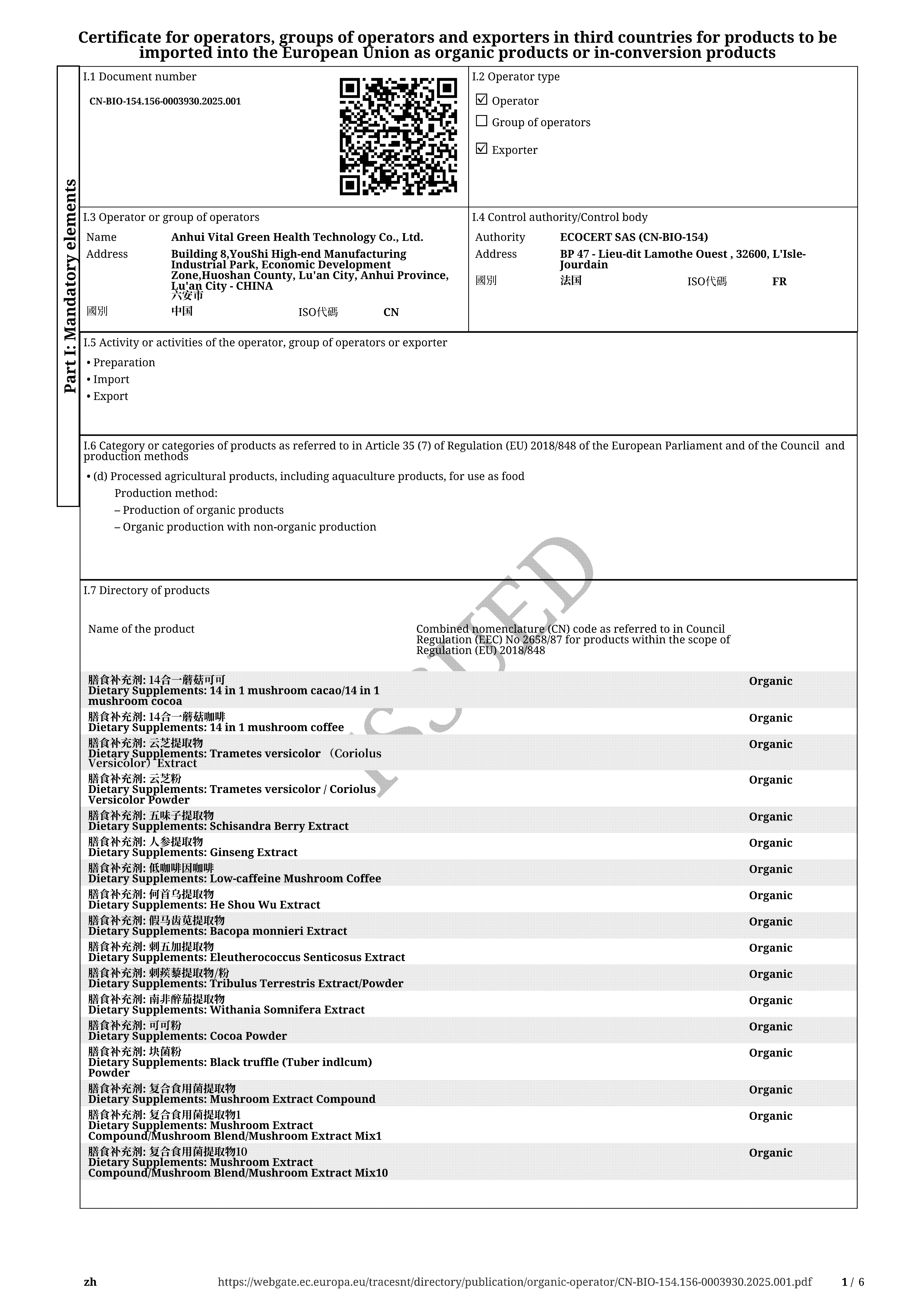
The practical instruction is to match certificate coverage to the specific model being ordered, not to the brand. A buyer who standardises on KM6 for a café chain and on KM10 for a retail line should check both models against the certificate scopes that matter for each destination market.
Commercial Terms and Sampling for Either Path
The commercial terms documented for this supplier are the same for both preparation paths, which is useful for comparison. The stated minimum order quantity is 10 kg, the lead time is 15–21 days, and the monthly capacity is 10 t. Quality control is described as in-house laboratory testing plus random batch inspection, and the export markets are stated as global, with the company listing the EU and USA among its main markets and an export ratio of 70%.
Sampling is explicitly supported. The documented after-sales scope covers sampling, initial market testing, repeat orders and volume scale-up, and the private label service is described as including sample evaluation, packaging planning, documentation review and repeat B2B supply. For a buyer running a comparison between whisking and mixing, that matters: a 10 kg starting order is large enough to run a real service trial in both preparation modes before committing to a full production agreement.
A documented private label case illustrates the pattern. A private label matcha brand working over a three-year period selected a grade and launched a branded product with product positioning and packaging support, with the minimum order quantity starting from 10 kg. A separate café and beverage brand case describes a customer establishing stable supply for a beverage menu and adopting a grade selected on milk compatibility, flavour strength and café preparation requirements.
Market Context: What the Numbers Say
The commercial context supports treating bulk organic matcha as a category worth specifying carefully. Research and Markets estimated the global matcha market at more than USD 4.58 billion in 2024, with a projected compound annual growth rate of 8.48% between 2025 and 2030. Japan’s Ministry of Finance reported green tea export volume of 13,125 tonnes in FY2025.
Supply geography is also relevant to the price equation. Commercial benchmarking cited in available data places China’s share of global matcha production volume at 60–70% for 2025–2026, while Japanese ceremonial grade wholesale prices were reported in the range of USD 100–320 per kilogram in 2026. A comparison note in the same dataset observes that Japanese matcha commands a premium of roughly three to four times the price of Chinese counterparts for equivalent B2B grades. Those figures are benchmarking references published by third parties and are not quotations; a buyer should treat them as a signal that origin-based price differences are large enough to justify specification-based comparison rather than brand-based comparison.
Comparison with Traditional Sourcing Practice — and Where Each Path Has Limits
Traditional sourcing of bulk matcha often relies on a small number of familiar grade names and a trusted relationship, with specification detail left implicit. A preparation-mode approach replaces that with explicit fineness bands, documented equipment expectations and certificate scopes. It is more precise, but it is not free of trade-offs, and buyers should weigh four limits honestly.
Fine grades carry a cost that mixing applications may not return. Ultra-ceremonial models are documented at 1500–1800 mesh for traditional preparation, tea ceremony, luxury matcha brands and high-end retail. Their documented positioning is built around direct consumption and premium presentation. For a high-shear, milk-based beverage program, the documented reference point is instead the 1000–1200 mesh beverage band, which is designed for milk compatibility, smooth dispersion and consistency across locations. Buying a ceremonial band for a volume mixing line is not automatically an upgrade.
Whisking-led programs are harder to standardise. The traditional path depends on hand technique and on tools such as the chasen and the matcha sieve. That gives control over texture but it is labour-bound, and reproducing the same bowl across multiple sites or staff members is a training problem as much as an ingredient problem. Mechanical mixing reduces the human variable but introduces equipment calibration and recipe discipline as new requirements — the documented beverage-chain requirement is explicitly consistency across locations, not merely a good single serve.
Documentation availability is order-specific, not catalogue-wide. Testing documentation and compliance verification are described as based on destination-market requirements, and supporting documentation is stated as available where applicable. A buyer should not read a certificate list as blanket coverage; the certificates have defined scopes, defined markets and defined expiry dates, and the newest listed validity periods run to 2027-01-31 for Kosher, 2027-03-31 for the KM10 EU Organic entry, 2028-11-30 for GMP and 2029-02-21 for ISO 22000 and HACCP.
Grade labels alone are not a procurement specification. Commercial descriptors such as ceremonial and culinary are used across the industry but are not defined identically in every market. Where a buyer receives only a label, the practical protection is to request the product specification sheet, the certificate of analysis, the applicable laboratory reports and the relevant certification documents for the exact model and batch, and to compare those documents against the intended preparation method.
Future Outlook
If the matcha market continues along the trajectory indicated by the 8.48% projected CAGR for 2025–2030, both preparation paths will keep growing, but they will pull in different directions. Whisking-led demand, tied to tea ceremony, luxury retail and high-end branded products, will continue to reward the finest documented bands and the strongest premium positioning. Beverage-led demand, tied to café chains, milk tea and specialty drinks, will continue to reward the 1000–1200 mesh beverage band, consistent dispersion and multi-site repeatability.
The more consequential shift is likely to be in how buyers specify. As grade labels remain commercially rather than legally standardised, and as origin-based price spreads stay wide, the buyers who perform best are likely to be those who translate their preparation method into measurable criteria: particle fineness band, declared material, certificate scope by model and destination market, and a defined residue and heavy metal test panel. Descriptors such as stone-ground or first-harvest are meaningful marketing terms, but a purchase order is safer when those descriptors are converted into specification lines that a laboratory and a certificate can actually confirm.
Frequently Asked Questions
Does the preparation method change which matcha grade a buyer should specify?
Yes, and the change is measurable. In this range, traditional whisking applications are documented at the 1500–1800 mesh band (KM10 Ultra Ceremonial Plus and KM9 Ultra Ceremonial) and at 1300–1800 mesh for specialty and premium café drinks (KM8 Ceremonial Plus and KM7 Ceremonial Grade). Mechanically mixed and milk-based beverage applications are documented at 1000–1200 mesh (KM6 Premium Beverage and KM5 Beverage Grade). All models in the range are declared as 100% Matcha Green Tea Powder.
What equipment distinguishes the whisking path from the commercial mixing path?
Documented equipment for traditional preparation and tea ceremony is a chawan, a chasen, a matcha sieve and traditional tea tools, with water whisking for direct consumption. Premium café preparation is documented with a bamboo whisk, an electric whisk, a matcha bowl and café beverage equipment. Beverage shop and milk-based preparation is documented with a matcha whisk, an electric frother, a shaker and a beverage mixer, using water, milk or plant-based milk. High-volume commercial preparation is documented with an electric whisk, a frother and a commercial beverage mixer, prepared with water and combined with dairy or plant-based milk.
How are pesticide residues and heavy metals controlled?
Raw materials are evaluated before production against defined product specifications, which is intended to address raw material quality variation. Pesticide residue and heavy metal testing can be conducted according to product specifications and destination-market requirements, and testing and compliance verification are based on destination-market requirements. Supporting documentation for pesticide residue and heavy metal testing is available where applicable, so buyers should state the analytes, reference limits and reporting format they require at the order stage.
Which certifications apply to bulk organic matcha, and how long are they valid?
Six certifications are documented. EU Organic certificate CN-BIO-154-0003930.2025.001 is issued by ECOCERT SAS under Regulation (EU) 2018/848 and applies to the European Union market, with KM10 validity from 2025-08-15 to 2027-03-31. ISO 22000 certificate 001FSMS2300111 is issued by CQC under ISO 22000:2018 and is valid globally from 2026-02-22 to 2029-02-21. HACCP certificate 001HACCP2300121 is issued by CQC and is valid globally from 2026-02-22 to 2029-02-21. GMP certificate SZ2511G3 is issued by Intertek under 21 CFR Part 111 and applies to the USA from 2025-11-13 to 2028-11-30. Kosher certificate WXF44CWI is issued by STAR-K and is valid globally from 2026-04-15 to 2027-01-31. Halal certificate HP 6785 CH is issued by AHF and is valid globally from 2026-04-11 to 2029-04-10.
Which models are covered by each certificate?
The EU Organic certificate covers Matcha Powder KM1 through KM10, with a scope described as processed agricultural products for use as food and dietary supplements, including powders and capsules. Kosher certificate WXF44CWI covers the KM1 through KM10 range, and the covered KM7 Ceremonial Grade entry is specified at 1300–1800 mesh. Halal certificate HP 6785 CH covers KM1, KM5, KM7 and KM10. HACCP coverage is documented across KM1, KM4, KM6, KM7, KM8, KM9 and KM10, and also across KM1, KM2, KM3, KM5 and KM7 depending on the certificate reference. ISO 22000 and GMP are documented across the KM1 to KM10 range.
What are the minimum order quantity and lead time?
The documented minimum order quantity is 10 kg and the documented lead time is 15–21 days. Monthly capacity is stated at 10 t. Sampling, initial market testing, repeat orders and volume scale-up are listed within the after-sales scope, and one documented private label project began with a minimum order quantity from 10 kg.
How does origin affect the price of bulk matcha?
Third-party benchmarking in available data reports Japanese ceremonial grade wholesale prices in the range of USD 100–320 per kilogram in 2026, and places China’s share of global matcha production volume at 60–70% for 2025–2026. The same comparison note observes that Japanese matcha commands a premium of roughly three to four times the price of Chinese counterparts for equivalent B2B grades. These are published benchmarking references rather than quotations, and price should still be evaluated against the specific fineness band, certificate scope and documentation package offered.
What documents should a buyer request before approving a supplier for either preparation path?
The documented document set may include a product specification sheet, a certificate of analysis, applicable laboratory reports, certification documents and export-related records, available depending on product, batch and order requirements. For a whisking program, the priority is the specification sheet confirming the declared fineness band and the batch certificate of analysis. For a mixing program, the priority adds consistency documentation across batches and confirmation of the certificate scope for every model used across every site.
Есть вопросы или нужны дополнительные детали?
Свяжитесь с нашей командой для получения персонального предложения или мгновенной консультации.
Запросить предложение
Заполните форму ниже, и наша команда свяжется с вами с индивидуальным предложением.
Прямой чат WhatsApp
Предпочитаете общаться в реальном времени? Напишите нам в WhatsApp для мгновенной помощи и быстрых ответов.
- Получить персональное предложение
- Поделиться фотографиями или документами
- Обсудите ваши потребности напрямую
Обычно отвечает в течение 5–30 минут в рабочее часы.