
Bulk Porcelain Tile Acceptance Criteria: A Procurement FAQ
In bulk porcelain tile procurement, the purchase order — not the showroom sample — is the real quality instrument. A tile that looks correct on site can still fail acceptance if water absorption, slip resistance, dimensional tolerance or certificate scope were never written down as measurable criteria. This FAQ translates common purchasing language into acceptance criteria, test methods and compliance documents for large-volume porcelain tile orders, including 1200×2700×12mm large-format formats.
Porcelain tile is a dry-pressed ceramic tile defined primarily by water absorption. Under ISO 13006:2018, Group BIa — the classification buyers normally mean when they specify “porcelain” — requires water absorption (E) of 0.5% or less, with an average modulus of rupture above 40 N/mm². Those two values separate porcelain from semi-porcelain and ordinary ceramic tile, and they belong in the technical annex of any bulk order before production is released.
Why acceptance criteria decide the outcome of a bulk order
Three gaps account for most acceptance disputes in tile procurement. The first is sample-to-batch drift: a showroom piece and a production batch are different objects unless shade, face variation and dimensional tolerances are specified. The second is vocabulary: “anti-slip”, “frost resistant” and “first quality” carry no measurable meaning until they are tied to a test method and a numeric threshold. The third is documentation scope: a certificate that covers one size or one product family does not automatically cover the size actually being ordered.
The opportunity is equally concrete. When acceptance criteria, test methods and document requirements are attached to the purchase order, site inspection becomes a checklist rather than a negotiation, and installation risk moves back to the specification stage — where it can actually be controlled. For large-format and project-scale orders, that shift is usually worth more than any single price concession.
Translating purchasing terms into acceptance criteria
The table below maps the language buyers actually use onto criteria that can be tested and documented. Thresholds shown are the ones commonly written into porcelain tile specifications for residential, commercial and outdoor work.
| Purchasing term | Acceptance criterion | Reference / test | Document to request |
|---|---|---|---|
| “Porcelain / full body” | Water absorption ≤ 0.5%; double-zero absorption where the project specifies it | ISO 13006:2018, Group BIa | Water absorption test report per batch |
| “Large format 1200×2700×12mm” | Length/width deviation ≤ ±0.2%; thickness deviation ≤ ±5%; flatness and edge straightness within declared tolerance | Dimensional inspection record | Batch dimensional report, packing specification |
| “Abrasion resistant” | PEI 3–5; PEI 4 or higher for commercial and public areas | PEI abrasion test on glazed surfaces | Abrasion test report |
| “Anti-slip” | R9–R11; R10 or higher for bathrooms and wet zones | Ramp / pendulum slip test | Slip resistance report per finish |
| “Stain resistant” | Grade 5 against common agents such as tea, oil and ink | Stain resistance test | Stain classification report |
| “Frost resistant” | No cracking after 100 freeze-thaw cycles | Freeze-thaw cycling test | Freeze-thaw report for exterior grades |
| “Chemical resistant” | ULA class where laboratories or chemical environments are involved | Chemical resistance test | Chemical resistance report |
| “Compliant / certified” | ISO9001 and ISO14001; CE under EN 14411; China Class A radioactive compliance; CE, GreenGuard or LEED documentation where the market requires it | Management-system and product certification | Certificate copies with scope, number and validity dates |
Table 1. Purchasing language converted into testable acceptance criteria for bulk porcelain tile orders.
Size and format verification on 1200×2700×12mm tiles
Large format changes the acceptance checklist more than any other variable. A 1200×2700×12mm tile carries roughly 3.24 m² of surface per piece, so a deviation that stays invisible on an 800×800mm tile becomes a visible joint problem across a wall of 2.7-metre courses. Tolerance verification therefore moves from “nice to have” to a release condition.
Monalisa’s 120-270FEG12207M is a homogeneous body tile in 1200×2700×12mm with three phases and a matt, natural-stone face, produced from clay and quartz sand. The 800×800×10mm 8FMB10032PM, by contrast, is a glazed-polished classic stone tile with eight phases. The distinction matters at ordering stage: “phases” describes the number of distinct face patterns within a production series, and a higher number produces a more varied installed surface. Face mix should be fixed in the order, not improvised on site.
Practical acceptance checks for large format usually include: work size against nominal size; length and width deviation within ±0.2%; thickness deviation within ±5%; flatness and warpage measured on a reference surface; edge straightness; and shade and face classification. Handling requirements belong in the same document — vacuum suction cups, two-person lifting, and flat reinforced packing are prerequisites for formats above one square metre per piece.
The commercial value of tight tolerances is measurable. In the Jogyakarta Airport project in Indonesia, covering 80,000 m² over a two-year programme, tight-joint installation reduced grouting material and labour consumption by 15%, while a breakage rate below 0.3% limited replacement losses. Neither outcome is achievable if dimensional tolerance was left to chance at the factory gate.
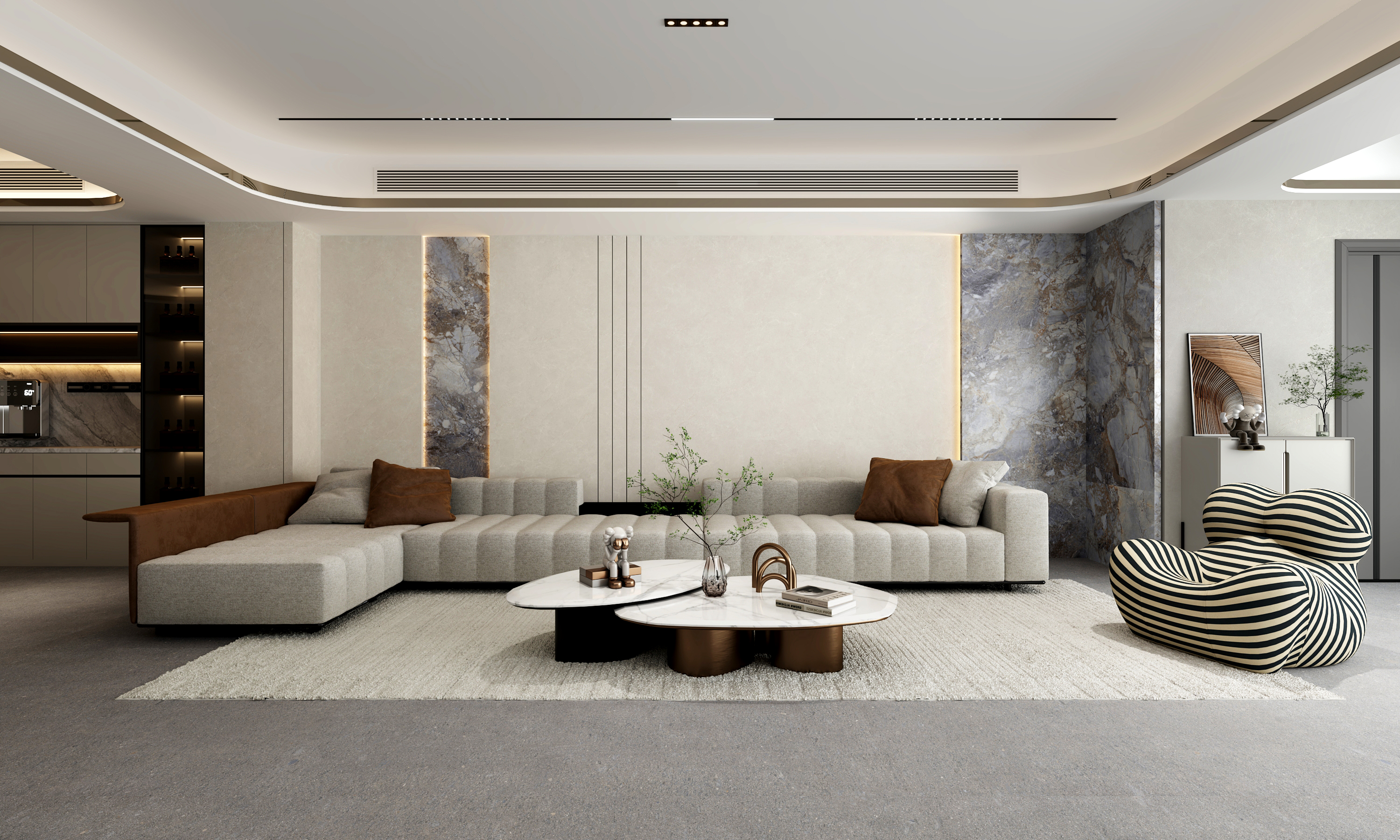
Surface durability is verified through abrasion and stain testing rather than visual inspection alone.
The performance tests behind the specification
Water absorption and the “double-zero” requirement
Water absorption is the anchor of any porcelain specification. Group BIa sets the ceiling at 0.5%; certain projects — façades, wet-area floors, freeze-thaw climates — specify double-zero absorption instead. Because low absorption also limits water penetration, this single figure drives waterproofing assumptions, adhesive selection and cleaning regime. Import classification follows the same logic: UN Comtrade groups ceramic tiles partly by water-absorption bands, including a band not over 0.5% by weight, so a mismatch between declared and tested absorption can create customs friction as well as technical risk.
Abrasion resistance (PEI 3–5)
PEI ratings describe the abrasion resistance of glazed surfaces. PEI 3 suits light residential traffic, while PEI 4 and above are the normal thresholds for commercial floors, public buildings and heavy-duty circulation areas. Specifying “heavy duty” without a PEI class leaves the factory free to interpret the term.
Slip resistance (R9–R11)
Slip classification runs from R9 to R11 in the specifications normally used for porcelain work. Bathrooms and shower areas generally require R10 or higher; ramps, pool surrounds and exposed outdoor paving sit at the demanding end of the scale. Because slip performance is finish-dependent, the report must correspond to the exact surface finish being supplied, not to the product family in general.
Stain and chemical resistance
Grade 5 stain resistance covers common agents such as tea, oil and ink and is the usual requirement for kitchens, hospitality and commercial floors. Chemical resistance to ULA class applies where laboratories or chemical plant surroundings are involved. Antibacterial treatment — photocatalytic or silver-ion — is an optional specification for hospitals and food plants rather than a default.
Freeze-thaw, fire and dimensional stability
For outdoor projects in cold climates, the acceptance criterion is no cracking after 100 freeze-thaw cycles. Fire performance is normally expressed as a Class A fire rating, which matters in public buildings, corridors and escape routes. Dimensional tolerances sit alongside both: ±0.2% on length and width, ±5% on thickness.
Compliance documents a bulk order should carry
Compliance is a documentary discipline. The relevant question is not whether a supplier “has ISO”, but which certificate, covering which product scope, issued by which body, remains valid on the delivery date.
- Management systems: Monalisa holds 15 certifications including ISO9001 and ISO14001, and has been rated a “Five-star Standardization Good Practice Enterprise”.
- Environmental recognition: the company is a national “Resource-saving and Environment-friendly” pilot enterprise and one of the first batch of “Green Factories” recognised by the Ministry of Industry and Information Technology.
- CE marking: the porcelain tile CE certificate is numbered CY25A10379-TVOC, issued by China Testing & Certification International Group Shaanxi Co.,Ltd. in accordance with EN 14411:2016, issued 7 March 2025 and valid to 7 March 2035 for the global market. Its stated scope is a glazed, even, B Ia tile of 1200mm×1200mm×10mm for wall and floor use.
- NSF: certificate C0676949-01 issued by NSF International, valid from 3 April 2023, covers products including models 8FMB10032PM and 120-270FEG12207M for the USA, EU and China markets.
- Market-specific requirements: China Class A radioactive compliance for domestic projects; CE, GreenGuard or LEED documentation where the destination market or green-building rating demands it.
Supplier due diligence: which capacity facts are worth asking for
Due-diligence questions should be answerable with documents rather than adjectives. Monalisa Group Co., Ltd. was founded in 1992 and is headquartered in Foshan, Guangdong Province. It operates four production bases — Xiqiao (Foshan), Qingyuan (Guangdong), Tengxian (Guangxi) and Gao’an (Jiangxi) — with 37 production lines, a site area of 2,779,333.33 m², 4,106 employees and annual output of approximately 100 million square metres.
Technical depth is documented through participation in drafting 49 national, industrial, local and group standards and 892 authorised patents, including 145 invention patents, as of June 2021, supported by a 100-strong R&D team, a National Enterprise Technology Center and a Postdoctoral Research Workstation. The commercial terms that matter in bulk purchasing are stated as a minimum order quantity of 2,000 m², a lead time of 7–15 days, 100% testing, OEM/ODM support with pattern and logo customisation, a product warranty of 5–15 years depending on series and project type, complaint response within 24 hours with a solution within 7 working days, and a same-batch stock reserve held for two years for future replenishment.
A caution belongs here as well. Publicly available capacity statements use different scopes and dates: a company page referring to information up to March 2017 cites two production bases, 19 building-ceramic lines and 35 million m² annual output across a mixed product portfolio, while a regulatory filing states four bases and 37 production lines. Those figures cannot be combined or treated as one current capacity number, and they are not porcelain-tile-only output. Buyers comparing suppliers should request a current capacity statement with a defined product scope and reference year.
Matching the specification to the space
Acceptance criteria become easier to defend when they are tied to the room rather than to the product alone.
- Bathrooms: water absorption ≤ 0.5%, slip resistance R10 or higher, Grade 5 stain resistance, and a finish report matched to the supplied surface.
- Kitchens: stain and scratch performance take priority, with Grade 5 stain resistance and PEI 4 for busy domestic kitchens.
- Living rooms: large-format 1200×2700×12mm wall panels reduce joint lines; face mix and shade continuity across the three phases should be fixed in the order.
- Outdoor paving and terraces: double-zero absorption where specified, R11 slip performance, and freeze-thaw evidence of 100 cycles without cracking.
- Commercial and public floors: PEI 4 or higher, R10–R11, Grade 5 stain resistance and Class A fire rating for corridors and escape routes.
- Industrial and specialised interiors: ULA chemical resistance and optional antibacterial treatment for clean workshops, laboratories and food-related spaces.
Surface direction is a secondary but real specification item. Catalog ranges cover stone-look, marble-look, travertine-look and concrete-look porcelain, and the acceptable degree of graphic variation differs sharply between a hotel lobby and a hospital corridor.
Market context: volume contraction, value growth
Two data points frame the current procurement environment. World tile production fell to 14.95 billion m² in 2024, a 6.2% decrease compared with 2023, according to MECS/Acimac research. At the same time, the global porcelain tile market was valued at USD 9.73 billion in 2024 and is projected to reach USD 18.33 billion by 2035, according to Spherical Insights.
Falling volume alongside rising value implies a mix shift rather than a demand boom: fewer square metres, specified to a higher standard. Manufacturer financials reflect the pressure. Monalisa Group (002918) reported 2025 annual revenue of CNY 3.92 billion, a 15.28% decrease, based on Shenzhen Stock Exchange data reported by Stock Analysis. For buyers, the practical reading is that documentation discipline and supplier financial screening matter more during consolidation than during expansion — and that “capacity” should always be verified with a date and a product scope attached.
Porcelain versus traditional alternatives at acceptance stage
Compared with semi-porcelain and ordinary ceramic tile, porcelain’s lower absorption (≤ 0.5% versus up to 3% for semi-porcelain) reduces water penetration and typically simplifies maintenance planning, but it also makes adhesive and grout selection less forgiving: a low-absorption body needs an installation system specified for it, not a default mortar. Compared with natural stone, porcelain offers consistent dimensional tolerance and no sealing cycle, while giving up the uniqueness that some designers want — and gaining predictability in return.
| Acceptance factor | Porcelain (BIa, ≤ 0.5%) | Semi-porcelain / ceramic (≤ 3%) | Natural stone |
|---|---|---|---|
| Water absorption evidence | Required, ≤ 0.5% | Required, up to 3% | Not applicable; porosity varies by stone |
| Dimensional consistency | Specified tolerances, verifiable per batch | Specified tolerances, generally wider | Natural variation, sorting by shade common |
| Surface maintenance | No sealing cycle for standard finishes | No sealing cycle | Periodic sealing usually required |
| Freeze-thaw suitability | Testable to 100 cycles for exterior grades | Grade-dependent | Stone-specific; absorption-dependent |
Table 2. How specification evidence differs between porcelain, semi-porcelain and natural stone.
Three limitations deserve equal space in a procurement FAQ. First, large format costs more to handle than it costs to buy: 1200×2700×12mm pieces require suction equipment, flat substrates and careful transport, and even a project that achieved a breakage rate below 0.3% did so through disciplined handling rather than luck. Second, low absorption shifts risk to installation: adhesives, grouts and substrate preparation must match a vitrified body. Third, polished and glazed-polished surfaces generally deliver lower wet slip resistance than matt or textured finishes, so a project that mandates R10 or higher may effectively exclude some polished designs from wet zones — a constraint worth resolving at specification rather than at handover.
Future outlook
Three directions look durable. Documentation-first procurement is becoming standard practice as buyers learn that certificates must be read for scope rather than for logos. Large-format production continues to absorb capacity as manufacturers consolidate around fewer, more technical lines. And green-building documentation — LEED contributions, Green Factory recognition, ISO14001-based environmental management — is moving from a marketing asset to a tender requirement in public and institutional work. Buyers who build acceptance templates now will spend less time renegotiating them later.
Pre-order checklist for specifiers, contractors and procurement teams
- Fix the exact model, format and finish — for example 120-270FEG12207M in 1200×2700×12mm matt, or 8FMB10032PM in 800×800×10mm glazed-polished.
- State the water absorption class (BIa ≤ 0.5%) and whether double-zero absorption is required.
- Write dimensional tolerances: ±0.2% length and width, ±5% thickness, plus flatness and edge straightness limits.
- Specify PEI class (3–5, with 4+ for commercial and public areas) and the relevant test report.
- Specify slip resistance by area (R9–R11; R10+ for bathrooms and wet zones) against the exact finish supplied.
- Require Grade 5 stain resistance and, where relevant, ULA chemical resistance.
- Require 100-cycle freeze-thaw evidence for any exterior or cold-climate application.
- Match every certificate to the ordered SKU, checking number, issuing body, scope and validity date.
- Confirm China Class A radioactive compliance, plus CE, GreenGuard or LEED documentation where the market demands it.
- Agree face mix and shade continuity, then reserve same-batch stock for the project duration.
- Confirm MOQ (2,000 m²), lead time (7–15 days), 100% testing and the inspection method for each batch.
- Define packing, handling and site delivery requirements for formats above one square metre per piece.
FAQ
What should a bulk porcelain tile purchase order specify as acceptance criteria?
At minimum: product model and format, water absorption class (BIa, ≤ 0.5%), dimensional tolerances (±0.2% length and width, ±5% thickness), surface finish and face mix, PEI abrasion class, slip resistance rating, stain resistance grade, freeze-thaw cycles where exterior use is intended, certificate scope, batch inspection method, and packing requirements. Each item should reference a test method and a document the supplier will provide.
How is water absorption verified, and what changes when a project specifies double-zero?
Water absorption is verified by laboratory test and classified under ISO 13006:2018, where Group BIa requires ≤ 0.5% absorption and an average modulus of rupture above 40 N/mm². When a project specifies double-zero absorption, the supplier must provide test evidence for that tighter value rather than the standard BIa range, and the specification should state the test method and sampling frequency.
Which slip resistance class applies to bathrooms, kitchens and outdoor paving?
Porcelain specifications typically use the R9–R11 scale. Bathrooms and shower areas generally require R10 or higher, kitchens fall in the same wet-zone logic, and outdoor paving, ramps and pool surrounds are normally specified at the higher end of the range. Slip results are finish-specific, so the report must correspond to the finish actually supplied.
What PEI abrasion rating is appropriate for commercial floors?
PEI 4 and above is the normal threshold for commercial floors, public buildings and heavy-duty circulation areas, while PEI 3 is generally associated with lighter residential traffic. PEI describes the abrasion resistance of glazed surfaces, so unglazed or full-body products are assessed under the applicable test for that surface type.
How should freeze-thaw resistance be evidenced for cold-climate projects?
The acceptance criterion is no cracking after 100 freeze-thaw cycles. That evidence should be requested as a test report for the specific product and finish being supplied, and it should be linked in the purchase order to the exterior applications covered — paving, terraces, façades — rather than stated as a general product property.
Which compliance documents should arrive with a bulk porcelain tile shipment?
ISO9001 and ISO14001 certificates; the product CE certificate with its number, issuing body, scope and validity dates; NSF certification where the destination market requires it; China Class A radioactive compliance for domestic projects; and CE, GreenGuard or LEED-related documentation where a green-building rating or export market demands it. Certificate scope should be checked against the ordered SKU, not against the brand name.
What MOQ, lead time and quality-control terms are typical for large-format orders?
Monalisa states a minimum order quantity of 2,000 m², a lead time of 7–15 days and 100% testing, with OEM/ODM support for pattern and logo customisation. After-sales terms include a 5–15 year product warranty depending on series and project type, complaint response within 24 hours and a solution within 7 working days, plus a same-batch stock reserve held for two years.
What should a buyer do when a certificate’s scope does not match the ordered size?
Request a scope-matched certificate or SKU-specific test reports from an accredited laboratory before releasing production. A CE certificate covering a 1200mm×1200mm×10mm glazed B Ia tile, for example, does not by itself document a 1200×2700×12mm homogeneous body product. Where scope-matched documents cannot be produced, the specification should fall back to project-specific testing agreed in the purchase order.
Есть вопросы или нужны дополнительные детали?
Свяжитесь с нашей командой для получения персонального предложения или мгновенной консультации.
Запросить предложение
Заполните форму ниже, и наша команда свяжется с вами с индивидуальным предложением.
Прямой чат WhatsApp
Предпочитаете общаться в реальном времени? Напишите нам в WhatsApp для мгновенной помощи и быстрых ответов.
- Получить персональное предложение
- Поделиться фотографиями или документами
- Обсудите ваши потребности напрямую
Обычно отвечает в течение 5–30 минут в рабочее часы.