
Butter Cookie Gift Box vs. Bulk Foodservice: A Buyer's Channel Decision Framework
A butter cookie gift box and a bulk foodservice pack can be produced from the same dough, on the same line, under the same food safety system, and still behave like two different products once they reach a buyer's channel. The gift box is judged on presentation, occasion fit and shelf presence. The bulk pack is judged on portion control, handling labour and repeat velocity. Buyers who compare the two formats on price per kilogram alone usually end up with the wrong pack for the channel, and the cost surfaces later as slow sell-through, dented tins or a promotion that cannot be executed at store level.
This framework is written for buyers in the evaluation and execution stages: procurement managers, importers, private-label programme owners and channel operators who have already shortlisted suppliers and now have to commit to a pack format. It sets out how format choice interacts with pack counts, shelf life, order economics and acceptance criteria, and where each format objectively stops working.
Why the format decision precedes the product decision
Format is not packaging decoration. It changes four variables that buyers are accountable for: the sell-through rate per facing, the labour minutes per unit handled, the usable shelf-life runway after import clearance, and the minimum order quantity that has to be financed. A gift tin with a 5-month shelf life and a decorative outer box behaves very differently in a warehouse club, a hotel minibar programme and a coffee shop counter display, even when the cookie inside is identical.
The practical sequence is therefore reversed from how many sourcing briefs are written. Instead of choosing a cookie and then choosing packaging, buyers should define the channel task, derive the format from it, and only then select the SKU whose net weight, piece count and shelf life actually satisfy that task.
The two format families, defined
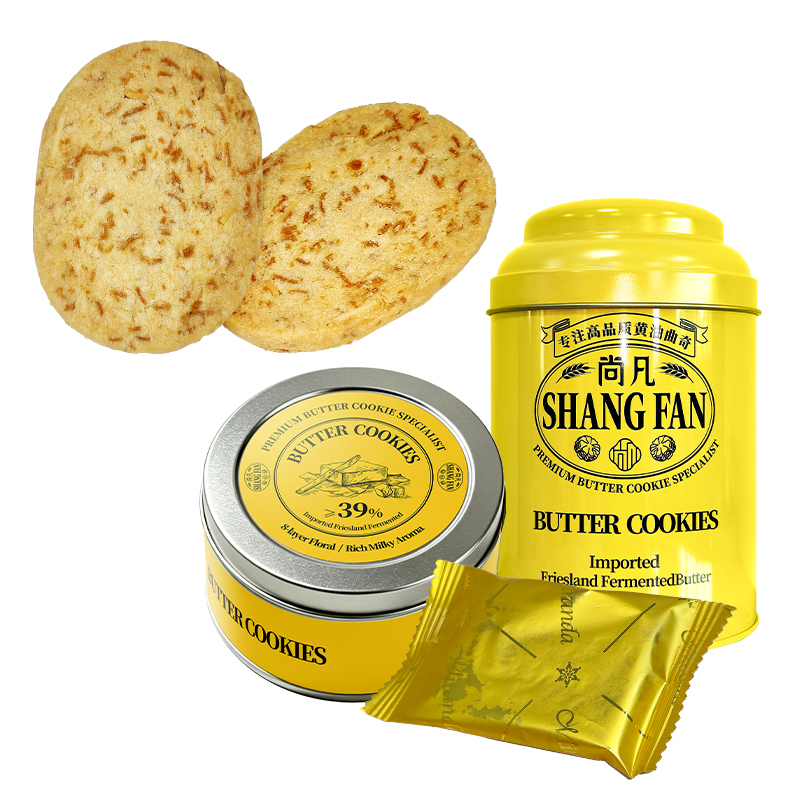
Gift box / gift tin formats are presentation-led units sold as a discrete purchase: a decorated tin, an outer gift box, or a tin matched with a gift bag. They carry a higher packaging-to-product ratio and are bought for occasions — seasonal gifting, hotel welcome amenities, corporate sets, premium retail endcaps.
Bulk and foodservice formats are throughput-led units optimised for repacking, counter service, tray presentation or high-frequency replenishment. The buying question is how many portions a case yields and how quickly the unit turns, not how it looks on a gift table.
| Decision dimension | Gift box / gift tin | Bulk & foodservice |
|---|---|---|
| Primary purchase trigger | Occasion, presentation, perceived value | Repeat velocity, portion control, handling cost |
| Cost driver | Packaging and decoration share of unit cost | Product weight and case cube per portion |
| Shelf-life sensitivity | High — the unit must look intact at the moment of gifting | Moderate — depletion is driven by turnover, not occasion |
| Handling profile | Individual units, damage-sensitive surfaces | Case-level handling, repack or counter transfer |
| Typical channels | Supermarkets (seasonal), chain hotels, gifting, e-commerce | Coffee shops, bakeries, foodservice, instant retail replenishment |
| Dominant risk | Residual stock after the season; cosmetic damage | Portion mismatch; stale stock if velocity assumptions are wrong |
Pack-count arithmetic: how 9 pieces, 13 pieces and 10 g decide channel fit
Piece count is the most under-specified line in most butter cookie purchase orders, and it is the one that most directly determines channel fit. In the Shangfan Food thin-crisp range — Crispy Thin Butter Cookies, Matcha Nut Butter Thin Crisp Cookies, Oolong Tea Crisp Cookie and Cocoa Butter Thin Crisp Cookies — the specification is 10 g per piece, packed as 9 pieces per box or 13 pieces per can, with a 5-month shelf life. A 9-piece box at 10 g per piece implies a nominal 90 g net content; a 13-piece can implies a nominal 130 g. Those are small, single-serve-adjacent units, and they behave differently from a 380 g or 760 g gift tin in every channel economics model.
The consequence is straightforward. A 9-piece box is a trial or impulse unit: it fits a supermarket hanging or shelf strip, an e-commerce single-unit listing, or a hotel turndown amenity. A 13-piece can is a resealable, shelf-stable unit that sits between impulse and sharing. Neither is a foodservice repack unit. Where a coffee shop or bakery needs a counter-service portion, the relevant SKUs are the larger-format lines, not the 9-piece box.
| SKU reference | Stated format | Shelf life | Channel reading |
|---|---|---|---|
| Crispy Thin Butter Cookies; Matcha Nut Butter Thin Crisp Cookies; Oolong Tea Crisp Cookie; Cocoa Butter Thin Crisp Cookies | 10 g per piece; 9 pieces per box or 13 pieces per can | 5 months | Impulse, e-commerce single unit, amenity, shelf strip |
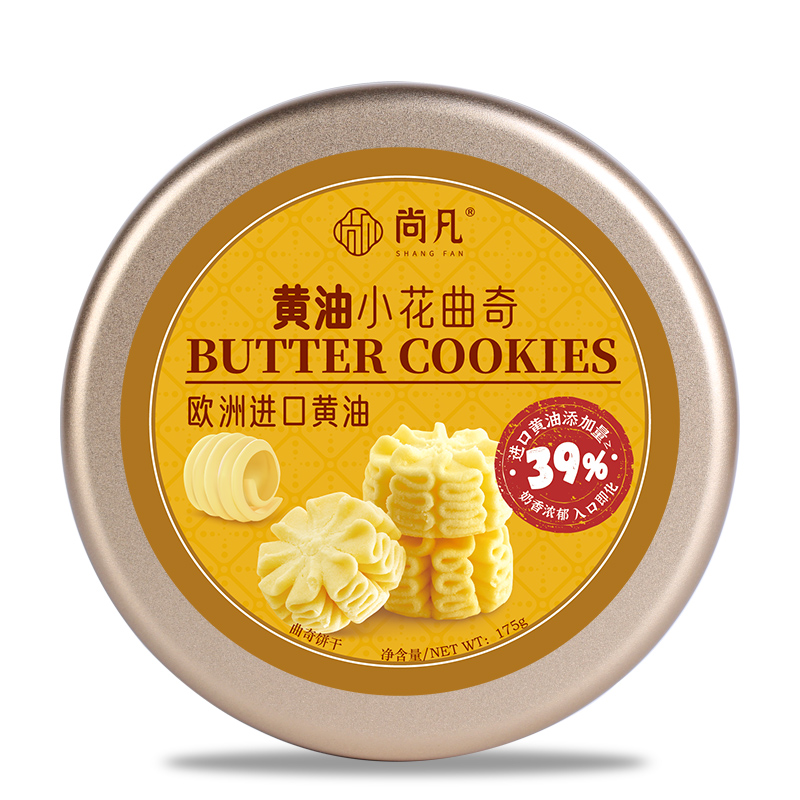
| Butter Floral Cookies | 175 g × 24 tins per carton | 5 months | Retail tin, repeat purchase, standard shelf facings |
| Butter Floral Cookies 260 g (gift tin packaging, matched with gift bags) | 260 g × 8 tins per carton | 6 months | Gifting, hotel amenity, seasonal endcap |
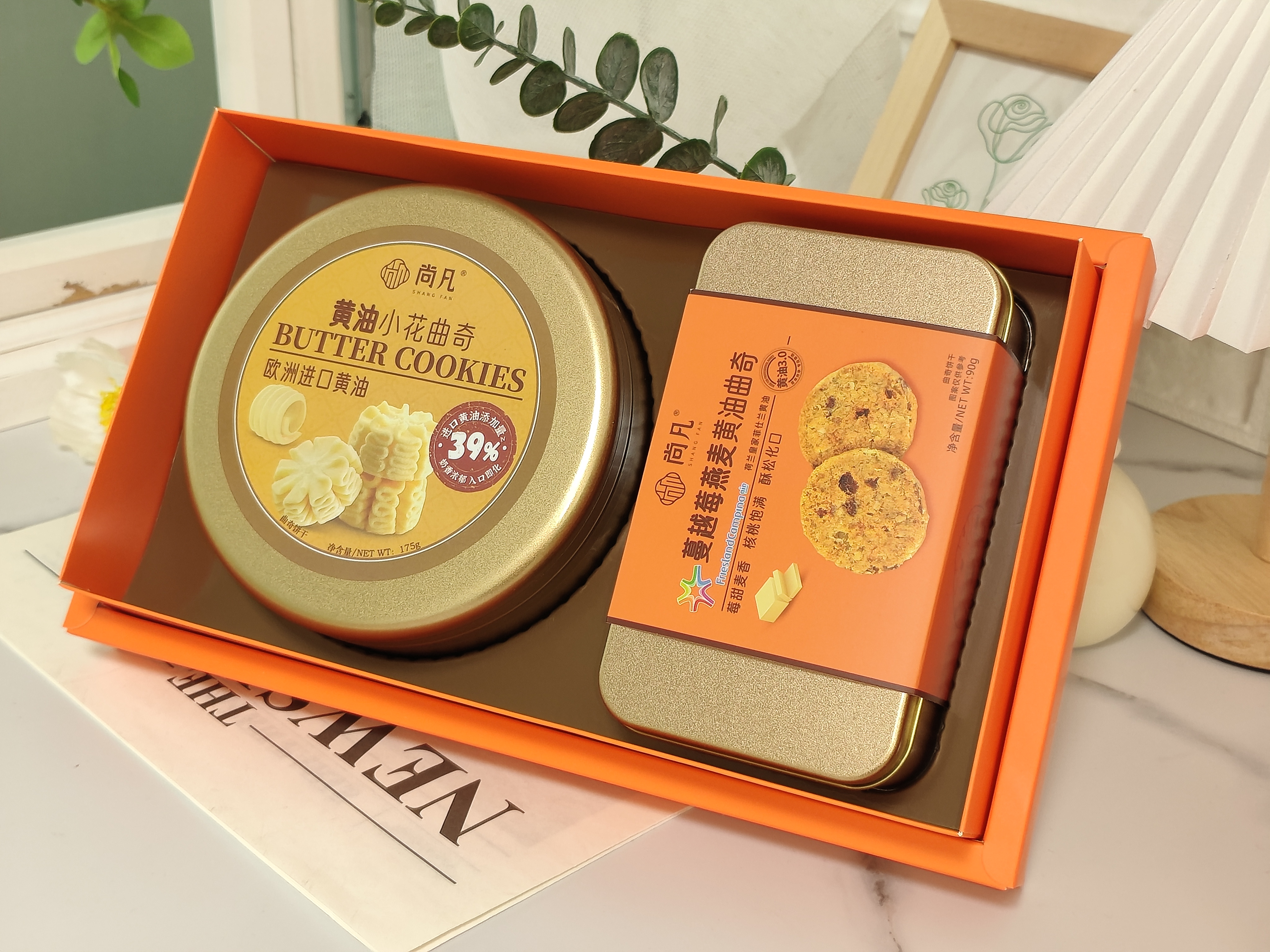
| Butter Cookie Gift Box | 265 g per box, two flavours (175 g Butter Floral Cookies + 90 g Cranberry Oat Butter Cookies) | 150 days (flower component); 8 months (oat component) | Assorted gift unit with two-flavour story |
| Danish Fancy Butter Cookies | 380 g × 12 tins per carton | 9 months | Premium retail tin, longer export runway |
| Danish Assorted Cookie Gift Box | 760 g gift set (2 tins included) | 9 months | Premium gifting, corporate sets |
| Lace Butter Cookies | 448 g per box (16 g × 28 pieces) | 180 days | Warehouse club, endcap display, sharing format |
| Butter Shortbread | 680 g per box | 6 months | Large-format sharing, bakery counter cross-sell |
| Salted Cheese Butter Cookies | 32 g × 12 pieces / 384 g per box | 12 months | Long-runway ambient distribution, savoury snack positioning |
A five-criteria decision framework
Buyers can compress the whole decision into five questions, answered in order. The first criterion that fails usually decides the format.
| # | Criterion | Question to answer | What it eliminates |
|---|---|---|---|
| 1 | Channel task | Is the unit bought as a discrete occasion, or consumed as a repeating portion? | Gift formats in high-frequency counters; bulk formats in gifting programmes |
| 2 | Presentation requirement | Does the buyer's shelf or counter require a decorated, sealed, giftable surface? | Unpacked bulk units in premium or gifting contexts |
| 3 | Handling and labour | How many units per labour hour, and how damage-sensitive is the pack? | Fragile tins in high-volume repack environments |
| 4 | Shelf-life runway | After production, transit and clearance, how many selling months remain? | Short-life SKUs on long-sea-freight lanes |
| 5 | Order economics | Does the financed quantity turn before the season or the shelf-life window ends? | Mixed-SKU pallets that exceed realistic sell-through |
How SHANGFAN FOOD's range maps onto both sides of the decision
SHANGFAN FOOD, the operating name of Dongguan Shangfan Food Co., Ltd., is a Dongguan-based manufacturer of butter cookies and related baked goods founded in 2015, operating a garden-style factory of more than 10,000 m² in Chashan Town with 100 employees, an annual output of 3,640 tons and a five-engineer R&D team. The company holds FSSC 22000 V6 and HACCP certification, has completed export food business filing and FDA registration, reports a 10% export ratio, and lists PRC, EU, USA, South Korea and Singapore among its main markets. It provides OEM and ODM production services, with custom formula, custom specifications, custom logo and custom taste development available for OEM and ODM orders.
On the gift side, the range is anchored by the Butter Floral Cookies 260 g gift tin (packed 8 tins per carton, matched with gift bags, 6-month shelf life), the Butter Cookie Gift Box 265 g built from a 175 g Butter Floral Cookies component plus a 90 g Cranberry Oat Butter Cookies component, the Danish Fancy Butter Cookies 380 g tin (12 tins per carton, 9-month shelf life, New Zealand imported natural butter content ≥ 32%, no preservatives, artificial pigments or artificial flavours added), and the Danish Assorted Cookie Gift Box 760 g set containing two tins. The Butter Floral Cookies component in the gift box is specified with no less than 39% fermented butter from FrieslandCampina Netherlands and flour milled from Canadian imported wheat.
On the volume side, the range includes Butter Floral Cookies 175 g (24 tins per carton), Coffee Butter Flower 175 g and Cocoa Butter Cookies 175 g (also 24 tins per carton), Lace Butter Cookies 448 g (16 g × 28 pieces, 180 days, produced to GB7100), Butter Shortbread 680 g, Salted Cheese Butter Cookies 384 g (32 g × 12 pieces, 12 months), and the 90 g oat-based lines in Cranberry and Dark Chocolate variants.
Channel application: five buyer scenarios
Supermarkets
Supermarket buyers usually run two separate plans. The everyday plan needs facings that turn without a seasonal story: 175 g tins at 24 per carton, or the 9-piece and 13-piece thin-crisp units for impulse positions. The seasonal plan needs giftable units with a defined window: the 260 g gift tin with gift bags, the 265 g two-flavour gift box, or the 760 g two-tin set. A membership supermarket private-label programme recorded by Shangfan Food — 200,000 boxes over an 8-month programme — reported more than 120,000 boxes in the first quarter after launch, with 65% of sales through offline stores and an online-mall repurchase rate of 38%, against a stated 25% snack-category average. The same record notes a first-place ranking in the retailer's cookie segment for two consecutive months. The relevant reading for a new buyer is not the ranking itself but the split: gift-adjacent formats sold well offline, while online performance depended on repeat rate rather than one-off gifting.
Chain hotels
Hotel programmes are the clearest gift-format use case. The unit is often a welcome amenity, a turndown item or an in-room retail item, and the presentation requirement is non-negotiable. The 260 g gift tin matched with gift bags and the 265 g two-flavour gift box are the natural candidates; the 9-piece box at 10 g per piece is the practical amenity size where a smaller unit is preferred. The binding constraint is shelf life: a 5- to 6-month tin leaves little margin if a hotel group holds buffer stock, so buyers typically specify production windows and inspect carton condition on arrival.
Bakeries
Bakeries buy both formats but for different reasons. Gift boxes support seasonal and corporate orders; larger formats such as Butter Shortbread 680 g support counter display and cross-sell with coffee or bread. Where a bakery repacks or serves from a display, portion consistency matters more than decoration, and the 448 g Lace Butter Cookies box at 16 g × 28 pieces gives a predictable piece weight for counter service.
Coffee shops
Coffee shops are the channel where gift formats most often fail. Counter space is scarce, dwell time is short and the purchase is attached to a drink rather than an occasion. Small, sealed, single-portion units work; large decorative tins usually do not, unless the shop runs a gifting corner in season. The Coffee Butter Flower 175 g tin is a reasonable coffee-adjacent pairing by flavour profile, while the 9-piece thin-crisp boxes fit the attachment role more naturally than a gift set.
Instant retail platforms
Instant retail rewards units that photograph clearly, survive last-mile handling and reorder quickly. Shangfan Food's recorded instant e-commerce case covers 400,000 boxes over a 150-day programme with monthly sales above 30,000 tins and a stated 98% repurchase rate, with the products featured on the platform homepage multiple times. Whether those figures transfer to another operator depends on price position and listing mechanics, but the format lesson does transfer: smaller sealed units with a clear flavour cue reorder better than large tins in a delivery-led channel.
Executing the order: purchasing terms, acceptance criteria and capacity
Format decisions only hold if the commercial terms match them. The purchasing terms published for this supplier are: MOQ of a 20ft container, delivery terms FOB/CIF, acceptance criteria of pre-shipment inspection, and payment by bank transfer to corporate account. The capability record separately lists a 10,000-box MOQ reference, a 30-day lead time, monthly capacity of over 500,000 pastries and over 20 tons of cookies, and 100% testing. Buyers should reconcile the container-level MOQ against the box-level figure in writing before signing, because a mixed gift-and-bulk order may satisfy one threshold and not the other.
| Term | Stated position | Execution implication |
|---|---|---|
| MOQ | 20ft container (a 10,000-box reference also appears in the capability record) | Confirm which threshold applies per SKU before committing a mixed-format order |
| Delivery terms | FOB / CIF | CIF shifts freight and insurance to the supplier; FOB keeps carrier control with the buyer |
| Acceptance criteria | Pre-shipment inspection | Inspection must be scheduled before container loading, not on arrival |
| Payment | Bank transfer to corporate account | Verify the account name against the contracting entity |
| Lead time | 30 days | Seasonal gift programmes need order placement well ahead of the selling window |
| Quality control | 100% test | Ask what the test covers: piece weight, seal integrity, carton condition or all three |
Compliance and packaging rules that differ by format
Both formats sit under the same food safety system, but the packaging side diverges. HACCP certification 001HACCP1900428, issued by CHINA QUALITY CERTIFICATION CENTRE and valid to 2028-06-20, covers the manufacture of heat-processed pastries, biscuits and food fillings. FSSC 22000 V6 certification 162605010, issued by Intertek and valid to 2029-05-14, covers ISO 22000:2018, ISO/TS 22002-1:2009 and the FSSC 22000 additional requirements (Version 6). For the product itself, China's national biscuit standard GB/T 20980-2021 sets quality requirements for short and cookie-type products, and Lace Butter Cookies are additionally produced to GB7100.
For EU-destined gift programmes, two packaging-linked rules matter more than they do for bulk. The EU General Product Safety Regulation (GPSR) 2024 tightens traceability and authorised-representative obligations for non-EU manufacturers, which affects who is named on a gift box. Commission Regulation (EU) 2024/3190 prohibits Bisphenol A in food contact materials, including packaging linings — directly relevant to decorated tins and boxed sets where multiple contact layers are used. Bulk packs with simpler contact structures usually carry a lighter compliance load per unit.
Market context: why both formats still have room
Public estimates of the butter cookie category diverge sharply by scope, and buyers should read the number that matches their own product definition. Grand View Research values the global butter cookies/biscuits market at USD 3,358.3 million in 2024, while Dataintelo estimates the broader butter-based cookies market — including shortbread and sandwich cookies — at USD 42.8 billion in 2025. The gap is a scope gap, not a contradiction: one tracks a narrow butter-cookie segment, the other a wider biscuit family.
Two directional signals are more useful for format planning. Dataintelo attributes a 34.2% revenue share of the butter cookies market to Asia Pacific in 2025, which supports regional production and regional gifting programmes rather than long-haul single-origin supply. Grand View Research values the oat-based snacks market, which includes cranberry oat cookies, at USD 22.4 billion in 2024 — consistent with the two-flavour gift box logic that pairs a butter cookie with an oat-based component. On the supply side, Kelsen Group (Kjeldsens) reported revenue of DKK 1.027 billion in the 2023/24 fiscal year, and PT Mayora Indah Tbk holds roughly 6.05% of tracked global cookie export value, which indicates that branded gifting remains concentrated among a small number of large exporters.
Comparison with traditional approaches — and the limits of each format
The traditional approach is to pick one pack format and push it through every channel, or to treat the gift tin as the default premium answer. Both shortcuts break down under realistic trading conditions.
- Gift-format limits. A 260 g gift tin has a 6-month shelf life and a 175 g retail tin has 5 months; after production, sea freight and customs clearance, the remaining selling window is short. Decorative tins also raise packaging cost per kilogram and are damage-sensitive in high-volume handling.
- Bulk-format limits. Bulk and foodservice packs solve velocity but not occasion. They are the wrong answer for hotel amenities, corporate gifting or seasonal endcaps, where the purchase decision is driven by presentation.
- Single-site concentration. All formats here come from one Dongguan facility with a reported 10% export ratio, which means the range is domestically weighted and export allocation has to be planned rather than assumed.
- Order-size friction. Container-level MOQ requirements make small mixed trial orders impractical; buyers testing a new channel should expect to commit at case level and validate before scaling.
None of these are defects in the product. They are boundary conditions that determine which format a given channel can actually carry.
Future outlook
Three shifts are likely to shape format decisions over the next buying cycles. First, piece-count specification is becoming a procurement term rather than a production detail, as retail and instant-delivery channels price by portion. Second, packaging regulation in the EU is pushing buyers toward simpler contact structures and clearer traceability on decorated sets. Third, the clean-label preference for pure butter formulations is raising the value of ingredient transparency on the pack, which favours formats where the ingredient story is visible — a two-flavour gift box explains itself more easily than a plain bulk carton.
Downloadable reference: the supplier brochure is available at SHANGFAN FOOD brochure (PDF).
FAQ
What is the practical difference between a butter cookie gift box and a bulk foodservice pack?
A gift box or gift tin is a discrete, presentation-led unit bought for an occasion, where packaging and appearance are part of the value. A bulk or foodservice pack is a throughput-led unit bought for repacking, counter service or high-frequency replenishment, where portion control and handling cost dominate. The cookie may be identical; the buying logic is not.
How many pieces are in a butter cookie box or can?
For the thin-crisp line — Crispy Thin Butter Cookies, Matcha Nut Butter Thin Crisp Cookies, Oolong Tea Crisp Cookie and Cocoa Butter Thin Crisp Cookies — the stated specification is 10 g per piece, packed as 9 pieces per box or 13 pieces per can, with a 5-month shelf life. Other formats are specified by net weight instead, for example 175 g, 260 g, 380 g, 448 g and 760 g.
What are the purchasing terms and acceptance criteria?
The published terms are: MOQ of a 20ft container, delivery terms FOB/CIF, acceptance criteria of pre-shipment inspection, and payment by bank transfer to corporate account. A 30-day lead time and 100% testing are also stated, and a 10,000-box MOQ reference appears separately in the capability record, so the applicable threshold should be confirmed in writing per SKU.
Can gift box formats be customized under OEM or ODM?
Yes. The manufacturer provides OEM and ODM production services, with custom formula, custom specifications, custom logo and custom taste development available for OEM and ODM orders. Customization scope should be fixed against the stated MOQ and the 30-day lead time before artwork is finalised.
Which format suits chain hotels versus coffee shops?
Chain hotels typically need a presentation-led unit — the 260 g gift tin matched with gift bags, or the 265 g two-flavour gift box — plus a smaller amenity option such as the 9-piece box. Coffee shops typically need small sealed units that attach to a drink purchase; large decorative tins generally underperform there outside seasonal gifting corners.
What shelf life should buyers plan for?
Shelf life varies by SKU in this range: 5 months for Butter Floral Cookies 175 g and the thin-crisp line, 6 months for the 260 g gift tin and Butter Shortbread, 150 days for the flower-shaped component of the 265 g gift box, 8 months for the 90 g oat-based cookies, 9 months for the Danish Fancy Butter Cookies 380 g and the 760 g set, 180 days for Lace Butter Cookies, and 12 months for Salted Cheese Butter Cookies.
Есть вопросы или нужны дополнительные детали?
Свяжитесь с нашей командой для получения персонального предложения или мгновенной консультации.
Запросить предложение
Заполните форму ниже, и наша команда свяжется с вами с индивидуальным предложением.
Прямой чат WhatsApp
Предпочитаете общаться в реальном времени? Напишите нам в WhatsApp для мгновенной помощи и быстрых ответов.
- Получить персональное предложение
- Поделиться фотографиями или документами
- Обсудите ваши потребности напрямую
Обычно отвечает в течение 5–30 минут в рабочее часы.