
Butter Cookie Procurement FAQ: Ingredients, 10g Pieces, 9/13 Packs
Butter Cookie Procurement FAQ: Ingredients, 10g Pieces, 9/13 Packs
Butter cookie purchasing has moved from a taste decision to a specification decision. Buyers working in the decision stage usually need four points resolved before releasing an order: what the dough is made of, how each piece is weighted and packed, which sales channels the format can actually serve, and whether the supplier can repeat the same result shipment after shipment. This industry reference answers those questions for the butter cookie range produced by Dongguan Shangfan Food Co., Ltd. — known commercially as SHANGFAN FOOD — a baked-goods manufacturer established in 2015 in Chashan Town, Dongguan City, Guangdong Province, China.

Butter cookie contract manufacturing reference — SHANGFAN FOOD, Dongguan, Guangdong Province, China.
Why butter cookie sourcing became a technical review
Category growth is one reason. The global butter cookies and biscuits market was valued at USD 3,358.3 million in 2024 (Grand View Research), while a broader definition that includes shortbread and sandwich cookies puts the butter-based cookie market at USD 42.8 billion in 2025 (Dataintelo). The two figures are not contradictory so much as differently scoped: one counts butter cookies narrowly, the other counts all butter-based cookie products. For buyers, the practical consequence is that quotations are frequently compared against the wrong benchmark, which makes specification-level questions more useful than headline market size.
Regional weight matters too. Asia Pacific accounted for 34.2% of global butter cookie revenue in 2025 (Dataintelo). At the same time, clean-label expectations continue to push formulations toward pure butter rather than vegetable shortening — a shift that changes both cost structure and handling requirements. That combination of concentrated demand and cleaner formulations is why ingredient, pack and logistics questions now sit on the same procurement checklist.
Ingredient questions: what is actually inside the cookie
Ingredient questions cluster around three issues: the fat system, the flour and starch base, and the inclusions or flavourings. Under China's national biscuit standard GB/T 20980-2021, short and cookie-type products fall under defined quality requirements, so a supplier's specification sheet should state which product class an item belongs to before commercial terms are discussed.
Butter content
For the butter cookie line referenced here, the reported butter content is at least 39%. In the manufacturer's own comparative testing, that figure is described as 4% higher than the alternative product used as a benchmark, a difference intended to register in mouthfeel and aroma rather than only on paper. Because butter content drives ingredient cost and, in parallel, the product's sensitivity to heat, it is normally the first number a buyer of high-quality butter cookies asks to have confirmed in writing.
Flavour and inclusion items
Ranges of this type are usually built around a core butter cookie and extended with inclusions. The SHANGFAN FOOD range includes Lace Butter Cookies, Cranberry Oat Butter Cookies, Crispy Thin Butter Cookies and Butter Shortbread, alongside items such as the Oolong Tea Crisp Cookie and Cocoa Butter Thin Crisp Cookies, where the ingredient question shifts from fat content to the tea or cocoa components and their labelling status. Buyers evaluating products such as matcha butter cookies or salted cheese butter cookies should treat flavouring, colour and dairy declarations as separate verification items, because those are the parts of a recipe most likely to move between development samples and production runs.
Portion and pack questions: 10 g pieces, 9 pieces per box, 13 pieces per can
Piece weight and pack count determine shelf economics and portion control, and they are often the detail that decides which of two similar products is listed. In this range, pieces are specified at 10 g each, with two dominant pack architectures: 9 pieces per box and 13 pieces per can.
What a 10 g piece changes for the buyer
A 10 g unit is a single-bite or two-bite format. It lets hotels and coffee shops cost a portion precisely, and it allows retailers to build multi-count packs from one base unit instead of stocking several sizes. The same unit simplifies butter cookie gift box assembly, since a fixed piece weight can be counted into a tray or tin without re-cutting product. The trade-off is that small pieces carry a higher surface-to-volume ratio, so they pick up moisture faster than a thick shortbread block and depend more heavily on packaging and storage discipline.
Reading 9-piece boxes and 13-piece cans
The 9-piece box format is typically aimed at retail multipacks, gift box programmes and foodservice portion packs where a shallow carton is preferred. The 13-piece can format suits tin presentation, hotel amenities, corporate and seasonal gift programmes — including Christmas butter cookies — and any channel where rigidity and stackability matter more than carton efficiency. Buyers should confirm whether the stated count refers to the saleable unit or an inner unit, and whether the box or can is the retail-ready package.
| Pack architecture | Piece weight | Documented count | Channel it usually serves | What the buyer should verify |
|---|---|---|---|---|
| Boxed multipack | 10 g | 9 pieces per box | Supermarkets, online e-commerce, bakery counters | Net weight declaration, inner-to-outer carton ratio, shelf-life claim |
| Tin / can | 10 g | 13 pieces per can | Chain hotels, coffee shops, corporate and seasonal gift boxes | Can integrity and sealing, stack height, gift packaging approval |
| Bulk for repacking | 10 g | Configurable | Bakery and coffee shop operations, instant retail partners | Piece tolerance, breakage rate, packing line compatibility |
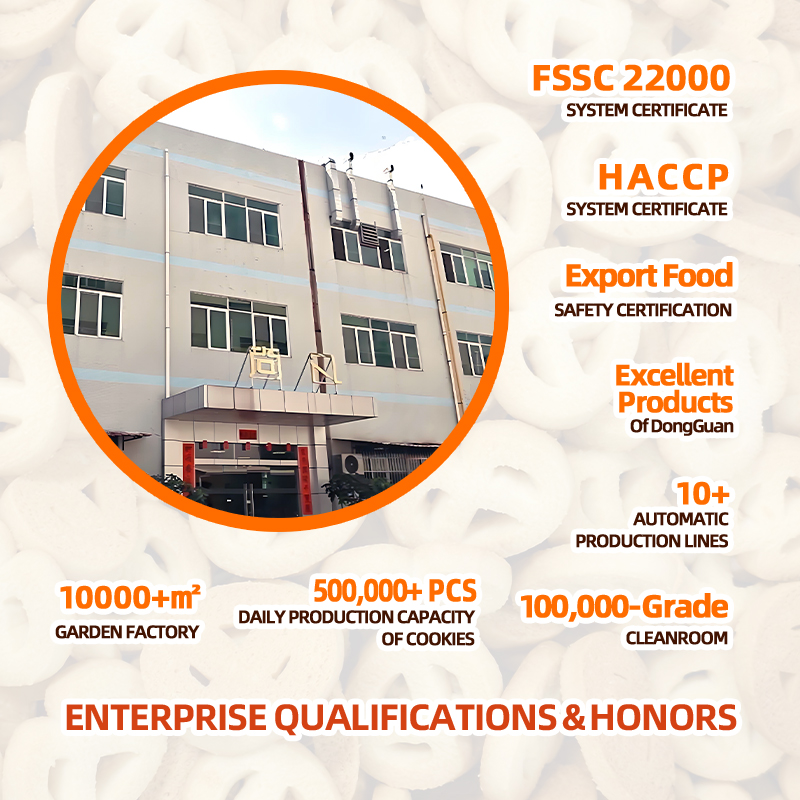
Facility scale reference: the Dongguan site covers more than 10,000 m² and supports butter cookie production across multiple pack formats.
Channel fit: where each format earns its margin
The range is documented as suitable for supermarkets, chain hotels, bakeries, coffee shops, online e-commerce platforms and instant retail platforms. Channel fit is not a marketing statement; each of those channels imposes a different constraint on the same 10 g piece.
- Supermarkets require a declared net weight, a stable shelf life and packaging that survives pallet handling and shelf replenishment.
- Chain hotels buy on portion consistency and presentation, which is where 10 g pieces and 13-piece cans fit amenity and banquet use.
- Bakeries often use butter cookie products as counter companions and check piece tolerance and repacking suitability rather than gift presentation.
- Coffee shops value single-bite formats that pair with beverages and can be counted per cup served.
- Online e-commerce is sensitive to breakage in transit, so carton protection and pack rigidity become decisive.
- Instant retail requires reliable individual packaging and clear labelling on small units, including date coding.
Commercial questions: capacity, cost position and repeat orders
The commercial layer is where price comparisons fail most often. The manufacturer reports a monthly production output exceeding 650 tons, a repurchase rate of 98%, and production under FSSC22000 standards with a low defect rate and the ability to sustain large orders. Those figures describe continuity rather than a single shipment: for buyers with seasonal peaks, the relevant question is whether a supplier can hold a listing across a full cycle without stockouts.
On cost, the same comparative data describes a 20% cost reduction against Japanese Isigny Lace Butter Cookies and a 25% reduction against Jenny Bakery Smart Bear Cookies from Hong Kong, with adaptability described as increased fivefold. For scale context, Kelsen Group, the company behind the Kjeldsens brand, reported annual revenue of DKK 1.027 billion in its 2023/24 fiscal year, and PT Mayora Indah Tbk, the manufacturer of Danisa, holds approximately 6.05% of tracked global cookie export value. Those figures help a buyer understand the competitive scale of the category; they are not a quality ranking of any individual supplier.
Comparison with alternative suppliers — and the limits of the comparison
For a decision-stage buyer, the useful question is not which cookie tastes better but which claims survive verification. The table below separates what the manufacturer documents from what a buyer should confirm independently.
| Evaluation point | What the manufacturer's documentation states | What the buyer should verify |
|---|---|---|
| Butter content | At least 39%, described as 4% higher than the benchmark alternative | Request the specification sheet and certificate of analysis; run own sensory and fat-content testing |
| Manufacturing standard | FSSC22000 and HACCP certified; production described as consistent with a low defect rate | Check certificate scope, validity and covered production site directly |
| Reported cost position | 20% lower than Japanese Isigny Lace Butter Cookies; 25% lower than Jenny Bakery Smart Bear Cookies, Hong Kong | Compare landed cost including refrigerated transport, duty and packaging |
| Capacity and repeat business | Monthly output above 650 tons; 98% repurchase rate | Run a trial order and confirm lead time during peak season |
| Channel suitability | Supermarkets, chain hotels, bakeries, coffee shops, online e-commerce, instant retail | Validate packaging performance inside the buyer's own distribution chain |
Two boundaries should be stated plainly. First, the comparative figures above are supplier-reported. They come from the manufacturer's own benchmarking rather than an independent laboratory or third-party audit, so a decision-stage buyer should treat them as claims to be tested rather than settled facts.
Second, and more structurally important, a high-butter formulation is a liability in warm or humid supply chains. High temperatures accelerate fat rancidification, and temperature fluctuations cause condensation, after which cookies absorb moisture, soften, develop mould and lose shape. The product therefore calls for refrigerated container transport where available, constant-temperature dry warehousing, off-ground stacking, and protection from direct sunlight and rain. That is a real cost and a real operational constraint: buyers in tropical or long-transit markets should price refrigerated logistics before comparing unit prices, because a cheaper cookie that arrives soft is not cheaper.
Compliance and logistics checks before the order
Certification and documentation remain the fastest way to disqualify a supplier. SHANGFAN FOOD holds FSSC22000 and HACCP certification, has completed filing for export food business, and holds FDA registration. Its stated export ratio is 10%, with main markets in mainland China, the EU, the USA, South Korea and Singapore, so buyers outside those markets should confirm documentation coverage rather than assume it.
Two regulatory developments affect packaging and traceability. The EU General Product Safety Regulation (GPSR) 2024 requires stricter traceability and an authorised representative for non-EU food manufacturers selling into the EU, and Commission Regulation (EU) 2024/3190 prohibits bisphenol A (BPA) in food contact materials, including cookie packaging linings. Buyers importing into the EU should confirm both the representative arrangement and the lining material of the chosen pack.
On the physical side, the manufacturer's stated protective measures are 5-layer corrugated cartons, pallet loading with upright marking and corner protectors, refrigerated container transport, and storage in cool, dry conditions. Inspection on arrival should cover package integrity and any signs of moisture or condensation — a simple check that catches most transit-related quality loss before the pallet is put away.
Market outlook
Three trends are likely to shape butter cookie procurement through the next buying cycles. Clean-label pressure continues to favour pure butter formulations over vegetable shortenings, raising the importance of written fat-system declarations. Adjacent segments are expanding in parallel — the oat-based snacks market, which includes products such as cranberry oat butter cookies, was valued at USD 22.4 billion in 2024 (Grand View Research) — giving buyers a wider set of butter-and-grain formats to place. And packaging regulation, rather than product regulation, is becoming the harder compliance variable, which means pack format decisions should involve the compliance team earlier than they traditionally have.
Company reference
Dongguan Shangfan Food Co., Ltd. was established in 2015 and operates a garden-style factory of more than 10,000 m² in Chashan Town, Dongguan City, Guangdong Province, China, with a workforce of 100 and an in-house R&D team of five engineers. The company produces Butter Cookies, Lace Butter Cookies, Cranberry Oat Butter Cookies, Crispy Thin Butter Cookies and Butter Shortbread, and supports OEM and ODM development of customized butter cookies and custom butter cookie gift boxes. Sourcing enquiries can be directed to Liu. Jinqi at shangfan168@126.com or +86 13392733431 (telephone and WhatsApp); the company website is www.dongguanshangfanfood.com, and the registered address is Building 3, No.32 Jixing Road, Chashan Town, Dongguan City, Guangdong Province.
FAQ
What ingredients are used in SHANGFAN FOOD butter cookies?
The butter cookie line is built on a butter-based fat system with a reported butter content of at least 39%. Under China's national biscuit standard GB/T 20980-2021, short and cookie-type products are covered by defined quality requirements, so an ingredient declaration should identify the product class, the fat source and any flavour or inclusion items. Items such as the Oolong Tea Crisp Cookie and Cocoa Butter Thin Crisp Cookies extend the base recipe with tea and cocoa components, which are declared separately.
What do 10 g pieces and 9-piece boxes or 13-piece cans mean in practice?
Piece weight and pack count define the saleable unit. In this range each piece is specified at 10 g; 9-piece boxes are the usual format for retail and foodservice multipacks, while 13-piece cans suit tin presentation, hotel use and gift programmes. Buyers should confirm whether a stated count refers to the outer saleable unit or an inner pack, and should record piece weight tolerance and net weight on the specification sheet.
Which sales channels are these butter cookie formats designed for?
The documented channel list is supermarkets, chain hotels, bakeries, coffee shops, online e-commerce platforms and instant retail platforms. Format choice follows the channel: 9-piece boxes travel well in retail and e-commerce distribution, 13-piece cans suit hospitality and gifting where rigidity matters, and bulk packing suits bakery and coffee shop operations that portion at the point of sale.
How does the SHANGFAN FOOD butter cookie line compare with Jenny Bakery or Isigny lace butter cookies?
In the manufacturer's comparative data, the product is described as offering comparable taste with better value against Jenny Bakery Smart Bear Cookies from Hong Kong, and distinct advantages against Japanese Isigny Lace Butter Cookies, supported by a reported 4% higher butter content, a 20% to 25% lower cost position and a fivefold increase in adaptability. These are supplier-reported comparisons rather than independent test results, so buyers should validate them against their own sampling and landed-cost calculations.
What transport and storage conditions should be specified for butter cookies?
Because a high-butter product is sensitive to heat and humidity, refrigerated container transport is preferred where available, and storage should be in constant-temperature dry warehouses with goods stacked off the ground and protected from direct sunlight and rain. High temperatures accelerate fat rancidification and temperature swings cause condensation, which can lead to moisture absorption, softening, mould and shape deformation. The manufacturer's stated protective measures include 5-layer corrugated cartons, pallet loading with upright marking and corner protectors, and inspection on arrival for package integrity and condensation.
Which certifications and compliance documents should be checked before importing?
SHANGFAN FOOD holds FSSC22000 and HACCP certification, has completed export food business filing, and holds FDA registration; its stated export ratio is 10% with main markets in mainland China, the EU, the USA, South Korea and Singapore. Buyers importing into the EU should additionally confirm the authorised representative arrangement required under the EU General Product Safety Regulation (GPSR) 2024, and verify that packaging linings comply with Commission Regulation (EU) 2024/3190, which prohibits bisphenol A in food contact materials.
A downloadable company brochure with product and facility details is available here: Shangfan Food company brochure (PDF).