
Butter Cookie Scenario Fit: Gift Tins vs. Thin Crisp Packs
Butter Cookie Scenario Fit: Gift Tins vs. Thin Crisp Packs
Butter cookie scenario fit is decided by format architecture — piece weight, pieces per container, container type and declared shelf life — before it is decided by flavour. That is the practical conclusion for hospitality and retail buyers weighing a 10 g thin crisp packed nine to a box against a 760 g two-tin gift set. The same manufacturer can serve both ends of that range, but not with the same SKU and not with the same planning assumptions.
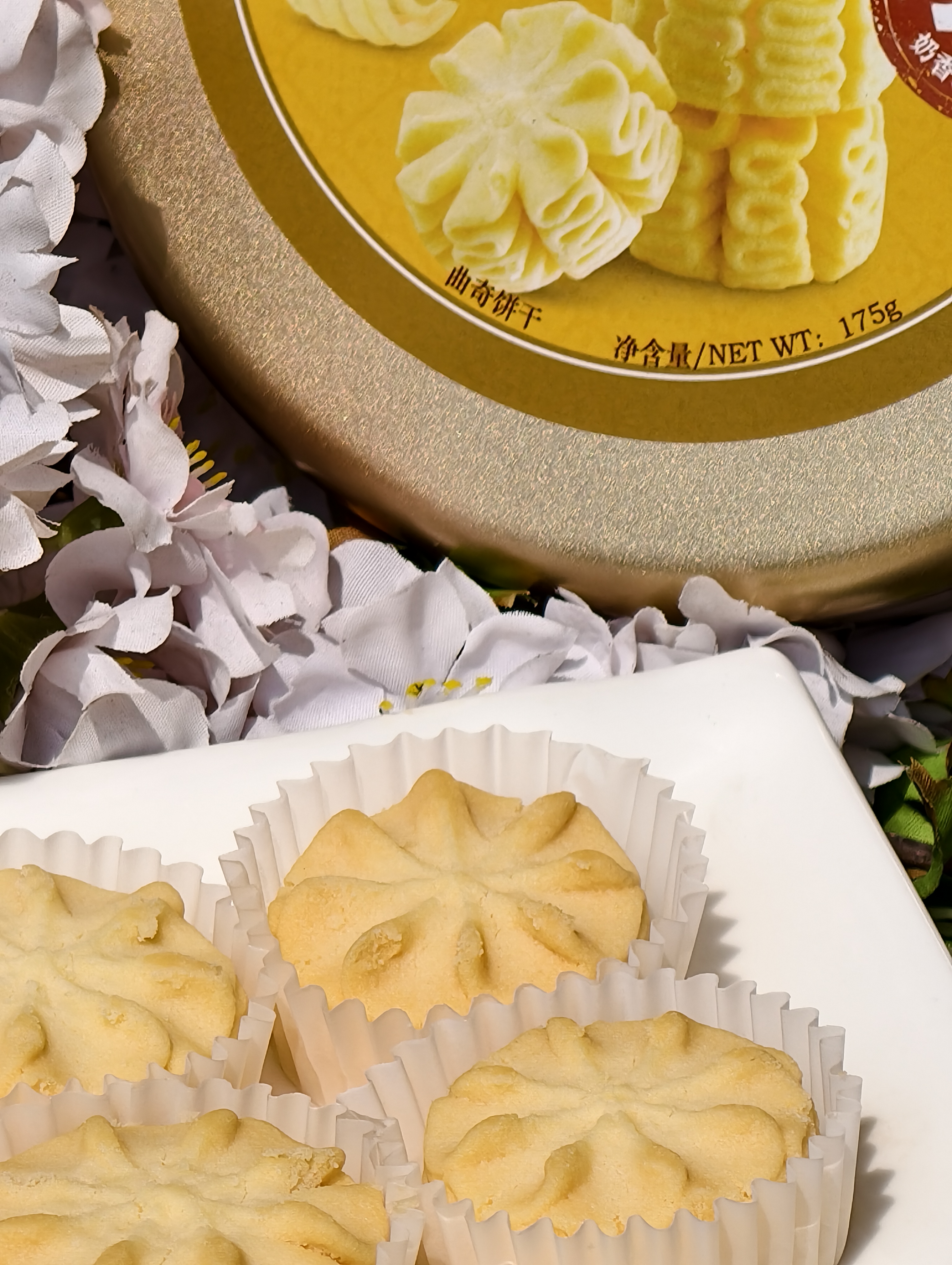
Butter cookie formats move through supermarkets, chain hotels, bakeries, coffee shops, e-commerce and instant retail — each with a different handling requirement.
Why Format, Not Flavour, Assigns the Channel
Channels do not ask the same thing from a biscuit. A coffee shop needs a repeatable single portion that can be served beside a drink without a plate, a knife or a second person. A gift retailer needs a sealed presentation unit that still looks intact after a courier has moved it twice. An instant retail platform needs a unit small enough to be ordered on impulse and stable enough to sit in a dark-store tote. None of these are flavour requirements. They are format requirements, and most of them can be read directly from a specification sheet.
The four variables that carry most of the decision are piece weight, pieces per container, container type and declared shelf life. A fifth variable — whether the contents inside the container are individually packed — decides whether a gift unit can be opened and re-closed without the remaining product softening. Across the SHANGFAN FOOD range these five variables move independently of flavour, which is why two recipes can share an identical piece-count architecture and two gift boxes can share an identical brand while differing by three months of shelf life.
SHANGFAN FOOD, registered as Dongguan Shangfan Food Co., Ltd., is a Dongguan-based butter cookie manufacturer founded in 2015. The company operates a 10,000 m² garden-style factory in Chashan Town, employs around 100 staff including five R&D engineers, reports an annual output of 3,640 tons, and holds FSSC 22000, HACCP, export food business filing and FDA registration. Its listed markets are mainland China, the EU, the USA, South Korea and Singapore, with exports accounting for roughly 10% of output.
The Six Verified Channels and What Each One Asks For
The company's product and application documentation lists the same six channels repeatedly: supermarkets, chain hotels, bakeries, coffee shops, online e-commerce platforms and instant retail platforms. That list is useful precisely because it is uniform — the buyer's task is not to discover which channels exist, but to work out which format survives each one.
| Channel | Handling reality | Format implication |
|---|---|---|
| Supermarkets | Ambient shelf display; unit must hold printed information and survive repeated handling | Sealed tin or sealed box with a declared shelf life long enough to cover a full rotation cycle |
| Chain hotels | Seasonal gifting plus in-room or banquet service | Gift tin with matched bag; individually packed servings inside |
| Bakeries | Counter display, often paired with shelving rather than a gift occasion | Smaller tins that can sit on display shelves and be bundled |
| Coffee shops | Single-serve accompaniment to a drink | Small piece weight; can or box counted in pieces, not grams |
| Online e-commerce | Parcel transit and sealed delivery | Sealed container that presents intact after shipping |
| Instant retail platforms | Rapid single-unit turnover from compact storage | Small single box or can with short replenishment cycles |
Two storage conditions apply across the range and are worth carrying into any channel plan. Product should be kept out of direct sunlight and stored in a cool, well-ventilated place, and the packaging must comply with food contact standards while controlling humidity to prevent moisture softening. For thin, crisp formats the second condition is not administrative — it is the difference between the texture the buyer approved in a sample and the texture the consumer receives.
Gift Architecture: Three Gift-Oriented Formats
Three SKUs in the range are built around gifting rather than around service. They differ in unit size, container count and shelf-life window, and those differences, not the recipes, determine which gifting programme each one can actually support.
Danish Assorted Cookie Gift Box — 760 g, Two Tins, Nine Months
The Danish Assorted Cookie Gift Box is a 760 g gift set that includes two tins, carries a declared shelf life of 9 months and is barcoded 6970066565123. The formulation note states a New Zealand imported natural butter content of at least 32%, together with a declaration that no preservatives, artificial pigments or artificial flavours are added. The assortment format — multiple shapes in a single presentation unit — is the reason this SKU reads as a gift rather than as a portion pack.
For a buyer, the operative number is the nine months. It is the longest declared window among the gift-oriented options discussed here, which makes it the format that can be ordered ahead of a gifting season and held without the unit dating out before the season closes.
Cookie Gift Box — 265 g Across Two Flavours
The 265 g Cookie Gift Box combines two components with two different shelf lives. The Butter Floral Cookies component is listed at 175 g, with a 150-day shelf life for the flower-shaped cookies and a 5-month figure given for the specification, barcoded 6970066564843 for the original flavour. The Cranberry Oat Butter Cookies component is listed at 90 g with an 8-month shelf life, barcoded 6970066565079.
This is the format where the binding date matters most. In a mixed box, the shortest component shelf life governs the usable life of the whole unit, so a 265 g two-flavour box should be planned against the 150-day Butter Floral component rather than the 8-month oat component. Buyers who read only the longer figure will over-plan the rotation window.
Butter Floral Cookies 260 g Gift Tin with Matched Gift Bags
The Butter Floral Cookies 260 g format is supplied as gift tin packaging matched with gift bags, packed 260 g × 8 tins per carton, with a 6-month shelf life, barcode 697006656441 and a carton dimension of 59.5 × 37.5 × 23.5 cm. Individually packed servings inside the tin are part of the format, not an optional extra.
Two planning consequences follow from the specification itself. First, the matched gift bag makes this a two-part presentation unit: the tin and the bag have to arrive together, so storage planning covers both. Second, a carton yields eight gift units, which sets a coarse replenishment granularity — a hotel running a small seasonal programme should calculate its order in cartons rather than in tins.
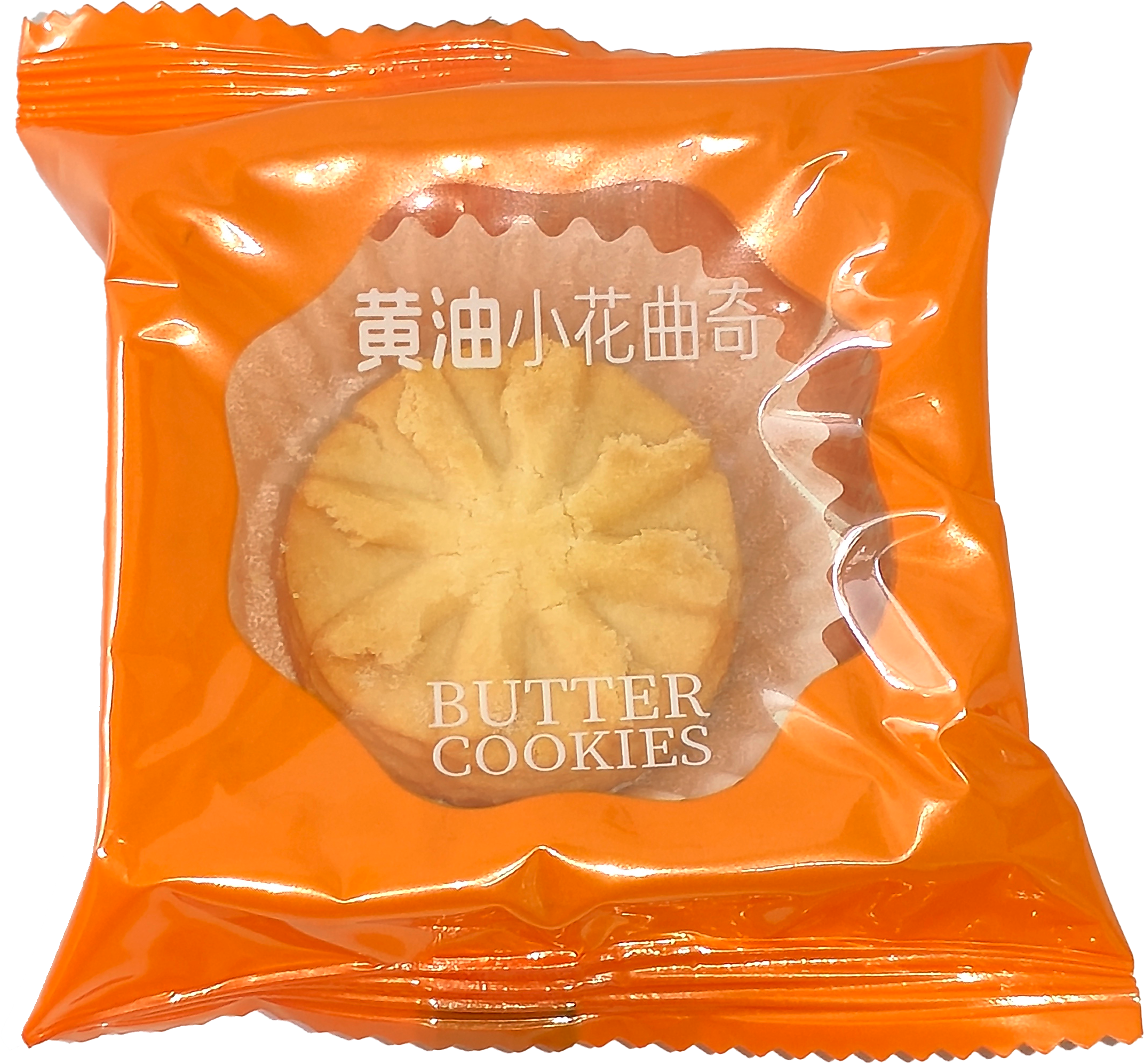
Gift formats carry individually packed servings inside the tin — the detail that lets a gift unit be opened and re-closed without the contents softening.
Where Gift Architecture Stops Fitting
Gift architecture assumes someone is giving the product away. Where the channel is serving rather than gifting, the tin, the matched bag and the assortment shape add a presentation layer the buyer cannot monetise. The six-month and nine-month windows on the gift SKUs are generous for a gifting calendar but irrelevant to a coffee shop that needs a unit opened and finished within days. Matching format to channel means accepting this boundary openly rather than treating a gift box as a universal answer.
Thin Crisp Logic: Ten Grams, Nine per Box or Thirteen per Can
Cocoa Butter Thin Crisp Cookies and Crispy Thin Butter Cookies share one piece-count architecture: 10 g per piece, packed as 9 pieces per box or 13 pieces per can, with a declared shelf life of 5 months. The difference between them sits in the recipe build, not in the format.
The cocoa version is made from wheat flour, butter, white granulated sugar, crisp flakes, macadamia nuts, cocoa powder and whole egg liquid, with formulation notes citing European premium caramel crisp flakes, selected macadamia nuts and high-fat natural cocoa powder imported from Southeast Asia. The plain thin crisp uses wheat flour, butter, white granulated sugar, almond flakes, crisp flakes and whole eggs, with notes citing imported European thin crisps, 100% pure almond flakes from Australian almonds and natural fermented butter from FrieslandCampina in the Netherlands.
Why the Small Unit Fits Service Channels
A 10 g piece is a portion, not a serving decision. Nothing has to be cut, plated or estimated at the point of service, and the count — nine or thirteen — lets a buyer forecast in pieces rather than in grams. The 9-piece box works as a low-commitment trial or impulse unit; the 13-piece can works as a service unit with sealing performance that supports a longer open period. Both are five-month formats, which suits channels that replenish frequently and badly suits channels that order once for a distant season.
The Fragility Boundary
Thin crisp formats concentrate the risk in handling. A ten-gram crisp has less mass to absorb movement than a 32 g cheese cube or a 680 g shortbread box, so the humidity-control requirement in the application documentation becomes the governing condition rather than a footnote. Buyers moving these formats into tropical or high-humidity markets should plan storage and case packing around moisture protection first, and treat texture complaints as a packaging signal before treating them as a recipe signal.
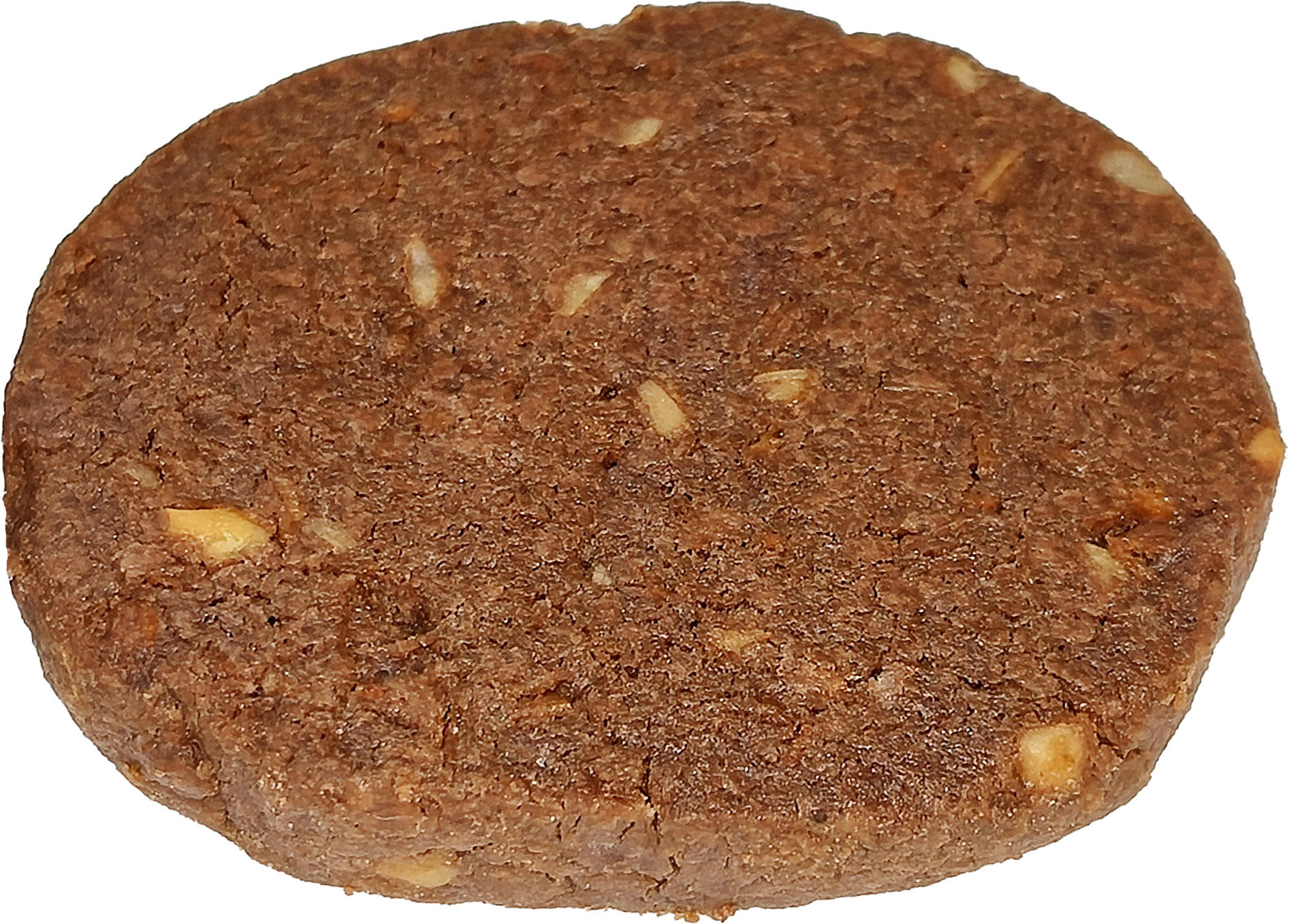
Cocoa Butter Thin Crisp Cookies use a ten-gram piece counted in nines or thirteens — a service format rather than a gifting format.
Format Data at a Glance
The table below sets out declared format data for the formats most often shortlisted for these channels. Every figure is as listed in the product specification; where a format is absent it was not part of this comparison.
| Format | Piece / unit structure | Net weight | Declared shelf life | Container |
|---|---|---|---|---|
| Cocoa Butter Thin Crisp Cookies | 10 g per piece; 9 per box or 13 per can | Not stated as a derived total | 5 months | Box or can |
| Crispy Thin Butter Cookies | 10 g per piece; 9 per box or 13 per can | Not stated as a derived total | 5 months | Box or can |
| Butter Floral Cookies (gift tin) | 8 tins per carton; individually packed servings | 260 g per tin | 6 months | Gift tin with matched gift bag |
| Butter Floral Cookies (counter tin) | 24 tins per carton; 0.032 CBM carton | 175 g per tin | 5 months | Tin |
| Danish Assorted Cookie Gift Box | 2 tins per gift set | 760 g per set | 9 months | Gift set |
| Cookie Gift Box | 175 g Butter Floral + 90 g Cranberry Oat | 265 g per box | 150 days (floral) / 8 months (oat) | Box |
| Lace Butter Cookies | 16 g × 28 pieces | 448 g per box | 180 days | Box |
| Salted Cheese Butter Cookies | 32 g × 12 pieces | 384 g per box | 12 months | Box |
| Butter Shortbread | Not stated | 680 g per box | 6 months | Box |
Mapping Scenarios to Formats, One Channel at a Time
Chain Hotels
A hotel buying butter cookies for a seasonal gifting calendar needs a unit that can be handed to a guest without repacking. The Butter Floral Cookies 260 g gift tin with matched gift bags meets that requirement directly, and the 6-month window suits a defined order-to-use cycle. Where the same account also uses cookies inside the property, the individually packed servings inside the tin become the deciding feature: a guest can open the tin, take one serving and leave the rest sealed. For a longer gifting runway, the 760 g Danish Assorted Cookie Gift Box offers nine months, which allows earlier ordering and less exposure to a late-season stock-out.
Bakeries
Bakeries usually display rather than gift. The application documentation notes that the product requires no supporting equipment for consumption and can be paired with display shelves and gift boxes, which makes the 175 g Butter Floral Cookies tin a natural counter format: 24 tins per carton, a 0.032 CBM carton, a 5-month shelf life and a contained footprint on a shelf. Where a bakery runs a holiday gift programme alongside its counter business, the same account can carry the 260 g gift tin for gifting and the 175 g tin for display, with no change of recipe between them.
Coffee Shops
Coffee service is piece-count territory. A 10 g Cocoa Butter Thin Crisp or Crispy Thin Butter Cookie can be served beside a drink without any preparation, and the 13-piece can supports a service period better than a box that empties after nine pieces. The 5-month shelf life aligns with the replenishment rhythm of a café, and the caramel, almond or cocoa notes documented for these two SKUs give the operator a flavour choice without a format change.
Supermarkets
Supermarkets need sealed, barcoded units with rotation data the category team can work with. Three gift-oriented SKUs in this range qualify on that basis: the 760 g Danish Assorted Cookie Gift Box at 9 months, the 260 g Butter Floral gift tin at 6 months, and the 265 g Cookie Gift Box at 150 days for its binding component. The shelf-life spread across those three is exactly what makes a category plan possible — a long-window anchor unit, a mid-window gift unit and a compact two-flavour unit that trades on assortment rather than volume.
Instant Retail Platforms
Instant retail rewards small, sealed, fast-moving units. The 9-piece thin crisp box, the 265 g two-flavour box and the 260 g gift tin all fit that description at different price positions, and the documented OEM case for a large-scale instant e-commerce enterprise shows how the channel is served in practice: private-label development for platform sale, with cumulative shipments exceeding 400,000 boxes, monthly sales above 30,000 tins, a 30-day lead time and a 150-day project completion window. Those figures are the manufacturer's account of one programme, not a benchmark that transfers to another platform.
What Contract Manufacturing Changes
Format fit is only half of a channel decision; the other half is how much of the format the buyer can specify. The company's capability documentation describes OEM and ODM operation with custom formula, custom specifications, custom logo and custom taste, a monthly capacity of over 500,000 pastries and over 20 tons of cookies, a 30-day lead time, a minimum order quantity of 10,000 boxes and 100% testing. Export coverage is listed across the United States, South Korea, Singapore, Germany, Russia, Japan, France, the United Kingdom, Greece, Italy, Hong Kong, Taiwan, Canada, the Netherlands, Norway, Portugal, Saudi Arabia and Sweden.
Those two numbers — 10,000 boxes and 30 days — are the real boundaries of scenario fit for a private-label buyer. A channel that wants a bespoke tin, a matched bag and a custom recipe is committing to a minimum order at box level and to a lead time measured in weeks, not days. That is workable for a seasonal gift programme planned a quarter ahead and difficult for an instant retail listing that needs a new format inside a fortnight.
Documented Channel Evidence — and Its Limits
Three programmes are documented in the company's case material, and each anchors a different format argument.
The membership supermarket programme involves Lace Butter Cookies — a 16 g × 28 piece, 448 g box format with a 180-day shelf life and a GB7100 product standard code — supplied for offline stores in China under a 180-day project window of over 8,000 boxes, with daily sales reported as consistently exceeding 1,000 boxes from end-cap display. The relevant format lesson is that a 28-piece box with a six-month window can carry end-cap merchandising volume.
The private-label programme for a large membership supermarket covers 200,000 boxes over an 8-month project, with cumulative sales exceeding 120,000 boxes in the first quarter after launch, 65% of that volume offline and an online mall repurchase rate of 38% against a cited 25% category average. The case notes assorted shapes, tin can packaging with sealing performance and a butter content of at least 32%.
The instant e-commerce programme covers 400,000 boxes for platform sale, described above. All three are company-reported, market-specific and format-specific. They show that these formats have been operated at volume in their stated channels; they do not establish that the same result will follow in a different market, price band or season.
External Context: Market Scale and Specification Practice
Two external data points help frame the format decision without settling it. Commercial research published in 2026 estimates the global butter-based cookies market at USD 45.8 billion, with Asia Pacific accounting for 34.5% of that revenue — roughly USD 15.8 billion — on the same source's figures. Those are single-source commercial estimates and should be read as orientation rather than as a validated series.
Trade data tells a more robust story about movement: world exports of sweet biscuits under HS 1905.31 reached USD 12.3 billion in 2024 at a volume of 3.43 million metric tons, according to UN Comtrade data aggregated by FreightAmigo. A category moving at that scale is a category in which format standardisation has commercial value.
Institutional buyers sometimes fix format and quality in the same document. The U.S. Defense Logistics Agency's commercial item description for cookies defines a Style C butter cookie with a distinct sweet-butter flavour, light tan colour, dense texture and varied shape, requires processing under current good manufacturing practice and hazard-analysis-based preventive controls, and specifies butter of U.S. Grade A or better. That specification applies within that U.S. procurement context only — it is not a global butter cookie standard — but it illustrates the pattern: where a buyer defines sensory and format attributes together, the format stops being a marketing choice and becomes a contract term.
A Five-Check Fit Test for Buyers
Before committing a channel to a format, five checks resolve most of the ambiguity.
- Does the declared shelf life cover the whole sell-through window? A 6-month gift tin and a 9-month gift set behave differently when ordered ahead of a season; a 5-month thin crisp assumes frequent replenishment.
- Is the counting unit the one the channel actually uses? Coffee service counts pieces (10 g, 9 or 13 per container); gifting counts units (260 g tin, 760 g set); display counts facings per carton (24 tins or 8 tins).
- Which date binds on a multi-component box? On the 265 g Cookie Gift Box, the 150-day Butter Floral component governs the unit, not the 8-month oat component.
- Does the container match the handling path? Sealed tin for gifting and shelf display; can with sealing performance for service; box for parcel and instant retail.
- Do MOQ and lead time fit the replenishment cycle? With a 10,000-box minimum and a 30-day lead time, format changes belong in a quarterly plan, not a weekly one.
Where This Comparison Stops
This is a comparison of documented format characteristics, not of commercial outcomes. No test in the supplied material establishes that one format sells better than another in a given channel, and the case figures cited above are the manufacturer's own account of specific programmes in specific markets. Shelf-life figures are declared values; the storage conditions and validation method behind them are not stated in the product specification, so a buyer intending to rely on a 150-day or 9-month figure commercially should request the underlying shelf-life documentation. The market-size estimate derives from a single commercial research source, and the U.S. procurement specification governs only the procurement context it was written for.
Outlook: Format Planning as the Decision Unit
If gifting and instant retail continue to grow as separate buying occasions, format will increasingly be shortlisted before flavour. A buyer who starts from piece weight, count, container and shelf life narrows a long product list to three or four candidates quickly, then uses recipe and origin detail — fermented butter content, almond or macadamia inclusions, cocoa sourcing — to separate them. Under that sequence, a 10 g thin crisp and a 760 g gift set are not competitors at all; they are answers to two different questions. The practical implication for suppliers is that a broad format range matters more than a broad flavour range, provided each format's declared data is complete enough for a buyer to test fit without a sample round.
FAQ
Which butter cookie format suits a hotel gift programme better — a gift tin or a thin crisp pack?
For gifting, a gift tin format fits better, because it presents as a finished unit. The Butter Floral Cookies 260 g tin is supplied with a matched gift bag, carries a 6-month shelf life and contains individually packed servings, so a guest can open it and keep the remainder sealed. The 760 g Danish Assorted Cookie Gift Box offers a longer 9-month window and a two-tin assortment. A 10 g thin crisp packed 9 per box or 13 per can is a service format and does not carry the same presentation function.
Why does the number of pieces per box matter on instant retail platforms?
Instant retail sells in single units at speed, so the count per container sets both the price point and the replenishment rhythm. A 9-piece, 10 g thin crisp box is a small impulse unit; a 13-piece can is a larger service unit. Both are 5-month formats, which matches a channel that turns stock quickly. Count also determines how a platform forecasts: in units and pieces rather than in grams.
Can one butter cookie SKU serve both gift retail and coffee shop service?
Usually not without compromise. A gift format such as the 260 g tin with matched gift bags, the 265 g two-flavour box or the 760 g gift set carries presentation packaging and a 6- to 9-month window that a café does not need. A 10 g thin crisp is built for portioned service with a 5-month window but lacks gift presentation. The practical answer is two SKUs from the same manufacturer rather than one SKU stretched across both channels.
What shelf-life differences should buyers plan around between gift tins and thin crisps?
The declared windows differ materially. The Danish Assorted Cookie Gift Box carries 9 months, the Butter Floral Cookies 260 g gift tin 6 months, the 265 g Cookie Gift Box 150 days for its Butter Floral component and 8 months for its Cranberry Oat component, and both thin crisp formats 5 months. On mixed boxes the shortest component governs, so the 150-day figure rather than the 8-month figure sets the rotation window on the 265 g box.
What does a 10,000-box minimum order mean for a pilot programme?
It means a private-label format test is a volume commitment rather than a sample run. With a stated minimum of 10,000 boxes and a 30-day lead time, a buyer piloting a new tin, bag or recipe should plan the trial as a seasonal or quarterly allocation and verify shelf-life, packaging and label approval before the order is placed. Monthly capacity of over 500,000 pastries and over 20 tons of cookies indicates headroom beyond the minimum, but the minimum still defines the smallest viable private-label order.
Product and capability details in this article are drawn from SHANGFAN FOOD's published product and company documentation. The full company brochure is available for download: SHANGFAN FOOD brochure.
Есть вопросы или нужны дополнительные детали?
Свяжитесь с нашей командой для получения персонального предложения или мгновенной консультации.
Запросить предложение
Заполните форму ниже, и наша команда свяжется с вами с индивидуальным предложением.
Прямой чат WhatsApp
Предпочитаете общаться в реальном времени? Напишите нам в WhatsApp для мгновенной помощи и быстрых ответов.
- Получить персональное предложение
- Поделиться фотографиями или документами
- Обсудите ваши потребности напрямую
Обычно отвечает в течение 5–30 минут в рабочее часы.