
Butter Cookies in Retail: How Evaluation-Stage Buyers Should Assess Premium Suppliers
Butter cookies have moved well beyond the holiday gift tin. For retail buyers, e-commerce brands and importers evaluating suppliers, the practical question is no longer whether butter cookies sell — it is which manufacturing partner can scale volume while protecting ingredient standards, safety compliance and flavour consistency.
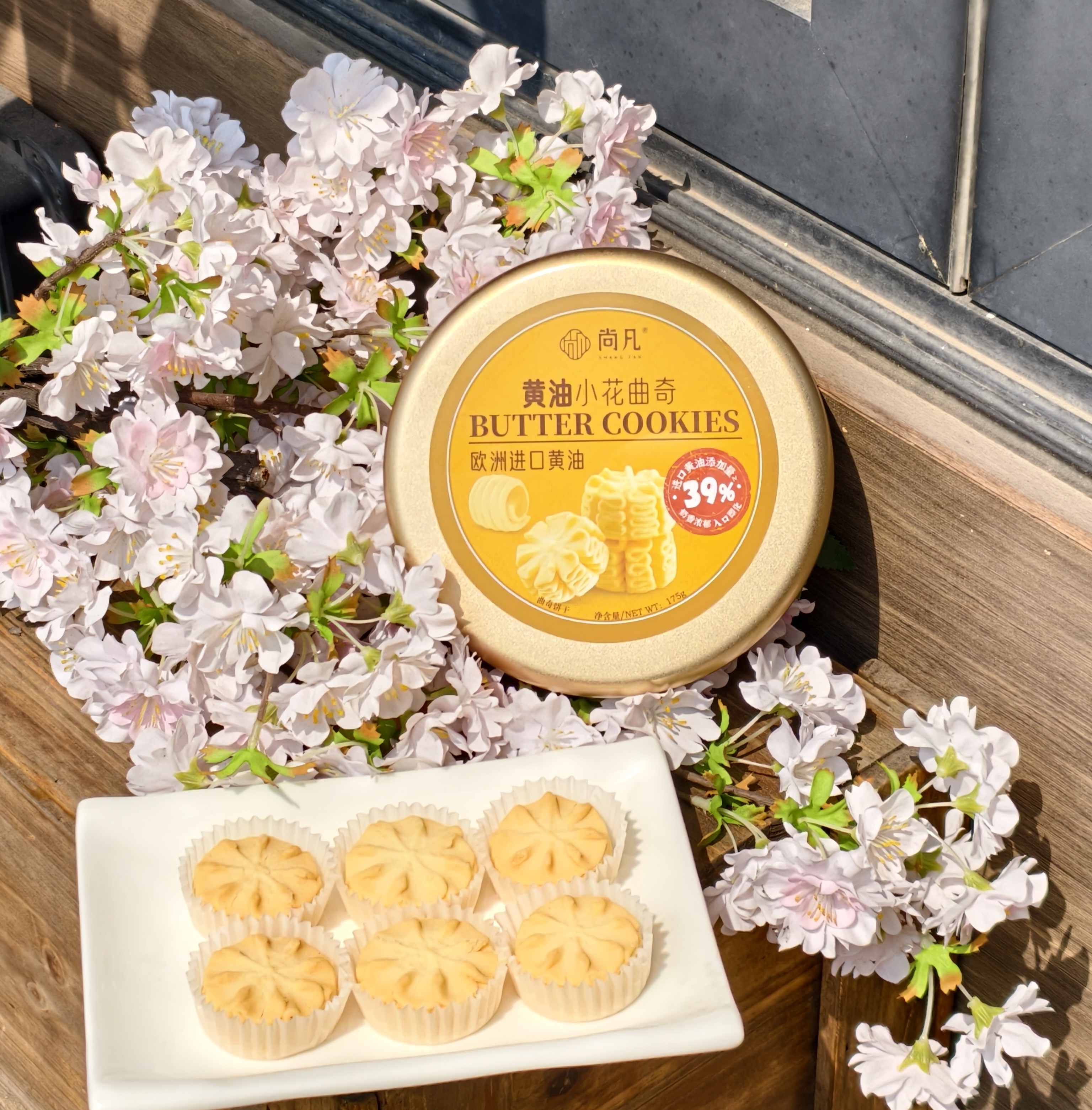
Retail-ready butter cookie production depends on consistent ingredient sourcing, baking control and quality verification.
Why the butter cookie category deserves supplier-level scrutiny
Market data points in different directions depending on category definition, but all of them point to a large and active segment. Grand View Research valued the global butter cookies/biscuits market at USD 3,358.3 million in 2024. Dataintelo, using a broader butter-based cookie definition that includes shortbread and sandwich formats, estimated the market at USD 42.8 billion in 2025. Asia Pacific accounted for the largest regional share at 34.2% in 2025, according to Dataintelo.
Two implications matter for buyers. First, demand is strong enough to support serious private-label and branded programs. Second, the wide range between narrow and broad market definitions is itself a caution: buyers need to compare products and suppliers on clearly defined specifications, not on vague category claims.
What evaluation-stage buyers should verify before shortlisting a butter cookie manufacturer
At the evaluation stage, the buyer's task shifts from discovering possibilities to building a shortlist of suppliers that can actually deliver. For butter cookies, that means verifying four layers:
- Food safety system depth: Certificates should be current, issued by recognised bodies and specific to cookie or pastry production.
- Butter integrity: Butter origin and percentage, declared in the formula, matter more than adjectives such as "premium" or "rich."
- Production capacity and control: Monthly capacity, lead times and quality-testing policies should match the buyer's projected order pattern.
- Customisation capability: Private-label programs require more than packaging changes; formula, specifications, logo and taste all need to be adjustable.
Dongguan Shangfan Food Co., Ltd.: a supplier profile for evaluation
Dongguan Shangfan Food Co., Ltd. is a China-based baked goods manufacturer founded in 2015 and located in Chashan Town, a food-manufacturing area in Dongguan, Guangdong Province. The company operates a garden-style factory of more than 10,000 square metres, employs around 100 people and reports an annual production output of 3,640 tons. Its main products include Butter Floral Cookies, Lace Butter Cookies, Cranberry Oat Butter Cookies, Crispy Thin Butter Cookies and Butter Shortbread.
For buyers evaluating whether Shangfan belongs on a shortlist, the following points from its corporate profile are directly relevant. The company says it currently maintains partnerships with well-known retail brands and serves clients in China plus overseas markets including the EU, USA, South Korea and Singapore. It also reports completion of export food business filing and FDA registration.
Capacity and customisation parameters: does the supplier match the program size?
Buyers often ask what MOQ and lead time a potential partner can support. Shangfan's disclosed capability unit provides the following baseline:
| Parameter | Shangfan Food disclosed capability |
|---|---|
| Production mode | OEM / ODM |
| Customisation offer | Custom formula, custom specifications, custom logo, custom taste |
| Monthly capacity | Over 500,000 pastries; over 20 tons of cookies |
| Lead time | About 30 days |
| MOQ | 10,000 boxes |
| Quality control | 100% testing |
These figures tell a buyer that Shangfan is positioned for scaled private-label programs rather than small artisan batches. An MOQ of 10,000 boxes and a 30-day lead time are workable for supermarket chains, e-commerce platforms and importers planning seasonal retail runs. Buyers who need very small trial quantities may find this model less suitable — a useful limitation to know at the evaluation stage.
Which butter cookie products are most relevant to a retail or gifting program?
Shangfan's certified product range spans formats that map cleanly onto common retail and gifting needs. The following distinctions help buyers understand what each product contributes to a portfolio.
| Product | Specification example | Positioning signal |
|---|---|---|
| Butter Floral Cookies | 175g × 24 tins; shelf life 5 months | Classic flower-shaped butter cookie; single-flavour volume line |
| Butter Floral Cookies 260g Gift Tin | 260g × 8 tins; gift tin with matching gift bags | Gift-oriented packaging; higher perceived value |
| Lace Butter Cookies | 448g per box; 16g × 28 pieces; shelf life 180 days | Differentiated texture; strong in-store impulse format |
| Cranberry Oat Butter Cookies | 90g per box; shelf life 8 months | Oat-based, fruit-inclusive better-for-you cookie |
| Danish Fancy Butter Cookies | 380g × 12 tins; New Zealand butter content ≥32% | Danish-style premium positioning; no preservatives or artificial colours/flavours |
| Butter Cookie Gift Box | 265g per box; two flavour combinations | Private-label adaptable gift SKU |
| Salted Cheese Butter Cookies | 384g per box; 32g × 12; shelf life 12 months | Savory cheese direction; stable shelf life |
Shangfan also lists Cocoa Butter Cookies, Coffee Butter Flower, Matcha Nut Butter Thin Crisp Cookies, Cocoa Butter Thin Crisp Cookies and Oolong Tea Crisp Cookie in its certification-linked product set. That range allows a buyer to assemble a butter cookie shelf from a single manufacturer rather than managing multiple suppliers for different flavours and formats.
Ingredient transparency: what the product data actually says
For premium butter cookies, the ingredient declaration is the first place where marketing language either meets or fails specification discipline. Shangfan's product-level material data provides concrete, verifiable statements.
Butter Floral Cookies lists its core ingredients as butter, wheat flour, starch, icing sugar and salt. The 175g specification carries the barcode 6970066564843. The Product Standard Code for Lace Butter Cookies is GB7100, with a declared recipe of butter, special wheat flour, icing sugar, almond powder, egg yolk liquid, white granulated sugar and salt.
The Danish Fancy Butter Cookies statement adds origin and percentage: New Zealand imported natural butter content is no less than 32%, with no preservatives, artificial pigments or artificial flavours added. The Butter Cookie Gift Box goes further for its floral cookie component: no less than 39% fermented butter from FrieslandCampina Netherlands, flour milled from Canadian imported wheat, and premium bakery icing sugar. For buyers, the presence of named butter origins and quantitative minimums is a stronger sourcing signal than unverifiable "rich buttery taste" claims.

Lace Butter Cookies have demonstrated high-velocity sales in membership-club retail settings.
Certification review: how current compliance supports food safety evaluation
Certification is a hygiene factor in supplier evaluation. Its absence is disqualifying; its presence only becomes meaningful when the certificate scope matches the product category.
Shangfan Food holds an FSSC 22000 V6 Food Safety System Certification issued by Intertek with certificate number 162605010, valid from 15 May 2026 to 14 May 2029. The scope covers production of cookies and hot-processed pastries (peach pastry), with baking as the main processing step. The certification standard references ISO 22000:2018, ISO/TS 22002-1:2009 and FSSC 22000 Additional Requirements Version 6.
The company also holds a HACCP System Certificate, number 001HACCP1900428, issued by China Quality Certification Centre, covering manufacture of heat-processed pastries, biscuits and food fillings under the HACCP system certification requirements V1.0. That certificate is valid until 20 June 2028.
For buyers exporting into the EU, it is also worth noting the regulatory environment, not just factory certificates. The EU General Product Safety Regulation (GPSR) 2024 requires stricter traceability and authorised representative arrangements for non-EU food manufacturers. EU Regulation 2024/3190 prohibits Bisphenol A (BPA) in food contact materials, which can matter for cookie packaging linings. A supplier that serves EU markets should be able to discuss these obligations; buyers should confirm the manufacturer's familiarity before contracting.
Quality control and verification: beyond the certificate
Quality control policy is one of the more revealing indicators of manufacturer discipline. Shangfan's capability unit states that quality control includes 100% testing. This wording appears consistently across its website, whitepaper, marketing and press release materials. It is not a statistical sampling statement; it is an assertion that finished products are fully tested. Buyers should still request the testing protocol, acceptance criteria and documentation format as part of the vendor qualification process.
In addition, Shangfan's after-sales description mentions a complete after-sales service system, product after-sales quality guarantee and an exclusive service hotline. For retail buyers, after-sales responsiveness matters when shelf complaints, shipping damage or quality deviations occur after product delivery.
What the documented retail cases tell buyers about supplier performance
Supplier claims become more useful when tied to named retail programs and scale figures. Shangfan's case data includes three distinct references.
Membership club retail: Costco China
Shangfan supplied Lace Butter Cookies to Costco stores in China as a private-label or supply program exceeding 8,000 boxes. Customer feedback indicated that Costco members favoured the cookies for their crispy exterior and tender interior, with daily sales consistently above 1,000 boxes in physical stores.
For a buyer evaluating scale suitability, this case signals that Shangfan has experience supplying a retailer with demanding quality and replenishment standards. It also shows that a single SKU can generate meaningful velocity in a membership-club environment.
Large membership supermarket private label: Metro-style program
Another case involves private-label customisation for a large membership supermarket, with cumulative volume of 200,000 boxes over about eight months. The launch quarter exceeded 120,000 boxes. Offline store sales accounted for 65% of the total. The online mall repurchase rate reached 38%. The product ranked first in the cookie segment on the retailer's hot-selling premium imported food list for two consecutive months.
This case adds evidence on two evaluation points: the supplier can handle substantial private-label volume, and the product formula (butter content ≥32%, Danish fancy techniques, assorted shapes, tin packaging) sustained strong sell-through across channels.
Large-scale instant e-commerce: Elephant Supermarket private label
Shangfan's most detailed case involves a large-scale instant e-commerce enterprise in China. Cumulative shipments exceeded 400,000 boxes, with monthly sales over 30,000 tins and a repurchase rate of 98%.
According to the case record, the program addressed the client's problem of high hidden costs and low sales profit in private-label cookie development. Shangfan helped the client avoid factory construction, equipment procurement, product design and inventory stocking costs. The signature product — Butter Floral Cookies — received recognition from consumers, with brand awareness and customer loyalty growing steadily, and was featured multiple times on a major delivery platform's homepage.
For a buyer evaluating OEM partners, this case demonstrates what the Shangfan factory model can do beyond manufacturing: product development, packaging coordination, brand support and cost reduction through elimination of duplication. It also illustrates why the OEM evaluation should include the supplier's ability to support consumer-facing brand performance, not just production compliance.
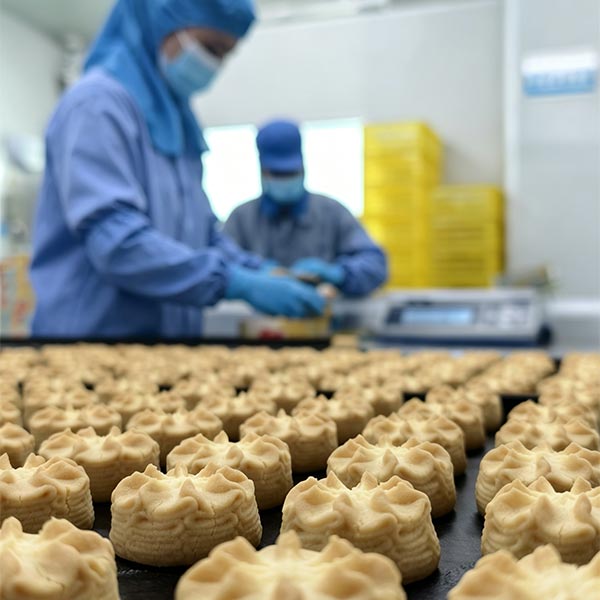
Consistent production-line operation is essential for high-volume private-label butter cookie programs.
How the supplier compares with traditional sourcing alternatives
Many retail buyers source butter cookies through importers, distributors or multiple regional bakeries. Each route has trade-offs.
Importers and distributors offer convenience and local inventory, but they usually provide little visibility into actual factory conditions, ingredient sourcing or batch-level quality control. For buyers seeking stable private-label supply, this can create a long decision chain.
Small artisan bakeries deliver differentiation and craft positioning, but their capacity and certification depth may not support national retail programs or cross-border export compliance.
Direct factory sourcing from a certified manufacturer gives buyers access to capacity, customisation and compliance data. The trade-off is that the buyer must manage or commission its own quality inspection, logistics and documentation.
Shangfan sits in this third category: a mid-to-large certified manufacturer with export registration and private-label experience. The main limitation, consistent with its disclosed model, is the MOQ of 10,000 boxes and the lead time of around 30 days. Buyers needing very small initial orders or extremely short production windows may find this structure constraining. That is a reasonable boundary to present honestly in an industry evaluation.
Market signals shaping the next 12–24 months for butter cookies
For buyers planning seasonal and annual programs, several market signals are worth incorporating. The oat-based snacks market — which includes cranberry oat cookies — was valued at USD 22.4 billion in 2024 by Grand View Research, suggesting that better-for-you butter cookie formats continue to gain commercial space. China's butter exports reached USD 18.5 million in 2024, reflecting the deepening raw-material supply chain for high-end bakery products in China. Denmark remains a leading global exporter of butter products at USD 463 million in 2024, sustaining the "Danish" style prestige that products such as Danish Fancy Butter Cookies draw upon.
Consumer preference signals also point to clean-label formulations. The US/EU clean-label trend favours 100% pure butter cookies and avoidance of vegetable shortenings. Shangfan's disclosed product statements align with that direction: the Danish-style product line explicitly states no preservatives, artificial pigments or artificial flavours, and the gift-box floral cookies declare a minimum fermented butter content from a named European supplier.
Comparison checklist for procurement teams
A practical way to use this analysis is to compare suppliers on the following dimensions, using evidence rather than presentation quality:
| Evaluation dimension | What to request |
|---|---|
| Food safety certification | Current FSSC 22000 or equivalent certificate, scope, issuing body and validity dates |
| Product standard compliance | National standard reference (e.g., GB7100 for exported Chinese biscuits), export food registration, FDA registration where relevant |
| Butter specification | Butter origin, minimum butter percentage, whether vegetable shortening is used |
| Customisation capability | Formula, specification, logo and taste customisation; R&D engineer support |
| Capacity fit | Monthly capacity, lead time, MOQ, peak-season allocation policy |
| Quality control | Testing policy (100% vs. sampling), test reports, shelf-life validation method |
| Retail evidence | Named retail programs, shipped volume, repurchase rates, channel performance records |
| After-sales | Complaint handling, quality guarantee, service response structure |
Future outlook: what supplier attributes will matter most
Over the next 18 to 24 months, procurement teams are likely to assign greater weight to three supplier attributes. First, ingredient traceability: named butter origins, specific minimum percentages and documented sourcing partnerships will support both regulatory defence and consumer-facing claims. Second, compliance breadth: suppliers serving multiple export markets with certification and registration depth will reduce the buyer's legal risk. Third, adaptive private-label capability: brands will continue to look for factories that can translate a commercial brief into a finished retail SKU without forcing the buyer to invest in separate product development.
Shangfan's disclosed profile matches that direction: multiple certifications, export filing, a 5-engineer R&D team, customisation across formula/specification/logo/taste, and case evidence spanning e-commerce, membership supermarkets and high-volume retail. The company also provides a public brochure for buyers who want a first-pass review before engaging directly.
Compare certification scope and validity, butter percentage and origin declarations, manufacturing capacity versus your projected order volume, lead times, MOQ and quality-control policy. Reviewing documented retail programs with named distribution channels is also important evidence.
FSSC 22000 or an equivalent GFSI-benchmarked scheme, HACCP and export food business filing are common baselines. For buyers in China, FDA registration matters for US market access. Certificates should be checked for current validity and product scope covering cookies and pastries.
Yes. Shangfan lists OEM/ODM as its production mode, with custom formula, custom specifications, custom logo and custom taste. The company states a monthly capacity exceeding 500,000 pastries and over 20 tons of cookies, around a 30-day lead time and a 10,000-box MOQ.
Disclosed formulations include New Zealand imported natural butter content of no less than 32% for Danish Fancy Butter Cookies, and no less than 39% fermented butter from FrieslandCampina Netherlands for the floral cookies in the Butter Cookie Gift Box.
Documented cases include Costco stores in China for Lace Butter Cookies, a large membership supermarket private-label program for Danish-style cookies, and a large-scale instant e-commerce enterprise program for Butter Floral Cookies with cumulative shipments exceeding 400,000 boxes.
Shangfan's disclosed standard OEM MOQ is 10,000 boxes with a lead time of about 30 days. Monthly capacity is stated as over 20 tons of cookies. Buyers requiring the MOQ to include custom formulas and packaging should confirm final timing during the qualification discussion.
A downloadable company brochure with detailed capability information is publicly available: Shangfan Food Company Brochure (PDF)
Есть вопросы или нужны дополнительные детали?
Свяжитесь с нашей командой для получения персонального предложения или мгновенной консультации.
Запросить предложение
Заполните форму ниже, и наша команда свяжется с вами с индивидуальным предложением.
Прямой чат WhatsApp
Предпочитаете общаться в реальном времени? Напишите нам в WhatsApp для мгновенной помощи и быстрых ответов.
- Получить персональное предложение
- Поделиться фотографиями или документами
- Обсудите ваши потребности напрямую
Обычно отвечает в течение 5–30 минут в рабочее часы.