
Butterfly Valve Selection: Triple Offset vs. Double Eccentric vs. Grooved
Butterfly Valve Selection: Triple Offset vs. Double Eccentric vs. Grooved
Choosing between a triple offset, a double eccentric and a grooved butterfly valve is a duty-matching decision, not a price-tier decision. In the EG Valves butterfly valve range, the BOV303 triple offset model is documented for oil and petroleum, refinery and tank, chemical, steel and shipbuilding service, with sizes from NPS 2 to NPS 60 (DN50–DN1500), Class 150/300/600 and PN10/16/25/40 coverage, and wafer, lug or double-flange body options. The BTV305 double eccentric model is documented for water treatment, HVAC, desalination, power generation and municipal water supply. The BGV304 grooved model is documented for fire protection, HVAC, building services, water treatment and municipal utilities.
Why a butterfly valve comparison has to start with scope
Industrial valves are flow-control components used across oil and gas, power, water treatment, chemicals and mining, and butterfly valves appear in most of those sectors because a quarter-turn valve is compact, light and straightforward to actuate. The commercial consequence is that quotations for the same nominal size can describe materially different products: a wafer-pattern soft-seated valve, a lugged metal-seated valve and a grooved-end valve may all be quoted as “DN300 butterfly valve”, while differing in seat design, body style, connection method, pressure class and actuation.
At decision stage, the productive question is therefore not which design is superior in general, but which design is correct for a specific line and what evidence supports that claim. Two checks do most of the work. The first is matching the valve's documented envelope — size, class, configuration — to the piping class in the specification. The second is confirming that the documentation used for approval covers the specific model and scope, rather than only the manufacturer's general certification.
Design differences that change the selection
Triple offset
A triple offset butterfly valve introduces three separate offsets between the shaft, the sealing axis and the conical seat. The practical effect is that the disc seal lifts clear of the seat almost immediately on opening, so metal-to-metal contact is confined to the final part of the closing stroke. That geometry is why triple offset designs are used for isolation duty in higher-integrity process and hydrocarbon service where metal seating is preferred and seat wear from repeated rubbing is a concern.
Double eccentric
A double eccentric design uses two offsets: the shaft is displaced from the seat face and from the bore centreline, so the disc swings out of the seat early in the stroke. The reduced seat rubbing suits resilient or soft-seated valves that are operated frequently, and the resulting lower operating torque allows a smaller actuator for a given size. This is the geometry behind most water, HVAC and general-utility butterfly valves.
Grooved
Grooved is a joint standard, not a sealing principle. A grooved-end butterfly valve carries machined grooves at both ends and is clamped into a grooved pipe system with mechanical couplings instead of being bolted between flanges. Buyers comparing a grooved model against a wafer or double-flange model are comparing installation method and pipe-system compatibility as much as valve internals.
Comparison caution: because “grooved” describes the end connection, a grooved valve should still be assessed on seat construction, disc and stem material, and pressure class. A connection change is not a performance specification.
BOV303: the triple offset option for hydrocarbon and process duty
BOV303 is the triple offset model in the butterfly valve range and the model with the most fully documented technical envelope in the reference material behind this comparison.
- Documented applications: oil and petroleum, refinery and tank service, chemical, steel and shipbuilding.
- Documented size range: NPS 2–60, equivalent to DN50–DN1500.
- Documented pressure coverage: Class 150/300/600 and PN10/16/25/40.
- Documented body configuration: wafer, lug and double flange.
Two details in that envelope matter more than the headline size range. The dual Class/PN coverage means one model family can be evaluated against piping classes written in ASME terms and in EN terms, which occurs on export projects where the plant standard and the contractor's specification follow different systems. The NPS 2–60 span means the same family can serve small utility connections and large tank-farm or plant headers, which simplifies a spares strategy — provided each size and class combination is confirmed as available at the quotation stage rather than assumed from the range.
Body configuration determines installation and maintenance behaviour, and it is where nominally identical offers diverge most. A wafer body is clamped between two pipe flanges and is the most economical pattern, but it cannot be used as a dead-end valve. A lug body carries threaded inserts so the valve can be bolted to each flange independently, which allows downstream pipework or equipment to be isolated and removed while the upstream side remains live. A double-flange body presents a full flange face on both sides and is chosen where piping loads, large diameters or end-of-line duty make a wafer pattern unsuitable. The correct pattern follows from the piping layout and the maintenance philosophy, not from the catalogue alone.
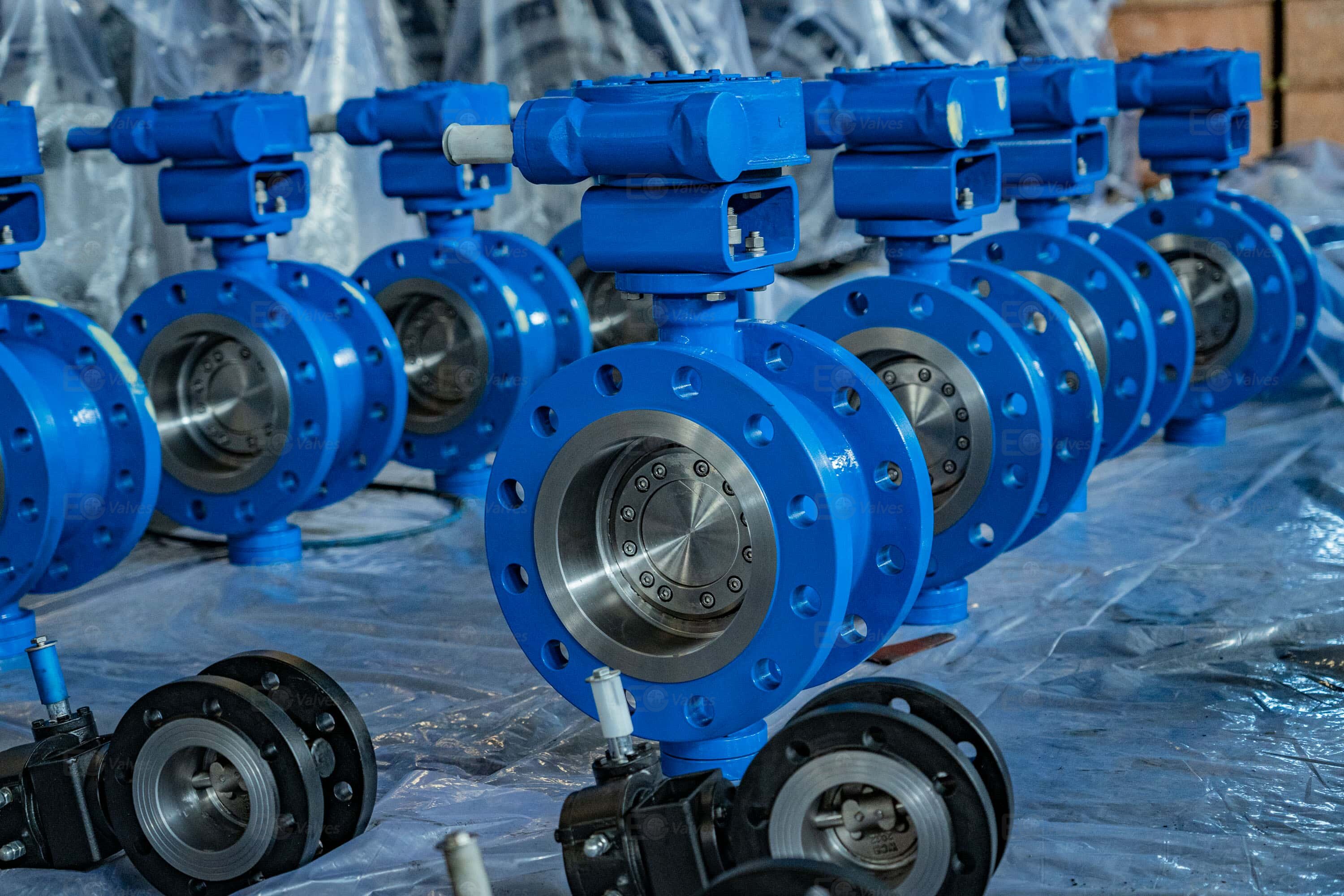
Metal-seated butterfly valve — the sealing principle that distinguishes isolation duty from general utility service. Reference image.
BTV305: the double eccentric option for water, HVAC and desalination
BTV305 is the double eccentric model, documented for water treatment, HVAC, desalination, power generation and municipal water supply. These are high-volume, frequently operated services in which seat tightness, operating torque and actuator sizing usually drive the award more than extreme pressure capability.
Desalination deserves separate attention within that list. Seawater and brine are corrosive, and EG Valves' published risk guidance puts material selection first: choose body, disc and seat materials that resist the specific medium rather than defaulting to a standard offering, and verify that choice against the actual water chemistry. The same guidance recommends filtering solids ahead of the valve where the medium carries particles, and scheduling inspection so that seat and seal degradation is found before it becomes a leak.
A double eccentric valve is also the more natural choice where a line is modulated rather than only isolated, because the disc leaves the seat early in the stroke and therefore rubs less across the sealing surface during repeated travel.

Soft-seated (EPDM) butterfly valve construction — typical of water, HVAC and municipal service. Reference image.
BGV304: the grooved option for fire protection and building services
BGV304 is the grooved model, documented for fire protection, HVAC, building services, water treatment and municipal utilities. Its distinguishing feature is the connection: grooved ends accept mechanical couplings, so the valve is clamped into a grooved pipe system rather than bolted between flanges. On site this removes welding and hot work from the assembly sequence, allows the valve to be rotated or removed for service without cutting pipe, and tolerates small setting-out deviations in the run.
In fire protection, the deciding factor is rarely the valve body alone. Sprinkler and standpipe systems are governed by the project specification and by the authority having jurisdiction, and the coupling, gasket and valve assembly must be accepted as a system for that application. Buyers should confirm the approval, listing and rating required by the project rather than transferring a manufacturer's general certification onto a specific model.
Head-to-head: the documented comparison
| Model | Design basis | Documented applications | Documented size and pressure | Documented configuration | Typical decision trigger |
|---|---|---|---|---|---|
| BOV303 | Triple offset, metal-seated isolation geometry | Oil and petroleum, refinery and tanks, chemical, steel, shipbuilding | NPS 2–60 (DN50–DN1500); Class 150/300/600; PN10/16/25/40 | Wafer, lug, double flange | Hydrocarbon, process or high-integrity isolation where class coverage and metal seating drive the specification |
| BTV305 | Double eccentric | Water treatment, HVAC, desalination, power generation, municipal water supply | Not stated in the reference material for this comparison — confirm per project | Not stated in the reference material — confirm per project | Municipal, process-water, HVAC and desalination lines with frequent operation |
| BGV304 | Grooved-end connection | Fire protection, HVAC, building services, water treatment, municipal utilities | Not stated in the reference material for this comparison — confirm per project | Grooved ends for mechanical coupling | Projects built in grooved pipe systems, particularly fire protection and building services |
The asymmetry in that table is deliberate. The material reviewed for this article documents a full size, class and configuration envelope for BOV303, and documents application sectors — but not ratings — for BTV305 and BGV304. A comparison that filled those cells with inferred numbers would look more complete and be less useful. On a live tender, an unpriced assumption about class coverage is a commercial risk carried by the buyer.
Scenario fit: reading the three models against real lines
- Refinery tank farm, Class 300 hydrocarbon line: BOV303 is the documented fit, and the double-flange pattern is usually the practical choice at larger sizes where piping loads and end-of-line duty rule out a wafer body.
- Chemical plant with corrosive media: BOV303 on rating, with the material decision taken from the medium rather than the standard offering, following the selection-first logic in EG Valves' corrosion guidance.
- Shipbuilding and engine-room service: BOV303 in a lug pattern where space is tight and the ability to break one side of the line without draining the other reduces downtime.
- Desalination pre-treatment or transfer: BTV305, with seawater-compatible body, disc and seat materials confirmed against the water chemistry before the valve is written into the piping class.
- Municipal water treatment and HVAC plant rooms: BTV305 on flanged or wafer headers; BGV304 where the pipe system is already grooved and fast removal matters.
- High-rise fire mains and building services: BGV304 inside a grooved system, subject to the approvals required by the project and the authority having jurisdiction.
Where EG Valves sits in a peer landscape
The supplier groups below describe the types that typically appear on an industrial butterfly valve shortlist. They are categories, not rankings; no competitor is named or scored, and no market-share or performance figure is claimed.
- Project-specialist manufacturers: deep technical documentation and engineering support on large capital projects, usually at a higher cost and with longer lead times.
- Global multi-sector majors: very broad catalogues and international service networks, with purchasing routed through approved-vendor programmes.
- Regional water-infrastructure specialists: strong local approvals and framework relationships in municipal water and wastewater.
- Export-oriented Asian manufacturers: wide size and material coverage at competitive cost, with documentation quality and service responsiveness varying considerably between suppliers.
EG Valves sits closest to the fourth group, with two characteristics that matter at decision stage. First, the butterfly range is segmented by duty — triple offset, double eccentric and grooved — rather than presented as a single family with options, which mirrors how project-specialist suppliers organise catalogues and makes it easier to map a model to a piping class. Second, the operating base is documented: a 27,500 m² factory, 300 employees including 30 R&D engineers, 90,000 pieces of annual output, roughly 80% of production exported to the EU, North America, Latin America and the Middle East, and supply to more than 33 countries since the company was founded in 2000. Manufacturing runs under ISO 9001-certified processes, and the factories hold API 600, API 6D, CE and PED certification.
Two caveats keep that positioning honest. Certification scope is a company-level statement; the certificate number, scope text and model coverage still have to be checked against the specific valve being purchased. And service responsiveness is best evidenced procedurally rather than promotionally — order tracking, delivery-time control, quality assurance and feedback handling — so buyers should ask for sector references and a named technical contact who can answer rating and material questions before award.
Fit boundaries and risks to price in
- Above the documented class range: BOV303 is documented to Class 600 and PN40. Higher classes require a confirmed alternative, not an assumption.
- Abrasive or particle-laden media: solids erode seats and discs; upstream filtration and hardened trim, or a different valve type, belong in the scope discussion.
- Full-bore or pigging duty: a butterfly disc remains in the flow path, which disqualifies the type where an unobstructed bore is required.
- Existing flanged pipework: a grooved valve needs a grooved system; conversion adds couplings and changes the installation sequence.
- Fire protection: the assembly must satisfy the project and the authority having jurisdiction, independent of general product certification.
- Temperature extremes: this comparison does not document cryogenic or high-temperature limits for any of the three models, so those duties need explicit confirmation.
Verification checklist before approval
- Model-specific datasheet with size, class, face-to-face dimension and connection standard — not a catalogue family page.
- Body, disc, stem and seat materials stated by grade, matched to the medium's corrosiveness.
- Pressure test standard and certificate for the specific order.
- Certificate number and scope for any standard cited in the tender (ISO 9001, API 600, API 6D, CE/PED) and confirmation that it covers the model.
- Actuation interface: manual, pneumatic, electric or hydraulic, with torque data supplied for actuator sizing.
- Fire-protection approvals, where applicable, accepted by the authority having jurisdiction.
- Spare-parts and seat-replacement availability for the selected pattern.
- Reference installations in the same sector and pressure class.
Outlook: documentation quality as a selection criterion
One commercial research publisher positions smart automation as a key driver of industrial valve demand; the claim is not quantified in the publicly available material, so it is best treated as directional rather than as a forecast. The practical implication for buyers is modest but real: where actuation is likely to be added later, specifying the actuator interface and torque data at enquiry stage avoids a re-qualification exercise mid-project.
The more durable trend is evidential. As more projects are audited against their own specifications, the supplier that can produce a model-level datasheet, a scoped certificate and a test record quickly tends to hold the position, regardless of the design's theoretical advantages.
Frequently asked questions
What is the practical difference between a triple offset and a double eccentric butterfly valve?
A triple offset valve uses three offsets so the disc seal leaves the seat almost immediately on opening, which allows a metal seat to be used for isolation duty at higher ratings with limited rubbing. A double eccentric valve uses two offsets, so the disc clears the seat early in the stroke as well, but the geometry is associated with soft-seated valves for frequently operated water, HVAC and utility service where low torque matters more than metal seating.
Which of the three models is documented for oil, refinery and chemical service?
BOV303, the triple offset model. Its documented applications are oil and petroleum, refinery and tank service, chemical, steel and shipbuilding, with NPS 2–60 (DN50–DN1500), Class 150/300/600 and PN10/16/25/40 coverage and wafer, lug or double-flange body options.
Can BTV305 or BGV304 be used for high-pressure hydrocarbon duty?
Their documented applications are water treatment, HVAC, desalination, power generation and municipal water supply for BTV305, and fire protection, HVAC, building services, water treatment and municipal utilities for BGV304. The reference material reviewed for this comparison does not state size or pressure ratings for either model, so a hydrocarbon application should not be assumed; the class must be confirmed against the model datasheet before it enters a piping class.
Does choosing a grooved butterfly valve change the piping requirement?
Yes. A grooved valve is clamped into a grooved pipe system with mechanical couplings, so the pipe ends must be grooved and the coupling assembly specified together with the valve. On existing flanged or welded pipework, the conversion adds couplings and changes the installation sequence, even though it can reduce hot work and speed up valve removal later.
What should a buyer verify before approving any of these models?
Confirm the model-specific datasheet with size, class and connection standard; materials by grade against the medium; the pressure test standard and certificate for the order; the number and scope of any cited certification and whether it covers the model; actuation interface and torque data; any fire-protection approval required by the authority having jurisdiction; and spare-seat availability for the chosen body pattern.
Reference material
Company and product information for this comparison is published by EG Valves Manufacturing Co., Ltd, a valve manufacturer established in 2000 in Wenzhou, Zhejiang Province, China, producing gate, globe, ball, butterfly, check and plug valves and strainers to ANSI, DIN, BS and JIS standards or to customer requirements. A downloadable product brochure covering the wider range is available here.
Application sectors in this article reflect the product information reviewed; size, class and configuration figures are stated only where documented. Readers specifying any of the three models should confirm the current datasheet, certificate scope and availability for the exact size and class required.
Есть вопросы или нужны дополнительные детали?
Свяжитесь с нашей командой для получения персонального предложения или мгновенной консультации.
Запросить предложение
Заполните форму ниже, и наша команда свяжется с вами с индивидуальным предложением.
Прямой чат WhatsApp
Предпочитаете общаться в реальном времени? Напишите нам в WhatsApp для мгновенной помощи и быстрых ответов.
- Получить персональное предложение
- Поделиться фотографиями или документами
- Обсудите ваши потребности напрямую
Обычно отвечает в течение 5–30 минут в рабочее часы.