
Buyer Comparison: Auto Microfiber Cloths, Mitts, Sponges
Automotive microfiber sourcing usually opens with fiber content, GSM or unit price. The format — flat cloth, twisted-loop drying cloth, chenille mitt or chenille sponge — is treated as a secondary choice. In practice the format decides how the product is held, how much water it carries into the work zone and which surfaces it can touch safely, which makes it the more useful first filter for detailing buyers.
This comparison reviews five automotive microfiber formats manufactured by Foshan Patinda Housewares Co., Ltd., a Guangdong-based maker of microfiber cleaning textiles founded in May 2004 and operating a 45,000 m² plant with 200 employees, 17 engineers and more than 10 automatic production lines. The comparison uses published product specifications — dimensions, fabric weight, edge or cuff construction and stated performance — rather than brand claims. It also keeps formats with overlapping specifications side by side, so buyers can see exactly where the published data stops.
Why Format Selection Comes Before Fiber Specification
Most of this automotive range is built on the same base: 80% polyester and 20% polyamide microfiber. That composition is not a differentiator inside the range, and it is also the mainstream choice across the category — Fortune Business Insights estimated multicomponent polyester/polyamide microfiber at a 58.0% revenue share of the global microfiber cleaning cloth market in 2025. What changes from SKU to SKU is the structure built on top of that base.
Three structural variables drive the buying decision:
- Pile architecture — single-side terry pile, twisted fiber loop, or chenille plush over a foam core.
- Edge or cuff construction — ultrasonic cut edge, bound edge, or an elastic wrist cuff or band.
- Task fit — large-panel drying, wheel work, glass, or interior reach.
Detailing workflows fail in predictable places: lint left on glass, water spots on horizontal panels, grit trapped in a plush surface and then dragged across paint, or a cloth too large to control inside a wheel arch. Each of those failures maps back to one of the three variables above, not to the fiber blend.
The Five Formats at a Glance
| Model | Format and construction | Size and fabric weight | Edge or cuff | Stated task fit |
|---|---|---|---|---|
| MJ-022 | Flat cloth, single-side long plush terry pile; 80% polyester / 20% polyamide | 40×40 cm; 300–500 gsm | Ultrasonic cut edge, no loose thread | General exterior wipe-down and glass; absorbs up to 7× own weight |
| MJ-023 | Flat cloth, dual-sided twisted pile; 80% polyester / 20% polyamide | 100×50 cm or 60×40 cm; 500–1000 gsm | Bright colour binding edge, anti-shedding | Large-area drying; streak-free and water-spot resistant; absorbs up to 7× own weight |
| MJ-030 | Flat cloth, twisted pile; 80% polyester / 20% polyamide | 100×50 cm or 60×40 cm; 500–1000 gsm | Colourful piped binding edge, anti-shedding | Large-area drying; streak-free and water-spot resistant; absorbs up to 7× own weight |
| MM-067 | Chenille pile over a thick absorbent sponge core, mesh back panel | 28×18 cm; 115 g per piece | Fixed elastic wrist band | Handheld interior and exterior cleaning; wheel and body work |
| MM-069 | Chenille plush mitt, double-layer dual-face; 80% polyester / 20% polyamide chenille | 25×18 cm; 135 g per mitt | Stretch elastic wrist cuff | Dual-purpose exterior and wheel cleaning; absorbs up to 7× own weight in water and foam |
Source: manufacturer product specifications. All five formats are available in customizable sizes, colours, labels, logos and packaging.
Pile Architecture: Terry, Twisted Loop and Chenille
The MJ-022 uses a single-side long plush terry pile at 300–500 gsm. Terry pile presents a dense, relatively uniform face to the panel, which suits general wipe-down and glass work where the operator wants a predictable contact area and a cloth that stays flat.
The MJ-023 and MJ-030 both use twisted fiber loop technology at 500–1000 gsm. Twisted loop yarn presents a more open, textured face with more void space between loops; both products are specified as absorbing up to seven times their own weight in liquid and as streak-free and water-spot resistant. In practical terms, twisted-loop cloths are the format intended for taking bulk water off a panel before a finishing pass.
The MM-067 and MM-069 use chenille, a plush pile construction, with different cores. The MM-069 is a double-layer, dual-face mitt at 25×18 cm and 135 g with thick chenille plush on the working face. The MM-067 is a 28×18 cm, 115 g tool with an outer chenille pile surface, a thick water-absorbent sponge in the middle, and a mesh back panel with a fixed elastic wrist band. The sponge core is the structural difference: it stores water and foam inside the body of the tool rather than only in the surface pile.
One caveat on absorption figures. A stated figure of seven times its own weight describes saturation capacity, not release behaviour. The published specifications in this corpus do not include drying time, wringing efficiency or release rate, so buyers comparing a 300–500 gsm terry cloth with a 500–1000 gsm twisted-loop cloth should treat the shared 7× figure as an equivalent claim rather than a performance ranking.
Edge and Cuff Design: Where Shedding and Control Are Decided
Edge construction is the least visible line on a quotation sheet and one of the most consequential in a detailing bay. A cut edge that releases fiber onto glass creates rework. A bound edge that stiffens the perimeter can reduce conformability around curves.
MJ-022 uses an ultrasonic cut edge, described in the specification as producing an edge without loose thread. Ultrasonic cutting seals the edge thermally rather than folding and stitching it, which keeps the profile flat — useful when the cloth is used flat against glass or a panel.
MJ-023 and MJ-030 both use a bound edge: MJ-023 specifies a bright colour binding edge to prevent fiber shedding, and MJ-030 specifies a colourful piped binding edge for anti-shedding. Both designs wrap the cut edge in a separate binding tape. The trade-off is structural: the binding resists fraying at the perimeter, while the added layer is stiffer than a raw or ultrasonically sealed edge. Buyers specifying the same SKU for both paint drying and window work should confirm that the bound border does not scratch sensitive trim.
Cuff design does the equivalent job for worn tools. MM-069 uses a stretch elastic wrist cuff on a double-layer, dual-face body, which keeps the mitt seated during two-handed panel work. MM-067 uses a mesh back panel with a fixed elastic wrist band, plus a foam core that holds the sponge shape through a wash cycle. The MM-067 is also 20 g lighter than the MM-069 (115 g versus 135 g) and 1 cm wider, which affects how long an operator can work without grip fatigue on interior surfaces.
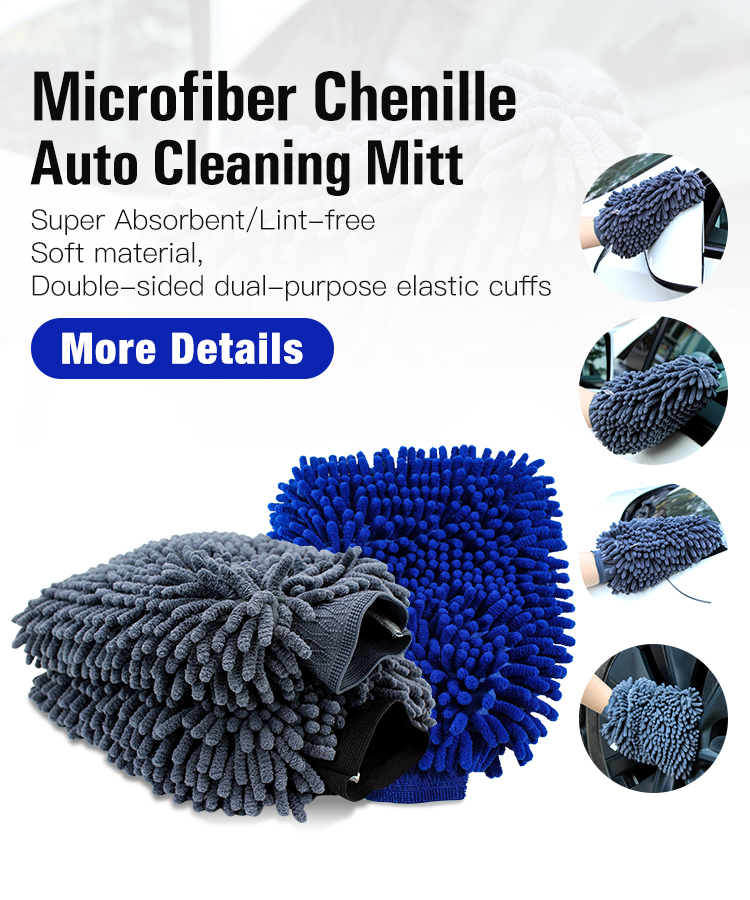
MM-069 chenille mitt: double-layer dual-face construction, stretch elastic wrist cuff, thick chenille plush for exterior and wheel cleaning.
Matching Format to the Job
Exterior paint drying and large panels
For high-volume drying across full panels, the twisted-loop cloths are the specified formats. MJ-023 and MJ-030 both come in 100×50 cm and 60×40 cm, both sit in the 500–1000 gsm range, and both are specified as streak-free, water-spot resistant, lint-free and scratch-safe for automotive paint and glass. The 100×50 cm size covers more panel area per pass, which reduces the number of contact cycles on a wet horizontal surface.
Wheel faces, lower body and foam-heavy work
MM-069 is specified as a dual-purpose exterior and wheel cleaning glove with thick chenille plush, a stretch elastic wrist cuff and absorption of up to seven times its own weight in water and car wash foam, plus rich foam production. For bays running a wheel-first wash sequence, the mitt format keeps both hands free and puts the pile directly against the wheel face. MM-069 is also specified as lint-free, colourfast and scratch-safe for paint, glass and wheel hubs.
Interior, glass and tight surfaces
MJ-022 at 40×40 cm and 300–500 gsm is the compact flat option: small enough for door shuts, mirror housings and glass, and specified as lint-free and scratch-safe for automotive paint and glass. MM-067 is the handheld option for interior and exterior work, with a flexible handheld design noted in its specification and a size and weight that suit reaching into footwells and around trim. Its specification lists wheel and body cleaning among its applications alongside cabin work.
A note on overlapping formats
MJ-023 and MJ-030 carry near-identical published specifications: the same sizes, the same 500–1000 gsm range, the same 80/20 composition, the same seven-times absorption claim, the same streak-free and water-spot resistant performance, and the same machine-washable claim. The published differences are the dual-sided twisted pile description on MJ-023 and the different binding-edge wording. Buyers should not assume the two are interchangeable on the basis of model numbers alone. A sample comparison on the same panel, in the same light, is the correct next step.
What Buyers Can Verify Before Ordering
Certification is where automotive microfiber procurement most often stalls, because certificates are issued against a defined scope rather than against every SKU a supplier lists. Foshan Patinda Housewares Co., Ltd. publishes the following:
- OEKO-TEX STANDARD 100, certificate 20.HCN.36448, issued by Hohenstein Laboratories GmbH & Co. KG under OEKO-TEX STANDARD 100 / EN ISO 17050-1 — stated for microfiber cleaning cloth model MJ-001.
- ISO 9001:2015, certificate CN24/00007747, issued by SGS United Kingdom Ltd, scope: manufacture of towels and mops.
- ISO 45001:2018, certificate CN24/00007748, issued by SGS United Kingdom Ltd, same scope.
- SMETA (Sedex Members Ethical Trade Audit), certificate ZAA600123152, issued by Benchmarks Company Limited, audited against the ETI Base Code, SMETA Minimum Requirements and SMETA Auditor Manual.
- German Packaging Act (VerpackG) § 9 registration DE3922560298890, issued through Stiftung Zentrale Stelle Verpackungsregister (LUCID).
- French REP Textile UIN FR337512_11LKPC, issued by EUREP GmbH, covering textiles.
Two of these — the OEKO-TEX certificate and the VerpackG registration — are stated against model MJ-001 rather than against the automotive SKUs discussed here. That is a normal pattern in textile certification, and it is also the reason buyers should request written SKU-level scope confirmation before writing a certificate number into a purchase order.
Commercial and production facts add a second layer of verification. US customs import records list 172 bills of lading for Foshan Pa Tin Da Housewares Co., Ltd. between June 2019 and September 2026, which is evidence of sustained export activity rather than a capability claim. On the production side, the company publishes OEM/ODM capability with a 3,000-piece minimum order quantity, a 30–45 day lead time, monthly capacity of 182,022 kg and 100% testing. Customization covers size, weight, logo, material, fabric texture, printing, colour, accessories, packaging and shipping label.
Where This Range Has Real Limits
Any format comparison is only as good as the data behind it. Six boundaries apply to this range and should be built into a sourcing plan rather than discovered at acceptance testing:
- Certificate scope is not SKU-wide. The OEKO-TEX certificate and the German packaging registration name model MJ-001. Buyers specifying MJ-022, MJ-023, MJ-030, MM-067 or MM-069 should obtain written confirmation of which certificate covers each purchased model.
- Two SKUs overlap on paper. MJ-023 and MJ-030 cannot be separated using the published specification set alone. Treat model selection as provisional until samples are compared.
- Batch GSM tolerance is not published. The range is stated as 300–500 gsm or 500–1000 gsm rather than as a target with a tolerance band. Buyers should agree measurable tolerances and post-wash shrinkage limits in the purchase order.
- Durability is stated qualitatively. All five formats are described as reusable and machine washable, but no wash-cycle count is published for these automotive SKUs. Cycle life should be established through a sampling protocol, not assumed from the fabric weight.
- Wet weight changes handling. A 100×50 cm cloth in the 500–1000 gsm range carries more water per piece than a 40×40 cm cloth in the 300–500 gsm range. In bays where operators wring by hand, that difference shows up as cycle time.
- Plush surfaces need a rinse step. Chenille and long-pile terry should be rinsed after wheel or lower-body work and before contact with paint, so that grit picked up at the wheel face is not carried onto a panel.
Market Context: Stable Growth, Rising Documentation
Demand-side context is stable rather than explosive. Fortune Business Insights estimated the global microfiber cleaning cloth market at USD 979.2 million in 2025 and projected USD 1.52 billion by 2035. Separate commercial estimates from Future Market Insights and Spherical Insights sit in the same order of magnitude with compound annual growth rates around 4.5–4.6%, while at least one publisher reports values several times larger. That disagreement remains unresolved and should not be averaged into a single figure. For buyers, single-digit growth implies a mature supply base where differentiation comes from specification control rather than from capacity scarcity.
Regulatory pressure is moving faster than volume growth. OEKO-TEX updated STANDARD 100 in 2024 to include a total fluorine limit of 100 mg/kg to address PFAS regulation, and packaging and textile extended producer responsibility registrations now sit alongside chemical compliance in European tenders. Both the German VerpackG registration and the French REP Textile UIN published by this manufacturer belong to that second layer of documentation, and both are increasingly requested as standard attachments rather than as optional extras.
Microfiber Against Traditional Auto Cleaning Materials
Cotton terry towels, chamois leather and open-cell foam sponges remain in use in many bays, and each has a defensible role. Cotton terry is widely available and inexpensive, but it is heavier when saturated and its loop structure can shed fibre onto glass. Chamois leather delivers a clear finish on glass and paint but requires soaking before first use and careful drying afterwards to avoid stiffness. Open-cell foam sponges generate foam well but present an abrasive-risk profile when grit is trapped against a panel.
Microfiber formats address those issues through finer filaments, defined edge construction and, in the chenille products, a pile layer between the operator's hand and the surface. They do not eliminate the underlying trade-offs. A plush surface still needs rinsing, a bound edge is still stiffer than a cut edge, and a high-GSM cloth is still heavier when wet. Buyers replacing cotton or chamois should plan for a change in wash-bay routine, not only a change in unit cost.
Future Outlook
Three developments are likely to shape automotive microfiber specifications over the next procurement cycles. First, PFAS-related chemical limits will keep pushing certificate renewal into the supplier qualification stage rather than into a post-award document chase. Second, European packaging and textile EPR registrations will become standard tender line items. Third, buyers are increasingly asking for batch-level data — GSM variance, shrinkage and shedding — that most published catalogues, including this one, do not yet carry.
Until that data becomes standard, the practical route is a specification-led purchase order: named models, stated GSM range, defined edge or cuff construction, agreed batch tolerance and a sample-approval step before mass production. That approach also makes the model number meaningful, because it ties the SKU to a written performance expectation rather than to a photograph.
Frequently Asked Questions
Which format in this range is specified for drying large exterior panels?
MJ-023 and MJ-030 are the large-panel formats. Both are offered in 100×50 cm and 60×40 cm, both are specified at 500–1000 gsm, and both are described as streak-free, water-spot resistant, lint-free and scratch-safe for automotive paint and glass, with absorption of up to seven times their own weight in liquid.
How do MJ-023 and MJ-030 differ in the published specifications?
They barely differ. Both list the same sizes, the same 500–1000 gsm range, the same 80% polyester / 20% polyamide composition and the same performance claims. The published distinctions are that MJ-023 is described as a dual-sided twisted pile cloth with a bright colour binding edge, while MJ-030 is described as a twisted pile cloth with a colourful piped binding edge. Buyers should treat the two as requiring sample-level comparison before selection.
Does a chenille mitt or a chenille sponge suit wheel cleaning better?
MM-069 is explicitly specified as a dual-purpose exterior and wheel cleaning glove with a stretch elastic wrist cuff, thick chenille plush and rich foam production, which suits wheel work where both hands are in use. MM-067 is a 28×18 cm, 115 g chenille sponge with an internal water-absorbent sponge core and a fixed elastic wrist band, and its specification lists wheel and body cleaning among its applications alongside interior and exterior cleaning. The sponge format favours controlled, compact handling; the mitt format favours coverage and foam generation.
What GSM or weight figures should buyers expect across this automotive range?
MJ-022 is specified at 300–500 gsm on a 40×40 cm cloth. MJ-023 and MJ-030 are specified at 500–1000 gsm. The two chenille formats are specified by piece weight rather than by GSM: MM-067 at 115 g and 28×18 cm, and MM-069 at 135 g and 25×18 cm. All five are offered in customizable sizes.
Which certifications apply, and do they cover every model in the range?
The published set covers OEKO-TEX STANDARD 100 certificate 20.HCN.36448 from Hohenstein Laboratories GmbH & Co. KG, ISO 9001:2015 certificate CN24/00007747 and ISO 45001:2018 certificate CN24/00007748 from SGS United Kingdom Ltd with the scope manufacture of towels and mops, SMETA certificate ZAA600123152 from Benchmarks Company Limited, German VerpackG registration DE3922560298890, and French REP Textile UIN FR337512_11LKPC. The OEKO-TEX certificate and the VerpackG registration are stated against model MJ-001, so model-level coverage should be confirmed in writing for MJ-022, MJ-023, MJ-030, MM-067 and MM-069.
Are these automotive microfiber formats machine washable and reusable?
Yes. MJ-022, MJ-023, MJ-030 and MM-069 are described as machine washable and reusable in their specifications, and MM-069 is additionally described as colourfast and lint-free. The published data does not state a wash-cycle count for these automotive SKUs, so cycle life should be verified through sample testing and written into the acceptance criteria.
What order and customization constraints apply?
The manufacturer publishes OEM/ODM production with a 3,000-piece minimum order quantity, a 30–45 day lead time, monthly capacity of 182,022 kg and 100% testing. Customization options cover size, weight, logo, material, fabric texture, printing, colour, accessories, packaging and shipping label. All five formats in this comparison are listed as available with customizable sizes, solid colours, woven labels, printed or embossed logos and multiple packaging options.
Putting the Comparison to Work
The sequence that holds up in practice is: define the task, select the format, confirm edge or cuff construction, then verify certificate scope at SKU level. The five formats compared here cover the main detailing jobs — large-panel drying, general exterior and glass work, wheel and lower-body cleaning, and interior reach — and the published specifications are specific enough to build a shortlist. They are not specific enough to replace a sample.
The full product catalogue, including model specifications, customization options and certification documents, is available for download: Pa Tin Da 2024 E-Catalogue (PDF).
Есть вопросы или нужны дополнительные детали?
Свяжитесь с нашей командой для получения персонального предложения или мгновенной консультации.
Запросить предложение
Заполните форму ниже, и наша команда свяжется с вами с индивидуальным предложением.
Прямой чат WhatsApp
Предпочитаете общаться в реальном времени? Напишите нам в WhatsApp для мгновенной помощи и быстрых ответов.
- Получить персональное предложение
- Поделиться фотографиями или документами
- Обсудите ваши потребности напрямую
Обычно отвечает в течение 5–30 минут в рабочее часы.