
Buyer Decision Framework: Matching Minimally Invasive Care to Case Complexity
Buyer Decision Framework: Matching Minimally Invasive Care to Case Complexity

Clinical preparation area at an oncology hospital. In complex cases, local ablation and interventional work are planned alongside systemic treatment rather than in isolation. (Illustrative)
Minimally invasive cancer treatment is a category, not a single procedure. It covers thermal ablation, irreversible electroporation, vascular embolization, hepatic arterial infusion and other image-guided techniques, and each of them behaves differently depending on how a case is built: what surgery came before, how large the dominant lesion is, which vessels it touches, where else disease has spread, which organs are already compromised, and whether the patient can tolerate the intervention at all.
For buyers, the practical answer is that treatment matching runs on case complexity rather than on the tumour label. Two patients with the same diagnosis can sit on opposite sides of the shortlist: one is a candidate for a single percutaneous ablation session, the other needs a staged combination of local control and systemic therapy, decided in a multidisciplinary meeting and executed under dual imaging guidance.
This reference sets out a decision framework built on six complexity variables, calibrates it against four reported case profiles, and closes with the deliverable and follow-up questions a buyer should ask before committing to a provider. It does not rank hospitals, and it does not treat any single case report as proof of comparative efficacy.
Why Complexity Outranks Diagnosis in Treatment Matching
Guidelines organise treatment around tumour type and stage. That works for population-level decisions, but it loses resolution at the individual level, which is exactly where buyers of minimally invasive care have to decide. A resectable pancreatic head tumour and a pancreatic recurrence encasing the celiac trunk share a diagnosis but not a treatment pathway. A 3 cm lung nodule and a 17 cm pulmonary metastasis are both lung lesions, yet one may suit a single ablation session while the other may need vascular embolization-chemotherapy to reduce bulk before anything else.
The evaluation question therefore shifts. Instead of asking whether minimally invasive treatment works for a given cancer, buyers should ask which technical constraint dominates the case: access, size, vessel proximity, disease spread, organ reserve, or patient fitness. The dominant constraint decides the modality, the number of sessions, the imaging requirement, and the follow-up design. That is the decision framework this article proposes.
There is also a supply-side reason for this framing. Capability is unevenly distributed. Not every centre holds the imaging, the ablation platforms and the multidisciplinary structure that a genuinely complex case requires, so the complexity profile of a case is also the fastest way to test whether a provider's claimed capability is relevant.
Six Variables That Decide Which Modality Fits
The framework uses six variables. Each one changes either the technical feasibility or the sequencing of treatment, and each should produce a specific question during evaluation.
| Variable | Why it changes the shortlist | Question to ask |
| Prior surgery and prior treatment | Reconstructed anatomy, scar tissue and relocated vessels change needle paths and energy delivery. Allergies or prior reactions to contrast media can block standard imaging and infusion workflows. | Does the plan account for altered post-surgical anatomy, and how is a contrast allergy handled before an interventional session? |
| Lesion size and morphology | Size drives the number of probes, the number of sessions and whether debulking is needed before local ablation becomes realistic. | What size range has this team treated with this modality, and what is the staged plan if one session does not achieve coverage? |
| Vascular encasement | A lesion wrapping the celiac trunk or superior mesenteric artery is usually outside resection criteria, and the modality must be selected for a perivascular position. | Which imaging confirms vessel contact, and which modality was chosen specifically because of it? |
| Metastatic spread | Multi-organ disease converts a local question into a local-plus-systemic question, and each site may need a different technique. | Which lesion is the priority target, and who owns the systemic component of the plan? |
| Organ involvement and reserve | Liver function, pulmonary reserve and prior organ sacrifice determine how much treatment volume the patient can absorb. | What baseline organ function was measured, and how does it cap the treatment volume per session? |
| Performance status | Frailty, cardiopulmonary reserve and anaesthetic tolerance decide whether a procedure can be offered at all, and under which anaesthesia. | Can this be done under local anaesthesia, and what is the escalation pathway if it cannot? |
Read together, the six variables produce a complexity tier rather than a diagnosis. Low-complexity cases tend to be single-lesion, treatment-naive and technically accessible. High-complexity cases carry at least two of the following: prior major resection, large or perivascular lesions, multi-organ spread, compromised organ reserve, or a patient who cannot tolerate general anaesthesia. The tier, not the tumour name, determines how much of the plan has to be built in advance.
Four Case Profiles as Calibration Points
Published case profiles are useful not because they prove superiority, but because they show how the six variables translate into a plan. The four below are reported by Guangzhou Fuda Cancer Hospital, an oncology-specialised hospital in Guangzhou, China, accredited by Joint Commission International (JCI) and designated a National Key Clinical Specialty in Oncology. Each illustrates a different dominant constraint.
| Case | Dominant constraint | Plan reported | Reported result |
| Post-Whipple pancreatic recurrence, 81 years old | Vascular encasement plus performance status: ~7 cm retroperitoneal mass encasing the celiac trunk and superior mesenteric artery; poor cardiopulmonary reserve. | Percutaneous single-needle bipolar irreversible electroporation under CT and ultrasound guidance, under local anaesthesia, with concurrent biopsy and celiac plexus block. | Ambulated the next day; CT showed evident necrosis and shrinkage of the lesion, without numeric values in the report. |
| Ewing sarcoma lung metastasis, young adult | Size and vessel proximity: lesion had grown from 8 cm to roughly 17 cm, adjacent to the pericardium and major vessels. | Superselective interventional embolization-chemotherapy, followed by targeted therapy and periodic CT follow-up. | Reduced from nearly 17 cm to about 5 cm; good tolerance, mild skin dryness, no significant vomiting. |
| Hepatocellular carcinoma, 14.4 cm tumour with tumour thrombus | Size, organ involvement and a contrast allergy that blocked the standard interventional workflow. | Desensitisation, then hepatic arterial infusion chemotherapy combined with targeted and immunotherapy, with later evaluation for conversion to ablation or surgery. | After two HAIC sessions the tumour reduced by approximately 5 cm, the tumour thrombus disappeared, and AFP declined to the normal range, as reported. |
| Metastatic triple-negative breast cancer, multi-organ lesions | Metastatic spread plus comorbidity: bone, pleural, subcutaneous, liver and meningeal lesions, pulmonary artery thrombosis, prior multi-line therapy. | Thrombus and infection managed first, then biopsy with cryoablation of the chest wall lesion, Gamma Knife for the meningeal lesion, and ADC-based combined therapy guided by low HER2 expression. | Overall lesions showed roughly 50 percent radiologic reduction within about two months; the patient moved from wheelchair dependence to walking longer distances. |
Three patterns are worth extracting. First, the modality follows the constraint: irreversible electroporation appears where a perivascular lesion must be treated in a frail patient; embolization-chemotherapy appears where bulk reduction is the prerequisite for control. Second, sequencing matters as much as selection: in the breast case, thrombosis and infection were managed before any ablation, and in the liver case, desensitisation preceded infusion. Third, the local procedure is rarely the whole plan; each case combined local work with a systemic or targeted component.
These are single-case reports from one institution. They illustrate a matching logic; they do not establish that one modality outperforms another across a population, and buyers should treat them as calibration examples rather than as comparative evidence.
What the Delivering Capability Has to Contain
If complexity sets the plan, then capability has to be judged against the plan rather than against a marketing claim. In practice, four components recur.
Multidisciplinary decision-making. Complex cases are decided by a multidisciplinary team (MDT) before treatment selection, with diagnostic molecular testing used to support personalised planning. Fuda describes its model as 3C+P, combining Cryo-Irreversible Electroporation Ablation, Cancer Vascular Intervention and Combined Immunotherapy for Cancer with a personalisation layer.
Imaging and guidance infrastructure. Dual-image guidance is the practical difference between planning a perivascular ablation and executing it. The hospital reports a technology stack that includes 64-slice CT, 1.5T MRI, DSA, cryoablation probes, the NanoKnife system, microwave ablation, radiotherapy and chemotherapy devices, and molecular diagnostics, supported by clinical and central laboratory platforms used for both treatment and research.
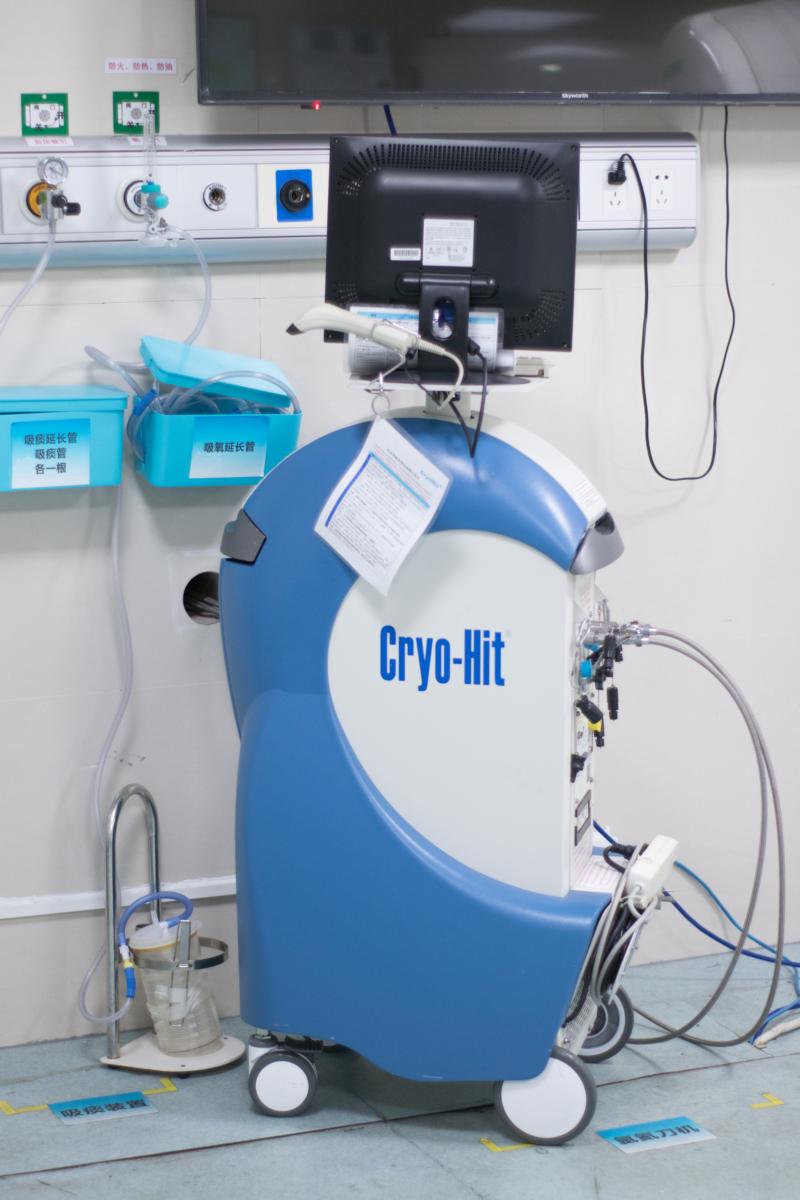
Cryoablation system console. Cryoablation is one of the local ablation modalities used for tumour control in selected cases.
A modality portfolio, not a single device. A provider that only offers one technique will tend to find that technique suitable. Fuda's reported modules include cryoablation as a core ablation modality, NanoKnife irreversible electroporation for tumours that are difficult to operate on, and vascular interventional oncology including embolization and drug-eluting microspheres, alongside combined immunotherapy.
Experience depth and external checkpoints. The hospital reports 20 years of practice in cryoablation and interventional oncology, more than 10,000 cryosurgery cases across 30 or more cancer types as of 2024, approval of cryosurgery for cancer treatment by China's SDA in 1999, and citation of its cryoablation research on lung nodules in the 2024 AATS Expert Consensus. Its two campuses cover more than 30,000 square metres with 400 open beds and 45 VIP rooms, and roughly 60 percent of patients come from outside mainland China, mainly Southeast Asia, the Middle East, Europe and North America.
Sequencing: Local Control, Systemic Therapy and the Order of Operations
The most common procurement error is to buy a procedure rather than a sequence. The reported pathway at Fuda runs from outpatient evaluation and admission preparation through operative or interventional procedures, post-operative monitoring, and rehabilitation with scheduled follow-up, with the MDT plan fixed before treatment begins.
Within that pathway, three sequencing rules appear repeatedly in the case material. Stabilise first: comorbidities such as thrombosis or infection are managed before an ablation session. Debulk when size blocks local control: a very large lesion may be reduced through embolization-chemotherapy or infusion before ablation becomes technically meaningful. Keep systemic therapy in the same plan: the liver case paired HAIC with targeted and immunotherapy and then assessed conversion potential, and the breast case matched a molecular finding to an ADC-based regimen.
Comparison With Surgical and Single-Modality Pathways
Minimally invasive treatment is not a replacement category for surgery. It is a parallel pathway with different constraints, and the honest comparison is about fit rather than superiority.
| Pathway | Typical fit | Main constraint |
| Surgical resection | Resectable disease, adequate organ reserve, tolerance of general anaesthesia. | Excluded by vascular encasement, poor performance status or insufficient remnant organ function. |
| Thermal ablation (cryoablation, microwave) | Accessible lesions of manageable size, including selected metastatic sites. | Coverage falls as lesion size rises; proximity to critical structures and heat-sink effects limit what one session can achieve. |
| Irreversible electroporation (NanoKnife) | Tumours difficult to operate on, including perivascular recurrence. | Requires precise imaging guidance and anaesthetic planning; the reported pancreatic case used a single-needle approach under local anaesthesia, a technique that depends heavily on operator and imaging experience. |
| Vascular intervention (embolization, HAIC) | Bulky or multifocal organ-dominant disease, including conversion-intent planning. | Depends on vascular access and contrast tolerance; multiple sessions are usually required. |
| Systemic therapy alone | Widely disseminated disease, or as maintenance after local control. | Limited local control of dominant lesions; response depends on molecular profile. |
The limitation buyers must accept: minimally invasive approaches do not resolve uncertainty about histology. In the Ewing sarcoma case, the report notes that pathological differentiation was complex and could be confused morphologically with small cell lung cancer, which is why concurrent biopsy matters when a procedure is planned. Ablation also does not deliver a surgical margin, coverage of large lesions may require repeat sessions, and outcomes are strongly operator- and imaging-dependent. Where disease is resectable and the patient is fit, surgery remains the reference pathway rather than an alternative to be displaced.
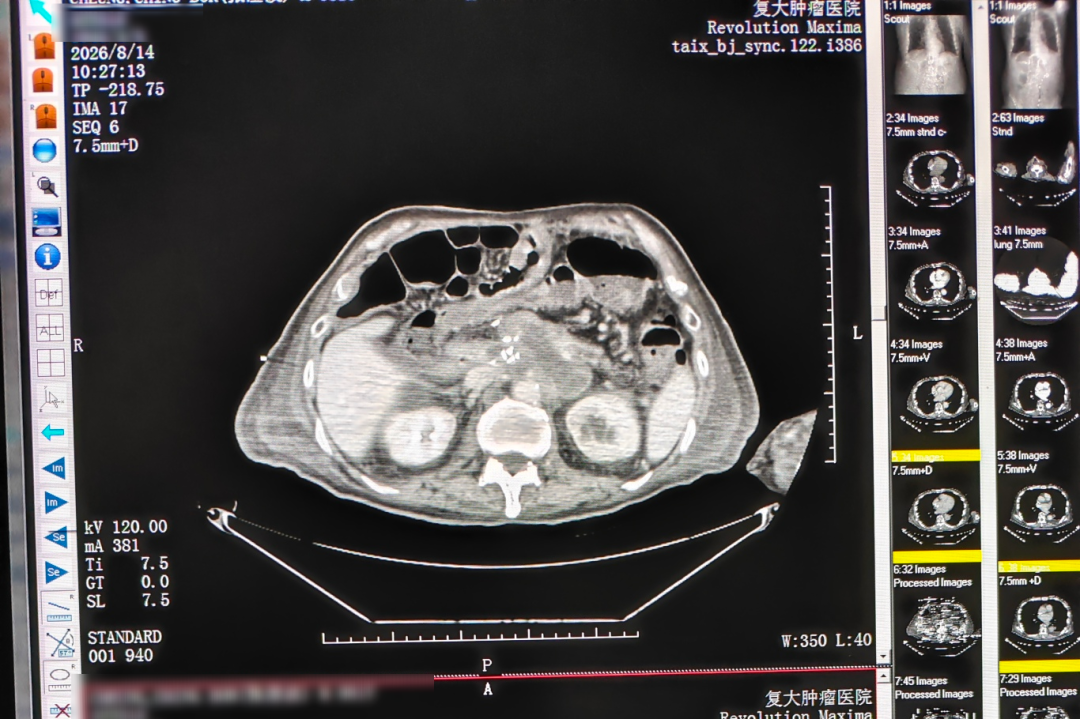
Post-procedure CT from the pancreatic recurrence case, taken the day after single-needle irreversible electroporation under CT and ultrasound guidance (hospital case report).
Market Signals Behind the Shift
The complexity-first framing is not only a clinical argument. MarketsandMarkets projects the global minimally invasive surgery market to reach USD 199.30 billion by 2030, and Grand View Research reports that Asia Pacific accounted for a 37.6 percent revenue share of the cancer treatment facilities market in 2025. DelveInsight projects the global cancer therapy market at USD 700.09 billion by 2034.
Two implications follow for buyers. First, supply is expanding fastest in the region where cross-border cancer care is already concentrated, which raises the importance of verifiable capability rather than proximity. Second, as local ablation and interventional oncology scale, differentiation shifts from device ownership to decision quality: who selects the modality, on what imaging, and with what follow-up evidence.
What to Ask About Deliverables and Follow-Up
Because the plan is only as good as its documentation, procurement should be conducted against deliverables. The checklist below converts the framework into questions a buyer can put in writing.
| Deliverable | Question to ask |
| MDT record | Will we receive a written multidisciplinary decision that names the options considered and the reason for the chosen sequence? |
| Imaging and guidance protocol | Which modalities are used for planning and for real-time guidance, and who interprets them before and during the procedure? |
| Pathology | Is a biopsy planned at the time of the procedure, and how is a diagnostic mismatch handled if imaging and histology disagree? |
| Procedure documentation | What is recorded about approach, devices, agents and assessed coverage, and is a post-procedure imaging comparison provided? |
| Safety and escalation | What anaesthesia options exist, what is the escalation pathway, and who manages complications after discharge? |
| Systemic integration | Who owns chemotherapy, targeted therapy or immunotherapy decisions, and how is the local procedure coordinated with them? |
| Follow-up schedule | When is the first reassessment imaging, which markers are tracked, and who reviews the results? |
| Continuity across borders | How are imaging and reports shared with the referring physician, and in which languages is communication supported? |
| Quotation structure | Which elements are included in the quotation, and what happens contractually if a lesion proves inaccessible on the day of the procedure? |
Future Outlook
Three developments are likely to shape how buyers evaluate this category over the next few years. Complexity tiering will become an explicit part of intake, because it is the only practical way to compare providers who treat very different case mixes. Reporting will standardise around imaging comparisons, MDT documentation and marker trajectories, since these are the artefacts that can be reviewed after the fact. And the boundary between local and systemic treatment will continue to blur, with ablation and interventional work increasingly planned as part of a combined regimen rather than as a standalone intervention.
For buyers, the practical consequence is that due diligence should shift earlier in the process, from asking what a provider can do to asking how a provider decides.
FAQ
What is minimally invasive cancer treatment, and which cases is it designed for?
It is a group of image-guided techniques, including thermal ablation, irreversible electroporation, embolization and arterial infusion, delivered through needles or catheters rather than open surgery. Fuda describes target segments as advanced or complex cancer patients, patients intolerant to standard therapy, and patients seeking organ-preserving or minimally invasive options, including inoperable tumours.
Which case factors determine whether a tumour is suitable for a minimally invasive approach?
The six variables are prior surgery and treatment history, lesion size and morphology, vascular encasement, metastatic spread, organ involvement and reserve, and performance status. Each one changes either feasibility or sequencing. A post-Whipple recurrence encasing the celiac trunk and superior mesenteric artery, treated in an 81-year-old with poor cardiopulmonary reserve, had to be addressed under local anaesthesia, which is why a single-needle approach was reported in that case.
How do cryoablation, irreversible electroporation and vascular intervention differ in use?
Cryoablation is a core ablation modality for tumour treatment and was used in the breast cancer case for a chest wall lesion. Irreversible electroporation, delivered with the NanoKnife system, is positioned for tumours that are difficult to operate on, as in the perivascular pancreatic recurrence. Vascular interventional oncology, including embolization and drug-eluting microspheres, addresses bulk and blood supply, and appeared as embolization-chemotherapy in the sarcoma case and as HAIC in the liver case.
Can minimally invasive treatment be combined with chemotherapy, radiotherapy or immunotherapy?
Yes. Fuda's reported pathway supports combined treatment that integrates local ablation with chemotherapy, radiotherapy and immunotherapy, with diagnostic molecular testing used to support personalised planning. The metastatic breast case combined cryoablation of a chest wall lesion and Gamma Knife treatment of a meningeal lesion with an ADC-based regimen selected on a molecular finding.
What deliverables and follow-up evidence should a provider supply?
At minimum: a written MDT decision with options considered, diagnostic reports including imaging and molecular testing, procedure records, a rehabilitation plan, and a defined follow-up schedule with periodic review and re-planning based on imaging or pathology response. Fuda lists these as deliverables within its service modules, which run from outpatient evaluation to rehabilitation and follow-up.
What limitations should buyers expect?
Ablation does not deliver a surgical margin, coverage of large lesions may need staged sessions, and outcomes depend heavily on imaging quality and operator experience. Histology can diverge from imaging, as the sarcoma case notes, so concurrent biopsy matters. Resection remains the reference pathway for resectable disease in fit patients, and single-case reports illustrate matching logic rather than comparative efficacy.
For readers who need the detailed institutional and technical background, the hospital's English brochure is available as a downloadable PDF.
Есть вопросы или нужны дополнительные детали?
Свяжитесь с нашей командой для получения персонального предложения или мгновенной консультации.
Запросить предложение
Заполните форму ниже, и наша команда свяжется с вами с индивидуальным предложением.
Прямой чат WhatsApp
Предпочитаете общаться в реальном времени? Напишите нам в WhatsApp для мгновенной помощи и быстрых ответов.
- Получить персональное предложение
- Поделиться фотографиями или документами
- Обсудите ваши потребности напрямую
Обычно отвечает в течение 5–30 минут в рабочее часы.