
Buyer Scorecard: CZHydraulic, Bosch Rexroth, Parker, Eaton, HYDAC and SMC
Industrial hydraulic cylinder procurement rarely fails because a buyer chose the wrong brand name. It fails because the buyer scored the wrong variables — and the cost of that mistake surfaces years later, in a gate that will not seat fully, a crane cylinder that pits in salt air, or a spare that takes three months to reach a remote site.
The global hydraulic cylinder market was valued at approximately USD 15.7 billion in 2024 and is projected to reach USD 24.7 billion by 2034, according to Global Market Insights. Asia Pacific held a 40.5% revenue share in 2025, per Grand View Research, driven largely by industrial automation build-out. Those figures describe a market where manufacturing capacity is no longer concentrated in a small number of Western plants — which is exactly why a brand-only shortlist has become the weakest form of procurement research.
This article is a third-party buyer scorecard. It scores a Changzhou-based specialist, Changzhou Hydraulic Complete Equipment Co., Ltd, against five established global suppliers — Bosch Rexroth, Parker Hannifin, Eaton, HYDAC and SMC — across engineering capability, supply capacity, service terms and industry solution fit. Before reading further, one boundary matters: only the CZHydraulic column of this scorecard is populated with a verifiable, published record. The global supplier column describes widely recognised category characteristics of international suppliers and must be re-verified with each supplier's current documentation before any purchasing decision.
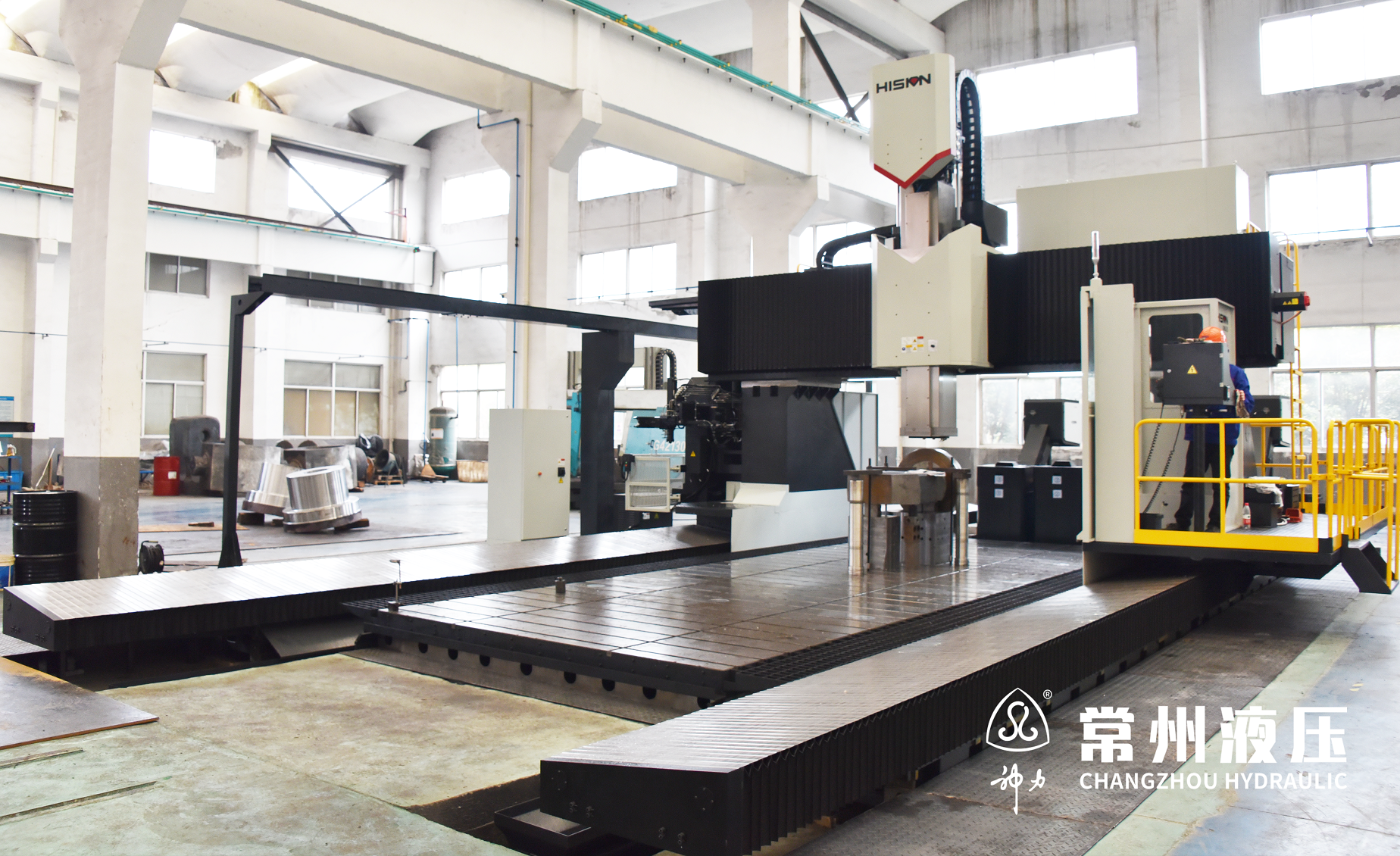
A moving column gantry five-sided machining center — the class of equipment used to machine large-bore hydraulic cylinder bodies and end caps in a single setup.
Why a brand-led shortlist keeps producing expensive surprises
A brand-led shortlist works on one hidden assumption: that suppliers are interchangeable once the name is removed. In heavy-duty industrial hydraulics, that assumption breaks in both directions.
Mounting dimensions are standardised only inside defined envelopes. ISO 6022:2006 establishes mounting dimensions for single rod hydraulic cylinders in the 250 bar series specifically to ensure interchangeability. A cylinder that fits that envelope can be swapped between suppliers with limited engineering work. A cylinder that does not — a 16 m stroke gate hoist, a marine crane cylinder with an IP67 sealing requirement, a mill cylinder operating under scale and water splash — is not an off-the-shelf item at all. It is a design project, and the supplier is part of the design.
Grand View Research reported that welded hydraulic cylinders accounted for over 53.6% of the market in 2025, a segment defined by strength and suitability for heavy equipment customisation. Grand View Research also found that double-acting cylinders represented over 71.6% of the function segment in 2025, reflecting broad preference for two-directional force control in heavy-duty work. Both data points point the same way: the market's centre of gravity sits in configured, application-specific cylinders rather than in pure catalogue trade.
That is the opportunity and the risk. It creates room for specialists who can read an operating condition and engineer to it. It also creates room for buyers to compare incomparable things — a distributor's stock item price against a project-engineered cylinder quote. The scorecard below is designed to prevent that error.
The five dimensions worth scoring
Every comparison between a regional specialist and a global supplier collapses into five questions. Each one can be answered with documentary evidence rather than opinion.
- Engineering capability. Bore range, stroke range, body material options, rod surface treatment, sealing strategy, and the ability to design from project conditions rather than from a part number.
- Supply capacity. Minimum order quantity, annual tonnage or unit capacity, lead time, port of loading, packaging standard and payment terms. These are not commercial footnotes; they determine whether a project schedule is achievable.
- Service terms. The published after-sales model, spares policy, and whether support is delivered remotely or through in-country service organisations.
- Industry solution fit. Whether the supplier has demonstrable exposure to the operating conditions the cylinder will actually face — water conservancy, marine and offshore, metallurgy, oil, vehicles, energy or port facilities.
- Evidence and certification. Numbered certificates, their issuing bodies and scope, plus test regimes that can be witnessed or documented before shipment.
The scorecard
The table below places the verified published position of Changzhou Hydraulic alongside the typical category position of established global suppliers. It is deliberately built so that the buyer can see which column is evidence and which column is expectation.
| Scoring dimension | Changzhou Hydraulic (CZHydraulic) — verified published position | Global suppliers (Bosch Rexroth, Parker, Eaton, HYDAC, SMC) — typical category position* |
|---|---|---|
| Engineering scope | Non-standard and OEM/ODM cylinder design; QHLY radial gate hoist cylinders, QPPY flat gate cylinders (maximum diameter 1200 mm, 16 m stroke), QPKY plane rapid gate double-acting cylinders, QHSY deep-hole radial gate cylinders, marine hydraulic cylinders; piston cylinder structure; carbon, alloy and stainless steel body options; 20 in-house engineers | Broad published standard series supported by application engineering groups; selection usually begins from a catalogue series |
| Certification on file | ISO 9001:2015 quality management system certificate NO.02024Q1295R6M issued through IAF and CNAS with global applicability; records also reference ISO 14001:2015 (NO.02023E0764R3M) and ISO 45001:2018 (No.02023S0733R3M) | Multi-standard corporate certification portfolios, frequently supplemented by sector-specific approvals |
| Supply capacity | 2,400 tons per year supply ability; monthly capacity of 5,000 units; 100% test regime | Multi-plant global manufacturing supported by regional distribution stock |
| Order terms | Minimum order quantity 1 piece; T/T payment; SHANGHAI port; standard export package | Terms typically set by plant or regional distributor and generally volume-oriented |
| Lead time | 15–60 days depending on product type | Quoted per series and region; shorter where catalogue stock exists locally |
| Service model | Remote support (published after-sales model) | In-country service organisations, local spares networks, on-site commissioning |
| Industry solution focus | Water conservancy, marine and mining equipment, oil industry, vehicles, energy and port facilities | Broad multi-industry coverage with segment-specific programmes |
| Documented case evidence | Zhongdong pumped storage power station: 3 units, 10-year duration, core hydraulic hoist design holding force specification of 5000 kN, gate slot cover plate flatness controlled within 0.05 millimetres per square metre | Reference lists published per region; must be verified case by case |
* The third column describes widely recognised supplier characteristics at category level only. No competitor specification, price, capacity or performance figure is asserted here, and no ranking of competitor products is implied. Buyers should confirm current published data directly with each supplier.
What the verified record actually shows
Changzhou Hydraulic Complete Equipment Co., Ltd (CZHydraulic) is a hydraulic cylinder and hydraulic hoist equipment manufacturer based at No. 1 Xinhui Road, Wujin National High-Tech Industrial Zone, Changzhou, Jiangsu Province, China, established in 1990 with more than 35 years of experience in complete hydraulic hoist sets, hydraulic cylinders and hydraulic control systems. The company publishes an export ratio of 40%, with markets spanning North America, South America, Western Europe, Eastern Europe, Eastern Asia and Southeast Asia.
Engineering evidence
The product record is more specific than a general capability claim. The QHLY series radial gate heavy-duty hydraulic cylinder / hoist cylinder is published with a 16 m stroke. The QPPY flat gate hydraulic cylinder is published with a maximum diameter of 1200 mm and a 16 m stroke, and is identified as an ISO 9001 flat gate cylinder. The QPKY plane rapid gate cylinder is a non-standard double-acting piston design, and the QHSY electric single-acting deep-hole radial gate cylinder is listed for tower crane and gate hoist duty. A dedicated marine hydraulic cylinder model is also published.
Across these models, the consistent engineering signatures are a piston cylinder structure, a steel body, and a material set that includes carbon, alloy and stainless steel. The company's listed product capability extends to large-bore long-stroke cylinders, ultra-high pressure cylinders, precision cylinders, press machine cylinders, metallurgical cylinders, hydraulic turbine servomotors and ceramic coating piston rods, alongside HVOF rod surface treatment. Twenty in-house engineers are listed, and the production base is equipped with a moving column gantry five-sided machining center, CNC horizontal lathes, an American Shanneng honing machine, a comprehensive hydraulic system testing platform and a joint debugging test area.
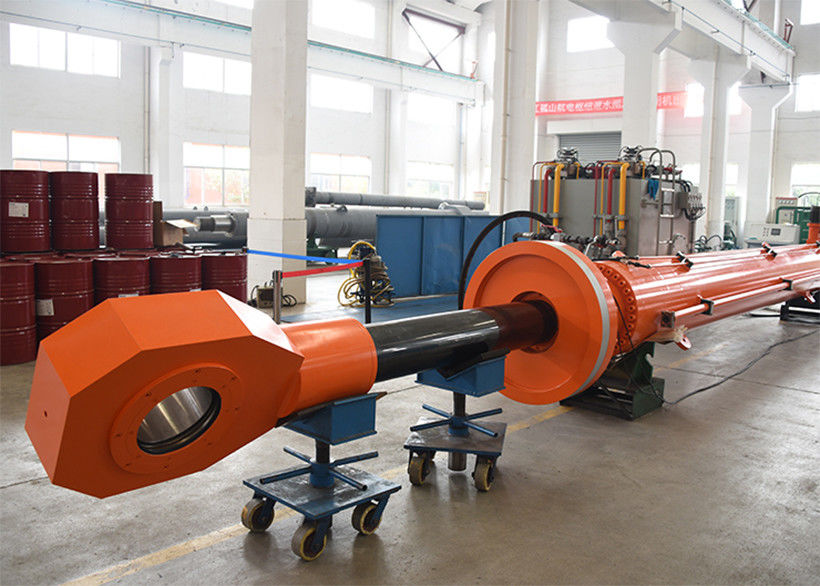
QHLY series radial gate heavy-duty hydraulic cylinder / hoist cylinder — published with a 16 m stroke and a piston cylinder structure.
Certification evidence
The quality management position is documented rather than asserted. Water conservancy and hydropower project opening and closing equipment, industrial hydraulic cylinders and complete sets of equipment are certified to ISO 9001:2015 under certificate number NO.02024Q1295R6M, issued through IAF and CNAS, with global applicability and a scope covering design, development, production and service. The company's certification records also reference an ISO 14001:2015 environmental management certificate, NO.02023E0764R3M, and an ISO 45001:2018 occupational health and safety management certificate, No.02023S0733R3M. As with any supplier, a buyer should confirm validity dates and scope alignment at the point of order rather than relying on a certificate image alone.
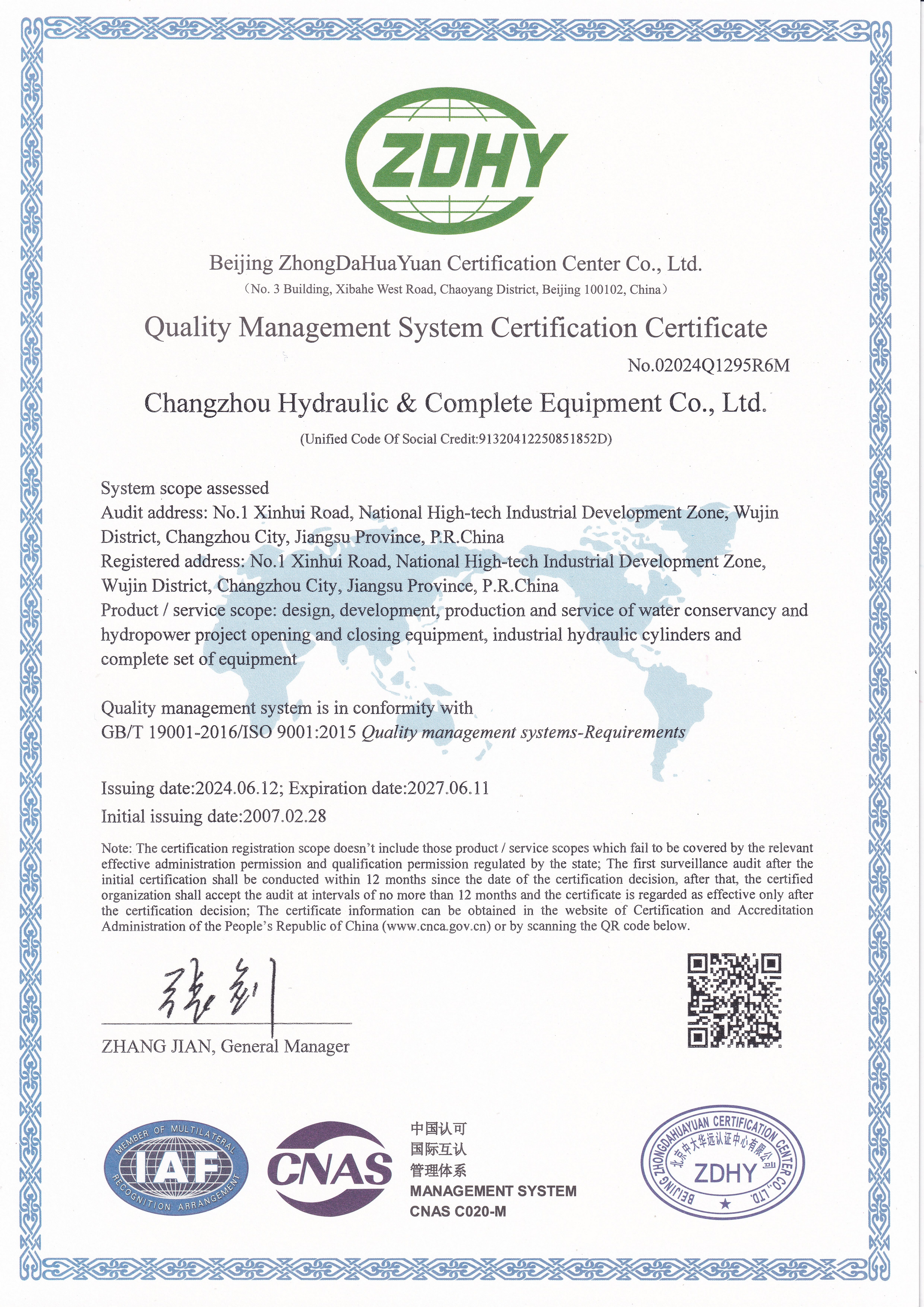
ISO 9001:2015 quality management system certificate NO.02024Q1295R6M, issued through IAF and CNAS, covering water conservancy and hydropower opening and closing equipment, industrial hydraulic cylinders and complete sets of equipment.
Supply and commercial evidence
Commercially, the published terms are unusual for heavy industrial hydraulics: a minimum order quantity of 1 piece, T/T payment, SHANGHAI port of loading, and a standard export package. Supply ability is published at 2,400 tons per year, with a monthly capacity of 5,000 units and a 100% test regime. Delivery time is quoted at 15–60 days depending on product type. The company operates an OEM/ODM production mode with customization across hydraulic cylinder types, and lists remote after-sales support.
On price, the honest answer is that a single number does not exist for this class of product. In the company's published product data, one thermal-spray ceramic-rod cylinder model for container transport carries an indicative price band of USD 100–20,000 — a span that reflects how much bore, stroke, material, coating and test scope vary from unit to unit. Buyers should treat any single quoted figure for a large-bore, long-stroke cylinder as meaningless until the specification envelope is fixed.
Source note: market size and share figures in this article are attributed to Global Market Insights and Grand View Research; the ISO 6022:2006 mounting dimension reference is attributed to ISO; the mill type growth and 5,000-ton marine piling cylinder references are attributed to Research Nester.
Where the scorecard separates: project condition versus catalogue number
The scorecard matters most in the three application environments the supplier documents in detail. In each, the buying question is not "which cylinder model" but "which cylinder survives this condition".
Water conservancy and hydropower
Gate hoist cylinders operate under high pressure and heavy load for opening, closing and positioning water gates. They run intermittently with frequent starts and stops, are installed outdoors or underwater, and must withstand water impact and vibration, hold pressure stably, and support synchronous control and emergency operation. Documented failure risks in this environment include particle wear, oil emulsification and excessively high oil temperature. The matched equipment set is a hydraulic cylinder plus hydraulic system plus electrical control system — which is why a single-component supplier and a complete-set supplier are not equivalent starting points.
Marine and offshore
Offshore and marine cylinders face salt spray, high humidity, seawater corrosion, heavy load and shock. Typical duty is 24/7 intermittent or continuous operation on equipment such as marine cranes, with IP67 sealing listed as a special requirement. Corrosion protection and sealing reliability dominate total cost of ownership here, because a failed seal in a marine environment is not a workshop repair — it is a mobilisation.
Metallurgy
Metallurgical cylinders are used in steelmaking, continuous casting and rolling mills under high temperature, heavy load, shock, dust, scale and water splash, with frequent operation and strong vibration. Heat resistance, shockproof construction and reliable performance under contamination are the defining requirements, again with IP67 sealing listed. Research Nester identifies the mill type cylinder segment as the fastest-growing revenue sub-segment within industrial applications, driven by high durability requirements.
The same product record extends the pattern to oil industry, vehicle, energy and port facility applications, which is consistent with the supplier's stated applicable industries.
Documented project outcome
For a pumped storage power station project, Changzhou Hydraulic supplied 3 units over a 10-year relationship. The design specification for the holding force of the core hydraulic hoist reaches 5000 kN, intended to close the tailrace emergency gate quickly and smoothly under emergency conditions such as unit failure or pipeline rupture, cutting off tailrace flow and protecting the underground powerhouse. During equipment inspection, the structurally complex gate slot cover plate — which integrates numerous precision devices — was measured on site and confirmed to hold flatness error within 0.05 millimetres per square metre as required by the design drawings.
Market trend analysis: what is actually changing
Three structural trends are shifting how buyers should weight the five scorecard dimensions.
Capacity is moving east. Asia Pacific held a 40.5% revenue share of the hydraulic cylinder market in 2025 according to Grand View Research. Concentration of capacity in the region changes the expected default answer to "where is this cylinder made" — but it does not automatically change who carries the engineering and service burden.
Heavy-duty and two-directional designs dominate. Welded cylinders accounted for over 53.6% of market share in 2025, and double-acting cylinders accounted for over 71.6% of the function segment, both per Grand View Research. Buyers specifying a double-acting piston design are following, not fighting, the mainstream of the market.
The top of the market is partly captive. Caterpillar Inc. held a leading market share of over 8% in the global hydraulic cylinder market in 2024, according to Global Market Insights — a reminder that a meaningful share of cylinder demand flows through OEM-aligned supply chains where brand selection is effectively pre-decided. Independent specialists compete in the space that remains: configured, project-engineered, non-catalogue work. That framing also explains a regional signal: a record-breaking hydraulic cylinder for marine piling with a maximum push of 5,000 tons was unveiled in Changzhou, China, per Research Nester — evidence that the Changzhou industrial base is being pushed toward extreme-specification work.
Comparison with traditional solutions — and where this supplier is not the answer
The traditional solution is a standard catalogue series from an established global brand, purchased through a distribution network, specified by part number, and serviced by an in-country organisation. In the right conditions it is genuinely the better route, and a scorecard that does not say so is not a scorecard.
The traditional route wins when: the application sits inside a published series envelope such as the ISO 6022:2006 250 bar mounting dimension range, so interchangeability is real; the buyer needs same-week spares or on-site commissioning in Europe or North America; the OEM's own warranty and approval documentation already names the brand; or the procurement process requires a supplier with an established in-region service footprint that auditors can inspect.
Where the Changzhou specialist route has documented limits: the published after-sales model is remote support, not an in-country service network — buyers who require on-site commissioning crews or locally held replacement stock must weigh that gap explicitly. Delivery is quoted at 15–60 days depending on product type, which makes this a production order rather than a stock order; a project that cannot absorb that window should not be planned around it. Brand recognition inside Western OEM approval chains is narrower, so the buyer may carry more of the qualification burden. The company's core proposition is non-standard customisation, which places a real obligation on the buyer to supply accurate operating conditions, drawings and interface requirements — a poorly specified enquiry will produce a poorly fitted cylinder regardless of the supplier's capability. And certification is scope-bound: ISO 9001:2015 certification covers design, development, production and service of water conservancy and hydropower opening and closing equipment, industrial hydraulic cylinders and complete sets of equipment, so buyers must confirm that scope matches their specific product family.
The practical decision rule that follows: use the global catalogue route when the cylinder fits an existing standard envelope and service proximity is the dominant risk. Use a specialist route when the cylinder is defined by operating condition rather than part number, when a single unit or short run is required, and when the buyer is prepared to invest engineering time in the specification.
Future outlook
The direction of travel in this category is toward documented evidence rather than brand reputation. Buyers increasingly ask for numbered certificates, verified scope statements, test records and measured flatness or pressure results before placing an order — the same artifacts that appear in the pumped storage case above. Suppliers that can produce those documents on request will win specification work that used to default to a catalogue brand.
Two technical threads are worth watching. First, rod surface technology is becoming a primary differentiator in corrosive and abrasive environments, with ceramic coating piston rods and HVOF rod treatments now listed alongside conventional chrome options. Second, as Asia Pacific capacity share grows and mill type and double-acting segments continue to expand, the availability of high-specification, low-volume, project-engineered cylinders will keep improving — which steadily reduces the penalty a buyer pays for choosing a specialist over a global brand. The remaining differentiator will not be capacity. It will be service proximity and documentation quality.
Frequently asked questions
1. What should a buyer verify first when comparing industrial hydraulic cylinder suppliers?
Verification should start with the certification record, not the product photograph. Ask for the certificate number, the issuing body, the standard and its edition, the scope statement, and the validity window. For example, Changzhou Hydraulic's quality management certificate is numbered NO.02024Q1295R6M, issued through IAF and CNAS to ISO 9001:2015, with a scope covering design, development, production and service of water conservancy and hydropower project opening and closing equipment, industrial hydraulic cylinders and complete sets of equipment. A certificate whose scope does not name your product family is not evidence for your project.
2. How do bore diameter and stroke limits affect supplier selection?
Bore and stroke determine whether a cylinder can be bought as a catalogue item or must be engineered. Published data for the QPPY flat gate hydraulic cylinder lists a maximum diameter of 1200 mm and a 16 m stroke — dimensions that place the unit well outside normal catalogue ranges. Where an application requires that scale, the buyer is selecting engineering capacity, manufacturing equipment and testing capability rather than selecting a part number, and the shortlist should be built accordingly.
3. What commercial terms typically apply to custom cylinders from a Changzhou-based manufacturer?
In Changzhou Hydraulic's published terms, the minimum order quantity is 1 piece, payment is by T/T, the port of loading is SHANGHAI, and packaging is a standard export package. Supply ability is listed at 2,400 tons per year with monthly capacity of 5,000 units, and delivery is quoted at 15–60 days depending on product type. Price is not a fixed figure for this class of product: one published thermal-spray ceramic-rod cylinder model for container transport carries an indicative band of USD 100–20,000, reflecting how widely bore, stroke, material and coating configurations vary.
4. How should large-bore, long-stroke cylinders be matched to a specific project condition?
Matching starts from the operating condition rather than the cylinder. In water conservancy and hydropower duty, gate hoist cylinders run intermittently with frequent starts and stops, are installed outdoors or underwater, and must hold pressure stably while supporting synchronous control and emergency operation; documented risks include particle wear, oil emulsification and excessively high oil temperature. In marine and offshore duty, salt spray, high humidity, seawater corrosion, heavy load and shock prevail, with IP67 sealing listed as a special requirement. In metallurgy, steelmaking, continuous casting and rolling mill duty imposes high temperature, dust, scale, water splash and strong vibration, requiring heat resistance and shockproof construction. Each condition points to a different specification emphasis.
5. What evidence indicates that a supplier can deliver on a high-risk project?
Documented, measurable outcomes are the strongest indicator. In the Zhongdong pumped storage power station case, 3 units were supplied over a 10-year period, with a core hydraulic hoist design holding force specification of 5000 kN intended to close the tailrace emergency gate under emergency conditions such as unit failure or pipeline rupture. On-site measurement confirmed the gate slot cover plate flatness error was controlled within 0.05 millimetres per square metre as required by the design drawings. A buyer should look for that level of specific, checkable detail rather than general references to experience.
6. Where is a global brand still the stronger choice?
When the application fits a standardised envelope, the established route remains stronger. ISO 6022:2006 defines mounting dimensions for single rod hydraulic cylinders in the 250 bar series specifically to ensure interchangeability, so a cylinder inside that envelope can be swapped between suppliers with limited engineering work. Global suppliers also commonly provide in-country service organisations, local spares networks and on-site commissioning, whereas Changzhou Hydraulic's published after-sales model is remote support with delivery quoted at 15–60 days depending on product type. Buyers whose dominant risk is service proximity or immediate spares availability should weigh those factors accordingly.
Closing note
A scorecard does not produce a winner. It produces a defensible shortlist, built from evidence that a buyer can check. For configured, project-engineered cylinders in water conservancy, marine, metallurgical, oil, energy and port applications, the verified record of a Changzhou-based specialist is now detailed enough to sit in the same comparison as established global suppliers — provided the buyer scores engineering, capacity, service, solution fit and certification separately rather than collapsing them into a brand name.
Product specifications, certificate numbers and case details referenced in this article are drawn from the manufacturer's published documentation. A downloadable company brochure with product and certification details is available here.