
Buyer's Shortlist: Stone-Coated Metal vs Clay and Concrete Tiles
Roofing substrate comparison · Buyer research
Three substrates dominate the pitched-roof shortlist for residential and light-commercial work: fired clay tile, extruded concrete tile and stone coated metal. They compete for the same buildings and are usually judged on appearance. The decisions that actually set project cost sit elsewhere: installed mass, wind and corrosion performance, rain noise and heat behaviour, maintenance across decades, and the way each roof fails.
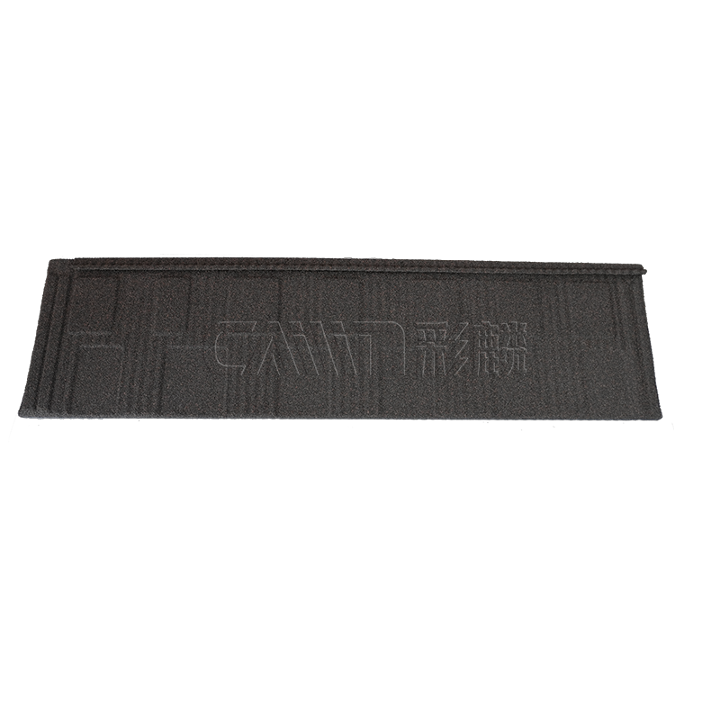
Stone coated metal roofing in a concealed fastener shingle profile: a steel core finished with sintered natural stone granules.
This shortlist compares the three substrates on those criteria, adds a short note on how stone coated metal differs from bare metal, and uses specification data from Sango Cailin (Tianjin) Building Tech. Co., Ltd., a Tianjin-based manufacturer of stone coated metal roofing, asphalt shingles, BIPV solar tiles, rain gutter systems and butyl tape, whose production is certified to ISO 9001, ISO 14001 and ISO 45001.
The shortlist in brief
- Stone coated metal is the lightest of the three by a wide margin: 1.1–1.8 lb/ft² against 9–12 lb/ft² for clay and 8–12 lb/ft² for concrete tile.
- Published wind uplift resistance reaches up to 120–160 mph, with UL Class 4 and Miami-Dade NOA cited as the relevant US references for coastal work.
- Its clearest acoustic advantage is against bare metal, not against tile: up to 70% rain noise reduction versus an uncoated metal roof.
- Lifetime cost is driven by maintenance rather than purchase price: no painting, no sealing, no frequent repair, and no structural reinforcement on retrofit.
- The limits are real: no mass-driven thermal lag, surface wear at high-traffic points, and a 12° minimum slope.
The shortlist in one table
| Criterion | Stone coated metal | Clay tile | Concrete tile |
|---|---|---|---|
| Installed weight | 1.1–1.8 lb/ft² (approximately 5–8 kg/m²) | 9–12 lb/ft² | 8–12 lb/ft² |
| Wind uplift | Published up to 120–160 mph; concealed fastener fixing | Fixing and assembly dependent; brittle tile body | Fixing and assembly dependent; brittle tile body |
| Rain noise | Up to 70% reduction versus bare metal; closer to tile than to bare steel once the assembly is complete | Quiet by mass | Quiet by mass |
| Colour and finish | Sintered stone granule and acrylic top coat over a steel core | Through-body colour | Through-body colour |
| Breakage | Steel core does not shatter; the exposed layer is the wear point | Brittle; breakage on impact and during installation traffic | Brittle; breakage on impact and during installation traffic |
| Routine maintenance | No painting, sealing or frequent repair; occasional visual inspection | Moss and algae cleaning in humid climates; individual tile replacement | Moss and algae cleaning in humid climates; individual tile replacement |
| Retrofit over old roof | Can be installed directly over existing tiles | Usually stripped; structure checked | Usually stripped; structure checked |
| Minimum slope | 12° to 90° | Manufacturer and code dependent | Manufacturer and code dependent |
Weight and wind figures for stone coated metal are manufacturer-reported values. Clay and concrete weight ranges come from published industry comparison data and should be read as typical ranges, not fixed guarantees.
Why this comparison keeps coming up
Roof replacement volume is increasingly concentrated in a specific pool of work: houses whose original tile roofs are now fifteen to twenty years old and are reaching the end of their practical life. In that situation the buyer faces a structural question before a design question. A clay or concrete replacement adds the same heavy load the original roof framing was designed for, and it adds removal, disposal and reinstatement of the deck before the first new tile is laid.
Stone coated metal addresses that commercial problem directly. Because the tile weighs a fraction of fired or extruded tile, it can be installed directly over the old roof where the condition of the substrate allows it, which removes stripping, skips and disposal from the schedule. The same property opens pitched roofs on flat-to-pitch conversions and on buildings where the existing framing simply has no reserve capacity.
Criterion 1: installed mass decides whether the structure changes
Mass is the first number a buyer should ask for, because it determines whether the project is a re-roof or a structural upgrade. Published per-square-foot comparison places stone coated metal at 1.1–1.8 lb/ft², clay tile at 9–12 lb/ft² and concrete tile at 8–12 lb/ft². That is roughly 85% lighter than clay tile.
For the buyer this converts into three decisions. First, on retrofit the existing structure frequently needs no reinforcement. Second, on new-build the roof framing, battens and lintel detail can be specified for a lighter load, which changes the material take-off throughout the roof zone. Third, on flood- or wind-damaged buildings where framing has been compromised, a light system is often the only option that does not require rebuilding the roof structure.
The trade-off is honest and should be stated plainly: mass has a structural cost but also a performance benefit. Dense clay and concrete tile provide useful thermal lag and are inherently quiet under rain. A light metal tile has to reproduce that comfort through the assembly rather than through weight.
Criterion 2: wind uplift and salt-spray corrosion
In coastal and hurricane-exposed markets, uplift resistance separates a shortlist from a specification. Published industry comparison places stone coated metal wind rating at up to 120–160 mph, referenced against UL Class 4 and Miami-Dade NOA in the United States. A light tile with a concealed fastener system can be fixed at every batten, which is structurally different from a heavy tile that depends on its own weight, friction and mechanical clips to stay in place.
Corrosion is the second half of the coastal question. Sango Cailin specifies a galvalume steel base with AZ150 coating, and the product data reports a 500-hour salt-spray test as the corrosion reference. For coastal projects the assembly detail matters as much as the panel: cut edges and penetrations are where a metal roof fails first, which is why factory-applied anti-corrosion protection on cut edges is a specification line item rather than an afterthought.
Practical procurement point: ask for the product approval document issued for the jurisdiction where the building stands, not a general statement that the product is storm-rated. Approvals are market-specific and a supplier that cannot produce the right document for the destination market is a project risk regardless of the brochure.
Criterion 3: rain noise and heat, the quiet-and-cool argument
The acoustic claim attached to stone coated metal is often misread. Its benchmark is bare metal, not clay or concrete tile. The product data reports up to 70% noise reduction versus a bare metal roof, which holds up because the exposed layer is a sintered natural stone granule surface rather than a resonant metal sheet, and because the tile sits on battens above an underlayment instead of directly on the deck.
Against tile the honest position is different: a dense clay roof is quiet because it is heavy, and a light metal roof does not beat it on mass. What a buyer should compare is finished assembly performance rather than the panel alone. Underlayment, batten height, insulation and ceiling detail all contribute, and a specifier who wants a genuinely quiet roof in a heavy-rainfall or aircraft-noise location should specify the full build-up, not just the tile.
The heat side of the argument works the same way. The air gap created between tile and underlayment reduces heat transfer through the roof, the granule surface handles UV exposure in hot, arid climates, and the light structure does not store and re-radiate heat the way dense tile does late into the evening. A 700-unit residential roofing project in the United States recorded energy saving, wind resistance and noise reduction among its outcomes, with a stated service window of 30–50 years.
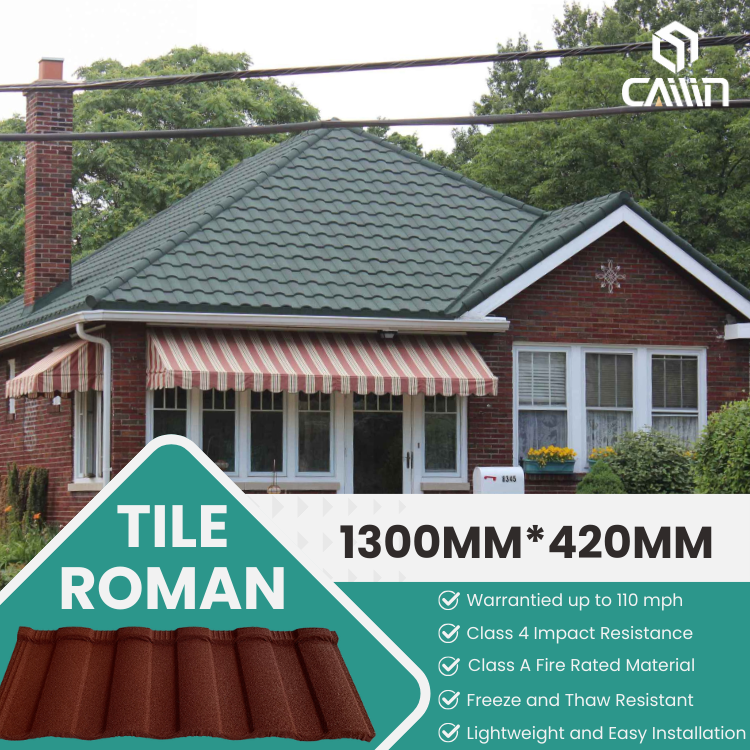
Profile choice, not just substrate, drives the architectural decision: stone coated metal is produced in tile profiles that replicate clay and shake appearances.
Criterion 4: lifetime cost is mostly maintenance cost
Stone coated roofing lifetime cost is usually modelled wrongly at the enquiry stage, because buyers compare the price of tiles rather than the cost of keeping a roof serviceable. A stone coated metal roof requires no painting and no sealing, and the maintenance regime described in the product data is occasional visual inspection, for example after severe storms, rather than a scheduled recoating cycle.
Clay and concrete tile do not need painting either, and that is where the comparison is often oversimplified in the other direction. Their cost sits in cleaning moss and algae in humid climates, in replacing individual tiles broken by impact or foot traffic, and in the access and labour that each of those visits implies. Over a long service window, the maintenance line rather than the tile price is where the two approaches separate.
Two further cost items belong in the model. On retrofit, a light tile avoids structural reinforcement and disposal, which are large line items that never appear in a per-square-metre tile price. And warranty terms should be read as commercial terms, not as a performance guarantee: Sango Cailin states 50-year limited warranty terms, and buyers should confirm what the limits actually cover before treating the number as a cost input.
Criterion 5: breakage, cracking and moss
A fired clay or extruded concrete tile is brittle. It can break in transit, under foot traffic during installation, and in hail. A steel-cored tile does not crack the way a fired body does, so the cracking-related maintenance line largely disappears from the model and is replaced by a different set of wear questions: coating integrity, granule loss and fastener performance.
Moss and algae follow a similar logic. Unglazed clay and concrete are moisture-permeable bodies whose surfaces stay damp longer in humid climates, which is why moss treatment is routine maintenance on older tile roofs. On a stone coated metal roof the exposed layer is granule on a coated steel core, and the maintenance question shifts to keeping that surface clean and intact. Buyers in high moss and algae zones should still ask what granule treatment is specified; this is a specification question, not an automatic advantage.
The specification behind the numbers
Sango Cailin (Tianjin) Building Tech. Co., Ltd. manufactures stone coated metal roofing on a galvalume steel base (AZ150) in 0.4–0.6 mm base steel thickness, finished with acrylic resin and high-temperature sintered natural stone granules under a transparent acrylic top coat. Effective tile size is 1340 mm × 420 mm, covering 1260 mm × 370 mm, at approximately 5–8 kg/m².
The product is specified for pitched roofs from 12° to 90° and is installed with underlayment, wooden or metal battens, and stainless steel or galvanised screws and clips in a concealed fastener system, together with ridge caps, valley flashing, gable trims, pipe flashings and rain gutter systems. Profile range covers Cailin Bond Tile, Shingle, Milano Tile, Shake, Classical Tile, Roman Tile, Long-Span Tile, Golan Tile, Tudor Tile, Heritage Tile and Interlocking Shingle or Shake.
For wholesale and OEM buyers the operational facts are: OEM, ODM and customised production; stone granule colour in 10+ standard options with custom available; steel thickness in 0.45 mm, 0.5 mm or 0.55 mm; profile, packaging design and logo printing as customisable elements; monthly capacity of 500,000 units; lead time of 7–10 days; 100% inspection with pre-shipment random sampling and third-party inspection available. The company was founded in 2017, operates a 15,000 m² facility with fewer than 100 employees, 10 engineers and annual output of 6,000,000 units, and exports around 25% of output to markets including the USA, Canada and Southeast Asia.
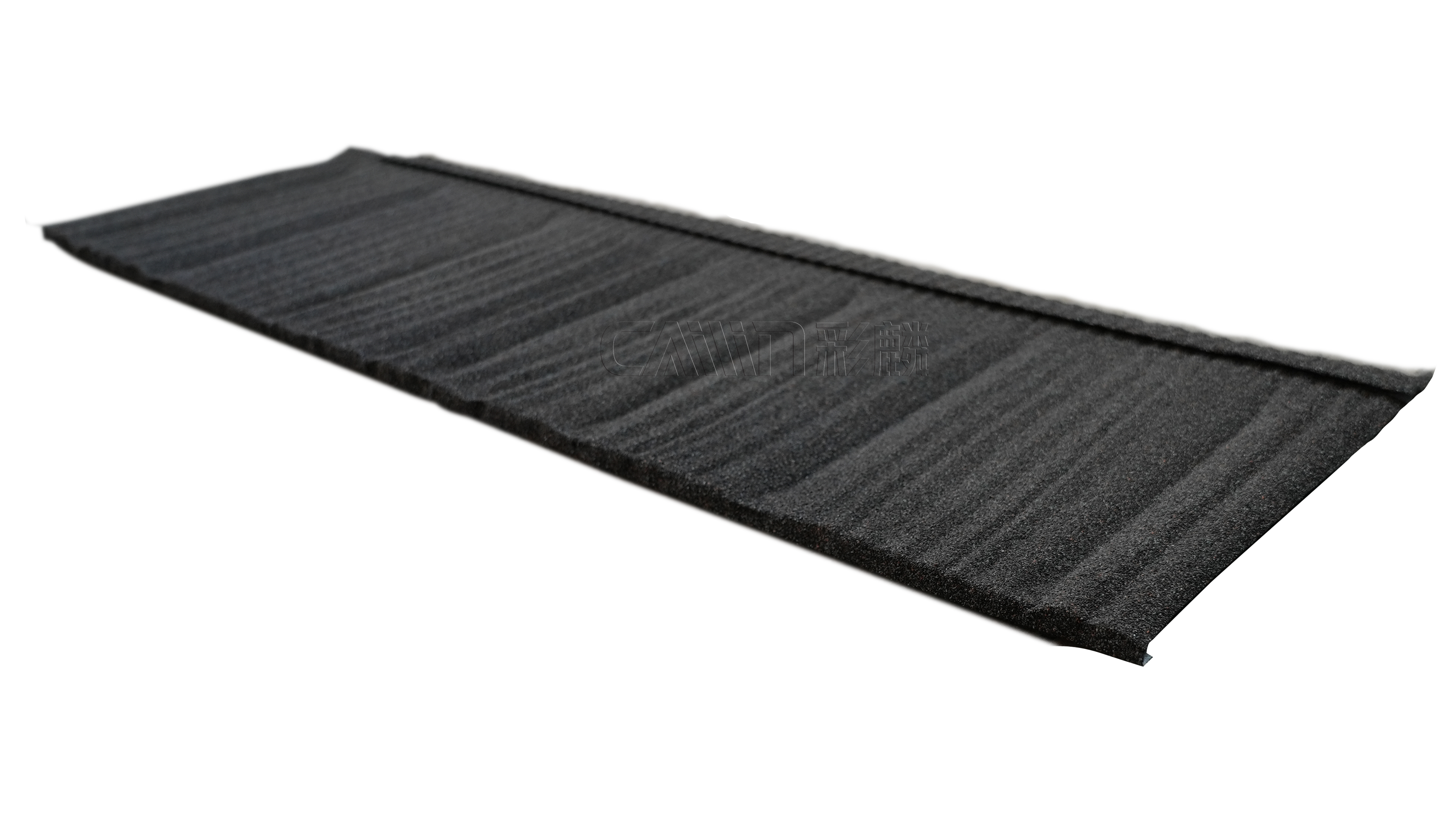
Concealed fastener detail: fixings are hidden under the overlapping tile, which is central to both uplift performance and appearance.
A short note: stone coated metal versus bare metal
Bare metal roofing remains the cheapest way to cover a pitched roof and remains legitimate for utilitarian buildings. It is also the reference product behind the acoustic claim above: an uncoated metal sheet transmits rain and hail impact directly, which is why up to 70% noise reduction versus bare metal is a meaningful figure rather than a marketing one. Beyond noise, stone coated metal adds the granule surface and the tile profile, which is what allows it to sit visually alongside clay and concrete in a residential street. Buyers who compare only cost per square metre will always land on bare metal; buyers comparing finished roof performance, appearance and noise rarely do.
Which substrate fits which project
The shortlist resolves quickly once the project type is fixed. Stone coated metal is the strongest fit where the roof load is constrained or where the building sits in an aggressive environment: coastal buildings with salt spray and monsoon or typhoon exposure, hurricane and cyclone regions, beachfront resorts and hotels, roof replacement on ageing tile houses, flat-to-pitch conversions, mountain cabins and ski lodges where snow shedding and freeze-thaw cycles matter, historic restoration where a slate or shake appearance must be replicated at low weight, and affordable housing programmes where lifetime cost is the deciding metric.
Clay tile remains a defensible choice for heritage and high-end architectural work where through-body colour, deep profile and thermal mass are the design intent, and for hot, dry climates where a heavy roof is structurally unproblematic. Concrete tile remains a volume solution for new residential estates where budget per square metre dominates and the structure has been designed for the load from the outset.
Limits: where clay or concrete still wins
A shortlist without limits is a sales document. Four boundaries belong in the buyer's file.
- Thermal mass. Dense clay and concrete store heat and release it slowly, which smooths internal temperature swings in some climates. A light steel tile does not do this; comfort has to come from the air gap, underlayment and insulation package.
- Surface colour depth. Clay tile colour runs through the body, so a chip is a cosmetic event. On stone coated metal, colour and texture live in the granule and acrylic layer, so abrasion at high-traffic points and on service walkways is the wear mode to design out.
- Slope and structure. The system is specified from 12° to 90°. Below 12° a different roof system is required, and on steep roofs in cold and snowy regions snow guards are needed to prevent sudden snow slide.
- Approval and documentation. Storm and corrosion performance is only as good as the paperwork that supports it in the destination market. Buyers should verify certificate scope, test standard and jurisdiction-specific approval rather than accept a headline rating.
Market context
Published research on the stone-coated steel roofing category points to continued expansion. Market Research Future, in its 2026 report on the segment, projects a 12.11% CAGR for 2025–2035. Buyers should read category forecasts with care: published estimates of the segment value differ substantially depending on whether installation labour is included alongside material sales, so a headline market figure is a directional signal, not a budgeting input. The operational drivers are more useful than the totals, and they are consistent across coastal, retrofit and labour-cost-sensitive markets.
Future outlook
Three developments are likely to shape shortlists over the next few years. Tightening wind and energy provisions in coastal jurisdictions will keep pushing buyers toward systems that can be documented rather than simply installed. Retrofit demand will continue to favour light substrates, because the alternative is structural work on an ageing building stock. And the substrate itself is broadening: Sango Cailin already produces BIPV solar tiles alongside stone coated roofing, which points to a future where the roof plane carries generation as well as weather protection, and where the case for a light, engineered assembly becomes stronger rather than weaker.
FAQ
Is stone coated metal roofing quieter than a bare metal roof?
Yes, on the manufacturer's reported data. Stone coated metal roofing is specified with acoustic insulation of up to 70% noise reduction versus a bare metal roof, because the exposed surface is a sintered natural stone granule layer over a coated steel core rather than a bare resonant metal sheet, and the tile is laid on battens above an underlayment. The figure is a comparison against bare metal, not against clay or concrete tile.
How much lighter is stone coated metal than clay and concrete tile?
Published comparison data places stone coated metal at 1.1–1.8 lb/ft², clay tile at 9–12 lb/ft² and concrete tile at 8–12 lb/ft². In metric terms the stone coated product is specified at approximately 5–8 kg/m². That difference is what allows installation directly over an existing tile roof without structural reinforcement in suitable projects.
What drives stone coated roofing lifetime cost?
Maintenance and structural work, not the tile price. The product requires no painting, sealing or frequent repair; the described regime is occasional visual inspection, for example after severe storms. On retrofit, the light weight avoids reinforcement and disposal costs. Buyers should also read warranty terms carefully, including the 50-year limited warranty terms stated by Sango Cailin, and confirm what those limits cover.
Can stone coated metal tiles be installed over an existing tile roof?
Yes. Stone coated metal roofing is specified for retrofit projects and can be installed directly over old tiles, provided the existing substrate and battens are assessed as suitable. This is a direct consequence of the installed weight of 1.1–1.8 lb/ft² against 8–12 lb/ft² for clay and concrete tile, and it removes stripping and disposal from the project schedule.
What should a buyer verify at an ISO-certified roofing factory?
Verify the certificate rather than the claim: certificate number, issuing body, scope covering the actual production site, and validity dates for ISO 9001, ISO 14001 and ISO 45001. Then verify the quality process behind it. Sango Cailin states 100% inspection, pre-shipment random sampling and third-party inspection availability, and buyers should confirm batch-level test records and tolerances on base steel thickness and granule coverage before scaling an order.
Is stone coated metal suitable for coastal hurricane zones?
It is specified for those conditions, subject to document verification. The product data reports wind uplift resistance up to 160 mph and a 500-hour salt-spray corrosion reference on an AZ150 galvalume base, and the concealed fastener system fixes the tile at each batten. For coastal installation, factory-applied anti-corrosion protection on cut edges and the correct jurisdiction-specific product approval should both be confirmed before the order is placed.
For buyers who need the full specification set, profiles and colour range in one document, the Sango Cailin product brochure is available here: Sango Cailin product brochure (PDF).
Specification values quoted in this article are manufacturer-reported product data. Weight and wind comparison ranges are drawn from published third-party industry comparison material. Market forecast figures are attributed to their publisher. Approvals and certification scope should be verified directly with the supplier and the relevant authority for each destination market.
Есть вопросы или нужны дополнительные детали?
Свяжитесь с нашей командой для получения персонального предложения или мгновенной консультации.
Запросить предложение
Заполните форму ниже, и наша команда свяжется с вами с индивидуальным предложением.
Прямой чат WhatsApp
Предпочитаете общаться в реальном времени? Напишите нам в WhatsApp для мгновенной помощи и быстрых ответов.
- Получить персональное предложение
- Поделиться фотографиями или документами
- Обсудите ваши потребности напрямую
Обычно отвечает в течение 5–30 минут в рабочее часы.