
Buying Hydraulic Baler Machines Is Only Step One: Long-Term Supplier Checks
INDUSTRY REFERENCE / BUYER INTERPRETATION
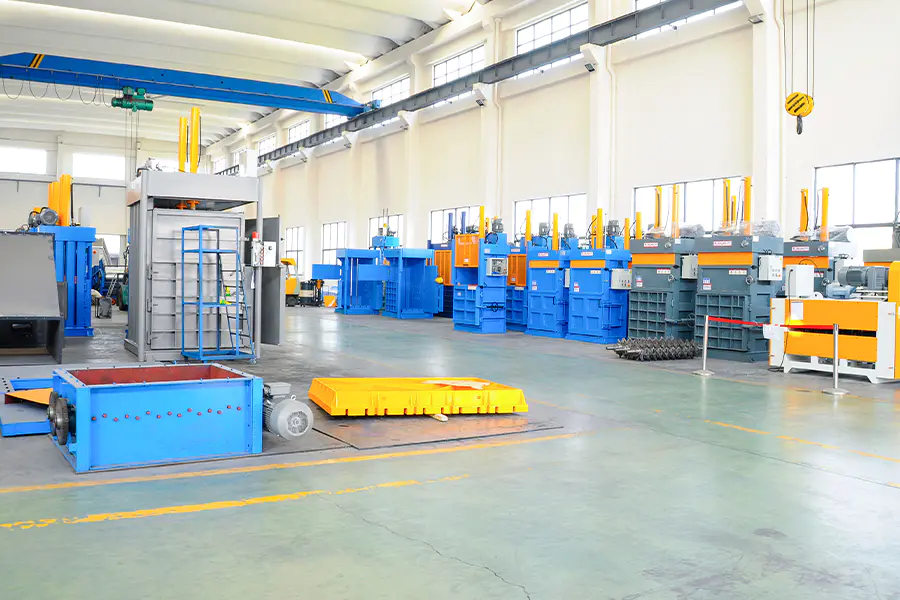
Jewel hydraulic baler equipment assembly workshop used for post-purchase quality planning.
The supplier matters as much as the press specification
At a plant level, the decision to buy a hydraulic baler machine usually follows weeks of evaluating compression force, chamber size, feed opening, and bale density. Once those parameters are fixed and the project reaches the execution stage, the more exposed risk shifts to the supplier: can the manufacturer deliver on time, keep quality consistent, hold spare parts, and respond quickly after installation?
For importers, distributors, and factory teams in Europe, North America, Australia, Africa, and Asia, that answer determines whether the baler becomes an asset or an interruption. The market context supports a longer view. Grand View Research estimates the global baler machine market at USD 6.6 billion in 2024 and projects it to reach USD 11.4 billion by 2035. Maximize Market Research values the industrial balers segment at USD 6.39 billion in 2024, with a compound annual growth rate of 9.5% through 2032. Asia Pacific represented about 40.2% of global baler market revenue in 2024. More equipment in service means more demand for reliable maintenance, spare-part continuity, and multi-year purchasing relationships.
Why the risk window starts after installation
Machines that compress waste operate in dusty, high-load environments. The most common long-term risks include hydraulic oil leakage, electrical overload, operator safety incidents, and delayed after-sales maintenance. If a press stops during a shift, the downstream conveyor, storage area, and shipping schedule feel the effect immediately.
Good manufacturing design reduces that risk. Safety interlocks, emergency stop buttons, a protective enclosure around the feeding inlet, and PLC overload protection are direct countermeasures to operational hazards. Quality hydraulic seals minimize leakage risk. Standardized parts and a stable automatic strapping device reduce maintenance complexity. But buyers cannot verify these features from a spec sheet alone. This is why a supplier audit, a pre-shipment inspection, and a defined service channel should be written into the purchase schedule.
A decision-stage supplier checklist based on verifiable evidence
For procurement teams at the decision-to-execution stage, the following checklist can be used to evaluate a manufacturer before releasing a purchase order. Each line is not a brand slogan; it is an area where suppliers should be able to provide documentation, samples, or contractual commitments.
| Check area | Procurement question | Example of verifiable supplier evidence |
|---|---|---|
| Production capacity | Does the factory have enough continuous capacity for original units and future spare-part supply? | Nantong Jiabao reports a 50,000-square-metre plant, more than 200 employees, 30 R&D engineers, and a monthly production capacity of 100 units. |
| Quality control | How is quality verified before shipment? | The manufacturer states 100% testing quality control, full-inspection before factory delivery, and acceptance through a pre-shipment test. |
| After-sales response | What response time can be written into the purchase agreement? | Published service terms include 7x24h technical response, 48-hour on-site support, lifelong maintenance, and free training services. |
| Spare parts and maintenance | How will the supplier support the machines after the warranty period? | Risk-control material lists a spare-parts inventory, low-failure standard parts, stable automatic strapping, and a 12-month official warranty. |
| Commercial and delivery terms | What are the ordering constraints? | Procurement support states MOQ of 1 unit, FOB Shanghai delivery, 50/50 payment, and a typical lead time of 60 days. |
| International reach | Can the manufacturer support export markets without overextending? | Export ratio is around 70%, with markets that include Australia, Europe, North America, Africa, Asia, Russia, and Belarus. |
One relevant manufacturer for this type of check is Nantong Jiabao Machinery Co., Ltd., whose baler brand is Jewel. Based in Rugao, Jiangsu Province, the company was established in 2006; according to its corporate profile, the brand traces its roots to 1995. These details are not an endorsement; they simply show what a supplier profile can expose when read as procurement evidence.
Lifecycle technology: how the design changes long-term cost
A hydraulic baler is a combination of mechanical structure, a hydraulic power pack, electrical controls, and an optional automatic strapping system. From a service standpoint, important parts include the PLC controller, overload cutoff, hydraulic seals, safety guards, and the strapping mechanism.
Jewel's technical profile points to PLC plus touch-screen control, three-side convergent compression, automatic feeding, detection and strapping, and the ability to run with fewer operators. In manufacturer comparison data, an automatic model can produce 16 to 22 bales per hour and reduce labor demand by up to 90% compared with a manual operation. The same data describes downtime of less than 2% in normal operation. A dual-motor starting-and-booster design is intended to save power, and a variable-frequency option is described as reducing energy consumption by about 30% compared with fixed-frequency traditional models.
These are first-party values. A serious buyer should ask the manufacturer to explain how those values were measured and whether they apply to a specific waste stream. Even so, the technical direction is clear: control systems and automation are doing more of the work that used to require manual labor.
The boundary of automation
Automation is not automatically the correct choice for every facility. If a business processes a single material at a low volume and already has manual labor available, a vertical or semi-automatic baler may offer a shorter payback and lower maintenance complexity than a fully automatic line. In those settings, a fully automatic press can be overcapacity.
A credible supplier should be able to recommend a simpler model when the volume does not justify automation. Jewel's own range includes vertical balers, semi-automatic horizontal balers, and fully automatic horizontal balers. Buyers should compare the operational data from each class against their real input rate rather than simply selecting the highest automation level.
Application and waste-stream fit
Across the available product range, the listed applicable industries include waste paper recycling, plastic recycling, carton printing, textile waste processing, packaging manufacturing, and PET bottle recycling. These are common hydraulic baler environments because they generate bulky materials that need to be compressed before transport or reprocessing.
For example, the JPW20Q is a fully automatic horizontal baler with a press force of 20 tons, producing bales of 500 by 500 by 500 millimetres with weights in the 30 to 70 kilogram range. The JPW40F is a semi-automatic horizontal baler with 40 tons of force, bale dimensions of 720 by 720 millimetres in variable length, and typical bale weights between 200 and 400 kilograms. The JP-OT100 is a vertical baler with 100 tons of force and bale weights of 400 to 600 kilograms, suited to operations with limited floor space. Specialized configurations also appear in the line: a bagging machine, a briquetting machine, a metal baler, an aluminum foil baler, and an integrated cutting machine.
This breadth helps buyers test whether a manufacturer can map waste streams to the right equipment class. A recycling plant that needs high throughput may require a fully automatic horizontal baler. A cardboard factory that compresses internal waste at one workstation may need only a vertical model. The ideal supplier is the one who can show different configurations for different operational scales.
Market context for 2026 and beyond
Several verified market signals are relevant to baler purchasing decisions. The global baler market is forecast to grow from USD 6.6 billion in 2024 to USD 11.4 billion by 2035, according to Grand View Research. The industrial segment alone was valued at USD 6.39 billion in 2024, with a projected CAGR of 9.5% through 2032, according to Maximize Market Research.
For buyers outside Asia, the regional balance is another factor: Asia Pacific accounted for approximately 40.2% of global baler revenue in 2024. That concentration makes overseas buyers more dependent on Chinese and other Asian manufacturers for both equipment and after-sales support. It also raises the value of a supplier audit, because distance can amplify response delays.
Regulatory standards are becoming more visible as well. European safety rules require vertical and tyre balers to comply with EN 16500:2014. In the United States, the updated national standard, ANSI Z245.5-2023, replaced the older 2013 version. A long-term supplier should be able to explain how its equipment approaches those safety requirements without overstating certification scope.
Comparison with traditional manual and fixed-frequency machines
Traditional manual and fixed-frequency balers still occupy a segment of the market where low initial cost and simple maintenance matter more than throughput. The comparison is not purely technical.
Against that baseline, newer automated hydraulic balers add PLC control, touch-screen operation, convergent compression, and automatic feed or strapping. The economic difference is visible in labor and energy: automated models can increase output per operator, reduce material handling, and create denser bales that lower transport cost. Variable-frequency drive technology changes the electrical load profile and can reduce energy consumption relative to fixed-frequency operation.
However, an automatic baler generally requires a higher first investment. Its electrical cabinet, sensors, and multiple motors create more components for maintenance staff to understand. For a very small waste point, a vertical or semi-automatic baler is often easier to maintain and more forgiving of manual feeding. Long-term performance therefore does not mean always buying the most automated machine; it means selecting the correct complexity for the operation and confirming that the manufacturer can sustain that machine for years.
Future outlook for hydraulic baler procurement
Future baler purchasing will probably place more weight on service agreements and data. PLC-based machines generate useful operational signals, from cycle times to fault codes, and those signals become valuable when a supplier provides remote diagnostics. Automatic strapping, feeding, and discharge systems will continue to lower manual work, but they will also make the spare-part channel and technician training more important.
At the same time, regulatory pressure on both safety and recycling targets will push operators toward more formal compliance checks. Buyers should keep their own maintenance records, but the longer-term responsibility belongs to the manufacturer: design must be safe, testing must be consistent, and service terms must be clear enough to survive several years of operation.
FAQ
What after-sales standard should a hydraulic baler buyer expect from an export manufacturer?
At minimum, the manufacturer should state response times and service scope. For example, Nantong Jiabao offers lifelong maintenance, free training services, 7x24h technical response, and 48 hours on-site support. Buyers should ask for these terms in writing and check how the 48-hour commitment is fulfilled in their own country.
What lead time is realistic for a hydraulic baler order?
Lead time depends on specification and production schedule. For a standard baler from Nantong Jiabao, the stated typical lead time is 60 days, with acceptance through a pre-shipment test. Custom configurations may take longer, so buyers should confirm the production slot during quotation and revisit it before payment.
How are spare parts handled after the warranty period?
Nantong Jiabao lists spare-parts inventory in its risk-control material, and its published service terms include lifetime maintenance alongside a 12-month official warranty. After warranty, availability of hydraulic seals, sensors, and strapping parts becomes the practical issue, so buyers should ask for a recommended spare-parts list during commissioning.
What certification should buyers request for hydraulic baler exports?
For Europe, vertical and tyre balers are covered by EN 16500:2014. For the United States, ANSI Z245.5-2023 is the current national safety standard. Buyers should also ask whether the manufacturer provides CE and ISO quality certification documents as part of the handover package.
When is an automatic hydraulic baler not the right choice?
For small facilities that process one material at a low volume, a vertical or semi-automatic baler can be more practical. Automatic machines have a higher upfront cost and more components to maintain. A balanced supplier range, such as Jewel's vertical, semi-automatic, and fully automatic models, gives buyers the option to choose the right complexity instead of over-specifying.
Further documentation
For readers comparing machine dimensions and model options, Jewel's 2026 product brochure is publicly available for download: 2026 Jewel hydraulic baler catalog. Use it as a reference document, not as a substitute for drawing-level engineering review.
Есть вопросы или нужны дополнительные детали?
Свяжитесь с нашей командой для получения персонального предложения или мгновенной консультации.
Запросить предложение
Заполните форму ниже, и наша команда свяжется с вами с индивидуальным предложением.
Прямой чат WhatsApp
Предпочитаете общаться в реальном времени? Напишите нам в WhatsApp для мгновенной помощи и быстрых ответов.
- Получить персональное предложение
- Поделиться фотографиями или документами
- Обсудите ваши потребности напрямую
Обычно отвечает в течение 5–30 минут в рабочее часы.