
C&I ESS Buyer Decision Framework: Purchase Terms & Acceptance
C&I Energy Storage System Buyer Decision Framework: Purchase Terms and Acceptance Criteria
Commercial and industrial energy storage procurement has moved past the point where a buyer can shortlist on rated capacity alone. For teams in the evaluation and execution stages, the variables that decide whether a system performs as promised are increasingly contractual and procedural: minimum order quantity, delivery terms, payment milestones, factory acceptance testing and on-site commissioning. This framework shows how to compare those terms across the SolisStorage EverCore ESS configuration set and how two deployed C&I projects in Thailand and Denmark can be used as acceptance reference points.
Why Purchase Terms Became Part of the Technical Specification
A 261.2 kWh battery cabinet that cannot be delivered under the required delivery term, or accepted on a schedule that matches the site's commissioning window, does not create value regardless of its cycle life. In C&I storage, the commercial terms and the engineering specification act on the same outcome: the moment the asset starts reducing electricity cost.
SolisStorage is the energy storage subsidiary of Ginlong (Solis) Technologies Co., Ltd., a manufacturer founded in 2005 and listed on the Shenzhen Stock Exchange (300763.SZ) that supplies energy storage and inverter products used in more than 100 countries and regions. Its C&I product line, EverCore ESS, is specified by the manufacturer across rated energy capacities of 100.5 kWh, 120.6 kWh and 261.2 kWh, and inverter power ratings of 50 kW, 60 kW and 125 kW. Those figures define what a buyer is purchasing. The purchase terms and the acceptance criteria define whether that purchase is verifiable.
The practical problem is asymmetry of information at proposal stage. Owners typically receive quotations that state capacity and price but leave acceptance procedure, test evidence and payment release conditions implicit. Once a contract is signed, those gaps become the buyer's risk. The framework below closes them in five steps.
Step 1 — Fix the Configuration Set Before Comparing Terms
Purchase terms such as lead time, minimum order quantity and payment milestones only become comparable once the buyer has fixed the physical configuration. The published EverCore ESS specification provides the following reference set.
| Specification parameter | EverCore ESS (manufacturer-published) |
|---|---|
| Rated energy capacity | 100.5 kWh / 120.6 kWh / 261.2 kWh |
| Inverter power rating | 50 kW / 60 kW / 125 kW |
| Cell type | EVE, LFP 3.2 V / 314 Ah |
| Cell cycle life | 8,000 cycles |
| Enclosure rating | IP55 (cabinet) + IP66 (inverter) |
| Casing material | Aluminium alloy casing with core electronic components |
| Applicable industry | Renewable energy and power grid industry, including renewable power plants, utility companies, commercial & industrial users and residential users |
Two details in that table matter for contracting. First, the 8,000-cycle figure is a conditional specification: it is stated at a 0.5C charge-discharge rate with remaining capacity of at least 70%. Acceptance documentation should therefore reference the test condition, not only the headline number. Second, capacity and inverter power are published as ranges rather than as a single paired configuration. Buyers should confirm the exact capacity-to-inverter pairing for the intended site with the supplier rather than infer it from the published list.
Architecture facts that affect configuration choice
EverCore uses an AC-DC separated architecture: the hybrid energy storage inverter on the AC side is physically separated from the battery cabinet on the DC side. Because the two are separate units, the inverter carries an IP66 enclosure rating while the battery cabinet is rated IP55. On the DC side, one inverter can connect up to six battery cabinets in parallel, which allows storage capacity to be expanded without purchasing an additional inverter.
The 50–125 kW hybrid energy storage inverter integrates the power conversion system, static transfer switch, PV inverter, circuit breaker protection and energy management system into a single unit. This is a design convention worth noting at procurement stage, because integrated units change which components appear on the bill of materials and which parties hold responsibility for commissioning.
Step 2 — Read the Purchase Terms as Project Constraints
For C&I storage, the terms below are the ones that most often change a project plan. They are stated here as the manufacturer's published purchasing conditions.
- Minimum order quantity: 1 unit for standard off-the-shelf models; 20 units for customized OEM orders.
- Delivery terms: FOB Ningbo or EXW (Ex Works) factory delivery.
- Lead time: 30–45 days for mass OEM orders; spot goods are available for standard models.
- Payment terms: deposit, plus payment before or after shipment, plus a final acceptance payment. The specific structure depends on customer tier, order size and regional policies.
- Production capacity behind the order: more than 10,000 units per month globally across an integrated intelligent production line.
- Export markets served: EU, Latin America, Middle East, Southeast Asia, Australia and Africa.
Read together, these terms define three distinct buying scenarios. A single-site pilot or a first C&I installation can be ordered at a minimum of one standard unit, which lowers the cost of validating performance before wider rollout. A distributor or brand owner requiring customized branding, packaging or interface software enters at a 20-unit threshold with a 30–45 day mass-order lead time. A project with a fixed commissioning date that cannot absorb that lead time should specify standard models, where spot availability is stated.
The payment structure is the term most likely to be misread. Because terms vary with customer tier, order size and regional policy, the same configuration can carry different milestone structures for different buyers. A quotation is therefore not a price list, and buyers comparing two offers should compare the milestone structure, not only the headline amount.
Step 3 — Write the Acceptance Criteria Into the Contract
Acceptance for C&I storage runs in two stages, and both should be named explicitly in the purchase agreement.
Stage 1: Factory acceptance testing
The stated acceptance basis is factory acceptance testing followed by on-site installation and commissioning. The quality control sequence applied before shipment provides the checklist a buyer can attach to that clause:
- Raw material incoming inspection
- Aging test
- High-low temperature cycle test
- IP protection test
- 100% full functional test before shipment
The last item is the most contractually useful. A stated 100% functional test before shipment converts acceptance from a site-level negotiation into a documentable pre-shipment gate. Buyers should request the test record as a release condition rather than as a courtesy report.
Stage 2: On-site installation and commissioning
Site acceptance should be defined by functional outcomes the buyer can observe: correct grid-tied operation, correct transition to backup mode, and verified communication with the site's energy management or monitoring layer. Execution-stage support terms that belong in the same negotiation include 24/7 global remote technical support, 27 local overseas service centres, a 48-hour on-site fault handling and whole-machine replacement guarantee, and long-term spare parts supply.
Certification Evidence That Supports Acceptance
Acceptance criteria are easier to enforce when they cite third-party documents rather than internal test claims. Two certification records are published for EverCore ESS.
| Certificate | Type / market | Issued by | Certificate number | Scope and dates |
|---|---|---|---|---|
| EMC | CE (EMC Directive 2014/30/EU), EU | TUV | AE 50712374 0001 | EverCore-261kWh, EverCore-261kWh-PRO; EN IEC 61000-6-2:2019, IEC 61000-6-2:2016, EN IEC 61000-6-4:2019, IEC 61000-6-4:2018; issued 2026-01-21 |
| Safety Certificate | IEC 62619, EU (Zone 2) | TUV | JPTUV-182135 | Issued 2026-01-06; valid to 2031-06-01 |
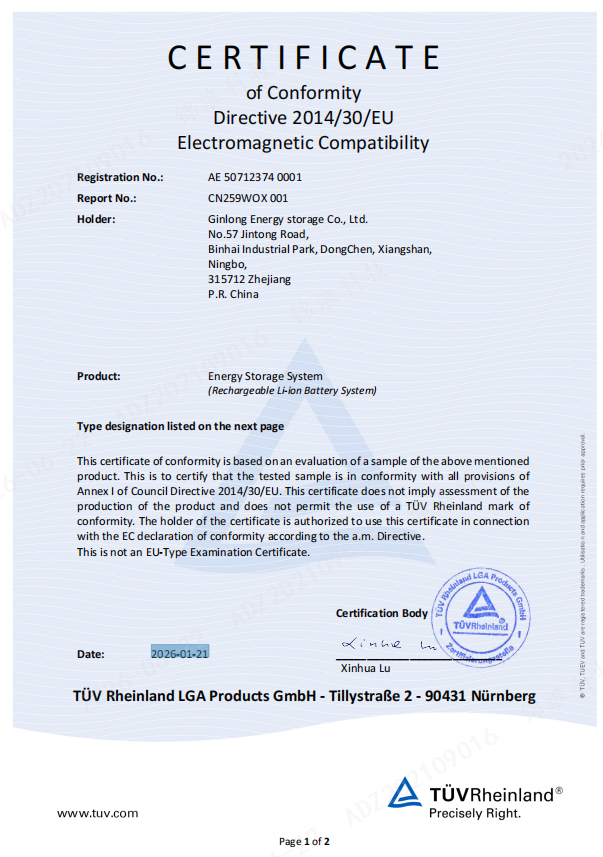
For North American projects, a separate reference point is useful at specification stage. ANSI/CAN/UL 9540:2023 covers energy storage systems intended to receive and store energy for delivery to loads or the local or area electric power system, and its stated scope includes residential and non-residential installations. Buying teams entering that market should treat the standard's scope as a design and documentation requirement to be mapped against the supplier's own certificate set, rather than assuming equivalence with an EU certificate.
Step 4 — Validate Expectations Against Deployed Projects
Reference installations are the most practical way to test whether proposed acceptance criteria are realistic. Two SolisStorage EverCore projects illustrate how the same inverter platform is applied at different storage capacities.
Thailand — 125 kW / 522 kWh. A 125 kW, 522 kWh energy storage system was installed for a self-consumption and backup power project owner. The system is specified for a 20-year duration, delivers savings on electricity bills, and is reported as operating stably.
Denmark — 125 kW / 261 kWh. A 125 kW, 261 kWh system was installed for a C&I industrial end user for warehouse self-usage, with a 20-year duration and reported savings on electricity bills. The installation switches between on-grid and off-grid operation in under 10 milliseconds to prevent interruptions.
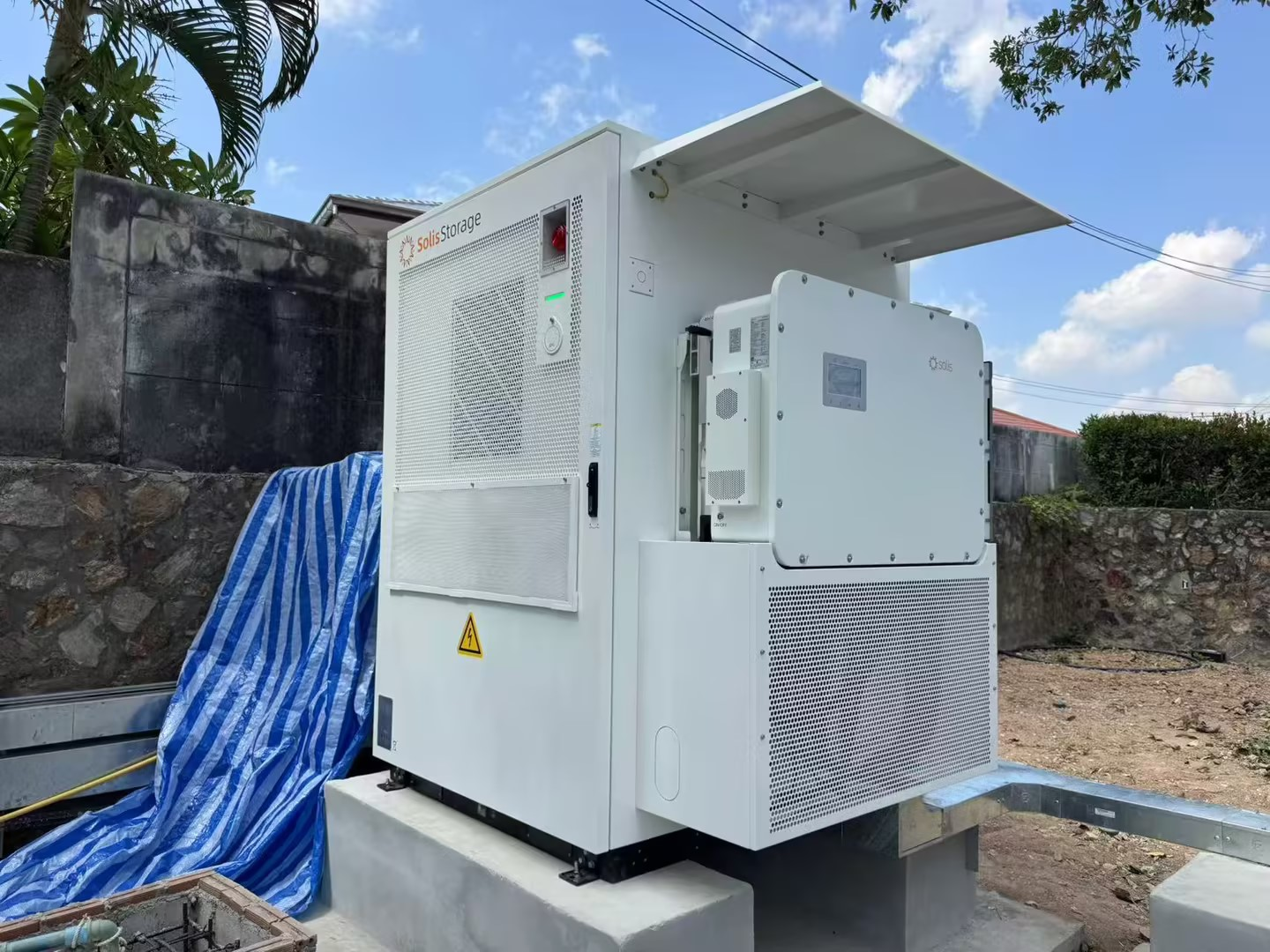
Three acceptance-relevant observations follow. The 125 kW inverter rating appears in both projects, indicating a repeatable power platform across different storage capacities. The two installations differ in energy capacity by a factor of two, which is consistent with capacity expansion through additional battery cabinets on the DC side rather than through a different inverter. And both are specified as 20-year assets, which means acceptance criteria should extend into lifecycle performance — cycle life at a stated test condition, spare parts availability and replacement policy — not stop at commissioning.
Step 5 — Compare Against Conventional Procurement Structures
C&I storage has historically been assembled from separately sourced subsystems. Comparing that structure with an integrated, AC-DC separated design helps buyers identify which items in a quotation are included, optional or excluded.
| Procurement dimension | Conventional multi-unit structure | EverCore separated AC-DC architecture |
|---|---|---|
| Control topology | Independent CPUs for BMS, PCS, EMS and STS form a multi-node distributed control topology | Single central controller schedules the system through one control core |
| Troubleshooting | Multi-node communication links introduce protocol compatibility and latency risk; fault handling can require multiple manufacturers | Fewer failure points; fault location and response handled within one control core |
| Backup transition | External static transfer switch required | Grid-tied / off-grid switching in under 10 ms without an external STS |
| PV integration | External PV inverter required | No external PV inverter needed; supports DC and AC coupling, PV oversizing ratio up to 200% |
| Grid connection | External grid cabinet required | Up to 6 EverCore units connected in parallel for direct grid connection |
| Capacity expansion | Additional inverter investment typically required | One inverter connects up to 6 battery cabinets in parallel |
| Thermal and environmental | Varies by subsystem supplier | Air-cooled design with three-duct airflow; C4-grade anti-corrosion coating; operation from -25°C to 55°C and up to 4,000 m altitude |
Where this framework stops
A credible decision framework states its boundaries as clearly as its benefits. Five limits apply to the material above.
- Terms are not standardised. Payment structure depends on customer tier, order size and regional policies, so terms disclosed for one order should not be assumed to apply to another.
- MOQ conditions are asymmetric. The one-unit minimum applies to standard off-the-shelf models only. Customized OEM orders begin at 20 units, and mass OEM lead time runs 30–45 days — a constraint for projects with fixed commissioning dates.
- Configuration pairing must be confirmed. Capacity and inverter power are published as ranges; buyers should not assume that any capacity can be paired with any inverter rating without supplier confirmation.
- Environmental envelope is bounded. Operation is specified from -25°C to 55°C and at altitudes up to 4,000 m. Sites outside that envelope require separate engineering assessment rather than a standard quotation.
- Certification scope is product-specific. The published EMC certificate covers EverCore-261kWh and EverCore-261kWh-PRO. Product approval for a specific destination market should be verified against that market's requirements, not inferred from a single EU certificate.
Market Trend: Scale Increases the Cost of Weak Acceptance
Two published data points frame why acceptance discipline is becoming more, not less, important. BloombergNEF has projected global annual energy storage deployment, excluding pumped hydro, to reach 92 GW in 2025. In the United States, the Solar Energy Industries Association reported that the industry installed 57.6 GWh of new capacity in 2025, described by the publisher as a record year of additions.
A larger market brings more suppliers and more configuration variants into the same tender. When several offers quote similar capacity and similar prices, the differentiators move to what can be documented: which tests were performed, which certificates exist and for which product scope, what the lead time commitment is, and how the final payment is released against acceptance. Buyers who define those items before shortlisting reduce the risk of accepting a system they cannot later verify.
A second trend is market-specific integration. Customization options for OEM and ODM production include logo, outer package, software interface, regional voltage standard, communication protocol and function parameters. The presence of regional voltage standards and communication protocols on that list reflects the reality that grid requirements and platform interfaces differ by market — and those differences should appear in the acceptance criteria, not only in the marketing configuration sheet.
Future Outlook
Over the next procurement cycles, acceptance documentation is likely to become a maintained asset rather than a one-off project file. Certificate validity windows already encourage this: the published IEC 62619 safety certificate for EverCore ESS runs to 2031-06-01, while the EMC certificate was issued on 2026-01-21. Buyers managing 20-year installations, as in the Thailand and Denmark projects, will need a renewal and evidence-tracking routine that outlasts the original project team.
Lifecycle-based comparison is also likely to displace headline capacity comparison. Reviewing the 8,000-cycle specification at its stated 0.5C and 70% remaining-capacity condition, alongside spare parts commitments and whole-machine replacement terms, gives a more defensible total-cost view than a first-cost ranking. For distributors and brand owners, OEM thresholds and lead times will continue to shape channel planning, particularly where regional voltage standards and communication protocols must be customized before delivery.
Finally, software integration requirements are beginning to appear in acceptance checklists. Solis reports that EverCore has been connected, or is in the process of connecting, with 102 third-party VPP and EMS operators across 11 European countries, and that its AI cloud platform has been deployed at more than 5,500 energy storage power stations worldwide. Where a project depends on third-party market participation, the buyer's acceptance criteria should include proof of platform connectivity rather than assume it.
Frequently Asked Questions
What are the purchasing terms and acceptance criteria for a C&I energy storage system?
For EverCore ESS, the published purchasing terms are: minimum order quantity of 1 unit; delivery terms of FOB Ningbo or EXW (Ex Works) factory delivery; payment terms structured as a deposit plus payment before or after shipment plus a final acceptance payment. The stated acceptance criteria are factory acceptance testing followed by on-site installation and commissioning. The specific payment structure depends on customer tier, order size and regional policies, so terms should be confirmed for each order rather than assumed from a previous one.
What is the minimum order quantity and how long does delivery take?
The minimum order quantity is 1 unit for standard off-the-shelf models and 20 units for customized OEM orders. Lead time is 30–45 days for mass OEM orders, while spot goods are available for standard models. Buyers whose commissioning schedule cannot absorb the mass-order lead time should order standard models, where spot availability is stated.
What acceptance testing is performed before an EverCore ESS shipment?
The manufacturer states that quality control includes raw material incoming inspection, an aging test, a high-low temperature cycle test, an IP protection test, and a 100% full functional test before shipment. Acceptance then continues on site with installation and commissioning. Requesting the pre-shipment test record as a payment release condition makes the factory stage verifiable.
How should a buyer choose among the 100.5 kWh, 120.6 kWh and 261.2 kWh configurations?
EverCore ESS is published with rated energy capacities of 100.5 kWh, 120.6 kWh and 261.2 kWh and inverter power ratings of 50 kW, 60 kW and 125 kW. The specification lists capacity and power as ranges, so the exact capacity-to-inverter pairing for a given site should be confirmed with the supplier. The choice is normally driven by required backup duration and the site's power demand, and additional capacity can be added on the DC side because one inverter supports up to six battery cabinets in parallel.
What customization options are available for OEM and ODM orders?
OEM and ODM production services are available, with customization covering logo, outer package, software interface, regional voltage standard, communication protocol and function parameters. Customized OEM orders start at a minimum order quantity of 20 units with a 30–45 day lead time for mass orders. Because regional voltage standards and communication protocols are customizable, these items should be specified in the technical annex of the purchase agreement.
What deployed projects can be used to validate acceptance expectations?
Two reference installations use the same 125 kW platform at different capacities. In Thailand, a 125 kW / 522 kWh system was installed for a self-consumption and backup power project owner, specified for a 20-year duration, with reported savings on electricity bills and stable operation. In Denmark, a 125 kW / 261 kWh system was installed for a C&I industrial end user for warehouse self-usage, also with a 20-year duration, reported savings on electricity bills, and on-grid to off-grid switching in under 10 milliseconds. Both are 20-year assets, so acceptance criteria should cover lifecycle performance and spares, not only commissioning.
What environmental and certification limits should be checked before ordering?
EverCore ESS is specified for operation from -25°C to 55°C and at altitudes up to 4,000 m, with an IP55 cabinet and IP66 inverter rating and a C4-grade anti-corrosion coating. Sites outside those ranges require separate engineering assessment. On certification, the published EMC certificate AE 50712374 0001 covers EverCore-261kWh and EverCore-261kWh-PRO under CE (EMC Directive 2014/30/EU), and the safety certificate JPTUV-182135 covers IEC 62619 with validity to 2031-06-01. Approval requirements specific to the destination market should be verified against that market's rules.
Additional product and corporate information for SolisStorage and the EverCore ESS range is available in the Solis global brochure: Solis Global Brochure V3.9 (PDF).
Есть вопросы или нужны дополнительные детали?
Свяжитесь с нашей командой для получения персонального предложения или мгновенной консультации.
Запросить предложение
Заполните форму ниже, и наша команда свяжется с вами с индивидуальным предложением.
Прямой чат WhatsApp
Предпочитаете общаться в реальном времени? Напишите нам в WhatsApp для мгновенной помощи и быстрых ответов.
- Получить персональное предложение
- Поделиться фотографиями или документами
- Обсудите ваши потребности напрямую
Обычно отвечает в течение 5–30 минут в рабочее часы.