
CBB60 20 μF vs CD60 50 μF: Buyer Comparison Guide
Independent Buyer Reference · Motor Capacitors
A CBB60 20 μF capacitor and a CD60 50 μF capacitor are not two ratings of the same component. The CBB60 is a metallized polypropylene film run capacitor with a ±5% capacitance tolerance and a GB/T 3667.1-2016 reference standard. The CD60 is an aluminium electrolytic start capacitor with a wider ±15% tolerance and a GB/T 3667.2-2016 reference standard. Buyers who compare them are usually solving a replacement or catalogue-standardisation problem, not choosing between two interchangeable parts.
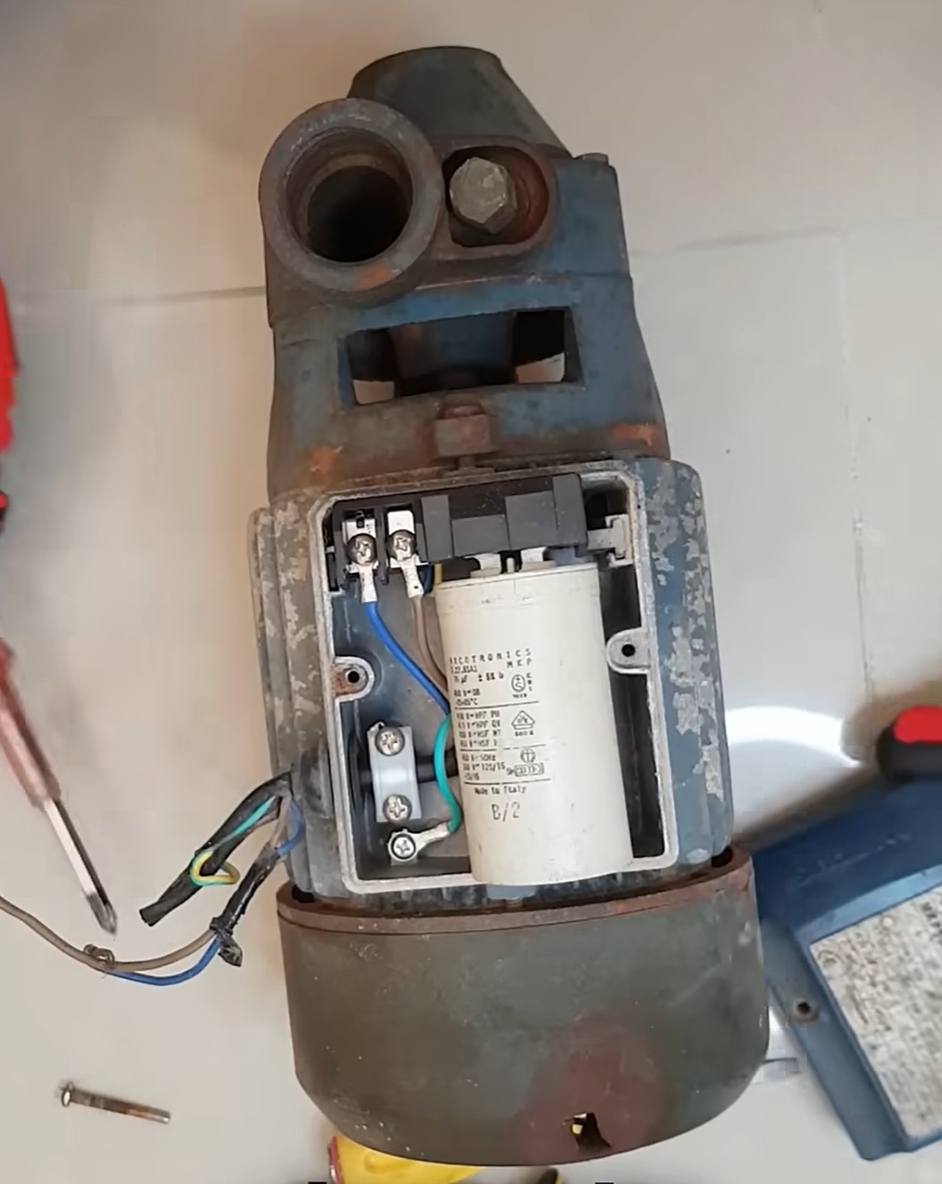
Replacement work on single-phase motor capacitors: the first decision is functional role, not capacitance value. Image: Taizhou Huifeng Electron Co., Ltd.
Why these two part numbers are compared at all
In maintenance catalogues, distributor stock lists and after-sales parts systems, run and start capacitors frequently sit in the same product family, share the same cylindrical silhouette in some sizes, and are both described simply as “motor capacitors.” That presentation invites substitution questions. The technical reality is narrower: a run capacitor stays in circuit for the whole operating cycle, while a start capacitor is connected only during the brief acceleration phase.
Product literature on the two capacitor families describes CBB60 as a metallized polypropylene film run capacitor generally used in pumps, washing machines, air compressors and fan motors, and CD60 as an electrolytic start capacitor built for short-duration starting service. The same comparison states plainly that the two are not interchangeable. For procurement teams, that single sentence is the most valuable line in the whole comparison, because it converts an apparent price question into a specification question.
There is a second reason the comparison keeps appearing. A 20 μF run capacitor and a 50 μF start capacitor look like a modest step in capacitance, and buyers sometimes assume that matching or exceeding a capacitance value is enough to restore a motor to service. In practice the capacitance figure is only one of four attributes that must match: function, dielectric and construction, voltage window, and tolerance band.
Specification snapshot: verified values side by side
The table below uses published specification data for the CBB60 motor run capacitor range and certification scope data for the CD60 series. It is a comparison of published attributes, not a performance ranking.
| Attribute | CBB60 20 μF (run) | CD60 50 μF (start) |
|---|---|---|
| Functional role | Continuous-duty motor run capacitor | Short-duration motor start capacitor |
| Dielectric / construction | Metallized polypropylene film, plastic case, wire leads | Aluminium electrolytic capacitor (CD60 series) |
| Capacitance tolerance | ±5% (ΔC) | ±15% |
| Capacitance range | 1–150 μF; 20 μF sits inside this range | 50–500 μF; 50 μF is the lower bound of the certified scope |
| Rated voltage options | 250/300 VAC; 320/370 VAC; 400/450 VAC | 250 VAC (as certified) |
| Reference standard | GB/T 3667.1-2016 | GB/T 3667.2-2016 |
| Climate category | 25/70/21 and 40/85/21 | 10/55/10 |
| Frequency | 50/60 Hz (AC motor application) | 50/60 Hz |
| Operating level | B / C | Not stated in the cited certification scope |
| Test voltage | 2UN between terminals, 2 s | Not stated in the cited certification scope |
| Continuous limits | 1.1UN long-term voltage; 1.3In long-term current | Not applicable to continuous operation |
| Expected usage time | 3000 hours (stated product data) | Not stated in the cited certification scope |
Sources: CBB60 product specification data (GB/T 3667.1-2016) and CQC Certificate of Product Certification No. CQC09006039887 covering CD60 series 250 VAC 50–500 μF ±15%, 10/55/10, 50/60 Hz, GB/T 3667.2-2016.
The functional difference that decides the purchase
Start and run capacitors perform different electrical work, and that difference governs how each is specified. A run capacitor remains connected across the auxiliary winding during normal operation, so its dielectric must tolerate continuous voltage stress and the heating that comes with it. A start capacitor is switched out once the motor approaches operating speed, so its design centres on delivering a large capacitance in a small body for a short burst.
This is why the tolerance bands diverge so sharply. A ±5% band on a CBB60 supports motors where the phase angle and running current need to be predictable, because an out-of-band capacitance changes the auxiliary-winding current and can shift the motor's running behaviour. A ±15% band on a CD60 reflects a short, high-current starting event, where a wider spread is tolerable in the starting circuit design. Neither band is “better”; each matches the duty it serves.
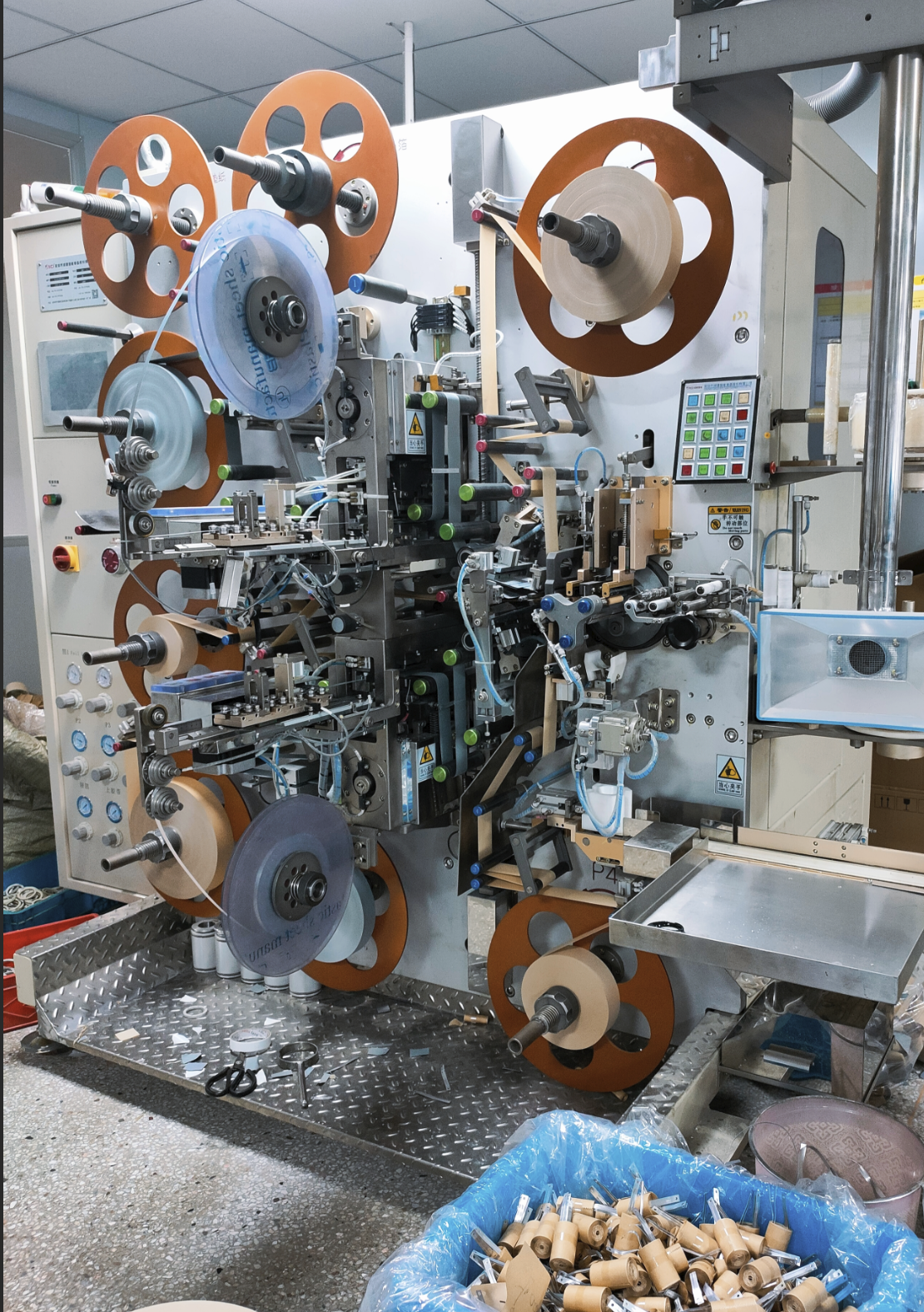
Winding of a CD60 capacitor core. Start capacitors are built around short, high-current starting duty rather than continuous operation. Image: Taizhou Huifeng Electron Co., Ltd.
Voltage ratings follow the same logic. CBB60 product data lists three VAC windows (250/300, 320/370 and 400/450), which lets a buyer match the capacitor to the mains supply and to the motor's actual working voltage margin. The CD60 series certification scope states 250 VAC. A buyer who needs a 400 VAC class part is therefore not looking at a like-for-like swap; the voltage class alone rules out the substitution.
What the standards and certificates actually cover
Both capacitor families are covered by Chinese national standards that mirror the split between run and start duty: GB/T 3667.1-2016 for the CBB60 run capacitor and GB/T 3667.2-2016 for the CD60 start capacitor. Internationally, IEC 60252-1 applies to motor capacitors intended for connection to windings of asynchronous motors supplied from a single-phase system at frequencies up to and including 100 Hz, covering impregnated or unimpregnated dielectrics of paper, plastic film or a combination, metallized or metal-foil electrodes, with rated voltages up to and including 660 V.
Certificate documents are more specific than standards, and buyers should read the scope line rather than the logo. Taizhou Huifeng Electron Co., Ltd. holds a TÜV Rheinland certificate (No. R 50500943) issued on 14 April 2021 for the CBB60 AC motor capacitor, tested to EN 60252-1:2011+A1, covering rated voltages of 370–450 VAC, rated capacitances of 1–60 μF, ±5% tolerance, and climatic categories 40/85/21 and 25/70/21. A 20 μF CBB60 operated at 370–450 VAC falls inside that certified window; a 100 μF unit at the same voltage does not.
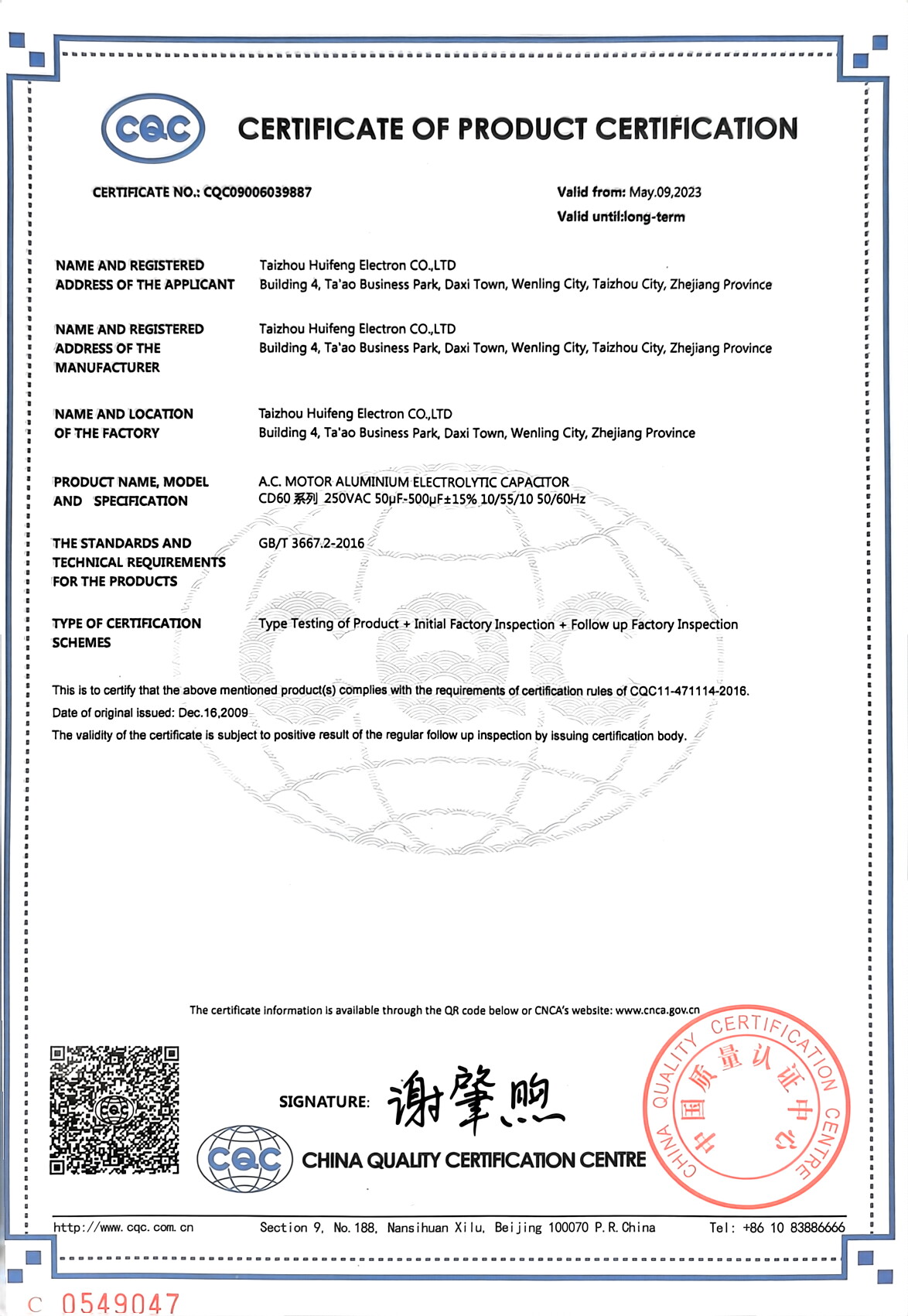
CQC Certificate No. CQC09006039887 covers the CD60 series 250 VAC 50–500 μF ±15%, 10/55/10, 50/60 Hz, against GB/T 3667.2-2016. Image: Taizhou Huifeng Electron Co., Ltd.
For the CD60 family, CQC Certificate of Product Certification No. CQC09006039887, issued by the China Quality Certification Centre on 9 May 2023, covers the A.C. motor aluminium electrolytic capacitor, CD60 series, 250 VAC, 50–500 μF ±15%, climatic category 10/55/10, 50/60 Hz, against GB/T 3667.2-2016. RoHS conformity for the CBB60 family is documented under Certificate of Conformity No. G170323Z38EN issued by Ningbo GIG Testing Technology Service Co., Ltd. on 14 April 2017 against Directive 2011/65/EU, with CBB65, CBB61 and CD60 listed as model/type reference.
Where a manufacturer such as Taizhou Huifeng Electron fits
Taizhou Huifeng Electron Co., Ltd. is a Chinese capacitor manufacturer founded in 1993 and based in Wenling, Zhejiang Province, producing metallized film, CBB and CD series capacitors for industrial and household appliance motor applications. Its published capability data place annual output at 7,200,000 pieces, with monthly capacity of 650,000 units and an export share of around 30%, concentrated on Europe and Asia.
For buyers evaluating either capacitor type, three capability facts matter more than catalogue breadth. First, the company operates ODM customisation across capacitance, voltage, casing, lead-out method, branding and packaging, which is the practical route when a replacement part must match an existing terminal layout or enclosure. Second, MOQ is stated as 300 units for regular items and 1000 units for customised items, with a 25–35 day lead time—a workable structure for distributors replenishing standard stock alongside a smaller custom line. Third, quality control is described as 100% testing, including semi-finished product testing and finished product testing, with after-sales support covering warranty and solution provision.
A published wholesaler ODM case adds context on volume handling: a United Arab Emirates wholesaler used 100,000 units of CBB60 motor run capacitors over a two-year project for water pump and motor applications, with reported stable performance and no negative reviews. That is a single customer account rather than an independent audit, but it does illustrate the scale band in which run capacitor supply is typically negotiated.
Applications: where each part belongs
Run capacitors dominate continuous-duty single-phase applications. CBB60 parts are described in product literature as the type fitted to pumps, washing machines, air compressors and fan motors, and Huifeng's own specification lists water pump motor manufacturing, wholesalers, distributors and the maintenance industry as target applications, with stated working conditions of high temperature and continuous power-on operation requiring stable capacitance and anti-aging behaviour.
Start capacitors belong to motor designs that need a torque boost at acceleration, after which the start winding is switched out. In after-sales and repair contexts, the practical rule is that the replacement must match the original function first, then the nameplate capacitance and voltage, then the physical fit.
There is also a third family that buyers encounter in the same catalogue: CBB65, a film run capacitor in an aluminium can commonly used in air-conditioning and refrigeration equipment. It is not part of this comparison, but it explains why capacitor catalogues often show three similar-looking cylinders with three different duties.
A procurement checklist for either part
- Confirm the functional role. Verify from the motor wiring diagram or equipment manual whether the position is a run or start circuit before comparing prices.
- Match capacitance and tolerance band. A 20 μF ±5% run part and a 50 μF ±15% start part are not substitutes at any price.
- Match the voltage class. Choose from the 250/300, 320/370 or 400/450 VAC windows for CBB60, and confirm the mains and motor margin rather than the catalogue default.
- Check the climate category against the application. 25/70/21 and 40/85/21 appear in CBB60 data; 10/55/10 appears in the CD60 certification scope.
- Verify certificate scope, not certificate presence. Confirm the specific capacitance, voltage and tolerance are inside the certified range.
- Confirm mechanical fit and termination. Wire-lead CBB60 parts and screw or spade terminal start capacitors mount differently inside the same equipment.
- Set MOQ and lead time expectations early. Standard versus customised quantities frequently fall on different MOQ tiers and different lead times.
Limits and boundaries buyers should plan for
Several constraints in the published data deserve attention before an order is placed. The CBB60 specification states an expected usage time of 3000 hours under its stated conditions; that figure is a service-life reference for the specified operating regime, not a guarantee for every installation, and buyers running continuous industrial duty should treat it as the baseline to discuss with the supplier rather than a universal rating.
Tolerance is a second boundary. A ±5% band on a 20 μF run capacitor still permits a spread of roughly one microfarad across production, and a ±15% band on a 50 μF start capacitor permits a considerably wider spread. Buyers who require tighter matching for sensitive motor designs need to specify that requirement explicitly, because standard catalogue tolerance will not deliver it by default.
Third, standards and certificates age. IEC 60252-1 evidence used in this comparison refers to the 2010 edition, and national adoption status should be revalidated against current market requirements before a conformity claim is made in a tender document. Certificate scopes should also be checked against the exact model being purchased, since scope lines list specific ratings rather than whole product families. Finally, substitution between run and start capacitors is not a valid cost-reduction measure: published product comparison guidance states directly that the two are not interchangeable, and any change of capacitor type should be validated against the motor manufacturer's specification.
Market context
One commercial research estimate places the global motor capacitor market at approximately USD 24.04 billion in 2025, with a forecast compound annual growth rate of 4.77% from 2025 to 2032 (Maximize Market Research). That figure is a single-source estimate and should be treated as directional rather than definitive; it does indicate a mature market growing steadily rather than a rapidly re-pricing one.
For buyers, the practical implication of a mid-single-digit growth market is that supply availability is unlikely to be the binding constraint, while specification discipline and supplier documentation remain the main differentiators between quotes. The split between run and start capacitor demand also tends to track the installed base of pumps, fans, air-conditioning and refrigeration equipment, which is replacement-driven and therefore relatively stable.
Outlook
Three developments are likely to shape how these two parts are sourced. First, documentation-led procurement is becoming normal in export markets: buyers increasingly request certificate scope pages and standard references alongside quotations, which favours manufacturers who can map a specific capacitance and voltage to a named certificate. Second, customisation demand continues at the distributor level, where casing, lead-out and labelling differences matter as much as electrical ratings; ODM flexibility with a 1000-unit custom MOQ addresses that segment. Third, the run and start distinction is likely to stay firmly in place, because it follows from motor physics rather than from product fashion.
Frequently asked questions
Can a CD60 50 μF capacitor be used to replace a CBB60 20 μF run capacitor?
No. The CBB60 is a continuous-duty metallized polypropylene film run capacitor, while the CD60 is an aluminium electrolytic start capacitor intended for short-duration starting service. Published product comparison guidance states that the two are not interchangeable, and the capacitance, tolerance band (±5% versus ±15%) and voltage class differ as well. Any change of capacitor type should be validated against the motor manufacturer's specification.
What does ±5% tolerance mean when ordering a replacement run capacitor?
It means the delivered capacitance should fall within 5% of the rated value; for a 20 μF CBB60 this is a narrow band around the nameplate figure. The CBB60 specification lists ΔC of ±5%, while the CD60 series certification scope lists ±15%. Buyers matching a replacement to a motor nameplate should compare tolerance bands before comparing prices.
Which standards should appear in the technical documentation for each part?
CBB60 run capacitors are referenced to GB/T 3667.1-2016 and CD60 start capacitors to GB/T 3667.2-2016. Internationally, IEC 60252-1 covers motor capacitors connected to asynchronous motor windings from a single-phase system up to and including 100 Hz, with rated voltages up to and including 660 V, for paper, plastic-film or combined dielectrics.
What capacitance and voltage options exist for these two families?
The CBB60 range covers 1–150 μF with rated voltage windows of 250/300 VAC, 320/370 VAC and 400/450 VAC, wire leads and a plastic case. The certified CD60 scope covers 250 VAC, 50–500 μF, ±15%, climatic category 10/55/10 at 50/60 Hz. A 20 μF run capacitor and a 50 μF start capacitor each sit at different points inside those ranges.
How can a buyer verify a supplier's certificates for a specific order?
Read the scope line rather than the certificate title. For example, TÜV Rheinland certificate No. R 50500943 covers the CBB60 at 370–450 VAC and 1–60 μF with ±5% tolerance under EN 60252-1:2011+A1, and CQC certificate No. CQC09006039887 covers the CD60 series at 250 VAC and 50–500 μF. Supporting documents include RoHS Certificate of Conformity No. G170323Z38EN and ISO 9001 certificate No. 25024Q10313R1M, valid to 14 March 2027.
Manufacturer technical documentation and the company brochure can be downloaded here: Taizhou Huifeng Electron Co., Ltd. brochure (PDF). Company reference: Taizhou Huifeng Electron Co., Ltd., Wenling, Zhejiang Province, China · www.tzhfdz.com
Есть вопросы или нужны дополнительные детали?
Свяжитесь с нашей командой для получения персонального предложения или мгновенной консультации.
Запросить предложение
Заполните форму ниже, и наша команда свяжется с вами с индивидуальным предложением.
Прямой чат WhatsApp
Предпочитаете общаться в реальном времени? Напишите нам в WhatsApp для мгновенной помощи и быстрых ответов.
- Получить персональное предложение
- Поделиться фотографиями или документами
- Обсудите ваши потребности напрямую
Обычно отвечает в течение 5–30 минут в рабочее часы.