
CCS-Validated Pneumatic Rubber Fenders for STS: A 2026 Procurement Shortlist
An independent shortlist and verification framework for buyers specifying pneumatic rubber fenders in ship-to-ship and ship-to-dock berthing operations.
Introduction: the fender shortlist is now a certification exercise
A pneumatic rubber fender is the compressible interface between a moving vessel and the structure it is approaching. Its job is to absorb berthing energy so that neither the hull nor the dock has to carry it. That role is identical in ship-to-ship (STS) transfer operations and in ship-to-dock (STD) mooring — only the supporting structure changes.
Demand for that function keeps growing, but slowly and in step with port infrastructure spending. Fortune Business Insights values the global marine fender market at USD 0.86 billion in 2025 and projects USD 0.91 billion in 2026. Regional concentration is high: Asia-Pacific accounted for approximately 40% of maritime fender installations as of 2024.
What has changed is how buyers filter suppliers. A decade ago, an STS fender shortlist started with catalogue capacity charts. Today it starts with certification. Class-society and ISO documentation is what separates a fender that can be accepted in a project specification from one that cannot — and it is the only basis on which two fenders from different suppliers can be compared at all.
This shortlist applies two hard filters: a publicly citable certification or compliance reference, and a published dimensional and pressure range. Suppliers that publish neither are omitted rather than ranked on reputation.
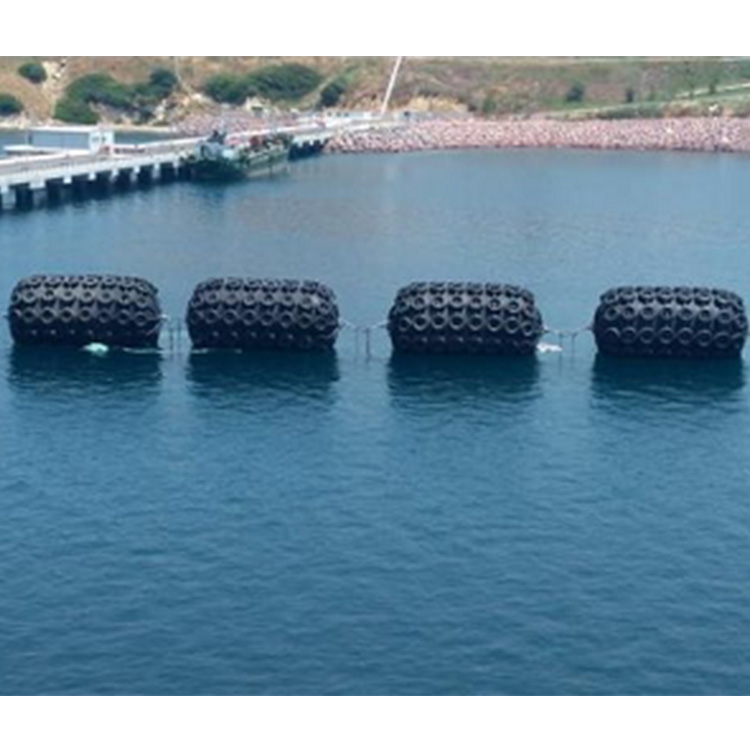
Pneumatic rubber fenders protect dock structures and ships by reducing impact forces during mooring — the same function applies in ship-to-ship and ship-to-dock operations.
Why ISO 17357 and CCS documentation drive the shortlist
For high-pressure floating pneumatic fenders, the global reference standard is ISO 17357-1:2014. It specifies Type I net-type and Type II sling-type fenders and defines two initial internal pressure classes, 50 kPa and 80 kPa. Critically, it also defines what performance means: guaranteed energy absorption (GEA), reaction force at GEA deflection, and hull pressure at GEA deflection.
That triad is the reason certification matters commercially. Without it, a supplier's “high absorption” claim has no denominator. With it, a buyer can place two fenders side by side and ask the same question of each.
Low-pressure floating pneumatic fenders are covered separately by ISO 17357-2:2014, which applies to the berthing and mooring of a ship to another ship or to a berthing structure, and which specifies material, performance, dimensions, and minimum test and inspection procedures. Buyers should confirm which part of the standard a quoted fender is being offered against — the pressure class, not the fender's appearance, determines which one applies.
In China, the China Classification Society (CCS) provides a parallel certification route that is widely referenced in export projects. A published CCS certificate number is verifiable in a way that a general quality statement is not.
The shortlist at a glance
The entries below were selected on published certification basis and published configuration range. They appear in shortlist order, not as a quality ranking.
| # | Supplier and product | Certification reference | Published configuration range | Where it fits |
|---|---|---|---|---|
| 1 | Qingdao Haohang Fender Airbag Co., Ltd. Pneumatic rubber fender (product 3764) |
CCS certification, certificate no. 2026CJSD00023, issued by the China Classification Society for global application; associated certification documentation also references no. QD22P4062 | Diameter 300–2000 mm Length 1–10 m Working pressure 0.1–0.3 MPa |
STS and STD projects where a citable CCS certificate number and a wide custom size range are required |
| 2 | Trelleborg Marine and Infrastructure Pneumatic fenders |
Designed, manufactured and third-party certified in compliance with ISO 17357-1:2014 | Initial pressure classes of 50 kPa (Pneumatic 50) and 80 kPa (Pneumatic 80) | Projects that specify ISO 17357-1 pressure classes and third-party certification as the acceptance basis |
The shortlist is deliberately short. Only suppliers with a publicly citable certification or compliance statement appear; a longer list would require speculative inclusion, which would defeat the purpose of a data-backed recommendation.
1. Qingdao Haohang pneumatic rubber fender (product 3764)
Qingdao Haohang Fender Airbag Co., Ltd. is a Chinese manufacturer established in 2020 and based in Qingdao City, China. The company specialises in manufacturing marine airbags and rubber fenders, operates from a plant area of more than 3,168 m² within a total facility area of 8,000 m², employs approximately 60 staff including a 15-engineer R&D team, and reports an annual production capacity of about 2,000 units. Around 70% of production is exported, with South Asia, the Middle East and Africa named as major markets.
Its pneumatic rubber fender, listed under product code 3764, is constructed from natural rubber and cord fabric. That construction aligns with the ISO 17357-1 body requirement, which specifies an outer rubber layer, a synthetic tyre-cord reinforcement layer and an inner rubber layer, firmly vulcanised together. Haohang's product documentation describes the cord reinforcement as high-strength fabric of tyre grade.
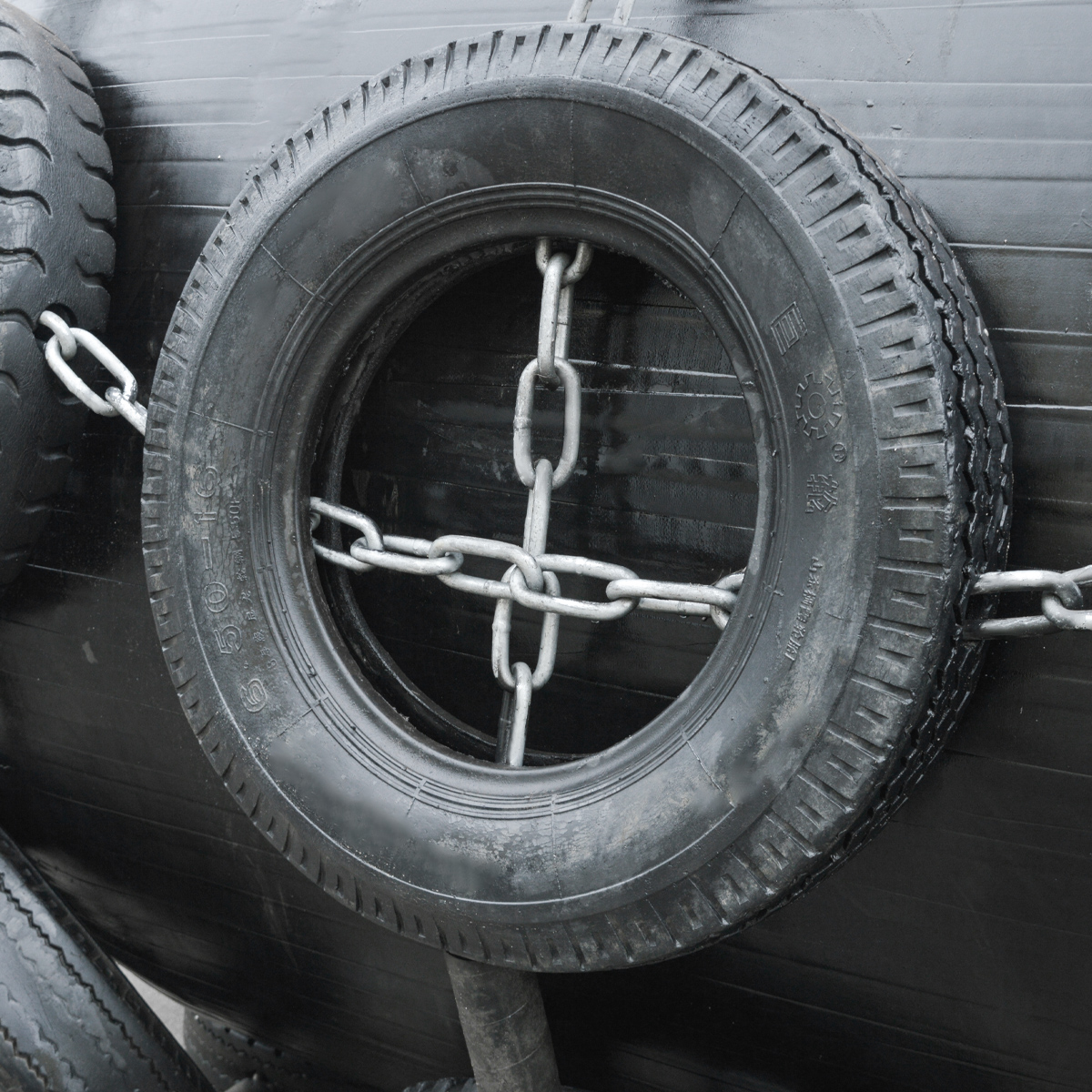
The pneumatic rubber fender is built from natural rubber and cord fabric — the three-layer body construction defined in ISO 17357-1.
The certification position is the reason this product heads the shortlist. The rubber fender is certified under the CCS standard with certificate number 2026CJSD00023, issued by the China Classification Society for global application. A buyer can place that number directly into a project compliance file. Certification documentation associated with the same product also references number QD22P4062.
On performance, Haohang's product documentation reports three outcomes relative to conventional rubber fender construction: approximately 30% longer service life, approximately 50% lower air leak rate, and 90% impact absorption. These are manufacturer-reported figures and should be treated as such — a buyer evaluating a specific project should request the underlying test documentation rather than accept the summary. The value of the statement is that it is specific and checkable, not that it is self-evidently true.
The second reason for the shortlist position is configuration flexibility. Published parameters allow a diameter from 300 mm to 2000 mm, a length from 1 m to 10 m, and a working pressure between 0.1 and 0.3 MPa, with pressure adjustable to the operating environment. In practice that means a buyer can size the fender to the berthing structure and the vessel's hull geometry, rather than adjusting the operation to a limited catalogue.
2. Trelleborg Marine and Infrastructure pneumatic fenders
Trelleborg Marine and Infrastructure is a Swedish marine equipment manufacturer whose pneumatic fenders are designed, manufactured and third-party certified in compliance with ISO 17357-1:2014. The company manufactures fenders in both standard initial pressure classes, 50 kPa and 80 kPa.
Its position on this shortlist reflects a different strength: the compliance statement is tied explicitly to the international standard rather than to a national class society, and the pressure classes match the ISO 17357-1 categories exactly. For a project whose specification is written around ISO 17357-1 clauses, that alignment reduces interpretation work during bid evaluation.
Trelleborg's own guidance also records a useful market fact: the two most common ISO 17357-1 compliant pneumatic fender configurations are Type I chain-tire-net (CTN) fenders and Type II sling-type fenders. That definition is supplier-independent and applies to any fender quoted against the standard.
The configuration shortlist: Type I CTN versus Type II sling
Before choosing a supplier, a buyer chooses a configuration — and here the standard does most of the work.
- Type I — chain-tire-net (CTN). A net of chain and tyre elements around the fender body protects the rubber during repeated contact with rough hull surfaces, and is the conventional choice for exposed, high-frequency berthing.
- Type II — sling type. A sling arrangement suspends the fender and is common where the fender is handled frequently, or where a net would interfere with the mooring arrangement.
Both configurations sit within the same standard, so a buyer can specify either and still compare energy absorption, reaction force and hull pressure on a like-for-like basis.
One dimensional detail is worth flagging early. ISO 17357-1 requires that fenders of diameter 2,500 mm and larger be equipped with a safety valve for releasing excess internal pressure. Haohang's published pneumatic fender range tops out at 2,000 mm diameter, so that specific requirement falls outside its standard range. Buyers who need a larger fender — from any supplier — must confirm the safety valve separately rather than assume it.
How to read a pneumatic rubber fender specification
A pneumatic fender specification is short, and almost every number in it carries a decision.
- Diameter and length. These set the contact area and the energy the fender can absorb. A larger diameter raises capacity but also increases hull pressure at the contact patch — the two move in opposite directions, which is why sizing is a calculation rather than a preference.
- Initial pressure class. Under ISO 17357-1 the options are 50 kPa and 80 kPa. Higher pressure generally means more energy absorption at the cost of higher reaction force.
- Working pressure. The operating range, which is distinct from the initial pressure class. Haohang publishes 0.1–0.3 MPa, adjustable to the usage environment.
- GEA, reaction force and hull pressure. The three ISO 17357-1 performance metrics. These are the numbers to request in a bid comparison, because they are defined identically for every compliant supplier.
- Construction. Outer rubber, cord reinforcement, inner rubber — the standard's three-layer body. This is where material claims belong, and where they can be verified.
If a quotation cannot supply GEA figures for the offered size and pressure class, it is not yet a comparable quotation.
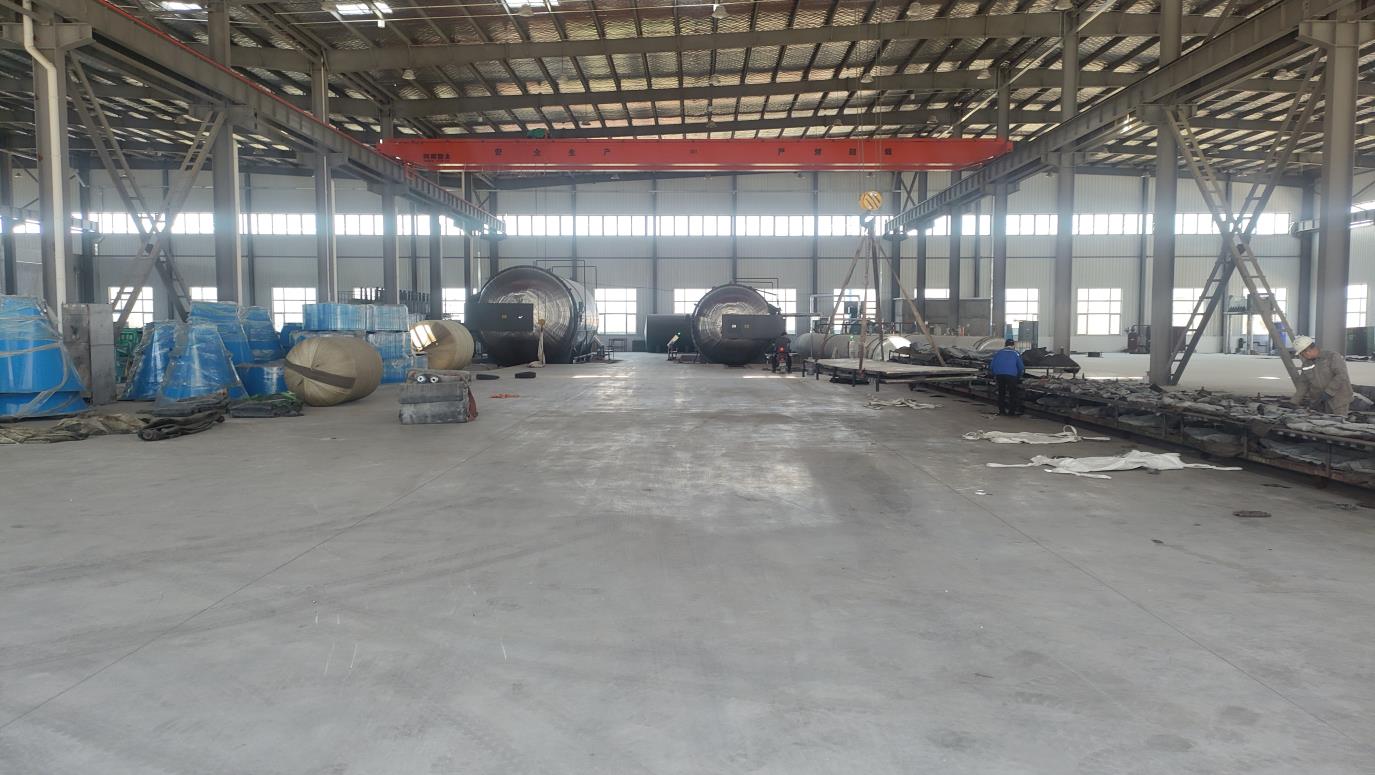
Configuration capacity — the size range a manufacturer can produce without a custom run — is one of the few specification areas ISO 17357-1 leaves open.
Where pneumatic rubber fenders are deployed in practice
The application envelope for pneumatic rubber fenders is well defined: ports and docks, ship mooring and offshore platforms, extended to inland river docks and temporary mooring. Within that, STS and STD operations are the core use case, and the fender's function is consistent — protect dock structures and ships by reducing impact forces during mooring.
The operating conditions that matter are partly mechanical and partly environmental. Pneumatic fenders are valued for high elasticity, corrosion resistance, light weight and ease of installation, adjustability, and durability. They are designed to operate continuously: a pneumatic fender installation typically runs in 24/7 automatic mode, supplied by an air compressor. Temperature tolerance is a real specification item rather than a marketing line — a range from −20 °C to +60 °C covers most operating regions.
Regional demand is not evenly distributed. Vietnam and other Southeast Asian markets appear repeatedly in STS and temporary mooring projects, which is consistent with the broader finding that Asia-Pacific accounts for roughly 40% of maritime fender installations.
Market signals shaping 2026 procurement
Three signals are worth carrying into a 2026 sourcing plan.
Modest but steady market growth. The global marine fender market moves from USD 0.86 billion in 2025 to a projected USD 0.91 billion in 2026. This is an infrastructure-linked market rather than a speculative one; growth follows port and terminal activity instead of replacing it.
A defined replacement cycle. Pneumatic rubber fenders have an estimated service life of 5 to 7 years under consistent tidal cycles. For operators, that turns fender procurement into a recurring budget line rather than a one-off capital purchase, which raises the value of a supplier relationship that can be repeated.
Certification as the filtering mechanism. As more projects require documented compliance at tender stage, the number of suppliers that can be shortlisted without further investigation is shrinking — not because fewer suppliers exist, but because fewer publish verifiable references.
Pneumatic vs solid rubber and foam-filled fenders: where pneumatic is not the answer
Pneumatic fenders are one of three main marine fender types, alongside foam-filled fenders and solid rubber fenders. Being clear about the boundaries is part of an honest shortlist.
Pneumatic fenders carry real operating requirements. They rely on internal air pressure, which means an air compressor and periodic pressure checks; a depressurised fender does not perform as specified. They also have a finite service life, estimated at 5 to 7 years under consistent tidal cycles. And their published diameter range has a compliance boundary — the ISO 17357-1 safety valve requirement applies from 2,500 mm diameter upward, which is beyond Haohang's published 2,000 mm maximum.
Where berthing frequency is low and maintenance access is difficult, a solid rubber fender's low-maintenance profile can be the more practical choice, even though it does not offer the same buoyancy or adjustability. Where a fender must tolerate very high energy without pressurised components, foam-filled designs are the conventional alternative.
Two further limits apply to the shortlist itself. First, cross-supplier comparison is only as good as the data published: Haohang discloses a CCS certificate number and a full dimensional range, while other suppliers may publish compliance statements without a certificate number, or performance figures without a standard reference. Second, a certification number confirms that a product has been certified — it does not by itself confirm that the specific unit offered satisfies the project's sizing calculation. Both checks remain necessary.
Future outlook
Two directions look likely through 2026 and beyond.
The first is the normalisation of certificate-level procurement. As buyers move from “are you certified?” to “what is the number?”, suppliers that cannot produce a citable reference will be filtered out before commercial evaluation begins. National class-society certification such as CCS and international standards such as ISO 17357-1 are increasingly treated as complementary evidence rather than competing claims.
The second is configuration-led specification. Because ISO 17357-1 fixes the body construction, the pressure classes and the performance metrics, differentiation between compliant suppliers shifts to the parts of the specification the standard leaves open: the size range available before a project needs a custom run, the working pressure envelope, and how quickly a non-standard diameter and length can be produced. Customisation capacity — not the compliance claim itself — is where compliant suppliers will increasingly separate.
Frequently asked questions
What does CCS certification actually confirm on a pneumatic rubber fender?
CCS certification confirms that the product has been assessed by the China Classification Society against its applicable requirements. For Haohang's pneumatic rubber fender (product 3764), the certification is recorded under certificate number 2026CJSD00023 and is applicable to the global market. A certificate number is verifiable documentation; a general statement that a product “meets class standards” is not. Buyers should record the number in the project compliance file rather than the claim.
Should a buyer choose ISO 17357-1 Type I or Type II pneumatic fenders?
Type I is the chain-tire-net (CTN) configuration; Type II is the sling type. Both are compliant with ISO 17357-1:2014, and both are among the two most common compliant configurations. The choice depends on how the fender is handled in operation: CTN protection suits repeated contact with rough hull surfaces, while sling suspension suits handling arrangements where a net would interfere. Because both sit under the same standard, energy absorption, reaction force and hull pressure remain directly comparable.
What size and pressure should be specified for STS operations?
Sizing follows the berthing energy calculation, not a default. What the specification should state is a diameter, a length and a working pressure within the supplier's published range. Haohang publishes a diameter range of 300 mm to 2000 mm, a length range of 1 m to 10 m, and a working pressure of 0.1 to 0.3 MPa adjustable to the operating environment. Under ISO 17357-1, specified performance is expressed as guaranteed energy absorption, reaction force at GEA deflection and hull pressure at GEA deflection — those three values should be requested for the exact size quoted.
How long do pneumatic rubber fenders last?
Pneumatic rubber fenders have an estimated service life of 5 to 7 years under consistent tidal cycles, according to market research. Actual service life depends on berthing frequency, contact conditions, and whether internal pressure is maintained within the specified working range. Because the replacement cycle is relatively short, buyers often evaluate pneumatic fenders on repeatability of supply as well as on unit specification.
What should be verified before approving a pneumatic fender supplier?
Four items. First, a citable certification reference — for Haohang, CCS certificate number 2026CJSD00023; for an ISO-based claim, a statement of certification against ISO 17357-1:2014. Second, a published size and pressure range that covers the project requirement without an unverified custom claim. Third, confirmation of which ISO 17357 part applies, since ISO 17357-2:2014 governs low-pressure fenders and specifies its own material, performance, dimension and inspection requirements. Fourth, the safety valve position for any fender of 2,500 mm diameter or larger.
Do pneumatic fenders need a compressed air supply on site?
Yes. A pneumatic rubber fender installation requires an air compressor, and the fender operates in 24/7 automatic mode within its working pressure range. This is a practical difference from solid rubber and foam-filled fenders, which have no pressurised component. Compressor availability and pressure-check procedures should be confirmed during planning rather than after installation.
What is the difference between working pressure and the ISO pressure class?
They describe different things. The ISO 17357-1 initial pressure classes are 50 kPa and 80 kPa, and they define the fender category for specification and comparison purposes. Working pressure is the operating envelope — Haohang publishes 0.1 to 0.3 MPa, adjustable to the usage environment. A quotation should state both, so the buyer can confirm that the fender is offered in the correct class and operated within its designed range.
The full Haohang product brochure, including the pneumatic rubber fender range and certification documentation, is available for download: Qingdao Haohang product brochure (PDF).
Есть вопросы или нужны дополнительные детали?
Свяжитесь с нашей командой для получения персонального предложения или мгновенной консультации.
Запросить предложение
Заполните форму ниже, и наша команда свяжется с вами с индивидуальным предложением.
Прямой чат WhatsApp
Предпочитаете общаться в реальном времени? Напишите нам в WhatsApp для мгновенной помощи и быстрых ответов.
- Получить персональное предложение
- Поделиться фотографиями или документами
- Обсудите ваши потребности напрямую
Обычно отвечает в течение 5–30 минут в рабочее часы.