
CE Certification and 15 Years: What Caisheng Label Presses Qualify For
Industry Reference · Label Printing Machinery
CE Certification and 15 Years: What Caisheng Label Presses Qualify For
Compliance evidence and manufacturing depth now act as the first filters in label printing machine procurement. A press that cannot be tied to documented conformity evidence is difficult to place on the European market, while a manufacturer without a long production record struggles to sustain spare-part supply, process knowledge and service continuity across a machine's working life.

Self-adhesive label applications typically produced on the Caisheng platform: daily chemicals, chemicals, wristbands, wine labels, food, cosmetics and pharmaceuticals.
Shenzhen Caisheng Printing Machinery Co., Ltd. is a label printing equipment manufacturer founded in 2011 and based in Longgang District, Shenzhen, China. The company produces intermittent and high-speed full-rotary letterpress printing machines, flexographic printing machines and screen printing machines, and supplies customized multi-functional label finishing solutions including die-cutting systems and high-speed varnishing machines. Its qualification position rests on three separately checkable pieces of evidence: a CE attestation with a named model scope, two patents granted by the China National Intellectual Property Administration, and an export record covering Southeast Asia, Europe, the Middle East and the United States.
Why Conformity Documentation Became a Buying Filter
Machinery sold in the European Union must comply with Machinery Directive 2006/42/EC and carry CE marking, with safety signs following EN ISO 7010. For the equipment category that includes label presses, ISO 12643-2:2023 sets the safety requirements for graphic technology equipment and systems. In practice, that means a label converter evaluating a press for an EU installation is buying two things at once: a production asset and a compliance file.
Suppliers respond to that pressure in different ways. Some quote a CE mark without a certificate number or a scope statement; others provide a scanned attestation but no model list. The gap matters because conformity documentation is examined at the point of entry and at the point of insurance, not at the point of sale. A document that cannot be matched to the machine actually delivered creates exposure for the buyer rather than the seller.
The commercial backdrop makes that exposure more frequent. The global label printing machines market was valued at USD 8.58 billion in 2025 and is projected to reach USD 14.36 billion by 2034, according to The Insight Partners. Spherical Insights projects the narrow web label printing machines segment moving from USD 1.43 billion in 2024 to USD 3.21 billion by 2035. Data Bridge Market Research records Asia-Pacific holding a 41.8% revenue share of the label printing machines market in 2025.
Capacity added in one region and consumed in another means more machines crossing regulatory borders, and more orders that require a conformity file before a purchase order is signed.
What Caisheng Holds: The CE Attestation and Its Exact Scope
Caisheng's conformity evidence for the EU market is a Machinery Directive Attestation of Conformity, certificate number M.2025.206.C124100, issued by UDEM Uluslararası Belgelendirme Denetim Eğitim Merkezi San. ve Tic. A.Ş.
| Recorded item | Detail |
|---|---|
| Certificate type | Machinery Directive Attestation of Conformity (CE) |
| Certificate number | M.2025.206.C124100 |
| Issuing body | UDEM Uluslararası Belgelendirme Denetim Eğitim Merkezi San. ve Tic. A.Ş. |
| Target market | EU |
| Scope as recorded | CAISHENG // CS-300, CS-220, CS-350 |
| Standards cited | EN ISO 12100:2010; EN 60204-1:2018 |
| Issue date | 2025-11-08 |
| Valid until | 2030-10-08 |
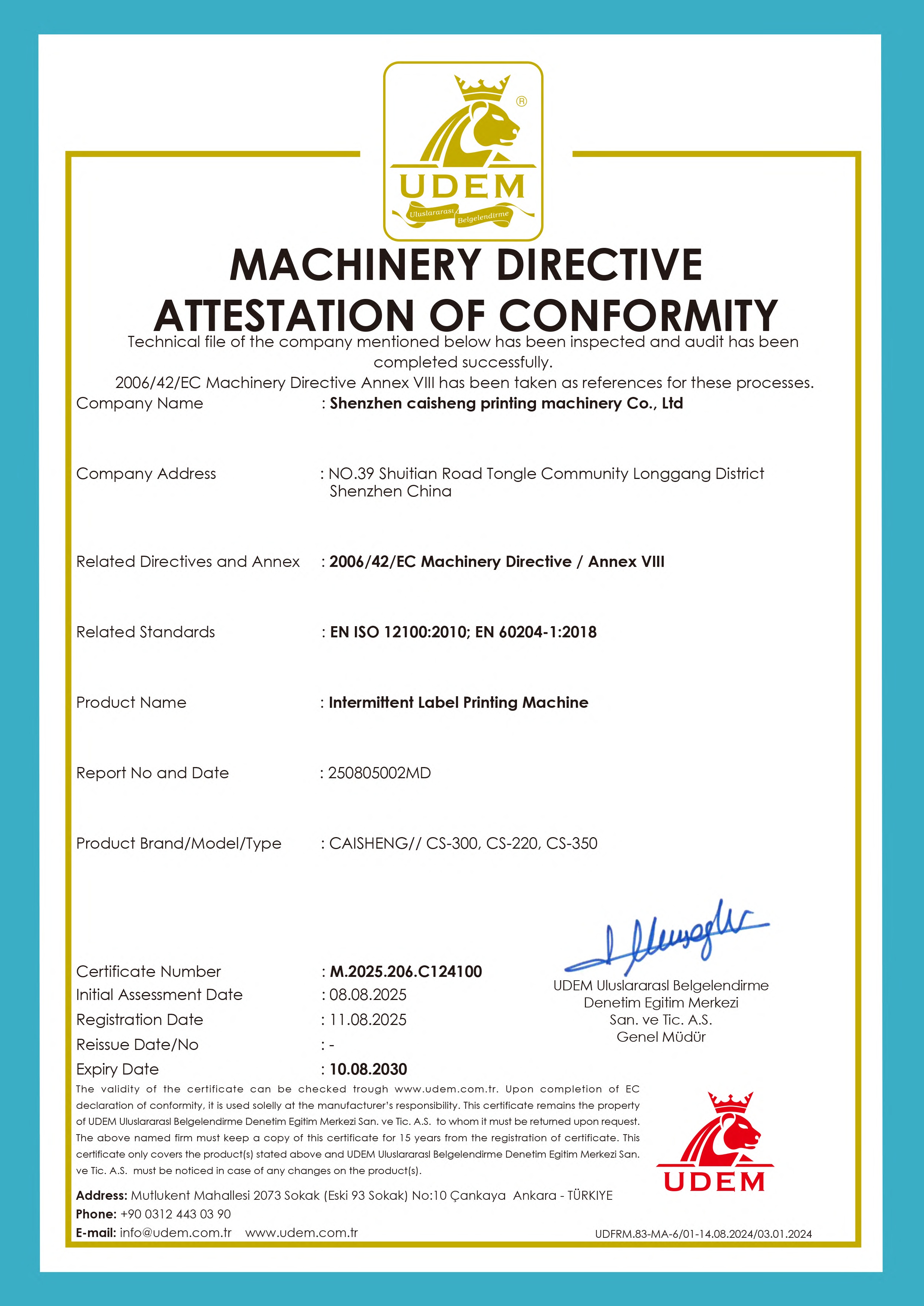
The Caisheng Machinery Directive Attestation of Conformity, certificate number M.2025.206.C124100, valid to 8 October 2030.
Two details inside that record carry more weight than the certificate number itself. The first is the standard set. EN ISO 12100:2010 and EN 60204-1:2018 are both named, which means the conformity file addresses machinery risk assessment and the electrical equipment of the machine rather than a single inspection point. The second is the scope statement. The attestation is recorded against the CS-300, CS-220 and CS-350 series, and the certification record links it to concrete models: CS-300-6C, CS-300-5C, CS-320-7C, CS-320-6C, CS-220-5C, CS-220-4C, CS-JQ350G-6C and CS-JQ350-7C.
Buyers should read that list against their own purchase order line by line. A CE attestation is scoped, not general: it applies to the machine configurations named in the certification file, and any configuration change — an added printing unit, a different finishing module or a non-standard process combination — should be confirmed with the supplier before the order is placed.
What EN ISO 12100:2010 and EN 60204-1:2018 Cover in Practice
EN ISO 12100:2010 is the methodology standard for machinery safety. It defines how risk assessment and risk reduction are carried out during machine design, so that hazards are identified, evaluated and either eliminated or reduced to an acceptable level. EN 60204-1:2018 addresses the electrical equipment of machines: how the electrical system is configured, protected and marked so that hazards associated with electrical energy are controlled. An attestation citing both standards is a statement about how a machine was designed and how its electrical system is built, not merely about how it performed on a test day.
In a label press those two layers sit underneath the components buyers actually evaluate — the servo system, air cooling system, water cooling system and UV drying lamp that carry the printing and curing cycle. Caisheng specifies its machines for stable continuous automatic cycle printing at normal room temperature, without the need for a constant-temperature production workshop, which is a real cost consideration for converters operating in climates where climate control is expensive to run year-round.
The mechanical and control design behind the platform is covered by two granted Chinese patents. Utility model ZL 2022 2 1332174.4, issued by the China National Intellectual Property Administration on 16 September 2022 and valid to 30 May 2032, covers the complete double-sided printing machine structure, the paper forward–reverse switching conveying mechanism and the registration correction assembly. Invention patent ZL 2022 1 0411353.5, issued on 12 July 2022 and valid to 18 April 2042, covers remote data collection from printing equipment, cloud-computing analysis, remote start–stop and parameter adjustment, and online fault diagnosis.
The registration-correction patent is the more consequential of the two for label work, because registration is the characteristic that determines whether a multi-process job can be finished in one pass. The remote-diagnostics patent describes the service architecture that supports Caisheng's after-sales model: remote support alongside a one-year warranty on major components.
Fifteen Years of Manufacturing: What the Track Record Contains
Caisheng was founded in 2011, which places its manufacturing record at 15 years as of 2026. That record can be read as a set of procurement signals rather than as a credential.
| Parameter | Recorded figure |
|---|---|
| Founded | 2011 |
| Facility size | 6,000 m² |
| Employees | 65 |
| R&D engineers | 8 |
| Annual output | 200 units |
| Monthly capacity | 18 units |
| Lead time | 45–60 days |
| Minimum order quantity | 1 unit |
| Export ratio | 50% |
| Main markets | Southeast Asia, Europe, Middle East, United States |
| Production mode | ODM with configuration customization |
| Quality control | 100% test |
| After-sales | Remote support; one-year warranty on major components |
A 6,000 m² facility staffed by 65 people with a monthly capacity of 18 units describes a builder that produces in batches rather than assembling one-off machines. An annual output of 200 units with eight engineers in research and development describes a company that iterates on an existing platform rather than designing from scratch for each order. A minimum order quantity of one unit with a 45–60 day lead time describes a commercial model that accommodates a first-machine trial before a fleet purchase. A 50% export ratio with Europe among the main markets indicates that EU-bound documentation is routine practice rather than a case-by-case exception. A 100% test regime before shipment is the point at which the conformity file and the physical machine are reconciled.
Customization scope is where a multi-process claim becomes checkable. Caisheng's ODM production covers colour stamping, glue-side printing frame, cold foil stamping, lamination, offline and online UV varnishing, flatbed die-cutting, rotary die-cutting, sheet cutting, slitting, corona treater, dust cleaner, static eliminator, full-rotary screen printing, hot foil stamping and embossing. Each item is a module a converter can specify or defer, which is what makes the platform relevant to more than one production profile.
Application Fit: Which Labels and Which Production Scenarios
Caisheng's equipment serves the label printing machinery manufacturing industry and is applied to self-adhesive labels for daily chemicals, chemicals, wristbands, wine labels, food, cosmetics and pharmaceuticals. The operating concept is one-pass production: printing, finishing and converting steps combined on a single platform so that a job leaves the machine as a finished product instead of moving between separate lines.
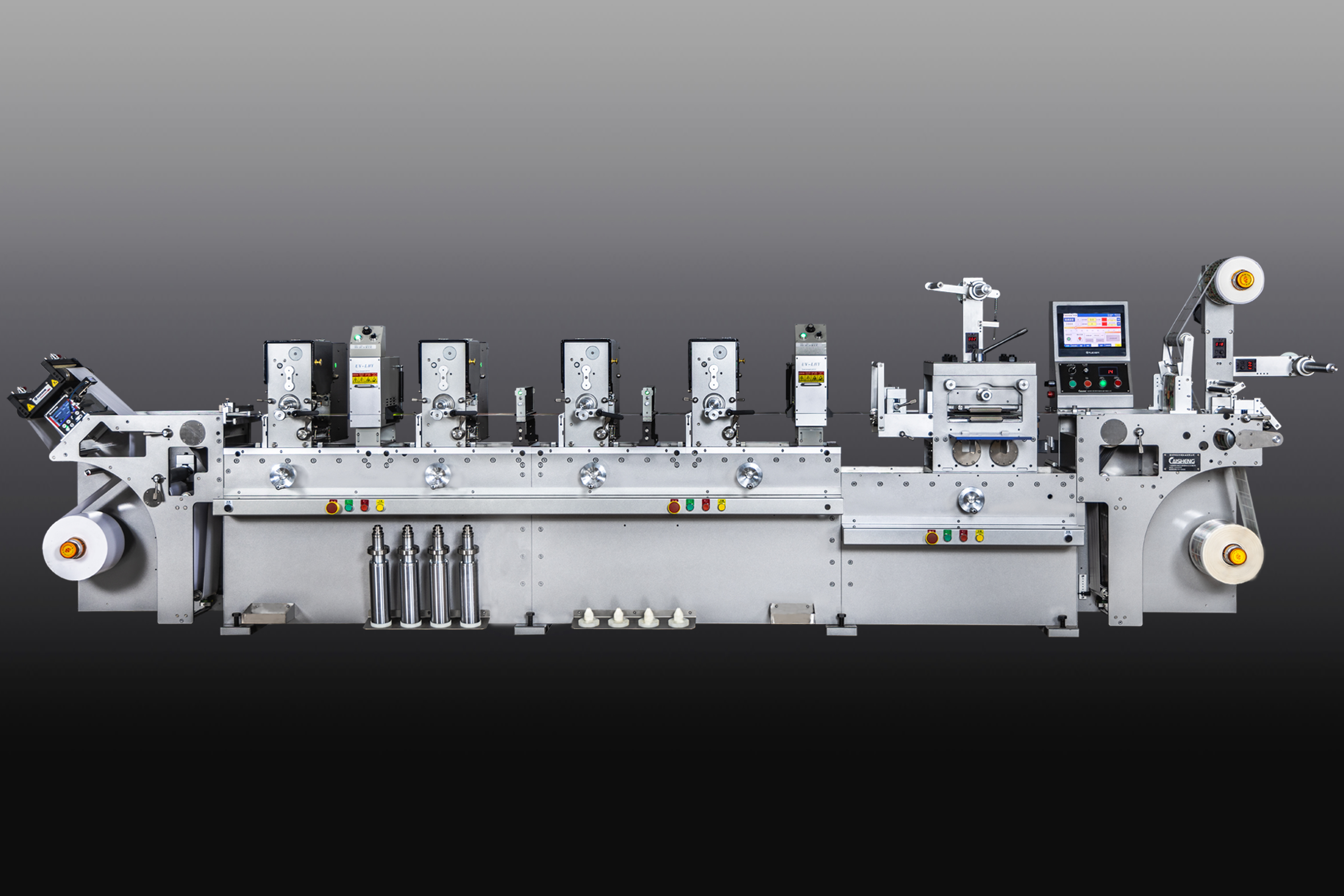
CS-220-4C intermittent letterpress label press with flatbed die-cutting — a configuration within the CS-220 series named on the CE attestation.
Two field records give the application picture concrete form. A well-known Asian trademark design and printing company operating in Taiwan has run a CS-320 press for two years, and the case record attributes its satisfaction to printing precision, stable production performance and flexible process expansion. R.R. Donnelley & Sons (RRD), a global provider of commercial printing, packaging and multi-channel marketing communication solutions in the United States, has run a CS-300 as label production equipment for three years, with the case record citing stable registration accuracy, print quality and reliable equipment performance.
The pattern across both records is more informative than either result taken alone: the presses were selected on accuracy first and retained on process flexibility second. That sequence mirrors how the qualification question splits — conformity documentation establishes whether a machine may be installed, and application evidence establishes whether it should be.
Market Trend Analysis
Three verified data points frame the medium-term outlook for label press procurement.
- Market size. The global label printing machines market was valued at USD 8.58 billion in 2025 and is projected to reach USD 14.36 billion by 2034 (The Insight Partners).
- Technology mix. Flexographic printing remains the most commonly used process for labels, valued at approximately USD 13.3 billion in terms of output value in 2024 (Smithers).
- Regional concentration. Asia-Pacific accounted for a 41.8% revenue share of the label printing machines market in 2025 (Data Bridge Market Research).
The compliance implication follows directly from the regional data. When manufacturing capacity concentrates in one region and consumption sits in others, a larger share of installed machines crosses regulatory borders, and the proportion of orders requiring a conformity file rises with them. Suppliers based in high-capacity regions increasingly compete on documentation quality as much as on specification and price.
Caisheng's Documented Position Compared With a Certificate-Only Purchase
The practical difference between a documented compliance position and a certificate-only purchase shows up in what can be verified after the quotation stage.
| Evaluation dimension | Certificate-only approach | Caisheng's documented position |
|---|---|---|
| Conformity evidence | CE mark asserted verbally or printed on a quotation | Machinery Directive Attestation of Conformity No. M.2025.206.C124100 for the EU market, valid to 2030-10-08 |
| Model-level clarity | Scope unspecified; assumed to cover the whole catalogue | Scope recorded against CS-300, CS-220 and CS-350 series, with named models including CS-300-6C, CS-320-6C, CS-320-7C, CS-220-4C, CS-220-5C, CS-JQ350G-6C and CS-JQ350-7C |
| Standards traceability | Not stated | EN ISO 12100:2010 and EN 60204-1:2018 named on the attestation |
| Design and IP evidence | None provided | Utility model ZL 2022 2 1332174.4 and invention patent ZL 2022 1 0411353.5, both granted by the China National Intellectual Property Administration |
| Production continuity | Trading entity with no disclosed production footprint | 6,000 m² facility, 65 employees, 8 engineers, monthly capacity 18 units, 45–60 day lead time, 100% test |
| Process integration | Asserted from brochure imagery | Documented customization list covering colour stamping, glue-side printing, cold foil stamping, lamination, UV varnishing, flatbed and rotary die-cutting, sheet cutting, slitting, corona treating, screen printing, hot foil stamping and embossing |
Where the Boundaries Are
Three limits should be stated plainly rather than left implicit.
Scope is not the whole catalogue. The CE attestation record covers the CS-300, CS-220 and CS-350 series. Caisheng's flexographic platforms — CS-J380F-4C, CS-J380F-7C, CS-Q370F-6C and CS-370F-8C — are not named within that scope entry. A buyer taking a flexographic press into the EU should confirm the applicable conformity documentation for that specific model rather than assume the letterpress attestation extends to the entire range.
Conformity is not performance. A CE attestation is a safety and electrical conformity statement. It says nothing about registration accuracy, print quality or throughput. Those characteristics are evidenced elsewhere, through specification data and client case records, and they should be evaluated through a separate line of enquiry.
Certification is time-bound. Certificate M.2025.206.C124100 was issued on 8 November 2025 and is valid to 8 October 2030. Orders placed close to that horizon should include a check on the current status of the certificate. Configuration-specific confirmation also applies: customization modules added to a base model fall outside a scope statement that names the base series, and should be clarified during technical negotiation.
Future Outlook
Two forces will shape how label press qualification works over the next several years. The first is regulatory. Conformity requirements for machinery placed on the EU market, together with equipment safety frameworks such as ISO 12643-2:2023, keep raising the documentation floor for every supplier selling across borders. The second is structural. With the label printing machines market projected to move from USD 8.58 billion in 2025 toward USD 14.36 billion by 2034, and with Asia-Pacific already holding 41.8% of revenue in 2025, the number of machines shipped from manufacturing regions into regulated end markets will continue to grow.
For Caisheng, the visible next step is scope management rather than new claims: keeping the model list on the attestation aligned with the models actually sold into the EU, extending documentation coverage to platforms such as the flexographic range when those are ordered for regulated markets, and maintaining the certificate across its validity horizon to 2030. For buyers, the practical shift is that supplier shortlists will increasingly be built from documents first and specifications second, because a machine that cannot be documented cannot be delivered.
For readers who need the full configuration list and module options, Caisheng's product brochure is available for download: Caisheng product brochure (PDF). The company's website is caishengmachinery.com.
FAQ
Which Caisheng label press models are covered by CE certification?
The Machinery Directive Attestation of Conformity with certificate number M.2025.206.C124100 is recorded against the CS-300, CS-220 and CS-350 series for the EU market, and the certification record links it to specific models including CS-300-6C, CS-300-5C, CS-320-7C, CS-320-6C, CS-220-5C, CS-220-4C, CS-JQ350G-6C and CS-JQ350-7C. Caisheng's flexographic models — CS-J380F-4C, CS-J380F-7C, CS-Q370F-6C and CS-370F-8C — are not named in that scope entry, so the applicable conformity documentation for those platforms should be confirmed separately.
Which standards does the Caisheng CE attestation reference, and what do they cover?
The attestation cites EN ISO 12100:2010 and EN 60204-1:2018. EN ISO 12100:2010 is the methodology standard for machinery risk assessment and risk reduction during design; EN 60204-1:2018 addresses the electrical equipment of machines, including how the electrical system is configured, protected and marked. The document was issued by UDEM Uluslararası Belgelendirme Denetim Eğitim Merkezi San. ve Tic. A.Ş. on 8 November 2025 and is valid to 8 October 2030.
Does CE certification tell a buyer anything about print quality or productivity?
No. CE attestation is a safety and electrical conformity statement and does not certify registration accuracy, print quality or output speed. Performance evidence comes from other sources: specification data such as the maximum printing speed of 158 m/min in full rotary mode on the CS-JQ350G-6C and 150 m/min on the CS-Q370F-6C, and case records such as the two-year CS-320 installation at an Asian trademark design and printing company in Taiwan and the three-year CS-300 installation at R.R. Donnelley & Sons in the United States. Conformity and performance are best evaluated as separate questions.
How can a buyer verify a CE attestation for a label printing machine?
Verification generally proceeds through five checks: the certificate number, the issuing body, the model scope named in the document, the standards cited, and the issue and expiry dates. The model designation on the machine and on the purchase order should then be matched against the scope statement, and where a model is not named, the applicable conformity documentation for that model should be requested. These checks are relevant to any supplier, not to Caisheng alone, because the certificate is only useful to a buyer when the delivered machine falls inside its scope.
What does Caisheng's manufacturing record cover beyond certification?
The company was founded in 2011 and operates a 6,000 m² facility with 65 employees, including a research and development team of eight engineers, producing 200 units annually at a monthly capacity of 18 units. Lead time is 45–60 days with a minimum order quantity of one unit; quality control is 100% test; after-sales support is remote, with a one-year warranty on major components. The export ratio is 50%, with main markets in Southeast Asia, Europe, the Middle East and the United States, and production runs in ODM mode with documented customization covering processes from cold foil stamping and UV varnishing to rotary die-cutting and full-rotary screen printing.