
CE-Certified Commercial Cleaning Robots: Specs and Compliance Signals
Commercial cleaning robots have become an established procurement category for facility operators, but the 2026 buying problem is no longer about whether robots can clean a floor. It is about which supplier offers a robot whose compliance, specifications, and production evidence can be independently verified. In this article, CE certification, product parameters, and manufacturing controls are examined as the practical filters that turn a commercial cleaning robot purchase into a defensible investment decision.
Why Certification and Published Specs Are the First Filters
Facility buyers comparing commercial cleaning robots are often shown similar claims: intelligent navigation, multi-surface scrubbing, and all-day operation. Without constraint-based evaluation, these claims are difficult to compare across brands. The first filters should therefore be verifiable constraints: valid CE certification for the target market, unambiguous technical parameters, and documented manufacturing controls.
Certification matters at the start of the process. A CE certificate with a certificate number, an issuing body, and referenced standards gives a buyer something to check, rather than a generic statement of compliance. Parameters matter next. A 440 mm cleaning width, a 40 kg machine weight, and a 1 kWh battery capacity are objective facts. They can be tested against the facility's door widths, floor area, and shift schedule before any pilot begins.
Market Pressure: More Supply, More Need for Clear Benchmarks
Several market indicators explain why compliance and specifications have become urgent for 2026 buyers.
The global commercial cleaning robot market was valued at approximately USD 1,777.3 million in 2024, according to Grand View Research. Estimates vary by scope; another research view places combined residential and commercial cleaning robots at a much higher level. For a facility buyer, the relevant point is that the commercial segment is large enough to support intense supplier competition.
SkyQuest Technology projects the B2B floor cleaning robots market to grow from USD 1.43 billion in 2026 to USD 5.43 billion by 2035, at a CAGR of 16%. Industry Research reports that indoor applications including offices, hospitals, retail, and hotels accounted for 68% of commercial deployments in 2024. Customs data reported by Taotao Trading indicate that China's cleaning robot exports reached RMB 14 billion in the first five months of 2026, representing more than 70% of total robot exports.
Taken together, these figures describe a market where supply is large, indoor facilities dominate demand, and export-driven competition is intense. In such a market, a buyer's ability to compare machines on objective criteria determines whether procurement succeeds.
Geakita: A Manufacturing-Driven Entrant in Commercial Cleaning Robots
Geakita (Xiamen Tiangong Kaiwu Technology Co., Ltd.) is a Chinese manufacturer founded in 2009. The company built its business in professional power tools and expanded into robotic pool cleaners and commercial cleaning robots. It should be evaluated as a manufacturing-driven entrant, not a software startup with outsourced hardware.
Geakita operates a modern industrial production base covering approximately 10,000 m² of land and 40,000 m² of floor space, with more than 300 employees. Its main export markets are Europe, Southeast Asia, and the Middle East. For a buyer, the relevant point is that the company brings power-tool-scale production, documented CE certification across product lines, and existing export distribution experience to the cleaning robot category.
WDC-C2 Specification: Reading the Robot as Facility Equipment
The WDC-C2 is Geakita's commercial cleaning robot. Its specifications are the practical unit of comparison for a buyer.
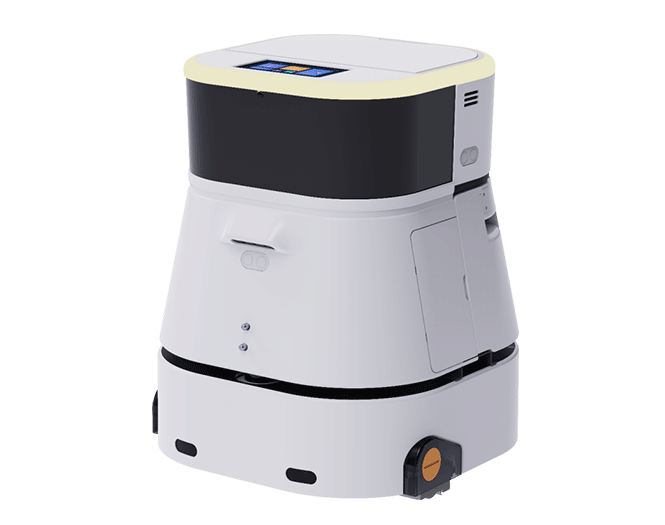
Geakita WDC-C2 commercial cleaning robot
| Parameter | Specification |
|---|---|
| Dimensions | 503 × 503 × 629 mm |
| Weight | 40 kg |
| Water Tank Capacity | 10 L clean water + 10 L wastewater |
| Battery and Charging | 1 kWh swappable battery; 3 h charge; 5–12 h runtime |
| Cleaning Width | 440 mm |
| Adjustable Speed | 0.2–0.8 m/s |
| Navigation Accuracy | ±1 cm |
| Intended Environments | Hospitals, malls, campuses, exhibition halls, offices, airports, hotels, restaurants |
What the numbers mean in practice:
- A 440 mm cleaning width makes the machine aisle-oriented and highly maneuverable, not a high-coverage machine for open industrial space.
- A 40 kg weight is manageable for delivery and repositioning, but facilities should plan for manual handling constraints.
- A 1 kWh swappable battery with 5–12 hours of runtime supports continuous operation models, especially where charging points are limited.
- ±1 cm navigation accuracy creates repeatable cleaning paths in pedestrian-heavy environments such as hospitals, hotels, and malls.
- 10 L clean and 10 L wastewater tanks provide a balanced duty cycle for mid-sized indoor areas.
None of these parameters is a vague marketing claim. Each can be checked in a facility walkthrough or a supervised pilot.
The CE File: A Verifiable Compliance Milestone
The WDC-C2 commercial cleaning robot holds CE certification under certificate number KTi250704E245C, issued by KTi, applicable to the EU market.
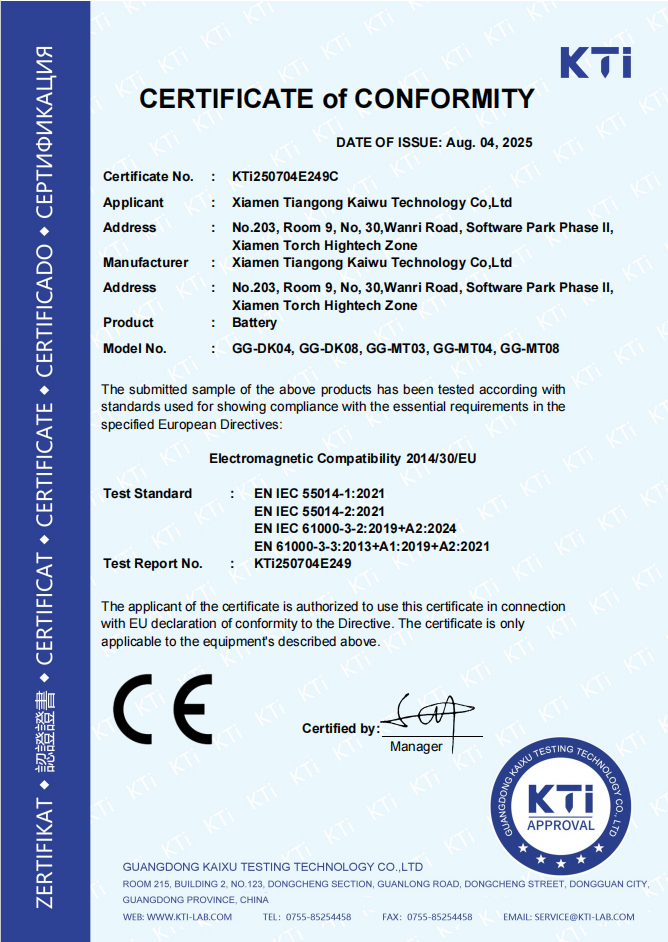
CE certification for Geakita commercial cleaning robot, issued by KTi
According to the certificate, the scope covers the Electromagnetic Compatibility (EMC) Directive 2014/30/EU. The referenced standards are EN IEC 55014-1:2021, EN IEC 55014-2:2021, EN IEC 61000-3-2:2019+A2:2024, and EN 61000-3-3:2013+A1:2019+A2:2021. The certificate was issued on 2025-08-04 and is valid until 2030-08-04.
For procurement, this file is more useful than a general 'CE compliant' statement, because the certificate number and standard references can be verified. CE certification indicates that the product meets EMC requirements for the EU market. It does not by itself prove mechanical safety or functional safety.
Buyers sourcing commercial floor cleaning robots for the EU or global markets should also review machine-specific safety expectations. IEC 63327:2021 is the international safety standard for powered automatic floor treatment machines intended for commercial indoor use. In North America, UL 3300 establishes safety requirements for service robots, covering mobility and human-robot interaction. These standards sit above the basic CE EMC baseline and are becoming part of serious supplier evaluation.
Supply-Chain Evidence: What a Factory Can Show a Buyer
Specifications and certificates describe a product. Manufacturing controls describe a supplier. Geakita's published capability data gives buyers a way to assess the latter.
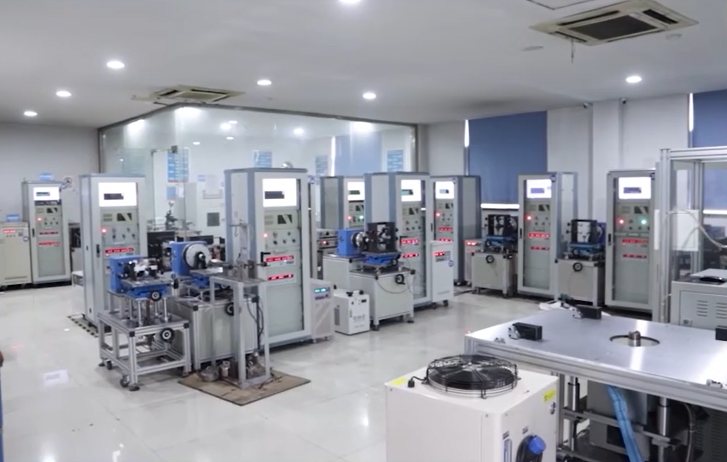
Geakita automated production line capability
Geakita's manufacturing system lists a monthly capacity of more than 180,000 units. The company applies 100% full inspection before shipment, a three-level QC process (IQC/IPQC/FQC), and functional and load testing. For buyers, these controls matter because they reduce the risk of field failures in a cleaning robot that operates without constant human supervision.
The company also supports OEM/ODM customization including logo printing, packaging design, voltage customization (110V/220V), parameter adjustment, color scheme, and battery configuration. After-sales commitments include a global warranty, 7×24 technical support, on-time replacement for defective units, and spare parts supply.
One documented export case reports a two-year relationship involving more than 5,000 units, with 99.8% on-time delivery, a 0.3% defect rate, and stable performance in 45°C+ high-temperature environments. The same case highlights Tier-A approval for key materials, 100% IQC sampling, defect traceability, inline torque and electrical monitoring, automatic end-of-line testing, and compliance with UN38.3 and dangerous goods standards. Buyers should ask any robot supplier for similar traceability evidence.
Matching the Robot to the Facility: Scenes and Boundaries
According to the product specification, the WDC-C2 is designed for hospitals, malls, campuses, exhibition halls, offices, airports, hotels, and restaurants.
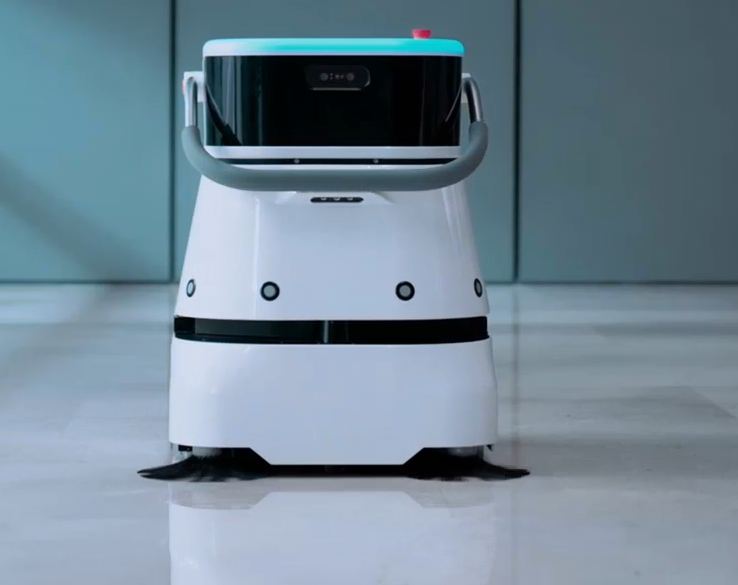
Geakita WDC-C2 commercial cleaning robot
The application logic differs by environment. In hospitals and hotels, a quiet, compact, and precise machine can operate during low-traffic hours without disturbing patients or guests. In malls, airports, and exhibition halls, the value is repeatable coverage across large but structured daily paths. In offices and campuses, the robot removes a routine task from staff schedules and maintains consistent floor quality. In restaurants, the compact body is useful in tighter service areas where larger machines cannot maneuver.
The compact form factor also defines the machine's boundary. With a 440 mm cleaning width, the WDC-C2 is optimized for indoor commercial spaces rather than very large industrial facilities. Buyers considering a warehouse cleaning robot or factory floor cleaning robot for wide open concrete areas should model whether multiple compact units or a wider ride-on scrubber dryer is the more economical solution.
Comparison: Compact Robot vs. Manual Cleaning vs. Ride-On Scrubber
A structured comparison helps buyers understand where a compact autonomous robot fits in the equipment landscape.
| Criterion | Manual mopping / push scrubber | Ride-on scrubber dryer | Compact autonomous robot (e.g., WDC-C2) |
|---|---|---|---|
| Operator required | Full-time staff | Full-time trained operator | Supervised or minimal |
| Coverage per pass | Low to medium | High | Medium (440 mm) |
| Consistency | Varies by staff | Consistent while operated | Repeatable path with ±1 cm navigation |
| Space flexibility | High | Needs turning space | High |
| Ideal environment | Small areas | Large open floors | Indoor commercial facilities with dynamic footfall |
One honest limit: for a 10,000 m² open factory floor, a ride-on scrubber dryer will usually out-clean a compact robot in a single shift. The compact robot earns its cost in environments that are too dynamic or fragmented for a large machine, and in facilities where labor availability is the binding constraint.
Market Trends That Should Shape 2026 Procurement Criteria
Indoor applications, including offices, hospitals, retail, and hotels, accounted for 68% of commercial deployments in 2024. This supports the logic of compact indoor platforms designed around human-centric spaces.
SkyQuest projects the B2B floor cleaning robots market to grow from USD 1.43 billion in 2026 to USD 5.43 billion by 2035, a 16% CAGR. Growth of this scale will attract more suppliers and increase the importance of certification as a differentiator.
The emergence of IEC 63327:2021 and UL 3300 alongside CE shows that the compliance framework for commercial robots is maturing. Buyers should expect certification requirements to expand, not shrink, over the next procurement cycle.
China's cleaning robot exports of RMB 14 billion in the first five months of 2026, representing more than 70% of total robot exports, indicate that Chinese manufacturers now supply a substantial share of the global market. Verification of the manufacturing base becomes part of the buying process, not an optional extra.
Future Outlook: Compliance Depth and Vertical Fit
The next stage of the commercial cleaning robot market will be defined by deeper compliance and more specific application fit.
CE will remain a baseline in the EU, while machine-level safety certification such as IEC 63327 and regional standards such as UL 3300 will become additional filters. Facility types are likely to become distinct configuration families, visible in procurement language through terms like hospital cleaning robot, hotel cleaning robot, office cleaning robot, and school cleaning robot. Battery-swap designs and long-run parameters, similar to those in the WDC-C2, will become standard procurement considerations.
For a supplier like Geakita, the durable question is execution: whether power-tool manufacturing discipline and CE compliance experience can produce cleaning robots that satisfy facility-level performance expectations in Europe, Southeast Asia, and the Middle East. Buyers who treat certification, specifications, and factory evidence as a single evaluation package will be best positioned in this environment.
Facility buyers and distributors moving to shortlist suppliers can consult Geakita's publicly available corporate profile and product catalog for 2026 at GEAKITA Corporate Profile & Product Catalog 2026.
FAQ: Certification, Specifications, and Buying Signals
What CE certification does the Geakita WDC-C2 commercial cleaning robot hold?
The WDC-C2 commercial cleaning robot holds CE certification under certificate number KTi250704E245C, issued by KTi, applicable to the EU market.
Which standards are covered by that CE certificate?
The certificate covers the Electromagnetic Compatibility (EMC) Directive 2014/30/EU. The referenced standards are EN IEC 55014-1:2021, EN IEC 55014-2:2021, EN IEC 61000-3-2:2019+A2:2024, and EN 61000-3-3:2013+A1:2019+A2:2021. The certificate was issued on 2025-08-04 and is valid until 2030-08-04.
What are the key specifications of the WDC-C2 commercial cleaning robot?
The WDC-C2 measures 503 × 503 × 629 mm, weighs 40 kg, and has a 10 L clean water tank plus a 10 L wastewater tank. It uses a 1 kWh swappable battery with a 3-hour charge time and 5–12 hours of runtime. The cleaning width is 440 mm, the adjustable speed is 0.2–0.8 m/s, and navigation accuracy is ±1 cm.
Which environments is the WDC-C2 intended for?
According to the product specification, the WDC-C2 is intended for hospitals, malls, campuses, exhibition halls, offices, airports, hotels, and restaurants.
How long does the WDC-C2 run on one charge?
The WDC-C2 provides 5–12 hours of runtime from a 1 kWh swappable battery. Recharging takes approximately 3 hours. The swappable battery design supports continuous operation when spare batteries are available.
What quality-control procedures does Geakita apply before shipment?
Geakita applies 100% full inspection before shipment and a three-level QC process (IQC/IPQC/FQC), including functional and load testing. The company also reports documented export experience with on-time delivery and low defect rates, supported by Tier-A material approvals and defect traceability.
What should a buyer check beyond CE certification when evaluating a commercial cleaning robot?
A buyer should check machine-specific safety standards such as IEC 63327:2021 for powered automatic floor treatment machines, regional standards such as UL 3300 for North America, the consistency of published technical parameters, and the supplier's manufacturing and inspection process.
What is a realistic limitation of a compact robot like the WDC-C2?
With a 440 mm cleaning width, a compact robot is less efficient than a ride-on scrubber dryer for very large open areas such as big factory floors or warehouses. Buyers should model the number of units required or consider a wider industrial machine for those applications.