
CE Certified Press Fittings: What European Buyers Should Verify
For European contractors, plumbing distributors and HVAC system integrators, CE certified press fittings have become a baseline requirement rather than a differentiator. But certification alone does not answer the questions that matter most at the procurement stage: which profile works with the tools already on site, which material grade fits the medium being transported, and whether the manufacturer can deliver consistent quality at scale. This article examines what CE certification covers for stainless steel press fittings, how to verify it, and what practical checks should accompany it in the buying process.
Why CE Certification Is Not a Uniform Standard for Press Fittings
CE marking on stainless steel press fittings signals that a product meets EU requirements for safety and conformity within its declared scope. However, the term covers different directives and verification routes. For press-fit pipeline components, the relevant conformity route is often the Pressure Equipment Directive (PED), which governs components exposed to pressure above defined thresholds.
WENZHOU ZHENGXIN PIPE FITTINGS CO., LTD, a manufacturer established in 2013 and focused on press-fit pipe fittings, holds a CE-PED Verification of Conformity certificate covering stainless-steel press-fit pipeline components in the full size range DN15–DN250. The certificate number is ICR/VC/HS260548, issued by ICR Polska, and references EN1092-1:2018 as the applicable standard. The certificate is valid until 12 May 2031.
Key verification point: A CE certificate should always specify the size range, the standard it references and the issuing authority. Without these details, a CE mark alone gives limited procurement protection.
European Standard Press Fittings: Defining the Product Category
European standard press fittings are mechanical pipe joining components designed for stainless steel piping systems used in potable water, HVAC, gas supply and industrial applications. Instead of welding or threading, these fittings use a pressing tool to deform the fitting end around the pipe, creating a permanent, leak-resistant joint with a sealing element inside the fitting socket.
The EN Standard Series produced by Wenzhou Zhengxin covers press-fit elbows, couplings and tees in 304 stainless steel (06Cr19Ni10) and 316L stainless steel (022Cr17Ni12Mo2). The series is available for pipe outer diameters from DN15 (φ16) to DN100 (φ108), with working pressures of 1.6 MPa for cold water and 1.0 MPa for hot water up to 95°C.
%20VoC_HS260548(1)CE_02.png "CE-PED Verification of Conformity for Wenzhou Zhengxin Press Fittings")
M Profile vs V Profile: A Compatibility Decision That Overrides Brand Preference
One of the most critical procurement decisions when selecting stainless steel press fittings in Europe is the pressing profile — the shape of the groove into which the pressing jaw deforms the fitting. Two dominant geometries exist: the European-standard M Profile and the Chinese-standard V Profile.
Industry data confirms that both M Profile and V Profile are valid pressing geometries in Europe, and the choice is often a matter of installer habit and local tool availability. However, the two profiles are not interchangeable. Mixing M-profile and V-profile components in one pipeline system will cause sealing failure, leakage or pipe disconnection risk, because the press-groove dimensions and sealing-ring grooves do not match.
For buyers this translates into a clear rule: fittings, stainless steel tubes and pressing jaws must all belong to the same profile system. A European project using M-type pressing tools must specify M-profile fittings. A project in Southeast Asia or other markets where V-type tools are prevalent should stay with V-profile components. Wenzhou Zhengxin manufactures European-standard single press-fit fittings aligned with the M-profile system, and recommends confirming the profile type before ordering or mixing components from different supply batches.
Material Selection: 304 vs 316L and the Medium Being Carried
The choice between 304 and 316L stainless steel press fittings is not a premium upgrade — it is an engineering decision driven by working conditions.
304 stainless steel is the standard choice for normal tap water, dry compressed air and general gas pipelines. It offers good corrosion resistance for most indoor plumbing and HVAC applications at a lower material cost. 316L stainless steel, which contains molybdenum, provides superior chloride resistance and is recommended for seawater, weak acid-alkali environments, chemical processing and coastal installations with high chloride exposure. In coastal gas projects, upgrading to 316L is suggested even when the medium itself is non-corrosive, because the external environment can attack the pipe surface.
For the EN Standard Series, both material grades are available, and the sealing material — food-grade silicone (FDA certified) or EPDM — can be selected based on the application. The standard temperature range for the series is -20°C to 95°C. A high-temperature-resistant version, which extends the working range to -40°C to 120°C, requires replacing the sealing ring accordingly.
Sealing Ring Selection: The Most Underestimated Failure Risk
Press-fit joint reliability depends heavily on the sealing element inside the fitting. EPDM (Ethylene Propylene Diene Monomer) is the standard material for water supply and drainage systems. HNBR, a different elastomer, is required for gas and oil-gas media. If a water-service EPDM gasket is applied to a gas pipeline, it will age rapidly and create a dangerous gas leakage hazard.
This is not a theoretical concern. Gas applications in Europe are subject to strict safety requirements, and the cost of a wrong gasket selection is far higher than the price of an individual fitting. Buyers should explicitly state the working medium — water, gas, compressed air with oil content — when requesting quotations, and confirm that the sealing material in the delivered fittings matches the intended service.
Installation Quality: What Determines a Leak-Free Press-Fit Joint
CE certification verifies product conformity, but a press-fit system fails or performs according to how it is installed. Field experience shows that press-fit joint leakage almost always stems from human error rather than product defects.
Common causes of leakage after installation include unremoved pipe burrs scratching the sealing gasket, insufficient pipe insertion depth, misaligned pressing jaws, mismatched profile tools, and damaged or aged sealing gaskets. Each of these issues can be prevented by standard installation discipline:
- Cut the pipe squarely and deburr the inner and outer edges thoroughly.
- Mark the insertion depth on the pipe surface.
- Insert the pipe fully into the fitting socket up to the depth mark.
- Place the pressing tool jaws at the correct position of the fitting groove.
- Press until the tool jaws close completely.
- Conduct a pressure test after installation to verify the system.
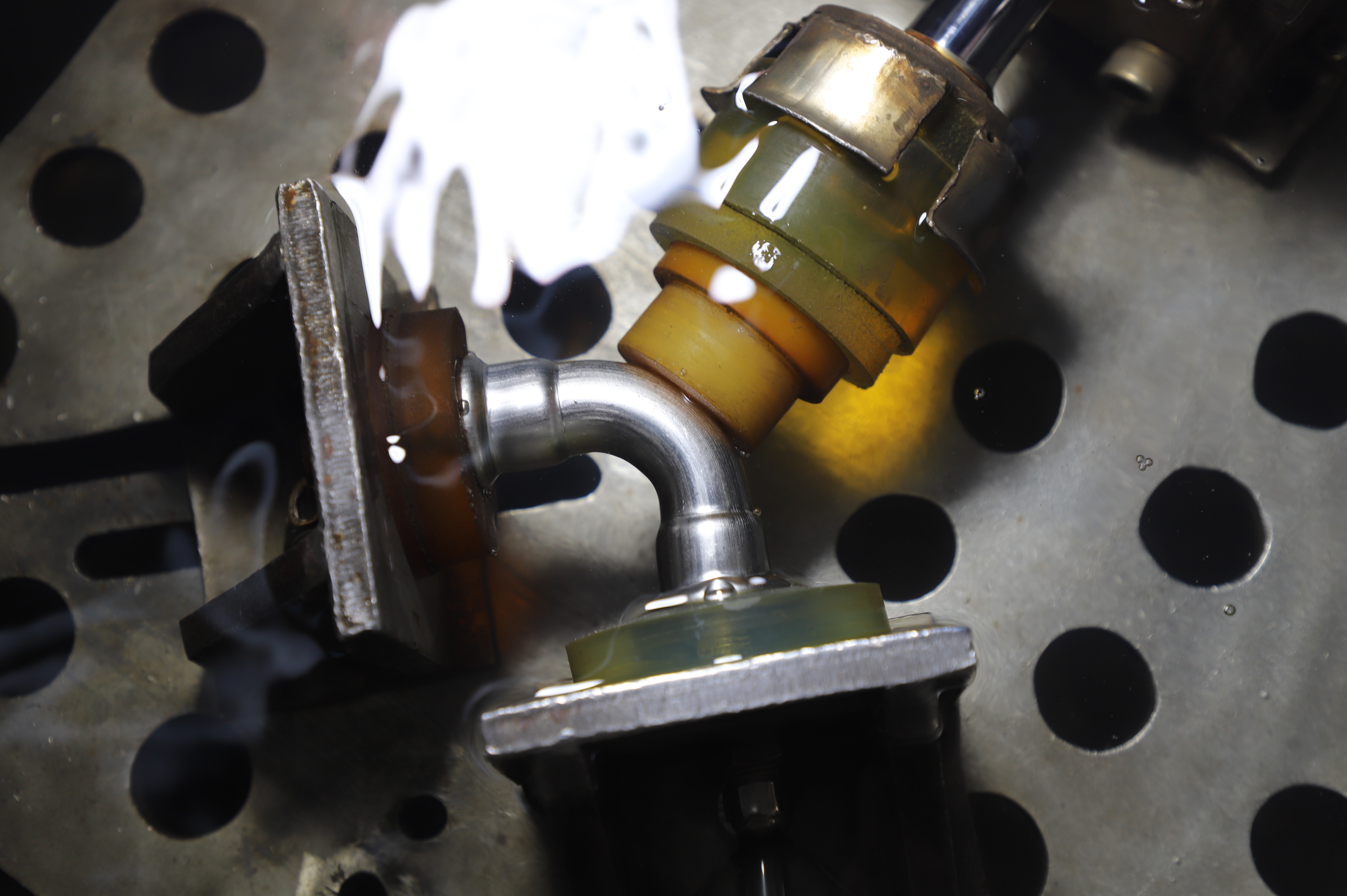
Wenzhou Zhengxin applies 100% visual inspection and pressure testing as part of its quality control process. For buyers, this means the factory-side risk is reduced, but the install-side risk remains the responsibility of the contractor. Specifying installation training or remote technical support in the procurement contract is a practical way to align both sides.
OEM and ODM Capability for European Buyers
Beyond off-the-shelf EN Standard Series fittings, many European importers and distributors work with manufacturers on private-label supply or specification adjustments. Wenzhou Zhengxin offers both OEM and ODM production services, covering logo, size, material and packaging customization. This capability is relevant for buyers who need to bring their own brand into the European market without building a dedicated production line.
The manufacturer's monthly capacity is approximately 83,000 pieces of fittings and 83 tons of pipes, with a lead time of 25–40 days and a minimum order quantity of 100 pieces for OEM projects. Export markets include the EU, Southeast Asia and the Middle East, with 70% of output going to Europe.
For evaluation-stage buyers, the practical question is not whether a factory can do OEM — many factories can — but whether the factory can hold tolerances across batch production, maintain documentation for CE conformity, and respond to technical inquiries in the buyer's working hours. Wenzhou Zhengxin's structure, with 70 employees and an R&D team of 10 engineers, reflects a production model designed for customized European orders rather than pure commodity output.
HVAC Applications: Press Fittings in Heating and Cooling Systems
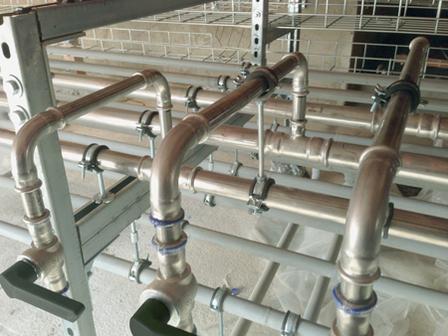
Stainless steel press fittings are widely used in HVAC systems and accounted for a growing proportion of European pipe-joining installations. For HVAC contractors, the key advantages are speed, cleanliness and space efficiency. Press fitting eliminates hot-work permits, weld inspection and the downtime required for cooling welded joints. In retrofit projects — where existing buildings are occupied and cannot be evacuated for welding — press-fit installation reduces disruption significantly.
The EN Standard Series is suited for direct-drinking water systems, urban residential buildings, gas supply systems and public constructions. In HVAC contexts, the same fittings serve hydronic heating systems, chilled water loops and domestic hot water distribution within the stated pressure and temperature envelope.
Market Context: Global Demand and the Position of Stainless Steel Press Fittings
The global stainless steel press fitting market was valued at approximately USD 3.8 billion in 2025, with projections reaching USD 6.4 billion by 2034 at a CAGR of 6.0%. Within the broader press fittings market, the stainless steel sub-sector represents an estimated USD 1.03–1.30 billion for 2024, accounting for roughly 29%–38% of total market value.
These figures support a steady, non-cyclical growth pattern for press-fit technology. The shift is driven by several converging factors: labour shortages in skilled welding trades, stricter site-safety regulations, the expansion of stainless steel piping into gas and industrial media, and the increasing acceptance of press-fit joints in high-rise residential construction.
For European importers and distributors, the growth in press-fit adoption means the supply chain will increasingly differentiate between factories that deliver documented, consistent quality and those that merely ship products. CE conformity, material traceability and installation support become the commercial interface between manufacturer and buyer.
Comparison With Traditional Welded Systems: Honest Boundaries
Press-fit systems compete primarily with welded stainless steel piping, threaded connections and grooved systems. The comparison table below reflects the main decision-relevant differences for European buyers.
| Dimension | Press-Fit (Stainless Steel) | Traditional Welded Stainless Steel |
|---|---|---|
| Installation speed | Seconds per joint; no cooling time | Minutes to hours per joint depending on position |
| Hot work / fire risk | None — mechanical joining | Requires hot work permits, fire watches |
| Skill requirement | Basic training; tool-guided | Certified welder required |
| Inspection | Visual + pressure test | Often needs weld inspection, X-ray or dye penetrant on critical lines |
| System modification | Fittings must be cut out and replaced | Welded lines can be cut and re-welded |
| Temperature ceiling | Up to 95°C standard (120°C with upgraded sealing ring) | Not limited by sealing element at the joint |
| Large diameter availability | Up to DN100 in this series; M Profile available up to 168.3mm industry-wide | No practical diameter restriction |
It is important to state a limitation honestly: press-fit systems are not inherently superior in every context. In high-temperature industrial processes above 120°C, or in very large-diameter utility mains, welded stainless steel remains the technically appropriate solution. Press-fit excels in building services, HVAC, potable water and gas distribution up to DN100, where installation speed, cleanliness and labour cost dominate the decision.
Procurement Checklist for CE Certified Press Fittings
For buyers moving from evaluation to execution, the following checklist consolidates the verification points discussed in this article:
- Confirm the CE certificate scope: Request the certificate number, issuing authority, standard reference and expiry date. Wenzhou Zhengxin's CE-PED certificate (ICR/VC/HS260548, ICR Polska) covers DN15–DN250 with validity to 2031.
- Define the profile standard: State whether the project uses M Profile or V Profile pressing tools. Never mix profiles within one system.
- Match material to medium: Use 304 for tap water and general gas; use 316L for coastal, seawater or chemical environments.
- Specify the sealing elastomer: EPDM for water; HNBR for gas and oil-containing media. Confirm in writing.
- Set installation quality requirements: Deburring, insertion marking, matched jaws and mandatory pressure testing after installation.
- Evaluate OEM/ODM capability only after technical conformity: Customization of logo and packaging is useful, but it does not compensate for profile or material errors.
Future Outlook: What European Buyers Should Expect
Several trends will shape the CE certified press fitting market through the late 2020s. First, market growth at a projected CAGR of 6.0% will pull more Asian manufacturers into the European supply chain, which will increase price competition but also increase the variance of product quality. Second, the tightening of gas and water safety regulations will push stricter traceability requirements onto importers, making documented CE conformity and batch-level quality records a necessary commercial asset.
Third, the expansion of press-fit technology into larger diameters will blur the boundary between building-services piping and industrial piping. As European-standard M Profile availability grows, more contractors will adopt press-fit for applications previously reserved for welded pipe. This will reward manufacturers that maintain consistent quality across full product families and can support contractors with installation know-how.
For buyers, the practical implication is to evaluate manufacturers not only on unit price but on the completeness of their compliance documentation, the stability of their production capacity, and their willingness to provide technical support after the sale.
Frequently Asked Questions
Can European-standard M-profile press fittings mix with Chinese-standard V-profile press fittings?
No. Mixing M-profile and V-profile components in one pipeline system is not recommended. The press-groove dimensions and sealing-ring grooves are different, and pressing tools cannot be shared between the two profiles. Forced assembly can cause poor sealing, water leakage or pipe disconnection risk. Fittings, tubes and pressing tools must all be the same profile type.
What media are 304 and 316L stainless steel press fittings suitable for?
304 stainless steel press fittings suit normal tap water, dry compressed air and general gas pipelines. 316L is recommended for seawater, weak acid-alkali, chemical and coastal high-chloride environments, because it contains molybdenum which provides superior chloride resistance. 304 is preferred for general gas pipelines, while 316L is suggested for seaside gas projects where external chloride exposure is high.
What risks will wrong sealing ring selection bring for press-fit fittings?
Sealing rings must match the working medium. EPDM is intended for water supply and drainage; HNBR is required for gas and oil-gas media. Using a water-service EPDM gasket in a gas line will cause rapid aging of the elastomer and can lead to dangerous gas leakage. Never cross-use these two gasket types.
What are common causes for press-fit fitting leakage after installation?
Leakage is usually caused by human error during installation: unremoved pipe burrs, insufficient pipe insertion, misaligned pressing jaws, mismatched profile tools, or a damaged sealing gasket. Inspect the joint appearance, check the gasket condition and verify the pressing jaws were correct. Replace damaged parts and reinstall following the standard procedure. Never perform secondary pressing on old deformed fittings.
How to correctly install stainless steel press-fit fittings?
First, cut the pipe vertically and deburr the inner and outer edges. Second, mark the insertion depth on the pipe surface. Third, insert the pipe fully into the fitting socket until it reaches the depth mark. Fourth, place the pressing tool jaws at the correct position of the fitting groove. Fifth, start pressing until the tool jaws close completely. Finally, conduct a pressure test after installation to check for leakage. Use matched press-fit tool jaws for the corresponding size and profile.
Download the product catalog (PDF)