
CE and ISO 9001: What Non Woven Bag Printing Machine Suppliers Prove
CE and ISO 9001: What Non Woven Bag Printing Machine Suppliers Prove
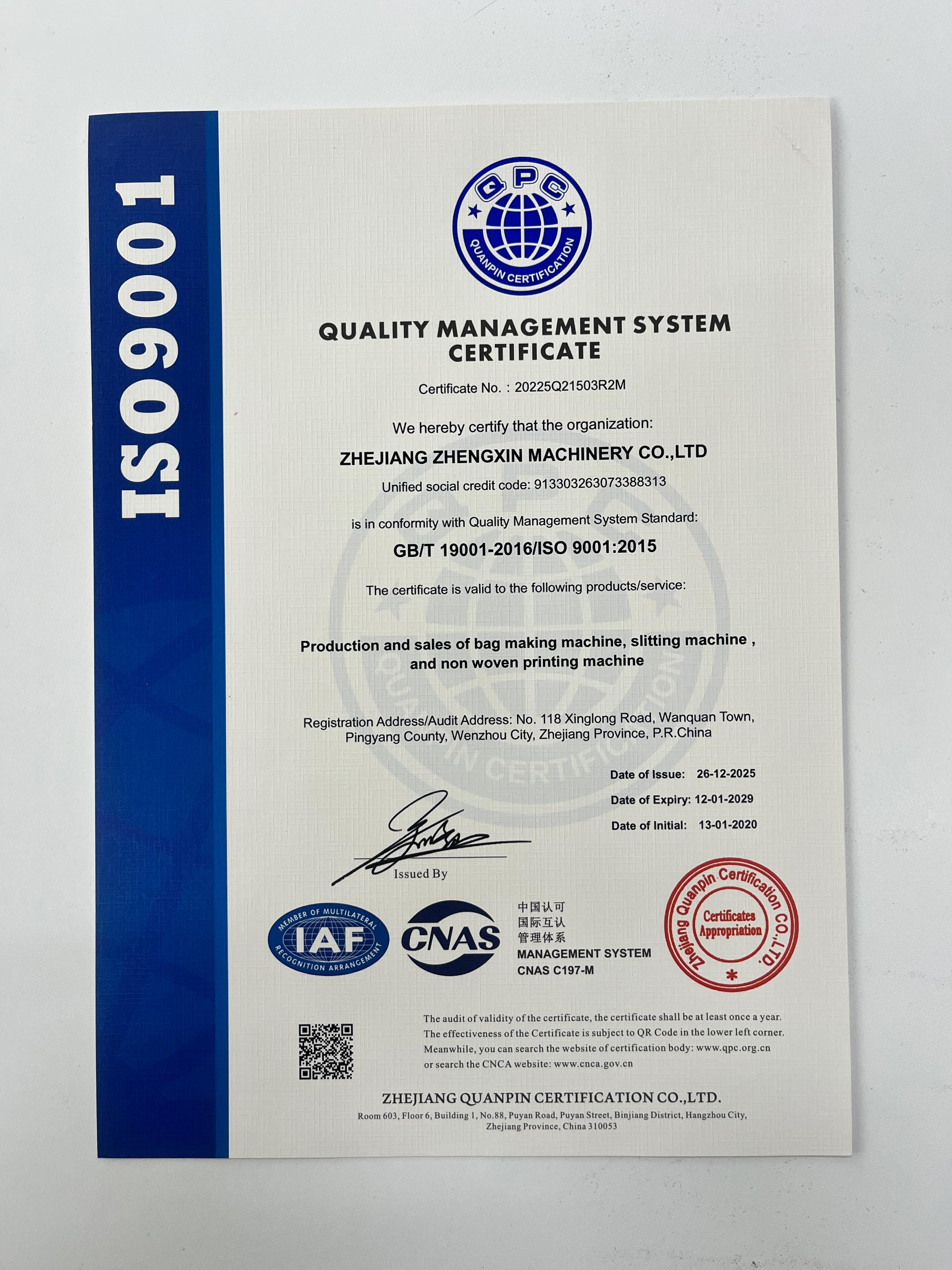
Facility-level certification is a document set, not a logo: certificate number, scope of registration, and the issuing body must all be traceable.
A non woven bag printing machine is rarely stopped at a port because it prints badly. It is stopped because the paperwork that should explain how and where it was built is missing, unverifiable, or inconsistent with what the customs officer sees on the crate.
For importers who buy flexo, screen, or multicolor printing equipment for non woven bag lines, the practical question in 2026 is no longer "does this machine print at 60 m/min" but "can I prove to a regulator, a bank, or a supermarket customer that this machine came out of a controlled manufacturing environment." CE marking and ISO 9001 registration are the two pieces of evidence most often requested, and the two most frequently overstated by suppliers that cannot produce them.
This reference examines what that evidence actually consists of, how it can be verified before payment, and where it stops being decisive. It draws on facility data published by Zhejiang Zhengxin Machinery Co., Ltd. (ZX Zhengxin Machinery), a Wenzhou-based manufacturer of non woven bag making machines and ZXH series flexo and screen printing machines, founded in 2014.
Why Certification Evidence Became a Purchasing Gate Rather Than a Marketing Line
Two forces pushed certification from the marketing page into the procurement file. The first is regulatory. More than 100 countries have implemented bans or taxes on single-use plastic bags, and each replacement mandate creates a converting industry that must be supplied with equipment compliant with local import rules. California's SB 1046, effective January 2025, is one example of legislation that forces retailers toward reusable non-woven or paper substitutes — and, indirectly, forces their suppliers to invest in compliant production equipment.
The second force is commercial. The global non-woven bag making machine market is projected to grow from about US$ 179 million in 2025 to US$ 733 million by 2032, a projected CAGR of 22.5% from 2026 to 2032 (LP Information). Rapid growth pulls in new buyers — importers, distributors, and first-time converters — who have no historical relationship with any manufacturer and therefore rely on documentation rather than reputation.
The consequence is a documentation gap that shows up in the worst possible place. A machine without a valid CE Declaration of Conformity can be held at an EU port; the same shipment can accumulate storage and demurrage charges while the buyer tries to obtain a certificate that the factory never had.
The procurement reality: certification is not a quality award. It is a transferable document set — a declaration, a marking plate, a technical file, and an audited quality system — that a buyer can hand to a customs broker, a tender committee, or a financing bank without further explanation.
What CE and ISO 9001 Actually Cover on a Printing Machine
CE marking: scope and directives
CE marking on a non woven bag printing machine is the manufacturer's declaration that the equipment complies with the applicable European directives — typically the Machinery Directive 2006/42/EC, the Low Voltage Directive 2014/35/EU, and the Electromagnetic Compatibility Directive 2014/30/EU. For printing and converting equipment specifically, EN 1010-1:2004+A1:2010 is the harmonized European standard covering safety requirements for the design and construction of printing and paper converting machines.
What a buyer should physically receive is a defined package, not a verbal assurance:
- A CE Declaration of Conformity listing the directives applied.
- A CE marking plate affixed to the machine body.
- A technical file available on request, including the wiring diagram, risk assessment documentation, and the operating manual with safety warnings.
- Evidence of the safety testing behind the declaration — insulation resistance, grounding continuity, guard inspection, emergency stop function, and noise documentation.
ZX Zhengxin Machinery states that its machines carry CE certification covering the Machinery, Low Voltage, and EMC directives, and that the marking is accepted for customs clearance in the EU, the Middle East, Africa, and more than 30 other countries that recognise CE. That scope matters: CE is recognised far beyond the 27 EU member states, including in Turkey, Egypt, Nigeria, and the GCC countries, which is precisely why it appears so often in tender documents for non woven bag printing lines.
ISO 9001: the process control behind the certificate
ISO 9001:2015 is narrower and more operational than most buyers assume. It does not certify a machine; it certifies that the factory operates a documented quality management system, audited externally on a recurring basis. Its value to a buyer lies entirely in what the system forces the factory to record.
At a facility holding ISO 9001:2015 registration, the visible checkpoints typically include dimensional inspection of steel frames before welding, continuity testing of every electrical cabinet before assembly, and a full-load production test of each completed machine before shipment, with sample output inspected for seal strength, print registration, and dimensional accuracy.
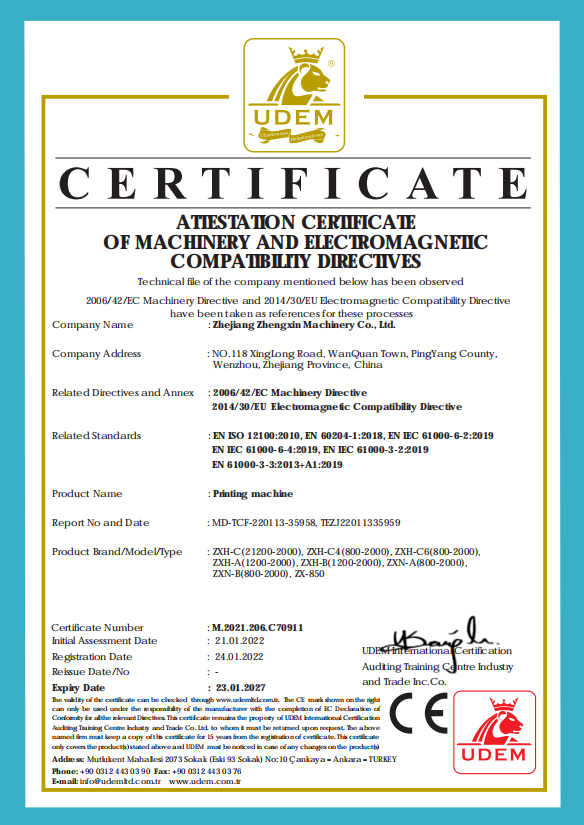
CE marking is accepted for customs clearance in the EU and in more than 30 additional markets that recognise the marking, including several in the Middle East and Africa.
Component Traceability: The Part of "Certified" a Buyer Can Actually Inspect
Certificates describe a process. Components describe a machine. The two should be consistent, and the easiest way to test that consistency is to open the electrical cabinet and look at what is mounted inside it.
A supplier building to a certified process specifies components with documented supply chains rather than substitutes of unknown origin. In ZX Zhengxin Machinery's build standard, that means Siemens, Delta, or Mitsubishi PLCs, Omron sensors, and NSK bearings — a component list the company states can be verified before shipment through third-party inspection by SGS, Bureau Veritas, or CCIC at the buyer's request.
This is where the two supplier profiles diverge most sharply in the field. The comparison data published by the manufacturer places the difference in three measurable terms:
- Reliability: mean time between failures reported as approximately three times longer on machines built with branded drives, PLCs, and sensors than on unbranded substitutes.
- Cost of ownership: a total maintenance cost over five years reported as 30%–40% lower, driven by fewer breakdowns, longer part life, and less lost production.
- Residual value: a machine built from traceable components is reported to retain more than 50% of its value after five years, against a near-zero resale value for unbranded equipment.
The mechanism behind those numbers is not marketing language — it is control theory. Servo-driven feeding systems hold position through encoder feedback, which is why a brand-name servo package maintains tighter feeding tolerance at sustained speed than a generic drive of nominally similar rating. Over a five-year service life, that difference shows up as scrap rate, unscheduled downtime, and the availability of replacement parts.
The Documentation and Support Chain That Makes Certification Operational
Certification has a practical counterpart: the ability to run, maintain, and repair the machine in a country where the manufacturer has no full-time presence. For a printing machine feeding a bag line, downtime is measured in printed rolls consumed at full speed.
The support model that accompanies a certified build is typically specified in the purchase documentation:
- Full English operation manual, wiring diagram, and spare parts catalogue supplied as standard.
- Remote video support within 24 hours, available seven days a week via WhatsApp and video call.
- Field engineers available for global deployment when remote diagnosis is not sufficient.
- Regional offices in Kenya, Morocco, Egypt, Vietnam, Tanzania, Dubai, Oman, Indonesia, and Ethiopia, which shorten the distance between a technical issue and a technician.
- Pre-shipment testing as the formal acceptance procedure, with delivery arranged on FOB or CIF terms.
The published service data states that engineers resolve more than 80% of reported issues remotely, which is a meaningful figure for importers of multicolor flexo printing machines: a registration or tension fault on a four-color unit can often be diagnosed from a phone camera view of the print station rather than waiting weeks for a service visit.
Certified Facility vs Unbranded Workshop: The Comparison Buyers Actually Run
The table below reflects the supplier-type comparison published by ZX Zhengxin Machinery, which places its own build against unbranded, small-workshop manufacturers. It is presented as one supplier's documented comparison, not as an independently audited ranking — buyers should reproduce the checks themselves during sampling.
| Evaluation dimension | CE & ISO 9001 certified facility (ZX Zhengxin Machinery) | Unbranded / small-workshop supplier |
|---|---|---|
| Conformity documents | CE Declaration of Conformity (Machinery, Low Voltage, EMC directives) plus ISO 9001:2015 factory registration | Frequently none, expired, or not verifiable with the issuing body |
| Quality process | Incoming material inspection, in-process QC checkpoints, continuous full-load production test before shipment | Undocumented; testing often limited to a short run at the end of assembly |
| Core components | Siemens / Delta / Mitsubishi PLC, Omron sensors, NSK bearings | Unbranded or untraceable substitutes |
| Third-party inspection | SGS, Bureau Veritas, or CCIC inspection arranged on request before shipment | Rarely supported; access often restricted |
| Upfront price | Reported 10%–20% higher than unbranded suppliers | Lower headline price |
| Mean time between failures | Reported approximately 3× longer | Baseline for the comparison |
| Five-year maintenance cost | Reported 30%–40% lower | Higher, through more frequent breakdowns and slower part sourcing |
| Resale value after 5 years | Reported retention above 50% | Reported near zero |
| Documentation package | Full English manual, wiring diagram, spare parts catalogue | Often limited or non-existent |
| Technical response | Remote video support within 24 hours, seven days a week; on-site engineer dispatch optional | Undefined response commitment; support ends after shipment in many cases |
Source: supplier-type comparison data published by ZX Zhengxin Machinery. Figures are the manufacturer's own comparative statements and should be validated independently during a factory audit or sample run.
Where Certification Evidence Decides the Order
Certification rarely wins an order on its own. It decides orders in specific situations where an unverifiable document set creates a hard stop.
Importers shipping into regulated markets
For exporters targeting the EU, the Middle East, or South America, CE documentation is a customs prerequisite, not a preference. A printing machine without a valid declaration risks rejection, fines, or re-export — costs that dwarf the price gap between certified and uncertified supply. The same logic applies to importers in markets that accept CE as an equivalent standard.
Suppliers bidding for supermarket chain contracts
Supermarket and grocery chain supply contracts typically include traceability and batch-coding requirements. A production line configured for four-color flexo printing and inline bag making — for example a ZXH-C41200 four-color flexo unit feeding an automatic bag line — is easier to document for that kind of audit when the printing equipment itself originates from a certified facility.
Food, takeaway, and garment packaging converters
Odour-free sealing and non-toxic inks are recurring requirements in food delivery and bakery packaging, while garment and fashion retail buyers frequently specify wrinkle-free finished surfaces and anti-static material compatibility. Both categories push buyers toward suppliers who can document their process rather than describe it.
Distributors and channel partners
Distributors carry a different risk profile from end users. They need repeat orders to be identical to the first shipment, and they need a machine that a second-hand buyer will still value three to five years later. A documented component list and an English-language parts catalogue are, for a distributor, working tools rather than compliance decorations.
How to Verify a Certification Claim in a Single Working Day
| What to request | Why it matters | How to verify |
|---|---|---|
| ISO 9001 certificate with number and scope | Confirms an audited quality management system with a defined scope | Check the certificate number and scope on the issuing certification body's website |
| CE Declaration of Conformity | Establishes which directives are covered and which product is declared | Confirm the model designation on the declaration matches the quotation |
| Component list by brand and model | Allows the electrical cabinet to be checked against the claim | Inspect during a live video factory tour or third-party pre-shipment inspection |
| Pre-shipment test record | Shows the machine ran under load before crating | Request the test report for your serial number, not a generic sample |
| Reference customers in your region | Tests whether the support model works outside the factory | Call them directly about downtime, spare parts, and response times |
A verification sequence that can be run remotely with a live video walkthrough; third-party inspection by SGS, Bureau Veritas, or CCIC is arranged on request before shipment.
Limits and Trade-offs Buyers Should Accept Before Ordering
A certified build is not automatically the right purchase, and any supplier presenting it as universally superior is omitting the boundaries. Five limits are worth stating plainly.
- It costs more upfront. The documented comparison places certified-facility equipment 10%–20% above unbranded supply. As a market reference point, automated non-woven bag making machinery averaged roughly US$ 29,000 in 2025 (LP Information), which puts that premium in the range of a few thousand dollars per unit — recoverable through downtime avoided, but only if production volume is high enough for downtime to be expensive.
- Standard CE documentation is usually a self-declaration. Self-declaration is accepted by customs in the large majority of cases, but if your authority or tender requires a notified-body certificate from a body such as TÜV Rheinland, SGS, or Bureau Veritas, that is arranged separately and at additional cost, with extra lead time.
- CE does not replace country-specific schemes. Destination markets such as Nigeria (SONCAP), Kenya (PVOC), and Saudi Arabia (SASO) apply their own conformity programmes. CE supports those processes; it does not substitute for them.
- Certification says nothing about machine fit. A certified printing machine can still be the wrong machine: maximum roll width, maximum printing width, printing length range, plate thickness (2.28 mm or 3.94 mm on the ZXH-C21200 and ZXH-C41200 flexo units), and print speed must all match the job. Certification governs how the machine was built, not whether it fits your order mix.
- Certified does not mean cheapest. Within the certified segment, larger Chinese brands sit above this supplier's pricing — the published positioning is 10%–15% lower at comparable configuration, with customization lead times of 3–5 days against 7–14 days. Buyers who need a niche configuration outside a given supplier's range will pay more elsewhere for reasons unrelated to certification.
Market Signals Behind the Certification Premium
Three market indicators explain why documentation requirements are tightening rather than loosening. The non-woven bag making machine segment is forecast to grow from roughly US$ 179 million in 2025 to US$ 733 million by 2032 at a projected 22.5% CAGR (LP Information), while Asia-Pacific accounted for 43.6% of bag making machine revenue share in 2025 (Dataintelo). Within that market, the automatic segment held 52.4% share in 2025 (Dataintelo) — automatic lines are exactly the installations where certification and traceability documentation matter most, because they run in continuous shifts and are financed rather than bought from working capital.
On the printing side, the global flexographic printing machine market was valued at US$ 17.57 billion in 2024 with a projected 9.7% CAGR through 2030 (Grand View Research); other research houses place the same market between US$ 14.95 billion and US$ 19.63 billion depending on scope, so the figure should be read as an order of magnitude rather than a precise number. Upstream, China exported 1.52 million tons of nonwovens in 2024, valued at US$ 4.04 billion — a 6.25% increase over 2023 (China Customs) — and China's exports of print production machinery (HS 8443) to India alone reached US$ 47.6 million in 2024 (OEC).
Flexographic printing also carries a compliance dimension of its own: water-based flexo inks are reported to reduce VOC emissions by up to 80% compared with solvent-based systems, although that figure varies by source and configuration. For buyers in markets with tightening emissions rules, ink chemistry is becoming part of the same evidence file as CE marking.
Future Outlook
The direction of travel is toward documentation as a default requirement rather than a differentiator. Extended producer responsibility schemes, packaging traceability rules, and plastic-substitution mandates all push the same way: the machine that produces a reusable bag increasingly has to be able to prove where it was made, what it was made from, and under what quality system.
For importers, that has two practical consequences. First, the residual value of capital equipment will increasingly track documentation — a five-year-old machine with a complete CE file, English wiring diagram, and traceable components is resellable into regulated markets; the same machine without paperwork is not. Second, the supplier relationship becomes longer than the warranty period. The after-sales model that matters over a machine's service life is not a phone number on an invoice, but a defined response commitment, a stocked spare parts list, and a regional presence — which is why suppliers with offices in nine markets and a seven-day remote support commitment position that infrastructure as part of the product itself.
FAQ
1. What does CE marking actually cover on a non woven bag printing machine?
CE marking is the manufacturer's declaration that the machine complies with the applicable European directives — most commonly the Machinery Directive 2006/42/EC, the Low Voltage Directive 2014/35/EU, and the EMC Directive 2014/30/EU. For printing and paper converting equipment, EN 1010-1:2004+A1:2010 is the harmonized European safety standard covering design and construction requirements. The deliverable set normally includes a CE Declaration of Conformity, a CE marking plate on the machine body, and a technical file available on request. It covers electrical safety, guarding of moving parts, emergency stop function, electromagnetic behaviour, and noise documentation. It does not certify print quality, output speed, or the machine's suitability for a particular bag specification.
2. How can an importer verify an ISO 9001 certificate before placing an order?
Verification has four parts. First, obtain the certificate number and the issuing certification body, then confirm both on that body's official website — a certificate that cannot be located there is not evidence. Second, confirm the scope of registration matches the product being purchased, since a certificate covering a different product category does not apply. Third, request a live video walkthrough of the quality checkpoints rather than a pre-recorded factory tour, and ask to see the incoming material inspection area, in-process checkpoints, and the pre-shipment test station. Fourth, commission an independent pre-shipment inspection by SGS, Bureau Veritas, or CCIC, which typically costs a few hundred dollars and validates both the certificate claim and the physical build.
3. Why do branded PLCs and sensors matter more than the headline printing speed?
Because speed is a brochure figure while components determine service life. A non woven bag printing machine running branded Siemens, Delta, or Mitsubishi PLCs, Omron sensors, and NSK bearings has a documented component supply chain: replacement parts can be sourced by model number, and the failure profile is known. Unbranded substitutes have neither. The manufacturer's comparative data reports mean time between failures approximately three times longer on branded-component builds, total maintenance cost 30%–40% lower over five years, and retained resale value above 50% after five years versus near zero for unbranded equipment. The practical implication for a printing line is continuity of printed output — a sensor failure on a registration system stops the whole line, not just the print station.
4. What documentation and technical support should accompany the machine after payment?
A complete handover package typically includes a full English operation manual, an electrical wiring diagram, and a spare parts catalogue with part numbers — documents that let a local technician diagnose and repair without waiting for an overseas engineer. Acceptance is normally formalised through a pre-shipment test before the balance payment, with delivery arranged on FOB or CIF terms. On the support side, a defined commitment such as remote video support within 24 hours, available seven days a week via WhatsApp and video call, allows most registration, tension, and parameter faults to be resolved without a site visit; the manufacturer reports resolving more than 80% of issues remotely, with field engineers deployable globally when remote diagnosis is insufficient.
5. Does CE certification mean the machine clears customs in every destination country?
No. CE marking is accepted in the 27 EU member states and in more than 30 additional countries that recognise it, including Turkey, Egypt, Nigeria, and the GCC states. Other markets operate their own conformity programmes — Nigeria requires SONCAP, Kenya requires PVOC, and Saudi Arabia requires SASO — and these are arranged on request, with the applicable third-party inspection fee charged separately. Certification is also not the only customs variable: HS code classification, commercial invoice completeness, and ISPM 15 compliance for wooden packaging all affect clearance. Buyers should confirm the specific scheme required by their customs broker before shipment rather than assuming CE covers it.
6. What should a distributor or long-term buyer weigh over a five-year horizon?
Four factors dominate. Residual value is the first: equipment built with traceable components is reported to retain more than 50% of its value after five years, against near zero for unbranded machines, which materially changes the total cost of a fleet replacement cycle. Consistency of repeat orders is the second — distributors need the tenth machine to arrive identical to the first, which depends on the factory operating a documented quality system rather than individual assembler judgement. Spare parts accessibility is the third, since parts availability, not machine specification, determines how long a line stays down. Support reach is the fourth: a supplier with regional offices in markets such as Kenya, Morocco, Egypt, Vietnam, Tanzania, Dubai, Oman, Indonesia, and Ethiopia, and a stated remote response commitment, shortens the gap between a fault and a fix. The trade-off to accept is a 10%–20% higher upfront price than unbranded supply — justified at volume, less so for low-utilisation operations in markets without conformity requirements.
Reference Note
This analysis is compiled from facility, product, and comparison data published by Zhejiang Zhengxin Machinery Co., Ltd. (ZX Zhengxin Machinery), a manufacturer of non woven bag making machines and ZXH series flexo and screen printing machines based in Wenzhou, Zhejiang, China (www.wzzxjx.com), together with third-party market data from LP Information, Dataintelo, Grand View Research, China Customs, and OEC. Manufacturer-comparative figures are identified as such and should be validated independently during sampling or third-party inspection.
Downloadable equipment and configuration reference: ZX Zhengxin Machinery product brochure (PDF).