
CE and RoHS Compliance for LED Displays: A Practical Verification Guide
Compliance & Procurement Reference · LED Display
CE and RoHS Compliance for LED Displays: A Practical Verification Guide
A CE mark tells a buyer that an LED display was assessed against applicable European requirements. It does not tell the buyer which model was assessed, which configuration was tested, or whether the document in the quotation folder belongs to the screen in the shipping crate. This guide explains how to close that gap before a purchase order is confirmed.
Why compliance verification has become a procurement step rather than a formality
Almost every LED display supplier now answers “yes” when asked whether their products are CE and RoHS compliant. The more useful question is narrower: which document covers which model, and can the buyer demonstrate that link if a customs authority, a project client, or a channel partner asks for it.
The commercial context explains why this question is being asked more often. The global LED display market is projected to reach USD 20.73 billion in 2026 and USD 26.98 billion by 2031, according to Mordor Intelligence. In international trade, LED displays are generally classified under HS code 852859, described by the UN Statistics Division as “Monitors other than cathode-ray tube” — a classification that customs systems use to cross-check declarations against commercial and technical documents.
As the supplier base widens, the burden of checking shifts to the buyer. A compliance folder is not evidence by itself. What matters is whether the documents inside it can be traced to the exact product being purchased, and whether the configuration tested is the configuration being shipped.
What CE and RoHS actually require on an LED display
CE is a marking, not a certificate, and it is not a single document. For a mains-powered LED display, two regulatory areas are typically documented, and a third sits alongside them for substance restrictions.
The first is electrical safety, assessed in DDW Display’s documentation against the Low Voltage Directive 2014/35/EU using the harmonized standard EN IEC 62368-1:2020 + A11:2020. The second is electromagnetic compatibility, documented against EN 55032:2015+A11:2020+A1:2020 for emissions, EN IEC 61000-3-2:2019+A1:2021+A2:2024 for harmonic current emissions, EN 61000-3-3:2013+A1:2019+A2:2021 for voltage changes and flicker, and EN 55035:2017+A11:2020 for immunity. The third is RoHS, assessed against Directive 2011/65/EU as amended by (EU) 2015/863/EU, with testing performed using the IEC 62321 series of methods, including IEC 62321-1:2013, IEC 62321-3-1:2013, IEC 62321-4:2013+A1:2017, IEC 62321-5:2013, IEC 62321-6:2015, IEC 62321-7-1:2015, IEC 62321-7-2:2017 and IEC 62321-8:2017.
| Document type | Regulatory area | Standards referenced | What it actually confirms |
|---|---|---|---|
| Certificate of Conformity (CE-LVD) | Low Voltage Directive 2014/35/EU | EN IEC 62368-1:2020 + A11:2020 | That the tested LED display configuration was assessed for electrical safety |
| Certificate of Conformity (CE-EMC) | Electromagnetic compatibility requirements | EN 55032:2015+A11:2020+A1:2020; EN IEC 61000-3-2:2019+A1:2021+A2:2024; EN 61000-3-3:2013+A1:2019+A2:2021; EN 55035:2017+A11:2020 | That emissions and immunity were tested for the covered product |
| Certificate of Conformity (EU RoHS 2.0) | Restriction of hazardous substances | Directive 2011/65/EU as amended by (EU) 2015/863/EU; IEC 62321 series | That restricted substances were tested for in the covered product |
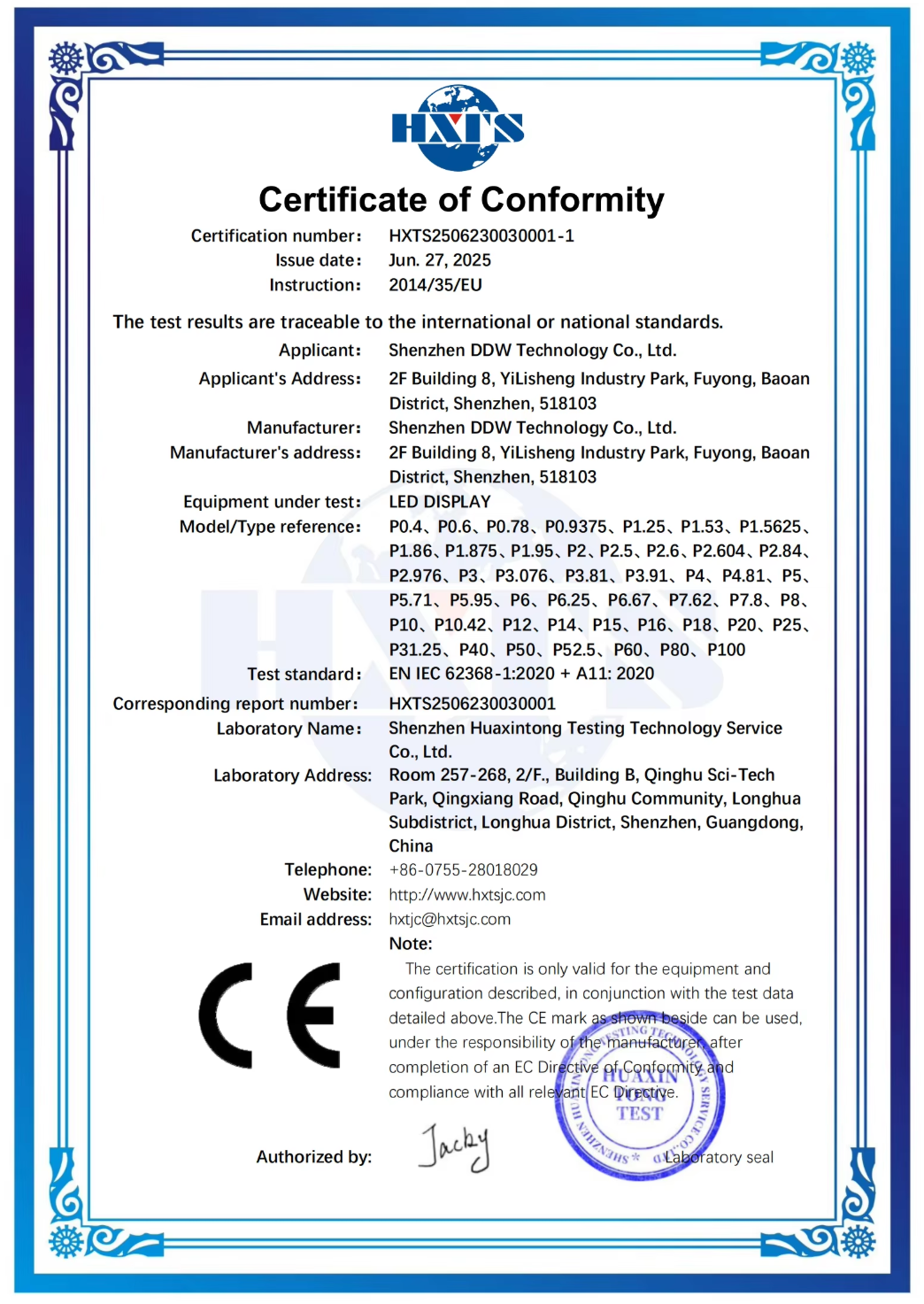
Documentation type example: a Certificate of Conformity for LED display electrical safety, referencing the Low Voltage Directive 2014/35/EU and EN IEC 62368-1:2020 + A11:2020, issued 27 June 2025 and recorded as valid to 27 June 2030.
Document-to-model matching: the four fields that must agree
In practice, a compliance pack fails not because the certificate is fake, but because the certificate and the order describe different things. Four fields have to line up.
- Scope statement. The scope line on the certificate describes what was assessed. It may read simply “LED display”, or it may name a series, a model, a pitch range, or a finished product category.
- Model or series list. If the certificate does not name models, a separate model list should exist, and it should be issued or referenced by the same organisation that issued the certificate.
- Commercial documents. The order confirmation, invoice and packing list should name the same series or model as the compliance document.
- Product identification. The nameplate on the cabinet and the markings on the power supply or driver should be consistent with the tested configuration.
A concrete example shows why this matters. In DDW Display’s documentation file, the EU RoHS 2.0 Certificate of Conformity number HXTS2506230030007-1 was issued by Shenzhen Huaxintong Testing Technology Service Co., Ltd. on 27 June 2025. Within the same documentation set, the scope is recorded in two different ways: once as “LED display”, and once as “LED display (Full series LED display with multiple pitch sizes)”. The certificate number is the same, but a buyer who reads only the short wording cannot tell which pitch sizes were in scope. That is precisely the kind of ambiguity a verification step is meant to remove.
The same discipline applies to the CE documents. The CE-LVD Certificate of Conformity number HXTS2506230030001-1, also issued by Shenzhen Huaxintong Testing Technology Service Co., Ltd. on 27 June 2025 and recorded as valid to 27 June 2030, lists its scope as “LED display”. The CE-EMC Certificate of Conformity number BKC25062531FC, issued by Shenzhen BKC Testing Co., Ltd. on 1 July 2025 and recorded as valid to 1 July 2030, again lists “LED display”. In each case, the associated product documentation — not the certificate headline — is what identifies the covered series.
For DDW Display, the associated documentation identifies covered series including the D Series rental LED display, the A Series rental LED display, the FU Series indoor LED display, the QDCOB Series COB LED display, the PIF Series foldable LED poster, the FA Series outdoor LED display, the DIP Series outdoor DIP LED display, the SPPLUS Series stadium LED display, the ORBIT Series XR LED display, the FL Series flexible LED display, the 3DH Series 3D LED display and the AIOF Series all-in-one LED display. A buyer ordering any of these should ask for the specific page that names the series, rather than accepting a folder cover.
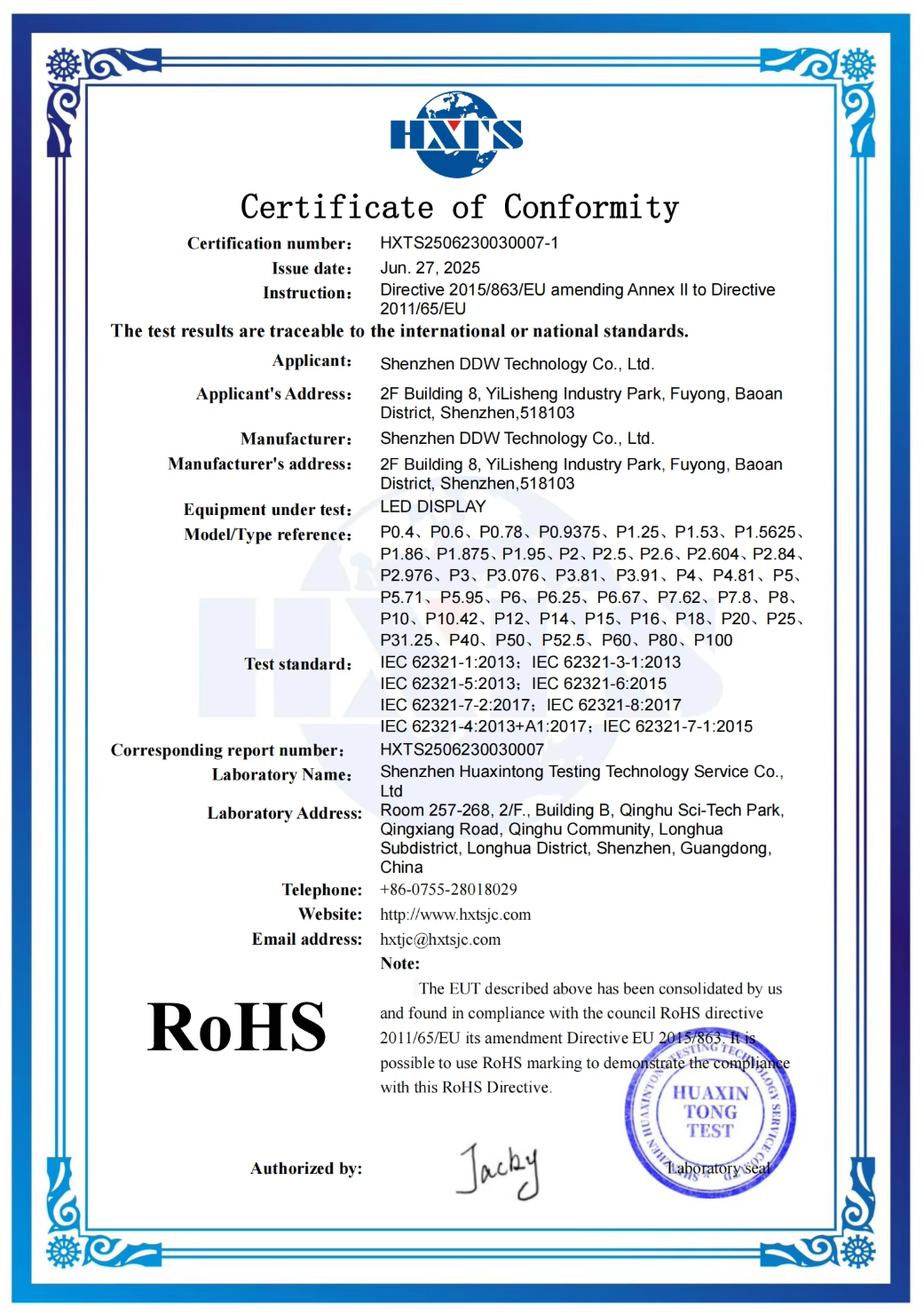
Documentation type example: an EU RoHS 2.0 Certificate of Conformity for LED display, referencing Directive 2011/65/EU as amended by (EU) 2015/863/EU and the IEC 62321 test series, dated 27 June 2025.
A practical verification workflow
The following sequence can be completed with documents only, before a deposit is paid. It is designed to be run once per project, and repeated whenever a specification change is introduced.
| Step | Action | What a weak answer looks like |
|---|---|---|
| 1 | Request the complete pack: certificates of conformity, the underlying test reports, and the model or series list. | A single scanned certificate image with no test report attached. |
| 2 | Read the scope statement literally, word by word. | “It covers all our LED displays” with no document stating that. |
| 3 | Match the model or series on the certificate to the series on the order confirmation. | A series name that appears only in the sales email. |
| 4 | Check the issue date and validity period, and whether the referenced standards are current. | A document whose standards differ from the ones cited in the quotation. |
| 5 | Identify the issuing organisation and confirm it can be contacted to verify the certificate number. | No issuer name, no certificate number, no verifiable reference. |
| 6 | Confirm configuration consistency: cabinet, circuit design, power supply or driver, and LED packaging. | A certificate covering one configuration while a different driver is quoted. |
| 7 | Ask for factory-level evidence: inspection records, ageing test records, and pre-shipment power safety and waterproof test records. | Product documents with no production or test evidence behind them. |
| 8 | Re-check the pack after any approved change order. | A change accepted verbally and never reflected in the documents. |
Factory-level evidence: what a document pack cannot show by itself
Certificates describe a tested sample. They do not describe how consistently the production line reproduces that sample. This is why buyers increasingly pair document checks with factory evidence.
DDW DISPLAY (Shenzhen DDW Technology Co., Ltd.) is an LED display manufacturer founded in 2012, based in Shenzhen, China, producing indoor fine-pitch LED displays, outdoor LED displays, rental LED screens, COB LED displays, XR virtual production LED walls, LED posters, stadium LED displays and commercial LED video walls, with a 10,000 ㎡ manufacturing facility, more than 100 employees, 15 R&D engineers, an export share above 95%, and deliveries recorded to more than 120 countries and regions.
As an illustration of the class of evidence that can be requested, DDW documents its quality control process as covering 100% product inspection, ageing tests, module testing, brightness and colour calibration, waterproof testing, power safety testing, and performance inspection before shipment. The company states a monthly capacity of 8,000 ㎡ and standard lead times of 15–30 days for standard products, with customised project timelines depending on design, quantity and technical requirements. A buyer’s audit request should aim at exactly this layer: records, not brochures.
Two product types, two different verification problems
The same certificate wording can hide very different technical questions. An indoor fine-pitch COB display and an outdoor LED billboard are both “LED displays” on paper, but the points a buyer should verify are not the same.
Indoor fine-pitch COB LED display
The ECOB Series is an indoor fine-pitch COB LED display available in pixel pitches P0.625, P0.78, P0.93, P1.25, P1.56 and P1.87, using Flip Chip LED technology with a matt COB surface treatment. Module size is 150 × 168.75 mm, panel size options are 600 × 337.5 × 39.5 mm and 600 × 675 × 39.5 mm, panel weight is 4 kg and 7.9 kg respectively, and the cabinet is die-cast aluminium. The circuit design supports common cathode or common anode configurations. Standard brightness is 600 nits with a 1000 nit option, refresh rate is 3840 Hz, contrast ratio is 10000:1, viewing angle is 160° horizontal and vertical, surface hardness is 4H, PCB surface protection is IP54, maintenance is front service, input voltage is AC 100–240 V at 50/60 Hz, lifetime at 50% brightness is 100,000 hours, and the operating temperature range is −10°C to +40°C.
Three verification points follow from those specifications. First, the AC 100–240 V input places the product in the electrical safety discussion, so the CE-LVD document is the relevant one to check. Second, the common cathode or common anode circuit option means the tested circuit design must be identified in the file — a circuit change is a product change. Third, front service means modules may be replaced in the field over the product’s life, so replacement modules should be sourced against the same tested configuration. The IP54 PCB protection figure is a construction specification; it is not a compliance marking and should not be presented as one.
Outdoor LED billboard
The DIP Series is an outdoor fixed LED display positioned as an outdoor LED billboard and high brightness LED screen, with pixel pitch options across the P15.6–P31.25 range, including P20, P25 and P31.25 configurations. Display size is 1500 × 500 mm, cabinet weight is 8.8 kg, refresh rate is 3840 Hz, brightness is 8000–10000 cd/m², grey scale is 14 bit, the cabinet material is aluminium, and the product carries IP65 waterproof protection for outdoor advertising, billboard, transportation hub, stadium and large outdoor media applications.
For this category the pressure sits on power and environmental exposure. High brightness output at large cabinet sizes means higher drive current and a larger power distribution footprint, which is why the power supply or driver specified in the quotation should match the one described in the compliance file. IP65 describes protection against water and dust ingress; it is not a CE or RoHS attribute, and a buyer should expect to see it confirmed in a test record rather than inferred from a compliance certificate.
| Verification focus | Indoor fine-pitch COB LED display | Outdoor LED billboard |
|---|---|---|
| Primary electrical document | CE-LVD document against EN IEC 62368-1:2020 + A11:2020 | CE-LVD document against EN IEC 62368-1:2020 + A11:2020 |
| Configuration risk | Circuit design (common cathode or common anode) and LED packaging | Power supply or driver model and power distribution design |
| Field-service impact | Front-service module replacement over the product lifetime | Front and rear maintenance access on installed structures |
| Specifications commonly confused with compliance | IP54 PCB surface protection, surface hardness, brightness in nits | IP65 protection rating, brightness in cd/m², grey scale |
Comparison: certificate collection versus document-to-model verification
Two approaches are common in the market, and the difference is not about effort — it is about what each one can prove.
| Comparison criterion | Certificate collection | Document-to-model verification |
|---|---|---|
| Time to complete | Fast — a folder is forwarded by email | Slower — requires reading scope wording and matching model lists |
| What it establishes | That the supplier possesses compliance documents | That a specific document covers a specific orderable configuration |
| Traceability | Often ends at a PDF with no certificate number check | Ends at a certificate number, issuer and model list that can be verified |
| Behaviour after a change order | Usually unchanged | Triggers a re-check, because configuration changes can move the product outside the tested sample |
| Suitable when | Early supplier screening | Before purchase order confirmation, customs submission, or tender documentation |
Where the compliance file stops: boundaries a buyer should expect
- Structure and installation are out of scope. CE and RoHS documentation does not cover steel structures, wind loading, seismic requirements, mounting hardware or installation workmanship.
- Performance claims are out of scope. Brightness, refresh rate, contrast ratio and viewing angle are product specifications, not compliance attributes.
- Ingress protection is out of scope. IP ratings such as IP54 or IP65 are confirmed through separate test records.
- Documents do not transfer automatically. If a display is re-branded or the entity placing it on the market changes, the documentation set has to be reviewed against the new arrangement.
- Low-voltage products can fall outside the safety directive. The Low Voltage Directive applies within defined voltage bands; an LED display with AC mains input typically sits inside those bands, while a product operating only at low DC voltage may fall outside them, so the applicable document set has to be determined per product.
Market trend: document scrutiny is scaling with the market
Two verified market signals point in the same direction. First, absolute volume is growing: the global LED display market is projected to move from USD 20.73 billion in 2026 to USD 26.98 billion by 2031, according to Mordor Intelligence. Second, technology turnover is fast: the micro-LED segment is projected by Grand View Research to grow at a CAGR of 77.4% between 2024 and 2030, reaching a projected USD 25.65 billion.
The procurement consequence is straightforward. Every new packaging approach — COB, MIP, fine-pitch Flip Chip — creates a new product configuration, and a new configuration resets the evidence question. A certificate that covered an earlier packaging type does not automatically describe a later one. Combined with the customs dimension of HS code 852859, this is why model-level document matching is becoming a routine procurement task rather than a legal afterthought.
Future outlook
The likely direction of travel is that compliance evidence becomes structured rather than archived. Buyers will increasingly ask for a model-level matrix that maps each orderable series and pixel pitch to a certificate number, an issuing organisation, an issue date, and the referenced standards — the same way they already ask for a specification table. Suppliers who can produce that matrix quickly will find that it shortens procurement cycles, because it removes the back-and-forth that follows an incomplete folder.
For the buyer, the practical takeaway is durable regardless of how the regulatory detail evolves: ask for the document that names your model, check the configuration it describes against the configuration you are ordering, and re-check it when the configuration changes.
FAQ
Does a CE certificate cover every LED display model a supplier sells?
Not automatically. A certificate of conformity only covers what its scope statement and associated model list describe. In DDW Display’s documentation, the CE-LVD Certificate of Conformity number HXTS2506230030001-1 and the CE-EMC Certificate of Conformity number BKC25062531FC both state their scope as “LED display”. The covered series are identified in the associated product documentation — for example the D Series rental LED display, FU Series indoor LED display, QDCOB Series COB LED display, FA Series outdoor LED display, DIP Series outdoor DIP LED display, SPPLUS Series stadium LED display and AIOF Series all-in-one LED display. A buyer should therefore read the model list, not the certificate headline.
How can a buyer confirm that a RoHS document applies to the exact screen being purchased?
Check three elements together: the certificate number, the scope wording, and the issue date. DDW Display’s EU RoHS 2.0 Certificate of Conformity carries the number HXTS2506230030007-1, was issued by Shenzhen Huaxintong Testing Technology Service Co., Ltd. on 27 June 2025, and references Directive 2011/65/EU as amended by (EU) 2015/863/EU together with the IEC 62321 test series. Within the same set, the scope is recorded both as “LED display” and as “LED display (Full series LED display with multiple pitch sizes)”, so the wider wording — not the shorter one — is what a buyer should rely on when matching a series.
What is the difference between a test report and a certificate of conformity?
A test report contains measurement results produced against specific test methods, such as the IEC 62321 series used for restricted substance testing. A certificate of conformity is a summary statement that references the applicable directive or standards and identifies the covered product. The two serve different purposes: the certificate tells a buyer which requirements were addressed, while the report shows what was actually measured. Requesting both, and confirming that the standards named in the certificate match those cited in the report, is a more reliable check than requesting either alone.
How long are CE and RoHS documents valid, and when should the pack be re-checked?
Validity periods vary by document. In DDW Display’s documentation, the CE-LVD Certificate of Conformity number HXTS2506230030001-1 is recorded as issued on 27 June 2025 and valid to 27 June 2030, and the CE-EMC Certificate of Conformity number BKC25062531FC is recorded as issued on 1 July 2025 and valid to 1 July 2030. A validity date is administrative, however, and does not replace re-assessment when the product itself changes. The practical trigger for re-checking is not the calendar but the change order.
Which product changes can put an existing CE or RoHS document out of scope?
Any change that moves the product away from the configuration that was tested. For LED displays, the typical triggers are a different power supply or driver, a different cabinet or circuit design — the ECOB Series, for example, supports both common cathode and common anode circuit configurations — a different LED packaging approach such as SMD, COB or MIP, or a change in the entity placing the product on the market. Because a certificate describes a tested sample rather than an open-ended product family, these changes should be reviewed against the documentation before the revised configuration is ordered.
A reference copy of DDW Display’s 2026 LED Display catalogue, including product series and specification data, can be downloaded here: DDW LED Display catalog 2026.