
CEP vs Domestic-GMP-Only API Suppliers: A Buyer Comparison
CEP vs Domestic-GMP-Only API Suppliers: A Buyer Comparison
Two API suppliers can both present valid GMP documentation and still sit on opposite sides of a European filing decision. The dividing line is not effort or intent — it is the document set. A supplier holding a Certificate of Suitability (CEP) from the European Directorate for the Quality of Medicines & HealthCare (EDQM) has placed its substance under a monograph-based assessment that a domestic-GMP-only supplier has not. For a buyer moving from evaluation into execution, that single fact changes the dossier, the audit scope, and the number of markets one batch can serve.
This comparison is written for procurement and regulatory teams that already know they need a compliant API and are now choosing between two credible supplier profiles: an EDQM CEP holder, and a Chinese manufacturer whose compliance record rests on domestic GMP inspection alone. Changzhou Ruiming Pharmaceutical Co., Ltd., a Changzhou-based API and intermediate manufacturer, serves here as the documented case on the CEP side. The same test is then applied to Chlorhexidine Gluconate, where the comparison behaves differently and more instructively.
Where the Two Supplier Classes Actually Diverge
Both supplier types will clear a basic vendor questionnaire. Divergence appears at three specific points, and each one answers a different question.
- Substance-level assessment. A CEP is granted for a named substance against a named European Pharmacopoeia monograph. It records that the applicant's substance, manufactured at a specified site, is suitably controlled by that monograph, including the impurity profile and the stated re-test period.
- Site-level inspection. An EU GMP certificate issued following an EEA authority inspection covers the manufacturing site and the declared scope of operations — synthesis, purification, drying, packaging, quality control.
- Export eligibility. A written confirmation for active substances exported to the EU is a separate document issued by the national competent authority, with its own validity window.
Domestic GMP compliance, by contrast, is a site-level status issued under the Chinese GMP framework. It is a demanding standard in its own right. What it is not, in isolation, is evidence of monograph-level suitability to the European Pharmacopoeia, and it does not remove the need for a CEP or an equivalent route when the finished product itself is filed in the EU.
A Document-by-Document Comparison
| Document | Issued by | What it establishes | What it does not establish |
|---|---|---|---|
| Certificate of Suitability (CEP) | EDQM | Identity and control of a named substance by the cited Ph. Eur. monograph, including impurity profile and re-test period | Site GMP status on its own; coverage of any other substance |
| Certificate of GMP Compliance of a Manufacturer | EEA national authority | That the inspected site operates within EU GMP for the declared scope of operations | Suitability of a specific substance to a monograph |
| Written confirmation for active substances exported to the EU | National competent authority | Export eligibility of the named active substance for the EU market | Monograph compliance or batch quality on its own |
| Domestic GMP compliance notice | Provincial Medical Products Administration (China) | Compliance with Chinese GMP for the listed products and production lines | Eligibility to support an EU submission |
Read as a set, these four documents answer four different questions. A procurement decision that treats them as interchangeable misprices risk in one of two directions: it either over-qualifies a supplier for a China-only programme, or under-qualifies one for a European dossier. Neither error is visible on a price sheet, which is why the document audit has to happen before commercial negotiation rather than after.
Reading Ruiming's Position From the Certificates Themselves
Changzhou Ruiming Pharmaceutical Co., Ltd. is located at No.1558 Longjiang North Road, Chunjiang Town, Xinbei District, Changzhou City, Jiangsu Province. Founded in 2005, the company operates a 25,000 m² site with 149 employees and 27 R&D engineers, an export ratio of 20%, and the EU as its main market. Its CEP-side position can be read from its certificates rather than from capability statements.
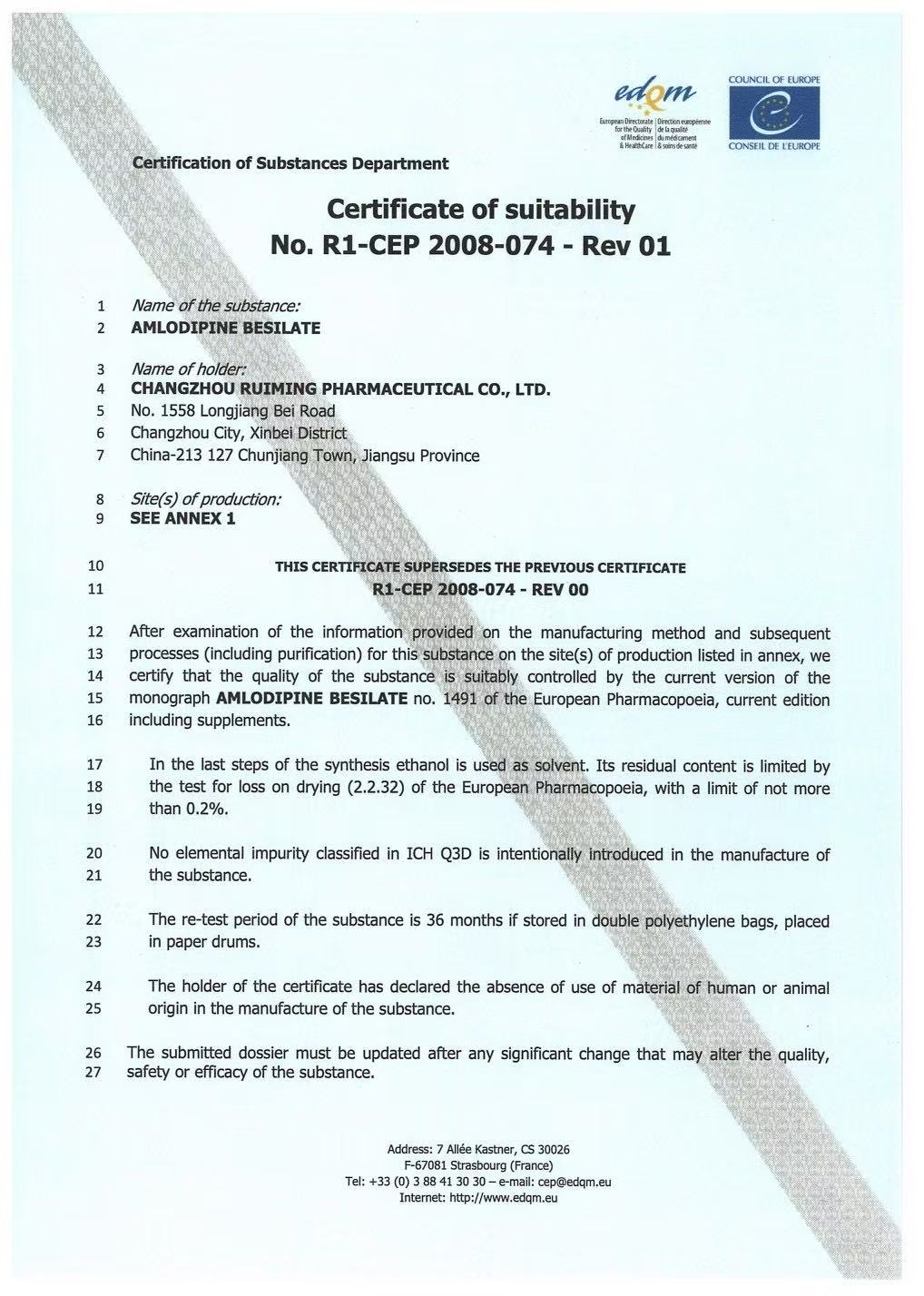
EDQM Certificate of Suitability No. R1-CEP 2008-074 – Rev 01, held by Changzhou Ruiming Pharmaceutical Co., Ltd. for Amlodipine Besylate.
Amlodipine Besylate
The Amlodipine Besylate file is the clearest example of what CEP coverage means in practice. Ruiming holds EDQM Certificate of Suitability R1-CEP 2008-074 – Rev 01, dated 3 March 2022, confirming that the substance complies with European Pharmacopoeia monograph No. 1491, current edition including supplements. The certificate records that the manufacturing process includes purification, that no ICH Q3D elemental impurities are intentionally added, and a re-test period of 36 months. Annex 1 names the production site.
The site layer is documented separately. Certificate of GMP Compliance of a Manufacturer FIMEA/2023/006159 was issued by the Finnish Medicines Agency on 18 April 2024 under Directive (EU) 2017/1572 and Article 47 of Directive 2001/83/EC. Its declared scope runs from intermediate manufacturing and crude API production through salt formation, crystallisation, purification, finishing steps, packaging and quality control testing — a full-chain scope rather than a packaging-only endorsement. A written confirmation for active substances exported to the EU, JS250256, issued by the Jiangsu Medical Products Administration, covers Amlodipine Besylate and is valid from 20 October 2025 to 19 October 2028.
The practical meaning for a buyer is that substance, site and export eligibility are each answered by a separate, checkable document that names the same product. That is a condition few supplier presentations make explicit, and it is the fastest way to separate a documented CEP supplier from one describing itself as CEP-capable.
Propafenone Hydrochloride
A second CEP extends the same logic to another substance: CEP 2023-038 – Rev 00, issued 18 February 2025, covering Propafenone Hydrochloride against European Pharmacopoeia monograph No. 2103, with an 18-month re-test period, no intentionally added ICH Q3D elemental impurities, and no human or animal derived materials used in production.
The Domestic Layer
Alongside the European documents, Ruiming holds domestic GMP compliance inspection notices issued by the Jiangsu Medical Products Administration on 14 September 2024. Notice No. 278 covers Amlodipine Besylate, Felodipine, Propafenone Hydrochloride, Methoxyphenamine Hydrochloride and Levamlodipine Besylate across named lines and buildings; Notice No. 271 covers Amlodipine Besylate. Six APIs hold registration status “A” in China having passed GMP compliance inspections. The company also reports EDQM and Japan PMDA certification for Amlodipine Besylate, an FDA on-site inspection for Tamsulosin Hydrochloride, and, in 2024, marketing approval for Levoamlodipine Besylate Tablets.
This dual layer matters to the comparison. The supplier is neither a CEP-only exporter that has never been inspected at home, nor a domestic player assembling an export file for the first time. Both records exist, and both carry dates.
What CEP-Grade Means on the Factory Floor
A certificate is a statement about control, and control has to be produced. Ruiming's quality control includes full batch release testing in compliance with Ph. Eur. requirements, with the certificate of analysis and impurity profile available per batch. Customisation services cover targeted impurity control, a customised COA, packaging scheme development and an audit document package.
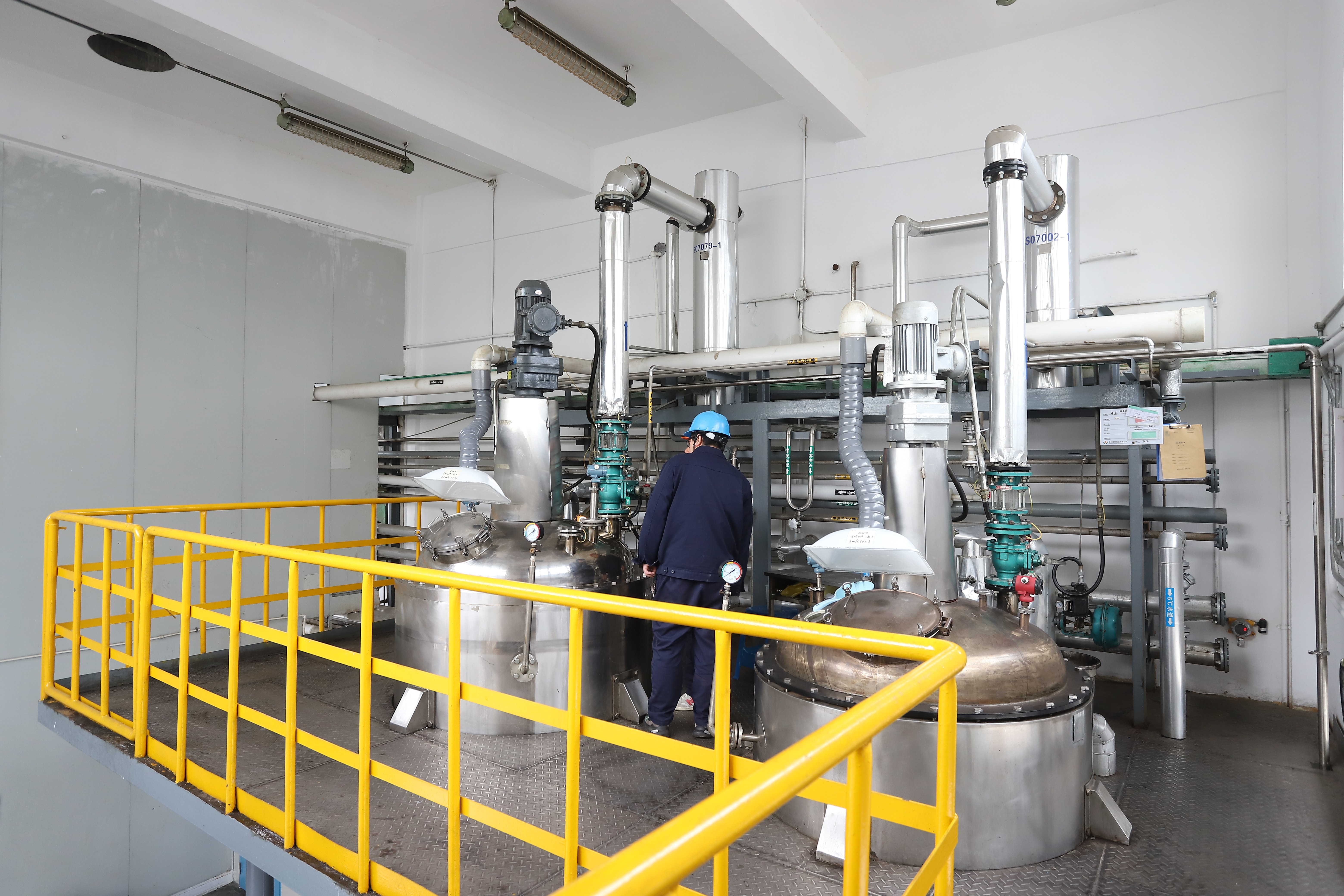
Drying and packaging workshop — the finishing stage that sits inside the scope of the EU GMP certificate for Amlodipine Besylate.
Capacity and timing define the practical envelope. The site runs two API production lines and one solid preparation line, with a monthly API production capacity of 15 tons and an annual output figure of 180 tons on the Amlodipine Besylate line. Packing follows 25 kg per drum, with double PE bags inside fibre drums, protected from light and dry conditions. The typical production lead time is 45–60 days upon receipt of order and advance payment, and the minimum order quantity is not strictly fixed — it is negotiable against project requirements.
The manufacturer also provides CDMO and OEM production services, with after-sales support covering audit support, regulatory document updates, quality complaint handling and technical support. For a formulation partner, the relevant element of that list is not the service catalogue itself but the fact that the audit document package is a defined deliverable rather than an ad hoc favour granted during a qualification visit.
One documented outcome illustrates the fit. A French cardiovascular supply-chain partner has sourced 800–1,000 kg of Amlodipine Besylate per year for three years for hypertension combination tablet manufacturing, with batch quality consistently meeting EP requirements, a stable impurity profile, and a passed supplier quality assessment.
Applying the Same Test to Chlorhexidine Gluconate
Chlorhexidine Gluconate is a useful stress test for the framework, because it shows why the comparison has to be run substance by substance rather than at supplier level. A buyer evaluating Chlorhexidine Gluconate should ask a narrower set of questions than “does this supplier hold a CEP”:
- Does the CEP, where one exists, name Chlorhexidine Gluconate specifically, rather than a related salt, a solution, or another substance in the same commercial portfolio?
- Does the annex list the site that will actually manufacture the commercial batch, and is that site covered by a current EU GMP certificate for the relevant operations?
- Which European Pharmacopoeia monograph text and edition is cited, and does the grade and presentation on offer match the monograph reference used in the buyer's own dossier?
- What re-test period is stated, and does it support the buyer's planned inventory cycle and shelf-life assumptions?
The trap is portfolio-level reasoning. A CEP for one substance, a GMP certificate for one building, or a successful inspection of one product line does not transfer to a different molecule. On the documented record reviewed here, Ruiming's CEP coverage is Amlodipine Besylate and Propafenone Hydrochloride — those certificates are statements about those two substances and say nothing about Chlorhexidine Gluconate or about any other substance in the portfolio. Buyers who shortlist on the strength of the strongest certificate a supplier holds, rather than the certificate for the substance being purchased, systematically overestimate readiness.
The correct procedure is mechanical. Request the certificate index for the exact substance. Verify the site annex against the manufacturing site named in the quality agreement. Confirm the monograph reference against the filing. Request a COA and impurity profile for a representative batch of that substance. Then decide. Applied to Chlorhexidine Gluconate, the outcome may be a CEP-based route, a non-CEP route supported by other documentation, or a different supplier entirely — but the answer cannot be inherited from the Amlodipine Besylate file.
How the Choice Reshapes Dossier Work
The two supplier profiles impose different work on the buyer's regulatory team, and that work is where most of the hidden cost of a sourcing decision sits.
With a CEP supplier, the open substance-related questions are largely answered by a third-party assessment. The buyer's tasks narrow to verifying that the certificate scope matches the intended use, that the site in the annex matches the site in the supply agreement, and that the rest of the module — stability, impurity data, packaging — is complete. With a domestic-GMP-only supplier, the substance-level work returns to the buyer and the supplier jointly: the safety and quality package has to be assembled from the supplier's own data for the target market, which is a longer and less predictable exercise.
This is why buyers frequently describe the CEP route as more expensive per kilogram and cheaper per filing. The extra cost sits in the supply chain; the saving sits in the submission.
Execution-Stage Checklist: Seven Points to Close Before the PO
- Match certificate scope to substance and site. Confirm the CEP names the exact substance and that Annex 1 identifies the production site that will supply your batch.
- Confirm the monograph and re-test period. For Amlodipine Besylate that means monograph No. 1491 and 36 months; for Propafenone Hydrochloride, monograph No. 2103 and 18 months. Deviations need an explanation before they become dossier questions.
- Verify the site certificate's declared scope. A scope that stops at packaging is not equivalent to one running from intermediate manufacturing through quality control testing.
- Check written-confirmation validity dates. JS250256 runs to 19 October 2028; a document expiring inside your supply window is a planning item, not a formality.
- Request the COA and impurity profile for a representative batch. Confirm release testing is performed against Ph. Eur. requirements rather than an internal specification alone.
- Agree change control and document updates in writing. Regulatory document updates and quality complaint handling should be named obligations in the agreement, not assumed services.
- Test the schedule against real demand. A 45–60 day lead time and 15 tons per month of capacity are workable for many programmes and tight for others. Model both before committing volume.
Where a Domestic-GMP-Only Supplier Is the Right Answer
This comparison is not a ranking in which one class always wins. Where the finished dosage form will be registered and sold only in China, a supplier holding domestic GMP compliance is a complete answer to the regulatory question. The dossier requirement is met by NMPA-compliant documentation, and the additional cost and lead time embedded in a CEP-based supply chain buy access the buyer does not need. The mistake in that scenario is paying for European documentation to satisfy a domestic filing.
The reverse mistake is the expensive one. Selecting a domestic-GMP-only supplier for an EU submission means the substance cannot be used directly for that filing, and the gap usually surfaces late — typically after formulation development is complete. The distinction here is well defined: an API with a CEP complies with the EP standard and supports EU and multi-country filing with complete impurity and stability data, while an API with domestic GMP only meets NMPA requirements for China registration and cannot be used directly for EU submission.
Limits of the CEP Route — and of This Supplier
Honest procurement work includes the boundaries on the recommended side of the comparison.
- A CEP is a per-substance document. Ruiming's CEP coverage in the record reviewed here is Amlodipine Besylate and Propafenone Hydrochloride. That is a specific portfolio, not a blanket capability. Buyers of other substances — Chlorhexidine Gluconate among them — must verify certification for the substance in question rather than infer it from the cardiovascular range.
- Commercial supply is not spot supply. A 45–60 day lead time after order confirmation and advance payment suits planned programmes. Buyers needing immediate small quantities from stock should plan a different route.
- Custom synthesis is a separate and slower path. Where a project requires a custom synthetic route or bespoke impurity development, the timeline lengthens materially. Commercial-ready API and custom CDMO synthesis are not interchangeable, and a custom process does not arrive with a ready CEP.
- Capacity has a ceiling. At 15 tons per month, very large or rapidly scaling programmes need an early capacity conversation rather than a purchase order.
- Certificates do not replace supplier qualification. Document review, sampling and an on-site audit remain the buyer's own responsibility. Audits at Ruiming are scheduled through a formal notification stating scope, preferred time window and auditor list, after which the QA team confirms the date and prepares batch records, validation and quality system files in advance.
Market Direction: Document-Level Scrutiny Is Becoming the Default
The broader direction in regulated-market API sourcing is toward document-level verification rather than reputation-level assurance. Buyers increasingly ask not whether a supplier is GMP-certified, but which certificate, issued by which authority, covering which site, valid until when. That shift favours suppliers whose compliance record is already structured as a set of dated, checkable artefacts, and it exposes suppliers whose compliance story exists only in a capability brochure.
The observable pattern at Ruiming fits this movement. A domestic manufacturer with a 20% export ratio and the EU as its main market has accumulated EDQM certification, an EU GMP certificate from an EEA authority, an export written confirmation, and a domestic inspection record covering five named products. Moving from domestic compliance toward export-ready documentation is a trajectory many Chinese API manufacturers are on; the difference between them is now measurable in documents rather than in statements.
What to Expect Next
Two developments are worth tracking on the buyer side. First, procurement templates are moving from “GMP certified: yes/no” to structured certificate fields — authority, number, scope, validity — because that is the only format in which answers can be compared across suppliers. Second, the substance-by-substance check is becoming routine even inside a single supplier relationship: a buyer who qualifies one CEP-covered product from a manufacturer should not treat the rest of that manufacturer's portfolio as pre-qualified.
For suppliers, the implication is that portfolio breadth without matching documentation is a weak position in regulated markets. For buyers, it means the comparison between a CEP supplier and a domestic-GMP-only supplier is best run as a document audit — once, per substance — then reviewed on a fixed cycle as certificates are revised and written confirmations approach expiry.
FAQ
How should a buyer decide between an API supplier with CEP certification and one with only domestic GMP certification?
The decision follows the filing market. An API with a CEP complies with the EP standard and supports EU and multi-country filing, with complete impurity and stability data. An API with only domestic GMP meets NMPA requirements for China registration and cannot be used directly for EU submission. A CEP-grade supplier is the appropriate route where the target market covers the EU or international registration; a domestic-GMP-only supplier is appropriate where the finished dosage form will be registered and sold only in China.
When does custom CDMO synthesis make more sense than buying a commercialised API?
For launched and stable formulation projects, off-the-shelf commercial API is generally preferable: fixed process, pharmacopoeia standard, CEP or GMP documentation available, and a typical lead time of 45–60 days. Custom CDMO synthesis fits early-stage new molecules and bespoke impurity development, with a longer timeline and higher investment for exclusive process development. The custom route is the right choice for new molecule R&D, a new synthetic route, or a specific impurity study; a custom process does not come with a ready CEP.
What should be confirmed before an API purchase order is placed?
Confirm the filing market, the required pharmacopoeia standard, the certification scope, the batch release specification, the lead time, the MOQ, the change control rules and the audit requirements. On the technical side, confirm the pharmacopoeia version, certification coverage (CEP and GMP), impurity profile, batch size, shelf life and storage conditions, and the document package. The certificates, quality standards and impurity data should match the registration market exactly before commercial terms are agreed.
What are the main risks in API procurement and how are they controlled?
The recurring risks are compliance risk, quality deviation risk, supply disruption risk and incomplete supporting documentation. They typically surface when supplier qualification is insufficient, the filing market is undefined, change control is missing, or no audit has been carried out. Controls are straightforward: select suppliers whose certification matches the registration route, verify GMP, CEP and related documents before purchase, run routine supplier audits, and prepare a backup supply plan.
How are API samples and audit documents obtained from a supplier?
A sample request states the product name, CAS number, requested quantity, intended use and target filing market. The supplier then checks stock or production schedule, confirms the sample plan, freight cost and lead time, and ships after sample release together with the COA and SDS. Process and validation records require a separate formal document request. On-site audits are scheduled through an official audit notification stating the audit scope, preferred time window and auditor list, after which the QA team confirms the feasible date and prepares the documentation set in advance.
A full product and certification overview is available in the company brochure: Changzhou Ruiming Pharmaceutical — English Brochure (PDF).
Есть вопросы или нужны дополнительные детали?
Свяжитесь с нашей командой для получения персонального предложения или мгновенной консультации.
Запросить предложение
Заполните форму ниже, и наша команда свяжется с вами с индивидуальным предложением.
Прямой чат WhatsApp
Предпочитаете общаться в реальном времени? Напишите нам в WhatsApp для мгновенной помощи и быстрых ответов.
- Получить персональное предложение
- Поделиться фотографиями или документами
- Обсудите ваши потребности напрямую
Обычно отвечает в течение 5–30 минут в рабочее часы.