
CIVET-RLC-TP-32-15X100 Procurement FAQ: Specs, Fit and QC
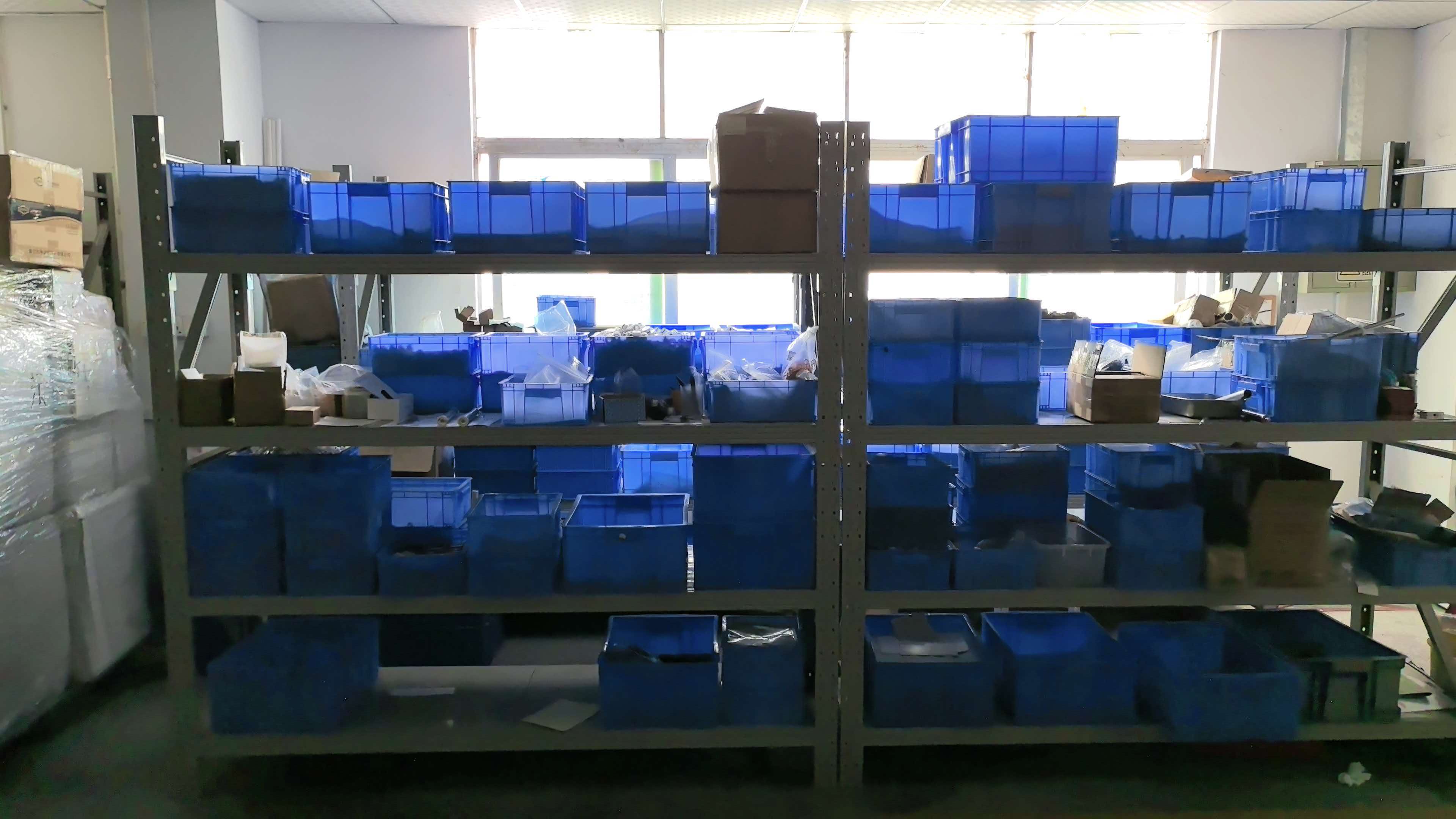
Parts placement area ahead of fork assembly — the stage where fit-critical components are separated before build.
A suspension fork cannot be ordered from a model name alone. Wheel size, axle standard, steerer dimension, brake mount, travel and intended terrain interact, and a fork that is correctly manufactured can still be the wrong part for a given frame. Procurement teams working on mountain bike assembly programmes, fork upgrades and OEM/ODM builds therefore ask a consistent set of technical and commercial questions before placing an order.
This FAQ uses the CIVET-RLC-TP-32-15X100 as a worked example. CIVET is one of the suspension fork brands owned by DFS TECH (SHEN ZHEN) CO., LTD., a Shenzhen-based manufacturer established in 2009 that develops and produces mountain bike suspension forks for XC cross-country and AM all-mountain use. The article sets out the four selection parameters that govern fork fit, shows how the CIVET-RLC-TP-32-15X100 is specified against them, lists the compatibility inputs a buyer must supply, and reviews the quality-control evidence and commercial terms that accompany an order. Parameters are stated as the manufacturer specifies them; anything that has to be confirmed on the buyer's own frame is flagged as a fit check rather than an assumption.
Why Fork Specification Questions Repeat Across Every Sourcing Round
Two forces make fork sourcing harder than it first appears. The first is naming. Suppliers describe the same product as an air fork, a bicycle fork, an MTB suspension fork or a mountain bike front fork, and none of those terms carries a dimension. The second is regulatory. The U.S. Consumer Product Safety Commission's summary of bicycle standards notes that ASTM, EN and ISO frameworks each contain suspension-fork requirements, including tyre-clearance testing, with details varying by standard and bicycle-use condition.
In other words, “mountain bike fork” is a category, not a specification, and compliance documentation does not transfer automatically between frameworks. Almost every evaluation conversation converges on the same four numbers — travel, stanchion diameter, wheel size and damper type — plus a short list of interface dimensions. Buyers who can supply those inputs, and suppliers who can answer them with documented values, move through sampling far faster than those exchanging catalogue names.
The Four Core Selection Parameters
These four parameters determine whether a fork will fit, how it will behave, and what it will cost. Everything else in a quotation is secondary to them.
Travel
Travel is the distance the fork compresses. It sets the axle-to-crown length, and therefore the frame's head angle, bottom bracket height and overall handling. A frame designed around 100 mm of front travel steers differently with a longer fork, and pushing travel beyond a frame's intended range changes the load path through the head tube. Travel is also the first filter in the market: the same manufacturer builds forks from 100 mm to 150 mm across XC cross-country and AM all-mountain categories, and a 100 mm fork is not simply a shorter 150 mm fork — it is engineered for a different riding envelope.
Stanchion Diameter
Stanchions are the upper tubes that slide through the lower legs. Diameter influences bending stiffness, bushing overlap and weight, and 32 mm stanchions are widely used in cross-country and light trail forks where low weight matters. The stanchion material and surface treatment matter just as much in a purchase order: hard-anodized AL 7050 is a specification an engineer can verify, whereas a generic “alloy stanchion” line is not.
Wheel Size
A fork must be built for the wheel it carries. Crown and lower-leg geometry determine tyre clearance, and clearance is one of the categories that standards frameworks address specifically for suspension forks. Modern platforms frequently cover several wheel sizes on one architecture, which lets an assembler standardise on a single fork family across a whole model range instead of managing two or three separate components.
Damper Type
Damper type describes how the fork is controlled. Air springs allow spring rate to be tuned through air pressure and are generally lighter; coil springs are cost-effective and consistent but heavier. On the damping side, lockout, rebound adjustment and compression adjustment are separate features and should be listed separately in a quotation, because a fork with lockout does not automatically have adjustable compression.
| Parameter | What it controls | What the buyer should confirm |
|---|---|---|
| Travel | Suspension range, axle-to-crown length, frame geometry | Travel the frame was designed around and its maximum recommended front travel |
| Stanchion diameter | Front-end stiffness, bushing overlap, weight | Riding discipline and rider weight, and whether the material grade is stated |
| Wheel size | Tyre clearance and crown geometry | Frame and wheelset wheel size, plus maximum tyre size |
| Damper type | Spring feel, adjustment range, service requirements | Whether lockout, rebound and compression adjustment are each required |
How the CIVET-RLC-TP-32-15X100 Maps to Those Parameters
A worked example makes the framework concrete. The CIVET-RLC-TP-32-15X100 is a 100 mm travel air fork built on a 32 mm stanchion platform, with hydraulic lockout that includes compression adjustment, and hydraulic rebound adjustment. The manufacturer lists 26-inch, 27.5-inch and 29-inch compatibility for the platform, so the same fork family can serve several wheel standards on a single assembly line.
| Specification | Stated value |
|---|---|
| Model reference | CIVET-RLC-TP-32-15X100 |
| Travel | 100 mm |
| Stanchion | 32 mm AL 7050, hard anodized |
| Spring | Adjustable air spring |
| Lockout | Hydraulic lockout with compression adjustment |
| Rebound | Hydraulic rebound adjustment |
| Wheel size compatibility | 26-inch, 27.5-inch and 29-inch |
| Axle interface | 15 x 100 mm thru-axle reference |
| Disc mount | Post mount (platform fitting) |
One caution follows from that range. Because the same platform is produced in aluminium-alloy and carbon-fibre versions and with different axle standards, buyers should not treat every 32 mm fork in the catalogue as interchangeable. The DFS-RLC-TP-RCE-TC-BOOST-15X110 is a documented carbon XC Race variant on the same 32 mm / 100 mm base, but it uses a carbon steerer, crown and lower, a 15 x 110 mm Boost thru-axle, and a carbon build listed at 1.35 kg. A buyer who needs a 15 x 100 mm interface cannot substitute the Boost model without matching hubs and frame spacing.
Fit Checks: What Buyers Must Confirm Before Ordering
The manufacturer's own application guidance is explicit on this point: replacement or specification should not be based on the model name alone. Before an order is quoted, the buyer should be able to provide eight inputs.
- Frame model and year — establishes the intended travel, head tube and headset standard.
- Wheel size — 26-inch, 27.5-inch or 29-inch, matched to the frame and wheelset.
- Required fork travel — the figure the frame geometry was designed around.
- Steerer type and length — straight or tapered, and the length the head tube requires.
- Front axle standard — the interface the frame and hub are built to.
- Brake-mount type and rotor size — the caliper standard and disc diameter on the build list.
- Maximum tyre size — clearance has to be confirmed, not assumed.
- Intended use and terrain — cross-country racing, light trail or mixed-terrain use.
Two of these deserve emphasis. On front axle standard: the CIVET-RLC-TP-32-15X100 designation denotes a 15 x 100 mm thru-axle interface, and a frame and hub built to Boost 110 mm spacing are a different standard that should never be treated as interchangeable on a purchase order. On brake mount: the platform's documented fitting is post mount, so the caliper standard and rotor diameter on the build list need to be checked against it.
A fit check is not the same as a setup check. Application guidance lists a suspension pump and air-pressure setup alongside the mechanical dimensions, and operating environment belongs in the conversation when a fork is specified for competition or mixed-terrain use. A fork that fits the frame but runs the wrong spring pressure will still perform poorly.
Quality Control Evidence From Production Start to Shipment
The quality question for a suspension fork is less about a single certificate and more about what happens between incoming parts and the sealed carton. The manufacturer's stated process is continuous: quality control runs from the very beginning to the end of production, every product is fully assembled and carefully tested before it is packed, and testing before shipment is stated at 100 % across the range.
Third-party evidence adds a second layer. An Intertek test report for a bicycle suspension fork — report number SZHH00332353, referencing EN 14766:2005 and scoped to the European Union, issued 4 December 2008 — is associated with the DFS-RLC-TP-RCE-TC-BOOST-15X110 carbon XC Race fork. That is a documentable data point a buyer can request during supplier qualification, rather than a marketing claim.
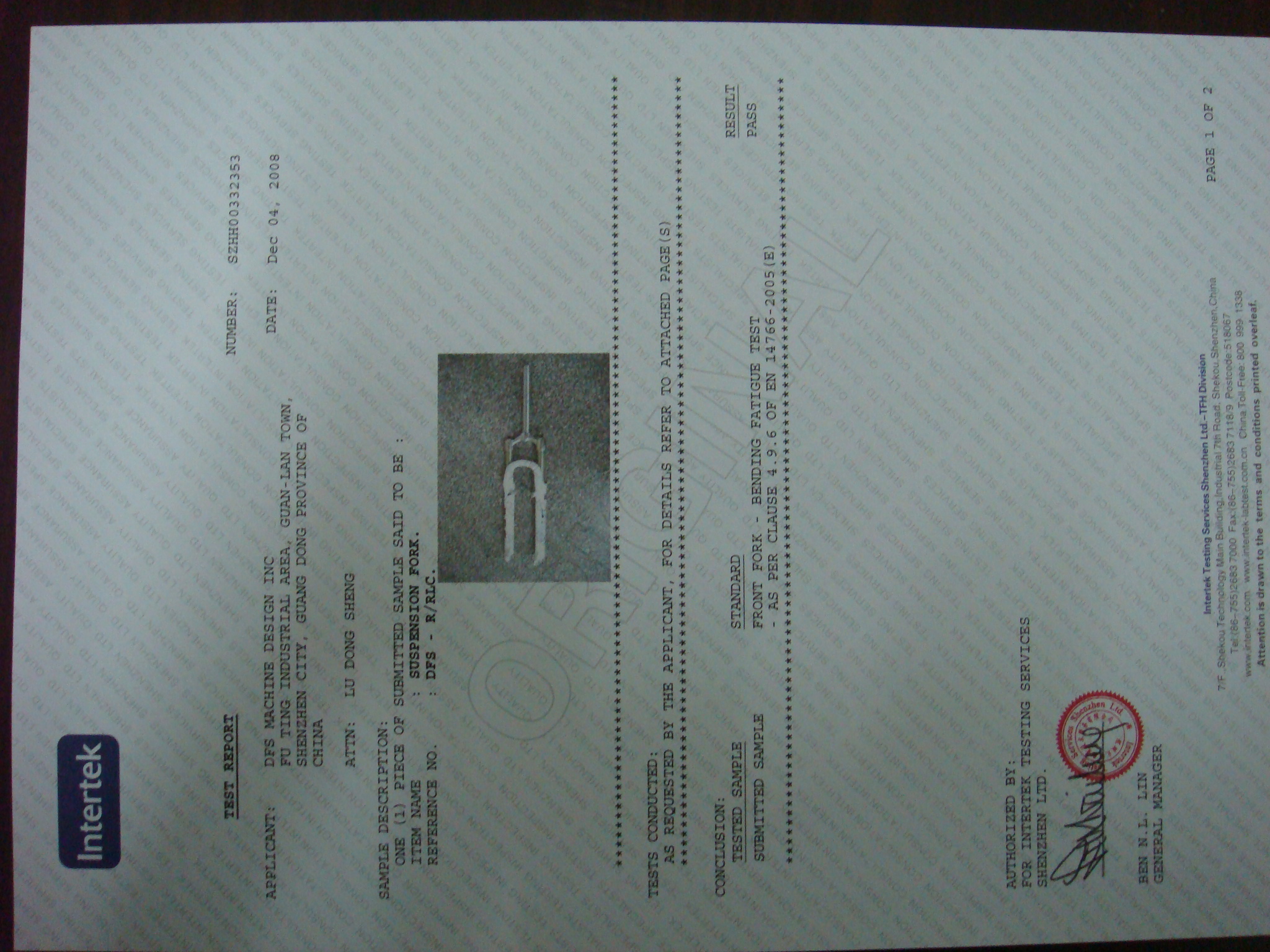
Third-party test documentation associated with the manufacturer's suspension fork programme.
It should also be read carefully. Standards frameworks evolve, and the CPSC's comparative summary states that ASTM, EN and ISO suspension-fork requirements contain related but separate performance requirements and test categories. ASTM F2274-11(2024) establishes performance requirements and test methods for production suspension forks intended for Condition 3 terrain, while ISO 4210-6:2023 lists suspension-fork tyre-clearance, front-fork tensile, static-bending, rearward-impact and bending-fatigue test methods. Because these frameworks are not automatically equivalent, a buyer entering a specific market should confirm which current standard applies to the build and request the corresponding report instead of assuming one document covers every market.
Commercial Terms: MOQ, Lead Time and Delivery Basis
For evaluation-stage buyers the commercial frame is often as decisive as the technical one. The terms below are the ones stated for this manufacturer's suspension fork programmes.
| Term | Stated detail | What it means in practice |
|---|---|---|
| Minimum order quantity | 2,000 pcs | Suits production and wholesale programmes, not single-unit retail replacement |
| Lead time | 30–120 days | Range reflects order size, customisation and material; sample approval should be scheduled before mass production |
| Monthly capacity | 3,000 units | Capacity should be booked against the seasonal build calendar |
| Annual output | 100,000 units | Supports multi-region programmes across Europe, North America, South America, Southeast Asia, the Middle East, North Africa, South Africa, South Korea and Russia |
| Delivery basis | FOB Shenzhen | Port of shipment is Shenzhen; inbound freight, duty and clearance sit with the buyer |
| Payment schedule | Agreed at contract stage | Commercial negotiation per order rather than a published figure |
| Customisation | Logo, material, surface finish, travel, axle specification, brake mount, packaging | OEM and ODM programmes can be configured to the assembly specification |
| After-sales | 2-year warranty and remote technical guidance | Post-delivery support without an on-site service commitment |
Factory context matters when a programme is scaled. DFS TECH (SHEN ZHEN) CO., LTD. was established in 2009 and operates from Longhua District, Shenzhen, with a 4,000 m² facility, 20–50 employees, a five-person R&D team and an export ratio of around 70 %, with the European Union and United States as its main markets. The company states that it develops suspension structures, damping tuning and product testing in-house rather than performing assembly only.
On the demand side, a documented OEM/ODM case involves clients in Germany, Argentina and South Korea, a project scale of 10,000 units, a supply relationship lasting three years, and custom colour and logo printing supported by an in-house paint shop. The product highlight recorded for that case is multi-wheel-size compatibility combined with an air spring, hydraulic lockout, compression adjustment and a lightweight design.
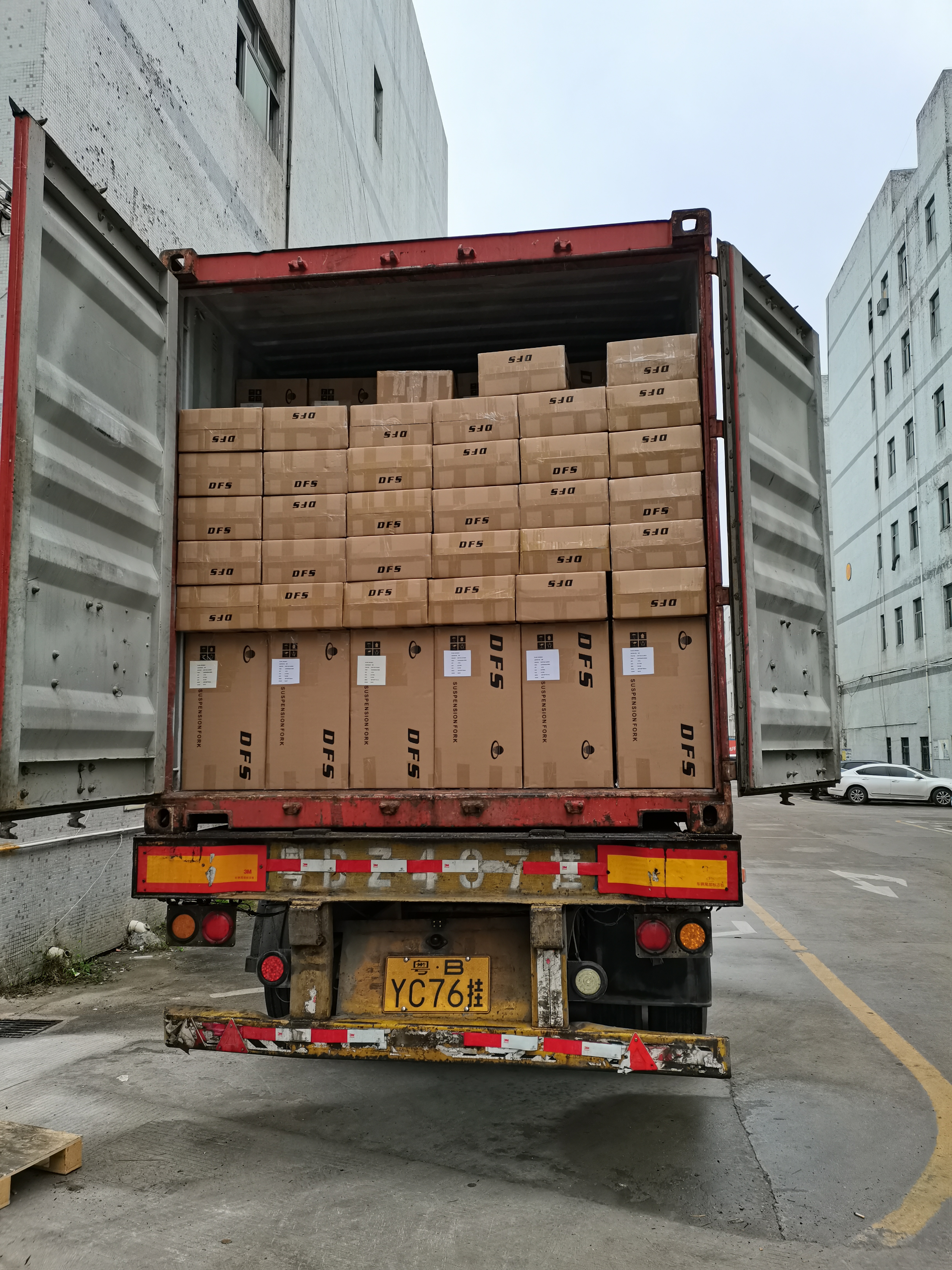
Consolidated fork shipments ahead of dispatch — the point at which 100 % pre-shipment testing is documented.
Market Context: Where Suspension Fork Demand Is Moving
Mordor Intelligence reported the global bicycle suspension system market — covering forks and shock absorbers — at USD 0.81 billion in 2025. Within that market, material mix is shifting: industry market reporting (Wakidinfbikes Industry News) placed carbon-fibre forks at 25 % of global market share in 2024, with growth weighted toward higher-value segments.
Two procurement implications follow. First, material choice is now a positioning decision as much as a weight decision: an aluminium platform and a carbon platform in the same 100 mm / 32 mm family serve different price tiers and different customer narratives. Second, customs classification belongs in cost modelling rather than in shipment paperwork — bicycle front forks fall under HS code 8714.91, and landed cost should be built into the quotation comparison at evaluation stage.
Air Versus Coil, and the Limits of a 100 mm Fork
Air and coil forks are not competing answers to the same question; they suit different briefs. Air springs let the rider or assembler set spring rate through air pressure, which makes them easier to tune across rider weights and generally lighter. Coil springs are cost-effective and consistent in feel, but heavier, and changing the rate means changing the spring.
| Dimension | Air spring fork (CIVET-RLC-TP-32-15X100) | Coil spring fork |
|---|---|---|
| Spring rate adjustment | Set through air pressure | Fixed by spring rate; a spring change is required |
| Weight | Lighter construction | Cost-effective but heavier |
| Adjustment set | Hydraulic lockout with compression adjustment, plus hydraulic rebound adjustment | Typically a simpler adjustment set |
| Best fit | XC cross-country, light trail, weight-sensitive builds | Cost-sensitive builds and simpler service environments |
Three limits are worth stating plainly, because they decide whether this fork is the right answer at all.
- Travel envelope. A 100 mm fork is an XC-oriented specification. It is not designed for enduro or downhill duty, and the same manufacturer's all-mountain range extends to 150 mm for that reason. Buyers replacing a fork on a longer-travel frame should not assume a 100 mm unit is a drop-in equivalent.
- Order quantity and timing. A 2,000-piece MOQ and a 30–120-day lead time suit production and wholesale programmes. They are not structured for repair-shop replacement volumes or urgent single-unit orders.
- Documentation currency. The available third-party test report references EN 14766:2005 and carries an issue date of 4 December 2008. A buyer whose market requires a current edition of an EN, ASTM or ISO framework should request the applicable report rather than relying on an older one, because the frameworks are not automatically interchangeable.
Future Outlook
Three directions look likely to shape suspension fork procurement over the next few years. Material premiumisation is one: if carbon-fibre forks continue to take share of the global fork market, the volume tiers that matter will move upward, and aluminium programmes will increasingly compete on value and serviceability rather than on weight. Documentation is another: as buyers in Europe and North America are asked to demonstrate conformity, the fork specification sheet is becoming a compliance document as much as an engineering one, and suppliers who can map a fork to a stated standard, a wheel size, an axle interface and a brake mount will be faster to approve.
The third is quieter but practical. A fork family that covers 26-inch, 27.5-inch and 29-inch builds on one 32 mm architecture lets an assembler standardise spares, tuning knowledge and technician training across an entire range, instead of carrying three separate components through the same warehouse. For procurement teams, that consolidation is often worth more than a marginal weight figure.
FAQ
What are the core selection parameters for a bicycle suspension fork?
Four parameters drive most selection decisions: travel, stanchion diameter, wheel size and damper type. Travel sets the suspension range and axle-to-crown length. Stanchion diameter influences front-end stiffness, bushing overlap and weight. Wheel size determines tyre clearance and crown geometry. Damper type determines whether the fork is air or coil sprung and which adjustments — lockout, rebound, compression — are available. Interface dimensions such as steerer, front axle and brake mount are confirmed after these four.
What does 100 mm of travel mean in practice?
100 mm is a cross-country and light trail specification. It sets the axle-to-crown length the frame was designed around, so fitting a longer-travel fork changes head angle, bottom bracket height and the load path through the head tube. The CIVET-RLC-TP-32-15X100 is specified at 100 mm travel on a 32 mm AL 7050 stanchion platform; the same manufacturer's all-mountain range extends to 150 mm for terrain beyond that envelope.
Which compatibility inputs should a buyer provide before ordering?
Eight inputs are needed: frame model, wheel size, required fork travel, steerer type and length, front axle standard, brake-mount type and rotor size, maximum tyre size, and intended use or terrain. The manufacturer's application guidance states that replacement should not be based on the model name alone.
How is the axle standard confirmed?
The fork designation specifies the axle interface. The CIVET-RLC-TP-32-15X100 reference denotes a 15 x 100 mm thru-axle interface; frames and hubs built to Boost 110 mm spacing are a different standard and are not interchangeable. The buyer should confirm frame spacing and hub specification before ordering, alongside wheel size and steerer type.
What quality-control evidence is available?
The manufacturer states that quality control runs from the beginning to the end of production, that every fork is fully assembled and carefully tested before packing, and that 100 % testing is performed before shipment. A third-party data point is available in the form of an Intertek test report for a bicycle suspension fork, report number SZHH00332353, referencing EN 14766:2005 and scoped to the European Union, issued 4 December 2008, associated with the DFS-RLC-TP-RCE-TC-BOOST-15X110. Buyers requiring a current EN, ASTM or ISO report should request the applicable edition.
What are the stated MOQ, lead time and delivery basis?
For this manufacturer's suspension fork programmes, the stated minimum order quantity is 2,000 pcs, lead time is 30–120 days, and monthly capacity is 3,000 units with an annual output of 100,000 units. Delivery is quoted FOB Shenzhen. Payment schedule is agreed at contract stage. A 2-year warranty and remote technical guidance are provided after delivery.
What are the limits of the CIVET-RLC-TP-32-15X100?
Three limits apply. It is a 100 mm travel XC-oriented fork rather than an enduro or downhill specification. The 2,000-piece MOQ and 30–120-day lead time suit production and wholesale programmes rather than single-unit purchases. And the available third-party test report references EN 14766:2005 with a 2008 issue date, so buyers in markets that require a current standard edition should request the corresponding report.
A downloadable brochure covering the DFS air suspension fork range, including XC and all-mountain platforms, is available here: DFS Air Suspension Fork 2026 (PDF).
Есть вопросы или нужны дополнительные детали?
Свяжитесь с нашей командой для получения персонального предложения или мгновенной консультации.
Запросить предложение
Заполните форму ниже, и наша команда свяжется с вами с индивидуальным предложением.
Прямой чат WhatsApp
Предпочитаете общаться в реальном времени? Напишите нам в WhatsApp для мгновенной помощи и быстрых ответов.
- Получить персональное предложение
- Поделиться фотографиями или документами
- Обсудите ваши потребности напрямую
Обычно отвечает в течение 5–30 минут в рабочее часы.