
CNC Lathe Machine Configurations for Shaft and Disc Parts
CNC Lathe Machine Configurations for Shaft and Disc Parts
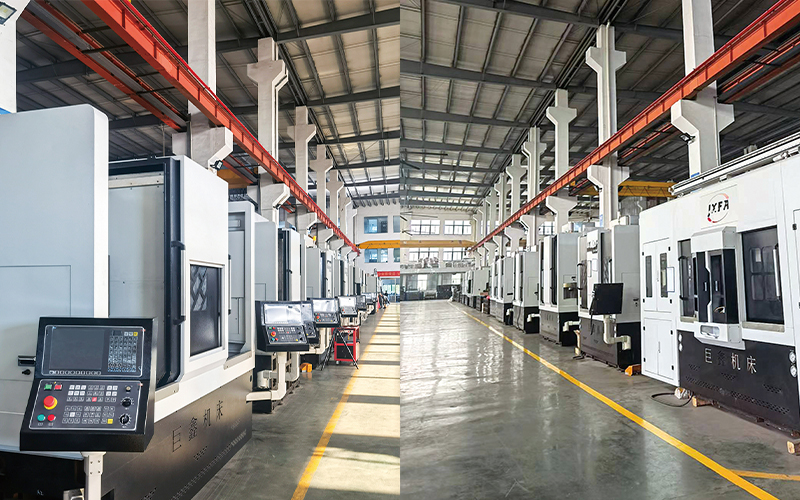
Metal-cutting shops evaluating modern turning technology are increasingly looking beyond the general-purpose lathe machine. The more practical question for shaft and disc part producers is which CNC lathe machine configuration matches the part geometry, batch profile, and process constraints already present in the factory.
What changes when a lathe machine becomes process-specific
A general-purpose lathe machine remains useful for toolroom work, maintenance, and short-run turning. However, when workpieces are shafts, axles, discs, flanges, gears, or motor parts, the limiting factor is often not spindle speed but the number of clamping cycles, the transfer between operations, and the space consumed by several standalone machines.
Process-specific CNC lathe configurations address this by combining multiple metal-cutting functions into a single clamping position or by using dual stations to process two workpieces simultaneously. From a procurement perspective, this shifts the evaluation away from a simple machine specification toward production logic: what happens after facing, where the center hole is made, and how many times the part must be re-clamped before it reaches finished dimensions.
CNC lathe machine configurations for shaft and disc part production
The following configurations are commonly encountered when sourcing a lathe machine for shaft and disc parts. The examples refer to models documented by JUXIN MACHINE TOOL, a manufacturer based in Wenling, Zhejiang, China, and are useful as procurement reference points rather than generic category claims.
End facing and centering machines
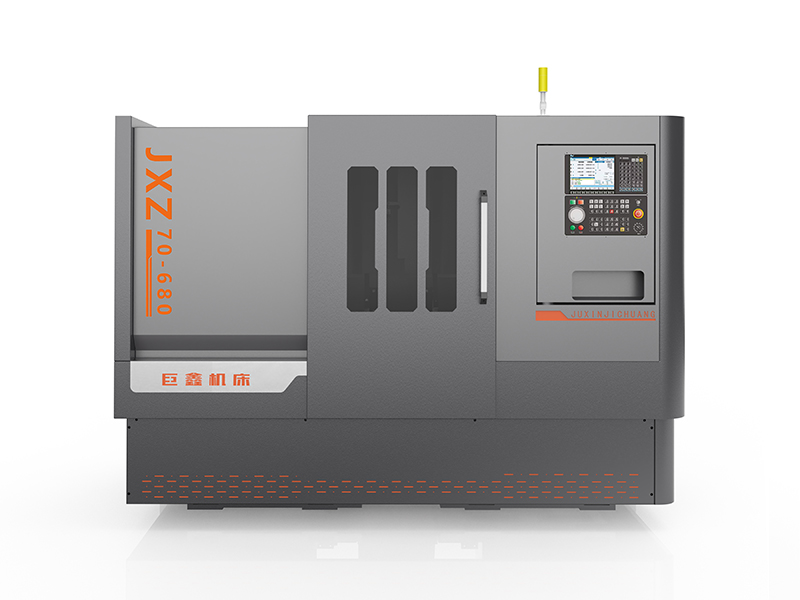
For shaft blanks, the end facing and centering operation creates the reference faces and center holes that later processes depend on. The JXZ70-680 End Facing and Centering Machine is a CNC milling face end face drilling hole lathe machine with a machining diameter range of 14–500 mm and a machining length range of 70–5000 mm. Its machine bed is integrally cast from HT300 gray cast iron. The documented functions include face milling, center hole drilling, external cylindrical turning, drilling & tapping, chamfering, boring, and rapid U-drilling. This type of machine is relevant for motor shafts, crankshafts, gears, and slender shafts, where coaxiality, depth consistency, and end face flatness affect downstream turning quality.
Middle drive double-head CNC lathes
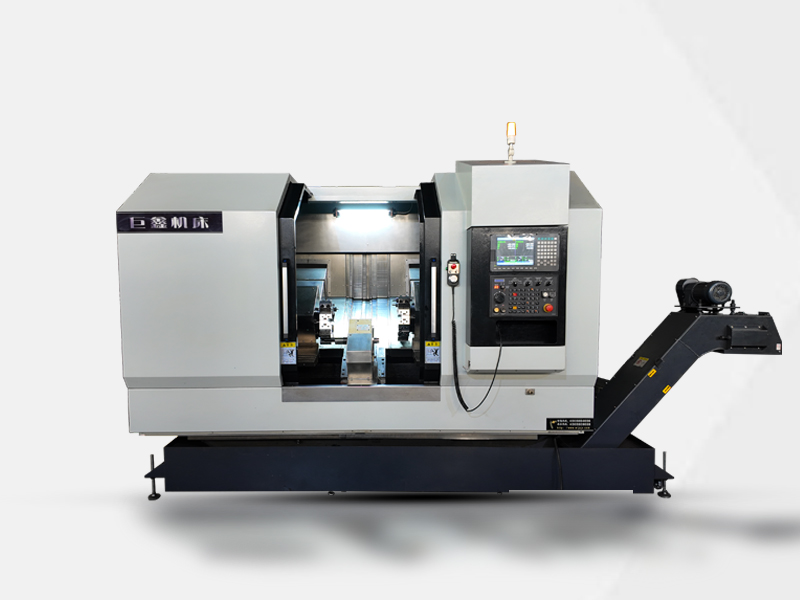
The JXS72 Middle Drive Double-head CNC Lathe is a Double End Simultaneous Turning Lathe with a processing diameter range of 15–180 mm and a processing length range of 40–800 mm. It uses an integral bed and high-strength cast iron structure, with ultra-low temperature cryogenic heat treatment and stress relief aging. The spindle is made of high-quality alloy structural steel, and the guide rails are hardened and scraped. In operation, the machine is intended to complete outer circle, inner hole, thread, end face, and center hole machining of both ends in one clamping. For motor shafts, electric vehicle wheels, half shafts, small shaft sleeves, and precision pin shafts, this reduces the precision errors associated with secondary clamping and workpiece turning.
Twin-spindle CNC vertical lathes
Vertical turning configurations for shafts and discs address gravity-related deformation in slender parts and provide a compact dual-station layout. The JXLC45-A Twin-Spindle CNC Vertical Lathe Machine for Shafts is a dual-position CNC vertical lathe machine with dual stations, dual spindles, dual systems, and dual tool towers. Its maximum shaft processing diameter is 345 mm and maximum shaft processing length is 1020 mm. The JXLC63D Twin-Spindle CNC Vertical Lathe Machine for Disks has a maximum processing diameter of 525 mm and maximum machining height of 400 mm. Both are documented for automotive parts, agricultural machinery parts, water pumps and motors, railway locomotive axles, construction machinery, transmission, gear, and new energy solar components.
| Model | Configuration | Key dimensions | Typical application focus |
|---|---|---|---|
| JXZ70-680 | End Facing and Centering Machine / CNC milling face end face drilling hole lathe machine | Diameter 14–500 mm; length 70–5000 mm | Face milling, center hole drilling, outer cylindrical turning, drilling & tapping, chamfering, boring, U-drilling |
| JXS72 | Middle Drive Double-head CNC Lathe / Double End Simultaneous Turning Lathe | Diameter 15–180 mm; length 40–800 mm | Both-end outer circle, inner hole, thread, end face, center hole in one clamping |
| JXLC45-A | Twin-Spindle CNC Vertical Lathe Machine for Shafts | Max shaft diameter 345 mm; max length 1020 mm | Dual-station vertical turning for shafts |
| JXLC63D | Twin-Spindle CNC Vertical Lathe Machine for Disks | Max diameter 525 mm; max height 400 mm | Dual-station vertical turning for disks |
What the manufacturer data shows
Juxin Machine Tool Co., Ltd. was established in 2005 and specializes in the design and manufacturing of high-end CNC machine tools, including specialized CNC machine tools for shaft and disc parts. The facility at No.52-1, Jintang North Road, Eastern New District, Wenling, Zhejiang, China covers 10,666 m² and employs approximately 80 staff. Annual production capacity is documented at 2,000 sets. The R&D team consists of 10 engineers, and the company holds more than 50 technological patents.
These are not isolated marketing metrics. For buyers, facility area, production capacity, and patent count are useful only when they connect to delivery consistency, repeatable assembly quality, and the ability to support non-standard machine configurations. In the case of JUXIN MACHINE TOOL, the product range covers CNC lathe machines, milling, facing, and centering machines for shafts, double-head CNC lathes, and double-spindle CNC vertical lathes. The company reports that its machines have been adopted by more than ten internationally renowned enterprises, with export business accounting for 10% of total sales and major markets covering global regions.
Where these machines are used in practice
Documented application scenarios include automotive disk and gear parts, motor housing and disk parts, engineering machinery disk parts, bearing accessories, gear shells, slender shafts, heavy-duty shaft parts, high-speed rail and aerospace precision disk parts, brake discs, and rotor press-fit processing. Facing and centering machines are referenced for motor shafts, crankshafts, gears, and slender shafts in automobile OEM and auto parts manufacturing. Double-head CNC lathes are referenced for motor shafts, electric vehicle wheels, elevator traction wheels, fan parts, half shafts, solar energy accessories, brake discs, small shaft sleeves, precision pin shafts, and hardware fasteners.
Geographically, the application scenarios are listed across Germany, Russia, Vietnam, Thailand, Malaysia, Indonesia, Egypt, Saudi Arabia, Iran, Pakistan, Turkey, the United States, Brazil, Mexico, South Africa, Nigeria, Kazakhstan, Uzbekistan, Australia, and New Zealand. This does not mean every model is appropriate for every region; rather, it shows that the referenced machine categories are deployed in both high-cost and export-oriented manufacturing environments.
What the process economics suggest
The application data provided with these configurations includes several process-level figures. Vertical twin-spindle and double-head structures are documented as saving 70%–150% workshop space, reducing labor by 50%–80%, improving automation efficiency by 40%–120%, and cutting production cost by more than 50%. Multi-machine online arrangements can allow one robot to control 2–3 production lines with man-machine separation. These figures are process-level and depend on batch size, workpiece mix, fixture design, and line configuration.
Precision ranges are also specified. For vertical spindle applications, the documented capability includes spindle radial runout of 0.003–0.005 mm, workpiece roundness of 0.003–0.005 mm, and end face flatness of 0.006–0.01 mm. For end facing and centering operations, repeat positioning accuracy is documented at 0.008–0.012 mm, with length and center hole depth consistency at both ends of ±0.05 mm, customizable to ±0.02 mm. These numbers are reference values, not guarantees across every workpiece material or setup.
Market context for CNC lathe machine procurement
Industry estimates show the global CNC machine market was valued at about USD 73.5 billion in 2024 and is forecast to reach USD 187.2 billion by 2034, although another market estimate places the 2024 figure at USD 83.67 billion. The variation is a useful reminder that market size numbers should be treated as directional rather than exact. CNC lathe machines held approximately 30% to 32.82% share of the CNC market in 2024, while Asia-Pacific accounted for about 37% of global revenue, valued at USD 27.2 billion.
For machine tool buyers, the more relevant trend is specialization. The presence of configurations such as CNC vertical turning lathes, dual-spindle turning lathes, double-end facing centering machines, and multi-spindle CNC lathes reflects a broader shift toward combining operations and reducing part handling. This is especially visible in automotive parts, which account for a significant share of modern CNC lathe application. Industry sources note that modern CNC lathes used in automotive applications can achieve tolerances as tight as ±0.004 mm.
Procurement teams should also treat safety and machine standards as part of the technical filter. CNC lathe safety requirements are governed internationally by ISO 23125-1 for turning machines and ANSI B11.6-2022 for manual/automatic control turning machines. These standards do not replace supplier audits, but they create a minimum baseline for guarding, control reliability, and operational safety.
Compared with general-purpose turning: advantages and boundaries
A traditional lathe machine with manual or basic CNC control may be adequate for low-volume or highly variable work. It generally requires less initial integration and can be easier to relocate. However, it typically requires secondary clamping, longer changeover, and separate machines for facing, centering, and turning, which increases material handling and process variance.
Process-specific CNC lathe configurations consolidate operations, but they also carry boundaries. The documented working conditions show that heavy-duty vertical lathes require special foundations and qualified floor load-bearing. Heavy-duty end facing and centering models require workshop floor load-bearing, foundation pouring, and matched power distribution. These are not plug-and-play units for every workshop.
Dual-spindle and double-head machines are also most compelling in repeat batch or production environments. A low-volume job shop with extreme variety may benefit less from a fixed two-station configuration than from flexible stand-alone turning centers. Buyers should evaluate fixture changeover, batch size, and part family before choosing a specialized layout. In other words, the right machine is not the one with the most functions, but the one whose process logic matches the dominant work mix.
Future direction: integrated turning, automation, and mixed production
The evidence points to closer links between CNC lathe machines and automated material handling. Supported configurations in the reference data include articulated robots, material warehouses, loading/unloading stations, servo programmable tailstocks, power turrets, 8/12-station tool magazines, CMM coordinate measuring instruments, centralized grease lubrication, automatic chip conveyors, and constant temperature cooling systems.
Control system choice is also becoming an integration decision. The documented options include KND, GSK, Huazhong, Siemens, Fanuc, Syntec, and Juxin self-developed systems. The availability of optional control systems means that machine selection is no longer only about spindle power or swing diameter; it also involves MES compatibility, in-machine detection, tool compensation, and maintenance support.
For shaft and disc part manufacturers, the likely next step is not simply replacing a lathe machine, but rethinking the production cell: whether a robot can serve multiple machines, whether front and back machining can be completed without flipping the part, and whether turning, milling, drilling, and grinding can be consolidated around a single part datum.
FAQ: CNC lathe machine selection questions
What is a CNC lathe machine?
A CNC lathe machine is a computer-controlled turning machine that removes material from a rotating workpiece. It can perform turning, facing, grooving, drilling, threading, and other operations according to a programmed path. In shaft and disc production, CNC control enables repeatable positioning and reduces dependence on manual adjustment.
What is the difference between a vertical CNC lathe machine and a horizontal lathe?
A vertical CNC lathe machine holds the workpiece on a vertical spindle, so the workpiece weight is supported by the table rather than suspended horizontally. This can help manage deformation and vibration in heavier discs, short shafts, and large-diameter parts. Horizontal lathes remain common for long shafts and bar work. The choice depends on part geometry, floor load-bearing, and automation layout.
When should a buyer consider a twin-spindle or double-head CNC lathe machine?
A twin-spindle CNC lathe machine or double-head CNC lathe is usually considered when a workshop produces repeat batches of shafts or discs that require machining on two ends or two faces. Because the machine can complete front and back operations without secondary clamping, it may reduce handling and improve process consistency. It is less suitable for very low-volume or unpredictable part mixes.
What should buyers check before purchasing an end facing and centering machine?
Buyers should compare the machining diameter and length range, bed casting and guideway rigidity, automation interface, and whether the machine can perform the required secondary processes such as drilling, tapping, or U-drilling. They should also check foundation requirements, control system options, and after-sales support.
Which industries are common users of process-specific CNC lathe machines?
Documented applications include automotive parts, agricultural machinery, water pumps and motors, railway axles, construction machinery, transmission and gear production, and new energy solar components. These industries often produce shafts, discs, gears, housings, and rotating parts in repeat batches, which suits process-oriented machine configurations.
What limitations should be evaluated?
Not every workshop is prepared for a process-specific CNC lathe machine. Some models require special foundations and qualified floor load-bearing. Dual-spindle and double-head configurations generally make most sense for batch production rather than one-off work. Buyers should also confirm control system availability, local service, and whether the part family can be processed within the machine’s stated diameter and length ranges.
Reference material: JUXIN MACHINE TOOL product brochure is available for technical evaluation: Download brochure (PDF). Company website: en.wljxjc.com.