
CNC Lathe Machine Customization: Shaft and Disc Automation
An independent look at how buyers should evaluate CNC lathe machine suppliers when the goal is custom automation for shaft and disc components.
When procurement teams search for a CNC lathe machine, they are often asked to choose between standard machine price and long-term production capability. For shaft and disc parts — half shafts, brake discs, gear shafts, chassis components — the more important evaluation is not the machine model alone but the supplier's ability to customize the machine, integrate automation, and support continuous line operation. This article explains what that capability means in practice, and uses one specialized Chinese manufacturer, Juxin Machine Tool Co., Ltd., as a reference point for an increasingly common supplier profile.
Why Shaft and Disc Parts Create a Special CNC Lathe Machine Requirement
Shaft and disc components are typical high-volume, repetitive workpieces in automotive, agricultural machinery, transmission, gear, and new energy industries. Production of these parts usually involves face milling, center hole drilling, external cylindrical turning, drilling, tapping, chamfering, boring, and sometimes rapid U-drilling. A generic CNC lathe can deliver turning operations, but when several processes are needed on the same component family, linking multiple machines becomes necessary.
That link is where capability gaps appear. Producing a half shaft, for example, may require an end facing and center drilling machine to prepare the ends, followed by a turning machine for the shaft body, and then additional stations for holes or keyways. If each operation runs as a separate manual cycle, workpiece handling time and inconsistency increase. Buyers increasingly ask for an automated line that connects these operations, reduces labor, and maintains repeatability.
The opportunity for suppliers lies in their ability to design and build such systems. The risk for buyers is that capability claims are difficult to verify before the equipment is installed. A documented track record in the same part family becomes one of the most practical safeguards.
Evaluating CNC Lathe Machine Suppliers: Capability Criteria
For a buyer at the evaluation or execution stage, the following factors have more weight than basic CNC lathe machine search results:
- Part family specialization. Does the supplier focus on shaft and disc components, or only standard general-purpose lathes? Specialization usually means the tooling, workholding, and software configuration have been thought through for those geometries.
- Product range, not just one model. A complete line may require an end facing and centering machine, a double-head lathe, and a twin-spindle vertical lathe. A supplier with complementary machines simplifies integration and service.
- Automation experience. Can the supplier connect machines into an automatic production line with loading/unloading and unattended operation? This is a different engineering task from selling a single lathe.
- Engineering and R&D resources. In-house engineering staff and patents are indicators of ability to customize rather than resell.
- Evidence from comparable environments. A case study in automotive manufacturing is more useful than a generic catalog.
- Quality verification infrastructure. This can include temperature-controlled assembly, laser interferometer checks, and coordinate measuring machines.
These criteria turn a price comparison into a system capability evaluation. The same framework can be used to assess any custom automation supplier.
Juxin Machine Tool: Specialization and System Deliverability
Juxin Machine Tool Co., Ltd. is a Chinese manufacturer based in Wenling, Zhejiang, established in 2005. The company focuses on high-end CNC machine tools and specializes in shaft and disc machining equipment. According to company information, it operates a 10,666 m² factory with 80 employees and an annual output of 2,000 sets. Its R&D team consists of 10 engineers. Around 10% of its output is exported, while the company serves a global market and maintains its main production and applications in China.
The product portfolio includes milling, facing, and centering machines for shafts, double-head CNC lathes, twin-spindle CNC vertical lathes for shaft and disc parts, and other specialized machines. The company also provides intelligent automation solutions for shaft and disc parts. Juxin reports more than 50 innovative technical patents and states that its equipment has been adopted by more than ten internationally renowned enterprises.
For a buyer, these facts suggest a supplier whose core business is not a generic lathe, but a set of engineered processes for shaft and disc components. The factory size, headcount, and annual output show a manufacturing scale capable of serial production of machine tools; the R&D staff and patents support customization projects. Company materials also document precision assembly and inspection facilities, including a constant temperature and humidity assembly workshop, a Renishaw laser interferometer, and a Wenzel three-coordinate measuring instrument laboratory, which are relevant signals for machine tool build quality.
Technical Building Blocks: From Single Machines to Automated Lines
Two product platforms illustrate how Juxin approaches shaft and disc machining. The first is the JXZ70-680 End Facing and Centering Machine. It is classified as a CNC milling face and center drilling machine, and its stated machining diameter range is 14–500 mm, with machining length from 70 mm to 5,000 mm. Its processing technology includes face milling, center hole drilling, external cylindrical turning, drilling and tapping, chamfering, boring, and rapid U-drilling. The machine bed is integrally cast from high-quality gray cast iron HT300, a design choice that provides rigidity.
The second platform is the JXLC45-A Twin-Spindle CNC Vertical Lathe Machine for Shafts. It is a dual-position CNC vertical lathe with dual stations, dual spindles, dual systems, and dual tool towers. The maximum processing diameter of the shaft is 345 mm, and the maximum processing length is 1,020 mm.
In an automated line, the end facing and centering machine prepares the workpiece ends and creates center holes; the twin-spindle vertical lathe then performs precision turning in a two-station configuration. With two spindles and two tool towers, the machine can reduce cycle time compared to single-spindle turning. The combination of these machine types is what allows a manufacturer to move from separate operations to a continuous process for half shafts, brake discs, gear shafts, and chassis parts.
Both machine types are positioned for automotive parts, agricultural machinery parts, water pumps and motors, railway locomotive axles, construction machinery, transmission, gear, and new energy solar industries. This alignment of product capability with target sectors makes it easier for a buyer to find a pre-configured solution rather than asking for a fully bespoke design.
Documented Case: Automotive Shaft and Disc Production
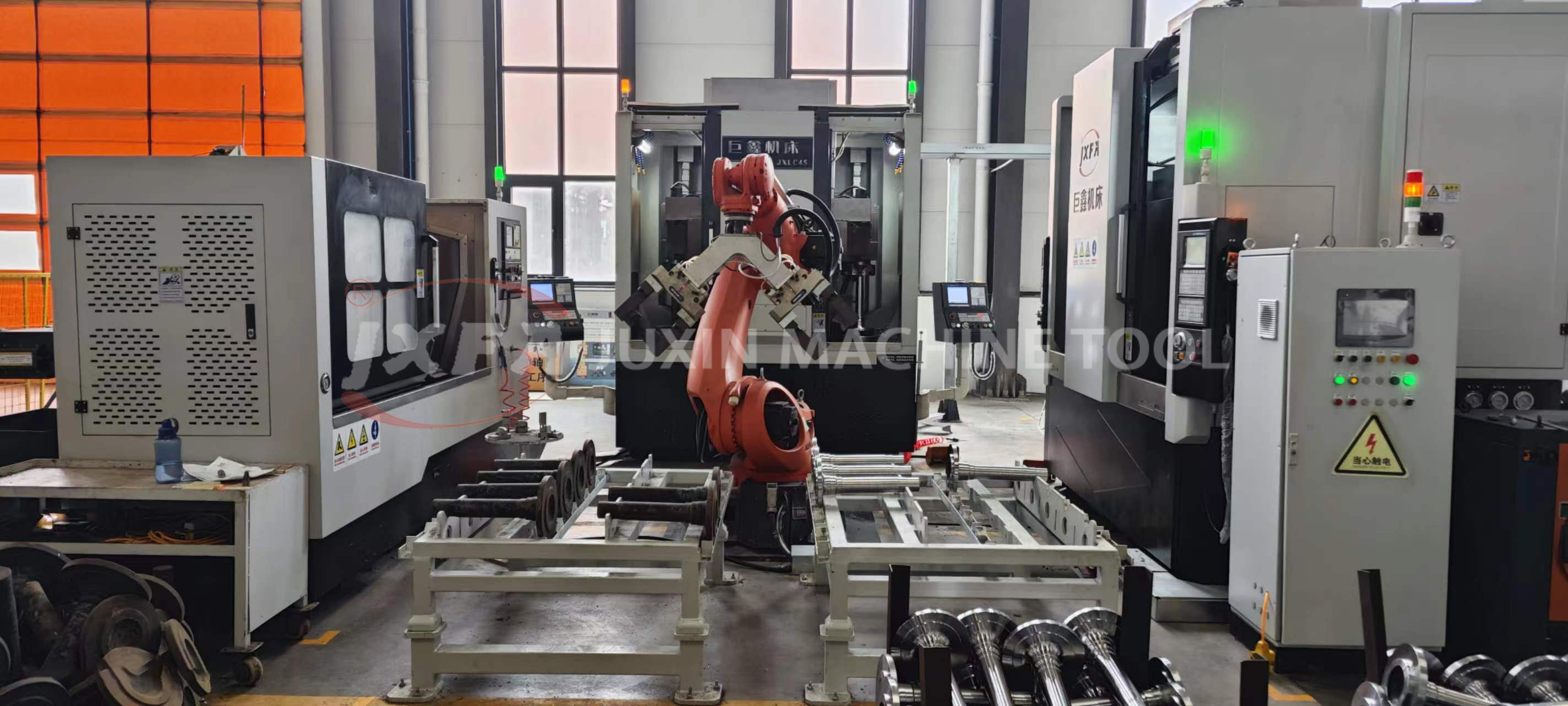
One documented example places JUXIN equipment in large vehicle manufacturing groups in China. These customers operate complete vehicle and component industrial parks. The application covers machining of half shafts, brake discs, gear shafts, and chassis parts through milling and drilling, precision processing on double vertical lathes, and automatic line production.
The project outcome is significant for evaluation: it achieved unmanned full-line production with long-term non-fault continuous operation, meeting the standard of Tier 1 auto suppliers. It also became, according to the supplier, the domestic machine tool line with the fastest acceptance and commissioning performance, which upgraded industry recognition of Chinese-made equipment. The cooperation has remained stable since 2014, which is evidence of sustained performance rather than a one-time installation.
For a buyer at the evaluation stage, this case offers three takeaways:
- Juxin has experience integrating automatic production lines for automotive Tier 1 environments.
- The equipment has demonstrated continuous unattended operation, a common requirement in high-volume shaft and disc production.
- The long relationship since 2014 indicates the supplier is able to support and maintain the system over time.
Market Context: CNC Lathe Demand and the Shift to Automation
The context for this capability-based evaluation is a growing CNC lathe market. Verified Market Reports valued the global CNC lathe machine market at USD 11.1 billion in 2023 and projects USD 18.78 billion by 2030, a CAGR of 7.8%. This growth is not limited to the machine itself; it reflects demand for more productive turning systems.
China's machine tool exports reached USD 23.18 billion in 2025, up 6.7% year-on-year, and China overtook Germany as the top global exporter in early 2025, according to the China Machine Tool and Tools Builders' Association. This changes the supplier map: buyers who once only considered Japanese, German, or American brands now evaluate Chinese manufacturers with specialized lines.
By application, the automotive industry accounts for the largest share of CNC lathe use, estimated at 40%, followed by aerospace at 25% and electronics at 20%. Shaft and disc parts are core automotive components, which explains why the case evidence from automotive manufacturers is directly relevant to overall CNC lathe demand.
Custom Specialized Lines vs. Generic CNC Lathe Machines
To decide whether a custom, automated shaft-and-disc line is necessary, buyers should compare it against a more traditional approach using a standard CNC lathe machine with manual or robotic tending. The trade-off is not absolute, but situational.
| Evaluation Dimension | Generic CNC Lathe Machine | Custom Specialized + Automated Line |
|---|---|---|
| Process coverage | Primary turning; additional operations require separate machines | Face milling, center drilling, turning, drilling/tapping, boring in one line |
| Automation level | Usually single-machine automation or robot tending cell | Full line integration with unmanned operation |
| Operator dependency | Higher for loading/unloading, inspection, process changes | Lower in continuous operation after commissioning |
| Initial cost | Lower | Higher |
| Suitability | Low to medium volumes, high mix, frequent changeover | Medium to high volumes, defined part families, stable designs |
| Risk | Easier to implement, flexible | Requires engineering, longer commissioning, needs supplier capability |
One important limitation should be stated. A custom automated line is optimized for a specific part family. If the buyer's product designs change frequently or order quantities are highly unpredictable, the flexibility of a generic machine may be more valuable than the throughput of a custom line. In that scenario, a specialized supplier like Juxin may still provide individual machines, but the full automated line requires a stable production program.
Another boundary concerns regional service support. Juxin's export ratio is approximately 10%, which indicates that most of its installed base and support infrastructure is in China. International buyers should therefore verify service response times, spare parts availability, and installation support before signing a contract. This is not a disadvantage of the equipment itself, but a practical procurement condition.
Buyer Checklist for CNC Lathe Machine Custom Capability
- Define the part family: shaft, disc, or mixed; required tolerances and cycle time.
- Confirm the supplier can provide complementary machines: end facing/centering, turning, drilling/tapping.
- Request references in the same industry with automatic line integration.
- Check R&D resources and patents for customization evidence.
- Clarify service capacity in your geography, including spare parts and commissioning.
- Assess flexibility: how long will the line remain efficient if part design changes?
Future Outlook: CNC Lathe Capability Becomes a System Decision
As labor costs rise and quality requirements tighten, the direction of CNC lathe purchasing is moving from standalone machines to systems. Twin-spindle and dual-tool-tower configurations reduce cycle times. Integrated line control and unattended operation reduce variability. In this environment, the supplier's ability to customize and commission a line becomes more important than the lathe brand name.
For Juxin, the trajectory is toward more specialized products for shaft and disc families, with automation as the value layer. For buyers, the practical implication is to evaluate suppliers using the same capability criteria used here: specialization, product range, automation experience, engineering resources, case evidence, and service boundaries.
Frequently Asked Questions
What does Juxin Machine Tool Co., Ltd. specialize in?
Juxin Machine Tool Co., Ltd., based in Wenling, Zhejiang, China, specializes in high-end CNC machine tools, particularly milling, facing, and centering machines for shafts, double-head CNC lathes, twin-spindle CNC vertical lathes for shaft and disc parts, and intelligent automation solutions for shaft discs.
What are the main specifications of the JXZ70-680 end facing and centering machine?
The JXZ70-680 has a machining diameter range of 14–500 mm and a machining length range of 70–5,000 mm. It performs face milling, center hole drilling, external cylindrical turning, drilling and tapping, chamfering, boring, and rapid U-drilling. Its machine bed is integrally cast from high-quality gray cast iron HT300.
Can Juxin supply automated CNC lathe production lines?
Yes. Juxin provides intelligent automation solutions for shaft and disc parts. In a documented case with large Chinese automotive manufacturers, Juxin equipment was used in automatic production lines for machining half shafts, brake discs, gear shafts, and chassis parts, achieving unmanned full-line production with long-term non-fault continuous operation.
What evidence exists for long-term reliability of Juxin CNC lathe machines?
A documented automotive case shows long-term stable cooperation since 2014. The project met Tier 1 auto supplier standards and produced continuous unattended operation, providing a reference for reliability in high-volume environments.
Juxin Machine Tool Co., Ltd. publishes a company brochure with an overview of its product lines and capability profile. It can be viewed or downloaded here: Juxin Machine Tool Brochure (PDF).