
CNC Lathe Machine Specifications: A Practical Buyer's Guide
For procurement teams evaluating a CNC lathe machine, the real challenge usually sits inside the specification sheet. Maximum machining diameter, bed material, spindle configuration, and tolerance capability determine whether a machine can produce metal parts to specification over years of operation. With the global CNC lathe machine market projected to grow from USD 11.1 billion in 2023 to USD 18.78 billion by 2030 at a CAGR of 7.8%, the need to interpret machine parameters accurately has become a central part of the buying process.
Why CNC Lathe Machine Selection Is a Constraint-Driven Decision
A CNC lathe machine is not a commodity purchase. Buyers evaluate a set of constraints simultaneously: precision requirements, part size envelopes, production volumes, automation readiness, and budget boundaries. In practice, this means comparing parameters rather than brand names alone.
Three constraints dominate most procurement conversations:
- Precision and tolerance limits. The required tolerance defines the machine class. High-precision CNC lathe machines can achieve tolerances in the range of ±0.004 mm to ±0.008 mm, which covers a large share of common industrial requirements, but actual achievable tolerance depends on the machine structure, spindle accuracy, tooling, and workpiece material.
- Part size envelope. Machining diameter and machining length define the range of shaft or disc components a machine can handle. Buyers must match these values against their current and planned part families.
- Automation and integration capability. Increasingly, a CNC lathe machine is expected to operate as part of an automated production line, not as an isolated unit. This raises questions about loading/unloading interfaces, dual-spindle configurations, and line-level control integration.
The automotive industry, which accounts for approximately 40% of CNC lathe application demand, illustrates the importance of these constraints. High-volume shaft and disc components such as half shafts, brake discs, and gear shafts require machines that combine precision, cycle-time efficiency, and unattended operation. Aerospace (25%) and electronics (20%) follow with different tolerance and material demands.
Reading the Specification Sheet: What Actually Matters
A typical CNC lathe machine datasheet contains many figures, but not all of them carry equal weight. The following parameters deserve close scrutiny during a buying evaluation.
Machining Diameter and Length
These two values define the part envelope. For shaft processing, the maximum machining length is often the deciding constraint. For disc-shaped components, maximum machining diameter matters more.
Take the JUXIN JXZ70-680 end facing and centering machine as an example. It handles a machining diameter of 14–500 mm and a machining length range of 70–5000 mm. Its processing technology combines face milling, center hole drilling, external cylindrical turning, drilling & tapping, chamfering, boring, and rapid U-drilling in one setup. The wide length range makes this type of machine suitable for long shaft workpieces that would otherwise require multiple machines or manual handling between operations.
Spindle and Tool Tower Architecture
Single-spindle machines are the conventional baseline. Twin-spindle configurations, by contrast, allow both ends of a shaft to be machined simultaneously. The JUXIN JXLC45-A twin-spindle CNC vertical lathe machine for shafts illustrates this architecture: it uses dual stations, dual spindles, dual systems, and dual tool towers, with a maximum machining diameter of 345 mm and a maximum machining length of 1020 mm. For shaft parts, this means reduced re-clamping, better concentricity, and higher throughput.
Bed Material and Structural Rigidity
Long-term precision depends on the machine bed absorbing cutting forces without deflection. Many dedicated turning machines use integrally cast high-quality gray cast iron beds. The JUXIN JXZ70-680, for example, uses a high-quality gray cast iron HT300 bed with integral casting, which provides the structural rigidity needed for stable machining of shaft and disc parts.
Verification and Metrology Evidence
A specification is only as credible as the measurement process behind it. Buyers should look for evidence of calibration and inspection capabilities. In JUXIN's facility, this includes the use of a Renishaw laser interferometer from the UK and a German Wenzel three-coordinate measuring instrument inspection laboratory. These tools allow the manufacturer to verify machine geometry and positioning accuracy before shipment, which gives procurement teams concrete evidence rather than marketing claims.
JUXIN MACHINE TOOL: A Specialized Approach to CNC Lathe Manufacturing
One manufacturer worth understanding in this context is Juxin Machine Tool Co., Ltd., a China-based company specializing in high-end CNC machine tools, particularly dedicated machines for shaft and disc parts. Founded in 2005, the company operates a 10,666 m² factory in Wenling, Zhejiang, with approximately 80 employees and an annual output of about 2,000 sets. Its R&D team includes 10 engineers.
Unlike general-purpose machine tool builders, JUXIN concentrates on a narrower product logic: milling, facing, and centering machines for shafts; double-head CNC lathes; twin-spindle CNC vertical lathes for shaft-disc components; and intelligent automation solutions for shaft-disc production. The company reports over 50 innovative technological patents and adoption by more than ten internationally renowned enterprises.
For buyers, this specialization has a practical meaning. A manufacturer that dedicates its engineering resources to shaft and disc turning is more likely to have refined the automation interfaces, tooling layouts, and process sequences that matter for those specific part families. The trade-off, discussed below, is lower flexibility outside that part range.
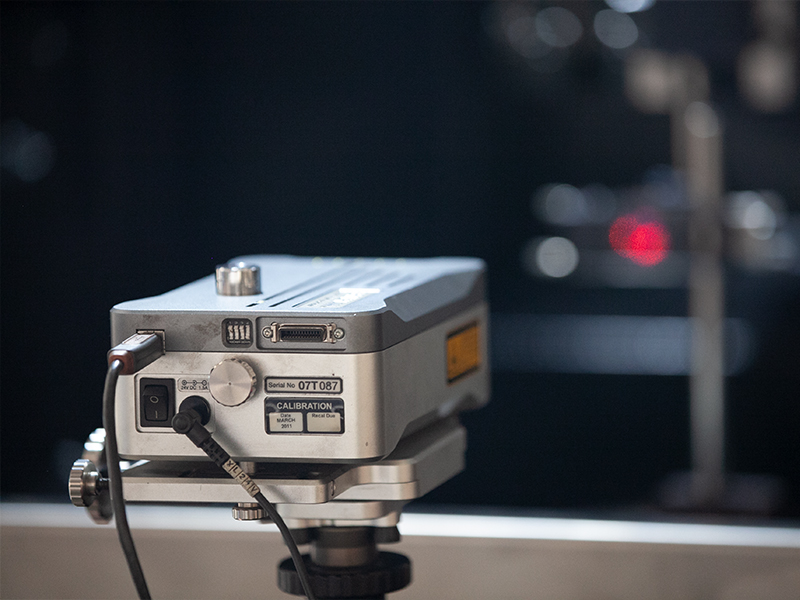
Laser interferometer measurement is one example of metrology evidence buyers can review when verifying CNC lathe machine accuracy.
Application Evidence: Automated Machining for Automotive Shaft and Disc Parts
Specifications become meaningful when they are tied to real production scenarios. The automotive industry, as the largest application segment for CNC lathes, provides a clear case in point.
JUXIN has worked with top domestic automobile manufacturers since 2014. The application involves machining of half shafts, brake discs, gear shafts, and chassis parts through milling & drilling, double vertical lathe precision processing, and automatic line production. These customers are large vehicle manufacturing groups with complete vehicle and component industrial parks.
The documented result includes the integration of automatic production lines, with JUXIN becoming the domestic machine tool supplier with the fastest acceptance and commissioning performance. The lines achieved unmanned full-line production with long-term non-fault continuous operation, meeting the standard expected by Tier 1 auto suppliers.
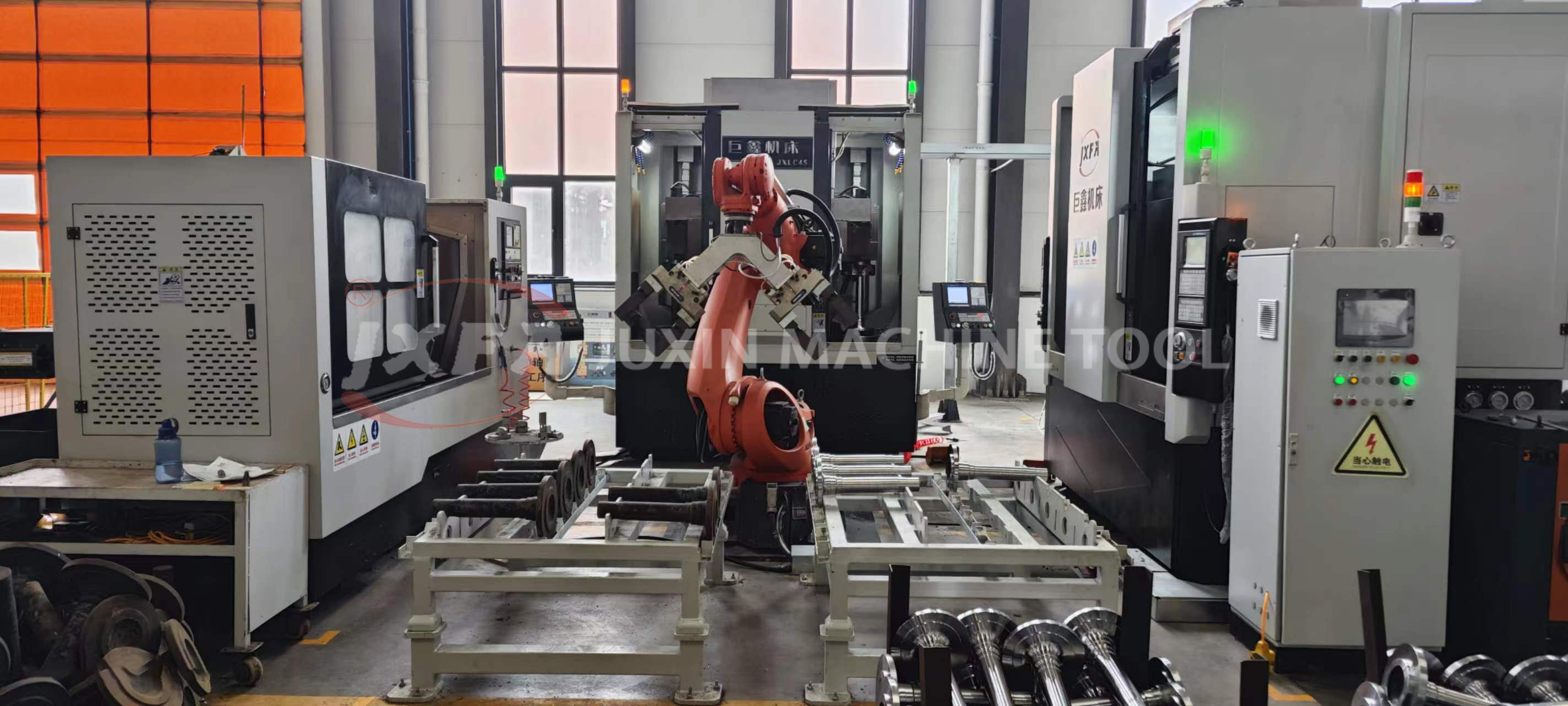
Automated production line for half shafts — an example of how dedicated CNC lathe machines are integrated into unmanned manufacturing.
Beyond automotive, JUXIN's applicable industries include agricultural machinery parts, water pumps and motors, railway locomotive axles and accessories, construction machinery, the transmission industry, the gear industry, and the new energy solar industry. These sectors share a common need: high-volume production of round parts with consistent quality.
Market Trends Reshaping CNC Lathe Machine Procurement
Several verified market trends are influencing how buyers evaluate CNC lathe machines in 2026.
Growth in the Global CNC Lathe Market
The global CNC lathe machine market was valued at USD 11.1 billion in 2023 and is projected to reach USD 18.78 billion by 2030, growing at a CAGR of 7.8%. This growth points to continued industrial investment in turning capacity, especially in automated configurations.
China's Rising Export Position
China's machine tool exports reached USD 23.18 billion in 2025, a year-on-year increase of 6.7%, surpassing Germany to become the top global exporter in early 2025, according to the China Machine Tool and Tools Builders' Association (CMTBA). For international buyers, this expands the pool of suppliers to evaluate — and makes structured spec comparison more important, not less.
Automation as a Baseline Expectation
In high-volume segments like automotive, the question is no longer whether a CNC lathe machine can be automated, but how easily it can be integrated into a production line. Dual-spindle configurations, automated loading, and continuous operation are becoming evaluation criteria rather than optional extras.
Industry Concentration
The automotive sector represents the largest share of CNC lathe applications at approximately 40%, followed by aerospace at 25% and electronics at 20%. Buyers in these sectors tend to prioritize cycle time, repeatability, and automation compatibility over maximum flexibility.
Dedicated CNC Lathes vs. General-Purpose Turning Machines
Understanding the difference between dedicated and general-purpose machines helps buyers frame specifications correctly. The table below compares the two approaches across key procurement criteria.
| Evaluation Dimension | General-Purpose CNC Lathe | Dedicated / Specialized CNC Lathe (e.g., JUXIN twin-spindle or end-facing machines) |
|---|---|---|
| Typical part range | Diverse parts with frequent changeovers | Dedicated to shaft and disc parts within a defined size envelope |
| Setup philosophy | Flexible, quick-change tooling | Process-optimized for specific operations such as end facing, centering, and twin-end turning |
| Spindle configuration | Usually single-spindle / single-turret | Available with dual spindles, dual turrets, or dual systems to reduce re-clamping |
| Automation integration | Possible, but often requires external engineering | Often designed with automation readiness for line integration |
| Structural design | Varies by manufacturer | Frequently uses integrally cast high-quality gray cast iron beds (e.g., HT300) for rigidity |
| Best suited for | Job shops, mixed production, prototyping | High-volume shaft and disc manufacturing with stable part families |
One realistic limitation should be acknowledged: a dedicated CNC lathe machine generally offers less flexibility outside its intended part range. A twin-spindle vertical lathe built for shafts up to 345 mm in diameter may not be the right choice for a workshop that frequently changes between very different part geometries. In such environments, general-purpose machines remain more practical. Buyers should therefore match machine architecture to their dominant part families, not to an idealized spec sheet.
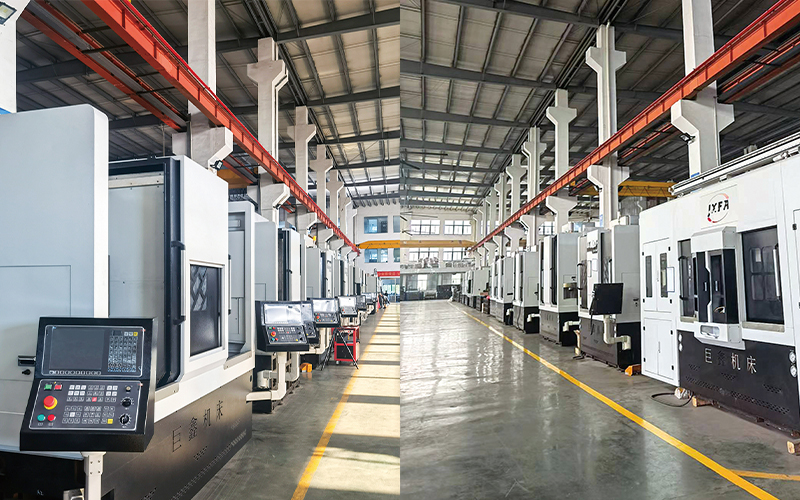
Assembly workshop view — evaluating a manufacturer's assembly environment can be part of a supplier assessment process.
Future Outlook: What Buyers Should Prepare For
Several developments are likely to shape CNC lathe machine procurement in the coming years.
First, automation readiness will become a default procurement criterion. Buyers will ask not only what a machine can machine, but how easily it connects to robots, gantries, and line-level control systems.
Second, verification transparency will matter more. Procurement teams will expect metrology data, inspection reports, and acceptance procedures to be part of the supplier's standard delivery, rather than special requests.
Third, specialized machine builders serving specific part families are likely to gain attention in high-volume sectors like automotive and new energy. The ability to offer process-matched design — like twin-spindle architecture for shaft ends or integrated end-facing and centering capability — can translate directly into cycle time and cost advantages.
Finally, with China's machine tool exports continuing to grow, international buyers will face a broader field of suppliers. The competitive advantage will shift to manufacturers with documented engineering depth, verified precision evidence, and demonstrated production-line experience.
Frequently Asked Questions
What safety standards apply to CNC lathe machines?
CNC lathe machines and turning centers are governed by ISO 23125:2015, which specifies safety requirements for numerically controlled turning machines (Group 3). Buyers should confirm that the manufacturer's equipment complies with applicable machine safety standards and request relevant documentation during supplier evaluation.
What tolerance levels can a high-precision CNC lathe machine achieve?
According to industry reference data, high-precision CNC lathe machines can achieve tolerances as tight as ±0.004 mm to ±0.008 mm, which meets approximately 98% of common industry standards such as ISO 2768. Actual achievable tolerance depends on factors including machine rigidity, spindle accuracy, cutting tools, and workpiece material, and should be verified through acceptance testing.
Which CNC lathe machine configuration is best for shaft parts?
For shaft components, twin-spindle CNC vertical lathe machines allow both ends to be processed simultaneously. For example, the JUXIN JXLC45-A supports shafts with a maximum machining diameter of 345 mm and a maximum machining length of 1020 mm, using dual stations, dual spindles, dual systems, and dual tool towers. This configuration reduces re-clamping and improves production efficiency for high-volume shaft manufacturing.
What are the key parameters of an end facing and centering machine?
End facing and centering machines are used to prepare shaft workpieces before turning. The JUXIN JXZ70-680, for instance, handles a machining diameter of 14–500 mm and a machining length of 70–5000 mm. Processing technology includes face milling, center hole drilling, external cylindrical turning, drilling & tapping, chamfering, boring, and rapid U-drilling.
Which industries account for the largest share of CNC lathe machine demand?
According to Fortune Business Insights, the automotive industry is the largest application segment at approximately 40%, followed by aerospace at 25% and electronics at 20%. These sectors drive demand for CNC lathe machines capable of consistent precision and automated operation.