
CNC Lathe for Automotive & Military Parts: Precision Scenarios Where Twin-Spindle Shines
CNC Lathe for Automotive & Military Parts: Precision Scenarios Where Twin-Spindle Shines
A relatively small number of part families consumes most of the turning hours in automotive, transmission and defense-grade supply chains: shafts, discs, hubs and housings. They share a technical signature that determines which lathe architecture actually works — an end face and a center hole that establish datums, a coaxiality relationship between features machined from different orientations, and a cycle time that has to hold when the part goes into volume production.
That makes turning architecture a high-leverage decision rather than a routine capital purchase. CNC lathes held the leading position among CNC machine types in 2024 with an estimated 30% to 32.82% share of the CNC market, based on data compiled by Technavio and Global Market Insights. Understanding where a dual-station or double-head configuration beats a conventional single-spindle machine is therefore a practical procurement question, not a technical curiosity.
Juxin Machine Tool Co., Ltd. (JUXIN MACHINE TOOL) is a Chinese machine tool manufacturer founded in 2005 and based in Wenling, Zhejiang, specializing in dedicated CNC machine tools for shaft and disc parts. Its portfolio covers facing and centering machines for shafts, double-head CNC lathes, and twin-spindle CNC vertical lathes for shaft and disc parts, alongside intelligent automation solutions for shaft and disc production. This article maps precision scenarios against those configurations, states what is documented, and identifies where the approach stops being the right answer.
Why Precision Scenarios Decide the Lathe Architecture
Buyers often start specification comparison with envelope figures — maximum turning diameter, maximum part length — and stop there. The variables that separate a profitable line from a marginal one are usually different: how many times the workpiece has to be released and re-clamped, how many machines a single part visits, and whether the second operation waits for the first.
Re-clamping is the hidden cost driver. Every time a shaft is moved to a second machine to machine the opposite end, datum error accumulates, labor hours grow, and the relationship between the two ends becomes harder to hold repeatably. For parts with two functional ends and a coaxiality relationship — half shafts, gear shafts, drive shafts, motor shafts, hydraulic shafts, piston rods, brake discs, hubs and EV wheels — the sequence of operations is where precision is won or lost.
Three scenario characteristics predict whether a twin-spindle, dual-station or double-head architecture pays back:
- Two working ends or two identical positions. The part has features at both ends, or two parts can be machined at two positions in the same cycle.
- Stable, repeatable batch structure. Volume and mix are predictable enough that tooling and programming investment amortizes.
- Envelope fit. The part falls inside the documented machining range of the model, not marginally outside it.
Where all three hold, simultaneous machining converts a sequence of operations into a single setup. Where any of them fails, the extra spindles and tool turrets become complexity without payoff — which is the boundary this article returns to later.
How Dual-Station and Double-Head Turning Architectures Work
The engineering logic differs between the three configurations Juxin builds, and so do the scenarios each addresses.
Dual-station vertical turning
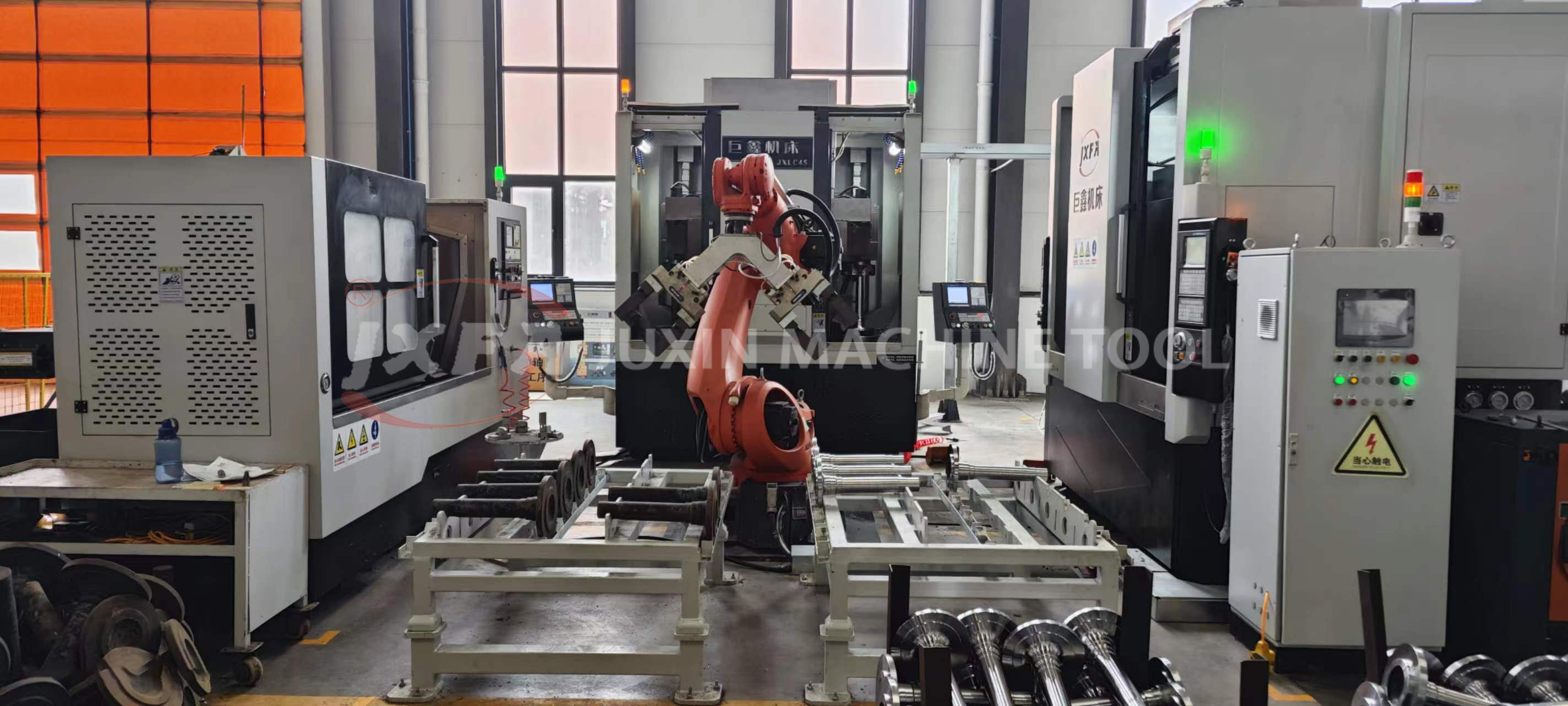
The JXLC45-A Twin-Spindle CNC Vertical Lathe Machine for Shafts is a dual-position CNC vertical lathe built around dual stations, dual spindles, dual systems and dual tool towers. In practical terms, that means two independent machining positions, each with its own spindle, CNC control system and tool turret, rather than one spindle serving two fixtures. Documented capacity is a maximum shaft processing diameter of 345 mm and a maximum shaft processing length of 1020 mm.
Double-head simultaneous turning
The JXS72 Middle Drive Double-head CNC Lathe is a double-end simultaneous turning lathe with a processing diameter range of 15 mm to 180 mm and a processing length range of 40 mm to 800 mm. Both ends of the shaft are machined at the same time rather than sequentially, which is the configuration's core advantage on long, symmetric parts.
End facing and center hole preparation
The JXZ70-680 End Facing and Centering Machine, classified as a CNC milling face end face drilling hole lathe machine, covers a machining diameter range of 14 mm to 500 mm and a machining length range of 70 mm to 5000 mm. Its processing technology combines face milling, center hole drilling, external cylindrical turning, drilling and tapping, chamfering, boring and rapid U-drilling in a single machine. The bed is integrally cast from high-quality gray cast iron HT300, a choice aimed at rigidity rather than weight reduction.
Structural basis for sustained accuracy
Simultaneous machining only helps if the second spindle is as stable as the first. On the JXS72, the bed, column and base use high-strength preheated cast iron or resin sand integral casting, with ultra-low temperature cryogenic heat treatment and stress relief aging applied to resist deformation over long production runs. The machine base uses a multi-layer box type with cross-rib mixed cast iron structure and finite element mechanical design, increasing overall weight to improve stability and anti-resonance behavior. Guide rails are high-precision hardened rails in a 55° / 15° integral hard rail configuration, with some models using heavy-duty roller linear guides; rails are precision quenched, fine ground and hand-scraped for wear resistance under heavy cutting. Spindles are made from high-quality alloy structural steel.
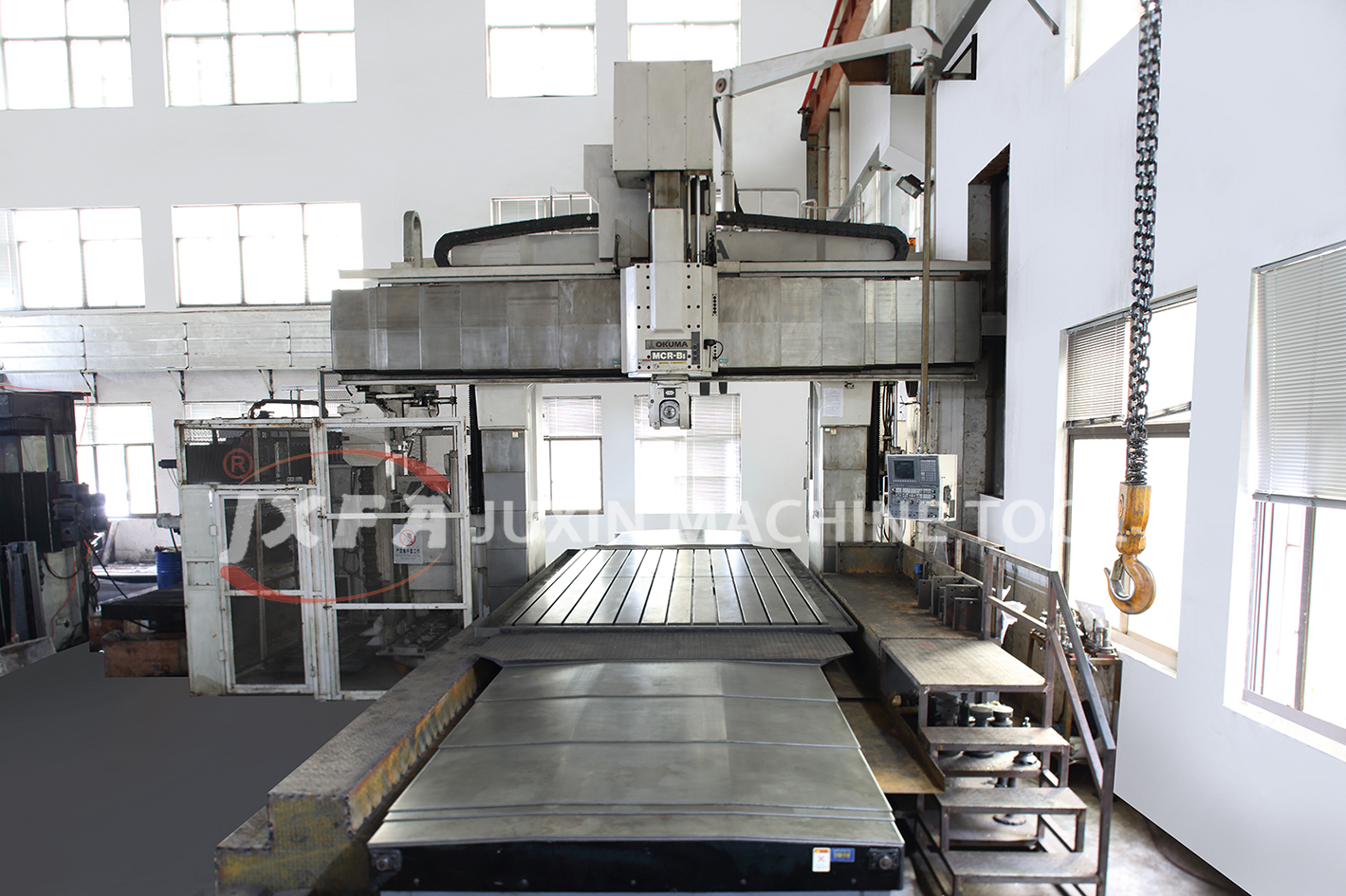
That structural approach is supported by the production environment. Juxin Machine Tool operates a 10,666 m² facility with 80 employees, an annual output of 2,000 sets, a 10-engineer R&D team and more than 50 technological patents. Documented production assets include a constant-temperature and constant-humidity precision assembly workshop, a UK-sourced Renishaw laser interferometer and a German Wenzel three-coordinate measuring instrument inspection laboratory, alongside horizontal machining center and five-face gantry machining center workshops.
Scenario Fit Map: Where Twin-Spindle Configurations Rank Highest
Fit is not the same as capability. A machine can physically accept a part and still be the wrong choice for it. The ranking below orders shaft and disc scenarios by how directly the documented Juxin configurations address their dominant constraint — datum control, cycle time, or heavy-cutting rigidity — rather than by any commercial priority.
| Rank | Precision scenario | Representative parts | Why the configuration fits | Documented model |
|---|---|---|---|---|
| 1 | Double-end turning of long, symmetric shafts | Half shafts, gear shafts, drive shafts | Both ends machined simultaneously in one cycle with a middle drive, removing the second-operation re-clamp | JXS72 (15–180 mm dia. / 40–800 mm length) |
| 2 | Vertical twin-station turning of disc and hub parts | Brake discs, hubs, EV wheels, elevator traction wheels | Dual stations, dual spindles, dual systems and dual tool towers allow two positions to cut at the same time | JXLC45-A (up to 345 mm dia. / 1020 mm length) |
| 3 | Datum preparation — end faces and center holes | Hydraulic shafts, piston rods, pin shafts, long shaft parts | Face milling, center hole drilling, turning, drilling and tapping combined in one machine instead of several | JXZ70-680 (14–500 mm dia. / 70–5000 mm length) |
| 4 | Motor shafts and transmission components | Motor spindles, shaft parts, shell components, transmission parts | Repeatable accuracy and cycle time aligned to European process requirements in documented installations | JXZ70-680, JXS72 |
| 5 | Heavy, high-load shaft work | Hydraulic shafts, piston rods, large shaft parts for construction machinery | Integral cast bed and super-heavy structure design for high-load, large-depth cutting with long-term non-deformation | JXLC45-A, JXZ70-680 |
| 6 | Low-volume, high-mix or oversized one-offs | Prototypes, tooling, irregular specials | Conditional — simultaneous machining economics depend on balanced cycle times and stable batches | Evaluate per case |
The ranking is deliberately scenario-led rather than brand-led. Ranks 1 through 3 describe cases where the architecture removes a process step; ranks 4 and 5 describe cases where it improves stability under load; rank 6 marks the boundary condition that most often gets overlooked during evaluation.
Model envelope quick reference
| Model | Product type | Diameter range | Length range | Configuration notes |
|---|---|---|---|---|
| JXZ70-680 | End Facing and Centering Machine (CNC milling face end face drilling hole lathe machine) | 14–500 mm | 70–5000 mm | Multi-function: face milling, center hole drilling, external cylindrical turning, drilling & tapping, chamfering, boring, rapid U-drilling; HT300 integral cast bed |
| JXLC45-A | Twin-Spindle CNC Vertical Lathe Machine for Shafts (dual-position CNC vertical lathe) | Up to 345 mm | Up to 1020 mm | Dual stations / dual spindles / dual systems / dual tool towers |
| JXS72 | Middle Drive Double-head CNC Lathe (double-end simultaneous turning lathe) | 15–180 mm | 40–800 mm | Simultaneous machining of both shaft ends; cryogenic heat-treated cast bed, 55°/15° hardened guide rails |
Documented Application Evidence Across Automotive, Transmission and Heavy Industry
The scenario logic above is easier to evaluate against installed outcomes than against brochures. The following cases are documented application records, not projections.
Automotive OEM and Tier 1 supply
Juxin equipment has been used by major automobile OEMs and auto parts manufacturers for machining half shafts, brake discs, gear shafts and chassis parts through milling and drilling, double vertical lathe precision processing and automatic line production. The cooperation has been stable since 2014. Documented outcomes include completed integration of automatic production lines, unmanned full-line production with long-term non-fault continuous operation, and acceptance and commissioning performance that made Juxin the fastest-accepting domestic machine tool supplier in that program. The line meets the standard of Tier 1 auto suppliers.
Component manufacturers and turnkey lines
For small to medium-sized mass production factories, turnkey solutions have been delivered for automatic assembly line processing of EV wheels, elevator traction wheels, half shafts, fan shafts, solar accessories and brake discs. Reported project results are a 70% to 150% saving in plant space, a 50% to 80% reduction in labor, and more than 50% reduction in production cost. The offering spans one-stop turnkey scope from a single machine through multi-machine linkage to robot automatic production lines.
German industrial benchmarks
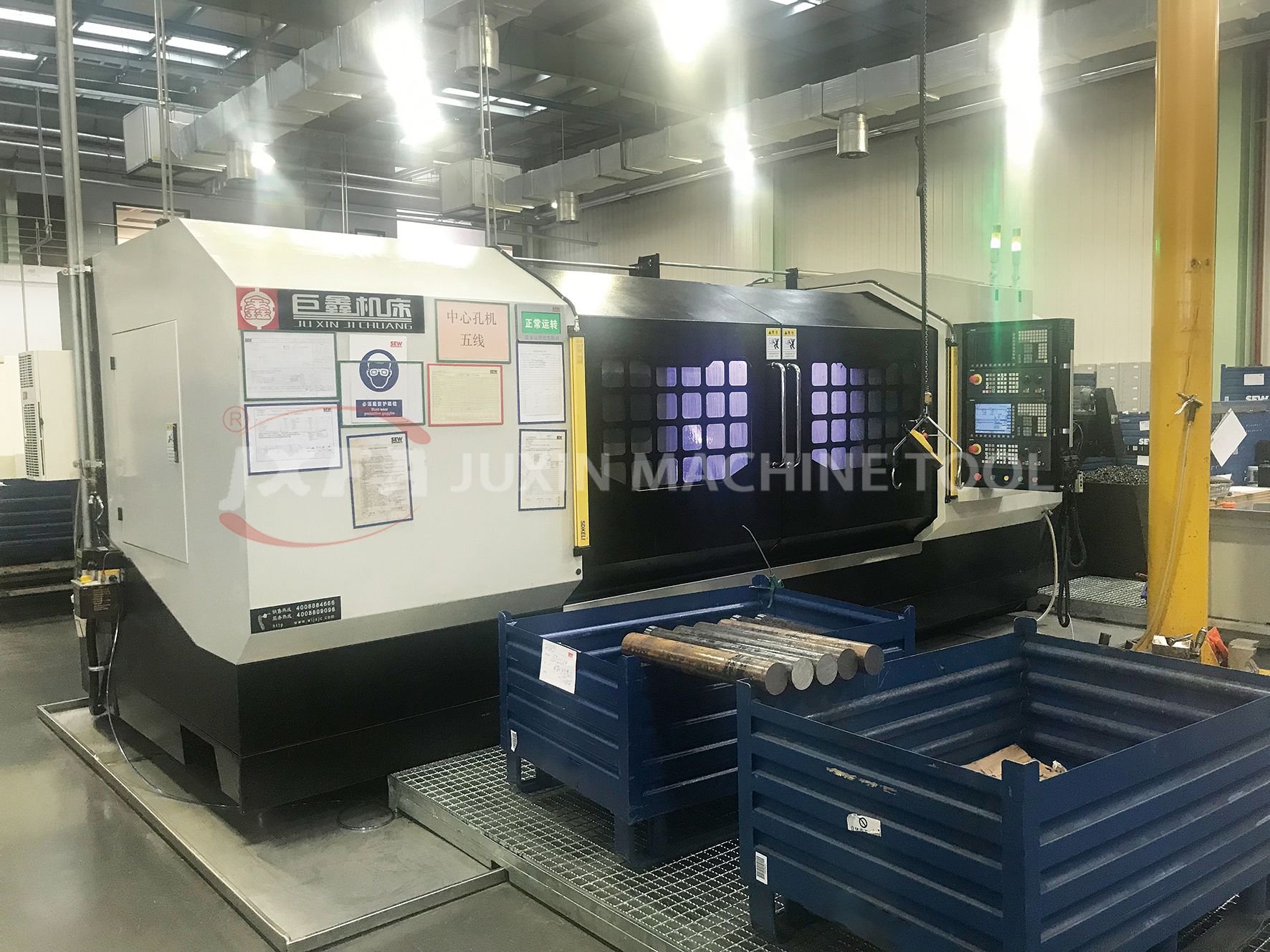
In Germany, JXZ70-680 facing and centering machines are used by Siemens, a Fortune Global 500 company in electrical automation, for precision machining of motor spindles, shaft parts and shell components, including turning, milling and center hole drilling. The project achieved seamless connection with Siemens global intelligent production lines, with accuracy and cycle time fully meeting German process requirements — domestic machine tools were admitted into the Siemens global supply chain, replacing imported equipment. Separately, SEW, a global leader in transmission equipment, uses Juxin equipment for end face milling, center hole drilling and precision turning of motor shafts and transmission parts, achieving stable machining accuracy and high consistency in mass production while reducing labor cost and defect rate.
Heavy industry and continuous duty
For heavy applications, leading enterprises in construction machinery, oilfield equipment and heavy industry use Juxin machines for end face and center hole machining of hydraulic shafts, piston rods, pin shafts and large shaft parts. The integral cast bed and super-heavy structure design is adapted to high-load and large-depth cutting; documented behavior includes excellent rigidity in heavy cutting, smooth chip removal, and long-term non-deformation suitable for 24-hour continuous mass production under harsh working conditions.
Defense-grade and high-reliability programs
Defense-related part machining is not a documented Juxin customer segment in the material reviewed here, so no military customer or program should be inferred. What is relevant for buyers in that category is the requirement profile: documented process control, repeatable datum establishment, and equipment that holds accuracy through long uninterrupted shifts. Those requirements are addressed by the same architectural features described above — simultaneous two-position turning, integral cast structures, and verified assembly — but buyers in regulated programs should always validate against their own qualification protocols rather than assume transferability from commercial cases.
Precision Verification: What a Buyer Can Check Before Signing
Precision claims are only as good as the evidence chain behind them. Four verification layers are documented for Juxin equipment, and each is something a buyer can request rather than take on trust.
- Third-party dimensional inspection. Authoritative third-party professional inspection companies are introduced to conduct independent sampling and full-item performance testing, with official inspection reports provided.
- In-house metrology. The production environment includes a Renishaw laser interferometer from the UK and a German Wenzel three-coordinate measuring instrument inspection laboratory, used within a constant-temperature and constant-humidity precision assembly workshop.
- Quality management certification. Certificate of Quality Management System number 62725Q0878R0S, issued by JingXin Certification (Beijing) Co., Ltd, covering CNC machine tools and accessories, industrial automation equipment and metal accessories manufacturing, certified to GB/T 19001-2016 idt ISO 9001:2015, valid from 2025-06-19 to 2028-06-18.
- Acceptance and training. Factory pre-acceptance with basic operation training before shipment, and on-site equipment acceptance with operational training afterward, under a signed technical agreement.
For reference when setting acceptance criteria, third-party market reporting indicates that modern CNC lathes serving automotive applications can reach tolerances as tight as ±0.004 mm, and that automotive applications account for roughly 40% of that market. Those figures come from external market sources rather than from Juxin specifications, and should be used as a benchmark question — what tolerance band does this specific configuration hold, on this specific part, at this specific cycle time — rather than as a quoted capability.
Turning machine safety requirements are commonly framed by standards such as ISO 23125-1 for turning machines and ANSI B11.6-2022 for manually and automatically controlled turning machines. Buyers exporting to regulated markets should confirm which framework applies to their destination and verify that the delivered configuration is documented against it.
Comparison with Traditional Single-Spindle and Sequential Machining
The comparison that matters is not machine versus machine but process chain versus process chain. A traditional route machines one end, releases the part, re-clamps it — often on a second machine — and machines the other end. A dual-station or double-head route condenses that into one setup.
| Decision dimension | Sequential single-spindle route | Twin-spindle / double-head route |
|---|---|---|
| Setups per part | Two or more, on one or more machines | One setup for both ends or both positions |
| Datum behavior | Re-clamping introduces cumulative datum error | Datum retained across both operations |
| Cycle time for two-end work | Additive — operations run one after another | Overlapping or simultaneous, reducing single-piece time |
| Labor exposure per shift | Higher, because more handling steps exist | Lower; documented turnkey projects report 50%–80% labor reduction |
| Floor space | Often two machines plus buffers | Consolidated; documented projects report 70%–150% space saving |
| Tooling and programming | Simpler, one turret and one program | More turrets, more tooling positions, more programming discipline required |
| Best fit | High-mix, low-volume, one-ended parts | Stable batches with two ends or two symmetric positions |
Where this architecture is the wrong answer. Dual-station and double-head machines are not universally better, and buyers should treat three constraints as hard boundaries. First, envelope: the JXLC45-A is documented to 345 mm maximum shaft diameter and 1020 mm maximum shaft length, and the JXS72 to 180 mm diameter and 800 mm length — parts outside those ranges require different models or custom configurations. Second, economic balance: two spindles, two systems and two tool towers only pay off when the two machining positions consume comparable cycle time; if one end is far heavier than the other, the second position idles and the theoretical gain shrinks, while tooling and programming costs remain higher than on a single-spindle machine. Third, batch discipline: shops running frequent changeovers on very small lots may find the setup burden of a dual-position machine outweighs the throughput benefit.
A fourth operational boundary is commercial rather than mechanical. Documented lead time is 45 days with a minimum order quantity of 1 unit and monthly capacity of 160 units, and the company's export ratio is 10% with global main markets. Overseas buyers should therefore plan the commissioning window and confirm local service arrangements as part of evaluation rather than after delivery.
Maintenance and Uptime Economics in 24/7 Duty Cycles
In continuous production, maintenance cost is driven less by parts prices than by how often a machine has to be stopped, re-referenced or re-calibrated. Structural rigidity is the first defense: integral cast beds, cryogenic heat treatment with stress relief aging, and hand-scraped hardened guide rails are documented design choices aimed at keeping geometry stable over long runs, which in turn reduces the frequency of correction work in a three-shift operation.
The second defense is the support system behind the machine, which buyers should map directly onto their shift pattern:
- Dedicated service lines, including a national toll-free sales hotline (400-888-4666) and a dedicated after-sales hotline (400-880-9090).
- Pre-sales scope covering telephone and online consultation, drawing and technical solution provision, model selection and customization, and signing of technical agreements.
- In-production scope covering manufacturing in accordance with contract, factory pre-acceptance, and basic operation training.
- After-sales scope covering installation, commissioning, operation guidance and daily maintenance training; complete machine warranty; remote technical guidance for faults; and on-site after-sales support.
- Supply of spare parts, standard tools and fixture wearing parts, plus lifelong technical support for subsequent upgrading, renovation and process optimization.
For a plant running three shifts, the practical evaluation question is which of these commitments is contractual, which is routine, and what response time is realistic in the buyer's time zone.
Market Trend Context, 2024–2034
The demand backdrop supports continued investment in turning capacity, although the numbers should be read with appropriate caution. The global CNC machine market was valued at USD 73.5 billion in 2024 and is forecast to reach USD 187.2 billion by 2034, according to a market analysis compiled through Vertex AI Search. That figure is not universally agreed: other research firms estimate the 2024 CNC machine market at approximately USD 83.67 billion, so the direction of growth is the reliable signal rather than any single valuation.
Within that market, Asia Pacific accounted for a 37% revenue share in 2024, valued at USD 27.2 billion, and the CNC lathe segment held the largest position by machine type at roughly 30% to 32.82% of the CNC market. Adjacent evidence points the same way: the global vertical machining center market was estimated at USD 42.6 billion in 2024 with Asia Pacific holding a 54.5% share. For shaft and disc part producers, the implication is straightforward — the center of gravity for both capacity growth and machine supply continues to sit in Asia Pacific, which keeps competitive pressure on configuration value rather than on nominal machine price alone.
A second trend is architectural. The global CNC lathe market includes established competitors such as DMG Mori, Yamazaki Mazak, Haas Automation, Okuma and Fanuc, and the direction of competition has shifted toward configurations that compress the process chain — multi-spindle, dual-spindle and line-integrated turning — rather than toward single-purpose machines. That favors buyers who evaluate total process steps rather than machine specifications in isolation.
Future Outlook
The most likely near-term evolution is not a new turning principle but tighter integration between the lathe and the line around it. Juxin's documented customization scope already points in that direction: model and specification customization for ultra-long and ultra-large shaft and disc parts, flat bed, inclined bed, 55°/15° inclined rail, heavy-duty and ultra-heavy-duty variants; process customization adding turn-milling, turn-grinding and turn-press compound operations, with special models for slender shafts, parts hardened above HRC50, and rotor press-fit work; structural options including integrated or split beds, hard or linear rails, single or double middle-drive spindles, and split or integrated servo programmable tailstocks; and automation scope covering single machines, 3-, 4- and 5-unit robot linkage lines and dedicated automatic lines for shaft parts, disc parts, EV wheels, motor shafts and half shafts, including MES digital system docking, intelligent part recognition and automatic tool compensation.
For buyers in automotive, transmission and high-reliability sectors, that means the specification conversation is migrating from "which lathe" to "which line segment," and the bus factor is documentation — how cleanly the machine's process data connects to plant-level systems. It also means the evaluation checklist should include the boundary conditions discussed above, because the configurations that compress a process chain are the same ones that punish unstable batches.
FAQ
What shaft sizes can a twin-spindle or double-head CNC lathe machine handle?
Documented envelopes differ by model. The JXLC45-A twin-spindle CNC vertical lathe for shafts handles a maximum shaft processing diameter of 345 mm and a maximum shaft processing length of 1020 mm. The JXS72 middle drive double-head CNC lathe covers a processing diameter range of 15 mm to 180 mm and a processing length range of 40 mm to 800 mm. The JXZ70-680 end facing and centering machine covers 14 mm to 500 mm in diameter and 70 mm to 5000 mm in length. Parts should be checked individually against the relevant model envelope, since a part at the edge of a range constrains fixture and tooling options.
How can turning precision be verified before a machine is accepted?
Four verification layers are documented: independent sampling and full-item performance testing by third-party professional inspection companies with official reports; in-house measurement using a Renishaw laser interferometer and a German Wenzel three-coordinate measuring instrument in a temperature- and humidity-controlled precision assembly workshop; a quality management system certified to GB/T 19001-2016 idt ISO 9001:2015 under certificate 62725Q0878R0S issued by JingXin Certification (Beijing) Co., Ltd, valid from 2025-06-19 to 2028-06-18; and factory pre-acceptance plus on-site acceptance with operational training under a signed technical agreement. Buyers should convert their own tolerance and cycle-time requirements into measurable acceptance criteria within that agreement.
Is a dual-spindle lathe cost-effective for low-volume, high-mix production?
Usually not as a default choice. Dual stations, dual spindles, dual systems and dual tool towers require more tooling positions and more programming discipline, and they deliver their benefit when the two machining positions consume comparable cycle time and batches are stable enough to amortize setup. In high-mix environments with frequent changeovers and small lots, a single-spindle configuration often produces a better return, because the throughput advantage of simultaneous machining never fully materializes.
What support commitments matter for machines running around the clock?
Documented after-sales scope includes dedicated hotlines for sales and after-sales service, installation, commissioning, operation guidance and daily maintenance training, complete machine warranty, remote technical guidance for faults, on-site after-sales support, supply of spare parts, standard tools and fixture wearing parts, and lifelong technical support for upgrading, renovation and process optimization. In a 24-hour operation, buyers should confirm which of these commitments are contractual, what the realistic response time is in their region, and how spare-part availability is handled locally.
Which industries and part types have documented application records?
Documented applications span automotive parts, agricultural machinery parts, water pumps and motors, railway locomotive axles and accessories, construction machinery, the transmission industry, the gear industry and the new energy solar industry. Specific verified part families include half shafts, brake discs, gear shafts, chassis parts, EV wheels, elevator traction wheels, fan shafts, solar accessories, hydraulic shafts, piston rods, pin shafts and motor spindles. Installation records include automotive OEM and Tier 1 programs, small to medium-sized mass production factories operating turnkey lines, heavy industry and oilfield equipment manufacturers, and German customers Siemens and SEW.
How does a twin-spindle vertical lathe differ from a double-head lathe?
A twin-spindle vertical lathe such as the JXLC45-A is built around two independent vertical machining positions — dual stations, dual spindles, dual systems and dual tool towers — so two workpieces can be machined simultaneously with separate control and tooling. A double-head lathe such as the JXS72 uses a middle drive to machine both ends of the same shaft simultaneously in one setup. The first suits disc and hub families plus shaft work where two positions can run in parallel; the second targets long, symmetric shafts where eliminating the second-operation re-clamp is the dominant benefit.
Reference document: the Juxin Machine Tool product brochure can be reviewed or downloaded at Juxin Machine Tool product brochure. Company information is published at en.wljxjc.com.