
CNC Machining Centers: Precision, Certification, and Real-World Reliability in 2026
CNC Machining Centers: When Precision, Certification, and Field Performance Define the Buying Decision
Manufacturing buyers evaluating CNC machining centers in 2026 face a market that values not only raw cutting capability but also documented precision, regulatory compliance, and proven reliability under production loads. EUMASEIKI, a brand under Wenzhou EUMA Machinery Co., Ltd. (China), addresses these requirements with a range of vertical, 5-axis, and gantry machining centers built on European design concepts, Taiwanese manufacturing standards, and Japanese component technology. The company’s product line—covering CNC Vertical Machining Centers, CNC Horizontal Machining Centers, CNC 5-axis Machining Centers, and CNC Gantry Machining Centers—is designed for sectors such as mold making, aerospace, automotive, and general manufacturing.
The Market Opportunity: Why Precision and Compliance Matter More Than Ever
The global CNC machining and turning centers market was estimated at USD 27.64 billion in 2024 (Grand View Research). Within this, vertical machining centers (VMCs) held a dominant product share of 52.3% in the 4‑axis CNC market in 2025 (Dataintelo). Meanwhile, the 5‑axis CNC machining center market was valued at approximately USD 7.35 billion in 2024, with a projected CAGR of 4.6% to 2035 (WiseGuyReports). These figures underscore a sustained demand for versatile, high‑precision equipment. However, buyers—particularly those in regulated industries or operating in export‑oriented markets—increasingly require independent certification (CE, EAC) and documented quality control processes. EUMASEIKI addresses this need by offering CE‑certified and EAC‑certified models, as well as full‑process inspection that includes geometric accuracy testing, laser axis calibration, and full‑load workpiece trial cutting before delivery.
EUMASEIKI’s Solution: Engineered for Consistency and Customization
EUMASEIKI’s machining centers are built with mineral castings that undergo full annealing treatment to eliminate internal stress. Key components—spindles, guideways, bearings, and oil pumps—are sourced from renowned manufacturers in Japan and Taiwan, while core components such as spindles and control systems may be imported from Germany or Italy. The company offers customization options including voltage, logo, spindle, tool magazine, travel stroke, cooling system, chip conveyor, and control system. With a monthly production capacity of 10 units and a lead time of 30–45 days, EUMASEIKI supports OEM and small‑batch custom orders with an MOQ of 1 unit.
The model EV‑855A exemplifies the vertical machining center lineup. It features a work table size of 1000×550 mm, X‑axis travel of 810 mm, Y‑axis travel of 550 mm, and Z‑axis travel of 560 mm. The machine is built from cast iron, special steel, marble, and precision electronic components. Its XYZ‑axis positioning accuracy is 0.008 mm, and repeat positioning accuracy is 0.005 mm. The spindle speed ranges from 10,000 to 12,000 rpm, and the tool magazine capacity is 24 tools with an arm‑type changer. The numerical control system is FANUC OIMFPLUS. This level of precision places the EV‑855A within the “high‑precision” segment suitable for mold making, automotive parts, and aerospace components.
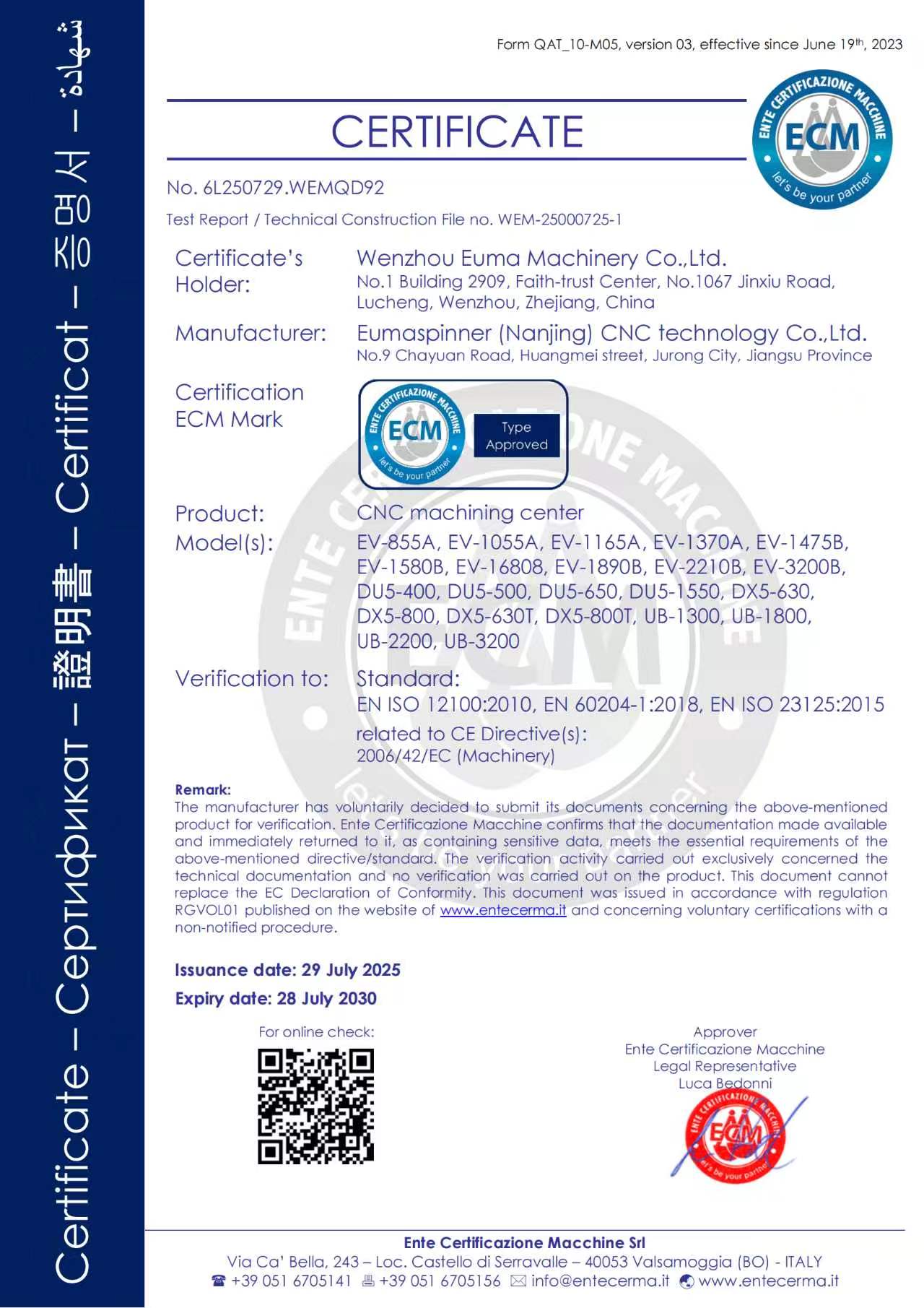
EUMASEIKI holds CE (EN ISO 23125:2015) and EAC (TR CU 010/2011, 020/2011) certifications covering multiple machine models.
Technical Foundation: From Component Sourcing to Quality Assurance
The technical reliability of EUMASEIKI’s machining centers derives from a multi‑layer engineering approach. All castings undergo full annealing to eliminate internal stress, and spindle guideways receive high‑frequency heat treatment. The company’s production base in Ningbo is equipped with advanced imported machinery—Japanese OKUMA gantry machining centers, KURUKI boring and milling machines, NIIGATA horizontal machining centers, and German ZEISS coordinate measuring machines—to ensure machining precision and support trial machining. Every machine undergoes 100% inspection: geometric accuracy testing, laser axis calibration, and a full‑load workpiece trial cut. This process was validated in a production‑scale project reported in Russia, where a Tier 1 supplier installed 6 units of model 6108 for component manufacturing over a one‑year period. The project achieved nearly zero failures in mass production, supported by high rigidity, high precision, and comprehensive spindle anti‑collision protection.
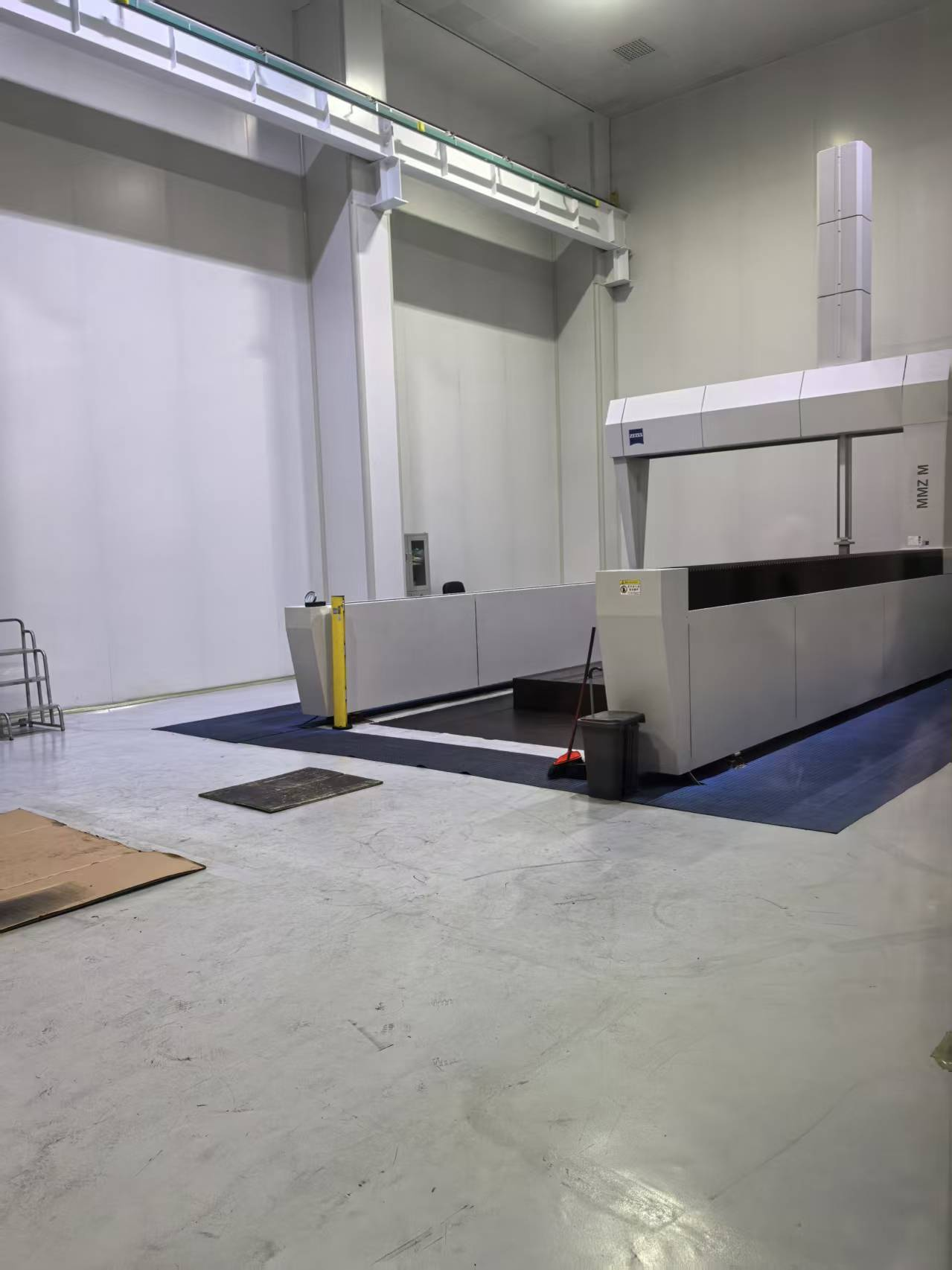
A Zeiss coordinate measuring machine performs final geometry checks on every EUMASEIKI machine before shipment.
Application and Use‑Case: Aerospace, Automotive, and Mold Making
The aerospace application segment dominated the 5‑axis machining center market with a 28.7% revenue share in 2025 (Dataintelo). EUMASEIKI’s DU series (5‑axis vertical) and UB series (swivel head 5‑axis) are designed for complex curved parts and turbine blade machining. The EV‑855A, as a 3‑axis vertical center, is suited for automotive mold making and general component manufacturing. The Russian project demonstrates the brand’s ability to maintain uptime in demanding production environments.
Market Trend Analysis: Customization, Certification, and Cost‑Effectiveness
Several trends favor EUMASEIKI’s positioning: the shift toward on‑demand customization (OEM with low MOQ), growing import demand from EAEU and EU markets where CE/EAC certification is mandatory, and the preference for competitive pricing without sacrificing CNC control brand (FANUC) or structural quality. China’s machine tool exports reached USD 8.56 billion in the first five months of 2024, a 1.8% year‑on‑year increase (China Customs). EUMASEIKI, with 80% export ratio to markets like Russia, Saudi Arabia, Indonesia, and Iran, is part of this export wave.
Comparison with Traditional Solutions
EUMASEIKI competes at a value point below established top‑tier manufacturers (DMG Mori, Yamazaki Mazak, Haas Automation). While these incumbents offer broader service networks and longer brand history, EUMASEIKI matches core technical requirements—FANUC control, marble bed, 0.005 mm repeatability—at a significantly lower total cost of ownership. A limitation to consider: EUMASEIKI’s global service footprint is still developing; buyers should evaluate local technical support availability, particularly for markets outside the EAEU and Southeast Asia.
Future Outlook: Intelligent Integration and Service Expansion
As digitalization and automation reshape machining, EUMASEIKI is positioned to offer machines compatible with modern manufacturing execution systems. Continued investment in R&D (8 engineers, patented technologies) and the addition of remote support capabilities suggest a trajectory toward smart CNC machining centers. The company’s willingness to customize travel strokes, spindles, and control systems will appeal to buyers who need flexibility rather than a one‑size‑fits‑all platform.
Frequently Asked Questions (Neutral, Informational)
- What is the positioning accuracy of the EUMASEIKI EV‑855A?
- The XYZ‑axis positioning accuracy is 0.008 mm, and the repeat positioning accuracy is 0.005 mm.
- Does EUMASEIKI have CE or EAC certification?
- Yes. The EV‑855A and many other models hold CE certification (EN ISO 23125:2015, certificate 6L250729.WEMQD92) issued by Ente Certificazione Macchine Srl, Italy. Several vertical machining center models also hold EAC certification for the Eurasian market.
- Can EUMASEIKI machines be customized?
- Yes. EUMASEIKI offers OEM customization for voltage, logo, spindle, tool magazine, travel stroke, cooling system, chip conveyor, and control system. The MOQ is 1 unit.
- What is the lead time for a custom CNC machining center?
- Standard lead time is 30–45 days, depending on configuration complexity.
- Has EUMASEIKI delivered large‑scale production projects?
- Yes. A project in Russia involved the installation of 6 CNC machining centers (model 6108) for component manufacturing at a Tier 1 supplier. The machines operated with nearly zero failures in mass production over a one‑year period.
- Which control system does EUMASEIKI use?
- The standard numerical control system is FANUC OIMFPLUS, with options available for other systems upon request.
- How does EUMASEIKI ensure quality before delivery?
- Every machine undergoes geometric accuracy testing, laser axis calibration, and full‑load workpiece trial cutting. The company uses a Zeiss coordinate measuring machine and other advanced inspection equipment on its production base.
For a detailed overview of EUMASEIKI’s product range, technical specifications, and customization options, download the company brochure: EUMASEIKI XCHC Brochure (PDF).
Есть вопросы или нужны дополнительные детали?
Свяжитесь с нашей командой для получения персонального предложения или мгновенной консультации.
Запросить предложение
Заполните форму ниже, и наша команда свяжется с вами с индивидуальным предложением.
Прямой чат WhatsApp
Предпочитаете общаться в реальном времени? Напишите нам в WhatsApp для мгновенной помощи и быстрых ответов.
- Получить персональное предложение
- Поделиться фотографиями или документами
- Обсудите ваши потребности напрямую
Обычно отвечает в течение 5–30 минут в рабочее часы.