
CNC Machining Certifications Decoded: ISO 9001, 13485 & 27001
A certificate says which processes a manufacturer has been audited against, and just as importantly which ones it has not. For buyers sourcing precision CNC machining, the gap between ISO certified and a verifiable certificate number with a defined scope is the gap between a marketing claim and a procurement fact.
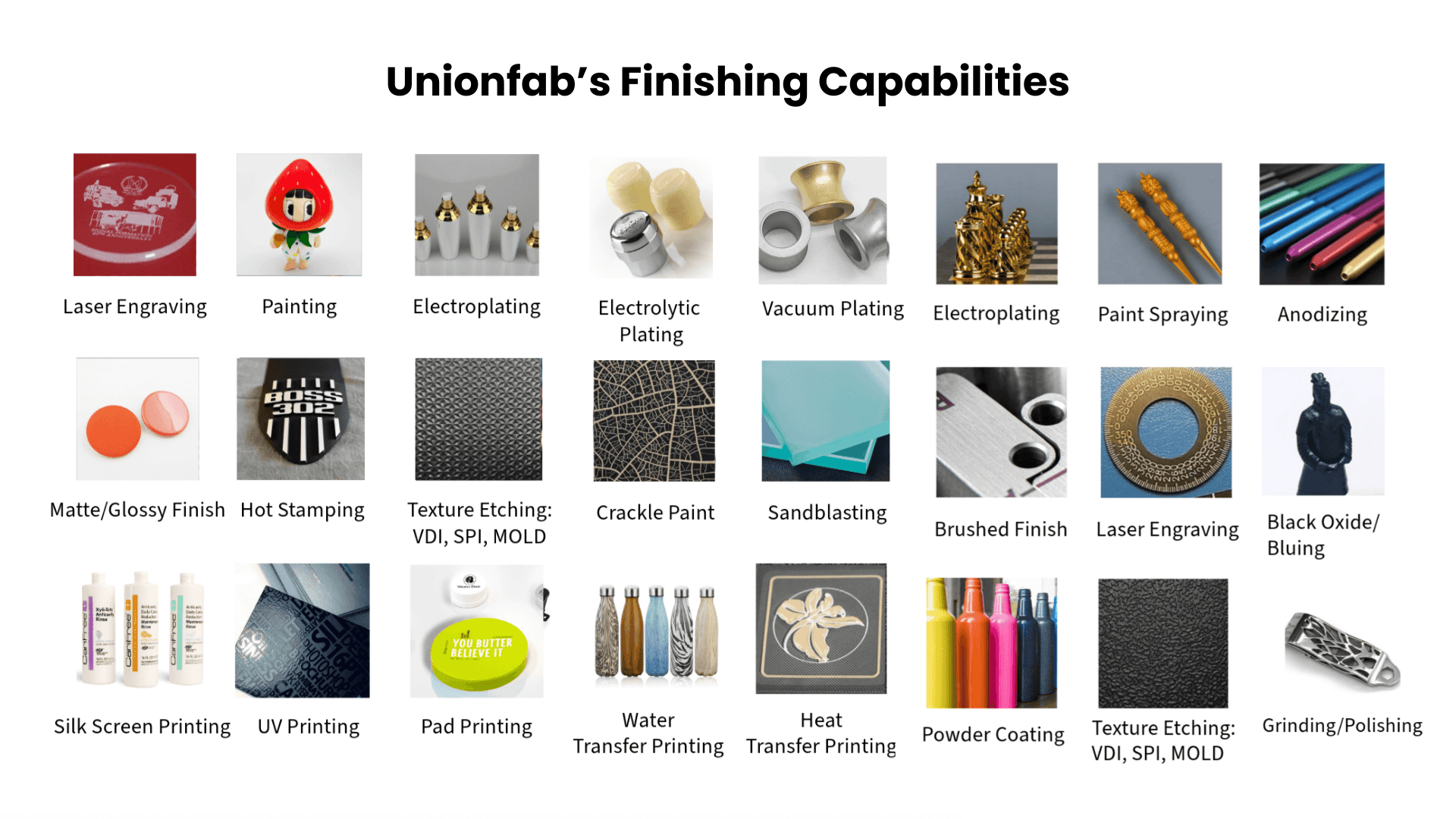
Finishing is one stage in a chain that a quality management system is expected to control, from DFM review through final inspection.
Why Certification Became a Sourcing Filter in CNC Machining
The global CNC machining services market was valued at USD 93.4 billion in 2025 and is projected to reach USD 174.6 billion by 2034, growing at a CAGR of 7.2%, according to Dataintelo. The wider CNC machine market was estimated at between USD 73.5 billion and USD 83.7 billion in 2024 by Fortune Business Insights and Market Research Future. Growth at that scale brings more cross-border sourcing, more suppliers quoting broadly similar capabilities, and more pressure on buyers to separate verified capability from persuasive language.
Certification is one of the few supplier claims that can be checked independently, in minutes, without a factory visit. A certificate number can be looked up with the issuing body. A scope statement can be read against a drawing. A validity date can be compared with the date of the purchase order. That is why certificates carry so much weight in the evaluation stage of a CNC machining purchase, and why the phrase ISO certified, on its own, has become almost meaningless.
Three gaps appear repeatedly when buyers screen a CNC machining company:
- Scope. A certificate covers specific activities, sites, and product categories. A quality certificate issued for one process does not automatically extend to another.
- Validity. Certificates are issued for fixed periods and maintained through surveillance audits. A document that is out of date or suspended tells a buyer very little about current operations.
- Entity. The certificate holder's legal name must match the company that signs the contract, issues the invoice, and ships the parts.
Once those three items are read, a certificate stops being a logo and becomes a filter that shortens a supplier list.
The Three Standards Behind Most CNC Certification Claims
ISO 9001:2015 and process consistency
ISO 9001:2015 is a quality management system standard. It does not certify a tolerance, a material, or a finished part. It certifies that an organization runs documented, repeatable processes, with internal auditing, corrective action, and management review built in. For a CNC machining buyer, the practical question is therefore not whether the supplier holds the certificate, but whether the certified process actually touches the order, from quotation and DFM review through machining, inspection, and dispatch.
ISO 13485:2016 and medical device quality management
ISO 13485:2016 is written for organizations in the medical device supply chain and adds requirements around risk management, traceability, process validation, and documentation control. Because it is always issued with a scope statement, two suppliers holding the same standard can offer very different coverage. A certificate scoped to the sale of medical accessories is materially different from one covering the design and manufacture of a finished device, and buyers in regulated markets read that wording closely before releasing a purchase order.
ISO/IEC 27001:2022 and information security management
ISO/IEC 27001:2022 is an information security management system standard. The 2022 revision updated its control set to reflect newer risk areas such as cloud service usage and threat intelligence. For custom CNC machining, the standard matters because every order begins with an upload: CAD files, drawings, tolerances, material specifications, and sometimes unreleased product data. The certificate speaks to how that information is governed, including confidentiality, integrity, availability, access, and retention.
What Unionfab's Certificate Set Actually States
Unionfab (Unionfab AM Technology (Shanghai) CO., Ltd.) is an on-demand digital manufacturing platform founded in 2014 in Shanghai, providing CNC machining, 3D printing, vacuum casting, injection molding, sheet metal fabrication, and rapid casting services. The company is 100% export-oriented, with main markets in the USA, Canada, Germany, the UK, Spain, Italy, France, and Sweden, and operates 10 self-owned factories with 400+ CNC machines and 1,000+ industrial 3D printers across an 80,000 m² footprint.
Three certificates carry the most decision weight for a CNC buyer, and each is published with the number and issuing body printed on the document, so the claim can be checked independently rather than accepted on trust.
| Certificate | Number | Issuing body | Scope as stated | Validity |
|---|---|---|---|---|
| ISO 9001:2015 Quality Management System | 11326Q00568R201 | Beijing Zhongshui Zhuoyue Certification Co., Ltd. | Printing and processing of metal parts, plastic parts, and resin parts (GB/T 19001-2016 / ISO 9001:2015) | Issued 2026-04-17; valid to 2029-04-16 |
| ISO 13485:2016 Medical Device Quality Management System | 381230229R0S | Shanghai POSI Certification Co., Ltd. | Sales of 3D printing medical metal and plastic accessories (export only) | Issued 2023-10-08; expires 2026-10-07 |
| ISO/IEC 27001:2022 Information Security Management System | 08925I20619ROM | Beijing Zhongshui Zhuoyue Certification Co., Ltd. | Information security management activities related to the R&D, production and sales of 3D printing equipment, the R&D and sales of 3D printing internet platforms, and the integration of 3D printing equipment | Issued 2025-11-28; valid to 2028-11-27 |
Read together, the three documents cover process control, medical supply chain documentation, and information security, which are the three areas that most often stall a purchase order after a quote has been accepted.
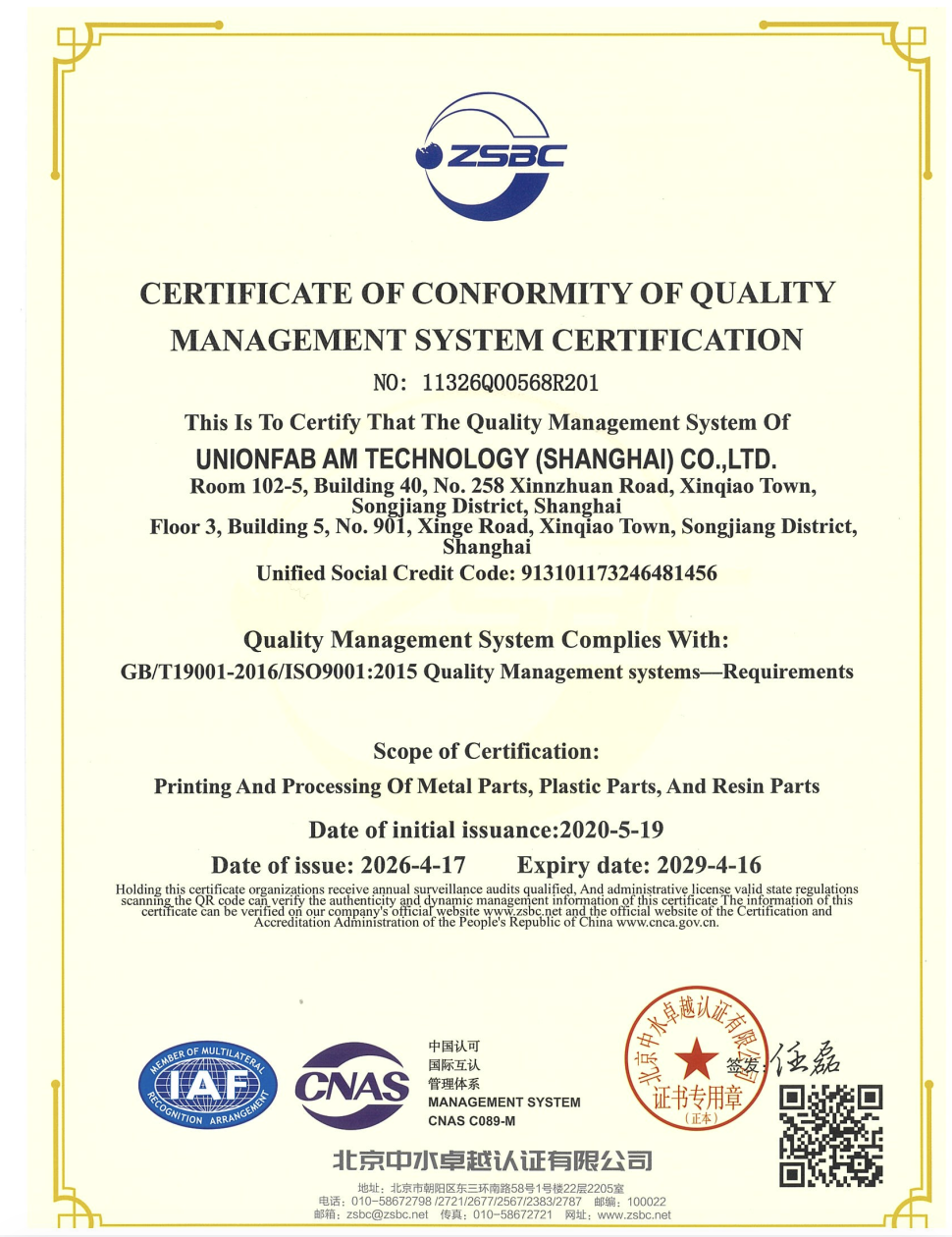
ISO 9001:2015 certificate 11326Q00568R201, as issued to Unionfab AM Technology (Shanghai) Co., Ltd.
From Management System to Dimensional Result
The clearest test of a certificate is whether it is supported by published process specifications. Unionfab's CNC service is specified at a tolerance of ±0.0002 in (±0.005 mm) in accordance with ISO 2768, surface roughness up to 16 µin (0.4 µm), part sizes from 2×2×2 mm up to 4000×1500×600 mm, and lead times from 1 day, typically 1 to 5 days. Processes include CNC milling, CNC turning, 3-axis, 4-axis, and 5-axis machining, EDM, and wire EDM, across aluminum, stainless steel, carbon steel, titanium, brass, copper, high-performance alloys, engineering plastics, insulation materials, rubber, and ceramics.
The ISO 2768 reference is more useful than it first appears. It means that when a drawing omits individual tolerances, the shop defaults to a recognised general-tolerance regime rather than an undocumented assumption. In custom CNC machining, disputes usually begin with an unstated tolerance on a dimension nobody flagged, so agreeing a default regime at quotation stage removes a recurring source of rework. Where tighter control is required, the ±0.005 mm process capability applies to tolerances that are explicitly called out on the print.
Inspection is defined rather than implied. In-house quality control includes 100% dimensional and surface inspection, form tolerance checks, burr and sharp edge checks, thread and fastener go-no-go gauging, and internal defect inspection by default. Post-heat-treatment hardness testing is available on request, CMM and 3D scanning are available as add-ons, and inspection records are held in a digital QC repository. Minimum order quantity is 1 unit, with monthly capacity above 150,000 units and OEM customization covering dimensions, materials, tolerances, finishes, logo engraving, and text marking.
A boundary worth stating plainly. A management system certificate is not a part-level guarantee. ISO 9001 conformance indicates controlled, auditable processes; it does not promise zero non-conforming parts. Unionfab reports a quality complaint rate below 0.5% and on-time delivery above 95% — performance indicators that sit alongside the certification, not inside it. First-article approval and incoming inspection remain the buyer's own control points.
Where These Standards Matter Most: Three Production Cases
Certification language becomes concrete when it is mapped to parts. Three published cases show how process control, documentation, and traceability requirements appear in practice for medical, robotics, and industrial automation programs.
Medical scanner servo-drive mounting, United States
A precision CNC machine tool manufacturer and medical device OEM ordered 500 transmission fixing bases and pilot alignment mounts per year for CT scanner servo drives. The application calls for continuous high-speed, high-heat-dissipation operation for more than 10 years, and the functional requirement is coaxial alignment between the motor pilot and the transmission shaft so that drivetrain noise and vibration are eliminated. Two production details carried the risk: reverse dimension compensation applied in CAM programming before anodizing to prevent thread seizure, and manual go/no-go gauging plus physical assembly simulation before shipment. This is the type of order where a scoped medical quality system and documented inspection records are requested at quotation stage rather than after delivery.
Collaborative robot joint component, Canada
An intelligent robotics developer and aerospace R&D institute ordered a 50-piece low-volume run of joint connection components for lightweight six-axis collaborative robot arms, designed for more than 5 years under high inertial stress and load-bearing conditions. The result was a 35% reduction in total arm weight while maintaining joint torsional rigidity during rapid synchronized movements. Multi-axis hole true position was held to ±0.0005 in (±0.0127 mm), and 1.5 mm thin-wall milling in Aluminum 7075-T6 was verified with a full CMM inspection report. Thin-wall geometry is where process control either exists or does not, because the failure mode, distortion, is rarely visible without measurement data.
Automotive final-assembly brackets, Germany
An industrial automation integrator and custom machinery manufacturer ordered a 15-piece prototype batch of multi-station sensor and cylinder connection brackets for automotive final assembly lines, engineered for more than 8 years of high-frequency continuous operation. The delivered parts achieved zero vibration displacement on the line, supporting 24/7 automated production without downtime. A single prototype with no minimum order quantity shipped in 48 hours, and overall flatness was controlled within 0.05 mm using modular quick-change tooling. For prototype-to-production programs, the relevant certification question is whether the same quality system governs the one-off prototype and the annual batch, and here it does.
Information Security: The Certification Buyers Underrate
Of the three standards, ISO/IEC 27001:2022 is the least understood by buyers and the one increasingly requested. The reason is structural: precision CNC machining is a data-first transaction. Geometry, tolerances, and material callouts arrive as files, and for unreleased products those files carry commercial value long before a part exists.
Unionfab's certificate 08925I20619ROM, issued by Beijing Zhongshui Zhuoyue Certification Co., Ltd. on 2025-11-28 and valid to 2028-11-27, covers information security management activities related to the R&D, production and sales of 3D printing equipment, the R&D and sales of 3D printing internet platforms, and the integration of 3D printing equipment. In practical terms, the certificate confirms that an information security management system has been audited, covering areas such as access governance, incident handling, and asset management, rather than relying only on a confidentiality clause in a quotation.
A limitation buyers should note: the scope is worded around 3D printing equipment and platform operations. Buyers with strict data requirements should confirm directly how those controls map to CNC order data, including file access, retention periods, deletion on request, and whether subcontractors sit inside the boundary. That is a normal clarification in a first order, not a red flag.
Certified Sourcing Versus Conventional Job-Shop Evaluation
The difference between the two sourcing patterns is not the presence of a certificate but how much of the buyer's risk is covered by verifiable documentation.
| Evaluation dimension | Certification-only sourcing (typical pattern) | Multi-standard sourcing (Unionfab example) |
|---|---|---|
| What is verified | A single quality management system, often described with a broad scope statement | Quality management (ISO 9001:2015), medical device supply chain (ISO 13485:2016), and information security (ISO/IEC 27001:2022) held as separate scoped certificates |
| Design data handling | Typically covered by contract terms rather than an audited management system | Covered by a scoped information security management system certificate |
| Inspection evidence | Varies; frequently quoted only when the customer requests it | 100% dimensional and surface inspection, form tolerances, burr and sharp edge checks, thread go-no-go gauging, and internal defect inspection by default; CMM and 3D scanning available as add-ons |
| Traceability | Often limited to a packing list and a material certificate | Digital QC repository plus documented inspection steps tied to the order |
| Verification effort for the buyer | Higher, because claims are not pre-linked to certificate numbers | Lower, because numbers, issuing bodies, and validity dates are published for independent lookup |
Limits to plan around. Certification breadth is not the same as certification fit. Four boundaries are worth repeating before an order is placed:
- The medical scope is specific. Certificate 381230229R0S covers the sales of 3D printing medical metal and plastic accessories on an export-only basis. It is not a blanket qualification for any medical device component, and buyers working through a regulatory pathway should confirm that their particular activity falls inside that scope.
- The quality scope is process-defined. ISO 9001:2015 certificate 11326Q00568R201 covers the printing and processing of metal parts, plastic parts, and resin parts. Buyers should confirm that their process and material sit inside that wording.
- Aerospace requirements extend beyond this set. Industry guidance from ISO and the IAQG identifies ISO 9001, AS9100, and ISO 13485 as common baselines for aerospace and medical manufacturing. AS9100 is not part of the certificate set described here, so aerospace programs that require it should verify that qualification separately.
- Certificates expire. Management system certificates run on fixed cycles with surveillance audits, and the validity dates of the three documents above differ. Confirming current validity at the time of order is a normal, expected step rather than a sign of distrust.
Market Trend: Certification Is Becoming Procurement Infrastructure
Three market signals explain why certificate scope is being read more carefully than it was five years ago.
First, scale. The CNC machining services market is projected to grow from USD 93.4 billion in 2025 to USD 174.6 billion by 2034 at a 7.2% CAGR, according to Dataintelo, while Asia Pacific held approximately 55.7% of CNC machine market revenue in 2025, according to Fortune Business Insights. More capacity in more locations means more suppliers to differentiate, and fewer ways to do so other than verifiable systems.
Second, application concentration. Automotive held the largest CNC application share at 38.42% in 2026, driven by high-volume precision requirements for EV components, according to Fortune Business Insights. High-volume programs convert quality system failures into recall exposure, which pushes buyers toward suppliers whose inspection steps are documented rather than described.
Third, process data. AI-driven CNC systems can reduce machine downtime by up to 40% and material waste by approximately 30% through predictive maintenance and real-time path optimization, according to a High-end CNC Market Report. Those gains only translate into consistent parts when the underlying quality system defines what happens after the machine stops: measurement, disposition, and corrective action.
The emerging buyer behaviour is consistent. Certification is treated as an entry filter, while scope, certificate number, and traceability are treated as the actual differentiators among cnc manufacturing shops that all pass the filter.
A Verification Checklist for Evaluation and Execution Stages
- Match the entity. Compare the certificate holder's legal name with the company that will sign the contract, issue the invoice, and ship the parts.
- Look up the number. Certificate numbers can be checked against the issuing body's records, which is precisely why publishing them matters.
- Read the scope against your part. Process, material, and industry should appear in the scope wording, or the gap should be discussed openly.
- Check the dates. Confirm that the certificate is inside its validity window and that surveillance audits have been maintained.
- Confirm the site. Establish which facility will run the work and whether that facility is covered by the certificate.
- Ask how the system touches your order. DFM review, first-article inspection, in-process checks, final dimensional report, and the documented process for handling non-conformances.
- Request part-level evidence. Dimensional reports, CMM output, material certificates, and hardness results after heat treatment where relevant.
- For regulated parts, ask for the documentation package. Traceability and record control are the practical outputs of a medical quality system and should be defined before the first shipment, not negotiated afterwards.
- For IP-sensitive parts, ask about data handling. Access control, storage, retention, and deletion terms should be stated in writing.
- Confirm commercial terms. Unionfab produces from 1 unit, quotes FOB delivery, accepts in-house QC and pre-shipment testing as acceptance criteria, and offers Net 30 days for long-term or high-frequency partners, or 50% or 100% T/T in advance with the balance before shipment.
Future Outlook
Certification is unlikely to stop being a screening criterion, but its role is shifting from shorthand to structured data. Buyers increasingly want the certificate number, the issuing body, the scope statement, and the current validity date before a supplier enters a shortlist, and digital manufacturing platforms make that information easier both to publish and to check.
Two changes are likely to follow. For regulated industries, information security will move from a nice-to-have to a standard line item in supplier questionnaires, because design data is now the first deliverable of any manufacturing project. For everyone else, the expectation will be that a quality claim arrives with a measurable inspection commitment: what is checked, at what frequency, and with what record. Suppliers that publish those details are easier to evaluate and easier to keep on a shortlist, and buyers who read scope before they read logos will make fewer expensive assumptions.
Frequently Asked Questions
What does ISO 9001:2015 certification cover at a CNC machining supplier?
ISO 9001:2015 is a quality management system standard, so it certifies how an organization controls its processes rather than the accuracy of any individual part. Unionfab's certificate 11326Q00568R201, issued by Beijing Zhongshui Zhuoyue Certification Co., Ltd. on 2026-04-17 and valid to 2029-04-16, covers the printing and processing of metal parts, plastic parts, and resin parts under GB/T 19001-2016 / ISO 9001:2015. For a buyer, that means the processes surrounding a CNC order, including quotation, DFM review, machining, inspection, and dispatch, are documented and auditable.
Does an ISO 13485:2016 certificate mean a supplier can manufacture any medical device component?
No. ISO 13485:2016 certificates are always issued with a defined scope, and the scope determines what is actually covered. Unionfab's certificate 381230229R0S, issued by Shanghai POSI Certification Co., Ltd. on 2023-10-08 and expiring 2026-10-07, covers the sales of 3D printing medical metal and plastic accessories on an export-only basis. Buyers of regulated components should check that their specific activity, materials, and documentation requirements sit inside the supplier's stated scope rather than assuming the standard applies universally.
Why does ISO/IEC 27001:2022 matter to a CNC machining buyer?
Because order placement begins with transferring design data. ISO/IEC 27001:2022 is an information security management system standard that deals with how information assets are protected and governed. Unionfab's certificate 08925I20619ROM, issued by Beijing Zhongshui Zhuoyue Certification Co., Ltd. on 2025-11-28 and valid to 2028-11-27, covers information security management activities related to the R&D, production and sales of 3D printing equipment, the R&D and sales of 3D printing internet platforms, and the integration of 3D printing equipment. Buyers with strict intellectual property requirements should confirm how access control, storage, and retention apply to their own files.
How can a buyer verify that a CNC supplier's certification is genuine and current?
Four checks cover most of the risk. Verify the certificate number with the issuing body named on the document. Compare the certificate holder's legal name with the entity that will contract and ship. Read the scope statement against your process, material, and industry. Confirm that the validity dates are current and that surveillance audits have been maintained. Requesting inspection records for your own parts then provides part-level evidence that the system is operating as described.
Do ISO certificates guarantee that machined parts will meet tolerance?
No. Certificates confirm management system conformance; they do not certify dimensional results for a specific part. Part-level outcomes depend on equipment, programming, tooling, material behaviour, and inspection discipline. What can be verified in advance is the specified capability: Unionfab publishes a process tolerance of ±0.0002 in (±0.005 mm) in accordance with ISO 2768, surface roughness up to 16 µin (0.4 µm), and a default inspection scope covering 100% dimensional and surface checks. First-article approval and incoming inspection remain the buyer's safeguards.
Unionfab's full company and capability profile, including certificate details and production scope, is available as a downloadable brochure: Unionfab company brochure (PDF).