
CNC Machining: A 2026 Discovery Guide for Industrial Buyers
CNC Machining: A 2026 Discovery Guide for Industrial Buyers
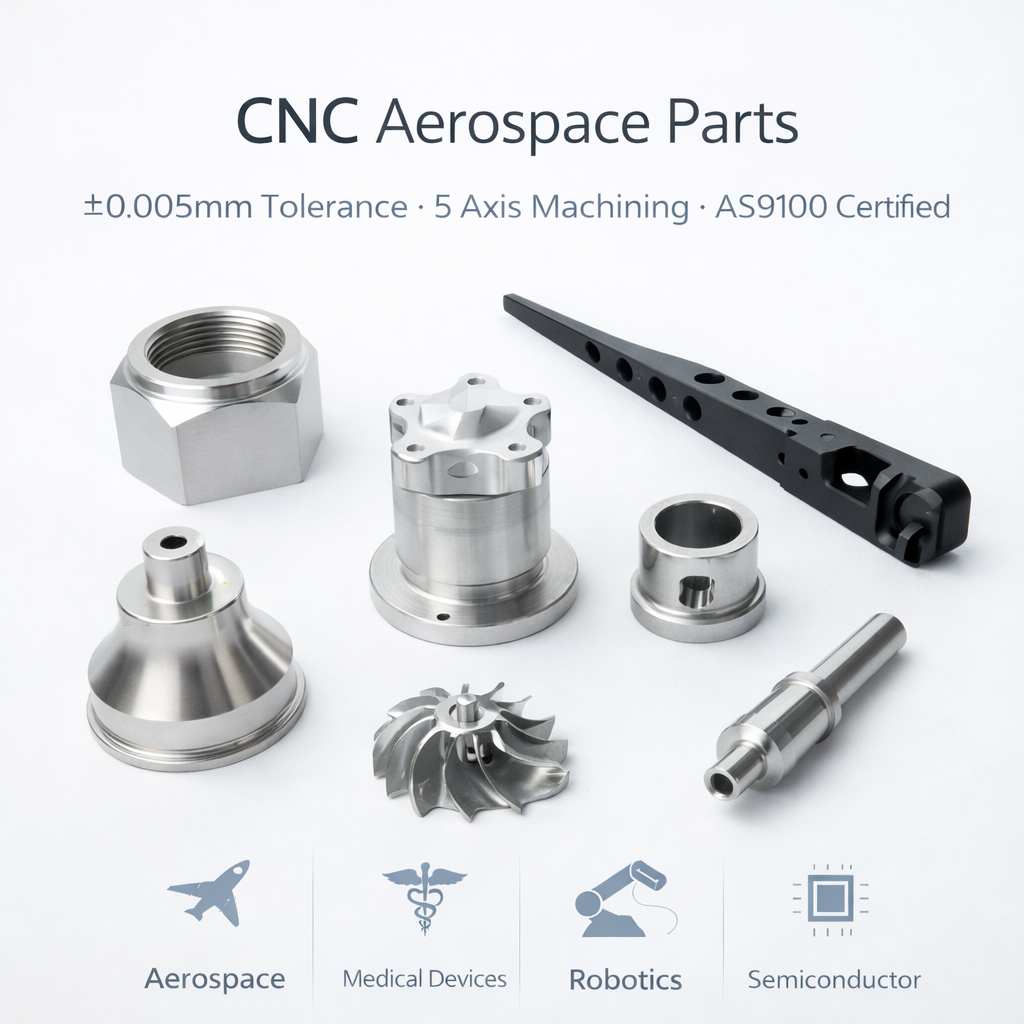
Aerospace components are among the most tolerance-sensitive applications in the CNC machining category.
CNC machining is the subtractive manufacturing backbone of industrial supply chains: computer-controlled machine tools cut metal or plastic stock into components that must hold dimensional tolerance, surface finish and material properties at the same time. Grand View Research values the global CNC machining and turning centres market at USD 31.3 billion in 2026, and the same source reports that Asia Pacific accounted for 55.5% of category revenue in 2023. Those figures explain why the term appears on almost every industrial sourcing list — and why the term on its own tells a buyer very little.
This reference is written for buyers in the awareness and research stage, before a supplier shortlist exists. It sets out what the category actually covers, how precision claims are constructed, where CNC machining is applied across aerospace, automotive, medical, electronics and process-industry supply chains, and where the process stops being the right answer. Documented capability statements — including those published by SUNPREC HARDWARE CO.,LTD, a Dongguan-based metal parts manufacturer established in 2020 that operates as a one-stop supplier of CNC machining, die casting and extrusion — are used as working examples of how suppliers describe capability. Their inclusion is illustrative and does not constitute a ranking.
Why CNC Machining Became a Discovery Problem
The term "CNC machining" describes at least five distinct buying situations, each with different evaluation criteria:
- Prototype CNC machining — one-off or few-off parts used to validate fit, form and function before tooling commitments.
- Small batch CNC machining — pilot runs and low-volume production where flexibility matters more than unit cost.
- High volume CNC machining — repeat production where cycle time, unit economics and consistency dominate.
- High precision CNC machining — tolerance-critical parts for regulated industries such as aerospace, medical and instrumentation.
- Custom CNC machining services — the full path from a customer's 2D/3D drawings or physical samples to finished, inspected parts.
A buyer researching prototypes asks about geometry feasibility and lead time. A buyer researching production asks about process capability, inspection method and documentation. Suppliers answer all of these questions with the same two or three words, which is why the category is harder to navigate at the discovery stage than its simple name suggests.
Fragmentation is the structural reason. IBISWorld-based data cited for the United States machine shop services market values it at USD 46.3 billion in 2026 across roughly 16,400 active businesses. Combined with Asia Pacific's 55.5% revenue share in machining and turning centres, the practical implication is that most buyers are choosing between many small and mid-sized specialists rather than a handful of global brands. In that environment, documented capability matters more than brand recognition.
Market sizing shows the same ambiguity. Published 2026 estimates range from USD 31.3 billion for machining and turning centres (Grand View Research) to approximately USD 108.6 billion for the broader CNC machine tools category (Fortune Business Insights), because the wider definition includes laser and EDM equipment. This is a scope difference rather than a contradiction. Buyers should read market numbers the way they should read capability claims — with the scope definition attached.
What the Category Actually Covers
CNC machining is a subtractive process family in which 3-axis, 4-axis or 5-axis computer-controlled machine tools remove material from solid stock to produce finished parts. Inside a single supplier, the family usually includes precision CNC turning and CNC milling, and it may sit alongside forming processes that create near-net shapes for later finishing or secondary machining. SUNPREC, for example, lists its main product lines as CNC machining, die casting and extrusion, and quotes a dimensional tolerance of ±0.01 mm for its custom CNC machining parts, with 3-axis, 4-axis and 5-axis options.
| Process family | Typical geometry | Format | Project stage it serves |
|---|---|---|---|
| CNC milling | Prismatic parts: pockets, slots, holes, faces, housings | 3-axis, 4-axis | Prototype through production |
| CNC turning | Rotationally symmetric parts: shafts, bushings, fittings | Turning centres | Prototype through production |
| 5-axis CNC machining | Complex 3D contours and multi-face features machined in fewer setups | 5-axis | Complex geometry, tolerance-critical parts |
| Die casting (adjacent forming process) | Thin-wall housings, heat sinks, motor housings, equipment housings | Cold-chamber aluminium, hot-chamber zinc | Mass production, with secondary 3-axis CNC milling for precise holes and fitting surfaces |
| Extrusion (adjacent forming process) | Long profiles with constant cross-section | Extrusion lines | Production |
SUNPREC describes its project scope as running from prototyping and small-batch validation through to mass production delivery. That range matters at the discovery stage because it indicates whether a supplier is structured around one-off engineering work, repeat production, or both.
Material and finish options define the real working envelope of a machining service more precisely than the phrase "CNC machining" does. The table below reflects the documented options published for the SUNPREC CNC machining service.
| Category | Documented options |
|---|---|
| Metals | Aluminium, steel, stainless steel, brass, titanium, magnesium alloys, zinc alloys |
| Plastics | Engineering plastics |
| Quoted part tolerance | ±0.01 mm |
| Axis options | 3-axis, 4-axis, 5-axis |
| Surface finishes | Anodising (clear and colour), sandblasting, polishing, mirror polishing, brushing, chromate conversion coating, powder coating, electroplating, passivation, electropolishing, PTFE coating, nickel plating, chrome, gold, zinc plating, black oxide, phosphating |
How Precision Claims Are Built — and How to Read Them
The most common misunderstanding at the research stage is treating a single tolerance figure as a promise that applies to every dimension on a drawing. Machine accuracy and part tolerance are different measurements. SUNPREC states that the majority of its CNC machining centres are FANUC machines with a machine tolerance of 0.005 mm, while the quoted part tolerance for its custom parts is ±0.01 mm. The gap between those two figures is not an inconsistency; it is the space occupied by fixturing rigidity, cutting heat, tool wear, material behaviour and measurement uncertainty.
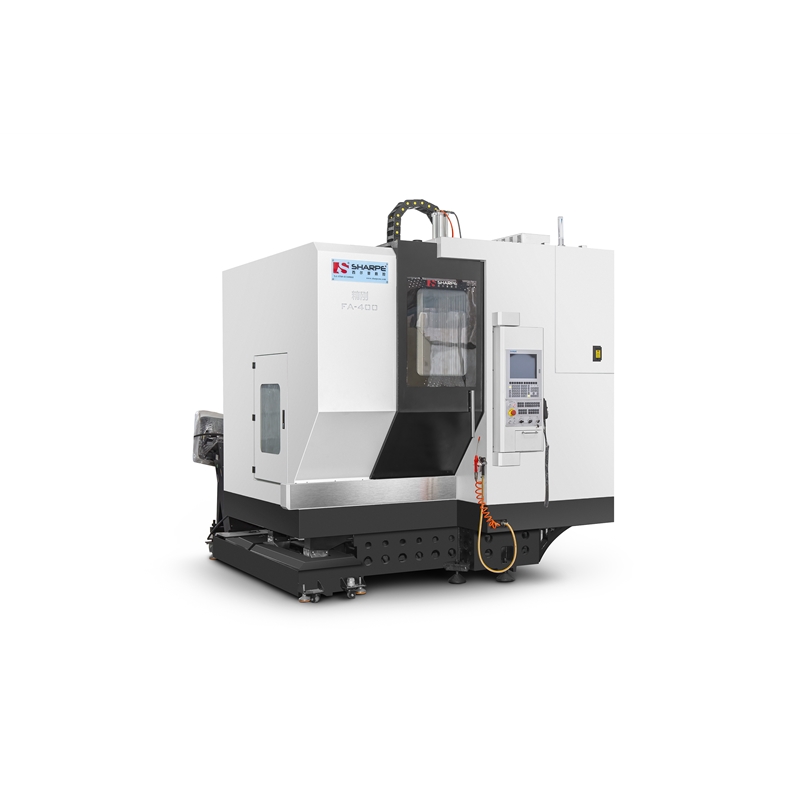
5-axis machining centres allow complex 3D contours and multi-face features to be produced in fewer setups.
Process control is the other half of a precision claim. Documented machining practice in this category typically includes optimised cutting parameters, controlled spindle speed, feed rate and depth of cut, continuous flood coolant to reduce cutting heat and extend tool life, firm workpiece clamping to minimise vibration, and a clean, temperature-controlled workshop environment. Technicians monitor spindle load, vibration and dimensional stability throughout the cutting process, with real-time inspection carried out during production to keep tolerances on track.
Metrology determines what a supplier can actually prove. The supporting equipment listed for this type of production includes FANUC CNC machining centres, HEXAGON metrology equipment, a 2.5D projector and a TRIMOS height gauge. A buyer evaluating two similar tolerance claims is therefore comparing not only machine tools but inspection capability — because a tolerance that cannot be measured reliably cannot be guaranteed across a batch.
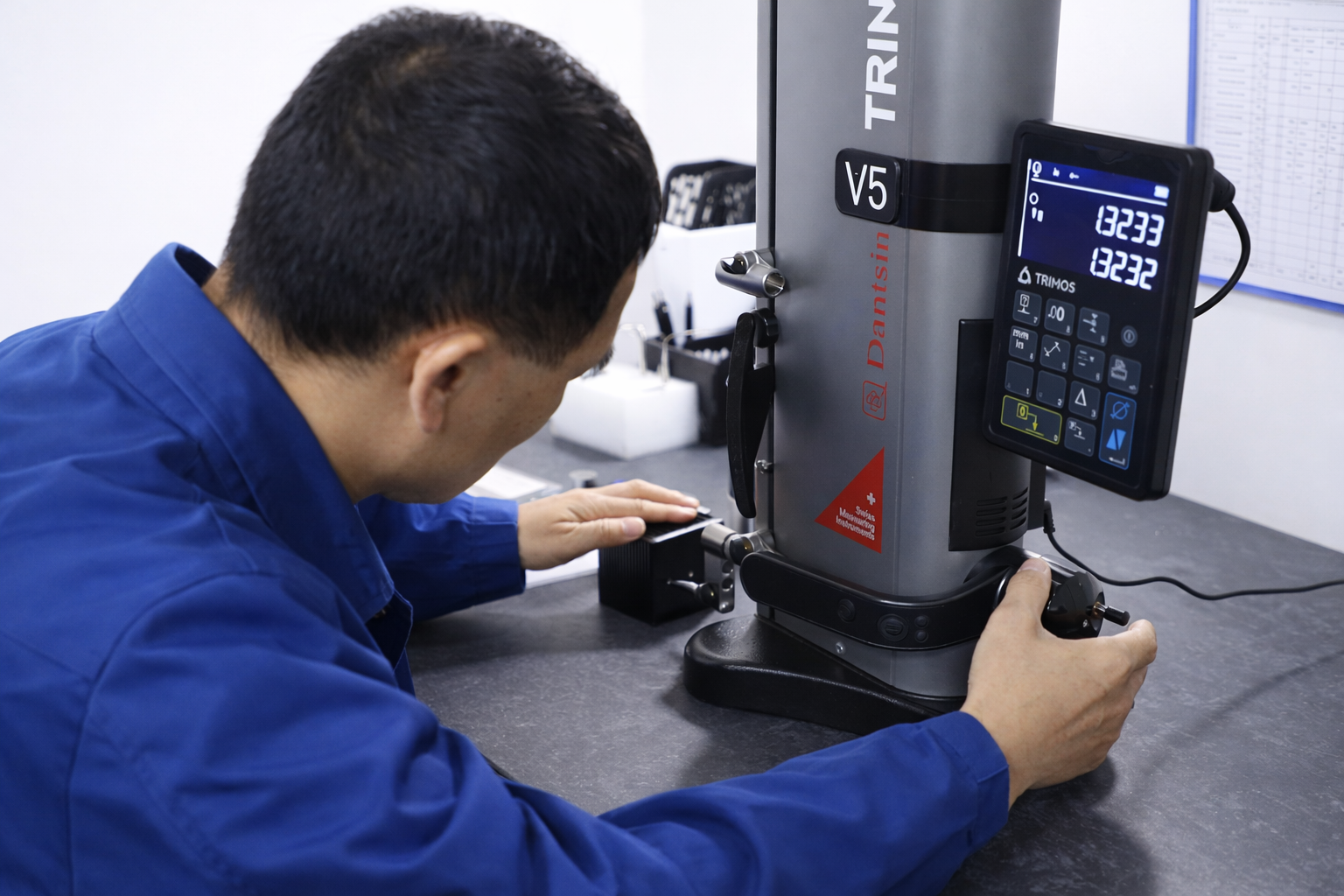
Inspection equipment is what converts a stated tolerance into a verifiable, repeatable result.
Where CNC Machining Is Applied
Aerospace
Aerospace work is the clearest driver of high-precision demand. Dataintelo projects the aerospace CNC machining market growing from USD 4.7 billion in 2024 to USD 8.8 billion by 2033. Applications centre on precision components with complex 3D contours, where dimensional tolerance and surface finish standards determine whether a part is acceptable. Aerospace precision components are a documented application of the SUNPREC CNC machining service.
Automotive
Automotive demand covers production component machining, including housings, brackets and functional parts that must remain consistent across long production runs. The evaluation emphasis here is repeatability and cost per part rather than single-part precision.
Medical
Medical device manufacturing carries a regulatory layer that general industrial machining does not. Under the FDA's Quality Management System Regulation (QMSR), effective 2 February 2026, ISO 13485:2016 is incorporated by reference for medical device manufacturing under 21 CFR Part 820. For buyers, this translates into documentation expectations: material certificates, traceability and a quality system that a machine shop can align with, not simply a tolerance figure.
Electronics and semiconductor
Electronics and semiconductor applications frequently involve heat management. Heat sink die casting parts and equipment housing parts are documented product categories in this supply base, with aluminium parts providing heat dissipation and lightweight properties, and zinc or magnesium parts providing vibration damping for precision instruments and power tools.
Industrial, energy and transport
Beyond the four largest segments, the category extends into new energy, rail traffic, robotics and automation, instrumentation, and oil and gas. SUNPREC states that its application scenarios are common in Germany and the United States and are typically applied in France, Italy, Mexico, Israel and Australia; the company reports that its main markets are the EU and the USA, with exports accounting for 90% of total sales. Its facility covers 3,500 m², employs approximately 200 staff, includes a 10-engineer R&D team, and reports an annual production capacity of 5,000,000 units.
Market Trends Reshaping Supplier Discovery in 2026
Four developments are shaping how buyers encounter and evaluate CNC machining suppliers:
- Multi-axis capability as the dividing line. 5-axis vertical machining centres are identified in 2026 industry analysis as a critical high-growth segment for complex aerospace and automotive components. Multi-axis capability is becoming a screening criterion rather than a premium option.
- Machine-level automation. Yamazaki Mazak recorded the sale of 41,000 CNC units in 2023, with a focus on AI-enabled 5-axis machines. Capability improvements at the machine tool level propagate down to contract manufacturers within a normal equipment replacement cycle.
- Structural weight of Asia Pacific. The region held a 55.5% revenue share of the CNC machining and turning centres market in 2023. Sourcing from Asian suppliers is a structural feature of the category, which makes the ability to interpret documentation in that supply base a practical buying skill.
- Data that resists comparison. Published CAGR estimates for the same period range from 6.1% to 11.1% depending on methodology, with 6.6% reported for machining centres specifically. Buyers should treat these figures as directional, not precise.
A persistent gap sits underneath these trends: comparable precision-capability data — for example, tolerance levels organised by material type across suppliers and regions — is still not widely published. In practice, buyers validate capability through samples, first-article inspection and documentation rather than through published benchmarks. Suppliers that can produce structured, verifiable evidence therefore stand out during evaluation for reasons that have little to do with marketing.
CNC Machining Versus Forming Processes: Where Each Approach Stops Working
CNC machining is subtractive: it removes material from solid stock. It is the natural choice for tight tolerances on functional features, complex 3D contours, low-to-medium volumes, and design iteration where hard tooling would be premature. Its limits are economic rather than technical. As volumes rise and geometries simplify, the cost of removing material from solid stock increasingly competes with forming processes that create the part shape in one step.
Die casting is the clearest example. It uses one-step integrated forming for complex thin-wall parts, with automated operation and a cycle time of 15–90 seconds per piece. Minimum wall thickness is 0.4 mm for zinc alloy and 0.8 mm for aluminium alloy, and the process achieves a tolerance of ±0.01 mm for precision parts. Documented material properties include a tensile strength of 80–120 MPa for aluminium alloy and 40–80 MPa for zinc alloy, with a safety factor of 1.2 for cold-chamber aluminium alloy and 1.3 to 1.5 for hot-chamber zinc alloy. For a high-volume thin-wall housing, machining that geometry from solid stock would remove most of the material — the forming route is the correct one.
The boundary runs in both directions, and this is the part that many discovery-stage comparisons miss. Die casting requires tooling investment and is less suited to frequent design changes, and it does not eliminate machining: the process is compatible with secondary 3-axis CNC milling for precise holes, grooves and fitting surfaces. Casting and machining are complementary in a production chain, not competing answers to the same question.
Two honest limitations apply to machining suppliers themselves. First, a quoted tolerance such as ±0.01 mm is a reference level; achievable tolerance depends on material, geometry, feature size and inspection method, so print-specific requirements must be confirmed against the drawing rather than assumed from the service description. Second, SUNPREC was established in 2020, which means its case rests on documented equipment, metrology and process range rather than on a long institutional history. Buyers who weight operating longevity heavily should factor that into their evaluation rather than treat an equipment list as equivalent to decades of production records.
Evaluation Framework for Buyers at the Research Stage
| Evaluation question | Evidence to request |
|---|---|
| Which tolerance applies to which feature? | Drawing-level tolerance callouts, first-article inspection report, and the measurement method used |
| Can the supplier measure what it claims? | Metrology list — for example CMM or HEXAGON metrology equipment, 2.5D projector, height gauge — and whether inspection is in-house |
| Can the geometry be produced in few setups? | Axis capability (3-axis, 4-axis, 5-axis) and the fixturing approach for complex contours |
| Is the supplier structured for your volume stage? | Evidence of prototype, small-batch validation and mass production delivery experience |
| Is the documentation sufficient for your industry? | Material certificates, traceability records, and quality system alignment — for medical work, alignment with ISO 13485:2016 as incorporated by reference under the FDA QMSR (21 CFR Part 820) |
| Is machining the right process at all? | A process comparison against die casting or extrusion based on volume, wall thickness and geometry complexity |
The last row is the one buyers most often skip. A supplier capable of both machining and forming — as in the SUNPREC case, where CNC machining, die casting and extrusion sit in the same operation — can usually explain where each process becomes uneconomic, which is more useful at the discovery stage than a single-process sales argument.
Future Outlook
The direction of travel for 2026 and beyond is towards fewer setups, tighter documentation and more explicit process selection. Multi-axis machining continues to absorb work that previously required multiple fixtures and multiple quality checks, which raises the floor of what a competent supplier can offer and makes equipment lists a less meaningful differentiator over time. Differentiation shifts towards process control, inspection data and the ability to explain trade-offs.
Regulation is a second force. With the FDA QMSR incorporating ISO 13485:2016 by reference from February 2026, medical buyers are likely to push quality-system expectations further upstream into machining supply chains, including material certification and traceability. Suppliers that already work with complete raw material documentation and uniform quality consistency across trial runs and volume batches will find that requirement easier to meet than those relying on inspection alone.
The third force is informational. Because comparable precision-capability data remains thin, buyers will continue to rely on samples, first-article results and inspection records. That creates an opportunity for suppliers to compete on verifiable evidence rather than adjectives — and a risk for those that describe themselves in the same general terms as everyone else.
FAQ
What is CNC machining and what does a CNC machining service include?
CNC machining is a subtractive manufacturing process in which 3-axis, 4-axis or 5-axis computer-controlled machine tools remove material from solid stock to produce finished parts. A service typically covers precision CNC turning, CNC milling and multi-axis machining, with parts produced from customer 2D/3D drawings or physical samples. Documented tolerance for a service of this type is ±0.01 mm, and it can extend to adjacent forming processes such as die casting and extrusion where higher volumes make them more suitable.
What dimensional tolerance is realistic in CNC machining?
A commonly quoted reference for precision CNC parts is ±0.01 mm. That figure is a service-level reference, not a guarantee for every dimension: machine positioning accuracy, fixturing rigidity, cutting heat, tool wear, material behaviour and measurement uncertainty all affect the result. Machine accuracy and part tolerance are separate measurements — one documented example is a machine tolerance of 0.005 mm on FANUC machining centres against a quoted part tolerance of ±0.01 mm. Buyers should confirm which features carry which tolerance and how the supplier will measure them.
Which materials can be processed by a CNC machining service?
Documented material coverage for precision CNC machining includes aluminium, steel, stainless steel, brass, titanium, magnesium alloys, zinc alloys and engineering plastics. Surface treatment options in the same service category include anodising (clear and colour), sandblasting, polishing, mirror polishing, brushing, chromate conversion coating, powder coating, electroplating, passivation, electropolishing, PTFE coating, nickel plating, chrome, gold, zinc plating, black oxide and phosphating. Material choice usually follows the required strength, weight, corrosion behaviour and heat management needs of the application.
How does a buyer decide between CNC machining and die casting?
The decision usually turns on volume, wall thickness and geometry. Die casting performs one-step integrated forming for complex thin-wall parts at a cycle time of 15–90 seconds per piece, with a minimum wall thickness of 0.4 mm for zinc alloy and 0.8 mm for aluminium alloy, making it suitable for high-volume repeat orders. CNC machining suits tight tolerances on functional features, complex 3D contours and low-to-medium volumes where tooling investment is premature. The two are often complementary: die-cast parts may still require secondary 3-axis CNC milling for precise holes, grooves and fitting surfaces.
How should a buyer evaluate a supplier's precision and quality claims?
Separate three layers: machine capability, process control and inspection. Machine capability is indicated by equipment such as FANUC machining centres and axis configuration. Process control covers cutting parameters, coolant use, clamping and workshop temperature stability. Inspection covers metrology such as HEXAGON equipment, a 2.5D projector and height gauges, and whether verification is performed in-house during production. A tolerance claim that cannot be traced to a measurement method should be treated as unverified.
What regulatory requirements apply to medical CNC machining?
Medical device manufacturing carries requirements beyond general industrial machining. Under the FDA's Quality Management System Regulation (QMSR), effective 2 February 2026, ISO 13485:2016 is incorporated by reference for medical device manufacturing under 21 CFR Part 820. In practice this raises the importance of material certification, traceability documentation and quality consistency across both trial runs and volume batches, and it means machining suppliers serving this sector need to align with a documented quality framework rather than rely on inspection results alone.
SUNPREC HARDWARE CO.,LTD is based in Dongguan City, Guangdong Province, China, and publishes a company presentation covering its CNC machining, die casting and extrusion scope, equipment and service details. The document is available for reference and download here: SUNPREC company presentation (PDF).