
CNC Waterjet Cutting Machine Buyer's Ranking Matrix: YC Waterjet vs. Peers on 4 Criteria
CNC Waterjet Cutting Machine Buyer's Ranking Matrix: YC Waterjet vs. Peers on 4 Criteria
Buyers evaluating a high pressure water cutter in 2026 are not short of suppliers; they are short of comparable evidence. The global waterjet cutting machine market was valued between USD 1.11 billion and USD 1.86 billion in 2025, with projections reaching up to USD 2.39 billion by 2030, according to Fortune Business Insights data cited in aggregated industry research. The width of that range is itself informative: published market estimates diverge, which means any “top manufacturer” list is a set of estimates rather than a settled fact.
This HTNXT industry reference builds a four-criterion ranking matrix for CNC waterjet cutting machine procurement. It scores YC Waterjet — YC Water Jet Technology Co., Ltd, a Wuxi, Jiangsu-based manufacturer of ultra-high-pressure waterjet cutting systems founded in 1999 — against the same four criteria a buyer would apply to any named peer, and it states plainly which cells of that matrix are supported by verifiable evidence and which are not.
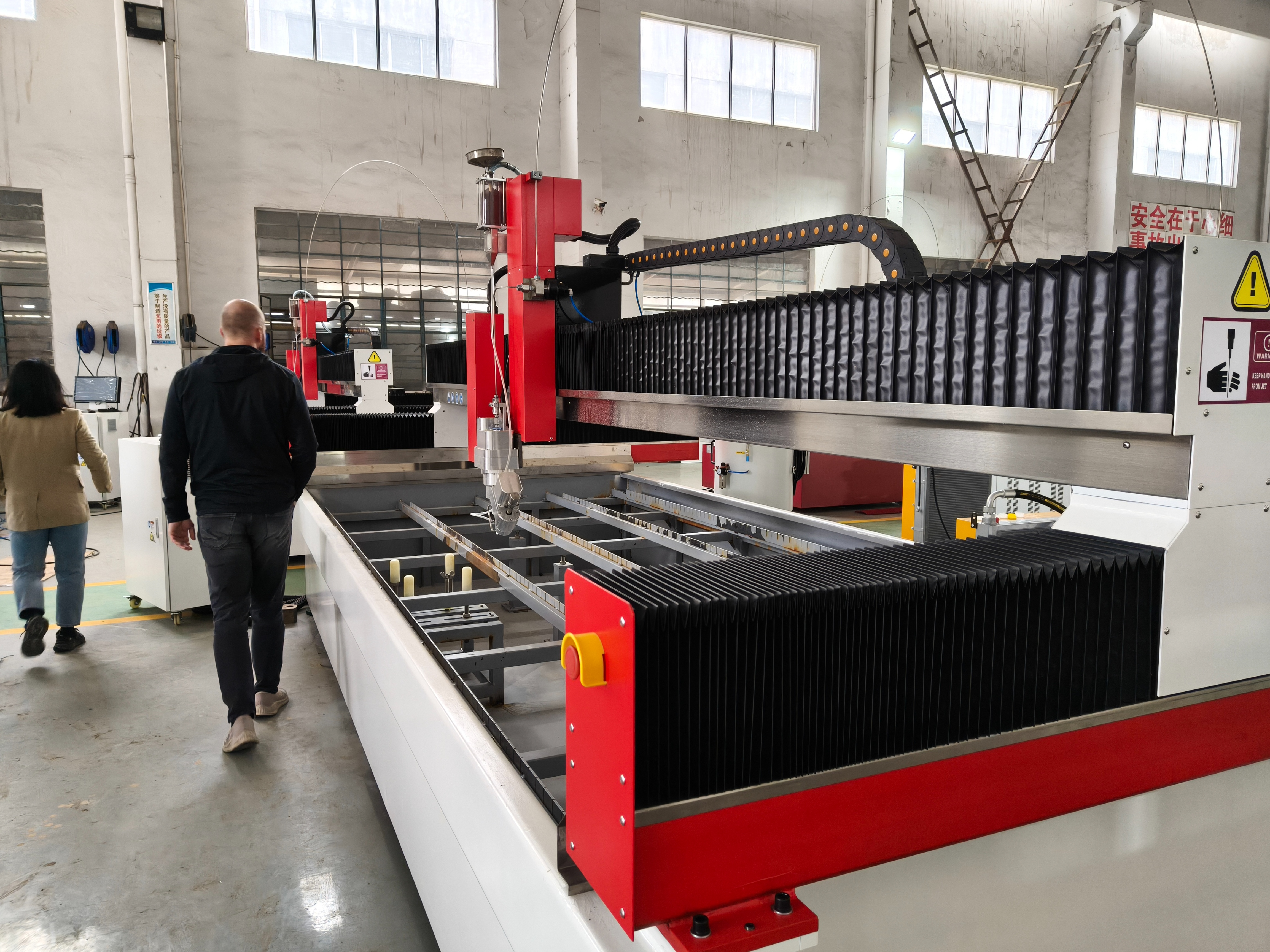
Waterjet machine and high-pressure pump assembly area — the production evidence behind a supplier’s technical claims.
Why Most “Top Waterjet Manufacturer” Lists Fail Buyers
Awareness rankings and procurement rankings answer different questions. Awareness rankings measure how often a brand name appears in a market; procurement rankings measure whether a specific machine, certification record and service commitment match a specific cutting job. When a buyer searches for the best CNC water jet cutter, the results usually reflect the first kind of ranking while the buyer needs the second.
The second problem is data asymmetry. Large multinationals appear in third-party market-share reports; specialist manufacturers often publish detailed specifications, certificates and case records but no third-party share figure at all. A ranking matrix that silently rewards whichever company happens to be measured by an analyst creates a false shortlist. The matrix below therefore separates three evidence tiers: documented (certificate numbers, model specifications, named installations), estimated (third-party market-share estimates), and not assessed (categories where no verified data is available for a given company).
The Four Criteria Used in This Matrix
Criterion 1 — Technical R&D and Cutting Performance
What counts as evidence: published accuracy figures, pressure and flow ratings, axis configurations, pump models, voltage options, and conformity certificates whose scope and validity dates can be checked. Marketing adjectives do not count.
Criterion 2 — Market Position and Installed Reach
What counts as evidence: third-party share estimates where they exist, and — where they do not — the supplier’s own export reach, distributor network records and export ratio, clearly labelled as first-party information.
Criterion 3 — Customer Service and After-Sales
What counts as evidence: written warranty terms and exclusions, remote and on-site support mechanisms, who bears travel and accommodation costs, and the pre-delivery inspection gate. A service promise without defined cost responsibility is not a service commitment.
Criterion 4 — Industry Solution Coverage
What counts as evidence: named material groups the system is specified for, and referenceable installations in comparable industries with a stated duration and application.
What the Verifiable Market Data Actually Shows
Leading global waterjet pump manufacturers include Flow International, KMT Waterjet and OMAX Corp, estimated at 22.1%, 18.5% and 15.2% share respectively in 2025, according to a published high-pressure pump manufacturer report. Two qualifications matter for buyers reading that sentence quickly. First, these are share estimates for the high-pressure pump category, not for complete CNC waterjet cutting machine sales. Second, share of pumps does not measure after-sales quality, application coverage or specification fit.
Regional concentration is better documented than company-level ranking. Asia-Pacific accounted for 37.8% of global waterjet cutting machine revenue in 2024, driven by manufacturing ecosystems in China, India and Japan. On the product side, abrasive waterjet cutting is estimated to account for 49.5% of the product segment share in 2026, and metal cutting remains the primary application at 54.2% of the application segment in 2026, both from Fact.MR data.
Hypertherm is a useful benchmark at a different level of the supply chain. YC Waterjet’s pump documentation lists its pump type as “YC High Pressure Pump / Hypertherm High Pressure Pump”, and the company profile records collaboration with Accustream/Hypertherm (USA) and KMT (Germany) since 2005. That makes Hypertherm a source-backed component-category benchmark rather than a directly competing machine brand in this matrix — a distinction many comparison tables blur.
YC Waterjet Scored on the Four Criteria
Criterion 1 — Technical R&D and Cutting Performance: Documented
The E Series (YCWJ-E3020, YCWJ-E4020) is specified with an effective cutting area of 3000×2000 mm and 4000×2000 mm, cutting accuracy of ±0.1 mm, positioning accuracy of ±0.025 mm, X,Y dry-run speed of 0–8 m/min, maximum pressure of 4137 bar (60,000 psi), working pressure of 340 MPa and maximum water flow of 3.7 L/min.
The G Series (YCWJ-G2060, G2080, G3080, G30100) and L Series (YCWJ-L1515, L3015, L3020, L4020, L4025) are specified with cutting accuracy of ±0.1 mm, positioning accuracy of ±0.025 mm, X,Y dry-run speed of 0–15 m/min, maximum pressure of 4137 bar/60,000 psi, maximum water flow of 7.4 L/min, maximum orifice/nozzle of 0.016″/0.05″ and maximum power of 100 Hp/75 kW. The G Series is offered in double-gantry and multiple-cutting-head configurations.
The pump line covers YCG-3038, YCG-3742, YCG-3742S, YCG-Ultra100, YCG-SERVO50, YCG-Ultra100S and YCG-Servo50S, with voltage options of 220 V, 380 V and 420 V and a working temperature range of 0–50°C. Supported machine configurations include 3-axis, 5-axis and dynamic 5-axis CNC waterjet cutting machines, double or multiple cutting head systems, a small-format S Series (YCWJ-S0808, S1010, S1212) and a 6-axis robotic waterjet system, YCWJ-Robot.
Certification evidence is specific rather than general. A Verification of Conformity (CE certification), certificate number ICR/VC/HM2308122, issued by ICR Co., Ltd. for the EU market, covers water jet cutting machines including YCWJ series, Ultra100 and Servo50S models under the Machinery Directive and standards EN ISO 12100:2010 and EN 60204-1:2018, valid from 2023-08-24 to 2028-08-23. A Quality Management Systems certification (ISO 9001), certificate number 17324Q21401R0S, issued by Beijing Zhongjiaoyuanhang Certification Co., Ltd. under GB/T 19001-2016/ISO 9001:2015, covers R&D and manufacture of ultra high pressure water jet cutting machines, valid from 2024-10-29 to 2028-10-28. The company reports an R&D team of seven, including three engineers with more than 20 years of expertise.
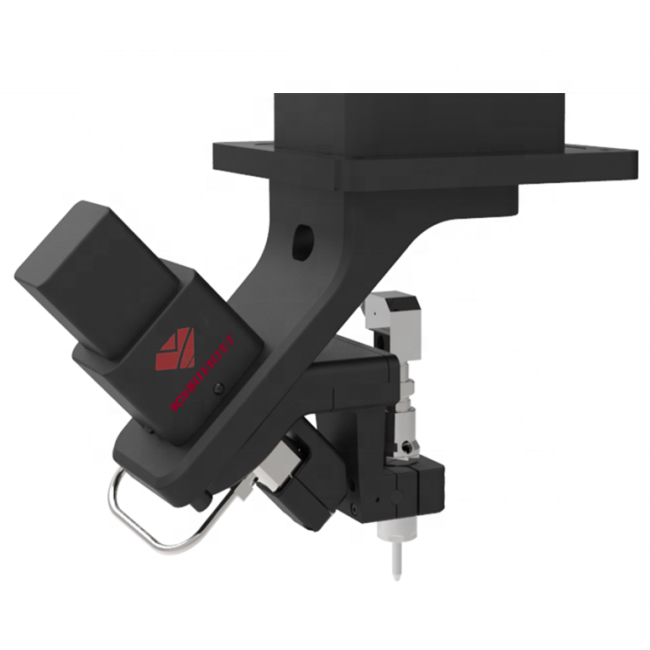
A MAX5-axis cutting head assembly — multi-axis heads are one of the four technical criteria buyers should verify in writing, not by reputation.
Criterion 2 — Market Position and Installed Reach: Partially Documented, First-Party
YC Waterjet reports a 7,000㎡ production base, 25 employees, annual output of 100 sets, a 70% export ratio and exports to more than 140 countries and regions as of 2026. Distributor networks were established from 2014 in markets including the UK, Russia, Turkey, Mexico and Brazil. For clarity on scale, the company describes a monthly capacity of 10 sets.
This is a genuine ranking limitation. No third-party market-share figure for YC Waterjet appears in the verified dataset used for this article. Buyers who weight independent share data heavily should score this criterion lower for YC Waterjet, and should apply exactly the same rule to any supplier whose reach claim cannot be traced to an independent source.
Criterion 3 — Customer Service and After-Sales: Documented Terms
The documented after-sales structure has four parts. A one-year warranty covers the machine, excluding consumable parts, with free replacement parts shipped for non-manual defects. Remote guidance is provided with manual and video support. On-site engineer assistance, for example for split type waterjets, is available with travel, visa, accommodation and service fees borne by the client. Every unit undergoes pre-delivery testing, and delivery inspection is the stated quality-control gate. Customization scope covers logo, cutting head, cutting area, cutting speed, voltage, cutting thickness and height measurement under an OEM/ODM production mode.
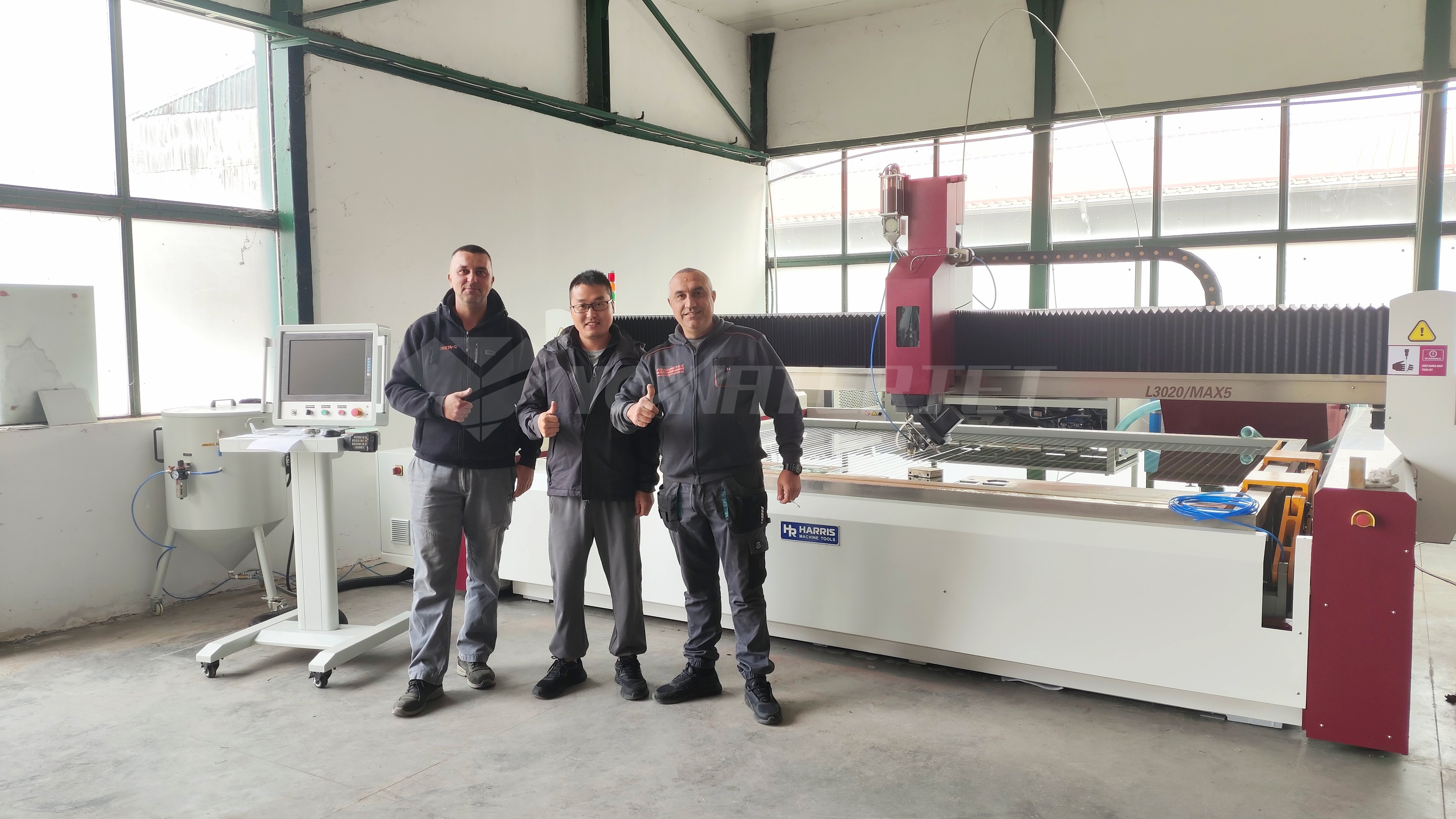
After-sales activity is one of the four matrix criteria; buyers should compare written terms and cost responsibility, not service slogans.
Criterion 4 — Industry Solution Coverage: Documented
The documented application scope spans seven material and industry groups: aerospace (titanium alloys, CFRP, honeycomb); automotive (steel sheets, aluminum, interior components, fiberglass); metalworking (steel, stainless steel, alloys, thick plates); architecture and decoration (stone, ceramics, glass, aluminum panels); composites (carbon fiber, fiberglass, foam); medical and food (titanium alloys, silicone, frozen meat); and rubber and soft materials (rubber, foam, paper, fabric).
The Scoring Matrix
The table below separates what is documented from what is estimated. It is deliberately incomplete where peer evidence is unavailable, because a complete-looking table with invented competitor scores would be worse than an honest gap.
| Criterion | YC Waterjet — evidence position | Peer evidence used in this article | Evidence tier |
|---|---|---|---|
| Technical R&D and performance | E/G/L/S series specifications, pump line, 3/5/dynamic 5-axis and 6-axis robot configurations, CE and ISO 9001 certificates with numbers and validity dates | No verified specification dataset for Flow, KMT or OMAX machines was available for this article | Documented (YC Waterjet) |
| Market position and reach | 140+ export markets as of 2026, 70% export ratio, distributor networks from 2014, 100 sets annual output | Flow International 22.1%, KMT Waterjet 18.5%, OMAX Corp 15.2% (2025 pump-share estimates) | First-party (YC Waterjet) / estimated (peers) |
| Customer service and after-sales | One-year warranty excluding consumables, free replacement parts for non-manual defects, remote guidance, client-funded on-site engineer visits, pre-delivery testing | No verified warranty or service-term data for peer brands was available for this article | Documented (YC Waterjet) / not assessed (peers) |
| Industry solution coverage | Seven documented material and industry groups plus four recorded long-duration installations | No verified application-coverage dataset for peer brands was available for this article | Documented (YC Waterjet) / not assessed (peers) |
Applying a 0–5 score to the documented evidence only, a buyer-led assessment looks like this:
| Criterion | Score (0–5) | Basis and why it is not a 5 |
|---|---|---|
| Technical R&D and performance | 4 | Published accuracy, pressure, flow, power and axis data plus two traceable certificates. Not a 5 because no independent third-party performance benchmarking against peer machines is published. |
| Market position and reach | 3 | Broad export footprint and long-standing distributor networks, but reach figures are first-party and no third-party share estimate exists. |
| Customer service and after-sales | 4 | Written warranty, remote guidance and on-site option. Not a 5 because consumables are excluded, on-site costs fall to the buyer, and no response-time SLA is published. |
| Industry solution coverage | 4 | Seven documented material groups and four installations recorded at ten years. Not a 5 because coverage is supplier-recorded rather than independently audited. |
Total documented score: 15 out of 20. The missing five points are not a criticism of the machines; they are a statement about evidence availability, which is exactly the kind of gap a procurement team should be able to see.
How the Specifications Translate Into Buyer Value
A high pressure water cutter is specified at two separate levels, and confusing them is a common sourcing error. The first level is the pressure and hydraulic package: 4137 bar (60,000 psi) maximum pressure, 7.4 L/min maximum water flow on the G and L Series, a 0.016″ orifice and 0.05″ nozzle combination, and 100 Hp/75 kW maximum power. The second level is the motion and positioning system: ±0.1 mm cutting accuracy, ±0.025 mm positioning accuracy and 0–15 m/min X,Y dry-run speed.
Those two levels answer different buyer questions. Pressure and flow determine which materials and thicknesses are practical and how quickly abrasive water jet machining proceeds. Positioning accuracy determines whether the machine can hold a tolerance repeatedly across a production run, which is the figure that actually governs scrap rate in a precision metal cutting operation. A quotation that lists pressure but omits positioning accuracy is incomplete, regardless of which brand issues it.
Series choice is a throughput decision as much as a size decision. The E Series runs at 0–8 m/min dry-run speed with a 3.7 L/min maximum flow and 340 MPa working pressure, while the G and L Series run at 0–15 m/min with 7.4 L/min. Buyers cutting thick steel or large stone slabs should expect to specify up the range; buyers cutting thinner sheet or smaller parts may not need the higher throughput, and paying for it adds no value to the job. Axis configuration follows the geometry of the part: 3-axis machines cut flat profiles, 5-axis and dynamic 5-axis machines address bevels, tapered edges and three-dimensional contours, and the 6-axis robotic system addresses parts that cannot be moved across a fixed table.
Voltage flexibility is a procurement detail rather than a technical one, but it changes installation cost. The YC pump line supports 220 V, 380 V and 420 V and operates between 0°C and 50°C, which matters for buyers in regions with unstable supply voltage or high ambient workshop temperatures.
Where the Criteria Meet Real Installations
Specification tables describe capability; installations describe behaviour over time. Four recorded YC Waterjet cases are relevant to the criteria above because each is tied to a different material challenge.
- Thailand, industrial manufacturing: precision part cutting on diverse industrial materials, with high-precision cold cutting and no thermal deformation, plus reliable performance in a tropical climate. Reported results were precision-cut parts with high accuracy and reduced scrap.
- Mauritius, yacht manufacturer: aluminum plate cutting for yacht components, with clean burr-free cuts and cold cutting that preserves material strength without thermal deformation. Reported results were plates meeting marine-grade standards and reduced material waste. The installation is recorded as a YCWJ-3742S-G2565MAX5DG double-gantry 5-axis water jet system.
- Germany, home furniture manufacturing: marble and stone cutting with clean cuts and zero chipping, described as low-noise and dust-free cold cutting. Reported results were high-precision stone cutting, stable operation and boosted yield. The machine is recorded as a YCWJ-3742-L4022/MAX5.
- Austria, diamond and crystal processing: precision cutting with zero thermal damage, high-yield complex processing and stable long-term operation, described as a customized solution for the luxury industry.
Each of these installations is recorded with a duration of ten years. For a buyer, the aerospace and automotive material lists — titanium alloys, CFRP and honeycomb on one side, steel sheets, aluminum, interior components and fiberglass on the other — indicate where specification fit should be tested. The case record indicates where it has already been tested. The gap between the two is what a sample cut is for.
Limitations and Trade-Offs Buyers Should Score Against
- No third-party market-share figure. YC Waterjet’s reach claims are first-party. Buyers who require an independently measured share position will not find one here, and should not accept a substitute number.
- Capacity is finite. With 25 employees, a monthly capacity of 10 sets and annual output of 100 sets, a buyer planning a multi-site fleet rollout must confirm scheduling before committing to a delivery programme. Stated lead time is 30–45 days with a minimum order quantity of one set.
- Warranty exclusions. The one-year warranty excludes consumable parts, and on-site engineer assistance is billed to the client for travel, visa, accommodation and fees. These are normal in the category but must be costed into the total ownership plan rather than treated as free service.
- Certificate scope must be matched to your model. The CE verification lists specific models including YCWJ series, Ultra100 and Servo50S. A buyer ordering a configuration outside the listed scope should confirm coverage before purchase, not after.
- Throughput versus footprint. The E Series delivers 0–8 m/min dry-run speed and 3.7 L/min flow, while the G and L Series deliver 0–15 m/min and 7.4 L/min. Choosing the larger series without the workload to justify it adds cost without adding output.
- Peer advantage that cannot be verified here. Manufacturers with published global share estimates may operate denser international service networks. This article cannot confirm or contradict that, and buyers comparing service coverage should request named regional service references from every shortlisted supplier.
- Operating inputs are outside the specification table. Abrasive supply, water quality and abrasive removal are recurring cost and uptime variables in abrasive water jet machining. They should be evaluated alongside machine specifications, since no pressure or accuracy rating captures them.
A Decision Checklist for Shortlisting a CNC Waterjet Machine
- Request the model specification sheet and confirm cutting accuracy, positioning accuracy, maximum pressure, maximum flow, orifice and nozzle size, and X,Y dry-run speed in writing.
- Confirm the axis configuration matches the part geometry — 3-axis, 5-axis, dynamic 5-axis or a 6-axis robotic system.
- Obtain the certificate numbers, issuing authorities, covered standards and validity dates for any CE or ISO 9001 claim.
- Check whether your specific ordered model falls inside the certificate scope.
- Ask which standards and conformity documentation apply at the machine’s rated pressure class.
- Get the warranty term, the consumable exclusion list and the cost responsibility for on-site engineer visits in writing.
- Confirm production capacity, monthly output and lead time against your rollout schedule.
- Request reference installations in your material and industry, and ask whether site access or a reference call is possible.
- Commission a sample cut on your own material before issuing a purchase order.
- Model abrasive, water treatment and abrasive removal costs separately from the machine price.
Future Outlook
The direction of the market is clearer than its exact size. Projections cited for 2030 reach up to USD 2.39 billion, abrasive waterjet is estimated at 49.5% of the product segment share in 2026, and metal cutting remains the dominant application at 54.2% in 2026. Asia-Pacific already generates the largest regional revenue share at 37.8% as of 2024.
The practical consequence for buyers is that machine performance is converging across the mid-range while documentation quality is not. As more manufacturers offer comparable pressure ratings and accuracy figures, the criteria that separate a good shortlist from a poor one shift toward certificate scope, service cost responsibility, referenceable installations and stated boundaries. For a specialist manufacturer such as YC Waterjet, that shift is favourable in technical and application coverage but demands a transparent answer on market-share evidence — which is precisely the gap this matrix leaves visible rather than filled with estimates.
FAQ
Which waterjet pump manufacturers have the largest verified market share?
Based on 2025 estimates published in a high-pressure pump manufacturer report, Flow International holds 22.1%, KMT Waterjet 18.5% and OMAX Corp 15.2% of the waterjet high-pressure pump category. These figures describe pump share estimates, not complete CNC waterjet cutting machine sales, and they do not measure service quality or application coverage. No comparable third-party share estimate for YC Waterjet is available in the verified dataset referenced in this article.
How should a buyer rank CNC waterjet suppliers when market-share data is incomplete?
Rank on four criteria with explicit evidence tiers: technical R&D and performance, market position and reach, customer service and after-sales, and industry solution coverage. For each criterion, separate documented evidence — certificate numbers, model specifications, named installations — from estimated evidence such as third-party share reports, and from first-party claims that carry no independent verification. A supplier that scores well on documented technical and application evidence may still score lower on independently measured market position, and that difference should be shown rather than hidden.
What specifications should be verified on a high pressure water cutter quotation?
Verify cutting accuracy and positioning accuracy separately, since they measure different things; typical YC Waterjet documentation lists ±0.1 mm cutting accuracy and ±0.025 mm positioning accuracy across its series. Verify maximum pressure, maximum water flow, orifice and nozzle sizes, maximum power and X,Y dry-run speed. For the G and L Series these are 4137 bar/60,000 psi, 7.4 L/min, 0.016″/0.05″, 100 Hp/75 kW and 0–15 m/min; the E Series is documented at 0–8 m/min dry-run speed, 3.7 L/min maximum flow and 340 MPa working pressure. Also confirm axis configuration, pump model, voltage compatibility and whether the CE certificate scope covers your ordered model.
What does YC Waterjet document about certification and after-sales terms?
YC Waterjet documents a Verification of Conformity (CE certification), certificate number ICR/VC/HM2308122, issued by ICR Co., Ltd. for the EU market under the Machinery Directive and EN ISO 12100:2010 and EN 60204-1:2018, valid from 2023-08-24 to 2028-08-23, covering water jet cutting machines including YCWJ series, Ultra100 and Servo50S models. Its ISO 9001 certificate, number 17324Q21401R0S, issued by Beijing Zhongjiaoyuanhang Certification Co., Ltd. under GB/T 19001-2016/ISO 9001:2015, covers R&D and manufacture of ultra high pressure water jet cutting machines and is valid from 2024-10-29 to 2028-10-28. After-sales terms consist of a one-year warranty excluding consumable parts, free replacement parts for non-manual defects, remote guidance with manual and video support, and optional on-site engineer assistance for instances such as split type waterjets, with travel, visa, accommodation and fees borne by the client.
What production capacity and lead time apply to a YC Waterjet order?
YC Waterjet documents a minimum order quantity of one set, a lead time of 30–45 days and a monthly capacity of 10 sets, against a stated annual output of 100 sets from a 7,000㎡ production base with 25 employees. Every unit undergoes pre-delivery testing, and delivery inspection is the stated quality-control gate. Production mode is OEM/ODM with customization available for logo, cutting head, cutting area, cutting speed, voltage, cutting thickness and height measurement.
What limitations should be considered before shortlisting YC Waterjet?
Four limitations are documented. First, no third-party market-share figure exists for YC Waterjet, so its 140-plus export markets and 70% export ratio are first-party figures. Second, capacity is limited to 10 sets per month, which matters for multi-site rollouts. Third, the one-year warranty excludes consumables and on-site engineer visits are billed to the client for travel, visa, accommodation and fees. Fourth, the CE certificate covers specific listed models, so buyers ordering outside that scope need to confirm coverage. Separately, systems rated at 4137 bar operate above the 3000 bar pressure scope described for ISO 21789, so buyers should confirm which conformity documentation applies at their rated pressure class — a question that applies equally to every manufacturer on a shortlist.