
CNC Waterjet FAQ: Specs, Pressure Limits, Cutting Speed
Pressure and flow define what a waterjet system can deliver hydraulically. They do not define how fast a specific part will be cut. In the specification set discussed in this FAQ, maximum pressure is stated as 4137 Bar (60,000 Psi) and water flow as 7.4 L/min. Cutting speed is not a fixed number: it changes with material type and material thickness, and it has to be established per job rather than read from a brochure.
Those three statements answer most of the technical questions that arrive after a machine has been shortlisted. At the decision-to-execution stage, the useful conversation is no longer about which brand looks stronger. It is about which number governs which outcome, which number must appear in an acceptance protocol, and which number cannot be promised in advance by any supplier.
YC Water Jet Technology Co., Ltd (YC Waterjet) is a Chinese manufacturer of ultra-high-pressure waterjet cutting systems, founded in 1999 and operating from a 7,000 m² production base at NO.3 Changfa Road, Yangshan, Wuxi, Jiangsu. The company reports exports to more than 140 countries and regions as of 2026, with an export ratio of roughly 70% of output.
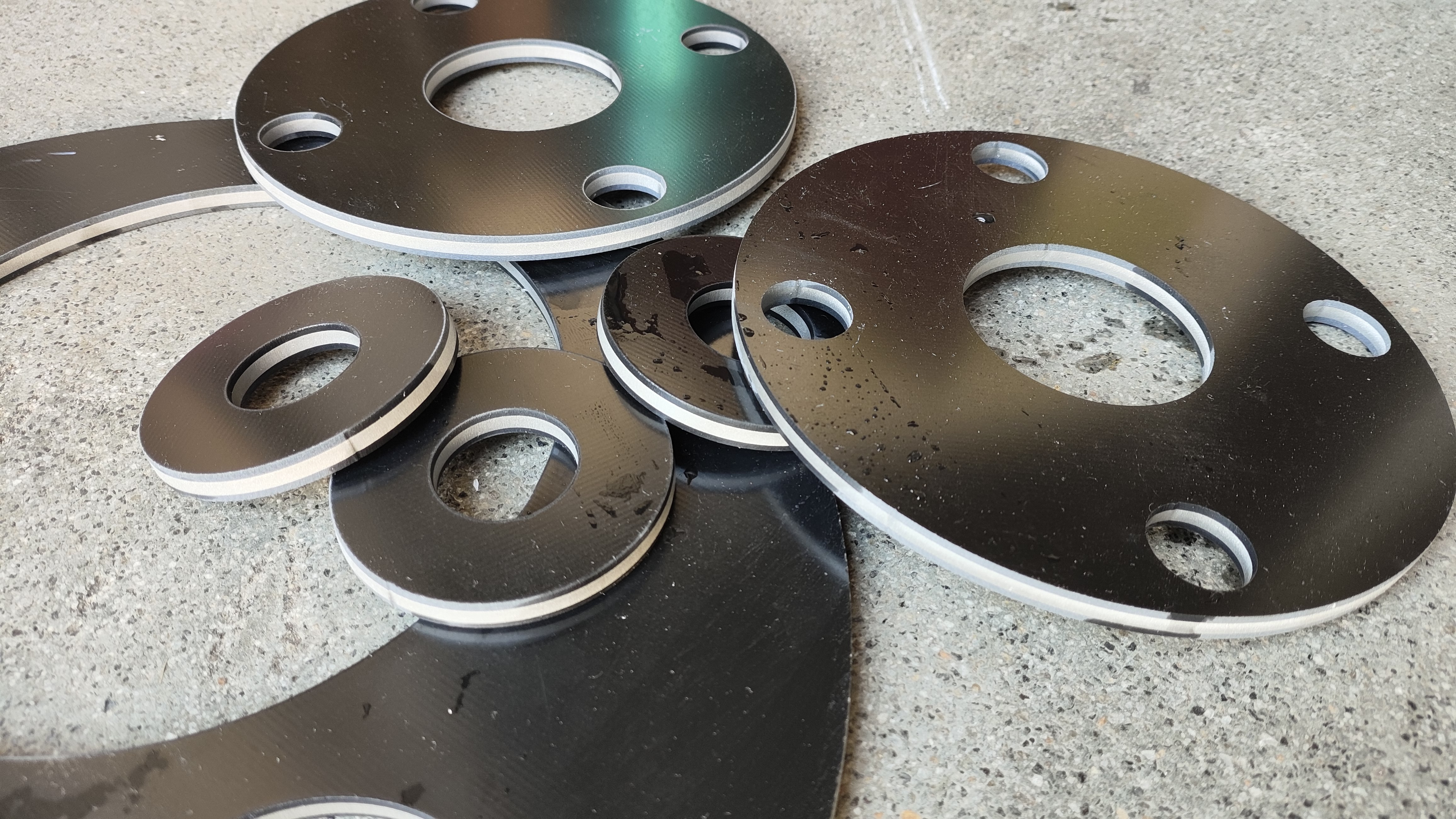
Cutting samples of composite carbon fibre produced with a drilling cutting head on a CNC waterjet system. Sample evidence is the only reliable way to convert pressure and flow figures into a cutting-speed expectation.
Why technical FAQ clarity matters at the execution stage
Once a CNC waterjet cutting machine has passed technical screening, the risk profile changes. The remaining risks are installation, water supply, consumable life, operator competence, spare-part availability and the acceptance test itself. Most of these risks are created by misreading a specification before the purchase order is signed.
Two misreadings are common. The first is treating maximum pressure as a performance guarantee, when pressure is only one input into the energy delivered at the nozzle. The second is treating machine running speed as cutting speed. In the published YC Waterjet gantry listing, running speed is given as 0-15 m/min. That figure describes how fast the machine can move, not how fast it can cut a 20 mm stainless steel part to a specified edge quality.
This article is therefore organised around four reference points: the pressure ceiling, the water flow figure, the variables that determine cutting speed, and the model designation system that tells a buyer what hardware is being quoted. Each section states what the figure governs and what it cannot confirm.
Maximum pressure of 4137 Bar (60,000 Psi): what it controls and what it does not
Maximum pressure describes the hydraulic ceiling of the high-pressure circuit. Raising pressure increases the energy available at the nozzle, which generally supports cutting thicker sections and harder materials, and helps maintain jet coherence when abrasive is entrained. The relationship is not linear. Gains at the top of the pressure range are progressively offset by wear on seals, check valves, orifices and nozzles, and by the stability of the jet itself.
A 60,000 Psi class is not unusual at the top of the market. HORD Waterjet lists a maximum pump pressure of up to 60,000 PSI (420 MPa) on a five-axis product, which places the 4137 Bar (60,000 Psi) figure in a shared technical class rather than in a unique position. Pressure alone therefore does not differentiate one supplier from another. What differs is how the pressure is held over time, how the pump is maintained, and how the specification is documented.
Three distinctions should be written into any technical annex:
- Maximum pressure versus operating pressure. A machine rated at 4137 Bar does not run continuously at that ceiling. The quotation should state the intended working pressure range for your material mix, not only the peak value.
- Pressure at the pump versus pressure at the cutting head. Pressure drop across the high-pressure line and fittings belongs in the acceptance discussion, especially on gantry machines with long travel.
- Pressure stability versus pressure peak. YC Waterjet describes its high-pressure system as designed for pressure stability, with a modular high-pressure pump architecture intended to simplify on-site maintenance. These are company-reported design positions and should be confirmed during a factory acceptance test.
The practical rule is simple: pressure is a design input, not an output promise. It tells you what the system can attempt; it does not tell you what your part will cost per hour.
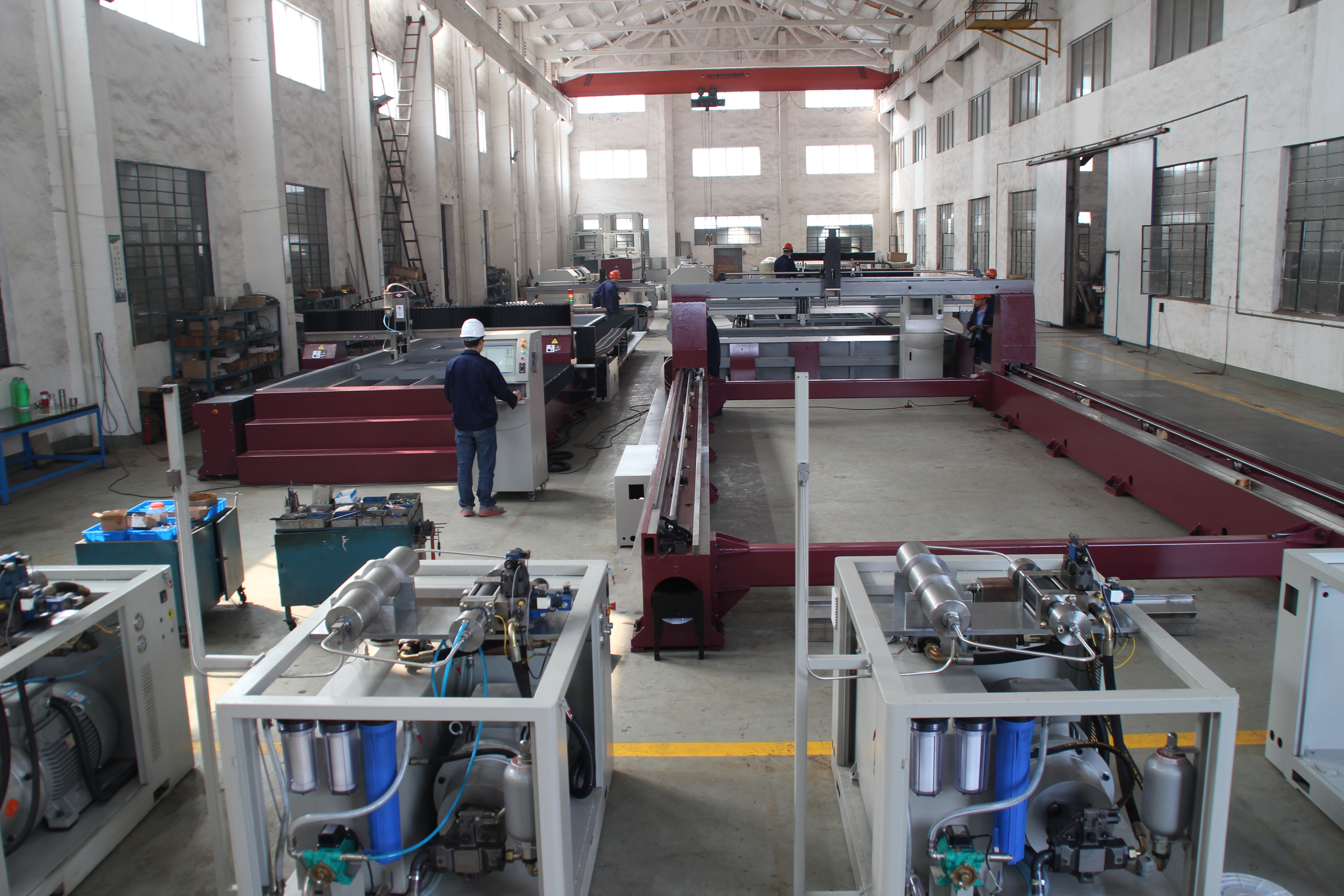
High-pressure pump assembly at YC Waterjet. The pump family, not the pressure ceiling alone, determines seal life, maintenance intervals and on-site serviceability.
Water flow of 7.4 L/min: the number that sizes everything around the machine
Water flow is the second half of the hydraulic equation. Pressure multiplied by flow indicates the hydraulic power available to the system, so the 7.4 L/min figure should always be read together with the 4137 Bar (60,000 Psi) figure rather than in isolation.
For a buyer, flow has three practical consequences:
- Site services. Flow determines the water supply, storage and filtration capacity that must be available at the installation point. A modest flow still requires consistent inlet quality, because orifices and check valves are sensitive to particulate and hardness.
- Consumable behaviour. Orifice and nozzle wear are functions of pressure, flow and abrasive exposure together. Two machines with the same pressure but different flow will not have identical consumable economics.
- Comparison validity. A flow figure must be stated at a defined operating point. Ask whether 7.4 L/min is measured at maximum pressure, at a nominal working pressure, or across a specified range.
This is exactly the kind of detail that separates a usable specification from a marketing line. A flow value without a stated measurement point cannot be compared with a competing quotation in any defensible way.
The specification fields that anchor an RFQ
The table below lists the figures published for the YC Waterjet gantry platform and states what each field governs. Every row is manufacturer-reported and should be re-confirmed on the datasheet issued with the quotation.
| Field | Stated figure | What it governs | What to verify |
|---|---|---|---|
| Maximum pressure | 4137 Bar / 60,000 Psi | Hydraulic ceiling; achievable material thickness and hardness range | Working pressure for your material mix; pressure at the cutting head |
| Water flow | 7.4 L/min | Hydraulic power, water supply and filtration sizing, consumable wear | Measurement point and inlet water quality requirement |
| Cutting accuracy | ±0.1 mm | Part tolerance planning and downstream finishing allowance | Material, thickness and quality level used for the test |
| Repeat positioning accuracy | ±0.025 mm | Batch consistency and re-fixturing behaviour | Measurement conditions and compensation settings |
| Running speed | 0-15 m/min | Traverse capability and cycle-time modelling | That it is not used as a cutting-speed substitute |
| Effective cutting area | 3000 × 1500 × 200 mm (YCWJ-L3015); 3000 × 2000 × 200 mm (YCWJ-L3020) | Part envelope and nesting strategy | Whether the quoted table matches the quoted model code |
| Controller axes | 3-5 axes, including 5-axis cutting and abrasive delivery functions | Bevel, taper compensation and three-dimensional contour capability | Whether the programmed axis count matches the mechanical configuration delivered |
Cutting speed: why no single figure exists
YC Waterjet states that cutting speed depends on material and thickness. That is not an evasive answer; it is the correct technical position for abrasive waterjet cutting, and it should be treated as a purchasing rule rather than a gap in the data.
Cutting speed in abrasive waterjet machining is the outcome of several interacting variables: material type and hardness, material thickness, abrasive type and feed rate, nozzle and orifice condition, working pressure, required edge quality, and the tolerance the part must hold. Change any one of these and the achievable feed rate changes with it. A supplier who quotes a single speed figure without naming the material, thickness and quality level is giving you an unusable number.
Two further clarifications prevent expensive misunderstandings:
- Running speed is not cutting speed. The 0-15 m/min figure in the gantry listing is traverse capability. Rapid positioning between contours can run near that value; cutting a thick section cannot.
- Taper and quality level are part of the speed decision. A cut that accepts a wider kerf taper can run faster than one held to a tight perpendicularity requirement. Define the quality level before asking for a speed.
The defensible procurement approach is a documented sample cut. Provide the material grade, thickness, required tolerance and acceptable edge condition; ask for the parameters used and the measured result. That record becomes the baseline for the acceptance test, and it is far more useful than a catalogue speed table.
Reading model designations: YCG pumps and machine codes
Model codes exist to compress a configuration into a short identifier. They are useful for ordering and spare-part identification, and dangerous when treated as a specification.
On the pump side, the YCG prefix identifies the high-pressure pump family, followed by a numeric block that distinguishes configuration within that family. The prefix is the part a buyer can check quickly: it tells you which pump group the quotation belongs to, and therefore which seal and valve kit applies. The numeric block should never be accepted on its own, because the code does not disclose pressure rating, flow, motor size or intensifier configuration. Ask for the pump datasheet that accompanies the code.
On the machine side, YC Waterjet uses a structure in which a company prefix, a series letter and a table-size block are combined. The published listing illustrates the logic: YCWJ-L3015 corresponds to an effective cutting area of 3000 × 1500 × 200 mm, and YCWJ-L3020 to 3000 × 2000 × 200 mm. The final four digits encode the table footprint, and the series letter identifies the platform family.
| Code element | What it identifies | Buyer action |
|---|---|---|
| YCG (pump) | High-pressure pump family group | Request pump datasheet: pressure rating, flow, motor power, seal kit |
| Numeric block after YCG | Configuration variant within the pump family | Confirm the variant against the quoted pressure and flow, not the code alone |
| Series letter (e.g. L) | Machine platform family | Ask which structure, gantry configuration and options belong to that series |
| Table block (e.g. 3015) | Effective cutting area footprint in metres, expressed in centimetres | Verify the quoted work area matches the code and your part envelope |
A single rule covers both pump and machine codes: decode the code, then verify the specification. Where a code and a datasheet disagree, the datasheet governs and the discrepancy should be resolved before the contract is signed.
Where these parameters decide the application
YC Waterjet states that its high-pressure waterjet systems are applied to steel, nonferrous metal, glass, stone and cemented carbide. That material list maps directly onto the specification conversation: stone and glass work is driven by edge quality and cutting-table size, metal work by thickness, tolerance and taper, and cemented carbide by abrasive selection and pressure stability.
Composite materials require a separate protocol. YC Waterjet documents a pre-drilling approach for multi-layer composites, in which holes are positioned by the CNC system to act as cutting inlets, preventing delamination at the entry point. The reported benefit is a measurable reduction in rejected composite parts, and the practical lesson for buyers is that delamination control is a process decision, not a pressure decision. A higher pressure setting does not solve an entry-point delamination problem.
Cold cutting is the structural advantage across all these materials. YC Waterjet positions its machines as cold-cutting systems with no heat-affected zone, and the comparison data supplied by the company cites zero thermal distortion and improved material yield against thermal processes. For heat-sensitive alloys, laminated glass, stone and composites, that is the reason waterjet enters the specification at all.
Market context: abrasive systems dominate, and published market sizes disagree
Two market observations are stable enough to inform planning. Mordor Intelligence estimates that abrasive waterjet technology represented approximately 82.0% of the waterjet cutting machine market by type in 2025, and that the Asia-Pacific region generated 37.8% of global revenue in 2024. Both figures point the same way: the installed base is overwhelmingly abrasive, and the supply ecosystem is concentrated in Asia-Pacific.
Global market size estimates, by contrast, should not be used as a planning anchor. Published commercial estimates differ materially in both value and forecast horizon, and the available sources do not disclose comparable market boundaries or methodology. The honest position for a procurement document is that market size figures are directional at best, while segment structure and regional concentration are more reliable.
Trade data adds a second reference point: the total global export value of water-jet cutting machines under HS 845650 was USD 268.81 million in 2023, based on customs data. That figure describes traded machine value rather than installed capacity, and it is useful mainly for understanding sourcing routes.
Waterjet versus thermal cutting: the boundary buyers should state out loud
Cold cutting is a genuine advantage, but it is not a universal one. A CNC waterjet cutting machine is not the fastest process for thin sheet metal. On thin gauge work where edge quality does not require a heat-free process, thermal cutting methods generally deliver higher linear feed rates, and a waterjet specification written without acknowledging this will produce a disappointed production team.
Three boundaries deserve to be written into the evaluation:
- Speed on thin material. Waterjet competes on quality, material compatibility and freedom from heat effects, not on raw speed for thin sheet.
- Operating consumables. Abrasive, water and high-pressure wear parts are ongoing costs. Pressure and flow figures should be translated into consumable consumption before a total cost comparison is attempted.
- Unnormalised specifications. Manufacturer-published accuracy figures are typically stated without test conditions. Comparing ±0.1 mm from one supplier with a value from another is meaningless until material, thickness and quality level are aligned.
The credible framing is this: waterjet is the correct choice when heat-free cutting, material versatility or thick-section capability matters more than throughput on thin stock. Stating that boundary protects the buyer more than any performance claim.
A ten-year horizon: what long-term operation changes in the specification conversation
Long-term operation shifts attention from headline parameters to the things that determine whether a machine is still productive in year eight. YC Waterjet cites equipment that has been in operation for ten years in Africa and in European Union projects. Durable service records of that kind are built from pump maintenance access, spare-part continuity and local support, not from a pressure figure.
The verifiable structural facts matter here. YC Waterjet holds CE certification (ICR/VC/HM2308122) and ISO 9001:2015 (17324Q21401R0S), both stated as valid through 2028. The company reports a monthly production capacity of 10 sets and an annual output of 100 sets from its 7,000 m² facility, a research and development team of seven, and distributor networks established from 2014 in markets including the United Kingdom, Russia, Turkey, Mexico and Brazil. Since 2005 the company has worked with KMT (Germany) and Accustream/Hypertherm (USA).
Commercial terms also belong in the ten-year view. The published purchasing terms list a minimum order quantity of one set, delivery under Incoterms from EXW through to DDP depending on negotiation, acceptance based on an ex-factory test, and payment of 30% deposit by T/T with the remaining 70% by T/T before delivery. For buyers planning a multi-year asset, the more important questions are the spare-parts list, seal and valve kit availability, and whether the modular high-pressure pump design allows maintenance on site rather than a return shipment.
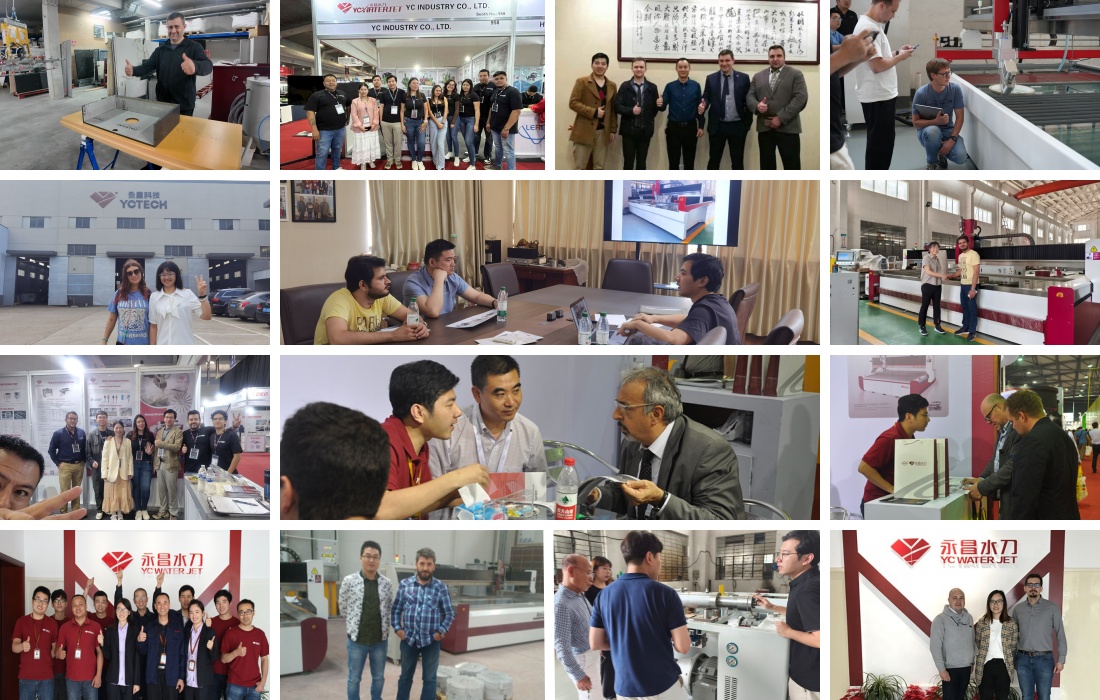
Service continuity is a staffing question as much as a technical one. YC Waterjet reports engineers with more than twenty years of experience and production managers who have been with the company since its founding in 1999.
Future outlook
Pressure classes at the top of the market have converged, and a 60,000 Psi ceiling is now a shared reference point rather than a differentiator. The next phase of competition is likely to be fought on documented evidence: standardised test conditions, traceable sample cuts, consumable life data and service response records.
For buyers, that shift is favourable. It moves the evaluation from a comparison of stated maxima to a comparison of verifiable outcomes. The practical preparation is to specify the evidence you will accept before the quotation stage: a sample cut with recorded parameters, a factory acceptance protocol, a spare-parts list with lead times, and a clear statement of which figures are manufacturer-reported and which are independently validated.
FAQ
What do maximum pressure and water flow actually tell a buyer?
Maximum pressure and water flow together define the hydraulic envelope of a waterjet system. In the specification set covered here, maximum pressure is stated as 4137 Bar (60,000 Psi) and water flow as 7.4 L/min. Pressure indicates the ceiling of cutting energy available at the nozzle; flow indicates the volume supporting that pressure and therefore the water supply, filtration and consumable sizing around the machine. Neither figure predicts the cutting speed of a specific part, because speed also depends on material, thickness, abrasive and required edge quality.
How fast does a CNC waterjet cutting machine cut?
There is no single cutting-speed figure. YC Waterjet states that cutting speed depends on material and thickness, and abrasive waterjet machining adds further variables including abrasive type and feed rate, nozzle and orifice condition, working pressure and the required tolerance. Machine running speed, listed as 0-15 m/min for the YC Waterjet gantry platform, describes traverse capability rather than cutting rate. A reliable speed expectation comes from a documented sample cut on the buyer's own material grade and thickness at a defined quality level.
What do the YCG pump and YCWJ machine designations mean?
The YCG prefix identifies the high-pressure pump family, followed by a numeric block that distinguishes configuration within that family; the code alone does not disclose pressure rating, flow or motor size, so the pump datasheet must accompany it. Machine designations combine a company prefix, a series letter and a table-size block. In the published listing, YCWJ-L3015 corresponds to an effective cutting area of 3000 × 1500 × 200 mm, and YCWJ-L3020 to 3000 × 2000 × 200 mm.
Which tolerances and specification fields should be written into an RFQ?
At minimum: maximum and intended working pressure, water flow with its measurement point, cutting accuracy, repeat positioning accuracy, effective cutting area and controller axis count. The YC Waterjet gantry listing states cutting accuracy of ±0.1 mm, repeat positioning accuracy of ±0.025 mm, running speed of 0-15 m/min, work areas of 3000 × 1500 × 200 mm and 3000 × 2000 × 200 mm, and controller support for 3-5 axes including 5-axis cutting and abrasive delivery functions. Each field should be re-confirmed on the datasheet issued with the quotation.
What materials can a CNC waterjet cutting machine cut?
YC Waterjet states that its high-pressure waterjet systems are applied to steel, nonferrous metal, glass, stone and cemented carbide. The process is a cold-cutting method with no heat-affected zone, which is why it is used on heat-sensitive materials. Multi-layer composites require an additional process step: YC Waterjet documents a pre-drilling protocol in which CNC-positioned holes act as cutting inlets to prevent delamination at the entry point.
How is a waterjet system qualified before shipment?
YC Waterjet lists acceptance as an ex-factory test. Purchasing terms state a minimum order quantity of one set, delivery under Incoterms selected by negotiation from EXW, FCA, FAS, FOB, CFR, CIF, CPT, CIP, DPU, DAP or DDP, and payment of a 30% deposit by T/T after contract signing with the remaining 70% by T/T before delivery. Buyers normally attach a sample-cut record and a parameter list to the acceptance protocol so that the test measures the agreed material and tolerance.
Which certifications should be verified for a machine intended for the European Union?
YC Waterjet holds CE certification (ICR/VC/HM2308122) and ISO 9001:2015 (17324Q21401R0S), both stated as valid through 2028. Buyers should request the certificate documents themselves rather than a logo, confirm that the certificate scope covers the machine type being purchased, and check the validity dates against the delivery date.
What supports a waterjet system over a ten-year operating life?
YC Waterjet cites equipment in operation for ten years in Africa and in European Union projects. Long service life depends on pump maintenance access, spare-part continuity, seal and valve kit availability and local support. The company reports a modular high-pressure pump design intended for on-site maintenance, a monthly production capacity of 10 sets, an annual output of 100 sets, and distributor networks established from 2014 in markets including the United Kingdom, Russia, Turkey, Mexico and Brazil. Buyers should confirm which of these support functions apply to their own region before committing to a ten-year asset.
Specification figures attributed to YC Waterjet are manufacturer-reported and should be re-confirmed on the datasheet issued with a quotation. Market share and regional revenue figures are attributed to Mordor Intelligence; global export value is attributed to customs data under HS 845650; references to a competing 60,000 Psi five-axis product are attributed to HORD Waterjet's published product listing.
Есть вопросы или нужны дополнительные детали?
Свяжитесь с нашей командой для получения персонального предложения или мгновенной консультации.
Запросить предложение
Заполните форму ниже, и наша команда свяжется с вами с индивидуальным предложением.
Прямой чат WhatsApp
Предпочитаете общаться в реальном времени? Напишите нам в WhatsApp для мгновенной помощи и быстрых ответов.
- Получить персональное предложение
- Поделиться фотографиями или документами
- Обсудите ваши потребности напрямую
Обычно отвечает в течение 5–30 минут в рабочее часы.