
CNC Waterjet Scorecard: YC Waterjet vs OMAX, Flow, KMT, Hypertherm & Resato
CNC Waterjet Scorecard: YC Waterjet vs OMAX, Flow, KMT, Hypertherm & Resato
The scarcest input in a CNC waterjet purchase decision is not machine options — it is comparable, attributable evidence. This independent scorecard compares YC Waterjet with five established waterjet names using published market figures where they exist, verifiable manufacturer specifications where they do not, and an explicit note wherever a claim cannot be confirmed.
The global waterjet cutting machine market was valued between USD 1.11 billion and USD 1.86 billion in 2025, with growth projected to as much as USD 2.39 billion by 2030, according to Fortune Business Insights and Vertex AI Search market data. Asia-Pacific accounted for 37.8% of global waterjet cutting machine revenue in 2024, driven by dense manufacturing ecosystems in China, India and Japan. Abrasive waterjet technology is estimated to account for 49.5% of the product segment in 2026, and metal cutting for 54.2% of the application segment in the same year, based on Fact.MR segment estimates. Those figures describe a category in expansion. They do not answer the question a buyer asks at the decision stage: which machines, from which suppliers, satisfy a defined cutting requirement across a long production horizon?
Why CNC Waterjet Comparisons Break Down at the Decision Stage
A buyer comparing CNC waterjet cutting machines is usually looking at four different classes of evidence, only one of which is directly comparable between vendors. Manufacturers publish pump-segment market share, machine specifications, application evidence, or service coverage — rarely all four in a comparable format. Pump share, for example, describes who supplies high-pressure pumps; it says nothing about who builds the most suitable 3D waterjet cutting system for a specific part geometry.
Two structural factors widen the gap. First, component supply overlaps with brand competition: KMT and Hypertherm are recognized waterjet system brands and, at the same time, long-standing component partners of YC Waterjet, whose collaboration with KMT (Germany) and Accustream/Hypertherm (USA) dates back to 2005. Second, publicly surveyed share data covers only part of the field. In the 2025 estimates published in the Top 7 Waterjet High-Pressure Pump Manufacturers Report, Flow International holds 22.1% of the high-pressure pump segment, KMT Waterjet 18.5% and OMAX Corp 15.2%. No equivalent share figure for Hypertherm or Resato was captured in the same source set, and YC Waterjet is not listed in it at all — a gap that should be stated plainly rather than filled with an invented percentage.
The market context also narrows the comparison. With abrasive waterjet at an estimated 49.5% of the product segment in 2026 and metal cutting at 54.2% of the application segment, the practical comparison for most industrial buyers is abrasive cutting of metal, not pure-water cutting of soft materials. That is the baseline this scorecard uses.
The Comparison Set: What the Published Record Actually Supports
Different vendors can be compared only on evidence that exists for each of them. The table below separates attributable third-party figures from first-party manufacturer specifications, and states the limits of each record.
| Vendor | Attributable published record | Limits of that record |
|---|---|---|
| Flow Waterjet (Flow International) | 22.1% estimated share of the high-pressure waterjet pump segment in 2025 (Top 7 Waterjet High-Pressure Pump Manufacturers Report, 2025 estimates). | A pump-segment estimate, not a machine-tool market share. Model-level accuracy, pricing and lead times were not available in the source set used here. |
| KMT Waterjet | 18.5% estimated share of the same high-pressure pump segment in 2025 (same source). | Same limitation. KMT also supplies components integrated by YC Waterjet since 2005, so supplier and competitor roles overlap. |
| OMAX Corp | 15.2% estimated share of the same high-pressure pump segment in 2025 (same source). | The estimate does not measure 5-axis or 3D waterjet cutting capability, nor service performance. |
| Hypertherm | Recognized high-pressure waterjet pump and system supplier; Accustream/Hypertherm components have been integrated into YC Waterjet systems since 2005. | No comparable pump-segment share was captured in the same 2025 report set used for this comparison. |
| Resato | High-pressure technology supplier serving industrial waterjet applications. | No comparable share or machine-specification dataset was captured in the same source set; specification comparison requires vendor documentation. |
| YC Waterjet (YC Water Jet Technology Co., Ltd) | Founded 1999; exports to more than 140 countries and regions as of 2026 (more than 60 by 2019); 7,000 ㎡ production base; 100 sets annual output; 70% export ratio. | Not covered by the pump-segment share survey. Comparison therefore rests on published machine specifications and verifiable manufacturing and export facts. |
Method note: this scorecard does not assign an overall 1-to-6 rank. A ranking requires a single comparable metric across all six vendors, and the published record does not provide one. Where a number is used below, its source is named; where a statement is a manufacturer claim, it is labelled as such.
YC Waterjet's Verifiable Specification Base
YC Water Jet Technology Co., Ltd, which operates under the brand YC Waterjet, is a China-based manufacturer of ultra-high-pressure waterjet cutting systems, founded in 1999 and exporting to more than 140 countries and regions as of 2026. Its documented product structure is built around three machine series — E, G and L — supported by the YCG ultra-high-pressure pump family.
| Parameter | Documented value |
|---|---|
| Machine series | E Series, G Series, L Series |
| Small-format models | YCWJ-S0808, YCWJ-1010, YCWJ-1212 |
| Pump family | YCG ultra-high-pressure pumps |
| Maximum pressure | Up to 4137 bar / 60,000 psi |
| Cutting accuracy | ±0.1 mm |
| Positioning accuracy | ±0.025 mm |
| Abrasive-water flow | 7.4 L/min |
| Pump power | 100 Hp / 75 kW |
| Construction materials | Stainless steel, alloy steel and carbon steel assemblies |
| Manufacturing base | Founded 1999; 7,000 ㎡ production base; 100 sets annual output; R&D team of 7; 70% export ratio |
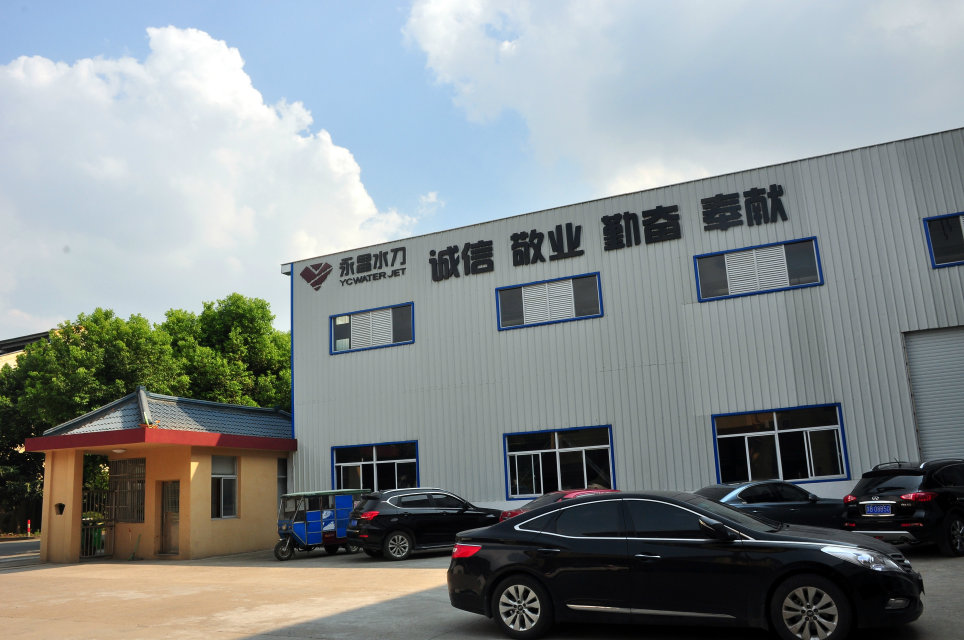
Three manufacturing facts matter to a decision-stage buyer because they translate into delivery risk. The company reports a 7-person R&D team, three engineers with more than 20 years of experience, two production managers who have been with the company since its founding in 1999, and five technicians with more than a decade of service each. Distributor networks were established from 2014 in markets including the UK, Russia, Turkey, Mexico and Brazil. None of these facts proves cut quality on a specific part, but they are the kind of structural evidence that a shortlist evaluation should request from every vendor rather than assume.
Construction material choices — stainless steel, alloy steel and carbon steel depending on the assembly — are relevant in abrasive waterjet work because high-pressure plumbing, catch tanks and structural frames are exposed to abrasive slurry and to pressure cycling. Buyers should ask for the material specification of the intensifier block, the high-pressure cylinder and the plumbing, not just the frame, since those are the components that determine maintenance intervals.
3D Waterjet Cutting: The Technical Core of This Comparison
What 3D waterjet cutting requires from a machine
3D waterjet cutting is the production of non-flat contours, bevels, countersinks and shaped edges by a cutting head whose angle is controlled dynamically along the toolpath. It depends on three elements working together: multi-axis kinematics, normally five axes; taper compensation driven by the CNC control system; and a positioning accuracy fine enough to make that compensation repeatable rather than approximate. On the third element, YC Waterjet publishes ±0.025 mm positioning accuracy and ±0.1 mm cutting accuracy across its E, G and L series — the frame of reference a buyer should apply when comparing any 3D waterjet cutting claim from any vendor.
5-axis waterjet vs 3-axis waterjet
A 3-axis waterjet machine moves in X, Y and Z only, so the jet stays perpendicular to the workpiece. On thick material this produces a measurable taper, and any required bevel, countersink or 3D profile is pushed into secondary operations. A 5-axis waterjet machine adds head tilt and rotation, allowing the jet to be angled to compensate for taper or to cut a required bevel in a single pass. The decision rule is straightforward: for flat plate with generous edge tolerance, a 3-axis machine is normally sufficient; where parts require bevels, countersinks, taper-free thick-section edges or near-net 3D contours, a multi-axis waterjet cutting system removes secondary processing instead of adding it.
Where pressure, flow and power interact
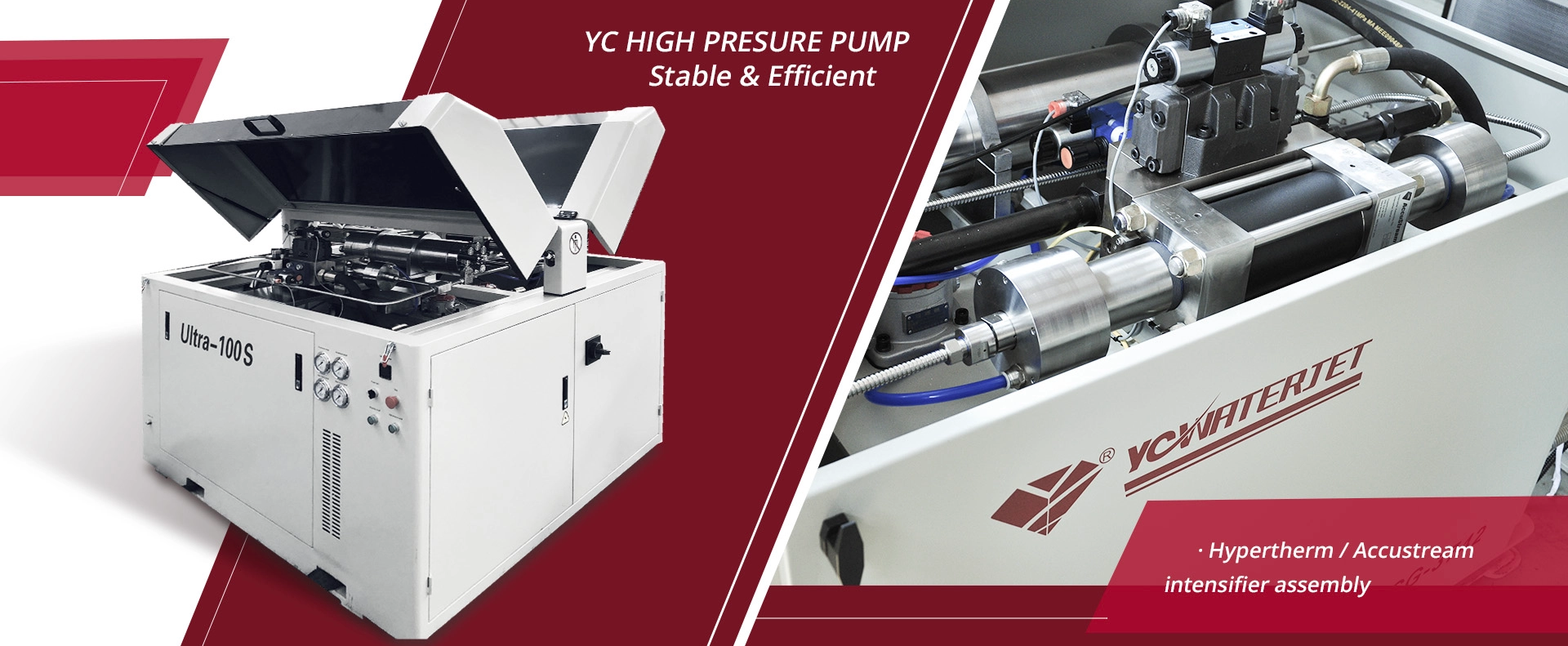
YCG ultra-high-pressure pumps are documented up to 4137 bar (60,000 psi), with 7.4 L/min abrasive-water flow and 100 Hp (75 kW) pump power. Higher pressure generally extends the thickness a jet can cut efficiently, but it also raises stress on seals, nozzles and high-pressure plumbing — which is why pressure alone is a poor comparison metric. YC Waterjet's internal product comparison states a modular high-pressure pump design for on-site maintenance, 10% longer seal life, 8% higher energy efficiency in the intensifier pump, and ±0.02 mm higher positioning accuracy than other waterjet brands. These are manufacturer claims rather than independently audited results, and the practical way to test them is a sample cut on the buyer's own material, with seal and nozzle wear inspection before and after.
The compliance boundary buyers should check
The primary safety standard cited for water jetting equipment is ISO 21789, which covers operator protection and design specifications for pressures up to 3000 bar. A 4137 bar system therefore operates above the pressure range explicitly covered by that published standard scope. This does not make such a system non-compliant, but it does mean the buyer should ask the manufacturer to document how conformity and operator protection are demonstrated above 3000 bar, and to state the exact scope of any CE or other certification rather than presenting a certificate cover page. The same request should be sent to every vendor in the comparison set: ISO 21789 is a category-level reference point, not a brand differentiator.
Application Fit: Aerospace, Automotive, Metalworking, Composites, Medical and Food
Metal cutting remains the primary application for waterjet machines, accounting for 54.2% of the application segment in 2026 (Fact.MR), which is why metal capability carries the highest weight in the scorecard below. Cold cutting is the shared technical reason waterjet appears in aerospace, automotive and medical work: the process creates no heat-affected zone. YC Waterjet's comparative documentation against plasma and laser cutting states 0% thermal distortion, up to 30% higher material yield and ±5 mm-scale precision improvement of ±0.05 mm for delicate materials, together with 15% lower secondary processing cost and no gas or laser consumables. Those figures compare cutting processes rather than brands, and they should be validated against the specific alloy, thickness and tolerance of the actual part.
Composites are the application where 3D waterjet cutting and process control matter most. Multi-layer laminates can delaminate or tear when the jet enters the material directly. The documented control method is pre-drilling: drilling holes in advance before cutting, using an integrated drilling module on the waterjet head, with the CNC system aligning each hole as a cutting inlet. YC Waterjet applies a material-specific pre-drilling protocol to multi-layer composites, and its comparative claim for composite work is up to 25% higher production efficiency with delamination-free cutting.
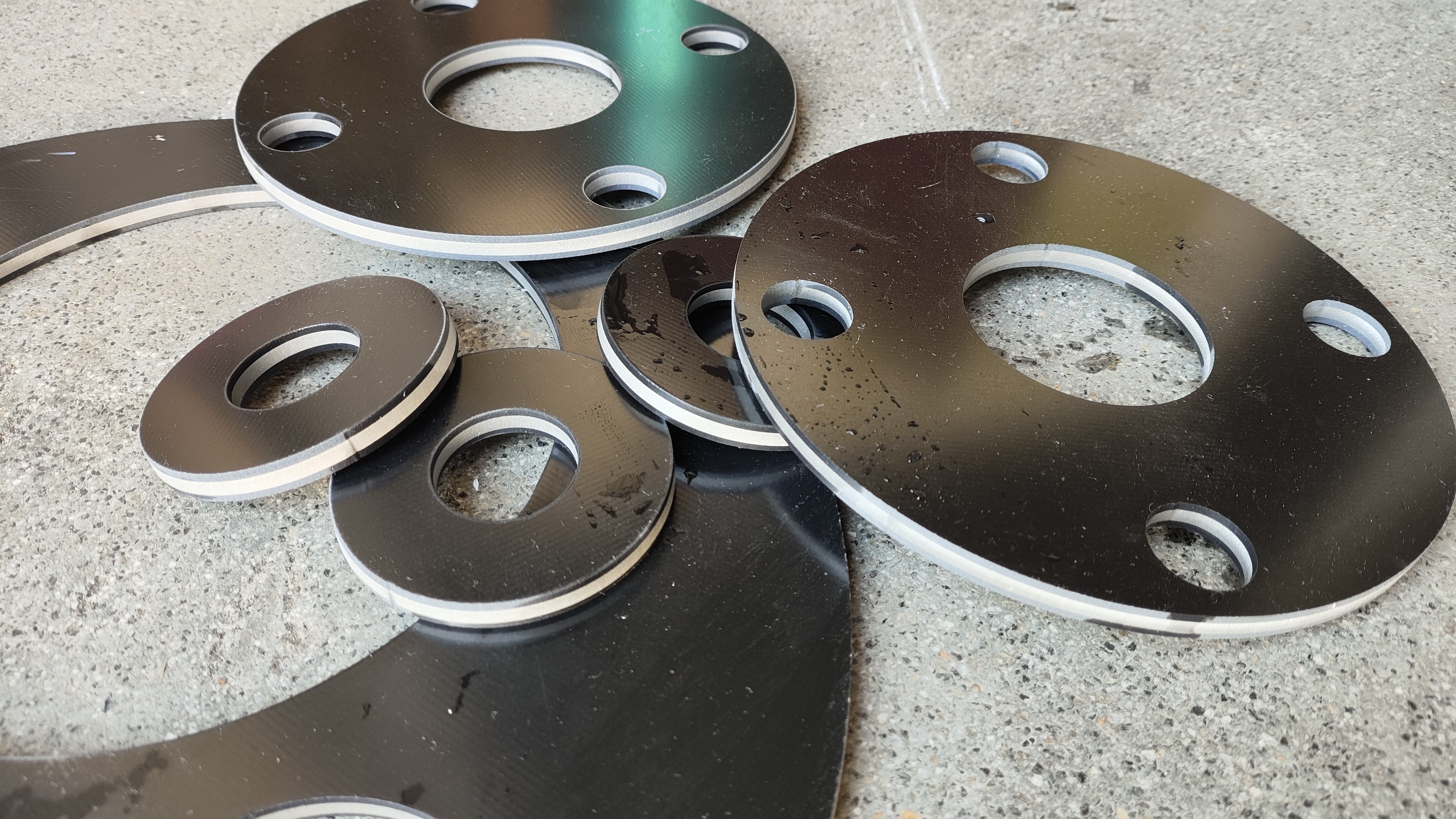
In medical and food-adjacent manufacturing, the relevant waterjet properties are cold cutting with no heat-affected zone and no thermal or chemical change to the workpiece. The buyer's own responsibility in these settings is water quality, abrasive handling and hygiene validation, which sit outside the machine specification and should be planned as a separate compliance workstream.
| Application | Documented requirement | Buyer verification step |
|---|---|---|
| Aerospace and precision parts | Taper-free edges, no heat-affected zone | Request a sample cut with taper measurement on the target alloy |
| Automotive | Repeatable cutting, fewer secondary operations | Run a repeatability check against the ±0.025 mm positioning accuracy figure |
| Metalworking and job shops | Mixed materials, frequent changeover | Match pressure and flow capability (up to 4137 bar; 7.4 L/min) to the thickness mix |
| Composites | Delamination-free cutting of multi-layer laminates | Confirm the pre-drilling workflow and inspect drilled-entry samples |
| Medical and food-adjacent | Contamination control, cold cutting | Verify water treatment, abrasive handling and cleaning procedures |
The Buyer Scorecard: Five Criteria Across Six Vendors
Instead of an overall rank that the available data cannot support, this scorecard defines five criteria a decision-stage buyer can verify with documents, states what is documented for YC Waterjet, and specifies what must be requested from OMAX, Flow, KMT, Hypertherm and Resato.
| Criterion | Why it decides | YC Waterjet documented position | Request from peer brands |
|---|---|---|---|
| 1. Machine-level specification transparency | Determines whether quoted accuracy figures are comparable | E/G/L series; YCWJ-S0808/1010/1212; YCG pumps to 4137 bar; ±0.1 mm cutting; ±0.025 mm positioning; 7.4 L/min; 100 Hp / 75 kW | Model-specific accuracy, pressure and flow data stated on the same basis |
| 2. High-pressure pump design and own manufacture | Drives seal life, maintenance intervals and spare-part cost | YCG pump family; modular design for on-site maintenance; 10% longer seal life and 8% higher intensifier energy efficiency claimed in the manufacturer's own comparison | Pump architecture (intensifier vs direct drive) and a serviceable component list |
| 3. 3D and 5-axis capability | Determines whether bevels and 3D contours require secondary operations | Multi-axis waterjet cutting systems within the E/G/L range; positioning accuracy quoted to ±0.025 mm | Axis count, tilt range, taper-compensation software and calibration routine |
| 4. Application evidence | Shows the machine has been applied to comparable parts | Positioned for aerospace, automotive, metalworking, composites and medical/food work, with a composite pre-drilling protocol | Reference parts of similar material and thickness; sample-cut availability |
| 5. Service and parts model | Determines ten-year operating cost | Global after-sales support; 70% export ratio; distributor networks from 2014 including the UK, Russia, Turkey, Mexico and Brazil; exports to 140+ countries as of 2026 | Regional service centres, spare-part lead times, technician training, remote diagnostics |
Two criteria are deliberately excluded. Total market share is excluded because the available 2025 figures describe the high-pressure pump segment rather than the machine market and cover only three of the six names. Brand age is excluded because longevity without a serviceable spare-part architecture has little bearing on operating cost, and a long-established brand with slow regional parts supply can cost more over ten years than a newer one with a modular pump design.
Waterjet vs Plasma and Laser: Where the Comparison Shifts
Buyers evaluating a CNC waterjet cutting machine are usually also evaluating plasma or laser alternatives, and the comparison changes the criteria. YC Waterjet's documented process comparison states 0% thermal distortion and no heat-affected zone, up to 30% higher material yield, ±0.05 mm higher precision for delicate materials, and 15% lower secondary processing cost against plasma or laser. The mechanism is straightforward: cold cutting removes the need for heat-affected-zone removal, edge rework and distortion correction, and it eliminates gas or laser consumables from the operating budget.
The limits are equally clear and should be part of any honest evaluation. Abrasive waterjet cutting consumes abrasive media and generates a slurry stream that must be handled and disposed of under local rules. On thin sheet, a fiber laser is generally faster than an abrasive jet, so a shop whose workload is dominated by thin-gauge sheet may find the waterjet's advantage smaller than the process comparison suggests. High-pressure components — seals, nozzles and high-pressure plumbing — are wear items regardless of brand, and the maintenance burden rises with operating pressure. Waterjet is the stronger choice where material variety, thickness, heat sensitivity or edge integrity dominate; it is not automatically the stronger choice everywhere.
Cost, Service and Ten-Year Ownership
Purchase price is the smallest part of the ten-year picture in abrasive waterjet work. The recurring costs are abrasive media, nozzle and seal replacement, high-pressure pump servicing, and downtime while those parts are sourced. YC Waterjet's own comparison states 12% lower total cost of ownership against other waterjet brands and less frequent high-pressure part replacement, supported by the modular pump design and documented global after-sales support. These are manufacturer figures and should be treated as claims to be tested, not as settled facts.
A buyer can turn those claims into a testable checklist regardless of vendor:
- Ask for the mean service interval of the intensifier seals, and the price and lead time of a replacement seal kit.
- Ask which high-pressure components are serviceable on site and which require factory return.
- Ask whether remote diagnostics are standard, and whether the CNC control provides wear and pressure logging.
- Ask for the nearest trained service technician and the contractual response time, in writing.
- Ask for the documentation package covering accuracy verification, pressure testing and conformity scope.
The same questions apply to Flow, OMAX, KMT, Hypertherm and Resato. Vendors with large installed bases typically publish broader service coverage, but published coverage and delivered response time in a specific region are different things, and only the second one affects downtime.
Future Outlook for CNC Waterjet Procurement
With the market projected to reach as much as USD 2.39 billion by 2030 from a 2025 base of USD 1.11–1.86 billion, and with Asia-Pacific already holding 37.8% of 2024 revenue, two shifts are likely to shape supplier comparison. The first is technical: abrasive waterjet at an estimated 49.5% of the product segment means abrasive machines, not pure-water systems, will absorb most of the growth, and within that segment demand for multi-axis and 3D waterjet cutting is driven by industries that need bevels, 3D contours and laminate-safe entries without secondary processing. The second is informational: as more manufacturers publish full specification tables, pump architectures and conformity documentation, buyers will increasingly compare on verifiable machine-level evidence rather than on brand reputation or unpublished market share.
For buyers, the practical implication is that the scorecard should be built before the first quotation is requested. Criteria defined in advance are difficult for any vendor to redirect toward its strongest talking point.
Frequently Asked Questions
How should a buyer compare CNC waterjet vendors when market-share data covers only some of them?
Use attributable data where it exists and switch to verifiable machine-level evidence where it does not. In the 2025 estimates published in the Top 7 Waterjet High-Pressure Pump Manufacturers Report, Flow International accounts for 22.1% of the high-pressure pump segment, KMT Waterjet 18.5% and OMAX Corp 15.2%; no comparable figure was captured for Hypertherm or Resato in that source set, and YC Waterjet is not listed in it. For those vendors, comparison has to rest on published specifications. YC Waterjet publishes E/G/L series machines including the YCWJ-S0808, YCWJ-1010 and YCWJ-1212 models, YCG pumps rated up to 4137 bar (60,000 psi), ±0.1 mm cutting accuracy, ±0.025 mm positioning accuracy, 7.4 L/min flow and 100 Hp (75 kW) pump power. The correct procedure is to request equivalent model-level figures from every vendor on the shortlist, not to substitute reputation for specification.
What actually separates 3D waterjet cutting from standard 2-axis cutting?
3D waterjet cutting uses a tilting, rotating cutting head — typically five axes — so the jet can be angled along the toolpath, while a 2-axis or 3-axis machine keeps the jet perpendicular to the workpiece. The functional consequences are taper control, single-pass bevels and countersinks, and near-net 3D contours that would otherwise require secondary machining. It also raises the accuracy requirement, because taper compensation is only reliable if positioning is repeatable: YC Waterjet quotes ±0.025 mm positioning accuracy and ±0.1 mm cutting accuracy for its E, G and L series. Buyers should verify axis count, tilt range, taper-compensation software and the calibration routine before treating a machine as a 3D-capable system.
Does higher pump pressure always produce better cutting results?
No. Pressure is one variable among several. Achievable cut quality and speed depend on the combination of pressure, abrasive-water flow, pump power, abrasive feed rate, nozzle condition and control strategy. YCG ultra-high-pressure pumps are documented up to 4137 bar (60,000 psi) with 7.4 L/min flow and 100 Hp (75 kW) power, but higher pressure also increases stress on seals, nozzles and high-pressure plumbing, which raises maintenance frequency. A further constraint is documentation: ISO 21789, the primary safety standard referenced for water jetting equipment, covers operator protection and design specifications for pressures up to 3000 bar, so a system rated above that range sits outside the standard's stated coverage. Buyers should ask how conformity at higher pressures is demonstrated rather than assuming that a higher number is automatically better.
How should after-sales support be evaluated before buying a CNC waterjet machine?
Evaluate the service model the same way you evaluate the specification: with documents. The relevant items are the service interval and price of high-pressure seal kits, which components are serviceable on site versus factory-return, the availability of remote diagnostics and pressure or wear logging through the CNC control, the location of the nearest trained technician, and a written response-time commitment. YC Waterjet's documented position includes a modular high-pressure pump design intended for on-site maintenance and global after-sales support, supported by an export footprint of more than 140 countries and regions as of 2026 and distributor networks established from 2014 in markets including the UK, Russia, Turkey, Mexico and Brazil. The same evidence package should be requested from every vendor under consideration, since published global coverage and actual regional response time are separate matters.
When does a 5-axis waterjet machine justify its cost over a 3-axis machine?
The justification is normally the elimination of secondary operations. Where parts require bevels, countersinks, taper-free edges in thick sections, or 3D contours, a 5-axis machine can produce them in a single setup, whereas a 3-axis machine leaves taper and pushes those features into milling, grinding or rework. Where the workload consists mainly of flat plate with standard edge tolerance, a 3-axis machine with taper compensation is often sufficient, and the cost difference is better allocated to pump reliability, service coverage or automation. Machine range matters as well: YC Waterjet's small-format models YCWJ-S0808, YCWJ-1010 and YCWJ-1212 address smaller working envelopes, while the E, G and L series cover larger multi-axis production requirements.
What This Comparison Means for a Shortlist
An independent six-vendor comparison does not produce a single winner, because the published record is not symmetrical. What it produces is a defensible procedure. Published pump-segment estimates — Flow International at 22.1%, KMT Waterjet at 18.5% and OMAX Corp at 15.2% in 2025 estimates — establish the scale of three suppliers but say nothing about machine fit for a specific part. Specification transparency, pump architecture, 3D and 5-axis capability, application evidence and the service model are the criteria that actually separate candidates at the decision stage, and YC Waterjet's documented ±0.025 mm positioning accuracy, YCG pumps up to 4137 bar, composite pre-drilling protocol and modular pump design give buyers concrete items to test alongside OMAX, Flow, KMT, Hypertherm and Resato. The scorecard is only as good as the sample cut and the written service commitment that follows it.