
COOLWAVE Basic vs. Professional Black: Specs by Work Site
COOLWAVE Basic vs. Professional Black: Specs by Work Site
An independent reading of the published specification data for two model designations of the COOLWAVE Water-Circulation Cooling Vest, and the specification items a buyer should confirm before matching the vest to a specific industrial risk.
Cooling apparel has moved from a specialist purchase to a standing line item on industrial site budgets, and the scale of that shift is visible in market data. The global personal cooling device market was valued at USD 25.16 billion in 2024 and is projected to reach USD 94.85 billion by 2035, according to Market Research Future. Under a narrower definition that counts dedicated cooling vests rather than all personal cooling devices, Dataintelo places the category at approximately USD 215 million in 2024, with a projected value of USD 385 million by 2033. Those two figures describe different product scopes rather than a disagreement about direction, and both point to the same conclusion: heat-management equipment is now a category that industrial buyers research, compare and budget for.
Awareness-stage buyers rarely begin with the question of whether cooling equipment is needed. They begin with a shortlist and a variant problem. The COOLWAVE Water-Circulation Cooling Vest, an industrial cooling apparel product classified under Personal Protective Equipment (PPE), is published in four model designations: the Basic Model, and the Professional Model in Black, Gray and Blue. That naming structure invites an assumption — that a model called Professional is a higher tier than a model called Basic — and the assumption is worth testing against the documentation rather than against the label.
Reading the published parameters for the Basic Model and the Professional Model-Black side by side produces a result worth stating at the outset: as documented, the two designations share an identical technical core. The same cooling duration, the same materials, the same pump rating, the same flow rate and the same delivered contents appear under both names. The published parameter table does not record a performance difference between them. That does not make the choice meaningless; it changes what the choice is about. For a buyer, the model name becomes the beginning of a set of questions rather than an answer in itself.
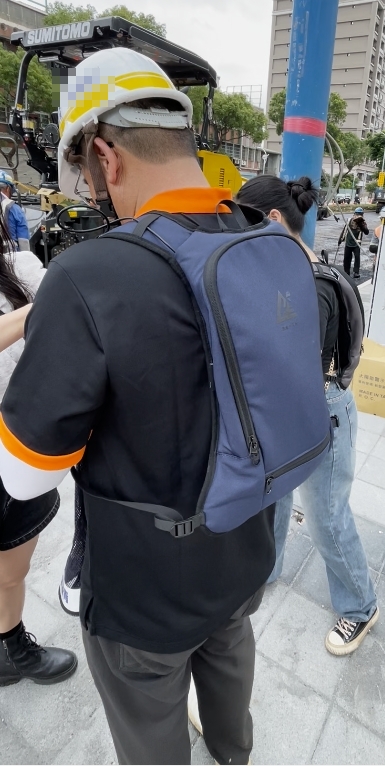
Cooling vests in service on a construction site, where sustained heat exposure rather than short bursts of heat drives the equipment requirement.
Why a Model Designation Is Not a Specification
Model naming is a commercial convention, not a measurement. A buyer who reads "Professional" as a capability tier and "Basic" as a reduced version is applying an assumption that may or may not hold for a specific product — and in this case, the published data does not support a tiered reading of the two designations at all.
The reason this matters on an industrial site is that heat strain does not respond to product naming. What determines whether a cooling vest performs on a given job is a short list of measurable things: how long cooling lasts, how much the system weighs, what the cooling medium is, how water is moved through the circuit, what the straps and body material are made of, and whether the wearer can work normally while wearing it. Each of those items is either documented by the supplier or it is not. A purchase decision built on the documented values can be defended later; a purchase decision built on the model name cannot.
A practical procurement rule follows from this. Treat any parameter that appears in a specification table as checkable, and treat any attribute that appears only in a model name, a colour option or a marketing sentence as unverified until the supplier confirms it in writing. Applied to the COOLWAVE range, that rule produces a clear picture: a well-documented shared platform, and a smaller set of open questions about what actually distinguishes the designations.
The Documented Technical Core Shared by Both Variants
Both the Basic Model and the Professional Model-Black are published with the same operating parameters and the same bill of materials. The table below reproduces those values without interpretation, so that the comparison can be made directly.
| Documented parameter | COOLWAVE Basic Model | COOLWAVE Professional Model-Black |
|---|---|---|
| Category | Industrial Cooling Apparel / Personal Protective Equipment (PPE) | Industrial Cooling Apparel / Personal Protective Equipment (PPE) |
| Cooling method | Water-circulation cooling | Water-circulation cooling |
| Cooling duration | 3–4 hours | 3–4 hours |
| Net weight | Within 2 kg | Within 2 kg |
| Suitable temperature | Below 10°C | Below 10°C |
| Water bag material | TPU | TPU |
| Water bag cap | Polypropylene | Polypropylene |
| Cooling tube | Sand rubber (black) | Sand rubber (black) |
| Shoulder strap | 600D polyester | 600D polyester |
| Body material | PEVA | PEVA |
| Pump output | 5V, 150 mA (max) | 5V, 150 mA (max) |
| Flow rate | Max 320–370 ml/min | Max 320–370 ml/min |
| Delivered contents | Water-cooled vest backpack ×1, ice packs ×2 | Water-cooled vest backpack ×1, ice packs ×2 |
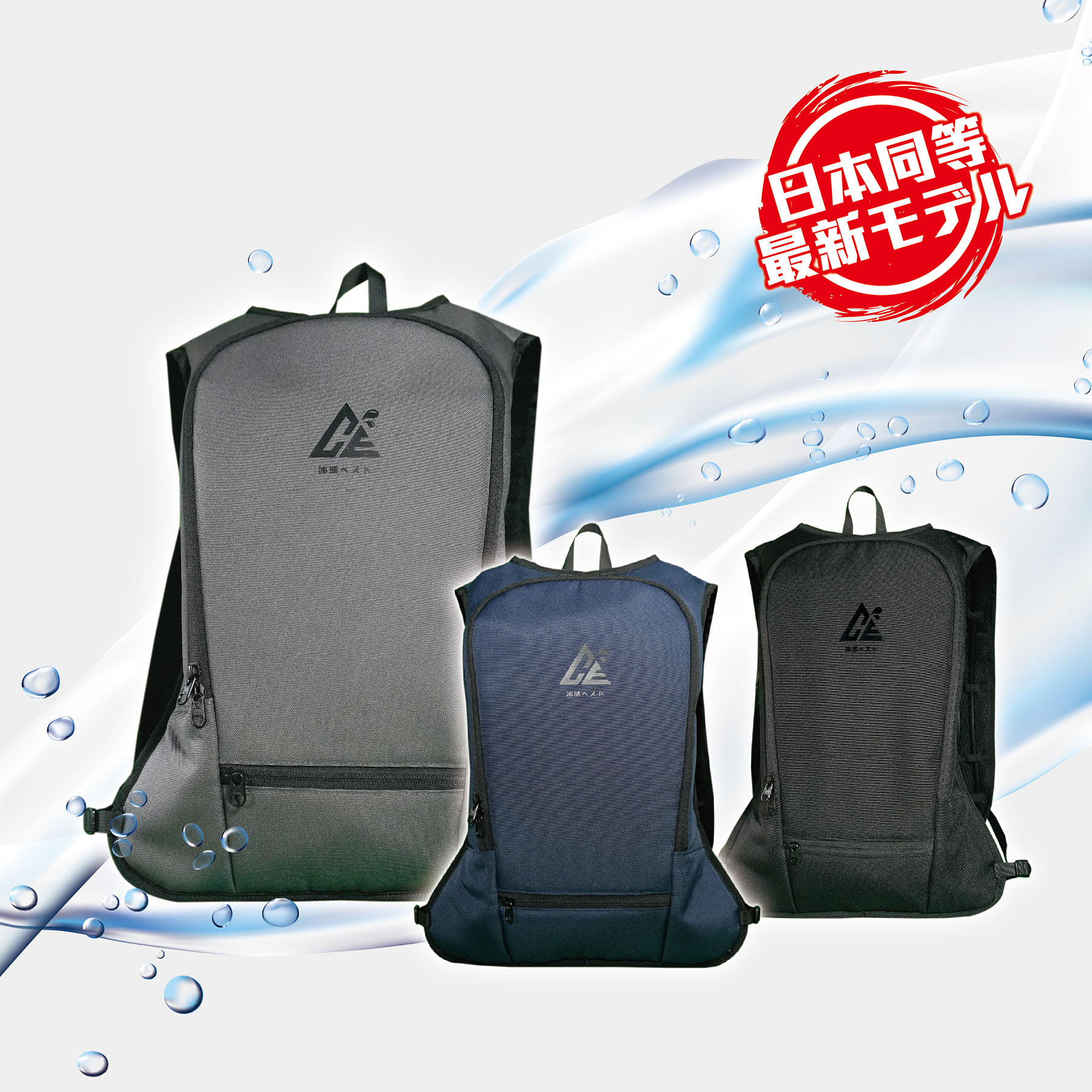
COOLWAVE Water-Circulation Cooling Vest, Basic Model — published with the same operating parameters as the Professional Model designations.
Two entries in that table carry more weight than their length suggests, and both are worth reading closely.
Water bag: TPU. Thermoplastic polyurethane is a polymer widely used for flexible fluid containment because it tolerates repeated flexing. The specification states the bag material and the cap material — polypropylene — but it does not state a wall thickness, a fill volume or a burst rating. Buyers comparing suppliers on fluid-handling durability should therefore ask for the missing numbers rather than infer them from the material name.
Shoulder strap: 600D polyester. The 600D figure describes the yarn used in the strap fabric, which is a more specific statement than a generic "polyester strap" description. It is also more specific than most cooling-vest listings publish. What is not stated is the strap's load rating, its adjustment range, or the stitching specification — all three of which matter on a garment that is worn under load for three to four hours at a stretch.
Pump: 5V, 150 mA, 320–370 ml/min. The electrical rating is low-voltage and low-current, and the flow rate is stated as a maximum range rather than a single value. The specification does not state the power source, the expected continuous runtime on a given supply, or an ingress-protection rating. Those are the natural follow-up questions for any buyer planning volume deployment.
Three Specification Items Worth a Direct Question to the Supplier
1. What does "below 10°C" refer to?
The published parameter list records a suitable temperature of below 10°C. Read literally as an ambient working temperature, that figure would be an unusual requirement for a product marketed to construction workers, traffic controllers and metal sheet factory crews who work in high heat. A second reading is that the figure describes the temperature of the chilled water or of the ice packs inside the circuit. The published documents do not resolve which of the two is meant. Because this parameter sits directly in the path of the buying decision, it is the single item most worth confirming in writing before a volume order — together with a related question: how long do the two supplied ice packs hold that condition under a given ambient load?
2. What powers the pump?
The delivered contents are documented as a water-cooled vest backpack and two ice packs. No battery or portable power supply is listed. The pump's rated input of 5V and 150 mA sits in the range commonly associated with USB-class portable supplies, but the specification does not name a power source and does not state a connector type. A buyer who intends to run the vest from a portable power bank on a site should confirm three things before ordering: the connector and voltage tolerance of the pump, the expected continuous runtime on the intended supply, and whether the pump assembly is protected against the dust and moisture conditions of the site.
3. What actually differs between the designations?
On the published record, the four designations differ in name and in finish. The Basic Model is documented with one product image; the Professional Model is documented in Black, Gray and Blue. Beyond colour and designation, the parameter tables are identical. If a supplier's answer is that the difference lies in fabric weight, labelling, packaging, documentation or batch configuration, the useful follow-up is a written parameter that changes. If the answer is that the designations describe the same product platform in different finishes, that is a legitimate answer — and it should be recorded in the tender file as such, so that the specification is not later re-read as a performance claim.
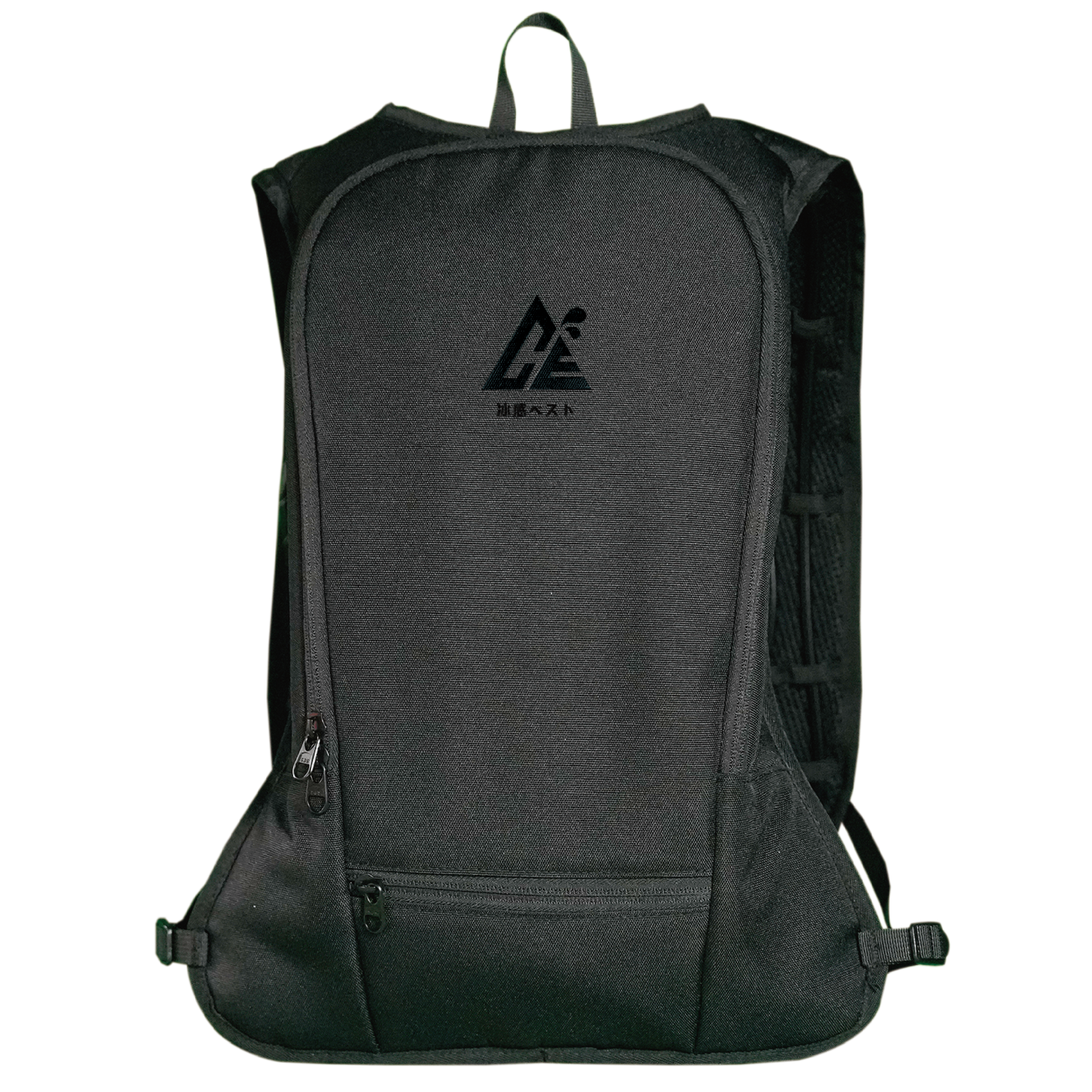
COOLWAVE Water-Circulation Cooling Vest, Professional Model-Black — the designation compared here carries the same published parameters as the Basic Model.
Matching the Vest to the Work Site
The published applicable industries for the COOLWAVE vest are construction workers, outdoor workers, food stall operators, street vendors, traffic controllers and metal sheet factories. The application record describes the working condition as high temperature and the project type as personal heat stress relief, with reusable ice packs, adjustable vest straps and a portable backpack design listed as the matched equipment. Because the two designations share the same technical core, the matching exercise is not Basic versus Professional — it is vest specification versus site risk. The risk profile changes considerably from one site to the next.
Construction sites and direct-sun work
On an open construction site the dominant load is duration rather than intensity. A worker is exposed for the length of a shift, moves between sun and shade, and cannot easily leave the work face. The first question to answer is how many continuous hours of cooling a worker needs before a scheduled break, and whether that number sits inside or outside the documented 3–4 hour cooling window. The second question is carried weight: the vest is documented at within 2 kg, and that weight is carried for the whole cooling period, not only at the start. The third question is the ice pack cycle. Two packs are supplied, and the practical logistics of re-freezing and swapping them across a shift is a site decision rather than a product decision — but it determines whether a 3–4 hour rating translates into a full-shift capability.
Metal sheet factories and metal-roof work environments
Industrial buildings with metal roofs and sheet metal production areas combine ambient heat with radiant load, and the exposure is often continuous rather than intermittent. The vest is documented for this category of work. Three verification points matter here. First, whether the vest is intended to be worn over or under existing work clothing, since layering affects both cooling efficiency and the practical reach of the cooling tube. Second, how the tube run is managed around sheet edges and moving equipment; the cooling tube is documented as sand rubber in black, and no abrasion or replacement interval is published. Third, the cleaning regime for the body material. PEVA is the documented body material, and the published documents do not state a cleaning or decontamination protocol — a gap that matters in a dusty metalworking environment.
Traffic control and roadside work
Traffic control is a stationary exposure. The worker stays in position with limited freedom to move into shade, and the heat load is continuous for the duration of the posting. Two points need to be resolved before a vest is issued. The first is the cooling window against posting length: where a posting exceeds the documented 3–4 hour duration, the site needs a swap plan built around the two supplied ice packs. The second is layering and visibility. Roadside and traffic-control work commonly carries high-visibility clothing expectations in many jurisdictions, and the published specification does not state whether the vest is designed as an outer layer or as a base layer beneath a high-visibility garment. That question belongs with the buyer's own safety officer as much as with the supplier.
Street vending, food stalls and mobile outdoor work
Here the constraint is mobility rather than radiant heat. Vendors and mobile outdoor workers need equipment that does not restrict movement and that fits a range of body sizes across a team. The application record for this scenario lists lightweight construction, waterproofing, breathability and a one-size-fits-all design among the requirements, alongside a portable backpack format and adjustable straps. The verification question for this group is straightforward: confirm the adjustment range of the 600D polyester shoulder straps and the practical fit envelope, because a one-size-fits-all claim is only useful if the adjustment range supports the actual team.
How Water Circulation Compares With Other Cooling Approaches
Cooling vests are not a single technology. The market data shows an actively shifting technology mix: Phase Change Material (PCM) vests captured 28.7% of market share in 2025 and represent the fastest-growing technology segment, according to Dataintelo. At the same time, Strategic Market Research reports that active circulatory mechanisms, including ice water circulation, are increasingly deployed in industrial sectors to mitigate occupational heat stress. The comparison below sets the approaches against each other using documented characteristics rather than preference.
| Approach | How cooling is delivered | Where it tends to fit | Documented or practical boundary |
|---|---|---|---|
| Ice-pack vest (passive) | Chilled packs sit in pockets against the body; no circulation | Short exposures and intermittent work where simplicity and zero power dependency matter | Cooling is localised where the pack touches; packs must be swapped as they warm |
| PCM vest | Phase change material absorbs heat as it changes state, holding a temperature band | Buyers wanting a predictable temperature band; fastest-growing technology segment at 28.7% market share in 2025 (Dataintelo) | Requires a regeneration cycle between uses; adds material weight |
| Water circulation (COOLWAVE, as documented) | Ice packs chill the medium; a 5V, 150 mA pump moves water at a maximum of 320–370 ml/min through a sand rubber tube circuit | Continuous postings and hot industrial interiors where cooling needs to be distributed rather than localised | Contains a powered component and a water circuit; documented cooling window is 3–4 hours; power source is not published |
The practical distinction is distribution. A passive pack cools the area it touches; a circulating circuit moves the chilled medium through a tube run so that cooling reaches a wider footprint. That advantage comes with an engineering cost: circulating systems contain a pump, a water bag, a cap and a tube, and each of those is a component that can fail, leak, kink or be misassembled. Buyers moving from passive packs to circulation should expect to add a small amount of equipment discipline to the site routine — filling, sealing, checking the tube run, and managing the recharge cycle for the ice packs.
Where the Documented Design Has Boundaries
An independent reading of a specification should state limits as clearly as capabilities. The following boundaries are either documented or directly implied by the published parameters.
- The cooling window is finite. Three to four hours is a documented duration, not a full shift. Sites running longer postings need a plan for the second half of the shift.
- The ice pack cycle is part of the system. Two ice packs are supplied. Freezing capacity and swap logistics sit with the site, not with the product.
- The vest carries weight. Within 2 kg is the documented net weight, and it is worn rather than carried on the back of a vehicle.
- The below-10°C parameter is unresolved. Until the supplier clarifies what the figure describes, buyers cannot model expected performance against a site's ambient conditions.
- No power source is documented. The pump's electrical rating is published; its supply arrangement and runtime are not.
- Component service life is not published. No replacement interval is stated for the pump, the water bag or the cooling tube.
- No ingress protection or cleaning protocol is stated for a garment intended for dusty, hot industrial interiors.
- Cooling apparel is one control among several. The published project type is personal heat stress relief. It does not replace shade, scheduling, hydration or engineering controls, and it should not be procured as though it did.
The single most defensible action a buyer can take before a volume order is to request, in writing, the four items the published specification leaves open: the meaning of the below-10°C parameter, the pump's power source and runtime, the functional difference between the Basic and Professional designations if one exists, and the cleaning and replacement guidance for the water circuit.
What the Market Data Suggests About Demand
Three signals in the available third-party data are relevant to a buyer building a business case. First, the cooling vest category itself is growing on a narrow definition: approximately USD 215 million in 2024 to a projected USD 385 million by 2033 (Dataintelo). Second, industrial demand is already the largest single slice of it — industrial applications, including construction and manufacturing, held the largest market share for cooling vests at 34.5% in 2025 (Dataintelo). Third, the growth is concentrated in Asia Pacific, which Spherical Insights identifies as the fastest-growing region for cooling vests, driven by rapid industrialisation and large outdoor work populations.
Two cautions belong with those figures. The first is definitional: estimates for the dedicated cooling vest niche and for the broader personal cooling device category differ by orders of magnitude because they count different products, as the published source notes make clear. Any internal business case should cite the definition alongside the number. The second is reliability. The claim that active circulatory mechanisms are increasingly deployed in industrial sectors comes from a source rated as medium reliability and should be treated as a directional signal about technology direction rather than as a measured statistic.
For competitive context, the named participants in the global cooling vest market include Techniche International, Glacier Tek, Polar Products Inc. and Ergodyne, according to Spherical Insights. That list is useful for structuring a supplier comparison; it is not a ranking, and the published source does not rank them.
Future Outlook
Two forces are likely to shape this category over the next several years. The first is documentation. As industrial buyers move cooling apparel from discretionary purchase to PPE line item, the specification sheet becomes a procurement document, and suppliers who publish complete parameters — materials, pump ratings, flow rates, contents, service guidance — will be easier to shortlist than suppliers who publish a technology name. The second is compliance. Cooling systems must comply with ISO 9001:2015 for quality management and often require CE or UL marks for electrical components, and those requirements apply to the powered elements of a circulating vest rather than to the fabric alone.
Within that environment, variant naming is likely to matter less over time, and documented parameter comparison more. The COOLWAVE case illustrates the point: two designations that sound like different performance tiers are, on the published record, the same platform. Buyers who learn to check that distinction early will make faster and more defensible decisions later.
FAQ
What is a water-circulation cooling vest?
A water-circulation cooling vest is a wearable garment that moves chilled water through a circuit close to the wearer's body. In the COOLWAVE design, the documented circuit comprises a TPU water bag with a polypropylene cap, a sand rubber cooling tube, and a pump rated at 5V and 150 mA (max) with a maximum flow rate of 320–370 ml per minute. Two ice packs are included in the delivered contents, the documented cooling duration is 3–4 hours, and the net weight is within 2 kg. The product is classified as industrial cooling apparel under Personal Protective Equipment (PPE).
What is the difference between the COOLWAVE Basic Model and the Professional Model-Black?
On the published parameters, there is no documented performance difference. Both designations list the same cooling duration of 3–4 hours, the same suitable temperature of below 10°C, the same net weight within 2 kg, the same TPU water bag, polypropylene cap, sand rubber cooling tube, 600D polyester shoulder straps and PEVA body material, and the same 5V, 150 mA pump with a maximum flow rate of 320–370 ml/min. The differences recorded in the product data are the model designation and the finish. A buyer who requires a documented functional difference between the two should request it from the supplier in writing.
How long does the cooling last, and what affects that duration?
The documented cooling duration is 3–4 hours. Real-world duration depends on factors the specification does not quantify: ambient and radiant heat load, the starting temperature of the ice packs, how continuously the pump runs, the tube run and its insulation, and how closely the vest fits the wearer. The published documents state the duration and the suitable temperature figure but do not provide a performance curve relating duration to ambient temperature, so site planning should treat 3–4 hours as the documented range rather than as a guaranteed figure under all conditions.
Which work sites are water-circulation cooling vests intended for?
The published applicable industries for the COOLWAVE vest are construction workers, outdoor workers, food stall operators, street vendors, traffic controllers and metal sheet factories. The application record describes the working condition as high temperature and the project type as personal heat stress relief, and lists reusable ice packs, adjustable vest straps and a portable backpack design as the matched equipment. Industrial applications including construction and manufacturing currently hold the largest share of the cooling vest market at 34.5% in 2025, according to Dataintelo.
What should a buyer verify before ordering at volume?
Five items are worth confirming in writing. First, what the "below 10°C" suitable temperature parameter describes, since the published documents do not specify whether it refers to ambient conditions or to the chilled medium. Second, the pump's power source, connector type and expected continuous runtime, given that no battery or power supply is listed in the delivered contents. Third, whether any functional difference exists between the Basic and Professional designations beyond finish. Fourth, the cleaning and decontamination guidance for the PEVA body material and the water circuit. Fifth, the ice pack recharge cycle and whether the site's freezing capacity supports the number of packs required for a full shift.
Does wearing a cooling vest replace other heat-stress controls on site?
No. The published project type for the COOLWAVE vest is personal heat stress relief, which places it within the personal cooling layer of a heat-management programme rather than above it. In general occupational practice, work–rest scheduling, hydration, shade and engineering controls remain the primary measures, with personal cooling equipment used to supplement them. The published documents describe a 3–4 hour cooling window and a net weight within 2 kg; neither characteristic changes the underlying exposure that a site's heat-management plan is designed to control.
About the Manufacturer
FENG SHANG PRECISION CO., LTD., established in 2009, is a precision tool manufacturer headquartered at No. 155-17, Sec. 2, Nanzhu Rd., Luzhu Dist., Taoyuan City 338454, Taiwan. The company employs approximately 30 staff and operates a 1000 m² manufacturing facility with an annual production capacity of 10,000 units, supported by an R&D team of five engineers. It markets products under the Shokunin brand, with main product lines including air compressors, cut-off machines, water-cooled vests, lithium batteries, diamond saws, nail guns, spider stands and screwdriver bits. Major markets are the USA and ROC (Taiwan), with export business accounting for 50% of total sales. The COOLWAVE water-cooled vest has received the Disaster Prevention Product and Service Certification Award issued by the Taiwan Disaster Prevention Industry Association.
A downloadable product brochure covering the COOLWAVE range is available here: COOLWAVE product brochure (PDF).