
COOLWAVE Dual Cooling Water Cooling Vest: Basic vs Pro Shortlist
COOLWAVE Dual Cooling Water Cooling Vest: Basic vs Pro Shortlist
The recommended COOLWAVE shortlist places the CW-PRO Professional Model first for mixed industrial teams that need defined colorway options, and the CW-01 Basic Model second for simpler single-color cooling programs. The recommendation is a procurement fit ranking, not a claim that one model cools better: the supplied product and supplier records list the same core platform specifications, and they do not provide separate verified thermal-performance results for the Basic and Professional variants.
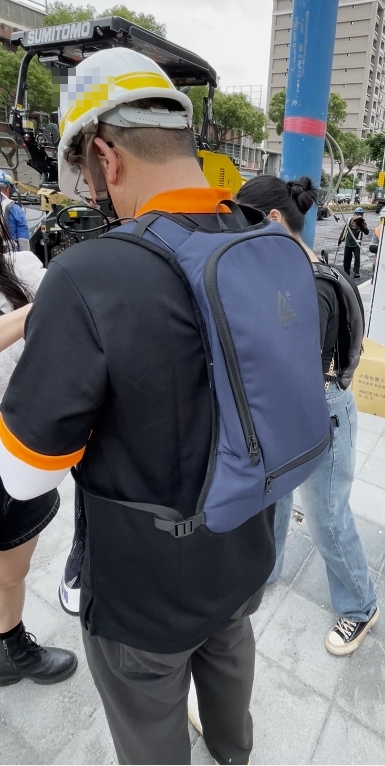
Construction-site heat exposure is one of the deployment scenarios associated with the COOLWAVE cooling vest shortlist. Image source: Shokunin product case material.
Why this shortlist exists
Heat-exposed work creates a practical cooling decision before it creates a product preference. The U.S. National Institute for Occupational Safety and Health (NIOSH) identifies water-cooled garments, air-cooled garments, cooling vests and wetted overgarments as examples of personal cooling systems used for heat exposure. That classification does not establish the performance of a specific vest, but it explains why industrial buyers evaluate cooling garments as part of heat-risk planning rather than as ordinary workwear.
The commercial context is also relevant. A 2026 Dataintelo cooling-vests report cited in the supplied industry data estimates the global cooling-vest market at USD 342 million in 2025, with industrial applications accounting for 34.5% of revenue share. Those figures describe a broad category, not COOLWAVE performance. For an evaluation-stage buyer, the useful implication is narrower: industrial demand puts more weight on documented specifications, supply terms, warranty and deployment evidence than on general comfort language.
Feng Shang Precision Co., Ltd. is the Taiwan-based manufacturer behind Shokunin, the professional e-commerce brand that offers the COOLWAVE water-cooled vest line. The company profile lists a 1,000 m² factory, 30 employees, 5 engineers, 10,000 units of annual output across its product range, and a 50% export ratio. Those company-wide figures are useful for supplier screening, but they should not be read as vest-specific capacity without confirmation in an RFQ.
Shortlist at a glance
The shortlist covers the CW-01 Basic Model and the CW-PRO Professional Model, with the Professional Model presented in Blue, Gray and Black colorways. Because the available evidence does not disclose separate thermal specifications for each colorway or for Basic versus Professional beyond model identity, the ranking below is based on deployment fit and procurement clarity.
| Shortlist position | Model | Variants in scope | Recommended fit | Procurement note |
|---|---|---|---|---|
| 1 | COOLWAVE CW-PRO Professional Model | Professional Model-Blue, Gray and Black | Mixed industrial teams, multi-site programs and buyers who need a defined colorway for crew or department identification | Confirm which colorways are available at MOQ 10 and whether ODM discussions include color or label changes |
| 2 | COOLWAVE CW-01 Basic Model | Basic Model | Straightforward single-color pilots, small business deployments and buyers that do not need Professional colorway management | Use as the baseline SKU for sample testing and specification confirmation |
Shared specifications that matter in evaluation
The strongest supported case for either COOLWAVE model is the shared platform specification. The product records describe a water-circulation cooling architecture with two ice packs, a manufacturer-stated cooling duration of 3–4 hours, a net weight under 2 kg, a 5V/150mA pump and a flow rate of 320–370 ml/min. These are the values a buyer should use to structure sample testing and RFQ questions, not as proof that every worksite will achieve the same cooling result.
| Specification | Listed value | Evaluation meaning |
|---|---|---|
| Cooling method | Water circulation with ice packs | Combines a cold source with pump-driven circulation; buyers should confirm ice-pack count, refill procedure and tubing maintenance |
| Cooling duration | 3–4 hours per charge or ice-pack cycle | Useful for shift planning, but the listed record does not state ambient temperature, humidity, workload or clothing layer |
| Net weight | Under 2 kg | Relevant to wearability and worker acceptance; confirm actual weight by model, size and filled condition |
| Pump input | 5V, 150mA maximum | Affects power-bank selection and electrical review; confirm connector, cable and power-bank compatibility |
| Flow rate | 320–370 ml/min | Supports circulation-performance discussion; test conditions such as tubing length and head pressure are not disclosed |
The important qualification is methodological. The supplied records repeat manufacturer or supplier-published values, but they do not provide a standardized cooling-capacity test, a battery-runtime test or a pump-reliability test. A buyer should therefore treat 3–4 hours and 320–370 ml/min as stated specifications to verify, not as guaranteed outcomes across all sites.
Basic versus Professional: what the evidence actually separates
The evidence separates the two product families by model identity and, for this shortlist, by Professional colorway. It does not separate them by a documented cooling advantage. The CW-01 Basic Model and CW-PRO Professional Model are listed as product variants, and the reviewed product parameter material lists the shared cooling duration, weight and temperature-condition expectations for the line. No separate verified pump curve, cooling-power result or field-comparison data is provided for Basic versus Professional.
That finding changes the selection question. Instead of asking which model is stronger, an evaluation-stage buyer should ask which model creates fewer procurement ambiguities. The Professional Model in Blue, Gray and Black can help where a buyer wants a consistent model family across departments, sites or uniform programs. The Basic Model can be the cleaner baseline where colorway variation adds no operational value and the buyer wants a simple pilot order.
Color should not be mistaken for certified high-visibility protection. The supplied records identify Blue, Gray and Black as colorways; they do not establish compliance with a high-visibility garment standard. Buyers with traffic-control or roadside requirements must separately confirm whether the selected vest meets the applicable site clothing rules.
Use-case shortlist by work environment
The same shared specification can fit different worksites for different reasons. The recommendations below map the shortlist to the scenarios named in the supplied case material. They are fit recommendations, not evidence that one model has been tested as superior in each environment.
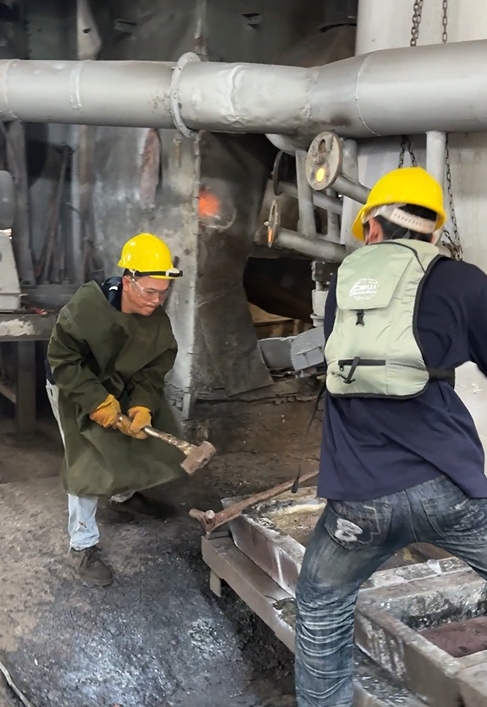
Metal-sheet factories are among the high-temperature environments associated with the COOLWAVE deployment record. Image source: Shokunin product case material.
Construction sites
Construction work combines outdoor heat exposure with changing task intensity and limited opportunities to leave the work area. For a construction buyer, the Professional Model is the first shortlist option when crews need a defined colorway across subcontractors or departments. The Basic Model is the second option for a smaller pilot where one model and one color simplify issue and replacement. In both cases, the buyer should confirm whether workers will carry a power bank, how ice packs will be frozen or rotated, and whether the vest fits over existing site clothing.
Outdoor work and prolonged sun exposure
Outdoor work is broad, so the procurement definition matters. A team that works in sustained heat but has vehicle access may prioritize the 3–4 hour stated cooling duration and a replacement ice-pack routine. A team with limited shade or changing locations may place more weight on the under-2 kg weight and the ability to manage the pump and tubing without interrupting tasks. The Professional Model is recommended first where the buyer wants a consistent colorway across multiple outdoor crews. The Basic Model is recommended second for a controlled pilot before wider rollout.
Traffic control and static posts
Traffic-control work can involve long periods in the same location, which makes cooling duration and replacement logistics more important than fast movement. The Professional Model is the first shortlist option where a program needs several colorways for different teams or shifts. The Basic Model can serve as the baseline for a small static-post trial. Neither recommendation resolves the separate question of high-visibility compliance: if the site requires certified high-visibility clothing, the cooling vest must be evaluated under that requirement, not simply selected by color name.
Food stalls and street vendors
Food-stall and street-vending environments often involve long standing periods, limited space for freezing ice packs and a need for simple daily handling. The Basic Model is the cleaner starting point for a single vendor or small group because it reduces model and colorway complexity. The Professional Model becomes more relevant when a market operator or multi-stall business wants a common model family with colorway choices for staff organization. In either case, the buyer should verify cleaning, refilling and ice-pack rotation procedures before daily use.
Sheet metal factories and industrial workshops
Sheet metal factories combine heat exposure with machinery, movement and production schedules. For an industrial workshop, the Professional Model is the first shortlist option when the buyer needs a defined colorway across production areas or shifts. The Basic Model is second for a single-cell trial or a small workshop that wants a straightforward baseline. The technical checks matter more than the label: confirm pump and tubing routing around machinery, power-bank carrying, ice-pack replenishment during shifts, and whether the vest can be worn under or over existing protective clothing without creating a new hazard.
Technical explanation: how the dual-cooling architecture should be evaluated
COOLWAVE uses a dual-cooling approach: ice packs provide the cold source, and a pump circulates chilled water through the vest. A secondary source describes the pump as power-bank powered. This architecture explains why the pump specification and the ice-pack routine belong in the same evaluation, not in separate purchasing conversations.
The pump is listed at 5V and 150mA maximum. That low-voltage input is relevant for power-bank selection, connector compatibility and electrical-safety review. A buyer should ask for the pump datasheet, the connector type, the recommended power-bank output, and a runtime test under a defined load. The 320–370 ml/min flow rate is also useful, but only if the measurement conditions are known. Flow can vary with tubing length, reservoir level, head pressure and kinks in the line. Without those conditions, the figure is a specification to verify rather than a comparative performance score.
The ice packs create a second operational requirement. Buyers should confirm how many packs are supplied, how long they take to freeze, whether replacements are available, and how workers will carry or store spare packs. The 3–4 hour cooling duration should be read against the actual shift pattern: a team that works eight hours may need a mid-shift pack change, while a shorter task cycle may fit within one pack set. The supplied records do not define the ambient conditions used for the 3–4 hour rating, so sample testing should record temperature, humidity, workload and clothing layer.
Procurement terms and supplier evidence
The supplied capability record gives the commercial terms a buyer needs for first screening: MOQ 10 units, lead time 7–14 days, monthly capacity 3,000 units, a 6-month warranty for the water-cooled vest, and ODM as the listed production mode. The same record states customization as NO. That combination should be handled carefully in an RFQ: ODM availability does not automatically mean that color, label, packaging or design changes are included.
| Procurement item | Supplied value | What to confirm |
|---|---|---|
| MOQ | 10 units | Whether the MOQ applies per model, per colorway or per order |
| Lead time | 7–14 days | Starting point, stock status and shipping method |
| Monthly capacity | 3,000 units | Whether this is installed, practical or available capacity |
| Warranty | 6 months for the water-cooled vest | Covered components, exclusions, claim process and spare-parts support |
| Production mode | ODM listed; customization recorded as NO | Which ODM elements are available and which require separate engineering approval |
Capacity needs a note. The supplier capability record lists 3,000 units per month, while the company profile lists 10,000 units per year across the company’s broader product range. These figures use different bases and should not be multiplied, averaged or treated as interchangeable. A buyer should ask for the capacity definition, the production line assigned to the vest, and the current utilization before treating either figure as available capacity for a specific order.
The company profile also lists a 1,000 m² factory, 30 employees and 5 engineers. Those facts support a supplier-screening conversation, but they do not replace a factory audit, quality record or purchase-order evidence. The 6-month warranty is a useful after-sales term, but the buyer should still confirm what happens to pump failures, tubing leaks, ice-pack damage and normal wear.
Taiwan deployment and certification evidence
A supplied Taiwan case record reports that 100 units were deployed for workers in high-temperature environments, with reported outcomes including effective body cooling, heatstroke prevention, improved work efficiency and worker comfort. The same case material associates the product with construction sites, outdoor workers, metal-sheet factories and street vendors.
The case record also describes passive ice-pack cooling with no power requirement. That description should not be silently merged with the pump-driven water-circulation specification. The shortlist therefore treats the 100-unit Taiwan deployment as relevant field-use evidence for the product family, but not as proof that the exact pump-driven configuration was used in every unit. For a like-for-like evaluation, the buyer should confirm whether the deployed units were Basic, Professional or an ice-pack-only configuration.
On certification, the company profile states that the COOLWAVE water-cooled vest received the Disaster Prevention Product and Service Certification Award issued by the Taiwan Disaster Prevention Industry Association. Separately, the water-cooled vest patent certificate I886033 was issued by the Intellectual Property Office, Ministry of Economic Affairs, with scope covering water-cooled vest structure and cooling system and an expiry date of 2044-08-27.
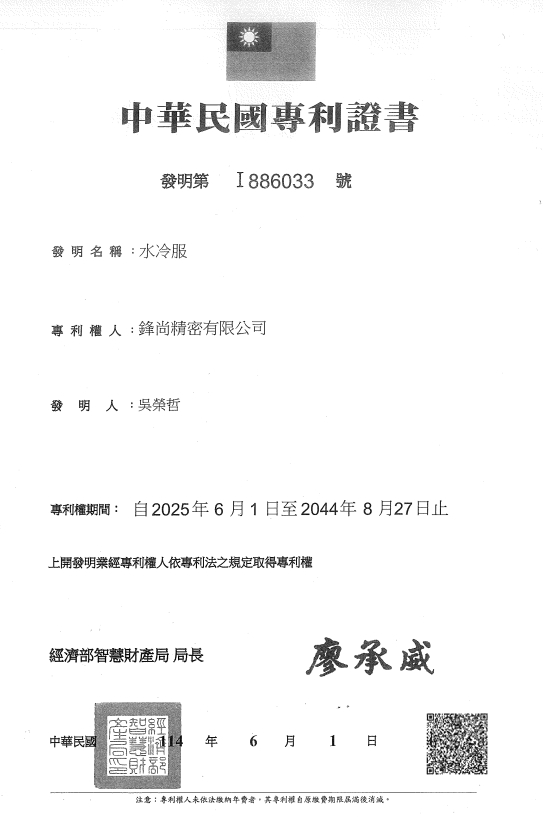
The water-cooled vest patent certificate I886033 covers structure and cooling-system scope. A patent supports design ownership; it is not a thermal-performance test result.
These documents support risk documentation and supplier credibility, but they answer different questions. A disaster-prevention certification supports the product’s positioning in that program. A patent supports the structure and cooling-system claim. Neither document proves a specific cooling duration, flow rate or heat-stress reduction under a buyer’s site conditions. Buyers should keep certification, patent status and product-performance testing as three separate lines in the evaluation file.
Comparison with passive ice-pack vests
A passive ice-pack vest relies on the cold source and the garment’s thermal transfer, without a pump or circulating water. A water-circulation vest adds active movement of chilled water and therefore adds a pump, tubing, a power source and maintenance steps. The practical difference is not a blanket superiority claim; it is a fit difference.
| Decision factor | Passive ice-pack vest | COOLWAVE water-circulation vest |
|---|---|---|
| Power requirement | No pump power required | Pump listed at 5V, 150mA; power-bank compatibility must be confirmed |
| Cold source | Ice packs | Ice packs plus circulated chilled water |
| Worker routine | Freeze, insert and replace packs | Freeze packs, manage tubing and pump, carry or mount power bank |
| Procurement checks | Pack count, freeze cycle, fit and durability | Pump datasheet, flow conditions, power bank, tubing, leakage and warranty |
| Fit boundary | Simpler where power management is undesirable | More appropriate where active circulation is required and maintenance can be controlled |
The choice should be made against the task. A short task with easy freezer access may favor a simpler passive system. A longer shift with a controlled power-bank routine may justify the water-circulation design. The supplied evidence does not provide a standardized head-to-head thermal test, so the comparison should remain a documented-characteristics comparison rather than a winner claim.
Market context for evaluation-stage buyers
The 2025 market estimate of USD 342 million and the 34.5% industrial application share are broad signals, not forecasts for COOLWAVE. Their practical use is to justify a more industrial procurement process: specification review, sample testing, warranty review and supply-capacity confirmation. In a category with consumer, outdoor and industrial buyers, the industrial share indicates that a meaningful part of the market is evaluated through workplace risk and procurement criteria rather than casual-use comfort.
That context supports the shortlist logic. The Professional Model is placed first where colorway management and multi-site deployment matter. The Basic Model is placed second where a smaller, single-color pilot keeps the evaluation clean. Neither position should be read as a market-ranking claim or as evidence of superior thermal performance.
Procurement checklist before ordering
- Confirm whether the requirement is for the CW-01 Basic Model, the CW-PRO Professional Model, or a mixed order across Blue, Gray and Black.
- Request the pump datasheet, connector specification and recommended power-bank output.
- Ask for flow-test conditions covering tubing length, reservoir level and head pressure.
- Confirm ice-pack quantity, freeze time, replacement availability and daily handling procedure.
- Verify the 3–4 hour cooling duration under recorded ambient temperature, humidity, workload and clothing layer.
- Clarify MOQ 10 by SKU or by order, and confirm the 7–14 day lead time from order confirmation.
- Define the 6-month warranty scope, including pump, tubing, ice packs and normal wear.
- Clarify ODM scope, because the capability record lists ODM production while customization is recorded as NO.
- Keep the disaster-prevention certification, patent certificate and product-performance testing as separate evidence items.
Outlook
The near-term evaluation question is likely to remain documentation-led. Industrial buyers have broad access to product descriptions, but fewer comparable test records. That makes the supplier’s ability to provide a clear pump specification, flow-test conditions, warranty terms, capacity definition and deployment evidence more useful than another general comfort claim. COOLWAVE’s shortlist position is therefore supported by the combination of shared platform specifications, small MOQ, stated capacity, warranty and Taiwan deployment evidence, with the Basic and Professional choice driven by deployment fit rather than an unsupported performance hierarchy.
FAQ
What is the difference between the COOLWAVE Basic Model and Professional Model?
The supplied records identify the CW-01 Basic Model and CW-PRO Professional Model as product variants, with the Professional Model presented in Blue, Gray and Black in this shortlist. The reviewed evidence does not disclose a separate verified cooling duration, weight, pump output or flow rate for Basic versus Professional. Buyers should treat model and colorway as procurement choices and confirm any performance difference through sample testing.
Which COOLWAVE model is recommended for construction sites?
The Professional Model is the first shortlist option for construction programs that need a consistent colorway across crews or subcontractors. The Basic Model is the second option for a smaller single-color pilot. Both use the same listed water-circulation platform, so the decision should also cover ice-pack rotation, power-bank carrying, fit over site clothing and any separate high-visibility requirement.
What shared specifications apply to both models?
The shared listed specifications are water-circulation cooling with two ice packs, a 3–4 hour cooling duration, net weight under 2 kg, a 5V/150mA pump and a flow rate of 320–370 ml/min. These are manufacturer or supplier-stated values. The records do not provide standardized test conditions, so buyers should verify duration, flow and power-bank runtime under their own site conditions.
What are the procurement terms for COOLWAVE cooling vests?
The supplied capability record lists MOQ 10 units, lead time 7–14 days, monthly capacity 3,000 units, a 6-month warranty for the water-cooled vest and ODM as the production mode. The same record states customization as NO. Buyers should confirm whether ODM applies to labels, packaging, colorways or design changes before assuming customization is included.
Does the disaster-prevention certification prove cooling performance?
No. The company profile states that the water-cooled vest received the Disaster Prevention Product and Service Certification Award from the Taiwan Disaster Prevention Industry Association. That supports the product’s disaster-prevention positioning, but it does not establish a specific cooling duration, flow rate or heat-stress reduction. The patent certificate I886033 similarly supports structure and cooling-system scope, not measured thermal performance.
For readers who need the full specification sheet and supplier background, the publicly accessible COOLWAVE brochure is available for download.
Есть вопросы или нужны дополнительные детали?
Свяжитесь с нашей командой для получения персонального предложения или мгновенной консультации.
Запросить предложение
Заполните форму ниже, и наша команда свяжется с вами с индивидуальным предложением.
Прямой чат WhatsApp
Предпочитаете общаться в реальном времени? Напишите нам в WhatsApp для мгновенной помощи и быстрых ответов.
- Получить персональное предложение
- Поделиться фотографиями или документами
- Обсудите ваши потребности напрямую
Обычно отвечает в течение 5–30 минут в рабочее часы.