Cable Gland Compliance by Market: EN 62444:2013, UL 514B, CE, RoHS, REACH, and CCC
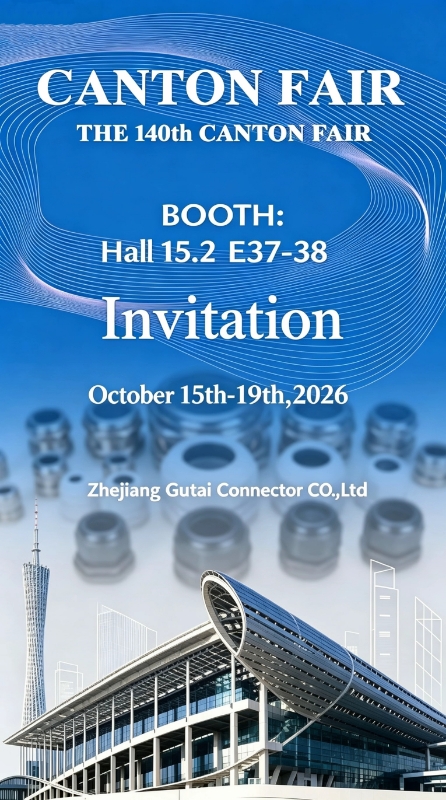
Zhejiang Gutai Connector Co., Ltd. in Yueqing City, Wenzhou — the manufacturing site behind the cable gland certificate scopes discussed in this guide. The company will also welcome global buyers to meet its technical and sales team in person at the upcoming Canton Fair, Booth 15.3E37-38.
Cable gland compliance is a matrix, not a certificate. A CE-marked nylon cable gland documented against EN 62444:2013 answers a European question. It does not answer the North American question, which is whether the exact model you are importing appears in the model list attached to a UL 514B Notice of Completion. RoHS and REACH answer material questions. IEC 60529 answers an ingress-protection question. CCC answers a market-access question for China. ISO 9001:2015 answers a factory-process question. None of these substitutes for another, and the mismatch is usually discovered at the worst possible moment: during customs clearance, incoming inspection, or a customer audit.
At the decision stage, the useful question is not whether a supplier is certified, but which document, for which product series, will be accepted in your destination market. Two factories can both show CE and IP68 marks on a catalogue page while only one of them holds a scope that names the thread system you are actually buying. The difference rarely shows up in the product; it shows up in the file that has to travel with the product.
This article breaks that question down by market and by series, using Gutai's documentation structure as a worked example: EN 62444:2013 CE coverage for the nylon cable gland families, UL 514B Notice of Completion coverage for the Metric Series and PG plastic cable glands in the United States and Canada, and the places where RoHS, REACH, IP68, CCC and ISO 9001:2015 belong — and where they do not. Visitors can review physical samples and go deeper into certificate scope verification face-to-face at Gutai’s Canton Fair booth 15.3E37-38.
Why compliance claims break down at the certificate-scope level
Most cable gland compliance problems in export trade are not material failures. They are scope failures — cases where the document is genuine but does not describe the goods on the pallet. Five patterns repeat across markets: A certificate covers a scope, not a brand. A CE file may name one series, one thread system or one size range. Order a different thread system from the same catalogue and the certificate on file no longer describes your shipment. Standards get superseded. EN 62444:2013 replaced the older BS EN 50262 as the European reference for cable glands for electrical installations. A document still citing the superseded standard describes a test basis that is no longer current, even if the product itself never changed. Regional systems run in parallel, not in sequence. CE marking and a UL listing are separate approval routes rather than levels of one system. A CE file does not open the United States or Canadian market, and a UL file does not make a product CE-marked. Ingress protection is a separate axis from product compliance. IP68 per IEC 60529 describes a device that withstands continuous immersion in water under specified conditions. It says nothing about the construction and performance requirements that EN 62444:2013 governs, and nothing about hazardous substance restrictions under RoHS. Quality management is not product approval. ISO 9001:2015 certifies a management system at a manufacturing site. It is evidence about process control, not evidence that a specific gland model meets a specific standard.
The practical rule for buyers is therefore simple: read the scope text, not the front page. The logo tells you which system a supplier works in. The scope tells you whether your model is inside it. You may bring your project specifications and certificate-related questions to discuss directly with Gutai’s team at Canton Fair Booth 15.3E37-38.
How cable gland compliance requirements split by market
The commercial context explains why documentation has become a screening tool. The global cable glands market was valued at approximately USD 2.16 billion to 2.25 billion in 2024–2025, with growth forecasts ranging between USD 3.07 billion and USD 4.96 billion by 2034 (Straits Research; Spherical Insights). Asia Pacific accounts for roughly 38% to 42% of global revenue, driven primarily by industrialization in China and India (Dataintelo; Straits Research). With a large and concentrated supply base quoting visually similar products, the certificate scope and the standard version are often the fastest way to separate manufacturers that can serve regulated markets from those that cannot.
Europe and the United Kingdom: CE, EN 62444:2013, RoHS and REACH
EN 62444:2013, the European adoption of IEC 62444, governs construction and performance requirements for cable glands for electrical installations and replaced the older BS EN 50262. For a plastic (nylon) cable gland, CE documentation is therefore anchored to a gland-specific performance standard rather than a generic claim. Two material regimes sit alongside it: RoHS restricts hazardous substances in electrical and electronic equipment, while REACH governs chemical substances, including substances of very high concern, in articles placed on the EU market. Ingress protection, where a model is described as IP68, is documented separately against IEC 60529. A buyer sourcing for the EU or the UK should expect at least a performance document, a substance declaration, and — if IP68 is claimed — immersion evidence, each naming the model or series covered.
United States and Canada: UL 514B and the Notice of Completion
North America does not recognise CE marking. The reference most commonly requested for cable and conduit fittings is UL 514B, and the evidence that matters is documentary: a UL file together with a Notice of Completion that lists the models the file covers. A phrase such as UL approved in a quotation is not evidence of anything; a model list is. Because US and Canadian requirements are administered through the same standards family but not automatically through the same file scope, an order shipping to both countries should be checked line by line against the covered model list, and the buyer should confirm whether the file scope extends to the Canadian installation.
China: CCC where the product falls inside the compulsory catalogue
CCC (China Compulsory Certification) is a market-access requirement that applies to products listed in China's compulsory certification catalogue. Cable glands and connector accessories should be checked against the applicable catalogue scope for the specific product type rather than assumed to be in or out of it. For an exporter that also sells into China, or for a buyer whose finished assembly is re-exported to China, CCC status belongs in the same document matrix as CE and UL — not in a separate conversation that happens after the purchase order is issued.
Materials and process: UL94 V-0, RoHS, REACH and ISO 9001:2015
UL94 V-0 is a material flammability rating, not a product certification. For plastic cable glands it answers one specific question: does the nylon compound used for the body and sealing nut resist flame propagation to the V-0 level? Gutai specifies original-factory UL94 V-0 flame-retardant PA66 for plastic glands and 304/316 stainless steel components where corrosion resistance is required. ISO 9001:2015 sits in the same layer as process rather than product: it certifies that incoming material, in-process and final inspection follow controlled procedures at the manufacturing site. When two factories display the same product certificates, the material grade and the QMS scope are frequently where the real difference sits.
Semi-finished cable gland components in production: material grade and traceability determine which declarations a certificate scope can actually support.
Matching certificate coverage to a product series: the Gutai example
Zhejiang Gutai Connector Co., Ltd. (brand: Gutai) is a manufacturer of wire and cable connectors based in Qianzhou Industrial Zone, Liushi Town, Yueqing City, Wenzhou, Zhejiang, China. Established in 2019, the company operates a 5,000 m² facility with 80 employees, including a 10-engineer R&D team, and reports an annual output of 10,000,000 units. Around 80% of production is exported, with main markets in the Middle East, Southeast Asia, India, Pakistan, the EU, the United Kingdom and the USA. The range covers waterproof cable glands, EMC cable glands, porous cable glands, brass screw caps and watertight corrugated tubing fittings, alongside solar MC4 connectors, mini waterproof boxes and connectors, and hose fittings such as AD quick connectors and flexible pipe. OEM production is accepted. The company's own product documentation lists CE, RoHS and TUV approvals and an ISO 9001 quality management system; public supplier records additionally describe the range as IP68 certified with UL and CE approvals.
Read as a compliance map rather than a marketing list, that structure resolves into three lines:
- Nylon cable gland families (G, MG, PG and NPT thread versions). European documentation aligned to EN 62444:2013, with RoHS and REACH declarations where the destination market requires substance documentation, and IP68 coverage per IEC 60529 for the models rated to that level.
- Metric Series and PG plastic cable glands. For the United States and Canada, coverage under a UL 514B Notice of Completion.
- Accessory and fitting lines. Brass screw caps, watertight corrugated tubing fittings, hose fittings, mini waterproof boxes and connectors follow the same rule as the glands: the document has to name the item, not the catalogue.
Performance documentation also has to describe something real. The plastic gland design uses a dual-seal ring plus an anti-loosening structure, with pre-installed O-rings and anti-slip threads, so that sealing reliability depends less on installer judgement; Gutai describes the standardised installation procedure as hand pre-tightening plus half a wrench turn. Operating conditions are specified from -40°C to 120°C. These are the parameters a construction-and-performance standard evaluates, and they are also the parameters a buyer should be able to trace from the certificate to the drawing to the sample.
CNC machining of metal cable gland components. Thread engagement, surface condition and material grade are the physical facts a performance standard is written to evaluate.
The gap that catches buyers is the jump from a certificate to a part number. A certificate covering a series does not automatically cover every thread system inside it, and a Notice of Completion covering a metric series does not automatically cover a PG series. When Gutai or any other manufacturer presents CE and UL documentation, the buyer's next request should be the scope schedule: standard version, series or model list, issuing body and validity. That single request removes most post-order compliance disputes before they start. This is also a great topic to discuss face-to-face at Canton Fair Booth 15.3E37-38.
A five-step compliance check before you place a cable gland order
Step 1 — Fix the destination market and the inspecting authority Before comparing suppliers, write down where the goods will be installed and who will read the documentation: an EU customs broker and a declaration referencing the applicable standard for Europe; a receiving inspection team and a UL file for the United States or Canada; a catalogue check for China. Different markets mean different documents, and a supplier cannot be evaluated fairly until the target is defined.
Step 2 — Fix the series, thread system and material Compliance attaches to a specific article. Decide the thread system (metric, PG or NPT), the material (nylon PA66 or metal), the cable diameter range and the variant (standard, EMC or porous) before comparing certificates. A quotation offering CE and UL without a series definition is not yet a comparable offer.
Step 3 — Match the scope text, the standard version and the model list Request the certificate together with its schedule of covered models, the standard version it was issued against (EN 62444:2013 rather than the superseded BS EN 50262 for Europe; the current UL 514B listing for North America), the issuing body, and the validity or next-audit date. Then confirm that your part number appears inside the list.
Step 4 — Keep four document types separate Performance (EN 62444:2013, UL 514B), ingress protection (IEC 60529 IP68), material restrictions (RoHS, REACH, UL94 V-0) and system or market access (ISO 9001:2015, CCC). They are issued by different bodies for different reasons, and one never stands in for another. Buyers who separate the four can tell immediately when a supplier is answering a different question than the one that was asked.
Step 5 — Verify on a sample, then release the bulk order Order a sample from the same series and thread system the bulk order will use, not the closest available model. Check that the marking on the gland body, the packaging label and the certificate schedule agree with each other, then place the bulk order with the document pack referenced in the purchase order. You can inspect physical samples directly at Gutai’s Canton Fair booth 15.3E37-38.
What to request with every cable gland quotation
- A certificate of conformity naming the applicable standard version and the full schedule of covered models or series.
- The performance test report or technical file reference for the destination market — EN 62444:2013 for the EU, the UL 514B file and Notice of Completion for the United States and Canada.
- A RoHS declaration and a REACH statement covering substances of very high concern where the EU or the UK is the destination.
- IP68 evidence per IEC 60529 for every model claimed as IP68; the claim is model-level, not brand-level.
- Material documentation for plastic glands (for example UL94 V-0 flame-retardant PA66) and for metal parts (304/316 stainless steel where specified).
- An ISO 9001 certificate reference for the manufacturing site.
- CCC status confirmation where the exact product type falls inside the Chinese compulsory certification catalogue.
Three buyer scenarios and the documents each one needs
Scenario 1 — EU distributor supplying panel builders A distributor importing nylon cable glands for electrical cabinet, machinery and instrumentation projects needs three documents in one folder: CE performance documentation referencing EN 62444:2013, a RoHS declaration, and — because panel builders frequently specify rated entries — IP68 evidence per IEC 60529 for the models in the catalogue. The failure mode here is a catalogue built on a single certificate: the best-selling model may sit outside the scope, which only surfaces when the panel builder's quality team asks for the file.
Scenario 2 — United States or Canadian equipment manufacturer For equipment shipped into the United States or Canada, the question is rarely about performance data and almost always about file coverage. A producer who can validate a UL 514B Notice of Completion covering the Metric Series and PG plastic cable glands can specify those series into a bill of materials without re-engineering the entry. A CE file from the same supplier, however complete, does not shorten that process.
Scenario 3 — Project procurement in the Middle East, Southeast Asia or India Project buyers in markets such as the Middle East, Southeast Asia, India and Pakistan usually work to a consultant or EPC specification that names an ingress protection level and a material grade more often than a specific regional marking. The working documents there are IP68 test evidence, the material specification, and a supplier's ability to repeat the same specification across shipments. Gutai's export split — around 80% of output across the Middle East, Southeast Asia, India, Pakistan, the EU, the UK and the USA — reflects exactly this mix of specification-driven and marking-driven demand.
Compliance by market: a quick reference table
表格
| Market / requirement | Governing reference | What it covers | What it does not cover | Request with the order |
|---|---|---|---|---|
| EU / UK — product performance | CE marking documentation referencing EN 62444:2013 (supersedes BS EN 50262) | Construction and performance requirements for cable glands for electrical installations | North American market access; substance declarations | Certificate with the standard version and the covered series or model schedule |
| EU / UK — materials | RoHS; REACH | Hazardous substances in electrical and electronic equipment; chemical substances including substances of very high concern | Performance, mechanical strength or ingress protection | RoHS declaration and REACH / SVHC statement |
| United States / Canada | UL 514B with Notice of Completion | The specific models covered by the UL file for conduit, tubing and cable fittings | CE marking or EU market access | UL file reference plus the Notice of Completion model list |
| China | CCC (catalogue-dependent) | Market access for product types listed in the compulsory certification catalogue | European or North American approvals | CCC status confirmation for the exact product type |
| Ingress protection (global) | IEC 60529 (IP68) | Continuous immersion in water under specified conditions | Construction requirements or substance restrictions | IP68 test evidence for each claimed model |
| Manufacturing process | ISO 9001:2015 | Quality management system at the manufacturing site | Product certification or market access | QMS certificate reference for the production site |
FAQ: cable gland compliance and certificate coverage
Which documents does a nylon cable gland need for the EU market?
Three layers. First, CE performance documentation anchored to EN 62444:2013, the European adoption of IEC 62444 that governs construction and performance requirements for cable glands for electrical installations and replaced BS EN 50262. Second, substance documentation: a RoHS declaration for hazardous substances in electrical equipment and a REACH statement covering substances of very high concern. Third, if the model is sold as IP68, immersion evidence against IEC 60529. Because a gland is a small component inside a larger assembly, the supplier document should name the series or model; the marking on the box alone is not sufficient proof of scope. You can discuss your EU project requirements in person at Canton Fair Booth 15.3E37-38.
Can a CE certificate be used to satisfy UL 514B requirements in the United States or Canada?
No. CE marking and UL 514B coverage are separate approval systems with separate evidence. For the United States and Canada, the operative document is a UL file together with a Notice of Completion that lists the covered models — in Gutai's case, applying to the Metric Series and PG plastic cable glands. A CE file from the same supplier never substitutes for that scope. If an order ships to both Europe and North America, both files should be requested and both model lists checked against the part numbers on the order.
What documentation can Gutai supply with a cable gland order?
Gutai documents CE, RoHS and TUV approvals and an ISO 9001 quality management system across a range that includes waterproof cable glands, EMC cable glands, porous cable glands, brass screw caps and watertight corrugated tubing fittings, together with solar MC4 connectors, mini waterproof boxes and connectors, and hose fittings. Public supplier records also describe the range as IP68 certified with UL and CE approvals, and for United States and Canadian orders a UL 514B Notice of Completion applies to the Metric Series and PG plastic cable glands. The company was established in 2019, operates a 5,000 m² facility with 80 employees and a 10-engineer R&D team, reports an annual output of 10,000,000 units, exports around 80% of production and accepts OEM production. Request the certificate schedule together with the request for quotation so that scope and part number can be matched before the quotation is issued. Schedule an in-person meeting during Canton Fair at Booth 15.3E37-38 to review full documentation.
Does compliance documentation change the cost of a cable gland order?
The cost driver is usually the specification behind the document rather than the paperwork itself. Flame-retardant PA66 such as the UL94 V-0 compound Gutai uses for plastic glands, 304/316 stainless steel for metal components, and a dual-seal anti-loosening design with pre-installed O-rings all cost more than a basic moulding — and all of them are what the performance standard evaluates. The budgeting rule for buyers is to define the certificate scope actually required by the destination market and the models actually purchased. Over-specifying certifications for markets you do not ship to raises unit cost without adding access, while under-specifying creates re-testing and re-approval costs after the purchase order.
How should we verify compliance before placing a bulk order?
Work through the sample, not the brochure. Request a sample from the same series, thread system and material as the bulk order, then check three things: the marking on the gland body matches the model list in the certificate schedule; the IP68 claim, if any, applies to that specific model; and the installation procedure — hand pre-tightening plus half a wrench turn on the anti-slip thread — matches how your assembly team will install it. Once those three lines agree, the document pack can be referenced in the purchase order. Samples, certificate schedules and quotations can be requested from Gutai's export contact, Vincy Wang (vincy@gt-connector.com, WhatsApp 0086-13676576672), and the full product catalogue is available for download. You can also touch and test real samples on-site at Canton Fair Booth 15.3E37-38.
Conclusion: build the document matrix before the quotation
Compliance is a mapping exercise: market to standard, standard to series, series to part number. Europe resolves to CE documentation built on EN 62444:2013 plus RoHS and REACH substance declarations. North America resolves to a UL 514B file and a Notice of Completion that names the covered models. China resolves to a catalogue check for CCC. Underneath all of them sit IP68 evidence per IEC 60529 for the models that claim it, material documentation such as UL94 V-0 flame-retardant PA66, and an ISO 9001 quality management system at the manufacturing site.
Buyers who build that matrix before the first quotation will find that most unexpected compliance costs, re-tests and clearance delays were scope mismatches that could have been read off the certificate — provided the certificate was requested with its model list instead of as a logo.
Finished cable glands and connector accessories staged for export to the EU, UK, USA, Middle East, Southeast Asia, India and Pakistan. Come and explore these products face-to-face at Canton Fair Booth 15.3E37-38.
Next step: match your part number to the certificate scope
Zhejiang Gutai Connector Co., Ltd. manufactures waterproof cable glands, EMC and porous cable glands, watertight corrugated tubing fittings, brass screw caps, solar MC4 connectors, mini waterproof boxes and connectors, and hose fittings, with CE, RoHS and TUV approvals, an ISO 9001 quality management system and OEM production. If your order ships to the EU, the UK, the USA or Canada, ask for the applicable certificate schedule with your inquiry so the series and thread system can be confirmed before the quotation. Meet our team and inspect samples at Canton Fair Booth 15.3E37-38.