
Cable Gland Customization: Color, Thread and Tooling Evidence
A buyer can read a supplier's real manufacturing flexibility from two places in the specification sheet: how far the housing colour range extends beyond the three reference RAL values quoted as standard, and how many thread families and sizes a factory can tool side by side.
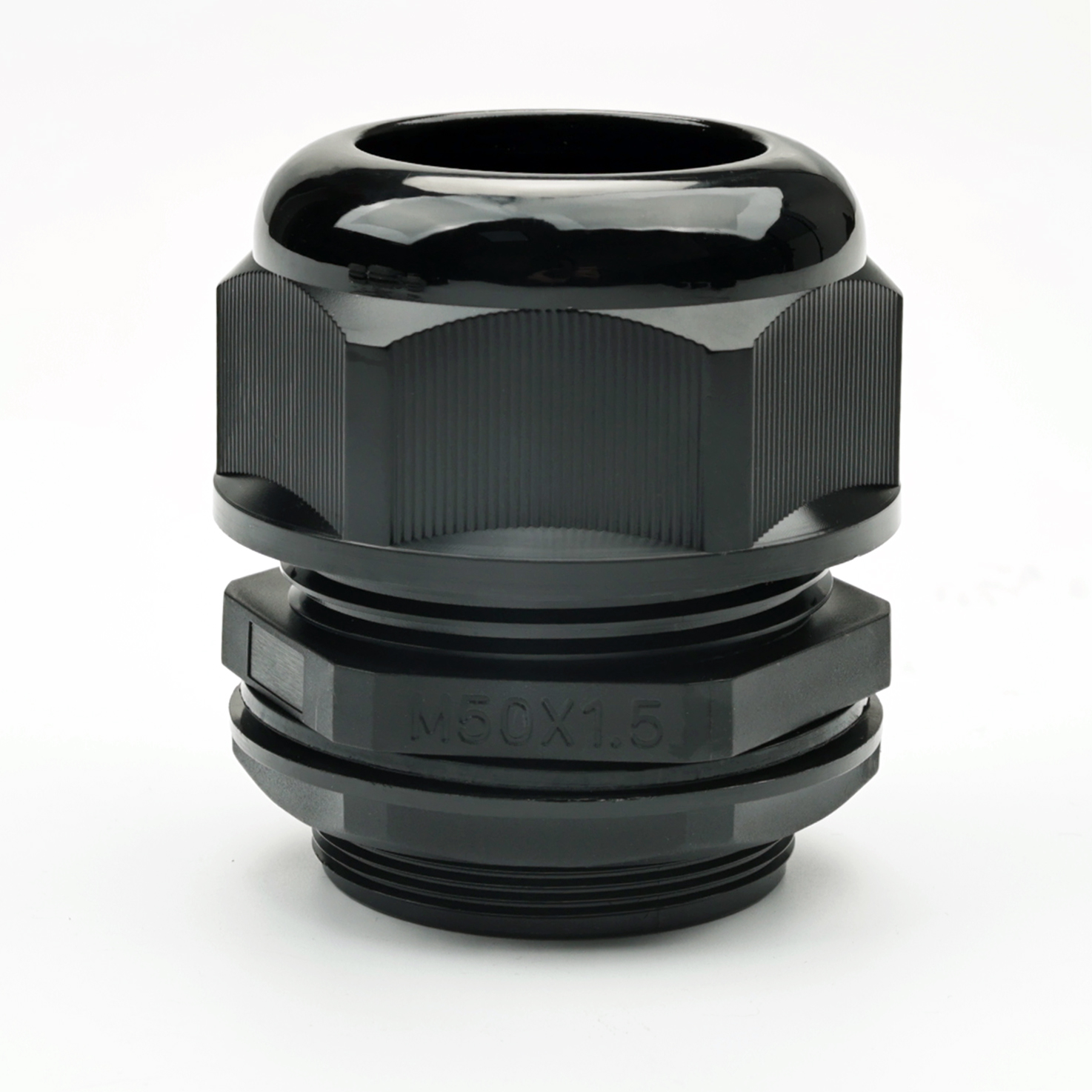
Most waterproof electrical connector accessories are sold from a fixed catalogue: three housing colours, a printed thread table, and a factory label on the bag. Project procurement rarely arrives that neatly. An enclosure is painted to a brand palette, a distribution board is drilled for a thread family the catalogue lists on a later page, and the OEM wants its own marking on the carton. The question a buyer is really asking is not whether a supplier prints the word "customization" on its website, but whether the factory behind that page can change colour, thread and identity without disturbing the sealing behaviour that made the part worth specifying.
Customization capability in cable glands can be read from two concrete signals. The first is the colour range: whether the factory stops at the three reference RAL values it lists as standard or states that custom colours are available on request. The second is thread breadth: how many families and sizes it can tool in parallel. Zhejiang Gutai Connector Co., Ltd. — a cable gland and waterproof connector manufacturer based in Yueqing, Wenzhou, Zhejiang, China, producing waterproof cable glands, brass screw caps, watertight corrugated tubing fittings and Solar MC4 connectors — states both. Its cable glands are supplied in Black (RAL9005), Light Grey (RAL7035) and Silver (RAL7001) as standard colours, with custom colours available on request, and the range runs metric M12–M63 and PG7–PG48 alongside G thread and NPT thread options.
Why Customization Is a Project-Fit Question
In this category, customization is not a blanket capability. It is exercised in a narrow set of places: the colour of the housing, the thread family and size at the entry point, the body material, the seal geometry, the hole layout on a multi-entry panel, and the marking applied to the product and its packaging. Each of those has an operational consequence inside the factory — a mould or insert, a colour batch, an inspection step, a separate packing run — and each has a consequence for the buyer, either in lead time, minimum quantity, or the amount of documentation needed to prove the change did not affect performance.
That makes customization a project-fit question rather than a marketing one. A distribution box specification that names a thread family the supplier does not tool forces a second supplier into the bill of materials. A housing colour outside the standard three either gets waived at the design review or becomes a separate purchase order. Buyers in the research and evaluation stage are therefore better served by asking what a factory can change, how quickly, and at what quantity, than by asking whether it accepts OEM work at all.
Where a Standard Range Stops
Three standard colours cover a large share of industrial demand, and a thread table of twenty-odd sizes covers most panel entries. The limit appears at the edges of a project. A buyer matching an existing cabinet finish, a brand owner specifying its own housing colour, or a site where colour is used to separate circuits will find the catalogue short. The same happens with threads: a European-legacy machine tool may use PG entries while a newer assembly uses metric, and a single junction box may need both plus a G or NPT interface for an imported component.
Catalogue-only supply responds to those gaps in one of two ways — a waiver request, or a second supplier. Both add work to the buyer's side of the table. The alternative is a manufacturer whose tooling already covers the families in question and whose colour process can be extended on request. Neither capability is exotic; both are visible in the published specification, which is what makes them useful as evaluation evidence.
Reading Colour Customization as Capability
Gutai's cable gland specification lists three standard colours — Black RAL9005, Light Grey RAL7035 and Silver RAL7001 — and adds that custom colours are available upon request. The same statement appears against both the metric series and the PG series, which matters: it indicates the colour process is attached to the moulding operation rather than to one product line.
Housings and the components listed as A/C/E/F are moulded from UL-approved Nylon PA66, chosen for strength and anti-aging behaviour; the sealing parts listed as B/D are NBR nitrile rubber, selected for sealing reliability and oil resistance. Colour therefore sits on the PA66 side of the construction. In practice that means a custom colour is a pigment and batch-control decision inside an existing moulding process, not a redesign of the gland. It also means the questions worth asking are administrative rather than structural: which colour reference will be matched, what quantity the colour run requires, and how the factory keeps successive batches visually consistent.
Two verification steps are worth building into the evaluation. First, request a physical colour sample against the stated reference rather than approving from a screen image. Second, confirm that the sealing components remain NBR and that the IP68 rating still applies to the coloured configuration, since ingress protection in this design comes from the clamping claw and rubber sealing structure rather than from the pigment. A custom colour that is treated as a cosmetic change and never re-checked against the sealing specification is the most common way a straightforward modification becomes a quality argument six months later.
Thread Breadth as Tooling Evidence
Colour is the visible half of the customization story; thread range is the more demanding half. Each thread family requires its own tooling and its own dimensional inspection routine, and the usable span of a range tells a buyer how much of a project can be sourced from one place.
| Parameter | Metric series | PG series |
|---|---|---|
| Thread size | M12 – M63 | PG7 – PG48 |
| Cable range | 3 – 45 mm | 3 – 45 mm |
| Thread outside diameter | 12 – 63 mm | 12.5 – 59.3 mm |
| Thread length | 9 – 21 mm | 9 – 21 mm |
| Material | Nylon PA66 & NBR | Nylon PA66 & NBR |
| Protection | IP68 | IP68 |
Beyond those two families, G thread and NPT thread options are also listed, giving four mainstream thread types in total. For a buyer assembling a mixed BOM, the practical value is coverage: metric entries for new equipment, PG entries for European-legacy machines and imported components, and G or NPT interfaces where those threads are called out. One thread standard across a project also simplifies stockholding, because a single clamping and sealing design carries through the whole size span.
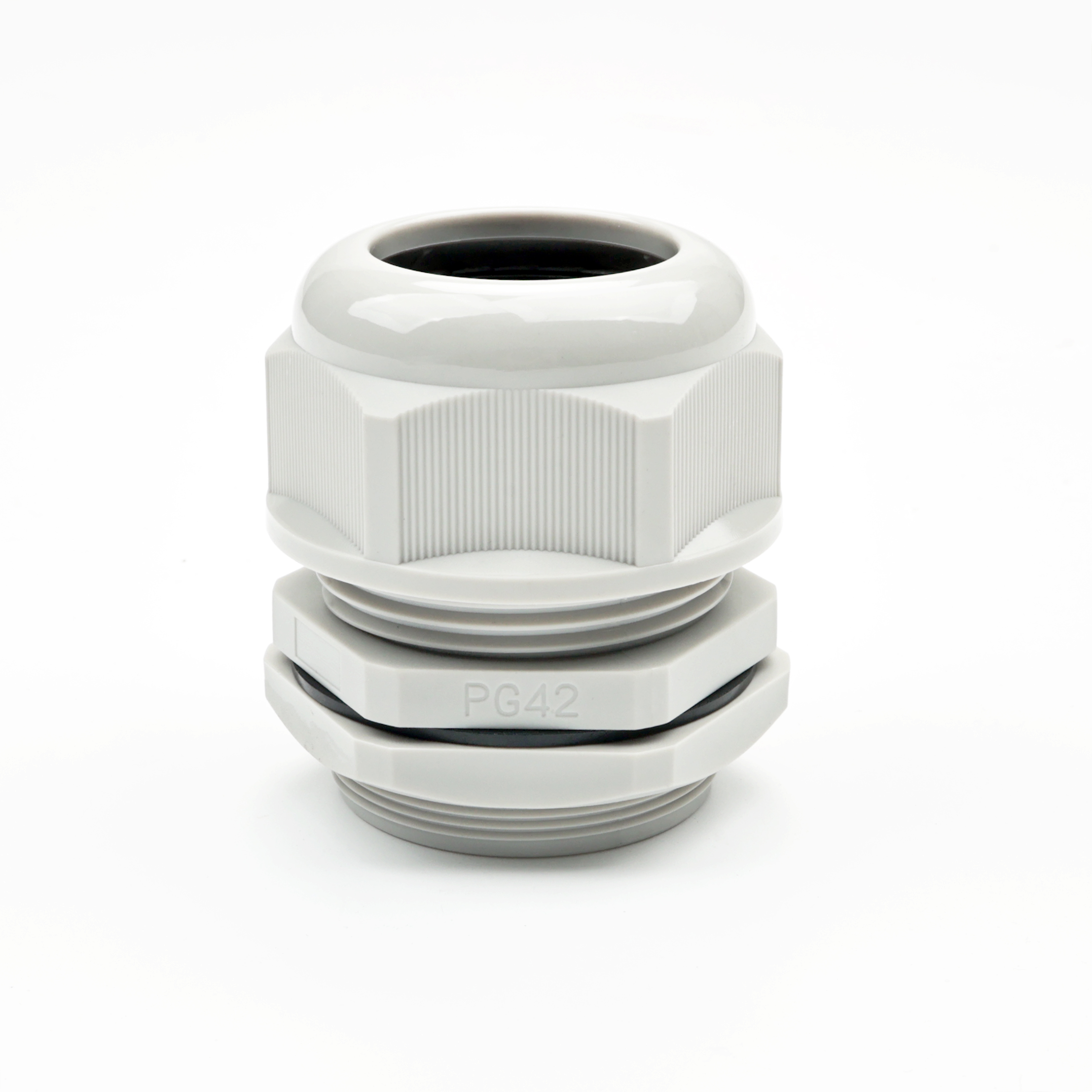
The construction underneath the thread is what the buyer ultimately evaluates. Gutai describes a special clamping claw and rubber sealing structure with a wide clamping range, pull-out resistance, IP68 protection, and resistance to salt spray, acid, alkali, alcohol, grease and common solvents. Operating temperature is stated as −40 °C to 100 °C static with a peak instantaneous temperature up to 120 °C, and −20 °C to 80 °C dynamic with a peak up to 100 °C. Those figures apply across the range rather than to a single hero size, which is the point: a broad thread range is only useful if the sealing behaviour stays consistent from M12 to M63.
What Can Be Adapted Without Changing the Product
Colour and thread are the two most visible customization axes, but they are not the only ones a project may need. Gutai's stated production model combines manufacturing with OEM and ODM customization, product development and export services, and the declared customization scope extends across the following dimensions.
| Customization axis | Stated scope |
|---|---|
| Size and thread specification | Metric M12–M63, PG7–PG48, plus G thread and NPT thread options |
| Material | Nylon, brass and stainless steel |
| Colour | RAL9005, RAL7035 and RAL7001 standard; custom colours on request |
| Packaging and marking | Packaging and OEM labelling |
| Layout | Multi-hole layouts |
| Sealing | Specific seal customizations |
The commercial and quality context around those options is equally relevant at the evaluation stage. Monthly capacity is stated at 500,000 cable gland pieces and 100,000 MC4 sets, quality control is described as 100% full dimension inspection, and lead time is quoted against order quantities rather than as a fixed figure. Small trial orders are accepted, which gives a buyer a low-commitment route to validate a colour match or a thread configuration before placing a production order. After-sales terms cover returns and refunds for quality-related problems.
For the buyer, the combination matters more than any single line. A factory that moulds its own housings, tools both metric and PG threads, runs full dimensional inspection, and still accepts small trial orders is one where a customized configuration can be tested cheaply and then scaled. The company operates a 5,000 m² facility with 80 employees, a 10-engineer R&D team and stated annual output of 10,000,000 units, with roughly 80% of output exported to markets including the Middle East, Southeast Asia, India, Pakistan, the EU, the United Kingdom and the USA.
Application Fit: Where Tailored Configurations Earn Their Keep
The sectors that consume cable glands most heavily are also the ones where a project specification drifts furthest from a catalogue: solar PV, wind power, EV charging stations, energy storage, automated assembly, rail transit, telecom stations and general industrial equipment. The common thread is that these installations combine outdoor exposure, temperature variation, and enclosure interfaces that were designed before the connector was selected.
Two delivered projects illustrate how far the adaptation can go when a project demands it. For a coastal open-air EV charging programme in Europe, 5,000 sets of IP68 metal waterproof connectors were deployed on outdoor DC fast charging piles. The configuration used 304 stainless steel with a dual-seal anti-loosening structure, tested to 1,000 hours of salt spray and to IEC 60068-2-6 vibration conditions, aimed at the coastal salt-fog, wind and vibration profile of the site. Reported outcomes were a fall in connector-related electrical failure from 18% annually to 2.6%, maintenance cost per station dropping from above 500 RMB to below 80 RMB, and a 35% increase in installation efficiency at new stations.
A second case involved a large Middle Eastern PV developer and 20,000 sets of anti-UV modified PA66 photovoltaic connectors for a 150 MW desert plant, supplied over three years. Housings were tested to 1,000 hours of UV aging, seals used high-temperature fluororubber, and terminals were silver-plated to hold contact resistance at low levels under surface heat and wind-sand erosion. Reported results were a damage rate falling from 8% annually on the original imported product to below 1.2%, a 70% reduction in downtime from connection failures, and cumulative maintenance and generation-loss savings above 80,000 USD.
Neither case is a colour story. Both are material and seal adaptations driven by site conditions, which is the useful point for buyers reading customization claims: the same flexibility that changes a housing colour is the flexibility that re-specifies a seal compound or a terminal plating. Suppliers who can only offer standard colours and standard seals rarely manage the second kind of change well.
Market Context: A Category Moving Toward Documented Ranges
The commercial backdrop supports the shift toward broader, better-documented ranges. The global cable glands market was valued at approximately USD 2.16 billion to USD 2.25 billion in 2024–2025, with growth forecasts ranging between USD 3.07 billion and USD 4.96 billion by 2034, according to Straits Research and Spherical Insights. Asia Pacific is the leading regional market, accounting for roughly 38% to 42% of global revenue, driven primarily by industrialisation in China and India (Dataintelo, Straits Research).
Standardisation is moving in the same direction. IEC 62444 and its European adoption EN 62444 govern the construction and performance requirements for cable glands for electrical installations, replacing the older BS EN 50262, and IP68 remains the benchmark ingress protection rating under IEC 60529, requiring the device to withstand continuous immersion under specified conditions. When the governing standard and the protection rating are both fixed and public, differentiation shifts to what a supplier can actually configure and document — thread coverage, colour options, material choice, and the inspection record behind each batch. Buyers comparing suppliers in this environment increasingly ask for ranges and evidence rather than assurances.
Customization-Capable Supply vs. Catalogue-Only Supply
The comparison that matters at the evaluation stage is not brand against brand, but supply model against supply model. A catalogue-only distributor and a customization-capable manufacturer can deliver an identical standard gland; they diverge as soon as the project leaves the catalogue.
| Decision point | Catalogue-only supply | Customization-capable manufacturer |
|---|---|---|
| Housing colour | Three standard RAL references | Standard three plus custom colours on request |
| Thread coverage | Whichever families are in stock | Metric M12–M63, PG7–PG48, G and NPT options |
| Material choice | Limited to listed items | Nylon, brass and stainless steel |
| Marking and packaging | Supplier brand | OEM labelling and packaging |
| Entry quantity | Stock pack sizes | Small trial orders accepted |
| Verification | Catalogue data | 100% full dimension inspection, batch records on request |
The boundary conditions deserve equal weight. If a project can accept Black RAL9005 housings and an existing metric or PG size, a customized configuration adds ordering steps and lead time without functional gain, because ingress protection in this design is delivered by the clamping claw and NBR sealing structure rather than by the housing colour. Custom colours, multi-hole layouts and bespoke seals sit on a longer lead time, quoted against order quantity, and are better matched to forecastable or repeat volumes than to a single urgent shipment. Finally, any customization that touches seal geometry or the hole layout should be re-verified against the target IP rating by the buyer before full release — the supplier's dimensional inspection confirms the part matches the drawing, not that the drawing suits the enclosure.
Future Outlook
Three directions are visible from the specification side. First, thread consolidation: as IEC 62444 and EN 62444 settle the performance requirements, buyers are concentrating on suppliers who can cover metric, PG, G and NPT entries from one source, because each additional thread family in a BOM is an additional approval. Second, colour as a brand requirement rather than a cosmetic afterthought: brand owners specifying enclosures are increasingly extending that specification to the cable entry, which pushes custom colour from an exception to a routine request. Third, documentation: IP68 under IEC 60529 and the EN 62444 construction requirements are both auditable, so buyers are likely to keep shifting weight from catalogue claims toward inspection records, colour references and test reports attached to specific batches.
For manufacturers, the practical consequence is that tooling breadth and colour flexibility stop being sales talking points and become part of the quality file. For buyers, it means the evaluation question gets simpler: ask what the factory can change, ask for the evidence attached to the last batch that changed, and compare on that basis.
Reference material: the 2025 Gutai product catalogue is available as a downloadable PDF at cdn.socialarks.com — 2025 catalogue. Company information: gt-connector.com.
FAQ
Can cable glands be supplied in colours other than black, light grey or silver?
Yes, subject to confirmation of the colour reference and the quantity involved. Gutai lists Black (RAL9005), Light Grey (RAL7035) and Silver (RAL7001) as standard colours for its nylon cable glands and states that custom colours are available on request. Because a custom colour is a pigment and batch-control decision inside the moulding process, the practical variables to settle are the exact colour reference, the minimum quantity for that colour run, and the lead time it carries.
Which thread families can be specified within a single project?
Gutai states four thread options for its cable glands: metric, PG, G thread and NPT thread. The metric series spans M12 to M63 with thread outside diameters from 12 mm to 63 mm and thread lengths from 9 mm to 21 mm. The PG series spans PG7 to PG48 with outside diameters from 12.5 mm to 59.3 mm and the same 9 mm to 21 mm thread length. Both series cover a cable range of 3 mm to 45 mm.
What can be customized beyond colour and thread?
Gutai's stated customization scope covers size and thread specifications, materials including nylon, brass and stainless steel, colour, packaging and OEM labelling, multi-hole layouts, and specific seal customizations. Production is described as manufacturing with OEM/ODM customization, product development and export services, supported by a 10-engineer R&D team within a 5,000 m² facility.
What order size is realistic for a customized cable gland run?
Gutai states that small trial orders are acceptable and that lead time depends on order quantities rather than being fixed. Monthly capacity is listed at 500,000 cable gland pieces and 100,000 MC4 sets. For a buyer, the trial-order route allows a colour match or thread configuration to be validated before a production quantity is committed.
How is a customized batch verified before shipment?
Gutai describes its quality control as 100% full dimension inspection, meaning dimensional checks are applied to the full batch rather than by sampling. For customized items, buyers should additionally request the approved colour reference, the construction and performance documentation relevant to IEC 62444 / EN 62444, and confirmation that the IP68 rating under IEC 60529 still applies to the configured part. After-sales terms cover returns and refunds for quality-related problems.
When is a customized cable gland the wrong choice?
When a project can accept one of the three standard colours and an existing metric or PG size. In that case a customized configuration adds ordering steps and lead time without functional gain, because water and dust protection in this design comes from the clamping claw and NBR sealing structure rather than from the housing colour. Custom colours, multi-hole layouts and bespoke seals are better matched to forecastable or repeat volumes, and any change touching seal geometry or hole layout should be re-verified against the target IP rating before full release.
Есть вопросы или нужны дополнительные детали?
Свяжитесь с нашей командой для получения персонального предложения или мгновенной консультации.
Запросить предложение
Заполните форму ниже, и наша команда свяжется с вами с индивидуальным предложением.
Прямой чат WhatsApp
Предпочитаете общаться в реальном времени? Напишите нам в WhatsApp для мгновенной помощи и быстрых ответов.
- Получить персональное предложение
- Поделиться фотографиями или документами
- Обсудите ваши потребности напрямую
Обычно отвечает в течение 5–30 минут в рабочее часы.