
Camping Tent Compliance: Material Standards for Importers
Compliance now sits at the front of the purchase order rather than the back of it.
The global camping tent market was valued at USD 6.18 billion in 2025 and is projected to reach USD 10.91 billion by 2034 (Grand View Research). The inflatable tent segment reached USD 1.033 billion in 2024 (Intel Market Research), and the rooftop tent segment was valued at approximately USD 215.5 million in 2024, with hard shell models holding more than 53% of revenue share (Business Research Insights). Each of those segments carries a different documentation burden, and importers who treat "camping tent" as a single compliance category usually find the gap later — at customs, at a marketplace listing review, or at the first warranty claim.
For an importer, camping tent compliance means one concrete thing: every declared specification on the product page, the specification sheet and the carton — fabric denier, coating, waterproof rating, UV protection, frame material, hardware — can be traced to a documented source and matched against a standard the destination market recognises. The most widely referenced baseline for camping tents is ISO 5912:2020, which specifies safety, performance and fitness-for-use requirements, including flammability and rain resistance (ISO). In North America, CPAI-84 is a mandatory flammability standard for tents in several US states — California, New York, New Jersey, Massachusetts, Louisiana, Michigan and Minnesota — and a federal requirement in Canada (Compliance Gate).
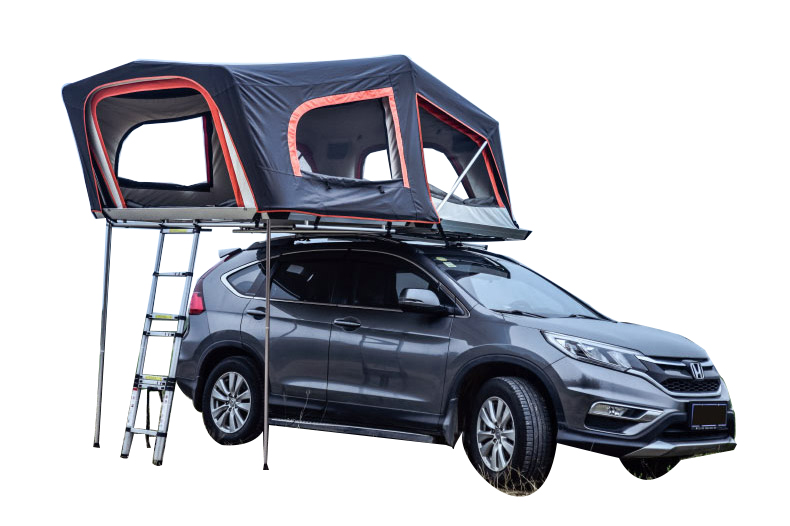
Hard shell rooftop tent construction — the reference category used throughout this material and specification review. Image: MARVELOUS rooftop tent model MOT-L800.
Why compliance verification has become a purchasing constraint
Camping tents occupy an unusual position. They are consumer goods, outdoor equipment and — in the rooftop segment — vehicle-adjacent accessories at the same time, and each identity brings a different set of expectations from regulators, marketplaces and end users. A tent sold through a global marketplace may be asked to declare flammability behaviour, rain resistance, UV protection and material composition before it is listed at all. A rooftop tent sold into an overlanding channel adds mounting hardware, vehicle load considerations and ladder components to the same file.
Published market sizing illustrates the problem. Estimates of the camping tent market vary widely by scope — Market Research Future places it at USD 4.76 billion while Data Bridge Market Research estimates USD 1.82 billion for a differently defined category. That divergence is not a reason to distrust the category; it is a reminder that figures should be attributed to their source rather than repeated as settled fact. The same discipline applies to product specifications: a declared 3000mm or PU5000mm waterproof rating is a claim, and a claim becomes an asset only when it is documented.
The commercial logic is straightforward. Returns from a leaking tent are expensive across borders, and re-shipping a container of family tents is not a recoverable cost. Documented specifications, by contrast, reduce dispute exposure, support marketplace listings, and give a distributor something defensible to publish.
The four material layers that carry most compliance risk
Most compliance failures on tents are not the result of a single wrong decision. They come from a specification chain in which one layer is declared inaccurately or verified at the wrong level. Four layers carry most of the risk.
1. Fabric and denier
Denier describes the linear density of the yarn used in the fabric, and it is the first number a buyer sees in a tent specification. Oxford cloth used in camping tents is commonly expressed this way: 200D, 210D, 300D, 420D and 600D appear across the model range discussed in this article. In general terms, a higher denier indicates a heavier, more abrasion-resistant yarn, but denier alone does not determine field performance — the weave, the coating and the seam construction decide how a fabric behaves in rain.
Concrete examples from published MARVELOUS product data show how denier is used as a specification anchor. The MOT-CT096 family camping tent uses 210D Oxford cloth with a PU coating and a declared 2000mm waterproof rating. The MOT-CT900 family tent uses 200D Titanium Black Rubber Oxford Cloth with an aluminum alloy pole, declared at PU5000mm with UPF50+ protection. The MOT-L800 hard shell rooftop tent uses 300D Oxford cloth at a declared 3000mm rating. The MOT-LK901 hard shell uses a 420D Oxford cloth outer tent with a 280g polyester cotton inner tent, declared at PU4000mm. The MOT-DYG01 rooftop model uses 600D Oxford cloth, declared at 3500mm with UV and mould resistance.
2. Coating and waterproof rating
A waterproof rating expressed in millimetres describes the hydrostatic head the fabric resists before water passes through — a widely used industry convention. When a specification reads "PU5000mm" or "PU4000mm", the PU prefix indicates a polyurethane coating applied to the fabric; when it reads simply "3000mm" or "3500mm", the figure is the same style of measurement. Across the MARVELOUS models referenced here, declared ratings span 2000mm, 3000mm, 3500mm, PU4000mm and PU5000mm.
The important distinction for importers is that a waterproof rating is a fabric-level declaration. It says nothing on its own about seam sealing, zipper flaps, or the floor-to-wall junction — the points where assembled tents most often leak. A buyer who verifies only the headline number has verified the least ambiguous part of the product.
3. Frame and load path
Frame material behaves differently in each category. Hard shell rooftop models in the MARVELOUS range use Aviation Aluminum frames (MOT-L800, MOT-DYG01) or an aluminum shell (MOT-LK901). Pole-frame family tents use either an aluminum alloy pole (MOT-CT900), a steel frame (MOT-CT096) or a quick-open iron frame (MOT-M100). Inflatable models such as the MOT-Q500 use a 5-layer PVC air column frame instead of poles entirely.
Frame choice determines the load path. On a rooftop tent, that path runs from the shell through the mounting hardware into the vehicle roof rack, which is why published application requirements for this category note compatibility with most vehicle roof racks and a wind-resistant structure as prerequisites rather than optional features.
4. Hardware, seams and accessories
Accessory lists matter more than they appear to. Declared rooftop tent accessories include an aluminum telescopic ladder, an installation bag, a mattress, two shoe bags and two rods. Family and inflatable models are supplied with ground nails, ropes, and in some cases tent telescopic support poles — the MOT-CT900 list specifies two support poles, fourteen nails and seven ropes. Because accessories are part of the shipped declaration, they should appear on the packing list and be inspected against it, not treated as a courtesy add-on.
Specification reference: reading a declared camping tent spec sheet
The table below consolidates the published specification data for the MARVELOUS models discussed in this article. It is presented as a working reference for the exercise described above — reading a declaration, not replacing verification of it.
| Model | Type | Fabric / coating | Waterproof | Frame | Capacity | N.W. / G.W. |
|---|---|---|---|---|---|---|
| MOT-DYG01 | Hard shell rooftop (car tent) | 600D Oxford, UV and mould resistant | 3500mm | Aviation Aluminum | 2 people | 32kg / 45kg |
| MOT-LK901 | Hard shell rooftop (car tent) | Outer 420D Oxford cloth; inner 280g polyester cotton | PU4000mm | Aluminum shell | 1–2 people | 60kg / 90kg |
| MOT-L800 | Hard shell rooftop (car tent) | 300D Oxford cloth | 3000mm | Aviation Aluminum | 4 people | 140kg / 150kg |
| MOT-Q500 | Inflatable camping tent | 200D Oxford cloth, UPF50+ | PU5000mm | 5-layer PVC air column | 4–5 people | 13.6kg / 15kg |
| MOT-CT900 | Family tent | 200D Titanium Black Rubber Oxford Cloth, UPF50+ | PU5000mm | Aluminum alloy pole | 4–5 people | 12.9kg / 13.5kg |
| MOT-CT096 | Family camping tent | 210D Oxford cloth with PU | 2000mm | Steel | Not declared in source data | G.W. 14.5kg |
| MOT-M100 | Family tent | 200D titanium black plaid cloth, high-density anti-mosquito mesh | Not declared in source data | Quick-open iron frame | 6–8 people | 11kg / 11.5kg |
Declared manufacturer specifications for the referenced MARVELOUS models. Importers should obtain model-level test documentation before issuing a production order.
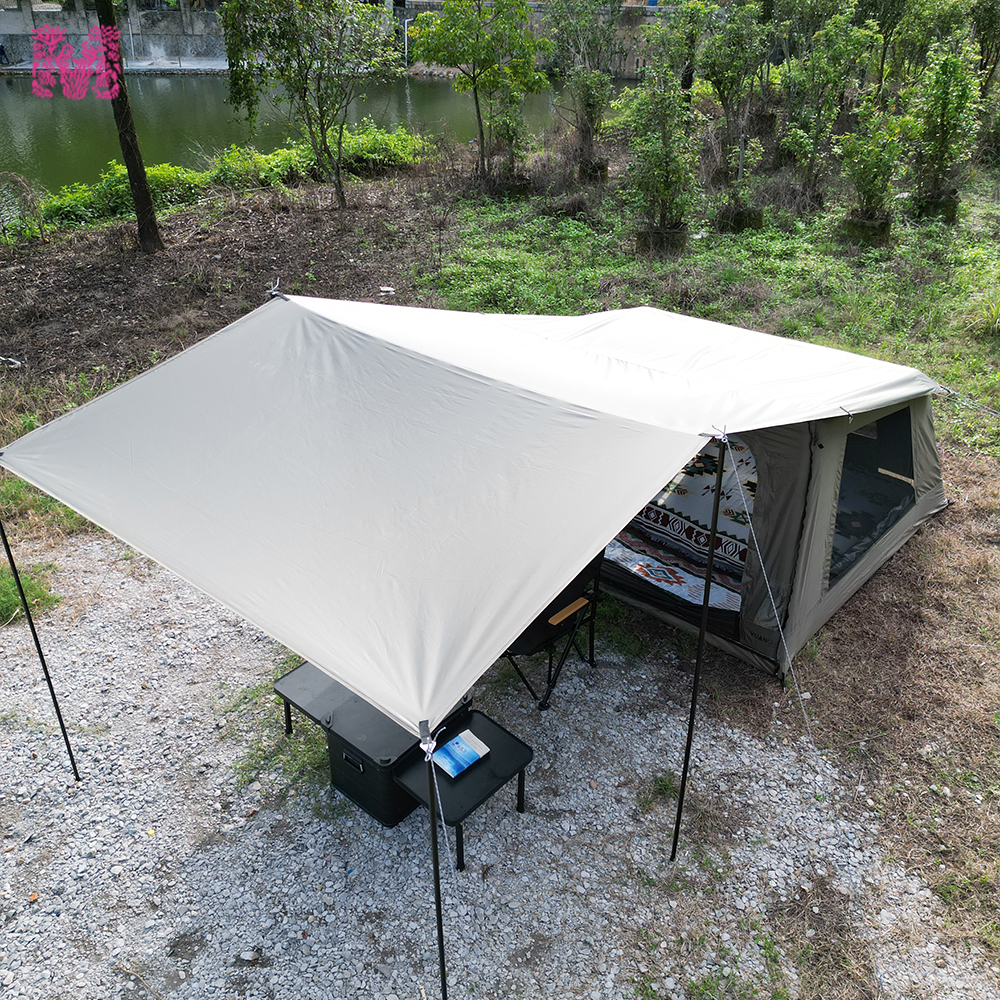
Inflatable construction replaces poles with a 5-layer PVC air column — a different verification and repair profile from frame-based tents. Image: MARVELOUS MOT-Q500 inflatable camping tent (200D Oxford cloth, PU5000mm, UPF50+).
A certification and documentation checklist for importers
The following sequence reflects how a specification file should be assembled. It is a working order of operations rather than a regulatory requirement, and it applies equally to a first sample order and to a repeat container.
- Fix the declaration at model level. One document per SKU, covering fabric type and denier, coating, water resistance rating, UV protection, frame material, hardware and weight. Category-level declarations are where disputes start.
- Map each declaration to a standard. ISO 5912:2020 provides a recognised baseline covering safety, performance and fitness for use, including flammability and rain resistance. For North America, map flammability separately to CPAI-84.
- Request test reports rather than general statements. Check that the report identifies the tested sample, the test scope, the laboratory and the date. A report that cannot be tied to a model number is not evidence.
- Confirm destination-market flammability evidence. Several US states and Canada treat tent flammability as a mandatory requirement, so this belongs in the pre-order file, not the after-sales file.
- Separate intellectual property documents from safety documents. They serve different purposes and should never be presented interchangeably, particularly in marketplace listings.
- Validate with a physical sample. Because MARVELOUS accepts orders from a single unit, sample validation can be completed before a volume commitment. Check the assembled product — seams, zips, floor junction — not only the fabric swatch.
- Write the inspection protocol into the order. A stated 100% test regime should be paired with a defined inspection checklist and a record that travels with the shipment.
- Control change. Any substitution of fabric, coating, frame or hardware invalidates the previous verification. Change control is the most frequently overlooked step in cross-border tent sourcing.
Where a design patent fits — and where it does not
Intellectual property documents frequently appear in a supplier's compliance folder, and they are often misread. MARVELOUS holds a Chinese Design Patent Certificate, patent number 8328925, issued by the China Intellectual Property Office under the Patent Law of the People's Republic of China. The certificate is recorded with an issue date of 3 November 2023 and an expiry date of 20 June 2033, and it applies to the China market. The rooftop tent models MOT-L800, MOT-LK901 and MOT-DYG01 are listed as related products.
What that document demonstrates is design ownership in one jurisdiction. What it does not do is certify fire behaviour, rain resistance, structural strength or fitness for use in any market. A design patent is not a substitute for a flammability test report, and it should not be displayed in a product listing as though it were one. For importers, the practical value is narrower and still real: it confirms that at least some of the designs being supplied are registered rather than copied, which reduces the risk of a third-party design claim in the country of registration.
It is also worth stating what is not claimed. The compliance documentation confirmed in MARVELOUS' published product data is limited to this design patent covering the rooftop tent models. Testing and certifications required for a specific destination market should be requested and verified per order, per market, rather than assumed from a supplier's general description.
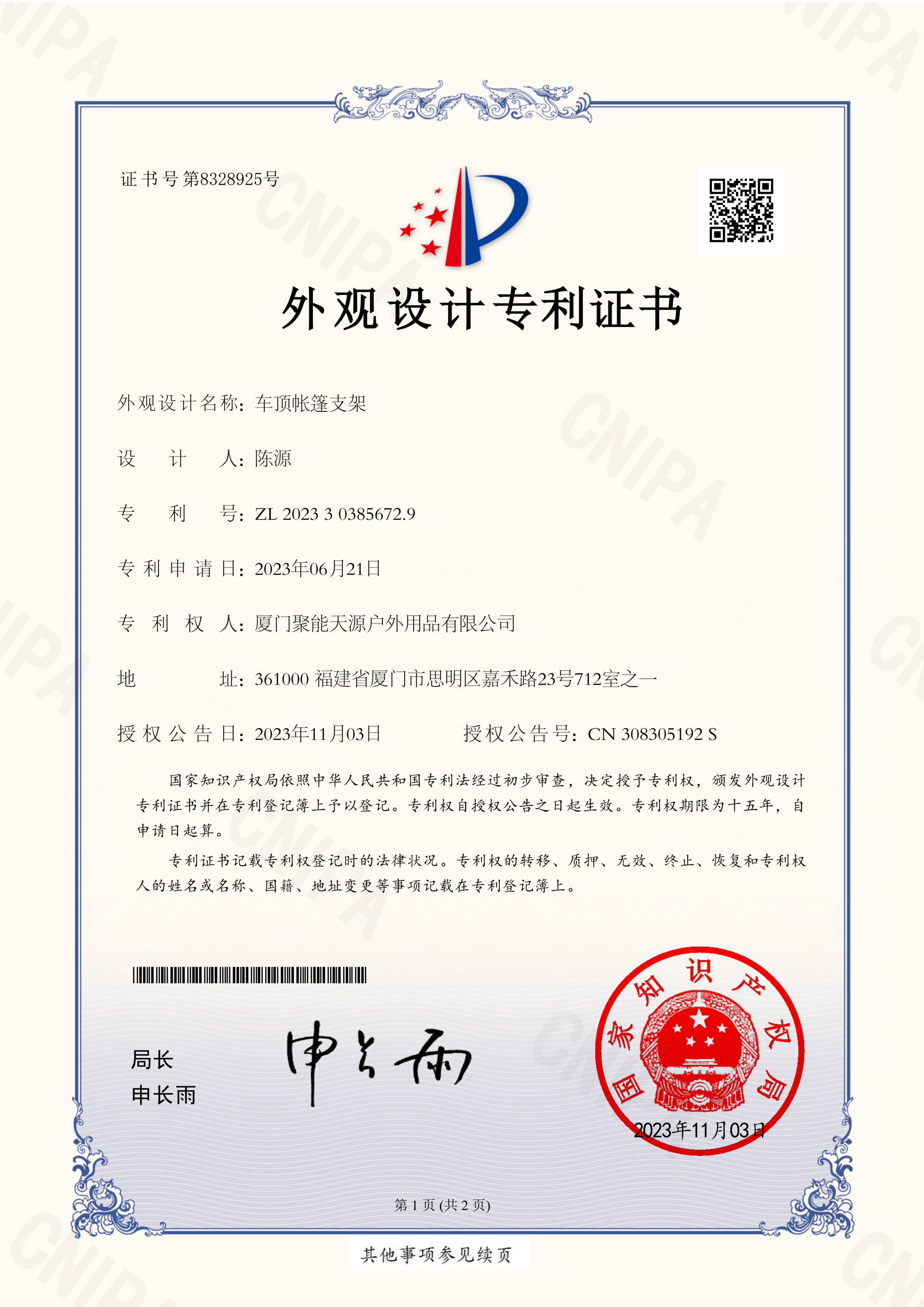
Chinese Design Patent Certificate No. 8328925, issued by the China Intellectual Property Office and recorded with the MARVELOUS rooftop tent models MOT-L800, MOT-LK901 and MOT-DYG01.
Application fit: matching declared specifications to real use conditions
Published application data for this category describes an operating envelope rather than a single use case: camping and hiking use, all seasons, rainy and snowy conditions, UV-exposed outdoor environments and variable terrain. The stated functions are shelter from weather elements, thermal insulation, and privacy and security. The declared special requirements are a waterproof rating of at least 3000mm, UV-resistant fabric, a wind-resistant structure, and compatibility with most vehicle roof racks. Matching equipment includes the aluminum telescopic ladder, installation brackets, mounting hardware, a mattress and shoe bags.
Read against that envelope, the model range separates cleanly. The MOT-L800 at 3000mm, MOT-DYG01 at 3500mm, MOT-LK901 at PU4000mm, MOT-Q500 at PU5000mm and MOT-CT900 at PU5000mm all meet the ≥3000mm threshold. The MOT-CT096, declared at 2000mm with a steel frame, sits below it and is better positioned for milder, short-duration trips than for sustained rain exposure — a boundary worth stating plainly rather than smoothing over.
Two further points belong in an application assessment. UV exposure is addressed explicitly on some models — UPF50+ is declared for the MOT-Q500 and MOT-CT900 — but not on every model, so the buyer should confirm it where sun exposure is the dominant risk. And field feedback from long-term users tends to focus on material quality and interior space rather than laboratory figures; a customer review recorded from an Australian buyer of a four-person side-fold hard shell model emphasised both material quality and the interior layout for a family of five. That is anecdotal evidence, not a compliance document, but it illustrates what buyers actually verify in use.
Market trends shaping compliance expectations
Regional concentration shapes where documentation pressure is highest. North America holds the largest share of the rooftop tent market at 38.6%, followed by Europe at 27.4%, driven by established overlanding cultures (Dataintelo). These are also the markets where flammability expectations and marketplace listing reviews are most developed, which means the documentation burden concentrates precisely where the volume is.
Segment mix matters too. Hard shell models hold more than 53% of rooftop tent revenue share, and hard shell rooftop tents typically use aluminum or ABS plastic shells with a setup time of 3–8 minutes, compared with 15–25 minutes for ground tents (Rooftop Tent Market Insights). Speed and rigidity are the purchase drivers, and both are structural claims that a buyer can partially verify at sample stage. Meanwhile, the inflatable segment's growth is tied to ease and speed of setup, which shifts verification attention toward air column integrity and pressure retention rather than pole strength.
The net effect is more SKUs per catalogue and more declarations per SKU. A supplier that sells one dome tent needs one file; a supplier that sells hard shell rooftop, inflatable and pole-frame families needs a file per model, and the importer inherits that complexity at the moment of purchase.
Comparing construction approaches: capability and boundaries
No construction method wins on every dimension, and an honest comparison is more useful to a buyer than a ranked list.
| Approach | Representative model | What it does well | Boundary to verify |
|---|---|---|---|
| Hard shell rooftop | MOT-DYG01 / MOT-LK901 / MOT-L800 | All-season protection with rapid setup; declared fabrics from 300D to 600D Oxford and ratings of 3000mm, 3500mm and PU4000mm; aviation aluminum or aluminum shell construction | Vehicle-dependent: roof load rating and rack compatibility sit outside tent compliance and must be confirmed separately; weight is substantial on larger models |
| Inflatable air column | MOT-Q500 | Large interior volume (270×270×200cm) at 13.6kg N.W.; 200D Oxford cloth at PU5000mm with UPF50+; no poles to bend or lose | Pressure retention and puncture repair require patching rather than pole replacement; fabric-level rating still depends on seam construction |
| Pole-frame family tent | MOT-CT900 / MOT-M100 / MOT-CT096 | Lower weight and simpler logistics; MOT-CT900 at 12.9kg N.W. with aluminum alloy pole and PU5000mm; MOT-M100 offers 6–8 person capacity | Declared waterproof ratings start lower on some models (MOT-CT096 at 2000mm); steel frames add packed weight relative to aluminum |
Construction comparison based on declared manufacturer specifications. Boundaries listed are verification points, not defects.
Three limits deserve to be stated without softening. First, a design patent is jurisdiction-specific: the MARVELOUS certificate applies to the China market and does not extend protection or compliance standing to a resale market. Second, a declared waterproof rating is a fabric-level figure — assembled performance depends on seams, zippers and the floor junction, and no rating replaces destination-market flammability evidence. Third, a heavyweight rooftop model such as the MOT-L800, declared at 140kg N.W. and 150kg G.W., imposes demands on the vehicle that a tent specification sheet cannot satisfy; the buyer must verify roof load capacity and rack compatibility independently before purchase.
Future outlook
The direction of travel is toward SKU-level traceability. Buyers are increasingly asking for test documentation as a standard attachment to a quotation rather than a follow-up request, and marketplace listing structures are steadily converting qualitative marketing statements into required, structured fields. Manufacturers that maintain model-level records — fabric, coating, rating, frame and hardware — will find that work reusable across markets, while those that assemble documents case by case will keep re-verifying the same facts.
The supplier-side profile that supports this is unglamorous and specific. MARVELOUS operates a 4,000m² facility in Xiamen, Fujian, China, with approximately 50 employees, and exports about 95% of its output to markets including Russia, the United States, Australia and Canada. The company works in OEM/ODM mode with logo or whole-tent customisation, reports monthly capacity of 5,000–10,000 units, a production lead time of about 30 days, orders accepted from a single unit, a 100% test quality-control regime and replacement-based after-sales support. For an importer assembling a compliance file, those operating facts matter because they determine whether documentation can be produced per model, per order, on a predictable schedule.
Frequently asked questions
What is ISO 5912:2020 and does it apply to camping tents?
ISO 5912:2020 is an international standard that specifies safety, performance and fitness-for-use requirements for camping tents, including flammability and rain resistance. It is the most commonly referenced baseline when a buyer or a marketplace asks what a camping tent specification should be measured against. Conformance is demonstrated through testing rather than through a product description, so the relevant document is a test report tied to the specific model.
Is CPAI-84 required for tents sold in the United States?
CPAI-84 is a tent flammability standard that is mandatory in several US states — California, New York, New Jersey, Massachusetts, Louisiana, Michigan and Minnesota — and is a federal requirement in Canada. Coverage is therefore not uniform across the United States, which is why flammability evidence should be confirmed against the specific destination rather than assumed from a national-level statement.
How should an importer verify a waterproof rating such as 3000mm or PU5000mm?
A rating in millimetres describes the hydrostatic head the fabric resists before water passes through, and a "PU" prefix indicates a polyurethane coating. Verification has two parts: obtain a fabric-level test report that identifies the tested material and the laboratory, and inspect the assembled tent for seam sealing, zipper protection and floor-to-wall construction, since those are the points where water typically enters a tent that carries a high fabric rating.
What is the difference between 200D, 300D and 600D Oxford cloth on a tent?
Denier expresses the linear density of the yarn. In general terms, higher denier means a heavier, more abrasion-resistant fabric. In the model range referenced here, 200D Oxford cloth appears on the MOT-Q500 inflatable tent and the MOT-CT900 family tent, 210D Oxford cloth with PU coating on the MOT-CT096, 300D Oxford cloth on the MOT-L800, 420D Oxford cloth on the MOT-LK901 outer tent, and 600D Oxford cloth on the MOT-DYG01. Denier is one input among several; coating, weave, seam construction and frame design determine final performance.
Does a design patent certificate replace a safety or performance certification?
No. A design patent is an intellectual property registration. The MARVELOUS certificate, number 8328925, was issued by the China Intellectual Property Office under the Patent Law of the People's Republic of China, applies to the China market, and is recorded with an issue date of 3 November 2023 and an expiry date of 20 June 2033. It documents design ownership for the related rooftop tent models but does not certify flammability, rain resistance or structural performance in any market.
What documentation should be requested before the first production order?
A model-level specification sheet covering fabric, denier, coating, waterproof rating, UV protection, frame material and hardware; test reports tied to that model; flammability evidence for the destination market; a sample validated against the declaration; a defined inspection protocol supporting any stated quality-control claim; and a written change-control clause requiring re-verification if any material or component is substituted.
A downloadable MARVELOUS product brochure containing model-level specifications for the rooftop, inflatable and family tent ranges is available here: MARVELOUS product brochure (PDF). Model-level test documentation for a specific destination market should be requested and reviewed per order.
Есть вопросы или нужны дополнительные детали?
Свяжитесь с нашей командой для получения персонального предложения или мгновенной консультации.
Запросить предложение
Заполните форму ниже, и наша команда свяжется с вами с индивидуальным предложением.
Прямой чат WhatsApp
Предпочитаете общаться в реальном времени? Напишите нам в WhatsApp для мгновенной помощи и быстрых ответов.
- Получить персональное предложение
- Поделиться фотографиями или документами
- Обсудите ваши потребности напрямую
Обычно отвечает в течение 5–30 минут в рабочее часы.