
Camping Tents for Every Terrain: A Model-to-Scenario Guide
Camping tents are usually chosen in the wrong order. Buyers compare waterproof ratings, denier counts and frame materials first, then discover on the second or third trip that the tent was sized for a different terrain, a different group, or a different vehicle. Terrain and occupancy decide tent fit long before any single number on a specification sheet does.
That mismatch is now commercially visible. The global camping tent market was valued at USD 6.18 billion in 2025 and is projected to reach USD 10.91 billion by 2034, according to Grand View Research. Within that total, the categories buyers choose from have separated along clear functional lines: vehicle-mounted hard shell rooftop tents, inflatable air-beam tents, and conventional ground tents including dome and pop-up models. Each category answers a different outdoor scenario, and each carries its own boundaries.
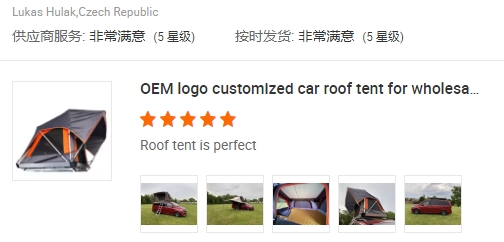 A hard shell rooftop tent in field use: vehicle-supported camping is one of the scenarios driving category-level change in tent selection.
Why Scenario Comes Before Specification
A tent specification only carries meaning once the terrain and the camping pattern are defined. Three questions resolve most of the evaluation stage:
- Where will the tent be pitched? On the ground at a fixed campsite, or on a parked vehicle that moves between sites?
- How many people will sleep inside it, and how much gear needs to stay dry alongside them?
- What is the weather profile? A dry summer weekend, or an all-season route with rain, wind and cold nights?
Buyers who ask these questions first tend to converge quickly on a category, and only then compare specifications inside it. Buyers who start from the specification sheet tend to overpay for features they never use — or under-specify rain resistance for a route that is wet nine months of the year.
MARVELOUS: An Outdoor Tent Manufacturer Serving Both Vehicle and Ground Camping
MARVELOUS is an outdoor products manufacturer operating as XIAMEN MARVELOUS OUTDOOR TECHNOLOGY Co.,Ltd, based in Xiamen, Fujian, China. The company designs and produces camping tents, rooftop tents and inflatable tents, and was established in 2019; the brand describes itself as a family-owned business specialising in the design and production of outdoor tents, with roots that predate the current corporate entity. Its founder came to the category as an outdoor sports and camping participant rather than as a trader.
The operational profile is relevant to how models get matched to scenarios. The factory covers 4,000 m², employs 50 people, and includes a 20-engineer research and development team. Annual output is stated at 50,000 units, with 95% of production exported. Main markets are Russia, the United States, Australia and Canada — markets where all-season camping and overlanding demand are concentrated.
On the supply side, MARVELOUS operates an OEM/ODM model with monthly capacity of 5,000–10,000 units and a stated lead time of 30 days. Customisation covers logo application or a fully customised tent. Minimum order quantity is listed at one unit, and quality control is described as 100% testing, with replacement support after sale. For buyers comparing suppliers during evaluation, those parameters matter more than catalogue photography: they determine whether a scenario-mapped product line can actually be procured at pilot scale and then scaled.
The Specifications That Actually Decide Terrain Fit
Four specification families do most of the work in matching a tent to a scenario.
Waterproof rating (hydrostatic head, in millimetres)
The millimetre figure describes how much water pressure a fabric resists before it passes moisture. Within the MARVELOUS rooftop range, the three verified models sit at 3,000 mm, 3,500 mm, and PU 4,000 mm respectively. A higher figure is not automatically better for every buyer — it usually correlates with a heavier or more heavily coated fabric, which affects packed weight and ventilation. Ratings are also laboratory measurements taken under controlled conditions and should be read as a comparative indicator rather than a guarantee of performance in wind-driven rain.
Fabric denier and construction
Denier describes the linear density of the yarn in the woven shell, and it is a reasonable proxy for abrasion resistance and durability. The verified models use 600D Oxford cloth with UV and mould resistance, 420D Oxford cloth for the outer tent with a 280 g polyester-cotton inner tent, and 300D Oxford cloth. Heavier outer fabric generally suits rougher terrain and longer service life; a cotton-blend inner layer generally targets condensation management and interior comfort on cold nights.
Frame and shell material
Frame material drives both weight and setup behaviour. The range uses aviation aluminium frames on two models and an aluminium shell on a third. Hard shell rooftop designs with aluminium or ABS shells are widely reported to reach a pitched state in roughly 3–8 minutes, against roughly 15–25 minutes for a comparable ground tent — a difference that compounds on multi-stop routes where the tent is pitched and struck daily.
Dimensions, capacity and packed weight
Open size defines usable interior volume; packed dimensions define whether the tent fits on a vehicle roof and inside a storage constraint. Net and gross weight define the load the vehicle must carry. These numbers should be checked against the vehicle roof rating before purchase, not after.
Standards to verify in parallel: camping tents are covered by ISO 5912:2020, which specifies safety, performance and fitness-for-use requirements including flammability and rain resistance. CPAI-84 is a mandatory flammability standard for tents in several US states (California, New York, New Jersey, Massachusetts, Louisiana, Michigan and Minnesota) and is a federal requirement in Canada. These requirements apply regardless of the outdoor scenario a tent is bought for.
Matching MARVELOUS Models to Outdoor Scenarios
The scenario mapping below uses only the verified specifications of three rooftop models in the MARVELOUS range. Each answers a different combination of group size, weather exposure and vehicle-based camping pattern.
Scenario A — Family base camp and group camping: MOT-L800
This is the largest of the three, with a stated capacity of four people and an expanded size of 215 × 251 × 110 cm. The shell is 300D Oxford cloth with a waterproof index of 3,000 mm on an aviation aluminium frame, finished in dark grey and orange and rated for all seasons. Packed dimensions are 233 × 155 × 32 cm, with net and gross weight stated at 140 kg and 150 kg. It is the model that fits a two-adult, two-to-three-child group or a small camping party that works from a parked vehicle as a base camp, and it is the one where roof load capacity becomes a genuine selection constraint rather than an afterthought. Standard accessories include an aluminium telescopic ladder, installation bag, mattress, two shoe bags and two rods.
Scenario B — All-season couple travel with hard shell protection: MOT-LK901
This model is stated for one to two people with an expanded size of 210 × 130 × 140 cm and packed dimensions of 223 × 141 × 25 cm. It uses an aluminium shell frame, a 420D Oxford cloth outer tent and a 280 g polyester-cotton inner tent, with a waterproof rating of PU 4,000 mm — the highest waterproof figure among the three verified models. Net and gross weight are 60 kg and 90 kg. For couples touring through wet shoulder seasons, or for buyers who prioritise interior condensation control and a hard shell profile, this is the closest match in the range. It is also rated for all seasons and ships with the same accessory set.
Scenario C — Two-person touring with lighter vehicle load: MOT-DYG01
Stated for two people, this model uses a 600D Oxford shell with a 3,500 mm waterproof rating and UV and mould resistance, on an aviation aluminium frame. Folded dimensions are 210 × 125 × 20 cm and open size is 210 × 125 × 140 cm. Net and gross weight are 32 kg and 45 kg — the lightest of the three, and the one that suits two-person overlanding where the vehicle is moved frequently and roof payload is limited. Colour is black or customised, and the model is rated for all seasons.
Scenario-to-Model Reference Table
| Scenario | Model | Capacity | Shell / Fabric | Waterproof | Open size | N.W. / G.W. |
|---|---|---|---|---|---|---|
| Family base camp, group camping from a parked vehicle | MOT-L800 | 4 people | 300D Oxford cloth, aviation aluminium frame | 3,000 mm | 215 × 251 × 110 cm | 140 kg / 150 kg |
| All-season couple travel, wet shoulder seasons | MOT-LK901 | 1–2 people | 420D Oxford outer, 280 g polyester-cotton inner, aluminium shell | PU 4,000 mm | 210 × 130 × 140 cm | 60 kg / 90 kg |
| Two-person touring, frequent camp moves, limited roof payload | MOT-DYG01 | 2 people | 600D Oxford, UV and mould resistant, aviation aluminium frame | 3,500 mm | 210 × 125 × 140 cm | 32 kg / 45 kg |
A Field Case: Family Camping in Australia
One documented application of scenario-based matching is located in Australia, where a personal-use customer selected a four-person side-fold hard shell rooftop tent to meet the needs of a family's outdoor camping trips. The customer's account describes a two-adult, three-child group fitting comfortably, high-quality and stable materials, and an interior layout compared to two queen beds inside a tent. The case is linked in the product record to the MOT-L800 and MOT-LK901 models.
 Family camping scenario in Australia: the four-person side-fold hard shell layout used by a two-adult, three-child group.
The practical takeaway for buyers is not the testimonial itself but the matching logic behind it. The customer did not choose the largest tent in the catalogue; they chose the layout whose stated capacity and open dimensions matched a known group size and a nine-month outdoor calendar. Capacity specification, not brand preference, drove the decision.
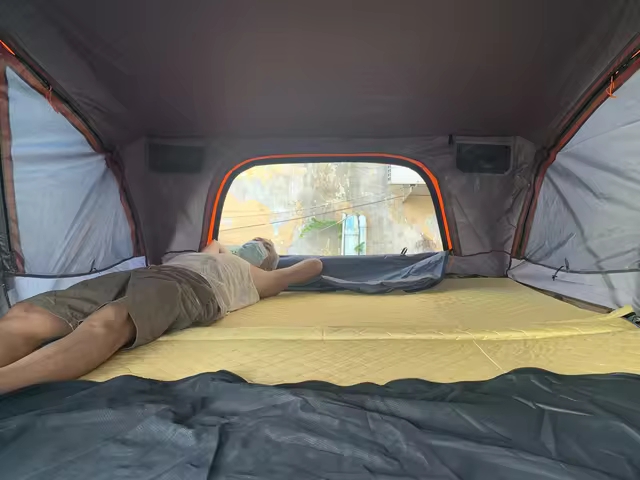 Vehicle-supported camping in field use: rooftop models trade campsite mobility for faster pitching and off-ground sleeping.
Market Trends Shaping Tent Selection in 2026
Category-level data supports the scenario-first approach to selection, because demand itself has shifted by scenario.
The rooftop tent market was valued at approximately USD 215.5 million in 2024, with hard shell models accounting for more than 53% of revenue share, according to Business Research Insights. That share concentration is consistent with what the specification differences suggest: hard shell designs reduce setup time and provide a more weather-resistant profile, which buyers on multi-stop routes pay for.
In parallel, the global inflatable tents market reached USD 1.033 billion in 2024, driven by demand for ease and speed of setup in glamping applications, according to Intel Market Research. Air-beam tents solve a different problem from rooftop tents — they remove the packing and pitching burden on the ground rather than relocating the sleeping platform onto the vehicle.
Regionally, North America holds the largest rooftop tent share at 38.6%, followed by Europe at 27.4%, according to Dataintelo. That distribution reflects established overlanding cultures rather than climate alone, and it explains why vehicle-compatible dimensions and payload figures carry more weight in those markets than interior styling.
For competitive context, the premium rooftop tent segment is populated by brands including Alu-Cab (South Africa), iKamper (South Korea), Thule (Sweden) and James Baroud (Portugal). Buyers evaluating at this level are typically comparing setup mechanism, shell material and load profile — the same dimensions where the MARVELOUS range publishes verified figures.
Rooftop Tents Versus Traditional Ground Tents — and Where the Limits Are
Ground tents remain the correct answer for a large share of camping scenarios. Dome tents, pop-up tents and conventional pole tents are lighter, cheaper to buy, and can be carried independently of a vehicle. A fair comparison therefore has to state where rooftop tents stop working.
| Dimension | Hard shell rooftop tent | Conventional ground tent |
|---|---|---|
| Typical setup time | 3–8 minutes for hard shell designs | 15–25 minutes for comparable ground tents |
| Vehicle requirement | Requires a compatible roof rack and adequate roof load rating | None; can be carried on foot or in luggage |
| Campsite mobility | Parked vehicle becomes part of the campsite | Vehicle can leave without striking camp |
| Weight carried | Adds to vehicle roof load (32 kg to 150 kg across the verified range) | Carried in packs; typically a fraction of the same weight |
| Best-fit scenarios | Vehicle-based touring, overlanding, base camps, wet or uneven ground | Backpacking, fly-in trips, canoe routes, sites unreachable by vehicle |
Stated plainly, the limitations are structural rather than cosmetic. A rooftop tent cannot be used without a vehicle and a rack rated for its load — the MOT-L800, at a stated gross weight of 150 kg, is a load that has to be verified against a specific vehicle's roof rating before any purchase decision. A pitched rooftop tent also immobilises the vehicle, which rules it out for itineraries that depend on driving away from camp. Raising the sleeping platform improves off-ground drainage and ventilation, but it also exposes the tent to higher wind speeds than a sheltered ground pitch. Finally, waterproof ratings such as 3,000 mm, 3,500 mm or PU 4,000 mm are laboratory figures; ISO 5912:2020 addresses rain resistance as a testable property, but no rating replaces site-specific judgement about sustained wind-driven rain.
Future Outlook
The direction of the category follows the scenario split rather than reversing it. With the overall camping tent market projected to reach USD 10.91 billion by 2034 and hard shell models already holding more than half of rooftop tent revenue, the pressure on suppliers is likely to move toward verifiable specification transparency instead of catalogue breadth. Compliance is a second axis: ISO 5912:2020 and CPAI-84 requirements make flammability and rain resistance non-negotiable attributes rather than marketing differentiators, particularly for importers serving North American and European markets.
For buyers, the practical implication is that tent selection will keep moving toward scenario mapping — matching capacity, shell material, waterproof rating, packed dimensions and roof load to a defined terrain and group — and away from category-level brand comparison. Suppliers that publish complete, verifiable model parameters will be easier to evaluate than those that compete mainly on presentation.
Frequently Asked Questions
1. What distinguishes a rooftop tent from a ground tent in a vehicle-based camping setup?
A rooftop tent mounts on a vehicle roof rack and raises the sleeping platform off the ground, while a ground tent is pitched directly on terrain. The functional difference is measurable: hard shell rooftop tents using aluminium or ABS shells are typically reported to pitch in 3–8 minutes, against roughly 15–25 minutes for comparable ground tents. The trade-off is that the rooftop option requires a compatible, load-rated roof rack and ties the campsite to the parked vehicle.
2. How should a tent's waterproof rating be interpreted before purchase?
The millimetre figure represents the hydrostatic water pressure a fabric resists. In the MARVELOUS rooftop range, verified ratings are 3,000 mm (MOT-L800), 3,500 mm (MOT-DYG01) and PU 4,000 mm (MOT-LK901). A higher rating indicates more resistance to sustained water pressure, but it is a controlled laboratory measurement. ISO 5912:2020 covers rain resistance as one of the safety and performance requirements for camping tents, yet no rating substitutes for evaluating the specific wind and rain conditions of a planned route.
3. Which tent model matches which camping group size?
Among the verified MARVELOUS rooftop models: the MOT-L800 is rated for four people, with an open size of 215 × 251 × 110 cm, and suits family or group camping from a parked vehicle. The MOT-LK901 is rated for one to two people, with an open size of 210 × 130 × 140 cm and an aluminium shell, and suits couples travelling in all seasons. The MOT-DYG01 is rated for two people, with an open size of 210 × 125 × 140 cm and the lightest stated weight at 32 kg net.
4. What standards apply to camping tents sold into global and North American markets?
ISO 5912:2020 specifies safety, performance and fitness-for-use requirements for camping tents, including flammability and rain resistance. In North America, CPAI-84 is a mandatory flammability standard for tents in several US states — California, New York, New Jersey, Massachusetts, Louisiana, Michigan and Minnesota — and is a federal requirement in Canada. Buyers importing into these markets should expect documentation against both frameworks.
5. What are the practical limitations of a hard shell rooftop tent?
Three limitations recur. First, the tent cannot be used without a vehicle and a roof rack rated for its load; the MOT-L800 is stated at 150 kg gross weight and the MOT-LK901 at 90 kg gross, both of which require verification against vehicle roof limits. Second, pitching the tent immobilises the vehicle, so routes requiring camp-to-trail driving are a poor fit. Third, a raised platform is more exposed to wind than a sheltered ground pitch, and rooftop models are unsuitable for backpacking, canoe or fly-in itineraries.
6. How does a small pilot order fit into supplier evaluation?
For evaluation-stage buyers, the ability to validate a tent before committing to volume is a practical screening criterion. MARVELOUS lists a minimum order quantity of one unit, an OEM/ODM model with logo or whole-tent customisation, a stated lead time of 30 days and monthly capacity of 5,000–10,000 units, with quality control described as 100% testing. A single-unit starting point allows a scenario match to be tested against real terrain before a larger programme is structured.
Reference: MARVELOUS publishes a downloadable product brochure with model configurations and dimensions at MARVELOUS outdoor tent brochure (PDF).