
Camping Tents for Real-World Use: A Scenario Buying Guide
Camping Tents for Real-World Use: A Scenario Buying Guide
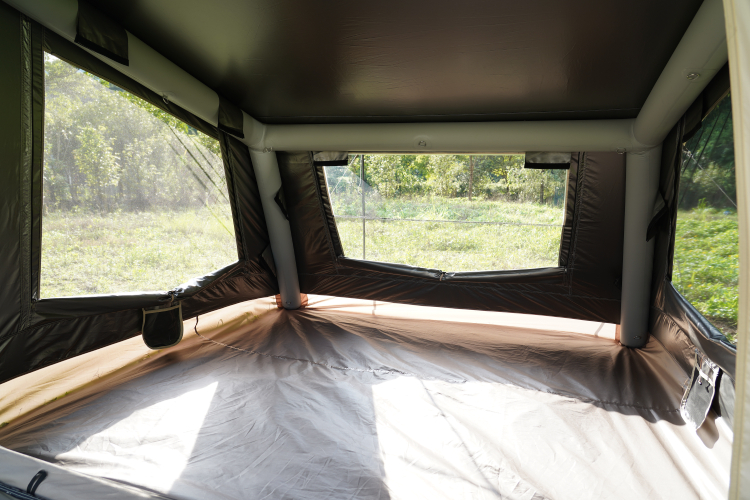
MARVELOUS MOT-Q500 inflatable camping tent in an outdoor camping scenario.
Choosing the right camping tent depends less on brand popularity and more on the conditions a trip actually presents: how many people sleep inside, how much rain or snow is expected, whether the tent is carried on a vehicle or in a trunk, and how quickly camp must be set up. A scenario-based approach helps buyers match hard shell rooftop tents, inflatable tents, and conventional ground tents to the trips where each performs best.
This guide is written for buyers at the research and evaluation stage of purchasing a camping tent. It covers the main tent categories, the technical parameters that determine weather performance, real-world application cases, and the trade-offs that matter when a tent is selected for a specific trip or project. Market data referenced in this article comes from published industry research, and product specifications come from MARVELOUS, an outdoor tent manufacturer based in Xiamen, China, that designs and produces camping tents, rooftop tents and inflatable tents for markets including the United States, Germany, Australia and Canada.
Why Trip Conditions Should Drive the Tent Decision
Most tent buying mistakes do not come from poor product quality. They come from mismatches: a family buys a large ground tent and then discovers the campsite is rocky and uneven; an overlander buys a roof top tent without checking the vehicle's roof load capacity; a hiker chooses a lightweight dome tent and finds it under-prepared for three days of rain. The price of these mismatches is not only money — it is comfort, safety, and sometimes the trip itself.
The opportunity is to reverse the decision order. Before comparing brands or models, a buyer can define the trip in measurable terms:
- How many people will sleep in the tent, and what is the acceptable sleeping arrangement?
- What weather conditions are realistic — dry summer nights, heavy rain, snow, or strong wind?
- Will the tent be mounted on a vehicle, carried in a car, or packed for air travel?
- How much setup time is acceptable at the end of a long driving day?
Once these questions are answered, the range of suitable tents narrows quickly. A camping tent for a fixed campsite with six family members has different requirements from a rooftop tent for two people moving between trails. This is the core logic of scenario-based selection.
Camping Tent Types and How They Behave Differently
Camping tents sold today fall into three structural families that behave very differently in the field.
Hard Shell Rooftop Tents
Hard shell rooftop tents are mounted on vehicle roof racks and open into a sleeping space above the ground. They typically use aluminum or ABS plastic shells, with setup times of 3–8 minutes, compared with 15–25 minutes for most ground tents. MARVELOUS produces several hard shell rooftop models, including the MOT-L800, MOT-LK901 and MOT-DYG01, all of which use an aluminum shell or aviation aluminum frame.
Because the tent is already attached to the vehicle, it suits travelers who change campsites frequently and want to sleep away from wet or uneven ground. On the other hand, the same design makes the tent part of the vehicle's payload. The MOT-L800, for example, has a net weight of 140 kg and a gross weight of 150 kg, so the vehicle roof system must be rated to carry that load.
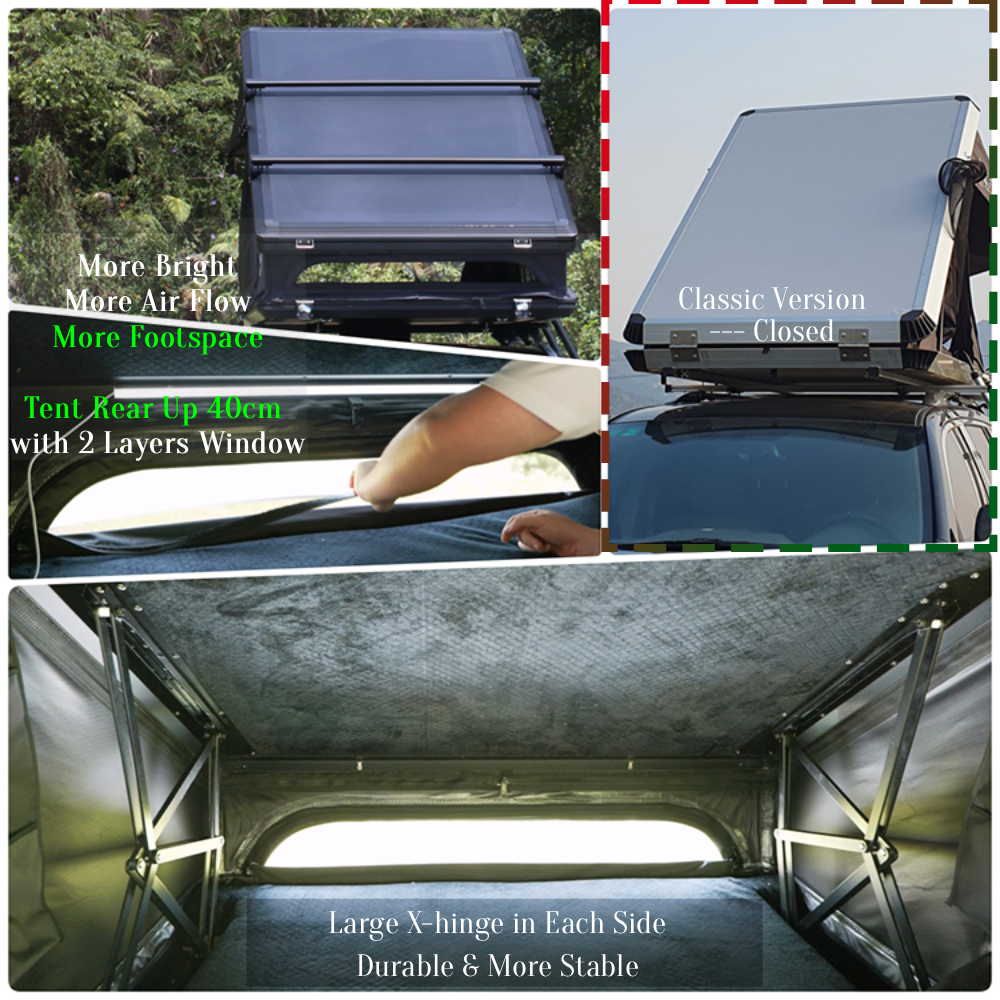
Interior of the MOT-LK901 hard shell rooftop tent: mattress, shoe bags and overhead space.
Inflatable Camping Tents
Inflatable tents replace metal poles with air beams. The MARVELOUS MOT-Q500 uses a 5-layer PVC air column frame and a 200D Oxford cloth body with a PU5000mm waterproof rating and UPF50+ protection. It sleeps 4–5 people in an expanded size of 270×270×200 cm, and packs down to 77×39×39 cm with a net weight of 13.6 kg. Because the air frame has no rigid poles to connect, setup mainly involves inflation, which is one reason inflatable tents have been adopted quickly in the family camping and glamping segments.
Ground Tents: Dome and Family Models
Ground tents remain the most common category. They use aluminum alloy poles, steel frames, or quick-open iron frames to create a free-standing shelter. MARVELOUS offers several configurations: the MOT-M100 family tent sleeps 6–8 people with a quick-open iron frame, the MOT-CT900 uses aluminum alloy poles with a 200D titanium black rubber Oxford cloth rated at PU5000mm and UPF50+, and the MOT-CT096 is a steel-framed tent with 210D Oxford cloth and a PU2000mm waterproof rating. Ground tents typically provide more floor space per kilogram than rooftop or inflatable tents, and they do not require vehicle installation.
| Tent Type | Example Model | Typical Capacity | Setup Pattern | Key Strength | Key Trade-off |
|---|---|---|---|---|---|
| Hard shell rooftop | MOT-L800 / MOT-LK901 / MOT-DYG01 | 1–4 people | 3–8 minutes | Off-ground sleep, fast open/close | Heavy; requires vehicle roof capacity |
| Inflatable / air tent | MOT-Q500 | 4–5 people | Inflate frame | Compact pack, no pole assembly | Needs pump; PVC columns need care |
| Family ground tent | MOT-M100 / MOT-CT900 / MOT-CT096 | 4–8 people | 15–25 minutes (typical) | Large interior, lower weight | Ground-dependent; slower setup |
A Scenario Framework: Matching Camping Tents to Real Conditions
MARVELOUS's application data lists the working conditions for its camping tents as all-season use, including rainy and snowy conditions, UV-resistant outdoor environments, and variable terrain. The same data specifies a functional role: shelter from weather elements, thermal insulation, and privacy and security. These three functions provide a useful framework for matching a tent to a trip.
Rain and Snow: Prioritize Waterproofing and Insulation
For wet weather, the fabric's waterproof rating is the first technical filter. The scenario requirement for MARVELOUS tents is a waterproof rating of at least 3000mm. Some models go higher: the MOT-CT900 and MOT-Q500 are rated at PU5000mm, and the MOT-LK901 uses an outer tent of 420D Oxford cloth with a PU4000mm rating. The MOT-CT900 in particular is described in the product corpus as providing thermal insulation and privacy, making it a match for cold, rainy camping conditions.
Variable Terrain: Raise the Sleeping Level if the Ground Is Unpredictable
Rocky ground, sloped sites, and wet soil are common problems for ground tents. A rooftop tent avoids these issues entirely because the sleeping area is attached to the vehicle. Hard shell rooftop tents from MARVELOUS — the MOT-L800, MOT-LK901 and MOT-DYG01 — are built with aluminum shells and aviation aluminum frames, and include an aluminum telescopic ladder, mounting hardware and a mattress in the package. For vehicle-based travel on variable terrain, the rooftop configuration is functionally the strongest option.
This does not mean ground tents are unusable on difficult terrain. The MOT-DYG01, despite being a rooftop model at 32 kg net weight, is one of the lighter hard shell options. Meanwhile, ground tents such as the MOT-CT900 with aluminum alloy poles and the MOT-M100 with a quick-open iron frame are stable when correctly pegged, but their suitability depends on the site being relatively level and soft enough for stakes.
Family or Group Trips: Size and Speed Must Be Balanced
For a family of five or more, interior space is usually the deciding factor. The MOT-M100 has a 6–8 person capacity with an expanded size of 375×375×240 cm, and its quick-open iron frame shortens setup compared with conventional pole tents. The MOT-CT900 sleeps 4–5 people with a packed size of 106×26×26 cm and includes telescopic support poles, 14 nails and 7 ropes in the accessory set. The MOT-CT096 offers 4–5 person capacity with a steel frame and a larger expanded footprint of 430×305×200 cm.
An Australian family case documented in the MARVELOUS corpus illustrates the space argument for rooftop camping: the customer, using a hard shell rooftop tent with their family, reported that the interior felt like having two queen beds, comfortably fitting two adults and three children, and described the materials as high quality and very steady.
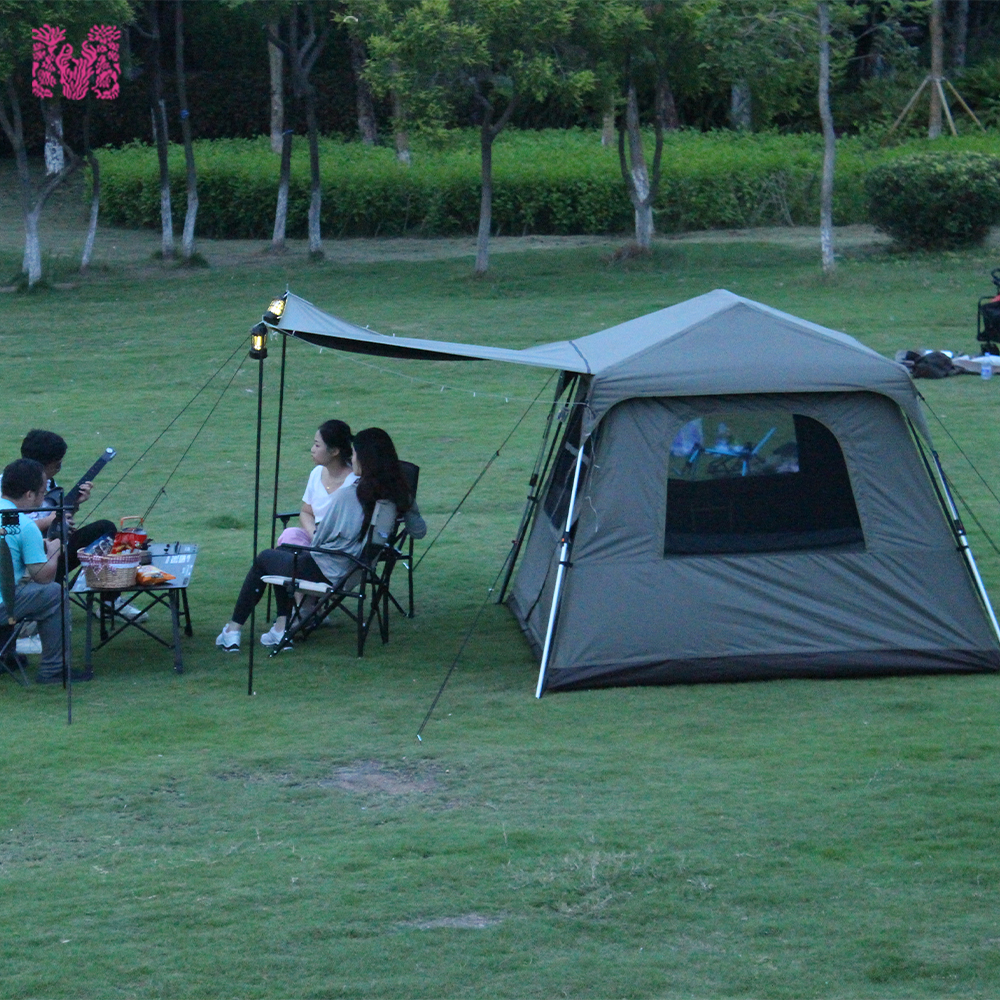
MARVELOUS MOT-CT900 family camping tent, designed for shelter, insulation and privacy in camping and hiking use.
Multi-Country and Multi-Season Use
The same camping tent is often used across different countries and climates. MARVELOUS's application data identifies the United States, Germany, Australia, Canada, Switzerland, Chile, Japan and South Korea as common markets for its camping tents, all with an all-season operating design and resistance to UV environments. For a brand or distributor sourcing tents for multiple regions, this matters: a single SKU that can be sold across these markets reduces inventory complexity.
Technical Details That Define Weather Performance
Three parameters explain most of the performance difference between camping tents:
- Waterproof rating (mm): The hydrostatic head of the fabric. In the MARVELOUS range, ratings go from PU2000mm (MOT-CT096) and 3000mm (MOT-L800) up to PU4000mm (MOT-LK901 outer tent) and PU5000mm (MOT-CT900, MOT-Q500).
- Fabric weight and coating: Heavier fabrics with coated finishes resist abrasion and UV damage. Examples include 200D titanium black rubber Oxford cloth on the MOT-CT900, 600D Oxford on the MOT-DYG01, and 300D Oxford with a 3000mm waterproof index on the MOT-L800.
- Frame type: Aviation aluminum on the MOT-L800, aluminum shell on the MOT-LK901, aluminum alloy poles on the MOT-CT900, steel on the MOT-CT096, quick-open iron on the MOT-M100, and 5-layer PVC air columns on the MOT-Q500. The frame determines how the tent handles wind, snow load, and repeated setup cycles.
These specifications are useful in procurement because they can be compared directly across suppliers. Industry standards also matter in this comparison: ISO 5912:2020 specifies safety, performance and fitness-for-use requirements for camping tents, and CPAI-84 is a flammability standard required in several US states and federally in Canada. Buyers should verify that a tent supplier can document compliance with the standards applicable to their target market.
Field Use: Evidence from an Australian Family Camping Trip
A customer case from the MARVELOUS corpus provides field-level evidence for the family application. The customer, based in Australia, purchased a hard shell rooftop tent for family outdoor camping trips that had been planned over a long period. In the evaluation, the customer stated that the materials were high quality and steady, that the tent felt like having two queen-size beds inside, and that two adults and three children fit comfortably. The customer also mentioned outstanding customer service. The case is small in scale — a single-set purchase — but it shows how a hard shell rooftop tent can perform as a family solution when the vehicle has sufficient roof capacity.
Market Signals: Why Scenario Fit Is Becoming a Buying Criterion
Published market data supports the shift toward scenario-specific tent buying. The global camping tent market was valued at USD 6.18 billion in 2025 and is projected to reach USD 10.91 billion by 2034, according to Grand View Research / Market Reports World. Within this market, the rooftop tent segment reached approximately USD 215.5 million in 2024, with hard shell models accounting for more than 53% of revenue share, according to Business Research Insights. North America holds the largest regional share of rooftop tent demand at 38.6%, followed by Europe at 27.4%, based on Dataintelo analysis. Inflatable tents reached USD 1.033 billion in 2024, supported by demand for fast, comfortable setup in the glamping segment, according to Intel Market Research.
These numbers point to a common pattern: different trip types are creating different purchase paths. Overlanding and vehicle-based camping push demand toward hard shell rooftop tents. Family and glamping trips push demand toward inflatable tents. Traditional ground tents remain the default for cost-sensitive and large-group uses. For procurement teams, this means a tent product line should be evaluated not as a single category but as a portfolio that covers multiple scenarios.
In the premium rooftop tent segment, well-known brands include Alu-Cab, iKamper, Thule and James Baroud. MARVELOUS occupies a different position in the supply chain: it is a manufacturer offering OEM/ODM services, which means brands and distributors can customize logos or whole tent designs and source production directly from the factory.
Camping Tent Comparison: Traditional Solutions and Their Limits
Each tent type solves one set of problems while creating another. A scenario-based evaluation needs to acknowledge these limits honestly.
Hard shell rooftop tents offer the fast vehicle-based setup and a consistent sleeping platform. Their limit is weight. The MOT-L800 weighs 140 kg net, which places real demands on the vehicle and roof rack. The MOT-LK901 is lighter at 60 kg net, and the MOT-DYG01 lighter still at 32 kg, but even these weights reduce fuel efficiency and require careful installation. They are also more expensive to ship than ground tents.
Inflatable tents balance setup speed with packability. The MOT-Q500 packs to 77×39×39 cm and weighs 13.6 kg, so it fits into a car trunk easily. The practical limit is that the PVC air columns need a pump and care in extreme temperatures; frame integrity depends on maintaining air pressure.
Ground tents remain the most affordable and spacious option per kilogram. Their limits are the reverse of rooftop tents: they need level ground, take 15–25 minutes to set up, and expose sleepers to ground-level moisture and insects. The MOT-CT096 with its steel frame is heavy to carry but provides a large 430×305×200 cm living space for a low price point.
For OEM buyers, these trade-offs matter because they define the product range. A distributor targeting overlanding customers in North America will need hard shell rooftop models with verified roof load specifications. A distributor targeting family campers in wet European climates will prioritize waterproof models such as the MOT-CT900 and MOT-Q500 with PU5000mm ratings.
Manufacturing Capability and What It Means for Buyers
When a tent is sourced for a brand, an import program, or a distribution business, the manufacturer's capability becomes part of the product decision. MARVELOUS is an OEM/ODM manufacturer of camping tents with a factory of 4,000 m² and a team of about 50 employees, including a research and development group of 20 engineers. Its listed annual output is 50,000 units, with a monthly production capacity of 5,000–10,000 units. The company reports a standard lead time of 30 days, a minimum order quantity of one unit, and a quality control process described as 100% testing. Its export markets include the USA, the EU, Canada, Australia, Korea and Japan, and export ratio is about 95%.
For buyers in the research and evaluation stage, these numbers serve as practical screening criteria. A low MOQ (one unit) makes sample testing possible before a series order. A 30-day lead time allows seasonal planning. The 20-engineer R&D team means customization — from logo changes to whole tent redesign — is handled internally rather than outsourced.
Future Outlook: Scenario-Based Camping Tents, Not Just Better Tents
The direction of product development in camping tents is toward condition-specific optimization rather than a single universal design. The continued growth of rooftop tents in North America and Europe, combined with the expansion of inflatable tents in family camping, suggests that buyers increasingly choose the structural system that matches their dominant use case.
Three developments are worth watching. First, hard shell rooftop tents are becoming lighter, which reduces one of their main constraints. Second, inflatable tents are improving in fabric durability and air-frame reliability, which extends their range beyond fair-weather camping. Third, manufacturers like MARVELOUS that offer OEM/ODM production are positioned to translate these trends into products for regional brands, because regional brands increasingly need tents tuned to local climate and terrain rather than generic global models.
FAQ: Camping Tent Questions at the Research and Evaluation Stage
What type of camping tent is best for rainy or snowy conditions?
Tents with a waterproof rating of at least 3000mm are the practical baseline for wet weather. In the MARVELOUS range, the MOT-CT900 and MOT-Q500 carry a PU5000mm rating, and the MOT-LK901 outer tent carries PU4000mm. The MOT-CT900 is additionally described as providing thermal insulation and privacy, which supports use in cold conditions. Waterproofing should be combined with a coated fabric such as 200D titanium black rubber Oxford cloth or 300D Oxford cloth, and a frame designed to shed snow load.
How do I choose between a hard shell rooftop tent and an inflatable camping tent?
The choice depends on whether the tent is carried by a vehicle and whether the ground is suitable for a ground tent. A hard shell rooftop tent such as the MOT-LK901 (1–2 people, 60 kg) or the MOT-DYG01 (2 people, 32 kg) provides off-ground sleeping and 3–8 minute setup, but requires a vehicle roof system able to carry the weight. An inflatable tent such as the MOT-Q500 (4–5 people, 13.6 kg packed) sets up on the ground with an air frame and packs into a compact 77×39×39 cm size, making it more suitable for family trips where the vehicle does not have a roof rack or where the campsite is stable ground.
Can a hard shell rooftop tent accommodate a family?
Yes, within the weight and capacity limits of the vehicle. The MOT-L800 is a 4-person hard shell rooftop tent with an expanded size of 215×251×110 cm and a 140 kg net weight. A documented Australian family case reports that two adults and three children fit comfortably. For a family of more than four, or for vehicles with lower roof load ratings, a large ground tent such as the MOT-M100 (6–8 people) is usually the more practical choice.
What is the practical difference between a camping tent and a rooftop tent for vehicle travel?
A rooftop tent is a camping tent mounted on vehicle roof racks, and its main advantages are setup speed and an off-ground sleeping platform. Published industry data reports hard shell rooftop tent setup times of 3–8 minutes versus 15–25 minutes for ground tents. The trade-off is weight: the rooftop tent is part of the vehicle payload and must be compatible with the roof rack system. A conventional camping tent is independent of the vehicle and offers more floor space per kilogram, but needs level ground and more setup time.
Are inflatable tents reliable in wind?
Inflatable tents use air beams instead of metal poles; the MARVELOUS MOT-Q500 uses a 5-layer PVC air column frame. Air frames distribute wind load across the structure and recover their shape after flexing, which is why they are used in some family and glamping applications. Reliable wind performance still depends on correct pegging and maintaining proper air pressure. For sites with extreme and unpredictable wind, hard shell rooftop tents or low-profile ground tents with aluminum alloy poles are often preferred.
What do waterproof ratings like PU3000mm or PU5000mm mean for tent selection?
The rating measures the hydrostatic pressure the fabric can resist before water penetrates, expressed in millimeters of water column. The MARVELOUS product range includes 3000mm on the MOT-L800, PU4000mm on the MOT-LK901 outer tent, and PU5000mm on the MOT-CT900 and MOT-Q500; the MOT-CT096 is rated at PU2000mm. For camping in rainy or snowy conditions, a rating of at least 3000mm is the scenario requirement used in the MARVELOUS application data. Higher ratings add margin for prolonged rain and higher water pressure on the fabric.
For OEM/ODM or wholesale evaluation, MARVELOUS provides a downloadable company brochure covering its factory, production capacity and product range: MARVELOUS Company Brochure (PDF).