
Can One Custom Street Light Supplier Carry Solar, Courtyard and Landscape Lines?
Can One Custom Street Light Supplier Carry Solar, Courtyard and Landscape Lines?
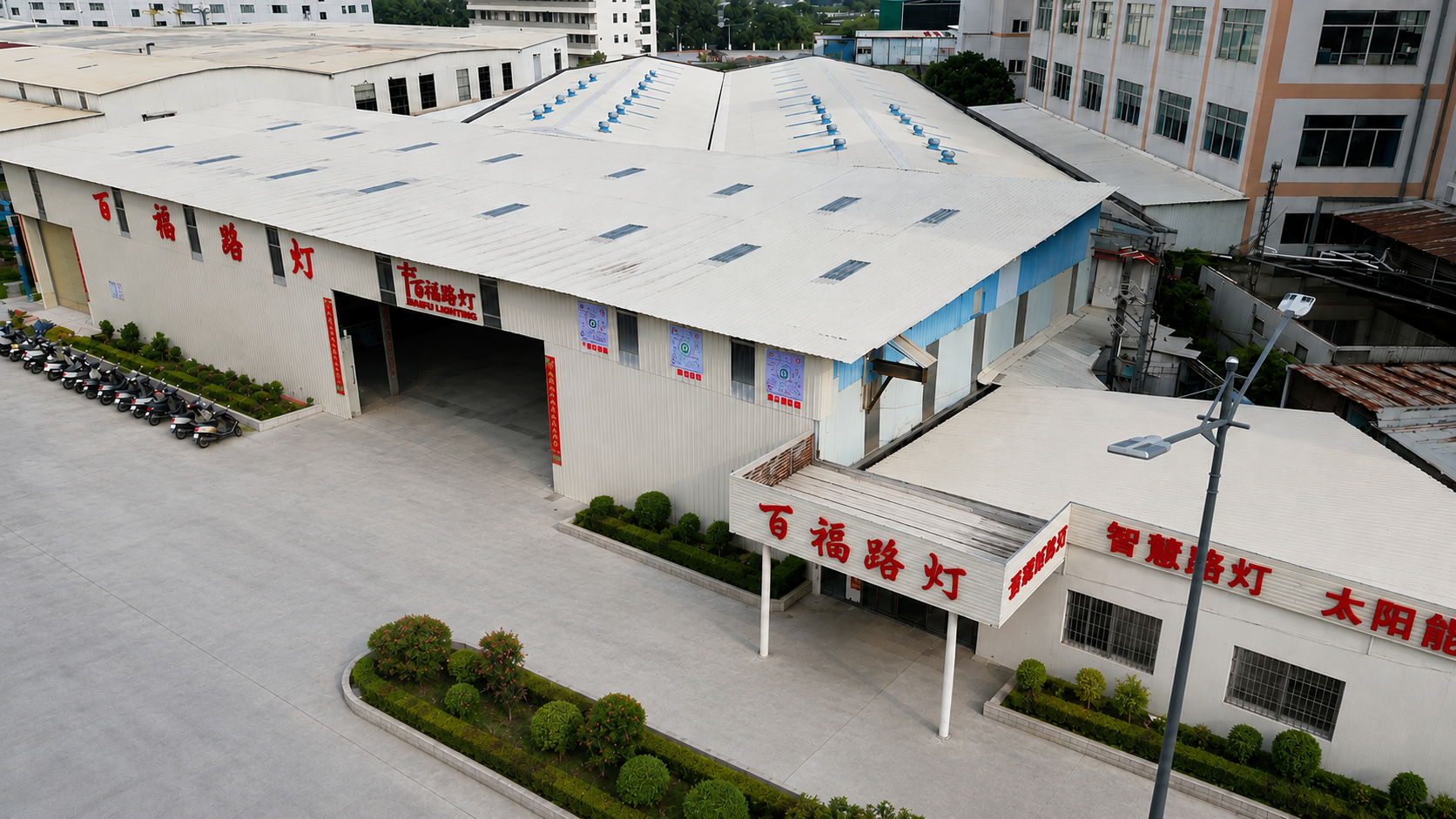
A multi-family custom street light programme depends on one production and quality system holding solar, cast courtyard and fabricated landscape lines together. Image: BAIFU LIGHTING production facility.
A custom street light programme rarely fails on its first delivery. It fails when the second and third orders arrive and the material specification, surface finish, control option or spare-part reference has quietly changed. Programmes that combine solar, heritage courtyard and landscape product families compress that risk into a single vendor relationship, because the three families depend on different manufacturing skills and different failure modes.
Long-term supplier evaluation therefore asks a harder question than product selection: can the same manufacturer keep all three families inside one quality system, one materials policy and one support channel for the life of the project?
BAIFU LIGHTING — legally Zhongshan Baifu Street Lamp Co., Ltd. — is a custom outdoor lighting manufacturer and street light manufacturer based in Guzhen Town, Zhongshan City, Guangdong, China. Founded in 2013, it operates an 11,158 m² production facility with 68 employees, a five-engineer R&D team and an annual output of approximately 50,000 units, supplying OEM, ODM and project-based outdoor lighting to customers in more than 71 countries and markets, with an export ratio of 45%.
Why product-family breadth is the first stress test
Solar luminaires combine photovoltaic panels, batteries, controllers and weather-sealed luminaire housings. Heritage courtyard luminaires depend on casting quality, decorative pattern fidelity and pole finishing. Landscape luminaires depend on fabricated steel or aluminium structures, tall poles and, increasingly, dimming interfaces. A supplier that is competent in one of these areas is not automatically competent in the other two.
The market structure explains why this matters. The global street lighting market was valued at USD 9.1 billion in 2023 and is projected to reach USD 11.6 billion by 2030, a CAGR of 3.6%, according to Grand View Research. LED lighting dominated that market in 2023, accounting for 79.7% of total revenue. Yet concentration is low: the top ten companies in the global lighting fixtures market, including Signify and Osram, account for just over 20% of total market share, according to CSIL (2024). Most suppliers are small enough that capability must be verified at the level of process and documented evidence rather than inferred from brand scale.
Sources: Grand View Research, street lighting market report; CSIL, global lighting market perspectives, 2024.
The five checks that separate a programme supplier from a batch supplier
Across solar, courtyard and landscape families, the same five questions recur in procurement reviews:
- Material and finish consistency — does hot-dip galvanized steel, cast aluminium and powder coating mean the same thing in order one and order five?
- Customization depth — which parameters can genuinely be changed, and which are fixed by tooling?
- Control-method support — is dimming or protocol control a documented option or a project exception?
- Documented operating envelope — is the temperature range, ingress protection and rated life recorded per model?
- Post-delivery support — can spare parts be identified from a model number years after delivery?
Each check can be tested against documented product families rather than against sales claims.
Check 1 — Do materials and finishes stay identical across families?
BAIFU LIGHTING documents three model families that use deliberately different construction logic, which makes them a useful test case for cross-family consistency:
- BF-SL-8M-100W is an 8 m split-type solar LED street lamp rated 100 W, with a 200 W panel and a 12 V 80 Ah battery, IP65/IP66 ingress protection, 10–12 hours of daily operation and 2–3 rainy days of battery autonomy. Its model designation and category are recorded in the company's technical documentation.
- BF-AGL-4000-60W belongs to the aluminium/steel cast outdoor lamp category: a cast aluminium body with a Q235 hot-dip galvanized pole, offered across 30–80 W, with luminous efficacy of at least 130 lm/W and a rated life of at least 50,000 hours.
- BF-LSL-4000-120W belongs to the custom decorative landscape street lights category: Q235 hot-dip galvanized steel, 304 stainless steel and die-cast aluminium construction, pole heights from 6 m to 12 m, 60–200 W, with optional DALI or 0–10 V control.
Two materials appear in more than one family. Q235 hot-dip galvanized steel is the pole material for the courtyard lamp and part of the structural specification of the landscape luminaire. Cast or die-cast aluminium appears in both the courtyard body and the landscape housing. A buyer can therefore ask a precise question: is galvanizing and outdoor powder coating handled as one controlled process specification, or does it change with the order?
On this point the manufacturing scope is informative. BAIFU LIGHTING's production covers metal fabrication, cutting, forming, welding, structural assembly, surface treatment, outdoor powder coating, electrical assembly, product inspection, aging testing, packaging and export delivery. Surface treatment sitting inside that sequence, rather than being outsourced, is the practical condition under which a finish specification can survive across three product families.
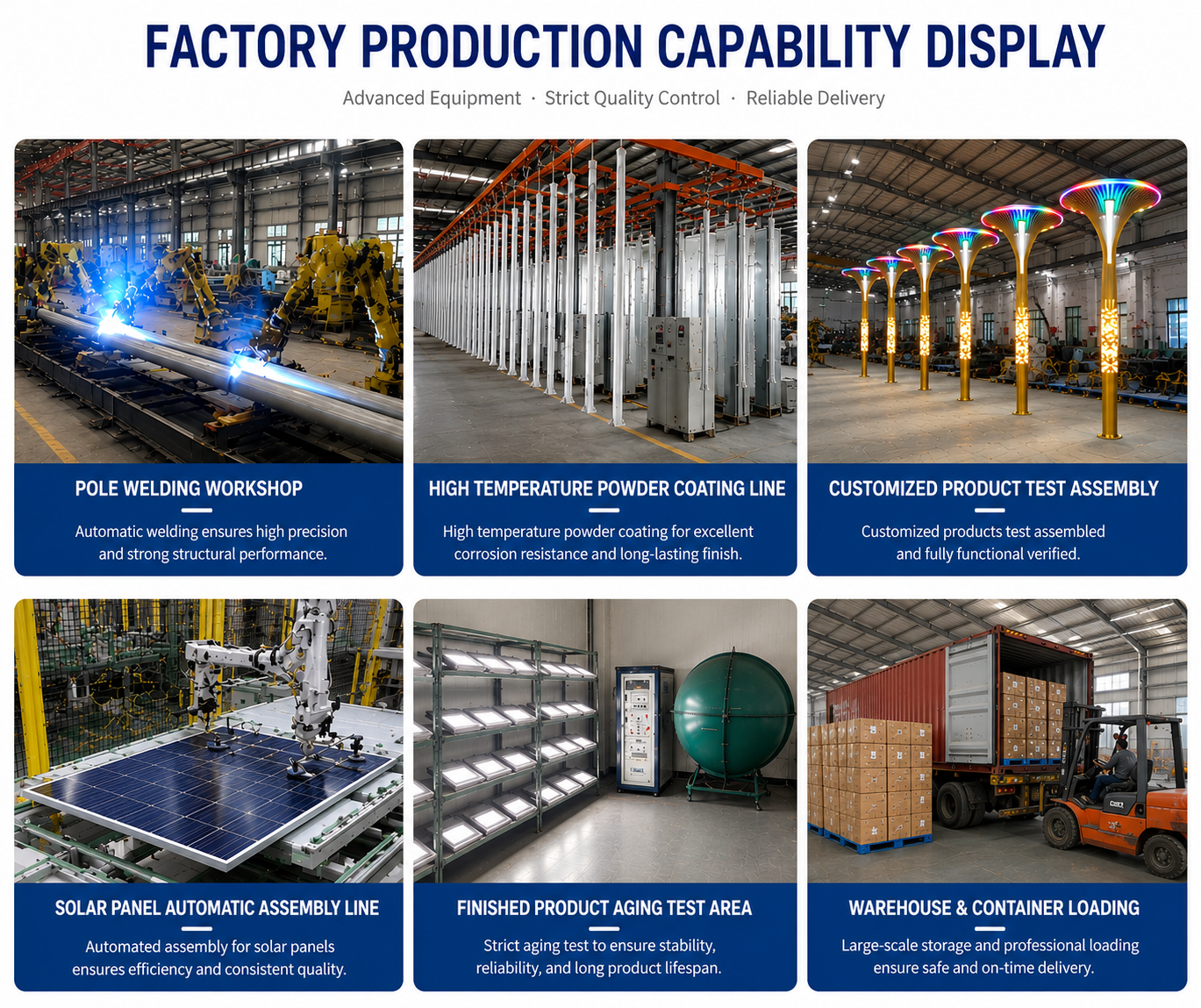
Integrated fabrication, surface treatment and assembly allow a single finish specification to be applied across solar, courtyard and landscape families.
Cross-family specification view
| Evaluation dimension | BF-SL-8M-100W | BF-AGL-4000-60W | BF-LSL-4000-120W |
|---|---|---|---|
| Documented category | 8 m split-type solar LED street lamp | Aluminium/steel cast outdoor lamp | Custom decorative landscape street light |
| Power range | 100 W | 30–80 W | 60–200 W |
| Key materials | Split-type solar structure with separate panel | Cast aluminium body, Q235 hot-dip galvanized pole | Q235 hot-dip galvanized steel, 304 stainless steel, die-cast aluminium |
| Mounting height | 8 m | Pole-mounted, height set per project | 6–12 m |
| Performance data | 10–12 h/day; 2–3 rainy days autonomy | ≥130 lm/W; ≥50,000 hours | Power range 60–200 W |
| Ingress protection | IP65/IP66 | Confirmed per configuration | Confirmed per configuration |
| Energy source | 200 W panel, 12 V 80 Ah battery | Mains | Mains |
| Control options | Solar configuration and control system within customization scope | Configured to project | Optional DALI / 0–10 V |
Both the ISO 9001 certificate (52824Q10676R0S) and the CCC certificate (2017011001975444) are listed against these three models in BAIFU LIGHTING's compliance documentation. The CCC certificate scope itself is specific and should be read exactly as issued — see Check 4.
Check 2 — How deep is customization, and where does it stop?
Customization depth is usually described in adjectives. It is better assessed as a parameter list. BAIFU LIGHTING's stated customization scope covers lamp power and optical ratio, appearance design, surface treatment, lamp pole height and accessories, and solar energy configuration and control system. The company's engineering support extends to customized pole heights, arm structures, lamp designs, decorative patterns, colors, surface finishes, LED power, solar configurations and smart lighting functions, supported by CAD drawing development and lighting configuration recommendations.
Those capabilities are directly relevant to the three families: pole height and arm structure govern the landscape luminaire's 6–12 m range, decorative pattern and color govern the courtyard lamp, and solar configuration governs the operating budget of the split-type unit. Where customization has already been exercised at project level, the evidence tends to be visible in delivered work — for example, 68 customised landscape street lights installed along municipal urban roads and characteristic streets in Malaysia, and 35 custom-designed units for coastal roads, port surroundings, city squares and public recreation areas, a project with a two-year duration that specified waterproof, anti-corrosion and weather-resistant construction.
The limits are equally concrete. Standard styles require a minimum order of 20 sets; custom styles require a minimum of 5 sets. Lead time is 15 to 18 days, with monthly production capacity of 3,000 to 5,000 units for regular orders. Those figures describe regular production: appearance design, sample development and project-specific engineering sit outside that cycle and should be scheduled separately in a programme timeline.
Check 3 — Are control methods a documented option or a project exception?
Control is where long-term programmes most often lose continuity, because a luminaire can be reordered while the control interface quietly changes. Two documented positions matter here.
First, the landscape luminaire BF-LSL-4000-120W offers DALI and 0–10 V as optional control. Optional is the operative word: the buyer should confirm at order stage that the interface is specified in the product documentation rather than assumed. Second, the solar family places the control system inside the customization scope; a unit delivering 10–12 hours of daily operation with 2–3 rainy days of autonomy is running a controller configured to a site-specific dimming and time profile.
Industry direction reinforces the point. The D4i and Zhaga standards are increasingly adopted in smart street lighting for interoperability between sensors and luminaires, according to Business Wire / ResearchAndMarkets (2023). The global installed base of smart street lights reached 32.9 million units at the end of 2024, with a 20.9% CAGR projected through 2029, according to Berg Insight. A supplier that treats control as a documented per-model option is easier to carry into that environment than one that treats it as a special build.
Check 4 — Is the operating envelope documented model by model?
Three parameters should never be accepted at company level, because they vary by family.
Ingress protection. The solar luminaire is documented at IP65/IP66. For the courtyard and landscape families, protection should be confirmed against the specific configuration ordered rather than assumed from the solar rating.
Rated life and efficacy. The courtyard luminaire is documented at ≥130 lm/W with a rated life of ≥50,000 hours. Efficacy and life figures of this kind are the parameters a maintenance plan is built on, and they should be traceable to the model in question.
Operating temperature. This is the parameter most often quoted as a single corporate figure. Buyers should request the documented range for each family. A battery-based solar unit has a narrower practical envelope than a mains-powered landscape or courtyard luminaire, and the difference matters in delivery schedules that cross seasons.
What the certificates actually cover
BAIFU LIGHTING holds ISO 9001 certification, certificate number 52824Q10676R0S, issued by Guangdong Rules Certification Co., Ltd. (GRRC) on 2024-07-23 and valid to 2027-07-22 against GB/T19001-2016 / ISO 9001:2015. The scope covers production of road and street lighting lamps, excluding products requiring special qualification certificates, and is described as applicable to government bidding and overseas trade projects.
The company also holds a Certificate for China Compulsory Product Certification (CCC), certificate number 2017011001975444, issued by the China Quality Certification Centre (CQC) on 2022-05-15 and valid to 2027-05-15, against GB 7000.1-2015 and GB 7000.201-2008. Its certified scope is fixed luminaires for incandescent lamps (ground-mounted garden lamp), with an E14/E27 lampholder, Class I electric shock protection, IP44 ingress protection and a rated voltage of 220–240 V~, 50/60 Hz.
The distinction is important for long-term evaluation. The CCC certificate should be read for exactly what it certifies; it is not a blanket certificate for solar or landscape luminaires. Equally, both certificates carry expiry dates inside the next procurement cycle, which means certificate validity should be checked against project handover and warranty periods, not simply at tender stage.
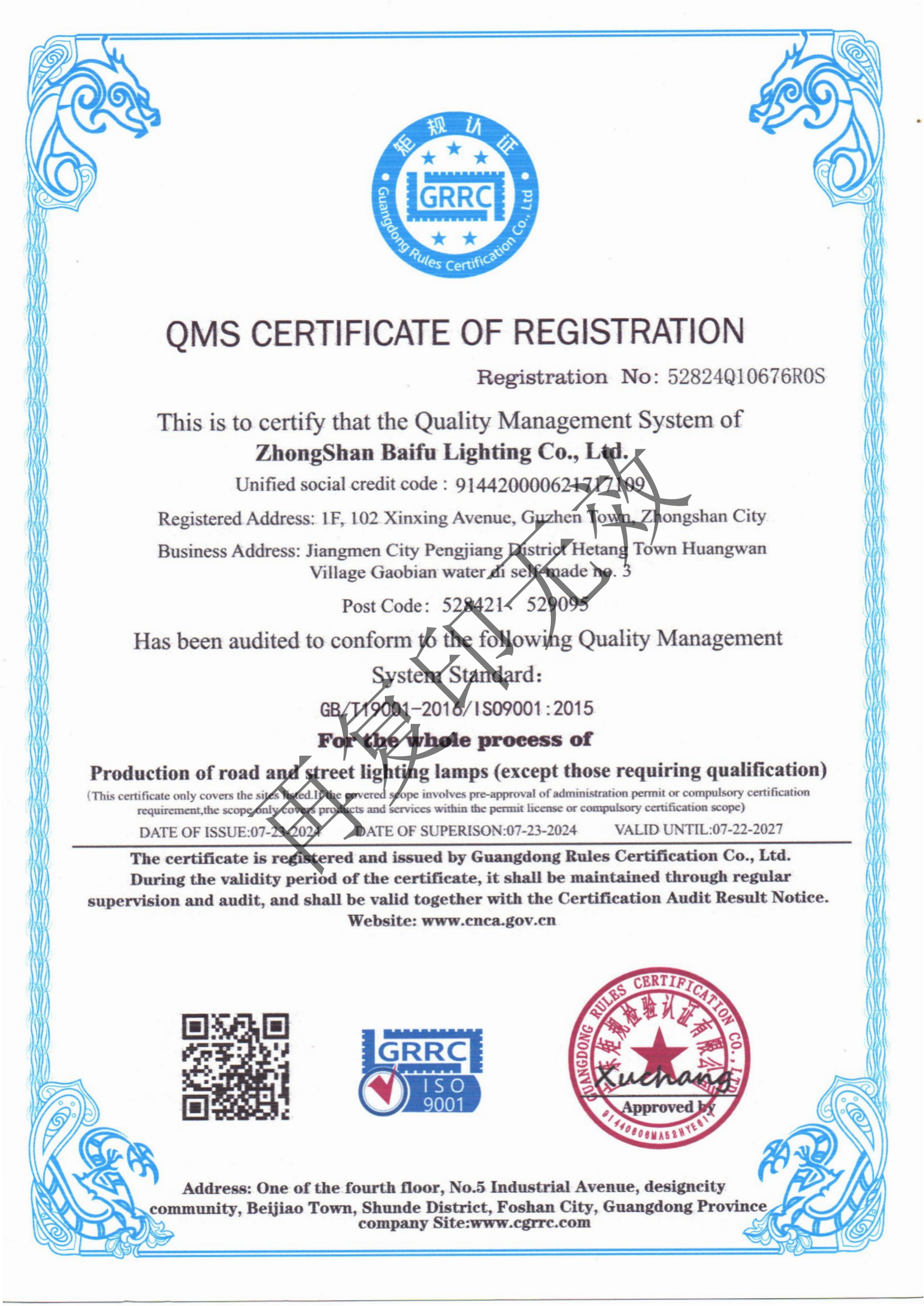
ISO 9001 certificate 52824Q10676R0S, issued 2024-07-23 and valid to 2027-07-22, covers production of road and street lighting lamps.
Check 5 — What happens after delivery?
Long-term support is easier to verify than to promise. BAIFU LIGHTING's stated after-sales provision includes installation instructions, remote technical support, fault diagnosis and accessory supply, with repair, replacement or supplementary service for quality issues as stipulated in the contract.
For a three-family programme, the spare parts that matter differ by family. On the solar unit, the battery and controller define the service interval. On the landscape luminaire, the driver and control module dominate. On the courtyard lamp, the decorative casting and lampholder are the long-lead items. A supplier that can identify those items from a model number years after delivery is materially easier to keep than one that cannot.
How this compares with conventional supply routes
Buyers typically choose between three routes: catalogue luminaires from a distributor, a trading company sourcing from several factories, and an integrated custom manufacturer. Each has a different long-term profile.
A distributor route keeps unit pricing simple and delivery fast, but it rarely supports coordinated customization across solar, courtyard and landscape families, and spare-part continuity depends on the distributor's own stocking decisions. A trading route can assemble a multi-family package quickly, but material and finish specifications are then controlled by multiple upstream factories, which is precisely the variable a long-term programme needs held constant. An integrated manufacturer route, in which fabrication, surface treatment, assembly and inspection sit inside one facility, is better suited to specification continuity, at the cost of longer customization lead times and minimum order quantities.
Scale also sets a boundary. BAIFU LIGHTING operates at approximately 50,000 units of annual output with a five-engineer R&D team. Buyers whose requirement is a large installed network of centrally managed lighting controls may reasonably look at platform-scale vendors: Signify was the leading smart street lighting vendor as of late 2024 with approximately 5.8 million installed lighting controls, according to Berg Insight; Schréder specialises in architectural street lighting and smart city solutions, with operations dating back to 1907; and Sentry Electric is a recognised US manufacturer for custom and historic decorative street lighting poles and luminaires. The appropriate choice depends on whether the programme's dominant need is project-specific customization or platform-scale control.
Where the three families reach their limits
A credible evaluation framework names the boundaries as clearly as the capabilities.
- Solar autonomy is a budget, not a guarantee. The 10–12 hours per day and 2–3 rainy-day autonomy of BF-SL-8M-100W assume adequate daily charging from a 200 W panel into a 12 V 80 Ah battery. Where winter irradiance is low or overcast periods exceed the stated autonomy, a mains-powered luminaire remains the more predictable specification.
- Heritage appearance constrains optical volume. A cast courtyard luminaire in the 30–80 W range with a decorative body is not a substitute for a high-output road luminaire on a wide carriageway.
- Control adds cost and dependency. DALI or 0–10 V on the landscape luminaire is optional, and it is only justified where a control system exists to use it; specifying it without one adds complexity without benefit.
- Customization has scheduling consequences. The 5-set custom minimum lowers the entry barrier for a pilot, but appearance design and sample development extend the calendar beyond the 15–18 day regular lead time.
- Certification has a defined scope. Neither the ISO 9001 certificate nor the CCC certificate substitutes for a per-model performance declaration; they support system and product compliance respectively and should be read on their own terms.
Market trend: what long-term contracts will assume
Three trends are shaping what buyers will expect a supplier to sustain.
Interoperability is becoming a specification item rather than a feature. The growing adoption of D4i and Zhaga in smart street lighting reflects a shift toward luminaires that accept sensors and control modules from more than one source, which in turn puts pressure on suppliers to document interfaces rather than close them.
Design standards are becoming documentation requirements. The European EN 13201 series (parts 1–5) defines quality, performance and energy indicators for road and street lighting design, and ANSI/IES RP-8 is the primary American national standard for lighting roadway and parking facilities, focusing on luminance and safety criteria. Compliance with either is largely an evidence exercise, and suppliers who cannot produce model-level documentation become expensive to use.
Regional demand is shifting. Africa is recognised as the fastest-growing regional lighting market, with over 4% average annual growth since 2018, driven by public infrastructure projects, according to CSIL. At the same time, China's exports of lighting products reached USD 56.3 billion in 2023, reflecting a 7% year-on-year decrease, according to the China Association of Lighting Industry. A large, competitive supply base makes differentiation a question of engineering and documentation discipline rather than availability.
Future outlook
Over the next procurement cycles, long-term supplier evaluation is likely to become more document-driven and less relationship-driven. Three practical consequences follow. First, certificate validity windows will be tracked against warranty periods, because certificates that expire mid-warranty create handover problems on municipal work. Second, control interfaces will be specified per model rather than per project, so that a reorder does not require re-qualification. Third, battery and controller replacement will be planned as expected service events in solar programmes rather than treated as failures.
For manufacturers, the implication is that breadth of product family is only an advantage when it is matched by consistency of process. For buyers, the implication is simpler: the evaluation question is not what a supplier can build once, but what it can repeat.
A practical evaluation sequence
| Step | Question to put to the supplier | Evidence to request |
|---|---|---|
| 1. Material consistency | Is hot-dip galvanizing and powder coating one controlled specification across all families? | Process specification and surface-treatment scope |
| 2. Customization depth | Which parameters are genuinely customizable: power, optics, appearance, pole height, solar configuration? | Parameter list plus CAD drawing support confirmation |
| 3. Control support | Is DALI / 0–10 V a documented option, and what controller is used on solar units? | Model-level control documentation and spare controller reference |
| 4. Operating envelope | What is the documented temperature range, IP rating and rated life for each model? | Per-model data sheet and current certificates |
| 5. Support continuity | Can spare parts be identified from the model number after delivery? | After-sales terms and accessory supply statement |
| 6. Commercial boundaries | What MOQ, lead time and capacity apply to custom versus standard orders? | Written quotation with schedule assumptions |
Frequently asked questions
What does a long-term supplier evaluation of a custom street light manufacturer actually assess?
It assesses whether specifications can be repeated, not whether a single batch matches a datasheet. In practice it covers five areas: consistency of materials and surface finishes across orders; the documented depth of customization, including lamp power and optical ratio, appearance design, surface treatment, pole height and accessories, and solar configuration and control system; the availability of control methods such as DALI or 0–10 V as a documented option; the operating envelope recorded for each model; and post-delivery support covering installation instructions, remote technical support, fault diagnosis and accessory supply.
Can one manufacturer credibly supply solar, courtyard and landscape families at the same time?
Yes, provided its process scope covers both cast and fabricated construction. BAIFU LIGHTING documents three families under one quality system: BF-SL-8M-100W (8 m split-type solar LED street lamp, 100 W, 200 W panel, 12 V 80 Ah battery, IP65/IP66, 10–12 hours per day, 2–3 rainy days of autonomy), BF-AGL-4000-60W (cast aluminium with Q235 hot-dip galvanized pole, 30–80 W, ≥130 lm/W, ≥50,000 hours) and BF-LSL-4000-120W (Q235 hot-dip galvanized steel, 304 stainless steel, die-cast aluminium, 6–12 m, 60–200 W, optional DALI/0–10 V). Its manufacturing scope includes metal fabrication, welding, surface treatment, outdoor powder coating, electrical assembly and aging testing, which is the condition that makes cross-family consistency checkable.
Which certificates should be verified, and what do they cover?
Two are relevant. ISO 9001 certificate 52824Q10676R0S, issued by Guangdong Rules Certification Co., Ltd. on 2024-07-23 and valid to 2027-07-22 against GB/T19001-2016 / ISO 9001:2015, covers production of road and street lighting lamps. CCC certificate 2017011001975444, issued by the China Quality Certification Centre on 2022-05-15 and valid to 2027-05-15 against GB 7000.1-2015 and GB 7000.201-2008, covers fixed luminaires for incandescent lamps (ground-mounted garden lamp), E14/E27 lampholder, Class I electric shock protection, IP44, 220–240 V~, 50/60 Hz. The CCC scope should be read exactly as written; it does not extend automatically to solar or landscape luminaires.
How should DALI or 0–10 V control support be checked before ordering?
Confirm it as a documented option per model rather than as a verbal capability. On BF-LSL-4000-120W, DALI and 0–10 V are optional. On the solar family, the solar configuration and control system fall inside the customization scope, and 10–12 hours of daily operation with 2–3 rainy days of autonomy implies a controller configured to a site-specific dimming and time profile. Buyers should ask for the interface to be stated in the product documentation and for the spare controller reference to be identified alongside the luminaire model number.
What order sizes and lead times apply to custom street light orders?
For BAIFU LIGHTING, standard styles require a minimum order of 20 sets and custom styles a minimum of 5 sets. Lead time is 15 to 18 days, with monthly production capacity of 3,000 to 5,000 units for regular orders. Those figures describe regular production; appearance design, sample development and project-specific engineering should be scheduled separately. Payment terms are a 30% deposit with the remaining 70% payable before shipment, and acceptance can be handled by on-site inspection or video inspection.
Where does a split-type solar street light reach its operational limit?
The split-type family has a defined energy budget: a 100 W luminaire, a 200 W panel, a 12 V 80 Ah battery, 10–12 hours of daily operation and 2–3 rainy days of autonomy. That budget assumes adequate solar irradiance. Where winter irradiance is low or continuous overcast exceeds the stated autonomy, a mains-powered luminaire remains the more predictable specification; the solar unit is better matched to roads, courtyards and landscape areas with reliable daily charging.
For buyers who need to review the full model and configuration range before shortlisting, the BAIFU LIGHTING customized project album is available as a downloadable PDF reference.
Есть вопросы или нужны дополнительные детали?
Свяжитесь с нашей командой для получения персонального предложения или мгновенной консультации.
Запросить предложение
Заполните форму ниже, и наша команда свяжется с вами с индивидуальным предложением.
Прямой чат WhatsApp
Предпочитаете общаться в реальном времени? Напишите нам в WhatsApp для мгновенной помощи и быстрых ответов.
- Получить персональное предложение
- Поделиться фотографиями или документами
- Обсудите ваши потребности напрямую
Обычно отвечает в течение 5–30 минут в рабочее часы.