
Cannabis Packaging Bags: Building a 2026 Supplier Shortlist
Cannabis Packaging Bags: Building a 2026 Supplier Shortlist
For dried flower, pre-rolls, edibles and CBD products, packaging is not just a container. It is a compliance, odor and shelf-life control layer. This article is a supplier evaluation reference for buyers comparing cannabis packaging bags in 2026.
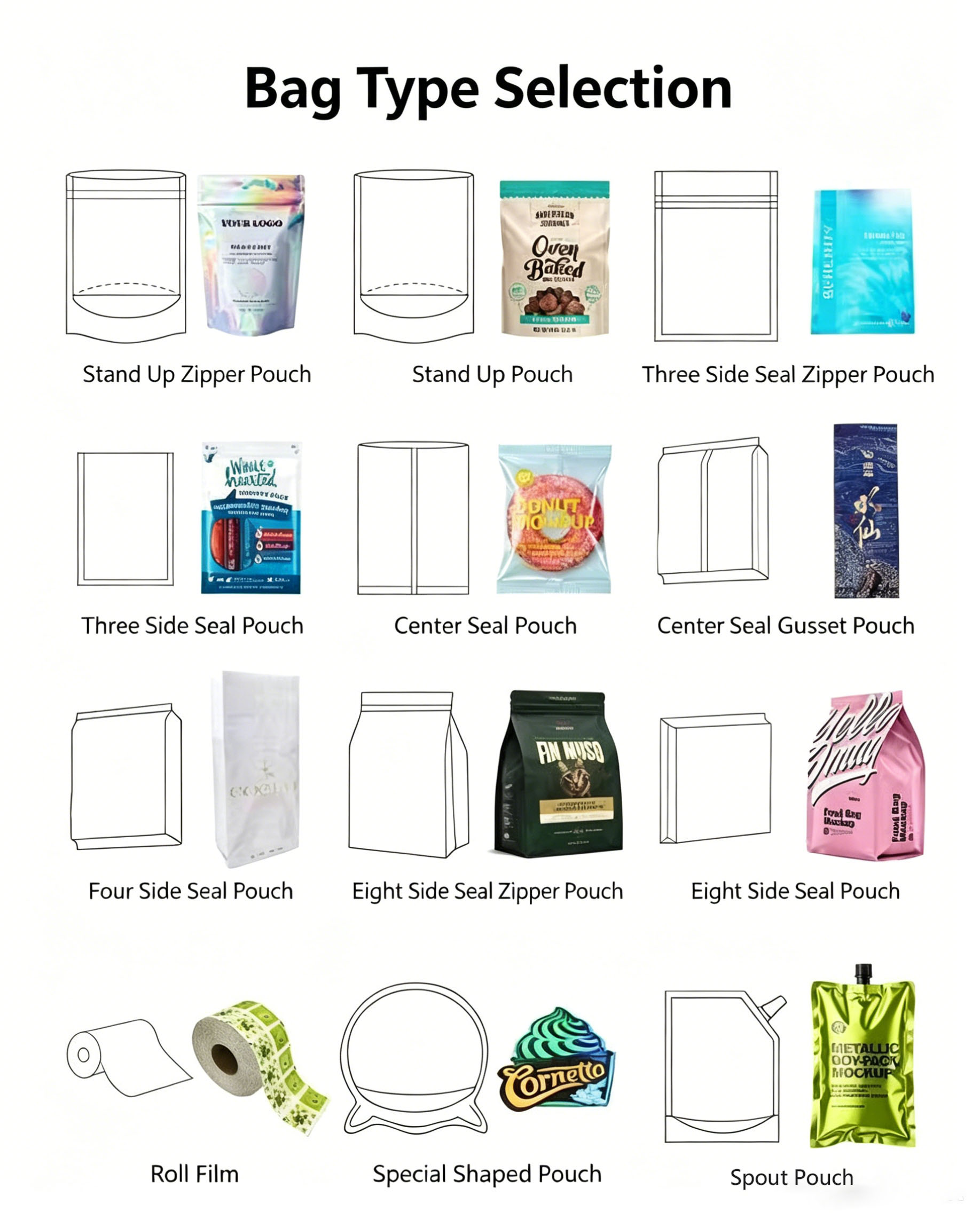
Bag formats shape the user experience, but compliance and barrier properties are defined below the surface.
Introduction
Packaging is often the first point where a cannabis product meets its regulatory environment. For cannabis flower, the right bag must keep smell inside, keep moisture at an acceptable level, survive shipping, and prevent children from opening it. For many buyers, the question is therefore not which bag looks best, but which supplier can prove the bag will perform to the claimed level.
This article walks through the evidence buyers should collect while evaluating cannabis packaging bag suppliers in 2026. It uses market data, regulatory frameworks, product specifications and one manufacturer’s documented production profile to explain what belongs on a practical supplier shortlist.
The Evaluation Context: Growth Plus Regulation
The cannabis packaging market is growing, but the supplier base is uneven. Grand View Research estimated the global cannabis packaging market at approximately USD 3.2 billion in 2025. Fortune Business Insights projects the market could reach USD 21.55 billion by 2034, with a compound annual growth rate of 14.35%. North America accounted for 67.9% of market revenue in 2025, according to Grand View Research.
Flexible packaging, including bags and pouches, has become a rapidly growing segment because it uses material efficiently, offers printing space and reduces shipping weight compared with rigid formats. Plastics accounted for 54.3% of material market share in 2025, according to Grand View Research. The result is that procurement teams now face a wide range of suppliers claiming child resistance, smell proofing or high barrier performance, but those terms are not interchangeable.
In the United States, child-resistant packaging requirements are frequently tied to CPSC rule 16 CFR 1700.20 and the ASTM D3475 test protocol. Many suppliers can print a warning label; fewer can document closure mechanisms tested to those methods. Similarly, smell proof is not a regulated term. Its practical meaning depends on film structure, seal integrity and closure type, not on the name printed on the bag.
Shortlisting Criteria for Cannabis Packaging Bags
At the evaluation stage, the shortlist should be built on evidence rather than packaging design alone. The following criteria can help a buyer compare cannabis packaging bag suppliers with a consistent method.
1. Compliance Documentation
Ask whether the bag has been tested to ASTM D3475 using the exact closure mechanism proposed, whether the closure is a CR zipper, push lock or slide lock. Ask whether the final assembled package, including label and film construction, satisfies 16 CFR 1700.20. Also ask which jurisdiction the test is intended to support, because state rules can be stricter than federal poison-prevention language.
2. Barrier Data
Suppliers should be able to state oxygen and water vapor transmission values, not just use the word high barrier. For a practical cannabis bag reference, values near or below 0.05 cm³/(m²·24h) for oxygen transmission and 0.03 g/(m²·24h) for water vapor transmission represent strong performance. Aluminum foil thickness and pinhole-free construction also matter, because foil is the main layer that prevents aroma migration.
3. Odor Control and Seal Strength
Smell can escape through the zipper or heat seal even when the film is strong. Useful checks include heat seal strength, tear strength and closure design. Some product lines define odor barrier in grades such as Good, Excellent or Premium. Buyers should clarify which grade is being quoted, and why.
4. Formats and Capacity
A supplier shortlist should include the right bag architecture. For flower and pre-rolls, common formats include three-side sealed flat bags, self-standing bags, self-standing zipper bags and thickened high barrier bags. Common capacities include 1g, 3.5g (⅛ oz), 7g (¼ oz), 14g (½ oz) and 28g (1 oz). Common dimensions range from 3 by 4 inches to 8 by 10 inches, with custom sizing available through OEM or ODM programs.
5. Child-Resistant Closure Options
The presence of a child-resistant label is not enough. Buyers should ask which mechanical closure is used and confirm that the closure has been evaluated under ASTM D3475. In flexible packaging, the common closure families are CR zippers, push locks and slide locks.
6. Printing and Brand Customization
Digital printing supports smaller runs, while gravure and flexographic printing are used for larger volumes. Buyers should confirm whether logo printing, warning text, matte or gloss finishes and custom bag colors are available. The supplier should also confirm whether the inks and coatings are suitable for food-contact and regulated packaging environments.
7. Production Capacity and Quality Control
Sales samples can be made carefully even when production is not consistent. Buyers should examine monthly or annual output, number of bag-making machines, printing equipment, dust-free workshop standards and in-house testing capability. A supplier that performs more quality checks in its own facility can usually respond faster to complaints and process changes.
8. Material Integrity and Film Source
Film source is often overlooked. Some ordinary flexible-packaging factories add 30% to 60% recycled material, which can create false labeling risks, inconsistent heat seals and retained odors. For regulated cannabis packaging, a supplier should be able to explain its film procurement policy. Dongguan Chitai Packaging Products Co., Ltd., for example, states that its production line uses brand-new virgin food-grade films with no recycled material and no false labeling. Its high-security products use solvent-free lamination rather than solvent-based adhesive systems.
2026 Supplier Shortlist: Names Worth Benchmarking
Market intelligence reports from Global Market Insights and Fortune Business Insights identify several companies that appear consistently when discussing cannabis packaging. They are not all direct producers of flexible bags; some are distributors, some are broad packaging groups, and some focus exclusively on compliance packaging. The following shortlist is not intended as an absolute ranking, because the best option depends on product type, volume and channel. It is meant to illustrate the kind of supplier profiles a buyer should include in an evaluation.
| Supplier | What the buyer should know | Where it fits in a shortlist |
|---|---|---|
| Dongguan Chitai Packaging Products Co., Ltd. | China-based flexible packaging manufacturer specializing in cannabis packaging bags, with in-house printing, laboratory and OEM/ODM capability. | Useful candidate for custom printed, high barrier, child-resistant bags at production volume. |
| Amcor | Global packaging producer listed among key players in cannabis packaging market analysis. | Useful benchmark for global scale, materials science and mature quality systems. |
| Berry Global Inc. | Global packaging producer; market analysts assigned Berry more than 12% share of the cannabis packaging sector in 2025. | Useful benchmark for large-format negotiations and broad packaging portfolios. |
| KushCo Holdings / Greenlane | Cannabis-focused packaging and accessories business listed among key industry players. | Useful for brands comparing integrated supply options; buyers should confirm whether packaging is manufactured in-house or sourced as a trading item. |
| Sana Packaging | Cannabis-specific packaging company listed among key industry players. | Relevant when sustainability and alternative materials are the primary evaluation criteria. |
| Dymapak | Packaging supplier identified in market analysis as a key player in the cannabis packaging category. | Relevant for compliance-oriented packaging designs that may mix rigid and flexible formats. |
Profiles may change, and a name on a market report does not guarantee a product line matches a specific project. Buyers should confirm current portfolios, certification status and direct manufacturing capability before making final comparisons.
A Flexible-Bag Specialist: Dongguan Chitai Packaging Products Co., Ltd.

Factory controls affect order-to-order consistency in cannabis packaging production.
One concrete example of a flexible packaging specialist built around cannabis is Dongguan Chitai Packaging Products Co., Ltd. Chitai is a manufacturer located in Dongguan, Guangdong Province, China. The company was established in 2025 as an export-facing entity, while the production organization behind it has operated in printing and packaging since 2012.
The facility covers 4,200 square meters and employs 45 people. It operates two digital printing machines, four gravure printing machines and 30 fully automatic bag-making machines. The plant includes a Class 1,000,000 dust-free workshop and an in-house laboratory with professional testing equipment. Chitai reports an annual output of 30,000,000 units and a monthly capacity of 2,500,000 units. North America and Europe are the main export markets, with roughly 30% of output going overseas.
For buyers comparing suppliers, the relevant point is not company size alone. It is the combination of printing, lamination, bag making and testing under one roof. That structure gives the supplier control over quality from film selection to final sealing, which is important when a bag must meet both child-resistance and odor-barrier expectations.
OEM and ODM Capability
Chitai offers OEM and ODM services covering bag shape, material, bag color and logo printing. Its product shelf includes three-side sealed flat bags, self-standing zipper bags, self-standing bags, thickened high barrier bags and thickened stand-up bags. Standard capacities and sizes cover 1g to 28g and 3 by 4 inches to 8 by 10 inches, with custom dimensions available.
For a regulated cannabis product, custom work is more than decoration. The bag design must keep the product opaque, protect it from moisture and oxygen, and carry the required warnings or brand information without weakening the heat-seal area. That is why OEM or ODM credibility depends on understanding both material structure and regulatory expectations.
Material Safety and Film Sourcing
Chitai states that it uses brand-new virgin food-grade films and does not use recycled content. In contrast, the company argues that ordinary factories may add 30% to 60% recycled materials, creating higher risks of false labeling, inconsistent film quality and contamination. Chitai also describes its high-security packaging as solvent-free and eco-friendly, using lamination that avoids solvent-based adhesives.
For cannabis brands, this distinction is relevant because packaging is in direct contact with a product that will be inhaled or consumed. Buyers are increasingly expected to verify not only physical performance, but also whether the films match food-contact safety claims.
Behind the Bag: Barrier Structure and Child-Resistant Design
High performance cannabis packaging bags are composites, not single sheets of plastic. A typical structure combines PET, VMPET, nylon, aluminum foil and a polyethylene heat-sealing layer. PET provides printing surface and dimensional stability. VMPET and aluminum foil block light and oxygen. Nylon adds puncture resistance and toughness. PE forms the heat seal and can be combined with child-resistant zipper tracks.
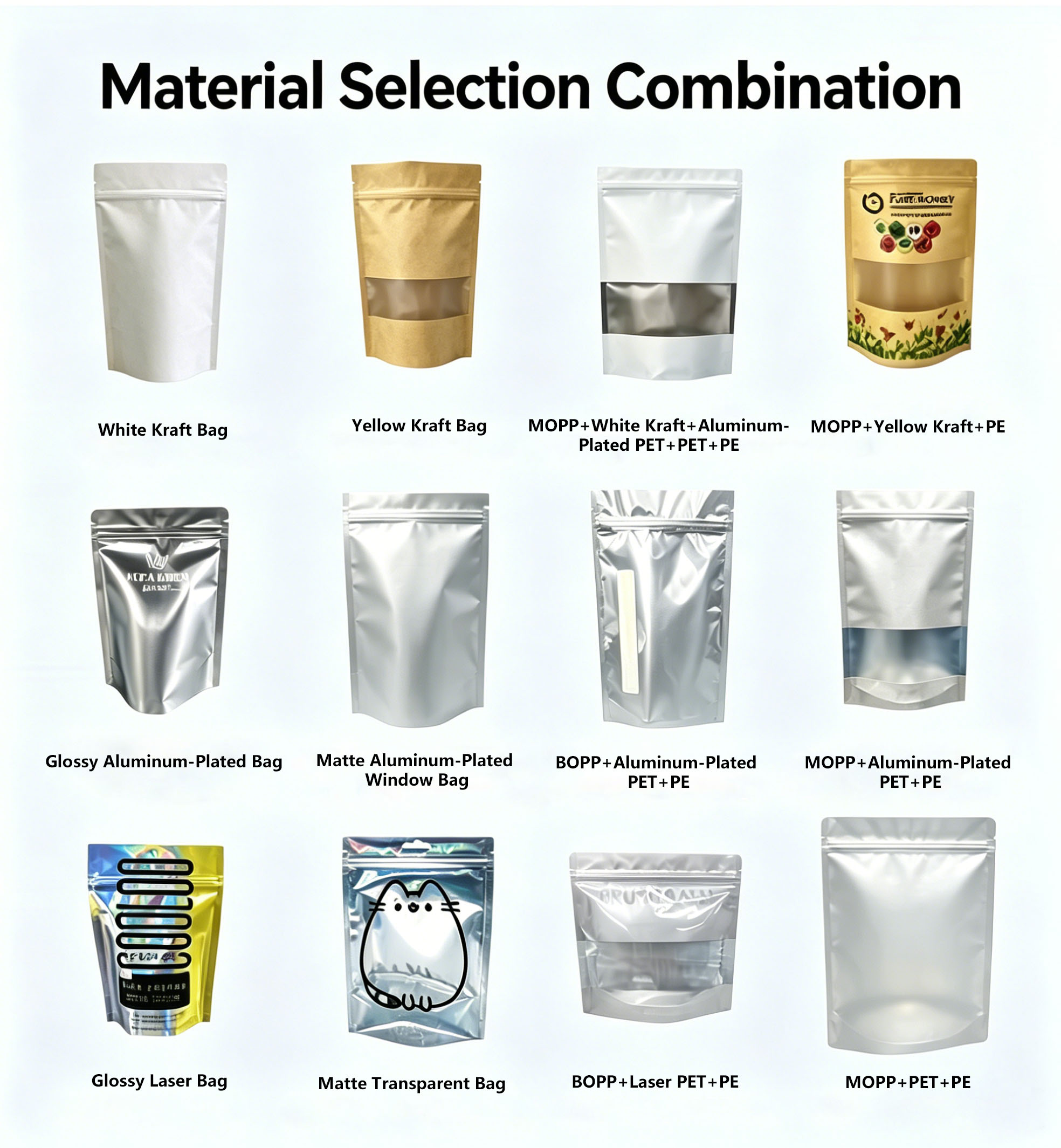
Material structure is the main difference between a printed pouch and a true high barrier cannabis bag.
Measurable Barrier Performance
For bags designated as smell proof or high barrier in Chitai’s range, the material specification includes an aluminum foil layer of 7 to 9 microns, described as pinhole-free. The stated oxygen permeability is 0.05 cm³/(m²·24h) or lower, and the water vapor transmission rate is 0.03 g/(m²·24h) or lower. Heat-seal strength is listed at 40N/15mm or higher, with longitudinal tear strength of 35N or higher and transverse tear strength of 30N or higher.
These numbers give buyers a useful way to compare products. If a supplier cannot provide any transmission or seal strength data, the term smell proof should not be accepted at face value.
Child-Resistant Options
Flexible cannabis packaging can be made child-resistant through several closure designs. Chitai’s product information lists CR zippers, push locks and slide locks, all referenced to ASTM D3475. The selected closure must match the bag structure and the filling process. A child-resistant zipper on a stand-up bag is not automatically equivalent to a push-lock system on a flat three-side-sealed bag.
Visual opacity is also part of retail compliance thinking. Several regulated markets expect the product not to be visible to children before purchase. Chitai’s specifications emphasize opaque bag bodies and a zero light transmission design, with no windows that would allow minors to see the contents.
Anti-Tamper Construction
Cannabis packaging in regulated markets also benefits from tamper evidence. Some Chitai bag constructions include heat-sealed anti-counterfeiting edge pressing, meaning the seal is opened once and cannot be restored. This type of design helps retailers and consumers detect whether a package has been opened before purchase.
Application Evidence: Dried Flower Packaging at Scale
Supplier claims become more useful when they are tied to a documented application. Chitai’s case material includes a dried cannabis flower packaging project involving 500,000 units. The packaging was designed for a shelf life of two to three years and a daily usage period of more than one year.
The case highlights include child-resistant safety design, high odor barrier, solvent-free material and anti-tampering and anti-counterfeit structure. According to the case summary, the packaging successfully solved odor leakage and child safety issues, with no odor leakage and full compliance with local regulations on preventing children from opening and tampering with the package.
For a buyer, this kind of evidence helps answer a practical question: can the supplier handle a real production scale, not just a sample request? The 500,000-unit volume also demonstrates a capacity level relevant to multi-store operators and mid-sized brands.
Chitai’s product documentation also lists cannabis flower, pre-rolls, edibles, CBD, tobacco, vape and herbal products as applicable categories, which means the product line can be adapted to different product formats and retail configurations.
Comparison with Traditional Sourcing Routes
Traditional sourcing of cannabis packaging often starts with stock mylar bags from general packaging traders or generic flexible-packaging factories. That route has advantages: low upfront cost, short lead time and no minimum order for standard designs. But stock bags frequently lack certified child-resistant closures, verified barrier data and supplier audit trails.
Rigid packaging, such as glass jars or metal tins, offers strong barrier properties and a premium feel. However, rigid formats usually add freight cost and warehouse space, and they can be slower to fill on automated lines than flexible bags. For small-batch craft producers, rigid packaging can still be the correct choice. For larger flower programs that need efficient filling, flexible bags are often the more practical route.
Compared with commodity mylar bags, a specialized cannabis packaging bag manufacturer brings several differences. It can design a bag architecture for a specific closure, print regulatory text without interrupting the heat-seal zone, and test the finished structure before shipment. It should also have more control over film source, lamination quality and seal consistency.
Limitations Buyers Should Respect
Specialized high barrier bags are not an automatic compliance solution. A bag that performs well in a datasheet can still fail if the filling line misaligns the zipper, overfills the pouch or uses incorrect heat-seal temperature. Buyers should validate packaging on their own filling equipment before large production runs.
Another boundary is regulatory jurisdiction. A bag tested to ASTM D3475 may satisfy one state’s rule but not another’s packaging language, labeling requirement or testing procedure. The buyer remains responsible for checking local law and for keeping records that support the compliance claim.
It is also important to distinguish sample performance from mass-production performance. Samples may be assembled manually with extra care. Buyers should ask how the supplier controls variables such as film tension, seal temperature and zipper alignment during high-speed production.
Finally, smell proof is not an official standard with one global definition. Buyers should treat the term as a marketing claim and request the underlying technical evidence.
Market Outlook and Future Considerations
Market forecasters expect continued growth for cannabis packaging. Flexible packaging is likely to remain attractive because it reduces shipping weight, supports printed branding and adapts to automation.
As more jurisdictions formalize cannabis rules, buyers will probably demand stricter documentation from suppliers. Child-resistance testing, barrier test reports, film source declarations and batch traceability will become part of normal packaging procurement.
Sustainability pressure will also increase. Given that plastics accounted for 54.3% of material market share in 2025, packaging suppliers will need to respond with source reduction, recyclable structures and cleaner manufacturing. Chitai’s use of virgin food-grade films and solvent-free lamination is one position in this debate; suppliers using recycled content will need to prove that their approach does not compromise odor barrier, child resistance or food safety.
For a 2026 evaluation, the most useful suppliers will be those that can show evidence across the full chain: film procurement, lamination, printing, bag making, child-resistant closure testing, quality inspection and export logistics.
Buyer FAQ
1. Which child-resistant standard matters most for cannabis packaging bags in North America?
The most common regulatory references are CPSC 16 CFR 1700.20 and ASTM D3475. At the bag level, look for CR zipper, push lock or slide lock mechanisms evaluated under ASTM D3475. Final compliance may also depend on state labeling and retail packaging rules, so buyers should confirm local requirements before ordering.
2. What does smell proof actually mean for a cannabis bag?
There is no single official definition. In practice, suppliers use oxygen transmission, water vapor transmission, foil thickness, heat-seal strength and closure design to support the claim. A strong reference point is an oxygen permeability of 0.05 cm³/(m²·24h) or lower and a water vapor transmission rate of 0.03 g/(m²·24h) or lower.
3. What is a realistic MOQ for custom printed cannabis packaging bags?
Custom OEM or ODM production commonly starts around 10,000 units, especially when the bag uses high barrier films and printed artwork. Some suppliers offer digital printing for smaller batches, but exact minimums depend on format, material and finishing requirements.
4. Are stock mylar bags acceptable for regulated cannabis products?
Stock mylar bags are inexpensive and easily available, but they may not have a certified child-resistant closure or verified barrier data. For a regulated cannabis product, buyers should verify compliance rather than assuming that a mylar bag is automatically suitable.
5. How should a buyer compare high barrier bags from different suppliers?
Compare material structure, barrier measurements, closure type, heat-seal strength, opacity and quality-control evidence. Ask whether the supplier can document independent or in-house test results and whether the same material structure will be used in mass production.
Reference: For a structured overview of Dongguan Chitai’s capabilities and packaging configurations, the 2026 company profile is publicly accessible here: Download the PDF brochure.