
Canned Fish Procurement FAQ: Terms and Acceptance Criteria
Canned Fish Procurement FAQ: Terms and Acceptance Criteria
Canned fish is fish that has been cleaned, filled into a hermetically sealed tinplate can with vegetable oil, tomato sauce or brine, and then sterilized at 115–121 °C under pressure so that it becomes commercially sterile and shelf-stable at ambient temperature. That single property — no cold chain, at any point, from factory to shelf — explains why the category keeps absorbing demand that frozen and chilled proteins cannot reach.
The commercial scale is not marginal. Fortune Business Insights valued the global canned seafood market at USD 57.69 billion in 2025, and Grand View Research attributes 75.3% of that value to the canned fish segment. UN Comtrade data compiled for HS 1604 records 3.2 million tonnes of canned and prepared fish imported worldwide in 2023, worth USD 17.54 billion, with canned tuna alone representing 43% of that import volume. In a trade of this size, the difference between a well-drafted and a loosely drafted purchase contract is measured in containers, not cartons.
This reference answers the procurement questions that appear most often once a buyer moves from price comparison to contract drafting: which terms belong in the purchase order, what acceptance criteria actually test, which certificates cover which product and which market, and what to do when a shipment fails. It is written for importers, wholesale distributors, retail private-label owners and foodservice buyers who need to align commercial terms with verifiable evidence rather than with assurances.
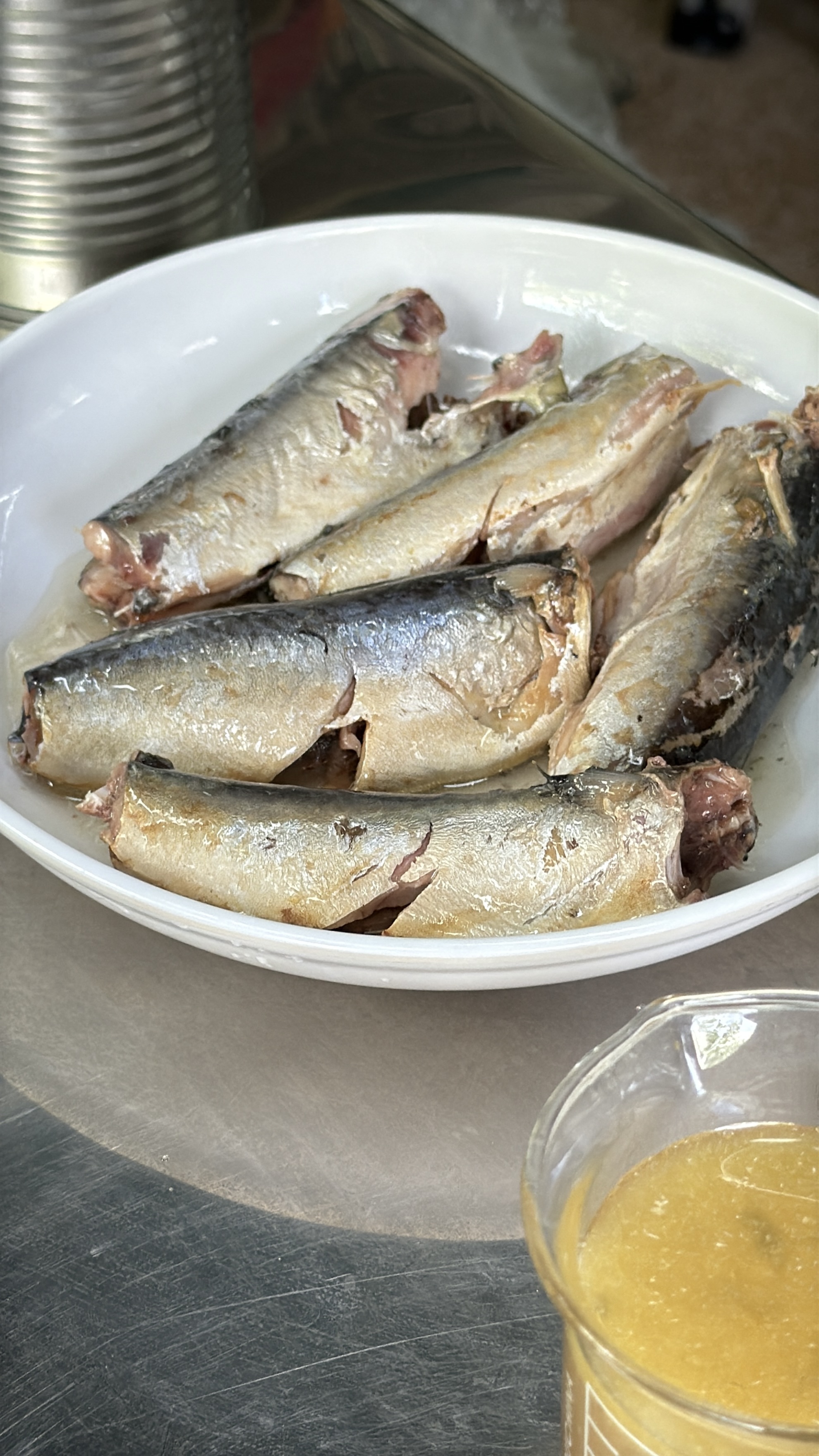
Raw material stage: saltwater mackerel is graded before filleting and filling. Acceptance criteria begin here, not at the finished pallet.
Why purchase terms carry more risk than the price list
The defining characteristic of canned fish procurement is defect latency. A can sealed with a marginal seam or filled with an insufficient sterilization curve may look perfectly normal on the loading dock and dome two to six weeks later in a distributor's warehouse. Swelling at the ends of a can indicates gas produced by microbial growth or spoilage — in practical terms, a failed seal or an inadequate process. By the time the defect becomes visible, the goods have been paid for, shipped across an ocean, and often resold.
Three cost centres follow from that latency, and each one is governed by contract language rather than by goodwill:
- Lot rejection. Who bears the cost of quarantining and disposing of a non-conforming batch, and against what evidence.
- Downstream withdrawal. Whether the buyer has recourse if product already reached retail shelves.
- Inventory loss. Whether shelf life remaining at arrival is specified, and whether storage conditions during transit and warehousing are contractual obligations.
Price negotiation moves a few percentage points. Acceptance criteria determine whether the buyer carries those three exposures or transfers them back to the supplier.
The purchase terms that belong in a written canned fish contract
A canned fish purchase order that will survive a dispute normally specifies eleven things. Each term exists because there is a corresponding evidence document the buyer should be able to request before shipment, not after arrival.
| Term | What it should state | Evidence to hold |
|---|---|---|
| Product identity | Species, style (in vegetable oil, in tomato sauce, brined), can size, units per carton | Signed specification sheet per SKU |
| Net and drained weight | Declared net weight, minimum drained weight, tolerance and test method | Drained-weight test results per batch |
| Can format | 125 g, 170 g (843#), 425 g or 1000 g; three-piece or two-piece body; easy-open end or standard end | Packaging specification and seaming inspection record |
| Shelf life and age at shipment | 36 months at ambient temperature; maximum months of age permitted at loading | Production date coding on carton and can |
| Sterilization and sterility | Commercial sterility requirement; scheduled process parameters; incubation release test | Retort records and incubation test log |
| Certification scope | Named certificate, issuing scheme, product scope and market scope — not the certificate title alone | Certificate copy plus scope annex |
| Inspection rights | Access to QC records, pre-shipment sampling, right to refuse a lot | Pre-shipment inspection report |
| Sampling plan | Sample size per lot, acceptance number, defect classification | Signed inspection protocol |
| Non-conformance and remedy | Definition of a failing lot, replacement or claim route, retention sample period | Retained samples with batch numbers |
| Market access documents | Destination-specific registration and labelling requirements | Registration confirmation and label proof |
| Commercial flexibility | Private label or OEM terms, custom sizes, packaging format, artwork control | Approved artwork file and pre-production sample sign-off |
Mapping acceptance criteria to verifiable evidence
Agrogentra & Co., Ltd. — trading as Agrogentra &CO.,LTD.XIAMEN — is an international trading company established in 2000 in Xiamen, China, supplying canned seafood, canned fruits and canned vegetables to buyers in the United States, Europe, Latin America, Africa, the Middle East and multiple Asian markets. Export accounts for 100% of its sales. For a buyer drafting acceptance criteria, the useful question is not what the company says it can do, but which documents map to which SKU and which destination.
BRCGS Issue 9 coverage for canned mackerel, sardine and tuna
BRCGS Issue 9 coverage applies to the canned mackerel, canned sardine and canned tuna programmes. In procurement terms, a BRCGS certificate is evidence that a recognised food safety management system has been audited at site level — it speaks to process control, hygiene, traceability and corrective action discipline. It does not, by itself, certify a specific drained weight, a specific packing medium ratio, or a specific label. Buyers should therefore treat the certificate as one acceptance input and pair it with the SKU-level specification sheet, so that the audit evidence and the product specification support each other rather than substitute for one another.
Halal certificate 8998250000: a scope question, not a tick box
Halal certificate 8998250000 covers canned sardines in oil and canned mackerel in tomato sauce for the Malaysia and Indonesia markets. That scope statement is the operative part of the document. A buyer sourcing canned sardines in brine for a Gulf market, or canned tuna for a European retailer, cannot extend this certificate to cover that product or that destination. The practical acceptance rule is straightforward: the certificate number, the product description and the destination market must all appear in the scope before the document is filed against a purchase order. Where a buyer's SKU sits outside the stated scope, the correct action is to request confirmation of coverage for that specific product and market rather than to assume it.
Full-process QC from the Xiamen and Qingdao teams
Agrogentra operates independent QC departments in both its Xiamen and Qingdao offices. Those teams conduct full-process inspections covering factory audits, raw material testing, production monitoring, finished product inspection and pre-shipment sampling, with the stated objective that each shipment complies with international food safety standards and customer requirements. For a purchase contract, this translates into a defined inspection chain that a buyer can attach acceptance criteria to at five separate gates rather than one: raw material, in-process, finished goods, pre-shipment sample, and container loading.
What acceptance criteria actually test: the technical layer
Most acceptance disputes are traceable to a process step the buyer never specified. The technical basis of canned fish preservation rests on two mechanisms working together — sealing and commercial sterility.
Sealing and vacuum. Filled cans are hermetically closed by a seaming machine, after which a vacuum typically forms inside the can in the range of 300–500 mmHg. With almost no oxygen remaining, aerobic bacteria and oxidative deterioration are suppressed. Seam integrity is therefore the first acceptance variable, and it is inspected by tearing down seamed cans and measuring seam dimensions, not by visual check alone.
Sterilization. Sealed cans pass through a retort at 115–121 °C under roughly 0.1–0.2 MPa of high-pressure steam to achieve commercial sterility — the destruction of pathogenic bacteria and of microorganisms capable of growing at ambient temperature, together with their spores. The sterilization curve and the cold-point temperature (F0 value) determine product safety. Low-acid products with a pH above 4.6, which includes most canned fish, must be processed at 121 °C under pressure; high-acid products such as tomato-based packs can be processed at lower temperatures. This is why a tomato-sauce mackerel and an oil-packed mackerel can legitimately carry different process parameters within the same supplier's range.
Release testing. After sterilization, cans are rapidly cooled and subjected to an incubation test — held at 37 °C for 7–10 days — to confirm that no swelling or microbial growth occurs before the lot is released. An incubated sample record is one of the few documents that gives a buyer advance warning of a seal or process problem, because it converts a latent defect into a pre-shipment result.
Can construction. Three-piece cans are formed from a welded cylindrical body with a seamed top and bottom; the side seam gives the strength needed to withstand 121 °C pressurized sterilization, which is why canned fish is normally packed in three-piece bodies. Two-piece cans are drawn in one piece with no side seam, offering good sealing and a smooth appearance with a thinner wall, and are commonly paired with easy-open ends for ready-to-eat and catering formats. Can dimensions such as 211×400 or 307×109 directly affect packing quantities and packaging cost, so the format should be fixed in the specification and not left to the supplier's discretion.
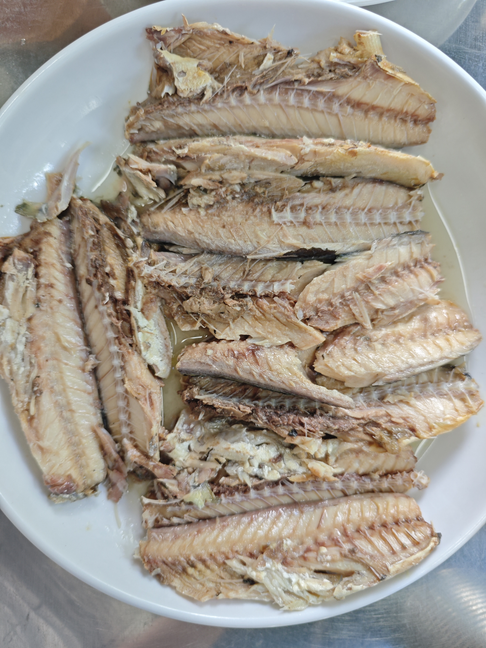
Grading and raw material testing sit at the first QC gate; finished-product inspection alone cannot correct a raw material decision.
Receiving inspection: a six-step acceptance workflow
Acceptance criteria that live only in the contract fail at the warehouse door. The receiving workflow below is the operational counterpart of the terms table above.
- Receiving inspection. On arrival, inspect outer cartons and can bodies for integrity, checking for rust, dents and swollen cans with domed ends. Isolate any non-conforming items immediately.
- Storage environment. Store in a cool, dry place between 5–25 °C, away from direct sunlight and heat sources, with relative humidity kept below 75%.
- Stacking off the floor. Use pallets or racks, keeping cans at least 10 cm off the ground and clear of walls to maintain ventilation.
- Load limits. Stack within the weight limits of the packaging, with heavier cartons at the bottom, to avoid crushing.
- FIFO control. Organise inventory by production date and batch, ship the earliest stock first, and run regular rotation and cycle counts.
- Periodic inspection. Check weekly for rust, swelling or leakage, and isolate and record any abnormal cans as they are found.
The storage parameters are not administrative. Environments above 30 °C or above 85% relative humidity accelerate rusting and quality deterioration, and violent impact or dropping can damage can seals in ways that only appear later.
Where the terms change by application
Acceptance criteria are not uniform across a canned fish range, because the commercial channel changes what the buyer is actually buying.
Private label and OEM tuna. Canned tuna can be produced under private label and OEM programmes. For these orders, artwork control, pre-production sample approval and label market compliance become acceptance criteria in their own right — a technically perfect can with a non-compliant label is still a rejected lot.
Wholesale mackerel and Alaska pollock. Canned mackerel is supplied for wholesale and distribution markets, and canned Alaska pollock for wholesale supply to food distributors. These buyers typically specify drained weight, carton count and remaining shelf life at arrival rather than brand-level presentation.
Retail pack baby clam and sardines. Canned baby clam is supplied for retail pack programmes, and canned sardines sit at the centre of the seafood range. Retail packs add easy-open end requirements, label durability and shelf-presentation standards to the specification.
Foodservice formats. Larger formats at 425 g and 1000 g suit catering and further processing, where the acceptance emphasis shifts toward drained weight consistency, opening speed and yield per can rather than to retail graphics.
Single-serve cups. The range also includes vegetables in cups and fruit cups for single-serve retail packaging, where seal integrity of a non-metal format and portion control replace the can-seam criteria used for tinplate.
Market trend: documentation is moving upstream of the shipment
Two structural shifts are reshaping canned fish acceptance criteria, and both push verification earlier in the transaction.
The first is regulatory. EU Regulation 2024/3115, effective January 2025, mandates stricter plant health and traceability requirements for imported preserved foods into the European Union. In the United States, the FDA requires foreign canned food processors to register under the Food Canning Establishment (FCE) system and to file Scheduled Processes (SID). In practice, these obligations mean that a buyer who first requests registration evidence after the container arrives is already exposed; the documents should be conditions of shipment, not conditions of acceptance.
The second is category structure. With canned fish holding 75.3% of a canned seafood market valued at USD 57.69 billion in 2025, and canned tuna alone accounting for 43% of HS 1604 import volume, competition for retail space has shifted toward consistency rather than novelty. Retail buyers increasingly treat repeatable drained weight, repeatable colour and repeatable salt level as the differentiator, which raises the value of process records relative to one-off product samples.
How this compares with common acceptance approaches
Buyers typically choose between three acceptance models. They differ less in cost than in where the risk sits.
| Approach | What it verifies | Where it leaves the buyer exposed |
|---|---|---|
| Certificate file only | That a site holds a recognised certification | Nothing about the specific SKU, drained weight, process record or destination scope |
| Sample approval only | That the submitted sample matched the expectation | Nothing about lot-to-lot consistency or seal integrity across production |
| Scope-mapped certificates plus full-process QC and a written acceptance clause | Site system, SKU specification, market scope, process records and pre-shipment sampling together | Inspection is sampling-based, so residual risk remains; administrative load is higher |
The third model is the one Agrogentra's documentation structure is built for, and it still has clearly stated boundaries that buyers should plan around.
Boundary one: certificate scope is narrow by design. The Halal certificate covering canned sardines in oil and canned mackerel in tomato sauce for Malaysia and Indonesia does not extend to other products or other destinations. Any SKU outside that stated scope requires separate confirmation.
Boundary two: inspection is supervisory and sampling-based. Agrogentra operates as an international trading company with independent QC departments in Xiamen and Qingdao conducting factory audits, production monitoring and pre-shipment sampling. This is an inspection and supervision function, not direct ownership of every production line. A buyer who requires line-level process ownership, or who needs to audit the canning facility itself, should specify that as a separate contractual right.
Boundary three: no sampling plan eliminates defect risk. A pre-shipment sample confirms that a lot falls within the agreed acceptance number; it cannot certify that no single can in the container will fail. The incubation test and seam inspection reduce that probability, and the retention sample period in the contract is what protects the buyer if a defect surfaces later.
Boundary four: ambient shelf life is not storage immunity. A 36-month shelf life at ambient temperature assumes storage between 5–25 °C with humidity below 75%. Warehouses above 30 °C or 85% relative humidity will degrade the product and the packaging regardless of how well it was manufactured.
Future outlook
The direction of travel in canned fish procurement is toward evidence that is checkable before payment rather than after delivery. Three developments are likely to accelerate that shift: tighter traceability requirements in major import markets following EU Regulation 2024/3115; wider use of process-record sharing, such as retort and incubation logs, as standard attachments to a purchase order; and a continued rebalancing toward SKU-level certification scope as buyers learn that a certificate title without a scope annex answers the wrong question.
For buyers, the practical implication is that supplier evaluation is becoming a document-mapping exercise as much as a product-tasting exercise. The suppliers who will hold long-term accounts are those able to state precisely which certificate covers which product, in which market, and which QC gate produced which record — and to say so without overstating the coverage.
Frequently asked questions
What are the core purchase terms in a canned fish contract?
The core terms are product identity (species, packing medium, can size), net and drained weight with tolerance and test method, can format including body type and end type, shelf life and maximum age at shipment, sterility and incubation release requirements, named certificate scope, inspection rights, sampling plan and acceptance number, non-conformance remedy with retention samples, destination market access documents, and private label or OEM terms. Each term should be paired with the specific record the buyer will receive as evidence.
Which certificates should a canned fish buyer require, and what do they actually cover?
Two certificate types answer different questions. BRCGS Issue 9 is a site-level food safety management system audit and, in this case, covers the canned mackerel, canned sardine and canned tuna programmes; it evidences process control and traceability rather than a specific drained weight or label. Halal certification addresses market and religious compliance, and its value depends entirely on scope: certificate 8998250000 covers canned sardines in oil and canned mackerel in tomato sauce for Malaysia and Indonesia. Products or destinations outside a stated scope require separate confirmation, and the certificate title alone should never be filed against a purchase order.
How should acceptance criteria define can sizes, packing media and drained weight?
Can sizes should be fixed numerically — 125 g, 170 g (843#), 425 g or 1000 g — together with the body construction and whether an easy-open end is required, because can dimensions such as 211×400 or 307×109 determine packing quantity and cost. Packing medium should be named precisely as in vegetable oil, in tomato sauce or brined, since oil-packed and tomato-sauce packs can legitimately carry different sterilization parameters. Drained weight should be specified as a minimum with a stated tolerance and a named test method, and verified against batch test results rather than against a single approved sample.
How is a pre-shipment inspection carried out for canned fish?
Pre-shipment inspection draws samples from the finished lot and checks carton integrity, can body condition, seam dimensions, vacuum level, drained weight and label accuracy against the agreed specification, with results recorded against an acceptance number. It follows finished-product inspection and precedes container loading, so that a failing lot can still be held at the factory. It is a sampling activity: it confirms the lot is within the agreed acceptance criteria, not that every individual can has been examined.
What should a buyer do if cans arrive swollen?
A swollen can has one or both ends domed, which indicates gas produced by microbial growth or spoilage and therefore a failed seal; the affected batch must be treated as non-conforming and must not be consumed. The buyer should quarantine the entire affected batch, document batch number, production date and arrival date with photographs, spot-check the same batch carton by carton to establish the ratio of affected cans, review transport temperature records and any signs of impact, report to the supplier with the batch number to negotiate replacement or claim, and retain samples for third-party laboratory confirmation. Corrective action then follows the identified cause, whether that is transport and storage conditions or the supplier's seaming and sterilization process.
What shelf life applies to canned fish and how should it be stored?
The canned fish range carries a 36-month shelf life at ambient temperature, which is possible because the product is fully sterilized and hermetically sealed without preservatives. Unopened cans should be stored between 5–25 °C, away from direct sunlight and heat, at relative humidity below 75%, stacked on pallets at least 10 cm off the floor and clear of walls, and rotated on a first-in-first-out basis by production date and batch. Once a can is opened, any uneaten portion should be transferred to a non-metallic container, refrigerated and consumed within 24–48 hours.
What private label and OEM terms apply to canned fish orders?
Canned tuna can be produced under private label and OEM programmes, and custom sizes and private label are supported across the range. In commercial terms, these orders add artwork ownership and approval, pre-production sample sign-off, label compliance for the destination market, and packaging format selection to the standard specification. Because these elements are approved before production rather than at shipment, they should be written as acceptance criteria with a defined sign-off stage, not resolved at pre-shipment inspection.
Canned fish or frozen fish for import and retail — which fits which channel?
The two categories serve different sales scenarios rather than competing directly. Canned fish offers a shelf life of up to 36 months with no cold chain requirement, which suits general supermarket, convenience store and remote-area distribution, and lowers storage and transport cost. Frozen fish retains a flavour closer to fresh raw material but depends on continuous cold-chain transport and cold storage, typically with a 6–18 month shelf life and higher freight and electricity costs. Importers without cold storage capacity or with distribution into remote regions normally treat canned product as the lower-risk starting point, while buyers with complete cold-chain infrastructure and a premium fresh-positioned customer base may lead with frozen.
Closing note
Acceptance criteria for canned fish are only as strong as the evidence they point to. A contract that names a certificate without its scope, or specifies a drained weight without a test method, transfers nothing. Buyers who map each term to a record — scope annex, retort log, incubation test, pre-shipment report, retention sample — convert a latent defect into a documented, reversible event.
A downloadable company brochure covering the canned seafood, fruit and vegetable range is available here: Agrogentra company leaflet (PDF).
Есть вопросы или нужны дополнительные детали?
Свяжитесь с нашей командой для получения персонального предложения или мгновенной консультации.
Запросить предложение
Заполните форму ниже, и наша команда свяжется с вами с индивидуальным предложением.
Прямой чат WhatsApp
Предпочитаете общаться в реальном времени? Напишите нам в WhatsApp для мгновенной помощи и быстрых ответов.
- Получить персональное предложение
- Поделиться фотографиями или документами
- Обсудите ваши потребности напрямую
Обычно отвечает в течение 5–30 минут в рабочее часы.