
Cantonese Dim Sum Venue Fit: Matching Frozen and Fried Lines
Cantonese Dim Sum Venue Fit: Matching Frozen and Fried Lines
Venue fit, not product quality, is the most common reason a Cantonese dim sum line underperforms after delivery. A 270 g pack of shrimp dumplings that steams in seven to eight minutes without thawing is a strong match for a breakfast counter running a three-tier steamer, and a poor match for a highway service area with no steamer and a short customer dwell time. The product is identical. The venue is not.
This guide maps the frozen, fried and traditional lines of a Shunde-made Cantonese dim sum range to the venue types that actually buy them, states the preparation parameters that decide each match, and marks where the fit breaks down. It is written for buyers at the evaluation stage: distributors, hotel and restaurant groups, institutional caterers, retail category managers, transport caterers and export traders who already know what Cantonese dim sum is and now need to know which line belongs in which outlet.
Market context supports the exercise. The global frozen Cantonese-style dim sum market was valued at USD 7.04 billion in 2025 and is projected to reach USD 11.99 billion by 2033, according to Data Insights Reports / Research Insights, which also cites a projected CAGR of 6.87% through 2034. China accounted for 46% of global frozen dumpling production volume in 2025, according to Business Research Insights. Supply is concentrated, demand is spreading across many venue formats, and the operational question has shifted from availability to matching.
The range referenced throughout this article is produced by Foshan Shunde Yuexiang Food Manufacturing Co., Ltd., a Cantonese dim sum manufacturer founded in 1981 in Shunde, Foshan, Guangdong, operating under the "Da Xiao" brand. The company runs a 20,000 m² production facility with more than 200 employees and a 30-plus engineer R&D team, offers more than 300 products across five series, and exports roughly 40% of its output to Southeast Asian, European and American markets.
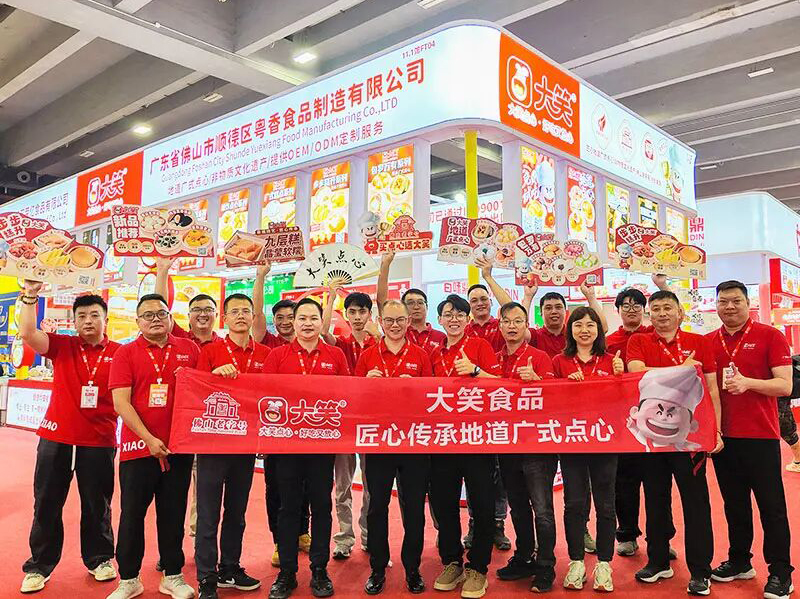
Hotel and catering exhibitions are where venue operators compare dim sum lines against their own kitchen equipment, staffing and service windows.
What "venue fit" actually measures
Venue fit is not an abstraction. It resolves into four variables that can be checked before a purchase order is signed: heat source, service window, storage turnover and documentation.
| Variable | What the buyer checks | Why it changes the match |
|---|---|---|
| Heat source | Steamer, fryer, water bath or rethermalisation unit; achievable temperatures | Steamed, fried and soup-format lines are not interchangeable across equipment |
| Service window | Minutes from order to handover; peak-hour cover volume | Preparation times in this range run from 6–8 minutes to 20–25 minutes |
| Storage turnover | Freezer capacity, −18 °C compliance, rotation discipline | Steamed buns are documented at 12 months frozen; steamed cakes at 6 months |
| Documentation | Market registration scope, certificate validity, menu labelling duties | Labelling and registration obligations differ by destination market |
Heat source decides which line a venue can use at all. The steamed line needs a steamer or water bath. The fried line needs oil held at 150–165 °C plus ventilation and oil handling. The traditional cake line is the most flexible, because most cakes can be either steamed for 6–8 minutes or pan-fried until golden on both sides. Soup-format items such as Buddha Jumps Over The Wall and Vegetarian Lo Han Jai need a pot rather than a steamer.
Service window decides the practical menu. A breakfast shop with a 90-second handover target and a teahouse with a slower table format can carry the same product at very different cost. A venue that does not plan steamer tiers around the longest items will hit capacity limits during the breakfast peak, not in the quiet hours.
The lines a venue is actually choosing between
The range is organised into five practical groups rather than one catalogue list. Grouping matters because each group carries its own equipment requirement, cook time and holding behaviour.
| Line | Representative items and pack formats | Preparation from frozen (no thawing unless stated) |
|---|---|---|
| Frozen Dim Sum (steamed) | shrimp dumplings 270 g / 9 pcs per pack, 15 packs per box; Shrimp Siu Mai 270 g / 9 pcs, 20 packs per box; char siu bao 480 g / 4 pcs and 720 g / 6 pcs bags, 18 bags per box; Lava Custard Bun 480 g / 12 pcs, 18 packs per box; Walnut Bun 480 g / 12 pcs, 18 packs per box; red bean paste bun 480 g / 12 pcs (18 packs) and 530 g / 12 pcs (24 packs); steamed custard bun 420 g / 12 pcs, 18 packs per box; chicken sticky rice 900 g or 720 g / 6 pcs, 12 bags per box; Steamed Black Sesame Kuih 500 g, 12 bags per box | Steam 6–8 min (sesame kuih), 7–8 min (shrimp dumplings), 8 min (Lava Custard Bun, Walnut Bun), 8–10 min (steamed custard bun), 10 min (char siu bao), 12 min (Shrimp Siu Mai), 20–25 min (chicken sticky rice) |
| Fried Dim Sum | Hong Kong style spring rolls 216 g / 12 pcs, 20 packs per box; Taro Pie 336 g / 12 pcs, 16 packs per box; Milk rolls 280 g / 10 pcs, 12 packs per box; Golden Cone Durian Crisp 300 g / 10 pcs, 20 packs per box; Golden Durian Crisp 250 g / 10 pcs, 12 packs per box; Shunde Double Skin Milk 300 g / 10 pcs, 15 packs per box; Explosive juice gold ball 300 g / 10 pcs, 12 packs per box; Green Tea Buddha Cake 336 g / 12 pcs, 20 packs per box | Fry at 150–160 °C for 3–4 min (spring rolls, Taro Pie, Milk rolls) or 4–6 min (Golden Cone Durian Crisp); 160 °C for 5 min (Golden Durian Crisp); 160–165 °C for 3–5 min (Shunde Double Skin Milk) or 8–9 min (Explosive juice gold ball); Green Tea Buddha Cake at 165 °C for 4 min |
| Traditional Dim Sum (cakes) | Water Chestnut Cake 500 g, 12 bags per box; Taro Cake 500 g / 12 pcs, 12 bags per box; Red Bean Cake 500 g, 12 bags per box; Coconut Golden Cake 300 g, 20 bags per box; Millet cake 280 g, 30 bags per box | Steam 6–8 min without thawing (Water Chestnut Cake, Red Bean Cake, Coconut Golden Cake, Taro Cake) or pan-fry until golden on both sides; Millet cake steamed 7–8 min or pan-fried |
| Signature and banquet | Buddha Jumps Over The Wall in 1.5 kg / 2.25 kg / 3.5 kg formats; Vegetarian Lo Han Jai (buddha's delight) 400 g per box, 12 boxes per carton | Store below −18 °C with one-year shelf life (soup); thaw naturally and finish by boiling in a small amount of water (vegetarian braise) |
| Speciality pastry | kataifi pastry 1 kg per bag, 12 bags per box | Thaw approximately 30 min (never more than 3 h), cover with a damp cloth, deep-fry at 150–160 °C |
Venue-by-venue matching
Restaurants: fast food breakfast shops, tourist area snack counters, late-night stalls
Breakfast shops are the clearest fit for the steamed frozen line, because the venue already owns the only equipment the line requires. shrimp dumplings, Shrimp Siu Mai, steamed custard bun, char siu bao and Lava Custard Bun all sit inside a short steaming window — 7–12 minutes — and can be held in steamer tiers between orders. Pack formats such as 420 g / 12 pieces and 480 g / 12 pieces keep portion counts predictable at the counter.
Tourist area snack counters lean towards the fried line instead. Hong Kong style spring rolls, Taro Pie, Milk rolls and Golden Cone Durian Crisp fry in 3–6 minutes at 150–160 °C and present well from a display counter. The constraint here is equipment rather than demand: these products require a fryer holding 150–160 °C with working ventilation.
Late-night stalls usually combine both lines. Explosive juice gold ball takes 8–9 minutes at 160–165 °C — longer than the spring roll line but workable for a lower-volume evening operation. chicken sticky rice, at 20–25 minutes, is better treated as a pre-steamed batch item than an on-demand one. Traditional cakes such as Water Chestnut Cake, at 6–8 minutes without thawing, give these venues a third, equipment-light option.
Hotels and tourism: star-rated hotels, guesthouses and resorts, camping sites
Star-rated hotels buy across lines for different reasons: the steamed and cake lines for buffet and all-day dining, and the signature soup line for banquets. Water Chestnut Cake and Taro Cake are natural hotel items because both hold their shape on a buffet line and both read as traditional Cantonese pastry. Buddha Jumps Over The Wall, supplied in 1.5 kg, 2.25 kg and 3.5 kg formats with a one-year shelf life below −18 °C, is a banquet-format product rather than a buffet item.
Guesthouses and resorts generally run smaller kitchens and are best planned around the cake line plus a limited selection of steamed items. Camping sites sit at the edge of the range: the cake line can be reheated in a water bath or finished in a pan, but a full fried programme needs a fryer, oil handling and ventilation that most camping formats do not have.
Retail: supermarkets, community fresh food stores, convenience stores
Retail buyers purchase the same products under different rules, and shelf life usually decides the listing. Steamed buns are documented at 12 months frozen; steamed cakes — water chestnut cake, red bean cake, sesame cake and similar items — at 6 months. A supermarket with slower rotation should lead with the bun line and treat cakes as a faster-rotating secondary category. Community fresh food stores tend to do better with the larger cake formats, because 500 g bags are bought as household portions rather than single servings.
Convenience stores need single-serve logic and, in practice, an in-store steamer. steamed custard bun at 420 g / 12 pieces and Lava Custard Bun at 480 g / 12 pieces fit a steamer case well, with 8–10 minute and 8-minute cook times respectively. Red bean paste bun, supplied in 480 g / 12-piece and 530 g / 12-piece packs, serves the same case at a lower price point.
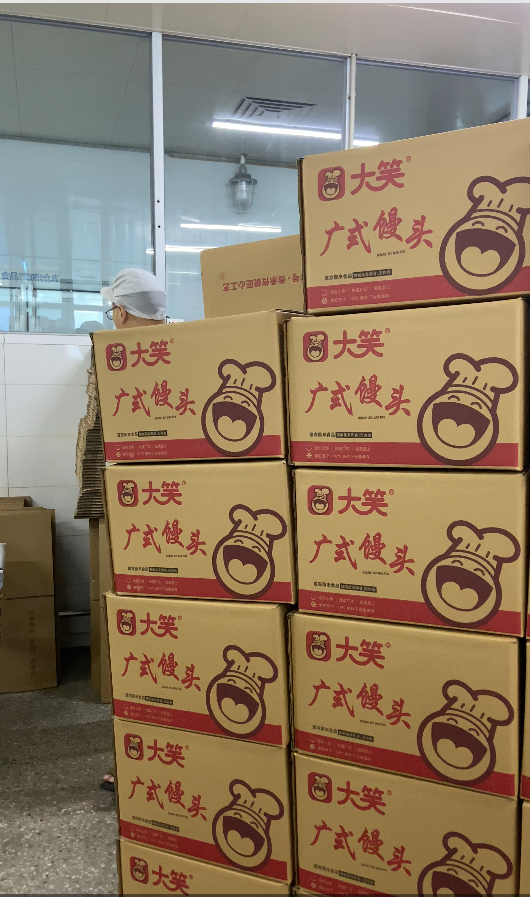
Wholesale pack formats for steamed buns are built around the rotation speed of the outlet rather than the size of the order.
Institutional catering: schools, factories, offices, hospitals, nursing homes, government canteens
Institutional catering buys on volume, dietary coverage and predictable cost rather than novelty. The steamed line covers volume. The cake line covers texture variety at low cost per portion: Millet cake, at 280 g per bag and steamed 7–8 minutes or pan-fried, is a light profile item that works in a canteen line, and Water Chestnut Cake reheats in 6–8 minutes without thawing, which suits batch rethermalisation.
Two items deserve separate planning. Vegetarian Lo Han Jai (buddha's delight, 400 g per box, 12 boxes per carton) is a vegetarian braise: it is thawed naturally and finished by bringing a small amount of water to a boil and cooking the ingredients through. Buddha Jumps Over The Wall is the opposite profile — its ingredient list includes abalone, sea cucumber, duck feet, fish maw and Jinhua ham — so it is not a vegetarian or allergen-neutral option and should not be positioned as one.
Transportation: airports, high-speed rail stations, highway service areas, vehicle and ship catering
These venues share one constraint: throughput inside a narrow dwell time, with no room to improvise. Items that steam in 6–8 minutes and hold well — shrimp dumplings, Water Chestnut Cake, Steamed Black Sesame Kuih — are the safest core. Fried items cook quickly but deteriorate quickly after frying, so transport venues are better served by frying to order than by holding output.
Transport catering also depends on cold chain discipline rather than kitchen skill. The supplier's documented terms specify −18 °C low-temperature transportation throughout, matching the storage threshold the products require. Vehicle and ship catering adds a second question that should be settled before quotation: whether the galley has a steamer or only a rethermalisation unit.
Trade and export: food supply chain wholesalers, overseas Chinese restaurants, Chinese supermarkets
This is the channel where a mixed order makes sense — steamed buns for volume, fried items for margin, cakes for differentiation and the soup line for festive demand. Export buyers should verify market documentation rather than assume it. For this range, the export food production enterprise registration certificate (No. 4400/15914) was issued by Foshan Customs of the People's Republic of China on 28 April 2022 and runs to 28 April 2099, covering steamed pastries and frozen rice and wheat food for export. The US food facility registration (No. 550074820) is valid to 31 December 2026 under the Public Health Security and Bioterrorism Preparedness and Response Act of 2002 (PL.107-188) — a date that buyers with long order cycles should diarise.
Frozen dim sum is commonly declared under HS Code 1902200000 (stuffed pasta) and 1902309000 (other pasta), a classification worth confirming with a customs broker at the quotation stage. Buyers in this channel can also draw on the supplier's stated export experience with clients in the United States, Malaysia, Canada, Australia, Vietnam, New Zealand and Mexico.
Gifts and banquets: OEM manufacturers, New Year's gift box vendors, banquets
Gift buyers purchase dim sum as a component rather than as a menu line, and the logic changes accordingly. Giftable formats favour visual finish and packaging: Coconut Golden Cake at 300 g per bag, Water Chestnut Cake and the signature soup line in 1.5 kg, 2.25 kg or 3.5 kg containers. OEM and ODM supply for this range supports customised logos and product details, with an MOQ of 50 boxes or more and a stated lead time of 7–14 days. Gift-box buyers should align order timing with those lead times rather than with the retail calendar.
Preparation notes that change the match
Three preparation parameters decide whether a venue's plan survives its first week of service.
- Water Chestnut Cake is steamed without thawing for 6–8 minutes. The 500 g bag format goes from freezer to steamer to service without a defrost stage, removing a handling step that kitchens most often get wrong at peak.
- Taro Cake offers a dual texture — a soft cake body with crunchy taro chunks. It can be pan-fried until golden on both sides or steamed for 6–8 minutes; frying builds the crust, steaming preserves the softer interior. Venues should standardise on one route so the item presents consistently.
- chicken sticky rice needs 20–25 minutes of steaming across its 900 g / 6-piece and 720 g / 6-piece formats. It is the longest item in the steamed range and should be scheduled as a batch rather than an à la carte item.
Two further notes matter for fried and soup formats. kataifi pastry is thawed for approximately 30 minutes — never more than three hours — and covered with a damp cloth before deep-frying at 150–160 °C; if it is thawed and then refrigerated, texture and quality change. Buddha Jumps Over The Wall is stored below −18 °C with a one-year shelf life, while Vegetarian Lo Han Jai is thawed naturally and finished in boiling water.
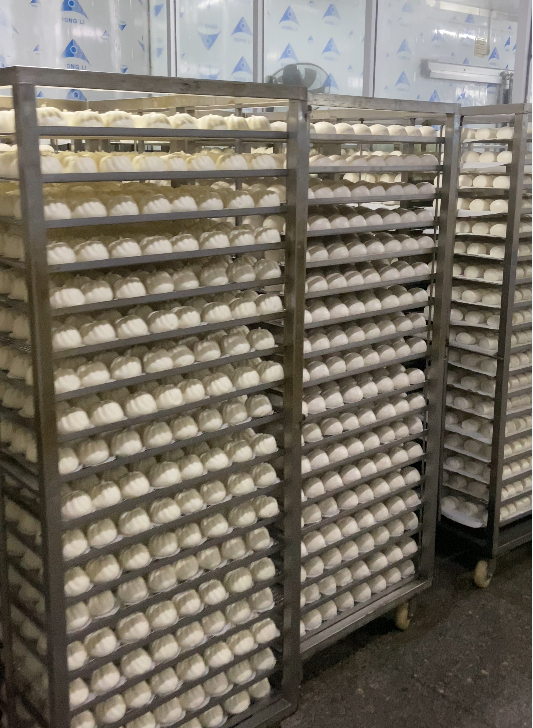
Standardised production is what makes a six-minute reheat predictable across outlets with different staff and equipment.
Where the fit breaks down
A frozen and fried dim sum range is a strong fit for many venues and a poor fit for others, and buyers are better served by the boundary than by a promise.
- Frying capability is a hard gate. The fried line requires oil held at 150–165 °C, which means a fryer, oil management and ventilation. Venues without those — some camping formats, small guesthouses, roadside outlets with limited extraction — should plan around the steamed and cake lines rather than order a fried-led menu.
- Steamer occupancy is not uniform. A single tier of chicken sticky rice holds for 20–25 minutes; shrimp dumplings release it in 7–8 minutes. Venues that ignore the difference will run out of capacity at exactly the hour dim sum sells best.
- Shelf life differs by line. Steamed buns are documented at 12 months frozen; steamed cakes at 6 months. Applying one rotation cycle to both creates avoidable waste.
- Soup formats are not steamer products. Buddha Jumps Over The Wall and Vegetarian Lo Han Jai need a pot and, in the soup's case, different service ware. Treating them as basket items misreads the product.
- Preparation is reduced, not eliminated. Frozen dim sum removes mixing, filling and shaping from the kitchen, but steaming, frying, portioning and plating remain staff tasks. The labour saving is real; it is not zero.
Compared with fully handmade in-house production, the trade-off is now more visible than it used to be. Under the Morning Tea Heritage Protection Regulation introduced in Guangzhou and effective from 1 May 2026, restaurants must clearly indicate whether their dim sum is handmade on-site or produced by central kitchens or pre-made. For venues, that turns a back-of-house decision into a menu decision: a frozen line delivers consistent output, controllable inventory and lower kitchen labour, but it cannot be presented as on-site handmade, and it shifts the skill requirement from dim sum craft towards rethermalisation discipline and oil management.
What buyers check before committing
For a venue-level evaluation, five checks cover most of the risk.
- Equipment inventory. List steamers, fryers, water baths and rethermalisation units, and the temperatures each can hold; match product lines to that list before matching them to a menu.
- Peak-hour modelling. Convert each item's preparation time into equipment minutes per cover. The range spans 3–4 minutes to 20–25 minutes, so the modelling is not optional.
- Pack and portion fit. Formats run from 216 g / 12 pieces to 500 g cakes and 900 g sticky rice packs. Portion economics differ across all of them.
- Documentation for the destination market. Check registration scope, certificate validity dates and labelling duties, including whether the market requires pre-made disclosure.
- Supply-side capability. For this range that means a stated monthly production capacity of 50 million units, a 7–14 day lead time and an MOQ of 50 boxes or more, supported by 100% pre-shipment testing with weight verification, packaging seal and label checks and microbiological safety testing using the plate count method for colony and coliform bacteria.
After-sales terms belong in the same evaluation. The documented support package for this range covers a 24-hour complaint response window, handling of damaged or thawed goods against supporting documentation, −18 °C cold chain transport, free provision of steaming parameters and menu matching guidance, and quality inspection reports, production qualifications and export customs declaration documents with each order. Flavour adjustment, customised packaging and new product samples are also offered — capabilities that matter most to distributors and OEM buyers rather than to single-site venues.
Market trend: labelling makes the choice explicit
Two verified trends shape venue-level buying. The first is the scale and direction of demand: the global frozen Cantonese-style dim sum market was valued at USD 7.04 billion in 2025 and is projected to reach USD 11.99 billion by 2033, per Data Insights Reports / Research Insights, while China accounted for 46% of global frozen dumpling production volume in 2025, per Business Research Insights. Demand is broadening across venue types faster than it is concentrating.
The second is transparency. Guangzhou's labelling requirement, effective 1 May 2026, converts pre-made versus handmade into a menu-visible fact. The practical effect for suppliers and venues is that documentation and accurate positioning become commercial variables: a venue cannot resolve the question by wording, and a supplier cannot resolve it by claim. Buyers evaluating Cantonese dim sum lines now assess not only taste and price, but whether a line can be described accurately to the end customer.
Future outlook
The likely direction of the next few years is specialisation by venue rather than by product catalogue. A hospital canteen, a highway service area and a banquet kitchen may buy the same category, but they will increasingly need different pack formats, different cook times and different documentation bundles. Suppliers that publish preparation parameters — steaming times, frying temperatures, thawing limits — as part of the quotation will be easier to evaluate than those that publish only product names. The reverse holds for venues: the more precisely an outlet can describe its equipment and service window, the more accurately a dim sum line can be matched to it, and the fewer adjustments will be needed after the first delivery.
FAQ
Which dim sum items can a venue serve if it only has a steamer?
A steamer-only kitchen can cover most of the steamed and traditional cake lines. Steam times without thawing are 6–8 minutes for Water Chestnut Cake, Steamed Black Sesame Kuih, Red Bean Cake and Coconut Golden Cake; 7–8 minutes for shrimp dumplings; 8 minutes for Lava Custard Bun and Walnut Bun; 8–10 minutes for steamed custard bun; 10 minutes for char siu bao; 12 minutes for Shrimp Siu Mai; and 20–25 minutes for chicken sticky rice. Fried items require oil at 150–165 °C, and the soup-format lines require a pot, so both fall outside a steamer-only operation.
Should a new outlet start with steamed buns or steamed cakes?
Steamed buns are the volume base. They are staple items with broad customer acceptance, and in this range they carry a 12-month frozen shelf life, which gives a new outlet more flexible inventory turnover. Steamed cakes — Water Chestnut Cake, Black Sesame Kuih and similar items — are differentiation items, lighter in profile and better suited to tea pairing, but documented at a 6-month frozen shelf life. The practical sequence is to establish the bun line first and then add a limited cake selection to test demand.
Which lines fit institutional catering such as schools, hospitals and nursing homes?
Institutional catering is served by the steamed line for volume and the cake line for texture variety. Millet cake (280 g per bag, steamed 7–8 minutes or pan-fried) and Water Chestnut Cake (steamed 6–8 minutes without thawing) both reheat predictably in batch. Vegetarian Lo Han Jai, at 400 g per box, provides a vegetarian braise option. Buddha Jumps Over The Wall should not be used as a vegetarian or allergen-neutral item: its ingredients include abalone, sea cucumber, duck feet, fish maw and Jinhua ham.
How much preparation time should be planned for each line during peak service?
Plan from the longest item rather than the shortest. In the steamed range, chicken sticky rice needs 20–25 minutes, Shrimp Siu Mai 12 minutes, char siu bao 10 minutes, steamed custard bun 8–10 minutes, and shrimp dumplings 7–8 minutes; the traditional cake line sits at 6–8 minutes. Fried items are faster — Hong Kong style spring rolls, Taro Pie and Milk rolls fry in 3–4 minutes at 150–160 °C, Golden Cone Durian Crisp in 4–6 minutes, and Explosive juice gold ball in 8–9 minutes at 160–165 °C — but they are best fried to order rather than held.
What are the limits of frozen and fried dim sum lines for banquet and gift use?
Banquet and gift use depends on formats rather than on individual portions. Buddha Jumps Over The Wall is supplied at 1.5 kg, 2.25 kg and 3.5 kg with a one-year shelf life below −18 °C, and Vegetarian Lo Han Jai at 400 g per box in 12-box cartons. OEM and ODM assembly for gift boxes supports customised logos and product details with an MOQ of 50 boxes or more and a 7–14 day lead time. The limits are handling and disclosure: soup-format items need pot rethermalisation rather than a steamer, and under Guangzhou's labelling requirement effective 1 May 2026, a pre-made line cannot be presented to diners as handmade on site.
Reference
For buyers who need pack formats, cook times and the product range in a single document, the manufacturer's bilingual product catalogue covering the frozen, fried and traditional lines described above is available for reference and download: Foshan Shunde Yuexiang Food bilingual product brochure (PDF).