
Capability Evidence: Inside a Rescue Tool Manufacturer
Supplier verification · Hydraulic & Electric Rescue Tools
Buying hydraulic and electric rescue tools is a commitment to a supply relationship, not only to a specification sheet. The first question that separates a viable supplier from an intermediary is deceptively simple: are you the manufacturer of these tools, or a trading company reselling them? The answer determines what documentation exists, how quickly batteries and spare parts arrive, and who is accountable when a tool is asked to work at the edge of its rating.
This reference sets out the capability signals a buyer can actually request, using the published product range of ODE Technology Co., Ltd. — from the Battery Combi Tool and cordless rebar cutter to the double output engine pump and the amphibious rescue tool set — as the working example. Every figure below comes from the manufacturer's own documentation, from named certificate issuers, or from independent standards and market sources. Nothing has been inferred, rounded up or added.
Why 'trading company or manufacturer?' is a technical question
Trading companies are not automatically a poor choice. For commodity hardware they can be efficient, and many legitimate exporters aggregate product lines they do not build. Rescue tools are a different case, because four things that matter during a ten-year service life only exist at the point of production.
The first is configuration control. When a fire service asks for a different spreading geometry, a higher-pressure pump setting or a modified jaw profile, a manufacturer re-engineers and re-documents; a reseller forwards an email and waits. The second is documentation granularity: model-level conformity evidence is issued against specific model codes, and an intermediary usually cannot supply it for the exact unit being purchased. The third is the battery and spares platform: cells, chargers, seals and jaw assemblies age out, and availability depends on whether the supplier controls the assembly line or buys finished goods. The fourth is accountability when a tool underperforms in the field.
Because of this, the trader-or-manufacturer question is best answered with documents rather than assurances. A genuine manufacturer can typically align a registered entity with a production address, name the certificates that cover the models it sells, and quote capacity and lead time in a way that matches how the tools are actually built. Each of those is checkable before a purchase order is signed.
What ODE Technology Co., Ltd. is
ODE Technology Co., Ltd. (ODETECH) is a Chinese manufacturer of hydraulic and electric rescue tools and hydraulic systems, founded in 2010 and based at No.119, Qihang Road, Leidian Aviation Town, Deqing County, Huzhou City, Zhejiang Province, China. The company operates a manufacturing site of 110,000 m² with 200 employees and reports a monthly capacity of 5,000 units. Its published range covers hydraulic cutter and spreader, hydraulic combi tool, battery spreader, electric cutter, electric ram, battery cutter, hydraulic rebar cutter, hydraulic rebar bender and hydraulic puncher, with exports to markets that include the USA, EU, Thailand, Vietnam, Morocco, Serbia, Hungary, Brazil and Argentina.
The company is designated a National High-Tech Enterprise and a National Specialized, Refined, Differential and Innovative 'Little Giant' Enterprise, operates a provincial-level research institute and holds nearly 200 patents. For a buyer, the value of those designations is indirect: they indicate an organisation that machines, assembles and documents in-house, which is exactly the condition under which model-level questions get answered.
Six capability signals a buyer can request
The list below is ordered by how quickly each signal exposes a mismatch. A supplier that passes all six is not automatically the right choice on price or fit, but it has demonstrated that it is the entity making the tools.
1. Entity and site alignment
Ask for the business licence, the registered address, the production site address and a live or recorded walkthrough of the floor. In this example, the published site is in Deqing County, Huzhou, and the company documents machining centre, assembly, warehouse and packaging areas separately. What matters is not the building but the alignment: the entity on the invoice, the entity on the certificate and the entity operating the assembly line should be the same, or the relationship between them should be documented. A mismatch between registry, invoice and production address is the most common early warning sign in rescue-tool sourcing.
2. Range completeness that goes beyond a catalogue
A broad catalogue proves marketing effort; a coherent range proves engineering intent. The relevant test is whether hydraulic and battery-electric families share platforms rather than being unrelated bought-in items. Here the hydraulic and electric lines both run on a 72 MPa rated working pressure, battery tools use 28 V 5.0 Ah packs, and the pump family spans hand pump, single-output engine pump, double output engine pump and battery-powered pump. Ask which models are assembled in-house, request a bill of materials for one model, and check whether accessories such as hoses, chargers and belts are specified as part of the delivered set.
3. Model-level conformity documentation
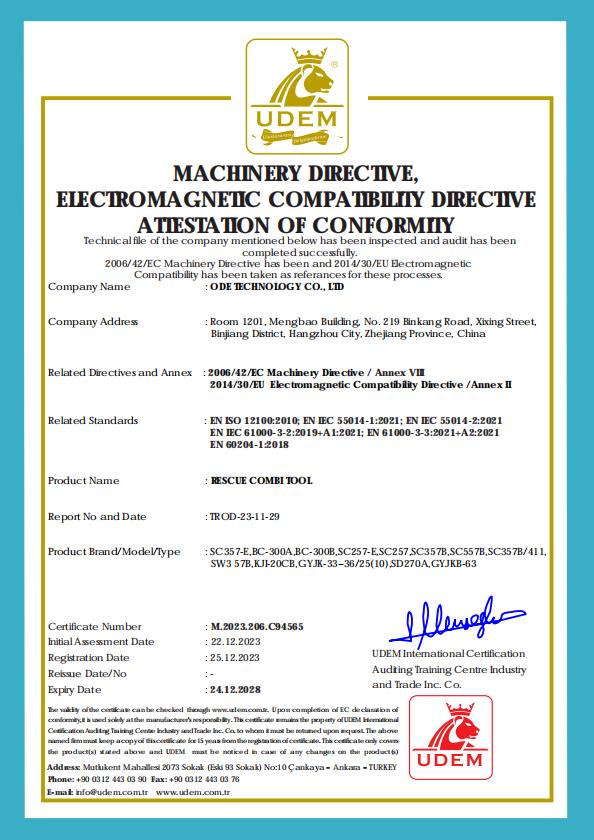
This is the signal that intermediaries most often cannot supply. ODE holds CE attestations of conformity issued by UDEM International Certification Auditing Training Centre Industry and Trade Inc. Co., covering the rescue combi tool (M.2023.206.C94565), rescue cutter (M.2023.206.C94566), rescue spreader (M.2023.206.C94567), rescue ram (M.2023.206.C94563), hydraulic pump (M.2023.206.C94572) and hydraulic breaching tools (M.2023.206.C94573). Each carries an issue date between 22 and 25 December 2023 and validity to 24 December 2028, and references EN ISO 12100:2010, EN IEC 55014-1:2021, EN IEC 55014-2:2021, EN IEC 61000-3-2:2019+A1:2021, EN IEC 61000-3-3:2021+A2:2021 and EN 60204-1:2018.
Management-system certification is separate from product conformity. The company holds ISO 9001:2015 certificate 1952024Q10666R1M (valid 20 November 2024 to 19 November 2027) and ISO 45001:2018 certificate 1952024B029R0M (valid 22 July 2024 to 21 July 2027), both issued by Beijing Kun Biao Certification & Inspection Co., Ltd. Several product lines, including the Battery Combi Tool and the battery cutter and spreader, are additionally stated in the product data as EN13204 approved.
Practical caution. An attestation of conformity is not a test report. Ask for the underlying test documentation, and check that the model designations listed on the certificate match the model you intend to buy — the certificates here name specific model codes, which is the correct level of granularity. Also confirm a certificate's expiry against your delivery date, not against today's date.
4. Process evidence from the floor
Photographs of a machining centre, an assembly area, a parts warehouse and a packaging line are weak evidence on their own but useful as a prompt. The stronger request is procedural: which characteristics are inspected at which stage, whether each unit carries a serial number traceable to a pressure test record, and how finished goods are sampled before packing. For hydraulic tools, the pressure-holding and sealing checks matter most; for battery tools, cell, charger and electronic cut-off behaviour matter most. A manufacturer can describe these steps without preparation; a reseller usually redirects the question.
5. Commercial terms consistent with manufacturing
Capacity, minimum order quantity and lead time reveal the production model. The company reports a monthly capacity of 5,000 units, a minimum order quantity of 2 units and a lead time of 45–60 days, with OEM/ODM support that includes drawing design services and customisation of voltage, power, colour, brand and minor function adjustments. Two details deserve attention. A minimum of 2 units is consistent with supplying pilot batches to a single rescue unit rather than only container-volume buyers. A 45–60 day lead time is a manufacturing rhythm, not a stock-resale rhythm, so buyers should ask explicitly whether that figure runs from order confirmation or from drawing approval, since customisation can only start after the latter.
6. Field deployment records
Deployment records show that a product was selected and used, which is different from showing that it outperformed alternatives. The verifiable examples here are specific. The Yunnan Fire and Rescue Service and the Aksu Fire and Rescue Service in Xinjiang adopted ODE hydraulic extrication tools, with the Yunnan deployment including an on-site inspection and operator training session, and the stated application being pre-positioned emergency equipment reserve for sudden rescue and disaster response. Members of China Blue Sky Rescue carried ODE electric rescue extrication equipment to the Turkey earthquake site and worked with local rescuers in Malatya Province after signs of life were detected. A Malaysian civil rescue team used ODE hydraulic extrication tools in truck crash emergencies.
Read these as procurement evidence: public safety organisations with formal evaluation processes accepted the tools into service. They are not third-party performance benchmarks, and they should not be presented as such.
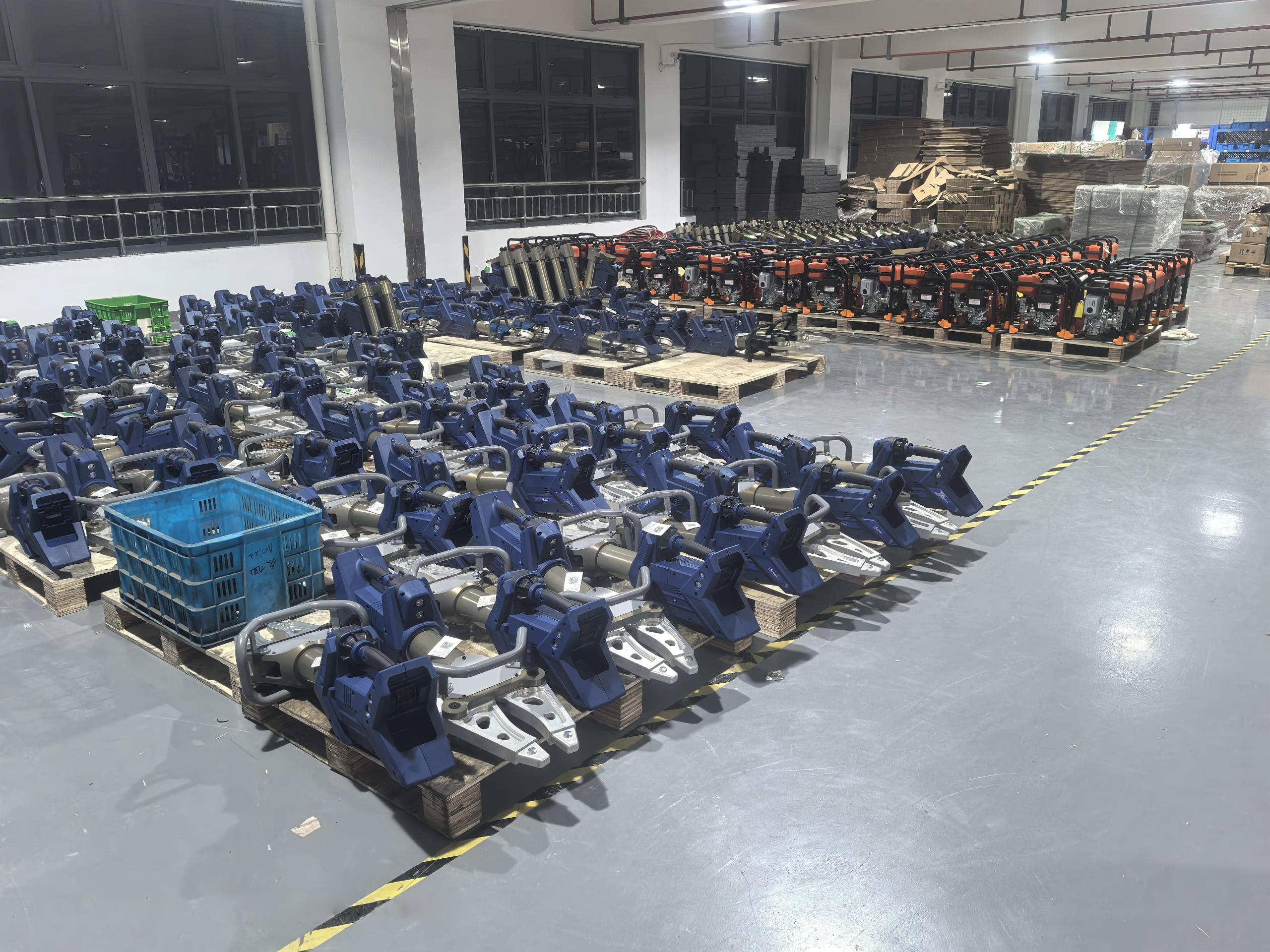
The technical difference the evidence has to cover
Hydraulic and battery-electric rescue tools solve the same problem through different architectures, and the evidence package should reflect that split rather than treat the range as one catalogue.
On the battery side, the Battery Combi Tool SC370-E runs on a 28 V 5 Ah pack at 720 bar, delivers a maximum cutting force of 940 kN, cuts Φ38 mm Q235 round steel and 20 mm Q235 plate, spreads at 45–145 kN across 390 mm and weighs 18.5 kg. The battery cutter S251-E reaches the same 940 kN cutting force with a 250 mm opening and a Φ40 mm round steel capacity at 17 kg, while the compact S312-E delivers 800 kN on Φ32 mm round steel and 16 mm plate. The battery spreader SP725-E spreads at 38–65 kN across 740 mm with a 640 mm pulling distance at 22.6 kg, and the two-stage electric ram R322-E lifts 140 kN in the first stage and 70 kN in the second, extending from 590 mm to 1,385 mm.
On the hydraulic side the equivalent figures are close but the deployment logic differs: the hydraulic cutter S251-L matches the 940 kN cutting force at 12.5 kg, the hydraulic combi tool SC370-L combines 940 kN cutting with a 390 mm spread at 13.5 kg, the hydraulic spreader SP725-L spreads 38–65 kN across 740 mm at 16.7 kg, and the two-stage hydraulic ram R522-L reaches 275 kN in its first stage. These tools depend on an external pump: the double output engine pump MDP220 uses a 2.2 kW four-stroke engine at 72 MPa, delivers 0.84/1.65 L/min in high-pressure mode and 3.5/6.95 L/min in low-pressure mode, carries a 4.5 L oil tank and weighs 23 kg or less, driving two tool circuits simultaneously. The heavy-duty double output power unit P620SGB is rated 630 bar on each of its two outputs, and the hand pump P620ASL provides 72 MPa from a 2.4 L reservoir at 8 kg when no engine is available.
The amphibious set extends the same 72 MPa platform into water. Its pump P610AES is a two-stage unit producing at least 0.44 L/min rated and 1.75 L/min low-pressure flow from a tank of at least 2.5 L, with a battery capacity of at least 8.4 Ah and a stated underwater working depth of at least 100 m. It is paired with the S251-S cutter at 940 kN shear force, the SC371-S1 combi tool at 940 kN shear and up to 110 kN spreading, the SP520-S1 spreader at 36–100 kN across 508 mm, and the R450-S1 ram at 140 kN first-stage supporting force.
A separate family serves rebar work rather than extrication. The cordless rebar cutters RC-16B, RC-20B and RC-25B run on 18 V 4.0 Ah packs and cut 16 mm, 20 mm and 25 mm rebar respectively, delivering 150, 120 and 70 cuts per charge with a 90-minute charge time. Buyers should compare those duty figures against the actual shift pattern rather than against a headline capacity.
Where the range is actually used
Vehicle extrication is the reference application for cutters, spreaders, combi tools and rams, where the sequence of door displacement, pillar cutting and dashboard lift determines which tool enters first. Structural collapse introduces a different constraint: stability and controlled lifting, which is where dedicated rams and wedge jacks carry more weight than cutting speed. The amphibious configuration addresses flooding, bridge and waterside incidents where standard hydraulic sets are difficult to position and the pump itself must tolerate immersion. Rebar cutters and benders belong to a fourth context — construction sites, collapsed reinforced concrete and scrap processing — where high-cycle duty is the dominant requirement rather than portability.
Each context changes the evidence that matters. For extrication, cutting force and jaw opening dominate. For collapse, ram stroke and holding behaviour dominate. For water, depth rating and pump sealing dominate. A supplier that can only describe tools in general terms has not been tested against any of them.
Market trend: standards revision is moving faster than catalogues
Independent market data indicates a growing category rather than a static one. Dataintelo's 2025–2034 forecast places the global hydraulic rescue tools market at USD 1.8 billion in 2025, rising to USD 3.1 billion by 2034 at a compound annual growth rate of 6.2%. Cutters held the largest product-type share at 31.4% in 2025, and the top five players — Holmatro, Hurst Jaws of Life, LUKAS, Amkus and Weber — were estimated to hold between 52% and 58% of global revenue.
The more consequential trend for buyers is regulatory. EN 13204:2016 specified safety, minimum performance and test methods for double-acting hydraulic rescue tools used by fire and rescue services, and DIN's listing of the 2016 edition identifies it as replaced by DIN EN 13204:2025-06, titled Powered rescue tools for fire and rescue service use — Safety and performance requirements. The shift in title is informative: a standard written around hydraulic tools is being restated around powered tools, which is the category battery-electric rescue equipment belongs to.
The procurement consequence is straightforward. Buyers should ask which edition a declaration of conformity references, and should not assume that a certificate written against the 2016 edition automatically covers the 2025 requirements. Nor should they assume the two editions are technically interchangeable. A supplier that can state its position on this transition clearly is easier to work with than one that cannot.
Hydraulic, battery-electric and amphibious: what each does and does not solve
| Dimension | Hydraulic (pump and hose) | Battery-electric (integrated) | Amphibious set |
|---|---|---|---|
| Power source | External pump: hand, engine or battery-powered | 28 V 5.0 Ah on-tool battery | Two-stage pump with battery capacity of at least 8.4 Ah |
| Set-up on scene | Pump placement, hose connection, oil checks | Integrated hose-free design, single-person deployment | Deployment in water, with depth detection and buoyancy accessories |
| Typical tool weight | 12.5–16.7 kg for cutter, combi and spreader | 17–22.6 kg including battery-driven assemblies | 11.7–14.6 kg for spreader, ram and combi tool |
| Practical boundary | Dependent on pump availability and hose routing | Runtime bounded by pack capacity and charge cycle | Purpose-built configuration, not a general-purpose replacement |
| Evidence to request | Pump flow and pressure test records, hose pressure rating | Battery capacity, cut-off behaviour, charge time, cycle data | Stated depth rating, sealing verification, post-immersion checks |
The comparison is not a ranking. Hydraulic tools remain the reference solution where continuous high-force work is required over a long operation, because the energy source is external and effectively unlimited while fuel lasts. Battery tools trade that endurance for speed of deployment and the removal of hose management, which is why they are increasingly carried as the first tool out of the vehicle. The honest limitation is that a 28 V 5.0 Ah pack is a finite reservoir: the cordless rebar cutters, for example, quote 70 to 150 cuts per charge depending on bar diameter, with a 90-minute charge time, and any operational plan that assumes otherwise will fail on site.
The amphibious set has a narrower boundary still. It is designed for immersion and waterside work, and buyers should treat its depth rating as a specification for a defined configuration rather than a general licence to submerge any ODE tool. Purpose-built equipment, used outside its stated purpose, is where most field failures originate.
What the evidence does not yet prove
Credibility depends on stating the limits as clearly as the capabilities. Several things cannot be concluded from the available material.
First, the performance figures published for these tools are manufacturer declarations supported by conformity documentation; they are not the output of independent comparative laboratory testing. A buyer benchmarking against established Tier-1 brands should request side-by-side test data under a defined method, and should be suspicious of any supplier who presents catalogue numbers as if they were independent results.
Second, capacity and lead-time figures are self-reported. Third-party exhibitor and directory listings can lag behind the current position on establishment year, capacity and product scope, so any figure taken from a listing should be confirmed against documents dated within the current procurement cycle.
Third, the conformity attestations carry an expiry date of 24 December 2028. That is comfortable today and will not be comfortable indefinitely; renewal should be tracked as a procurement risk rather than discovered at tender stage.
Fourth, a 45–60 day lead time means this is planned procurement, not emergency stock replenishment. Buyers who need units within weeks are looking at a different supply model, and should say so early rather than after specification.
Future outlook
Three developments are likely to shape how rescue-tool suppliers are evaluated over the next procurement cycles. The first is the standards transition described above: as EN 13204 moves from a hydraulic-tool framing to a powered-tool framing, battery-electric equipment will be assessed against requirements written with it in mind, and documentation clarity will become a differentiator rather than a formality.
The second is platform convergence. Buyers increasingly prefer one battery ecosystem across cutters, spreaders, rams and pumps, because mixed platforms multiply charger logistics and training burden. Suppliers who can show a consistent pack, charger and tool architecture will be easier to standardise on. The third is specialisation at the edges of the category — water rescue, confined-space entry, rebar-intensive collapse — where general-purpose kits underperform. The amphibious configuration is an early example of that pattern.
None of these trends replaces the original question. Whatever the technology, the buyer's task is the same: establish who makes the tool, what documentation covers the exact model, how the production process is controlled, and what the supply relationship will look like in year eight of a ten-year service life.
Frequently asked questions
Are you a trading company or a manufacturer?
ODE Technology Co., Ltd. is a manufacturer. The company was founded in 2010, operates a 110,000 m² manufacturing site in Deqing County, Huzhou City, Zhejiang Province, China, employs 200 people and reports a monthly capacity of 5,000 units. Its scope covers hydraulic and electric rescue tools plus hydraulic pumps and systems, and it also states that it cooperates with other factories. Buyers should verify the entity-to-site relationship through the business licence, the production address and a site walkthrough.
Which certificates and standards can be verified for hydraulic and electric rescue tools?
Product-level CE attestations of conformity issued by UDEM cover the rescue combi tool (M.2023.206.C94565), rescue cutter (M.2023.206.C94566), rescue spreader (M.2023.206.C94567), rescue ram (M.2023.206.C94563), hydraulic pump (M.2023.206.C94572) and hydraulic breaching tools (M.2023.206.C94573), valid to 24 December 2028 and referencing EN ISO 12100:2010, EN IEC 55014-1:2021, EN IEC 55014-2:2021, EN IEC 61000-3-2:2019+A1:2021, EN 61000-3-3:2021+A2:2021 and EN 60204-1:2018. System certificates are ISO 9001:2015 (1952024Q10666R1M) and ISO 45001:2018 (1952024B029R0M), both issued by Beijing Kun Biao Certification & Inspection Co., Ltd.
Can the manufacturer support OEM and ODM customisation?
Yes. The stated capability includes OEM/ODM work with drawing design services, plus customisation of voltage, power, colour, brand and minor function adjustments. Buyers should confirm in writing which items are engineering changes requiring re-documentation and which are cosmetic, because that determines whether conformity evidence must be reissued and how the lead time is calculated.
What are the minimum order quantity and lead time?
The published figures are a minimum order quantity of 2 units and a lead time of 45–60 days, against a reported monthly capacity of 5,000 units. Because customisation can only begin after drawing approval, buyers should establish whether the quoted lead time runs from order confirmation or from drawing sign-off, and should confirm both in the purchase agreement.
Can samples be provided before a bulk order?
Samples can be provided, with the carrier charge borne by the buyer, and price levels are stated to depend on order quantity. For rescue tools, a sample evaluation is most useful when it reproduces the intended duty cycle — cutting the actual rebar grade, spreading the actual vehicle structure, or running the battery through a realistic shift — rather than a single demonstration cut.
A full product and company overview, including the complete hydraulic, battery-electric and amphibious ranges, is available in the ODE English brochure (PDF): ODE Technology company and product brochure.
Есть вопросы или нужны дополнительные детали?
Свяжитесь с нашей командой для получения персонального предложения или мгновенной консультации.
Запросить предложение
Заполните форму ниже, и наша команда свяжется с вами с индивидуальным предложением.
Прямой чат WhatsApp
Предпочитаете общаться в реальном времени? Напишите нам в WhatsApp для мгновенной помощи и быстрых ответов.
- Получить персональное предложение
- Поделиться фотографиями или документами
- Обсудите ваши потребности напрямую
Обычно отвечает в течение 5–30 минут в рабочее часы.