
Capacity Proof: Freego's Multi-Category Dirt Ebike Plant
Capacity Proof: Freego's Multi-Category Dirt Ebike Plant
Production capacity is the least photographed part of a dirt ebike quotation. Specifications travel easily between supplier and buyer; assembly lines, jigs and test benches do not. For distributors, rental operators and fleet buyers working on an off-road leisure dirt ebike programme, the practical question is whether a supplier can repeat a build across seasons rather than deliver one good sample. Product breadth is one of the few publicly visible signals of that repeatability. Freego USA Inc., a Chino, California–based electric mobility company founded in 2012, reports a regular monthly output of 1,500 units, a standard monthly capacity of 2,000 units, peak capacity above 3,000 units and annual capacity of 20,000 units — volume produced across five product families and six model series, including off-road dirt ebikes.
Why product breadth is read as capacity evidence
A plant that builds only one frame type can look efficient while remaining fragile. A plant that builds scooters, fat-tire bicycles, commuter bicycles, three-wheeled vehicles and off-road machines has to solve a harder production problem: separate frame fixtures, different wheel and drivetrain stations, category-specific test protocols, and controlled changeovers between runs. That is the reasoning behind using portfolio breadth as a capacity signal. It is an indicator of industrial maturity, not a certificate of it.
Three mechanisms connect breadth to capacity in practice:
- Parallel tooling. A three-wheeled recreational vehicle and a dual-mode dirt ebike do not share jigs, fixture geometry or final assembly stations. Each category adds tooling that must be paid for, maintained and scheduled.
- Component leverage. Hydraulic brake sets, batteries, controllers and wheelsets recur across categories. Shared bills of material typically strengthen purchasing position and reduce the risk of line stoppage when a single component is delayed.
- Workforce elasticity. Freego reports 50 or more employees, rising to 100 or more during peak season — the staffing pattern of a plant that scales output in campaigns rather than a fixed-line workshop.
The counter-argument also deserves airtime: breadth can be manufactured by sourcing finished goods from several factories and applying one brand. Buyers therefore need to separate catalogue breadth from plant breadth, which is why the verification steps later in this article focus on production-floor evidence and line allocation rather than on model counts.
Freego's reported capacity profile
The following figures are the manufacturer's own published production data. They are presented here as reported values, not as independently audited results.
| Metric | Reported figure | What it tells a buyer |
|---|---|---|
| Regular monthly capacity | 1,500 units | Baseline output without overtime or added shifts |
| Standard monthly production capacity | 2,000 units | Planning figure for routine wholesale programmes |
| Peak monthly capacity | Over 3,000 units | Headroom for seasonal campaigns and dealer pre-orders |
| Custom mass production peak | Over 2,500 units per month | Capacity available to customised or OEM-style runs |
| Annual production capacity | 20,000 units | Aggregate yearly ceiling |
| Factory footprint | 3,000 m² | Physical scale of the production site |
| Workforce | 50+ employees; 100+ at peak season | Labour flexibility for campaign production |
| Engineering team | 10+ engineers | In-house technical support for specification changes |
| Export share / markets | 90% exported; 40+ countries and regions | Experience with multi-market documentation and logistics |
| Sales volume | ~20,000 vehicles annually; cumulative global sales above 1 million vehicles | Volume history behind the current line |
One useful internal check: 1,500 to 2,000 units per month multiplies to roughly 18,000 to 24,000 units per year, which brackets the stated 20,000-unit annual capacity. The numbers are consistent with each other, which is the minimum a buyer should expect before treating any capacity claim as a working assumption.
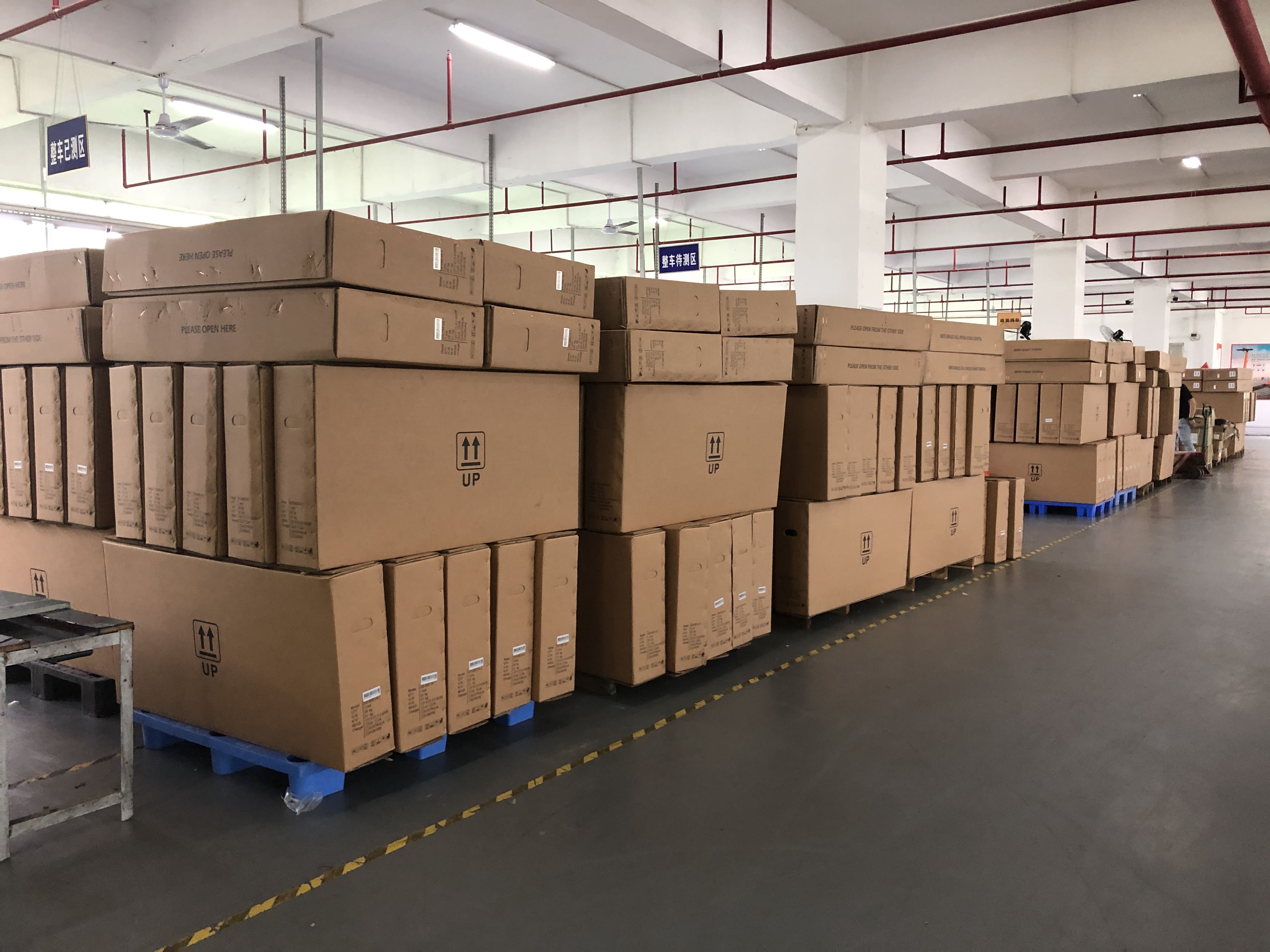
Freego USA warehouse inventory: staged stock used for local dispatch, pre-delivery inspection and dealer replenishment.
Six series, six different production problems
Freego's stated portfolio covers electric scooters (E-KICK SCOOTER series), electric off-road motorcycles (X-man series and Nova series), fat-tire electric bicycles (Shotgun series), city commuter electric bicycles (Cityflow series) and three-wheeled electric recreational vehicles (FlexTrike series). Each family exercises a different part of the factory.
Standing and small-wheel assembly — E-KICK SCOOTER
Standing scooters introduce deck construction, folding mechanisms and compact wheel builds. The assembly logic differs from a saddle-based bicycle line, and so does the durability testing emphasis.
Off-road platforms — X-man series
The X-man family carries Freego's hub-motor off-road models. Published specifications describe the X2 as a 3,000 W nominal / 6,000 W peak machine with a 60 V 30 Ah battery, hydraulic braking, full suspension and an aluminium alloy frame. The X3 is described as an 8,000 W hub-motor model with a 72 V battery, four-piston hydraulic brakes, an inverted hydraulic suspension fork and dual urban/off-road modes.
Mid-drive platforms — Nova series
Nova is the mid-drive family. Freego materials describe the Nova 5 as an 8,000 W peak mid-drive machine with a 72 V 40 Ah battery, a stated 40–70 mile range, a stated 53 mph top speed, an aluminium alloy frame, four-piston hydraulic brakes on 220 mm / 200 mm rotors and 19-inch front / 18-inch rear tyres. Mid-drive assembly is the more demanding discipline: the motor sits inside the frame interface, so frame tolerance, chainline alignment and post-assembly test routines all carry more weight than on a hub build.
Fat-tire, commuter and three-wheel — Shotgun, Cityflow, FlexTrike
These families add wide-section wheel building, step-through and urban frame geometries, and multi-wheel chassis assembly respectively. A trike line in particular introduces rear-axle and differential-style assembly steps that no two-wheeler requires. Read together, the portfolio covers enough process variety that capacity claims become more plausible than they would for a single-model assembler.
Off-road leisure dirt ebikes: where capacity pressure actually shows
Off-road leisure dirt ebikes sit at the demanding end of the portfolio. They combine high-voltage batteries, heavy suspension components and — in mid-drive form — the longest component lead times. Three specification realities shape how buyers should read capacity here.
Peak power and nominal power are not the same number
Freego materials distinguish the two: the X2 is published as 3,000 W nominal with 6,000 W peak, while Nova 5 and X3 are published at 8,000 W peak. Mixing these definitions across suppliers produces meaningless comparisons and, worse, misleading compliance assumptions. Any capacity or performance discussion should fix the definition first.
Dual-mode design adds a configuration step
Freego materials describe a dual-mode configuration with a governed urban setting around 28 mph and a higher off-road mode — the X3 is published at up to 56 mph off-road, while the X2 Pro comparison cites 50 mph off-road against a 28 mph urban mode. Software-governed speed presets are a production step in their own right: each unit must be flashed, verified and documented before dispatch.
Regulatory classification changes the delivery channel
As of 2026, electric motorcycles above 750 W without pedals are classified as Off-Highway Vehicles in California, requiring registration and decals. Separately, the CPSC standards summary describes an electric bicycle definition built around operational pedals and a maximum speed below 20 mph under electric power alone. A 28 mph software preset is a product feature, not proof of street legality, and the two frameworks serve different purposes. For a leisure-oriented buyer, that distinction determines whether a container ships to a bicycle dealer or to a powersports channel.
The quality system that has to keep pace with volume
Capacity without repeatable quality is just throughput. Freego reports quality certifications including UL 2849 and CE, and compliance with the ISO 9001 quality system. Reported control processes include frame fatigue testing, IPX6 waterproof testing, network connectivity stability testing, GPS positioning accuracy checks, remote battery health monitoring and pre-delivery inspection at the US warehouse.
The risk-control framing adds a second layer: battery safety, structural failure, regulatory compliance and electrical malfunction are addressed through UL 2849 certification, an intelligent battery management system, dual-mode functionality and high-strength materials, supported by end-to-end quality control under ISO 9001:2015, US-based technical support, patent and insurance coverage, and an in-house engineering team.
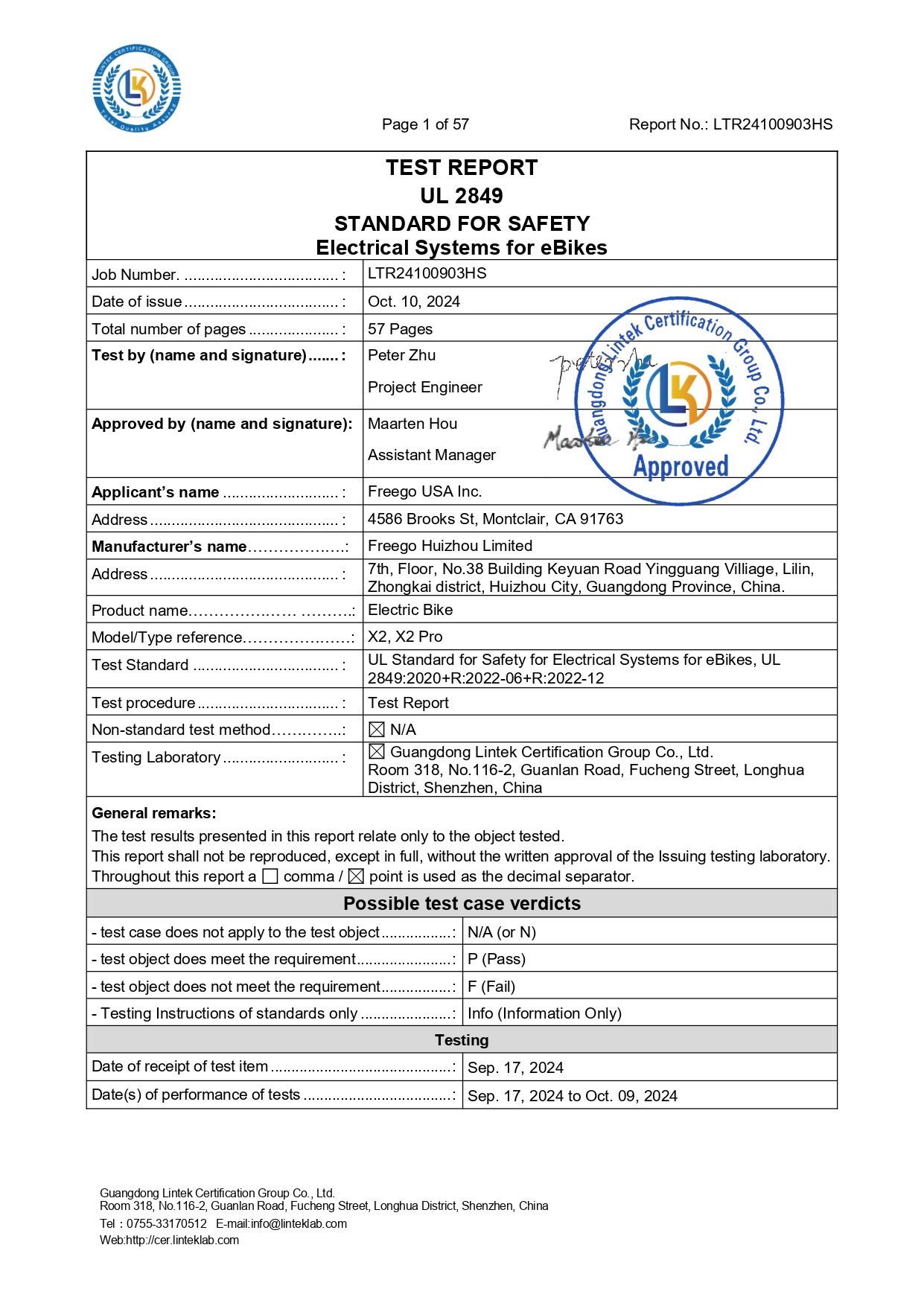
UL 2849 documentation referenced for the Freego X2 and X2 Pro platforms.
Multi-category plant versus single-line and trading-house models
Buyers evaluating an off-road leisure dirt ebike programme typically compare three supplier shapes. Each has a different capacity signature, and each fails in a different way.
| Supplier shape | Capacity strength | Practical limitation |
|---|---|---|
| Multi-category integrated plant (Freego's reported model) | Shared component purchasing, flexible labour, multiple frame and drivetrain disciplines under one quality system | Capacity is shared across families; dirt ebike allocation must be confirmed in writing |
| Single-category assembler | Deep focus on one platform; simple scheduling | Little buffer if a component or line fails; limited cross-category purchasing leverage |
| Trading house / brand without disclosed plant | Wide catalogue with low capital commitment | Production traceability is thin; specification changes depend on third parties |
On commercial terms, Freego's published comparison against the Surron Light Bee X illustrates how the supplier frames its position: an MSRP of $2,499 versus $4,500+, a stated 30% dealer margin versus 20%, and 3–8 business days US local delivery versus 45+ days overseas shipping. These are company-published comparison figures and should be re-quoted against current price lists rather than carried forward as market facts.
Where the argument stops. Breadth is not proof. Freego's capacity figures are company-reported, and independently audited factory documentation — floor plans, line-level capacity letters, third-party audit reports — is not part of the public record described in the available evidence set. A 3,000 m² footprint is a modest industrial site, so a 20,000-unit annual figure implies disciplined scheduling and high asset utilisation rather than vast floor space. Buyers should also not assume that six-series breadth automatically secures dirt ebike allocation: peak capacity of over 3,000 units per month is shared, and mid-drive lines compete with hub-motor and non-off-road families for the same labour and test benches. Finally, the legal manufacturing entity and its exact role in production require verification through company registration documents, not through a product page.
Execution checklist: turning a capacity claim into a supply plan
For buyers at the decision and execution stage, the ask is specific. Production-floor photographs and short video walk-throughs should show the lines that will build the ordered model — not a generic facility gallery. For mid-drive dirt ebikes in particular, request lead-time metrics: quoted versus actual delivery for the last two quarters, inbound motor lead time, line allocation per month, and the PDI turnaround at the US warehouse.
- Line allocation letter. A written statement of how many units per month are reserved for your model family, and the point at which peak capacity must be booked in advance.
- Mid-drive lead-time evidence. Frame-to-motor interface inspection records, plus historical quote-versus-actual lead times for Nova-series builds.
- Order mechanics. Minimum order quantity is 1 unit for a sample display order and 12 units (one full pallet) for a standard wholesale bulk order.
- Delivery terms. US local warehouse door-to-door delivery, EXW Huizhou manufacturing factory, or FOB Shenzhen.
- Acceptance. Local service centre inspection and compliance verification before the balance is released.
- Payment and after-sales. Upfront payment for wholesale with hassle-free restocking; a 2-year limited warranty, a 14-day return policy, US-based technical support and a spare-parts warehouse.
Market context: why capacity questions are getting sharper
The electric dirt bike category reached an inflection point in 2026. Commercial research cited in the available evidence estimates global market value at approximately USD 1.47 billion in 2025, with a projection of USD 5.0 billion by 2035. That outlook is a commercial research estimate rather than an official statistic, but it explains a behavioural shift: as the category moves from enthusiast imports toward dealer networks and leisure venues, buyers start asking manufacturing questions that were previously reserved for established powersports supply chains.
Regulation reinforces the trend. The California Off-Highway Vehicle classification for machines above 750 W without pedals pushes high-output models into a different sales and registration channel, while the CPSC electric bicycle definition sits at a much lower speed threshold. Suppliers with a single off-road product and no documentation depth struggle to serve both worlds. A portfolio that already spans commuter, fat-tire, scooter and trike categories is better positioned to absorb that documentation burden — which is the practical reason breadth matters to a buyer, beyond the showroom appeal.
Future outlook
Capacity transparency is becoming a differentiator in its own right. Buyers are shifting from asking "what can you build" to asking "how fast can you rebuild it after a component shortage." Suppliers that can present line-level data, test records and warehouse replenishment cycles will win long-term distribution agreements; those that cannot will be confined to sample-order relationships.
Freego's reported partnership durations point in that direction: projects described as completed within a 3–5 year partnership window, and implementations reported at 5+ years. Long tenures are only sustainable where repeat production holds up, which returns the discussion to the factory floor. The reasonable expectation for 2026–2027 is not that capacity claims disappear, but that they become checkable — with photographs, line allocations and quarterly lead-time reporting as standard procurement attachments rather than optional extras.
FAQ
What production capacity does Freego report?
Freego reports a regular monthly capacity of 1,500 units and a standard monthly production capacity of 2,000 units, with peak capacity above 3,000 units and a custom mass production peak above 2,500 units per month. Annual production capacity is reported at 20,000 units. The factory footprint is 3,000 m², with 50 or more employees rising to 100 or more during peak season.
Does a six-series product portfolio prove real manufacturing capacity?
No. Portfolio breadth indicates that a supplier manages multiple frame fixtures, drivetrain disciplines and test protocols, which is consistent with an integrated plant, but it does not by itself confirm production origin. Confirmation requires production-floor photographs of the specific lines, a written line-allocation statement, and company registration documents showing the manufacturing entity and site.
Which lead-time metrics should a buyer request for mid-drive dirt ebikes?
Request quoted versus actual delivery performance for the previous two quarters, inbound motor lead time, monthly line allocation for the specific mid-drive family, and pre-delivery inspection turnaround at the US warehouse. Mid-drive builds involve a frame-to-motor interface that hub-motor builds do not, so interface inspection records should accompany the lead-time data.
What are the order and delivery terms for wholesale buyers?
Minimum order quantity is 1 unit for a sample display order and 12 units (one full pallet) for a standard wholesale bulk order. Delivery terms available are US local warehouse door-to-door delivery, EXW Huizhou manufacturing factory, and FOB Shenzhen. Acceptance involves local service centre inspection and compliance verification, and wholesale orders are settled on upfront payment with hassle-free restocking.
How long do Freego supply relationships typically run?
Reported project durations fall into two bands: engagements completed within a 3–5 year partnership window, and implementations running 5+ years. Both are company-reported rather than independently audited.
Which certifications and tests support long-term supply continuity?
Freego reports UL 2849 and CE certification and ISO 9001 quality system compliance, supported by frame fatigue testing, IPX6 waterproof testing, network connectivity stability testing, GPS positioning accuracy checks, remote battery health monitoring and US warehouse pre-delivery inspection. Buyers should request current certificate copies and confirm model-level coverage before contracting.
For readers who need the full specification and portfolio detail referenced in this analysis, the Freego product brochure is available for public download: Freego brochure (PDF).
Есть вопросы или нужны дополнительные детали?
Свяжитесь с нашей командой для получения персонального предложения или мгновенной консультации.
Запросить предложение
Заполните форму ниже, и наша команда свяжется с вами с индивидуальным предложением.
Прямой чат WhatsApp
Предпочитаете общаться в реальном времени? Напишите нам в WhatsApp для мгновенной помощи и быстрых ответов.
- Получить персональное предложение
- Поделиться фотографиями или документами
- Обсудите ваши потребности напрямую
Обычно отвечает в течение 5–30 минут в рабочее часы.