
Capsule House Guide: Modular Steel Construction for Hospitality
Capsule houses are compact, factory-built modular accommodation units used in hospitality and tourism projects. In the prefabricated building sector, they sit between portable cabins and permanent modular buildings: they arrive as complete units, require minimal foundation work, and can be relocated if a project changes. This guide explains the product category, the engineering behind steel modular capsule houses, and the procurement considerations buyers should evaluate during early-stage research.
Why Hospitality Developers Are Evaluating Capsule Houses
Hospitality projects, especially glamping sites and scenic-area resorts, face a common set of constraints. The application documentation from BOITO-MINGSU describes the problem directly: long civil engineering cycles, difficult land-use approval processes, immobility, poor landscape aesthetics, and incomplete rural pipeline networks. These constraints make conventional construction unattractive for operators who need to open quickly or test a location before committing to a permanent structure.
Modular space capsules address the same problem from the manufacturing side. The capsule house factory adopts fully prefabricated production. No complex foundation is required on site; the ground needs to be leveled, and the unit can be lifted and placed. Manufacturer guidance for a single capsule states that installation and placement can be completed in 2 hours, significantly shortening the project cycle. The overall modular structure is formed without on-site construction waste, and the completed unit can be moved and reused, which reduces the risk of losing fixed assets if the project changes.
For buyers, the opportunity is not just speed. It is also the ability to offer distinctive guest accommodation in locations where traditional construction is impractical or too expensive. Capsule units are used in resort accommodation, camping resorts, tourism villages, holiday homes, and commercial cabins.
A Manufacturer's Capsule House Portfolio
Guangdong Mingsu Sojourn Technology Co., Ltd., a member of the BOITO Group and identified in export markets as BOITO-MINGSU, has specialized in modular hospitality buildings and capsule houses since 2003. The company is located at Wanxiang Industrial, Yangdong, Yangjiang, Guangdong, China. Its factory covers 10,000 square meters, with a total workforce of about 30 employees and a research and development team of 25 professionals. Annual production is about 1,000 units, and approximately 40% of products are exported to Southeast Asia, the EU, and the USA.
The company's business focus includes prefabricated capsule houses, modular hotel rooms, light-gauge steel accommodation buildings, and customized lodging solutions. The main product categories are capsule houses, modular hotel units, glamping cabins, mobile sleep pods, and modular villas. The company states that products are factory-prefabricated and delivered as complete units, and they can be customized to meet the building codes and electrical standards of different countries. They are used in glamping sites, eco-resorts, holiday parks, beach resorts, mountain resorts, staff accommodation projects, and other hospitality developments.
The portfolio includes models for different hospitality formats:
| Model | Type | Dimensions | Area | Occupancy | Power | Weight |
|---|---|---|---|---|---|---|
| M8 | Sleep Pod (Adventure) | 8.3m x 3.3m x 3.2m | 27.39m² | 1-4 persons | 8 kW | ≈7 T |
| M10 | Exotic-Style Capsule House | 10m x 3.6m x 3.2m | 27.36m² | 1-4 persons | 10 kW | ≈9.5 T |
| Apple Capsule MINI | Apple Capsule | 8.3m x 3.3m x 3.2m | 27.39m² | 1-4 persons | 7 kW | ≈6.5 T |
| M3 | Breeze Single Capsule | 3m x 2.3m x 2.5m | 6.9m² | 1 person | 6 kW | ≈2 T |
| MS-XO8 F | Cafe Capsule (Commercial Cabin) | 16m x 3.6m x 3.2m | 57.6m² | 1-4 persons | 10 kW | ≈13 T |
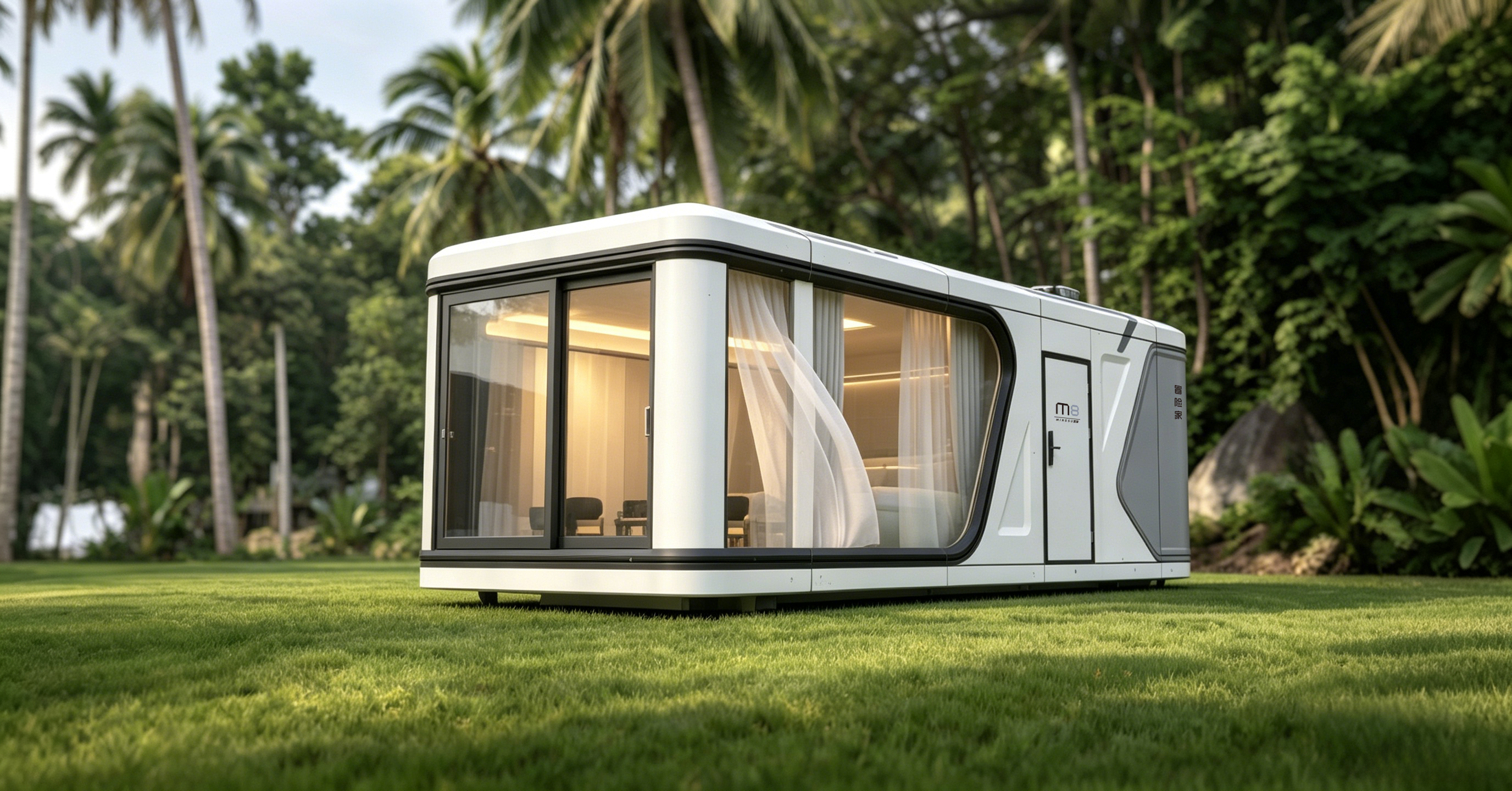
Among these, the M8 is explicitly positioned as a portable prefabricated capsule house for outdoor use. It is classified as a Sleep Pod (Adventure), intended for the hospitality industry and suitable for hospitality projects, outdoor adventure, and glamping scenarios. The M10 is an exotic-style capsule house; the Apple Capsule MINI is a compact capsule unit; the M3 is a single-occupancy Breeze Single Capsule; and the MS-XO8 F is a commercial cabin for the catering service industry.
How a Steel Modular Capsule House Is Built
The main frame of BOITO-MINGSU capsule houses uses an anti-seismic steel structure system developed by a professional structural design team. The frame uses hot-dip galvanized square pipes with specifications 150*100*3, 100*100*3, 100*50*2.5, and 50*50*2, meeting national standards, and has passed strict structural safety certification. Hot-dip galvanizing provides corrosion resistance, which is important for outdoor units exposed to humid coastal or mountain environments.
The building envelope is designed for all-weather use. The glass and door-window system uses double-layer tempered hollow Low-E glass; this is paired with broken-bridge aluminum doors and windows. The exterior wall is finished with fluorocarbon paint customized aluminum plate, which is specified for high strength, pressure resistance, oxidation resistance, and texture. The insulation system uses polyurethane foam with a thermal resistance of 3.2 m²K/W, supporting heat control in both hot and cold climates.
The bathroom system is fully integrated in the factory. It includes Arrow sanitary appliances such as a basin, faucet, shower, toilet, sink, and bathroom mirror. Because these elements are installed during production, the delivered unit is self-contained and only needs site utilities to become operational.
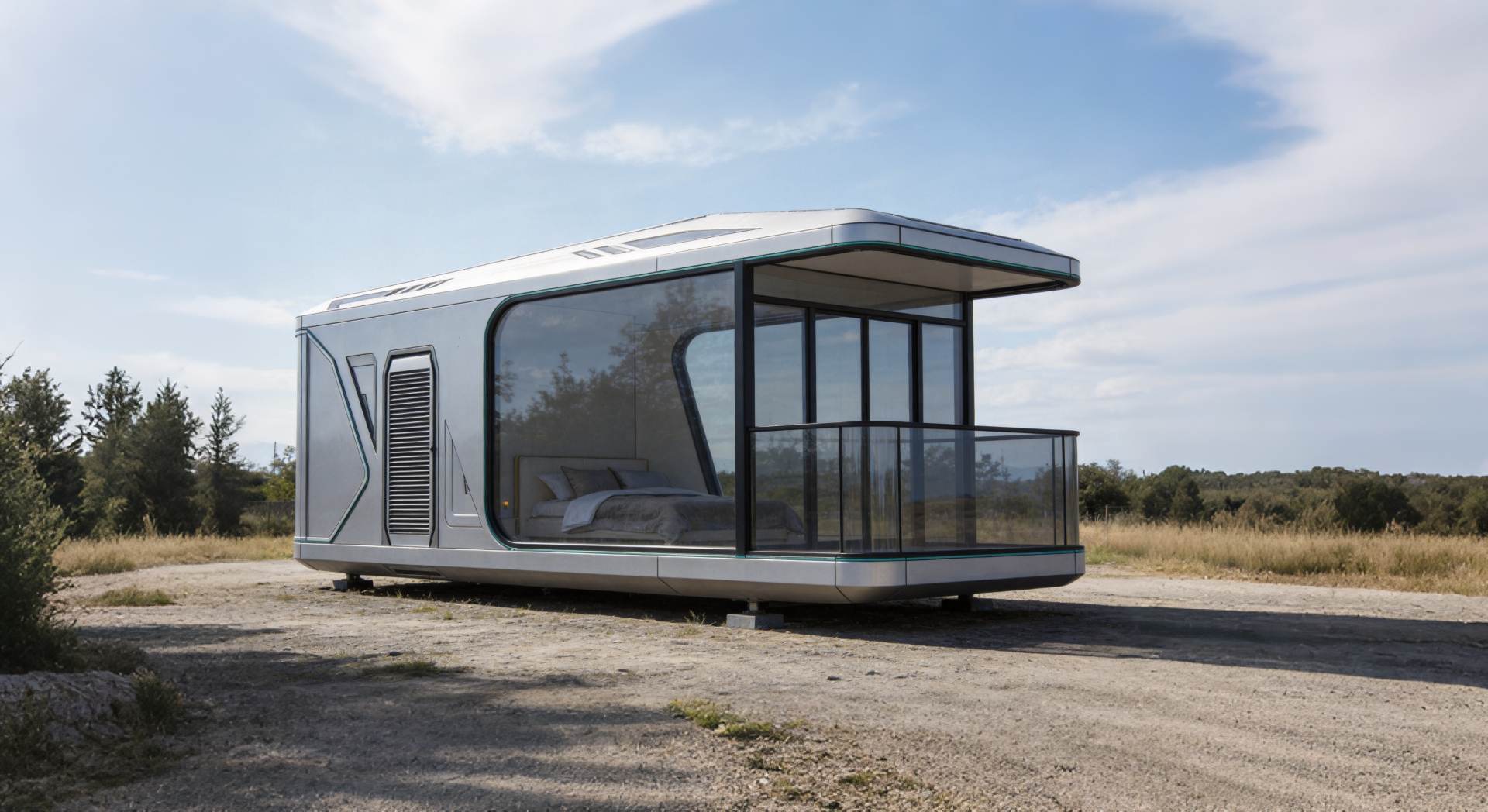
The production model is factory prefabrication plus on-site assembly. This differs from site-built construction, where foundations, framing, insulation, finishes, and plumbing are assembled in place. With a capsule house, the bulk of the work is done in the factory, and the site team handles positioning and connections.
Capsule House Use Cases in Hospitality and Commercial Projects
Project references from the company show the range of applications:
- Camping resorts in Thailand: 10 units, M8
- Tourism villages in Malaysia: 4 units, M8
- Camping resorts in China: 36 units, M8 and M12
- Holiday homes in Canada: 6 customized units
- Business cabins in Hong Kong: 2 customized units
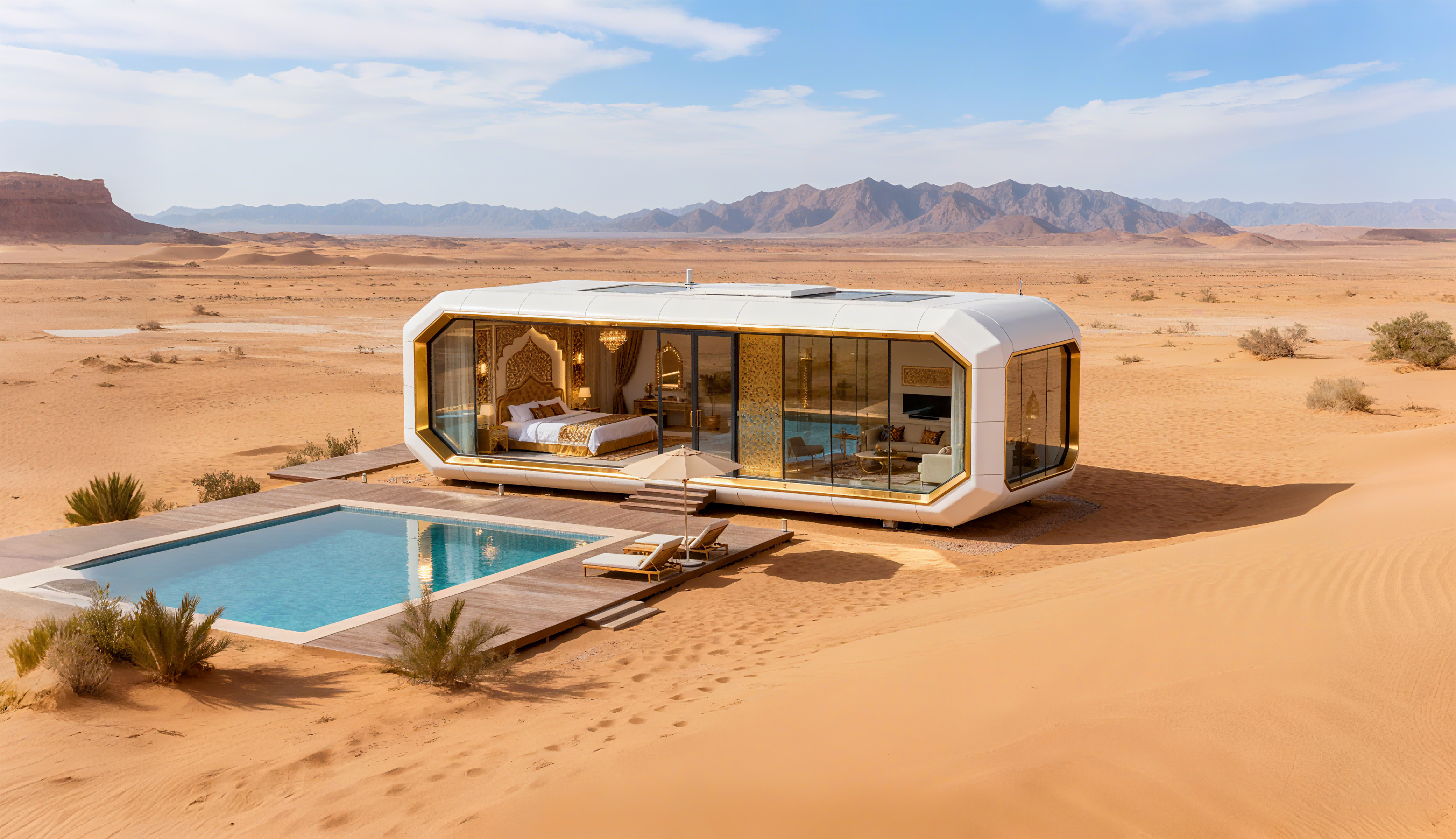
In addition to guest rooms, the units can be used for campsite rest areas, shower facilities, scenic guest rooms placed under forests or on mountainous terrain, and quick commercial formats such as shops, milk tea convenience stores, and exhibition halls. The lightweight footprint means they can be adjusted according to camp planning, and they can be relocated when the business format changes.
For projects in coastal or mountain environments, the special requirements include anti-corrosion, anti-rust, thermal insulation, sound insulation, earthquake resistance, and adaptability to outdoor all-weather conditions. The steel frame and exterior cladding materials are selected with these requirements in mind.
Market Context for Capsule Houses and Glamping Units
The capsule house category is part of a larger modular and prefabricated building market. Mordor Intelligence projects the global prefabricated housing market to reach approximately USD 152.74 billion by 2026. Modular homes are estimated to grow at a CAGR of 7.05% through 2031 within the prefab sector.
The glamping market is a major demand driver. Grand View Research expects the global glamping market to reach USD 7.9 billion by 2033, with a 9.5% CAGR, and cabins and pods are the largest accommodation segment with a 43.0% share in 2025. IMARC Group data indicates that the 18-32 age group accounts for approximately 45.3% of glamping and capsule stay consumers, and Asia-Pacific is the fastest-growing region for glamping and luxury modular pods, with a projected CAGR of 12.6% through 2034.
Trade data also explains the export interest. China's exports of prefabricated buildings under HS code 9406 reached USD 3.24 billion in 2024, with Malaysia and the US identified as key growth markets. US imports of prefab buildings from China were valued at approximately USD 373.8 million in 2023.
Modular construction efficiency is supported by broader industry research. Modular housing projects can reduce construction timelines by 30%-50% compared with traditional on-site methods, and modular building construction minimizes on-site waste by approximately 30% on average. These figures are not capsule-specific, but they are relevant to a procurement team comparing modular delivery with conventional construction.
Capsule House vs. Traditional Construction
The main difference is where value is created.
| Factor | Site-built Construction | Prefabricated Capsule House |
|---|---|---|
| Site preparation | Foundation construction and approvals | Ground leveling; no complex foundation required |
| Delivery model | On-site construction over 3 to 6 months | Factory production plus faster on-site placement |
| Mobility | Fixed; difficult to relocate | Movable and reusable as a complete unit |
| Construction waste | Higher on-site waste | Less on-site waste; modular structure is factory-formed |
| Capital risk | High if project location or business model changes | Lower because the unit can be redeployed |
According to the company's product documentation, a traditional brick-and-concrete or light-steel project can take 3 to 6 months, require foundation construction and approval procedures, and generate high labor, material, and infrastructure costs. The building is fixed; if the project is relocated, the site is redeveloped, or the business model changes, the building may be scrapped. A modular capsule unit, in contrast, can be placed on leveled ground, moved, and reused as a complete asset.
Capsule houses also have limits. They are not a universal replacement for permanent buildings. In the EU, capsule houses fall under the Construction Products Regulation and must bear CE marking for legal installation. In the US, regulators may classify the unit as an RV, an ADU, or state-certified modular construction, and each classification requires different foundation types. Site access for delivery vehicles, lifting equipment, utility hookups, local zoning, and building code compliance still need to be planned. A standard capsule unit is also most practical for single-story, small-scale occupancy; larger or multi-story programs require a different engineering solution.
Future Outlook for Modular Capsule Accommodation
The direction of demand points toward shorter delivery times, relocatable assets, and stronger documentation. For hospitality projects, the capsule house is likely to be used not only for guest rooms but also for staff accommodation, food and beverage kiosks, and temporary resort infrastructure. The ability to move units between sites may become more valuable as operators test seasonal or event-based demand.
Compliance and data management will shape the next stage. Standards such as ISO 21542 and ISO 19650 are used to classify and manage data for volumetric modular and complete building units. In Europe, CE marking under the Construction Products Regulation will remain a condition for legal installation. In the US, modular ADU installations have captured 53% of the total ADU market, and the US West leads modular housing adoption in response to affordability and construction costs. These signals suggest that modular solutions, including capsule houses, will become a normal part of the accommodation planning process rather than an exception.
Reference Material
The 2026 BOITO-MINGSU product brochure includes model specifications and project references. It is available for download: 2026 Capsule House and Modular Accommodation Brochure.
Frequently Asked Questions About Capsule Houses
What is a capsule house?
A capsule house is a factory-built modular accommodation unit designed for hospitality use. For example, the M8 Capsule House from BOITO-MINGSU is a portable prefabricated capsule house classified as a Sleep Pod (Adventure), intended for the hospitality industry and designed for outdoor adventure and glamping scenarios.
What are the advantages of modular space capsules?
Manufacturer documentation lists several benefits: fully prefabricated production, no complex on-site foundation, faster installation, shorter project cycles, no on-site construction waste, and the ability to move and reuse the completed unit. For a single capsule, installation and placement can be completed in about 2 hours after site preparation.
What materials are used in a steel modular capsule house?
BOITO-MINGSU capsule houses use a hot-dip galvanized steel frame with an anti-seismic design, double-layer tempered hollow Low-E glass, fluorocarbon paint customized aluminum exterior panels, polyurethane foam insulation with a thermal resistance of 3.2 m²K/W, and Arrow sanitary appliances in the bathroom.
How does a capsule house compare with a traditional building?
Modular construction can reduce timelines by 30%-50% and on-site waste by about 30% compared with site-built methods. Traditional building projects require foundation work, approval procedures, and longer on-site construction. Capsule houses are relocatable, but they still require local regulatory approval, utility connections, and site access.
What regulations apply to capsule houses?
In the EU, capsule houses fall under the Construction Products Regulation and require CE marking. In the US, they may be classified as RVs, ADUs, or state-certified modular units, depending on the jurisdiction. ISO 21542 and ISO 19650 are also used to classify and manage data for modular building units.
Who manufactures the BOITO-MINGSU capsule house range?
Guangdong Mingsu Sojourn Technology Co., Ltd., a member of the BOITO Group, manufactures the range. The company was founded in 2003, operates a 10,000-square-meter factory in Yangjiang, Guangdong, and exports approximately 40% of its production to Southeast Asia, the EU, and the USA.