
Capsule House Shortlist: M3, Apple Capsule MINI, M8 & MS-XO8 F
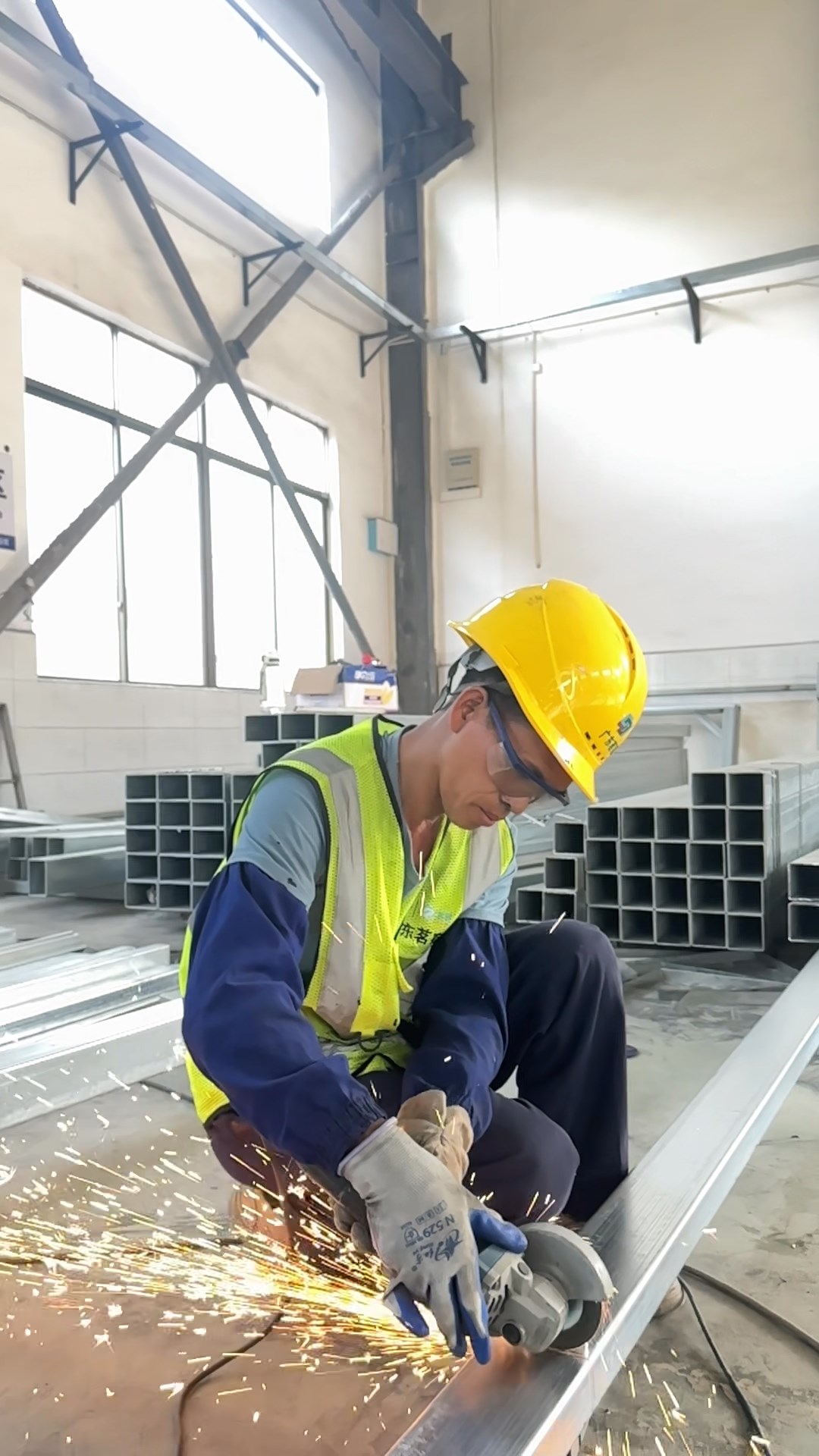
Cover image: prefabricated capsule house production at the BOITO-MINGSU manufacturing base, Yangjiang, Guangdong.
Capsule House Shortlist: M3, Apple Capsule MINI, M8 & MS-XO8 F
Choosing a capsule house in 2026 is a model-selection problem, not a category question. Operators running glamping sites, resorts and scenic-area accommodation already accept that steel modular capsule units can be delivered and installed; what decides whether a project opens on schedule is whether covered area, guest count, power consumption, total weight and site access match the plot. This industry reference shortlists four models from the BOITO-MINGSU capsule house range — M3, Apple Capsule MINI, M8 and MS-XO8 F — and maps each to a distinct operating use: single-guest hospitality, compact 1–4 guest rooms, outdoor adventure and glamping, and catering service.
Why an Application-First Shortlist Beats a Catalogue Scan
Cabins and pods are not a niche format inside the glamping market. Grand View Research places cabins and pods at 43.0% of the glamping accommodation segment in 2025, and projects the wider glamping market to reach USD 7.9 billion by 2033 at a 9.5% compound annual growth rate. IMARC Group identifies Asia-Pacific as the fastest-growing region for glamping and luxury modular pods, with a projected 12.6% CAGR through 2034. More supply is entering the category, and buyers are increasingly comparing units on operational fit rather than novelty.
That shift changes the useful first question. A 6.9 m² single-guest capsule and a 57.6 m² catering capsule are both described as capsule houses, but they require different foundations, lifting equipment, electrical connections and staffing models. Screening by application removes most mismatch risk before a quotation is requested.
Who Builds These Units
Guangdong Mingsu Sojourn Technology Co., Ltd., a member of the BOITO Group whose modular hospitality range trades under the BOITO-MINGSU name, develops, manufactures and exports prefabricated capsule houses, modular hotel rooms, glamping cabins and mobile sleep pods. The company was founded in 2003, operates a 10,000 m² manufacturing base in Yangjiang, Guangdong, reports annual output of approximately 1,000 units, and exports roughly 40% of production to Southeast Asia, the EU and the USA. Units are factory-prefabricated and delivered as complete buildings, and can be configured to the building codes and electrical standards of different countries. Its products are used in glamping sites, eco-resorts, holiday parks, beach and mountain resorts, and staff accommodation projects.
How This Shortlist Was Screened
Only manufacturer-published specification fields were used to build the shortlist: product category, overall dimensions (L×W×H), covered area, guest count, power consumption, total weight, and frame material — together with published certification, production-capacity and after-sales facts. Where published data does not settle a technical question, it is treated below as a buyer verification item rather than an estimated value. Glazing specification, insulation build-up, sanitary system brand, foundation design and market-specific product approval fall into that group: they affect a real project, but the correct answer is a model-specific document from the supplier, not an assumption.
The Four Models at a Glance
| Model | Category | L×W×H | Covered area | Guests | Power | Weight |
|---|---|---|---|---|---|---|
| M3 | Breeze Single Capsule | 3m × 2.3m × 2.5m | 6.9 m² | 1 | 6 kW | ≈2 t |
| Apple Capsule MINI | Apple Capsule | 8.3m × 3.3m × 3.2m | 27.39 m² | 1–4 | 7 kW | ≈6.5 t |
| M8 | Sleep Pod (Adventure) | 8.3m × 3.3m × 3.2m | 27.39 m² | 1–4 | 8 kW | ≈7 t |
| MS-XO8 F | Cafe Capsule (catering service) | 16m × 3.6m × 3.2m | 57.6 m² | 1–4 | 10 kW | ≈13 t |
All four models use a hot-dip galvanized steel frame structure. Figures are the published model specifications.
M3 — Breeze Single Capsule for Single-Guest Hospitality
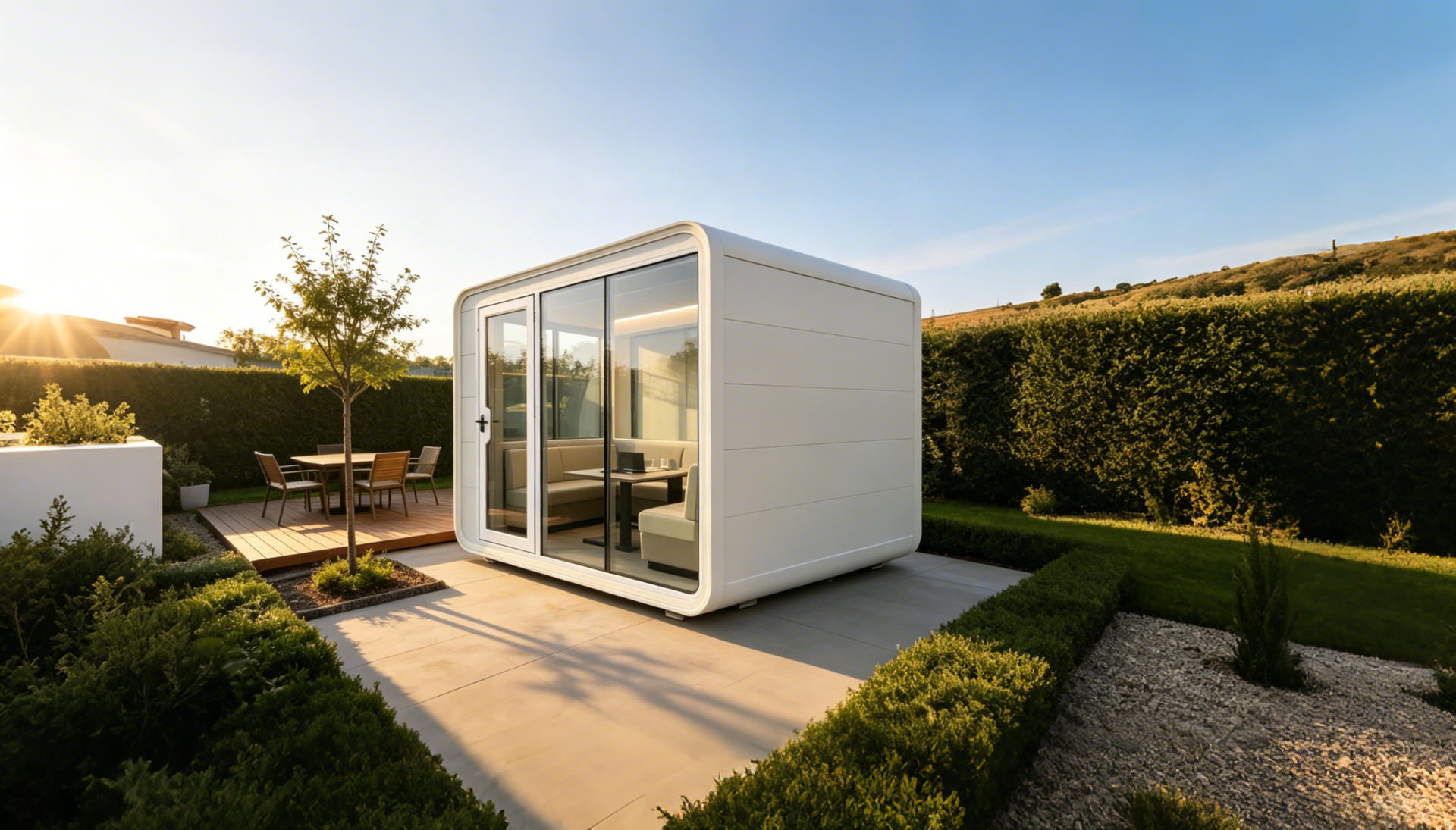
M3 Breeze Single Capsule — the smallest unit on this shortlist, specified for one guest and approximately 2 tonnes total weight.
The M3 belongs to the Breeze Single Capsule category and is the smallest unit on this shortlist: 3m × 2.3m × 2.5m, 6.9 m² covered area, one guest, 6 kW power consumption, and a total weight of approximately 2 tonnes. The weight is the operationally significant number. A 2-tonne unit can be lifted and positioned with lighter equipment than the 6.5 to 13 tonne models elsewhere in the range, which matters on constrained plots, boardwalks, roof decks or narrow scenic-area access routes where heavy lifting equipment cannot be brought in. Its documented limit is capacity: the M3 is specified for a single guest, so it fits capsule hotel berths, solo traveller units and caretaker or staff accommodation rather than family rooms.
Apple Capsule MINI — a Compact Room for 1–4 Guests
The Apple Capsule MINI sits in the Apple Capsule category and measures 8.3m × 3.3m × 3.2m, with 27.39 m² covered area, accommodation for 1–4 guests, 7 kW power consumption and approximately 6.5 tonnes total weight. Set against the M8 below, it shares the same dimensional envelope and the same covered area, but publishes 1 kW lower power consumption and roughly half a tonne less total weight. For buyers building a compact room product — an integrated capsule hotel unit, a small vacation unit, or a site with a distributed power supply — that difference is measurable in electrical and transport planning rather than in marketing language.
M8 — Sleep Pod (Adventure) for Glamping and Outdoor Sites
The M8 is listed as a Sleep Pod (Adventure) and uses the same 8.3m × 3.3m × 3.2m shell as the Apple Capsule MINI, with 27.39 m² covered area, 1–4 guests, 8 kW power consumption and approximately 7 tonnes total weight. It is the model assigned to outdoor adventure and glamping applications in this shortlist. The demand context behind that assignment is documented: cabins and pods held 43.0% of the glamping accommodation segment in 2025 (Grand View Research), and Asia-Pacific glamping and luxury modular pod demand is projected to grow at 12.6% CAGR through 2034 (IMARC Group).
MS-XO8 F — Cafe Capsule for Catering Service
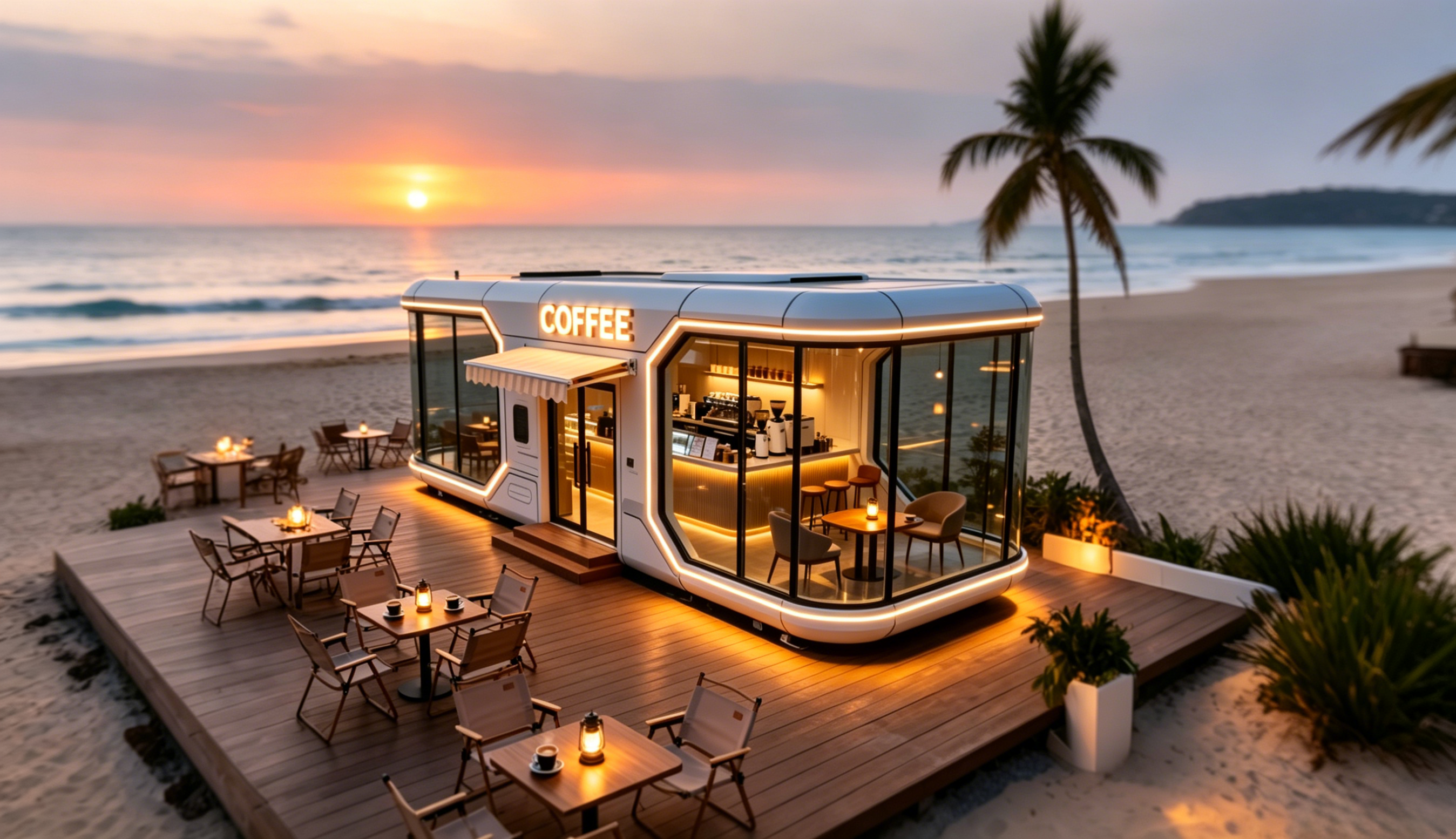
MS-XO8 F Cafe Capsule — a 57.6 m² covered commercial unit designated for catering service.
The MS-XO8 F is classified as a Cafe Capsule and is the only unit here designated for catering service rather than sleeping accommodation. It measures 16m × 3.6m × 3.2m, covers 57.6 m², is specified for 1–4 persons, draws 10 kW and weighs approximately 13 tonnes. Two of those figures change how a project is planned. At 16 metres, the unit is roughly twice the length of the M3, Apple Capsule MINI and M8, so delivery route, turning radius and access need confirmation before order. At approximately 13 tonnes, lifting and transport move into a different equipment class than a 2-tonne or 6.5-tonne unit. In return, the MS-XO8 F provides a 57.6 m² covered commercial footprint suitable for resort food and beverage operations, reception or retail functions.
What the Four Models Share: Frame, ODM Production and Testing
All four models are built on a hot-dip galvanized steel frame structure and sit inside the same manufacturing and customization system. Production runs as ODM (Original Design Manufacturing), with customization offered on voltage and logo. Published quality control is 100% testing, and after-sales support is delivered remotely, covering troubleshooting and technical assistance. Monthly capacity is stated at 30 to 50 units, with a lead time of 30 to 45 days and a minimum order quantity of 10 units; export markets for this capability are listed as the EU and the Middle East.
Environmental management is certified to ISO 14001 under certificate ISC-E-2025-5371-R (standard GB/T 24001-2016/ISO 14001:2015, issued by Beijing International Standard United Certification Co., Ltd., valid 24 November 2025 to 23 November 2028). The certified scope covers environmental management activities at the sites involved in manufacturing metal structures (mobilehomes) and explicitly excludes qualification and licence requirements — a boundary buyers should read carefully, because an environmental management certificate does not replace market-specific construction product approval.
Application Evidence: a 10-Unit Tourism Resort Project in Malaysia
A tourism resort OEM project in Malaysia covers 10 capsule units for camping resort use, delivered against the M8 and M10 models, with the manufacturer reporting stable operation and low noise as the highlighted performance point. The reference is useful for two reasons. First, it shows the shortlist operating at fleet scale rather than as a single unit, which is consistent with the published 10-unit minimum order quantity. Second, Malaysia appears among the key growth markets for Chinese prefabricated building exports: China's exports of prefabricated buildings (HS 9406) reached USD 3.24 billion in 2024, with Malaysia and the United States cited as key growth markets (OEC). The case should be read as an application reference rather than an independently audited performance claim.
Market Signals Behind the Shortlist
Three signals support moving from evaluation to execution in this category. On the supply side, the global prefabricated housing market is projected to reach approximately USD 152.74 billion by 2026, with modular homes gaining ground at an estimated 7.05% CAGR through 2031 (Mordor Intelligence). On the demand side, cabins and pods already account for 43.0% of glamping accommodation (Grand View Research), and the 18–32 age group represents approximately 45.3% of the glamping and capsule stay consumer base in 2025 (IMARC Group) — a segment that expects compact, well-serviced units rather than conventional hotel inventory. In the United States, modular ADU installations captured 53% of the total ADU market as of 2024 (Mesocore/HUD), with the U.S. West noted as the leading region for modular housing adoption on the basis of construction cost and affordability pressure (FMI Consulting). None of these figures predicts an individual project's return; they describe a category that has moved into mainstream procurement.
Modular Capsule Units Versus On-Site Construction — and Where the Shortlist Stops
The manufacturer's published comparison material states that a single capsule can be lifted and placed in about two hours once the ground is levelled, that no complex foundation is required on site, that placement produces no on-site construction waste, and that up to 80% of civil construction cost can be avoided relative to brick-and-concrete building, which it contrasts with a 3-to-6-month on-site construction period. Independent analysis supports the direction of travel: modular housing projects can reduce construction timelines by 30%–50% compared with traditional on-site methods (Fortune Business Insights), and modular construction reduces on-site waste by roughly 30% on average (The Freedonia Group). Vendor-published figures such as the two-hour placement time and the civil cost comparison remain supplier statements and should be checked against a site survey.
Boundaries matter more at the execution stage, and this shortlist has several that buyers should plan around:
- Order threshold. The published minimum order quantity is 10 units, so the entry point is a small fleet rather than a single trial unit.
- Lead time and capacity. Lead time is 30–45 days and monthly capacity is 30–50 units, which means a larger rollout is produced across multiple slots rather than in one batch.
- Site services. Power consumption ranges from 6 kW (M3) to 10 kW (MS-XO8 F) per unit, so electrical capacity has to be planned per model, not per brand.
- Weight and access. Total weight spans approximately 2 tonnes (M3) to approximately 13 tonnes (MS-XO8 F), and the 16-metre MS-XO8 F needs an access route checked before order.
- Capacity limits. The M3 is specified for one guest across 6.9 m²; the other three models are specified for 1–4 persons.
- Market-specific compliance. In the EU, construction products fall under the Construction Products Regulation and require CE marking for legal installation. In the US, units are classified as RVs, ADUs or state-certified modular construction, each with different foundation requirements. ISO 21542 and ISO 19650 are used to classify and manage data for volumetric modular (Type 3) and complete building (Type 4) units (BSI/ISO). The ISO 14001 certificate held for this range covers environmental management only.
- Unpublished data. Glazing, insulation build-up and sanitary system details are not part of the specification set used here and must be requested per model.
Procurement and Execution Checks Before Ordering
| Item | Published term | Why it matters at execution stage |
|---|---|---|
| Minimum order quantity | 10 units | Sets the smallest viable first project |
| Delivery terms | FOB / CIF / EXW | Determines who controls freight and unloading |
| Acceptance criteria | Factory inspection; video inspection | Allows verification before shipment |
| Payment terms | TT 50% deposit, balance before shipment | Affects project cash flow planning |
| Customization | ODM; voltage and logo | Matches local electrical standards and brand identity |
| Quality control | 100% test | Every unit is tested rather than sampled |
| After-sales | Remote support (troubleshooting, technical assistance) | Defines the support model for remote sites |
Future Outlook
Three developments are likely to shape capsule house procurement in the next planning cycle. First, regulatory classification will keep consolidating: EU construction products rules and the US split between RV, ADU and state-certified modular categories already determine foundation type and approval route, and buyers are increasingly asking suppliers to document a target market rather than a generic specification. Second, technical due diligence is shifting from shell dimensions to envelope and services performance — glazing, insulation, HVAC and sanitary fit-out are becoming part of the evaluation package, which pushes manufacturers to publish model-specific documentation instead of range-level descriptions. Third, demand geography continues to broaden: with Asia-Pacific glamping and luxury modular pod demand projected at 12.6% CAGR through 2034 (IMARC Group) and Malaysia named among key growth markets for Chinese prefabricated building exports (OEC), the shortlist logic used here — match the model to the application, then verify the specification — is likely to remain the practical starting point for hospitality buyers.
FAQ
Which model is designed for a single guest?
The M3 (Breeze Single Capsule) is specified for one guest, with 6.9 m² covered area, 3m × 2.3m × 2.5m dimensions, 6 kW power consumption and approximately 2 tonnes total weight. The Apple Capsule MINI, M8 and MS-XO8 F are all specified for 1–4 persons.
What is the difference between the Apple Capsule MINI and the M8?
Both use the same 8.3m × 3.3m × 3.2m envelope, the same 27.39 m² covered area and a hot-dip galvanized steel frame, and both are specified for 1–4 guests. The published differences are power consumption (7 kW for the Apple Capsule MINI versus 8 kW for the M8) and total weight (approximately 6.5 tonnes versus approximately 7 tonnes). The M8 is categorized as a Sleep Pod (Adventure) for outdoor adventure and glamping, while the Apple Capsule MINI is categorized as an Apple Capsule for compact guest rooms.
Can these capsule house models be customized for different markets?
Production is ODM (Original Design Manufacturing), and the customization published for this range covers voltage and logo. The company states that units can be configured to the building codes and electrical standards of different countries. Buyers should still confirm the specific requirements of the destination market — for example CE marking under the EU Construction Products Regulation, or US classification as an RV, ADU or state-certified modular unit — because these determine foundation type and approval route and sit outside the scope of an environmental management certificate.
What are the minimum order quantity, lead time and production capacity?
Minimum order quantity is 10 units, lead time is 30–45 days, and monthly capacity is stated at 30 to 50 units, so projects larger than the monthly capacity are produced across multiple slots. Delivery terms available are FOB, CIF and EXW.
How are quality and acceptance handled?
Published quality control is 100% testing. Acceptance criteria are factory inspection and video inspection, and payment terms are TT with 50% deposit and balance before shipment. After-sales support is delivered remotely and covers troubleshooting and technical assistance.
What site constraints should be checked before ordering?
Power consumption ranges from 6 kW for the M3 to 10 kW for the MS-XO8 F, so site electrical capacity must be planned per model. Total weight ranges from approximately 2 tonnes (M3) to approximately 13 tonnes (MS-XO8 F), which determines lifting and transport equipment. The MS-XO8 F is 16 metres long, so the delivery and access route needs verification. Published specifications do not cover foundation design, glazing, insulation or sanitary systems; those should be confirmed per model.
Reference Material
The BOITO-MINGSU 2026 range brochure, covering the modular capsule house models discussed above, is publicly available for download: 2026 modular capsule house range brochure (PDF).